Free equity analysis
Complete guide to understanding your Qualcomm equity compensation, including RSU, ISO, NSO, ESPP, vesting schedules, and tax strategies.
Employees
41K
Worldwide
Equity Programs
4
programs
Vesting Period
3 years
RSU vesting
Qualcomm offers 4 equity compensation programs to employees. Click on each program to learn more about eligibility, vesting, and tax implications.
Standard RSU program with 4-year vesting and 1-year cliff. Annual refresh grants available for eligible employees.
Learn about Qualcomm's Incentive Stock Options program, including vesting schedules and tax treatment.
Learn about Qualcomm's Non-Qualified Stock Options program, including vesting schedules and tax treatment.
Learn about Qualcomm's Employee Stock Purchase Plan program, including vesting schedules and tax treatment.
Qualcomm offers a comprehensive equity compensation program designed to align employee interests with company performance. As a Qualcomm employee, you may receive several types of equity awards, including Restricted Stock Units (RSUs), Performance Stock Units (PSUs), Incentive Stock Options (ISOs), Non-Qualified Stock Options (NSOs), and Restricted Stock Awards (RSAs). The company also provides an Employee Stock Purchase Plan (ESPP) that allows you to purchase Qualcomm shares at a 15% discount with a lookback provision.
As a leading semiconductor company, Qualcomm's equity compensation allows you to share in the company's success and innovation in wireless technology. These awards can represent a significant portion of your total compensation package, particularly as you advance in your career. The variety of equity types provides flexibility in how you build wealth and manage tax implications.
RSUs at Qualcomm typically vest over either 3 or 4 years, depending on your grant terms. The 4-year schedule generally vests 25% annually in year one, then continues with 25% annually over years 2-4 with monthly vesting during those later years. The 3-year schedule vests one-third annually, with semi-annual vesting in years 2 and 3. Performance-based awards have additional criteria tied to company goals.
Employees at Staff level and above may receive annual refresher grants during the September/October review cycle, helping maintain your equity stake as earlier grants vest. The ESPP operates on 6-month offering periods starting February 1 and August 1, providing regular opportunities to build your Qualcomm holdings at a discount.
Qualcomm employs multiple vesting schedules for equity compensation, with the specific timeline depending on your grant type and level. Understanding these variations is essential for planning your financial future.
Qualcomm typically uses either a 3-year or 4-year vesting schedule for RSUs, depending on your role and grant specifics:
3-Year Schedule: Under this structure, your RSUs vest in thirds (33.3% each year). The first year's shares vest annually, while years two and three vest semi-annually. This means you'll receive your first vesting on the anniversary of your grant date, then smaller installments twice per year thereafter.
4-Year Schedule: This more common structure allocates 25% of your grant each year. The first year's shares vest as a single annual installment, while years two through four vest monthly. This provides more frequent vesting events after your initial year, giving you regular access to shares.
Based on available grant data, vesting typically occurs on October 1 for service-based RSUs, though your specific grant agreement will detail your exact vesting dates.
Unlike many tech companies that impose a one-year cliff, Qualcomm's standard vesting schedules don't appear to include a cliff requirement. This means you'll begin receiving vested shares according to your schedule from the first vesting date, rather than waiting a full year before any shares vest.
Qualcomm's vesting is uniform rather than backloaded or frontloaded. Whether you're on a 3-year or 4-year schedule, shares vest in equal proportions annually (33.3% or 25% respectively), ensuring consistent equity compensation throughout your vesting period.
Qualcomm provides annual refresher grants for continuing employees, particularly at Staff, Senior Staff, and Principal levels. These refreshers are typically discussed during annual review cycles in September or October, aligning with the company's performance review process. Refresher grants help maintain your equity compensation as earlier grants vest and ensure ongoing retention incentives throughout your career at Qualcomm.
Note that Qualcomm also grants performance-based RSUs (PSUs) with different vesting criteria tied to company or individual performance metrics, though specific vesting details vary by grant.
Qualcomm offers a robust Employee Stock Purchase Plan that allows you to purchase company stock at a significant discount. The plan provides a 15% discount off the stock price, combined with a lookback provision that can substantially increase your potential returns.
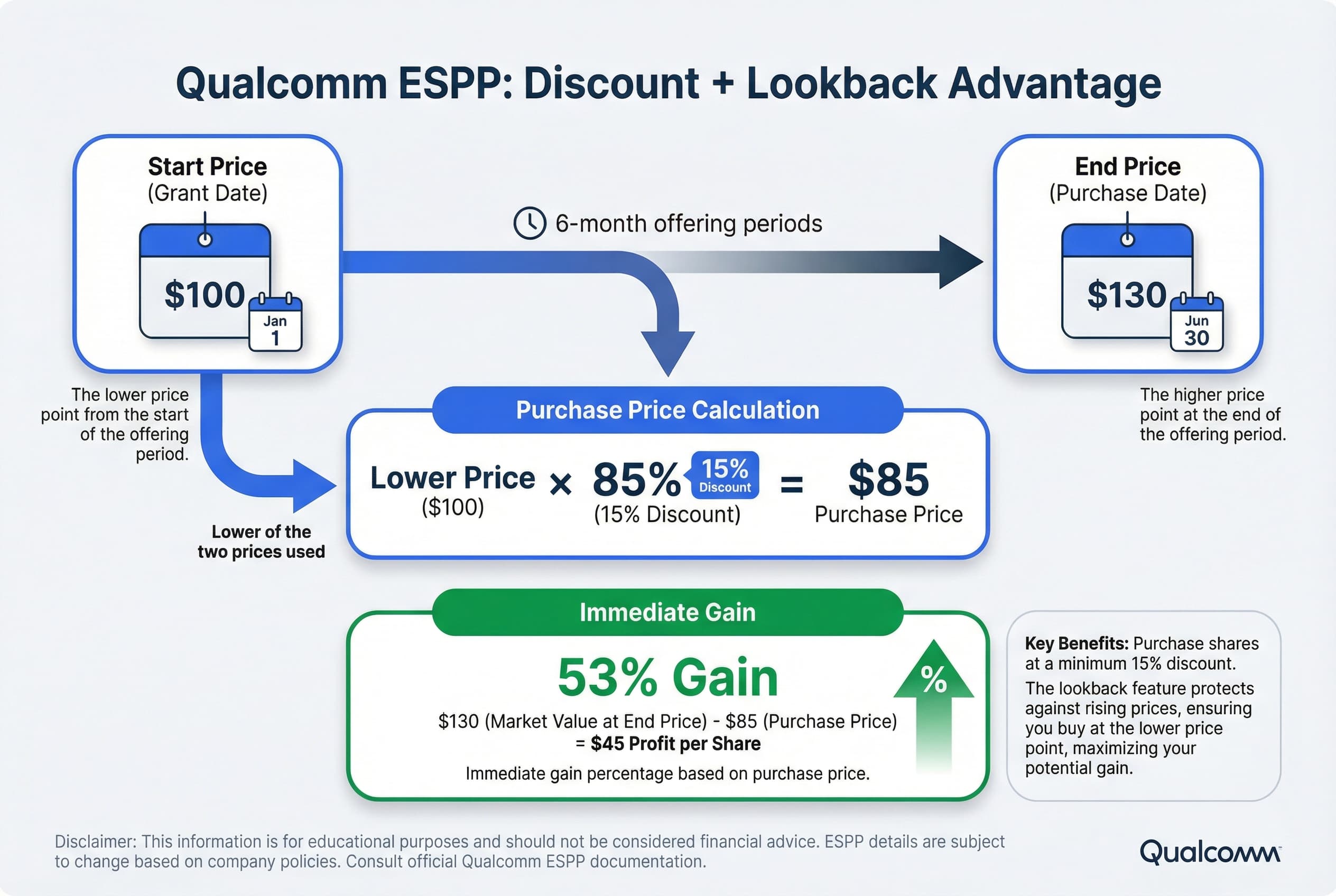
The ESPP operates on 6-month offering periods (for example, February 1 - July 31 and August 1 - January 31). The lookback provision means you'll purchase shares at 85% of whichever price is lower: the stock price at the beginning of the offering period or the price at the end of the purchase period. This feature can generate impressive returns if Qualcomm's stock appreciates during the offering period.
For instance, if the stock is $100 at the start and rises to $130 by the end, you'd purchase at $85 (15% off the $100 starting price), giving you an immediate 53% gain before even considering the discount.
You can contribute up to 15% of your compensation, subject to a $25,000 annual maximum under IRS Section 423(b) rules. Enrollment windows open twice per year, aligning with the offering period start dates in February and August.
To maximize tax benefits, consider holding your ESPP shares for at least two years from the offering date and one year from the purchase date. This creates a "qualifying disposition," allowing you to pay long-term capital gains rates on a portion of your profit rather than ordinary income tax rates. Selling before these thresholds results in a "disqualifying disposition," where the discount is taxed as ordinary income.
Given the combination of the discount and lookback provision, Qualcomm's ESPP represents one of the most valuable benefits available to employees and warrants serious consideration during enrollment periods.
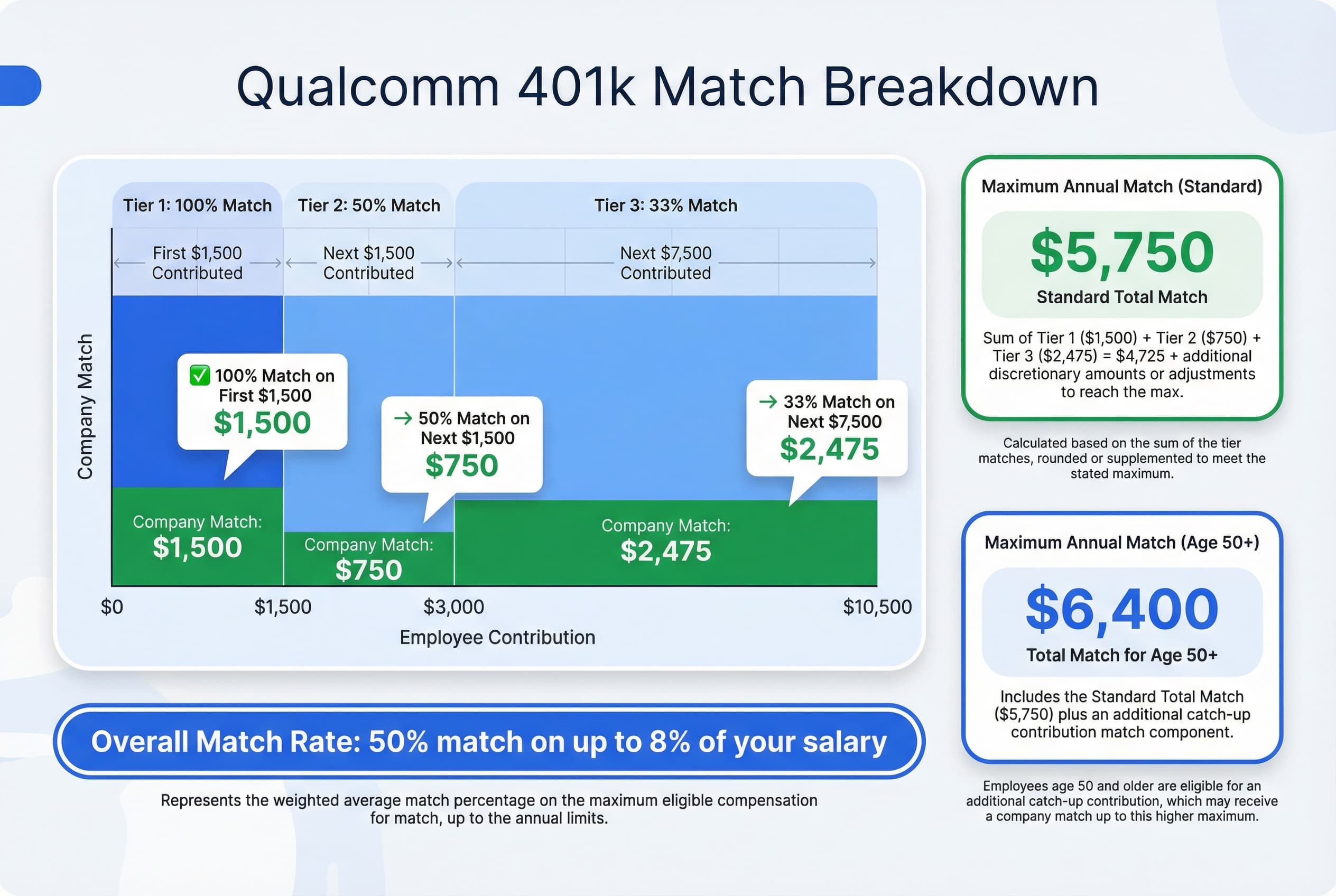
Qualcomm offers a competitive 401(k) plan with a structured matching formula designed to maximize contributions across different income levels. The company provides a 50% match on up to 8% of your salary, though the actual match structure is tiered: 100% on the first $1,500 you contribute, 50% on the next $1,500, 33% on the next $7,500, and 10% thereafter up to IRS limits. The maximum annual match is approximately $5,750 (or $6,400 for employees age 50 and older).
The employer match vests over a 2-year period, meaning you'll need to remain with Qualcomm for two years to fully own the company's contributions to your account.
Qualcomm provides robust contribution flexibility with Traditional, Roth, and After-tax contribution options. Importantly, the plan supports mega backdoor Roth conversions through after-tax contributions, allowing high earners to potentially contribute significantly more to Roth accounts beyond standard limits. The plan is administered by Fidelity.
The 401(k) includes BrokerageLink, a self-directed brokerage window that gives you access to a broader range of investment options beyond the plan's core fund lineup. This feature is particularly valuable if you want more control over your investment strategy or access to specific securities not available in the standard fund menu.
Understanding the tax treatment of your Qualcomm equity awards is crucial for effective financial planning. Different equity types trigger taxes at different times and rates.
RSUs are taxed as ordinary income at vesting, regardless of whether you sell the shares. The fair market value on the vesting date becomes taxable compensation, just like your salary. This creates an immediate tax liability even if you hold the shares.
Stock Options (ISOs and NSOs) have different timing. NSOs trigger ordinary income tax when exercised, based on the difference between the exercise price and current market value. ISOs receive preferential treatment - no regular tax at exercise, but potential Alternative Minimum Tax (AMT) applies. The spread between exercise price and fair market value becomes an AMT preference item, which can create unexpected tax liability even without selling shares.
ESPP purchases are taxed when you sell the shares. Holding shares for at least two years from the offering date and one year from purchase qualifies for favorable tax treatment, with only a portion taxed as ordinary income.
Qualcomm withholds taxes on RSU vesting, but the default withholding rate may not cover your full tax obligation, especially for high earners. Supplemental income is often withheld at 22% federally, but your actual marginal rate could be 32%, 35%, or 37%. This "gap" means you may owe additional taxes at year-end. Qualcomm allows you to adjust withholding elections during open trading windows.
After paying ordinary income tax on RSUs at vesting or options at exercise, any subsequent appreciation is taxed as capital gains when sold. Holding shares for more than one year after the taxable event qualifies for long-term capital gains rates (0%, 15%, or 20%), which are lower than ordinary income rates.
Qualcomm is headquartered in California, which has some of the highest state income tax rates (up to 13.3%). California taxes equity compensation as ordinary income, with no preferential capital gains rates. Remote employees should understand their state's tax treatment and potential multi-state allocation issues.
Disclaimer: This information is educational only and not tax advice. Equity compensation taxation is complex and depends on your individual circumstances. Consult a qualified tax professional or financial advisor before making decisions about your Qualcomm equity awards.
As a Qualcomm employee receiving equity compensation through RSUs, stock options, and the ESPP, you may find a significant portion of your wealth tied to a single stock. This concentration creates risk that extends beyond normal market volatility.
When your income, benefits, and investment portfolio all depend on one company, you face "double exposure" - if Qualcomm experiences difficulties, you could simultaneously see your job security, equity value, and net worth decline. This correlation amplifies your financial risk considerably.
Qualcomm operates in the cyclical semiconductor industry, which faces unique volatility from technological disruption, intense competition, and supply chain dependencies. The company's revenue concentration in mobile chipsets and licensing also creates exposure to smartphone market fluctuations and regulatory challenges around intellectual property. These industry-specific factors can cause stock price swings independent of your job performance.
Financial advisors commonly recommend limiting any single stock to 10-20% of your total net worth, including your home equity and retirement accounts. For Qualcomm employees with substantial equity grants, this often means developing a systematic selling strategy as RSUs vest.
Consider diversifying across different asset classes, industries, and geographies. Your 401(k) offers this opportunity, including access to Fidelity's BrokerageLink for broader investment options. Regular rebalancing helps maintain appropriate exposure levels while capturing the value of your equity compensation.
As a Qualcomm employee, equity compensation likely represents a significant portion of your total compensation package. Here's how to think strategically about managing your RSUs, ESPP shares, and stock options.
The decision to sell depends on your overall financial picture. Consider selling vested RSUs when they represent more than 10-15% of your net worth to reduce concentration risk. Remember that RSUs are taxed as ordinary income at vesting, so you've already paid taxes on them - there's no tax advantage to holding. For stock options, evaluate whether exercising makes sense based on the current stock price versus your exercise price and the 10-year expiration timeline.
Working in the semiconductor industry means your income, job security, and equity compensation are all tied to the same sector. This concentration risk increases during industry downturns. Regularly rebalancing by selling vested shares and investing in diversified assets (bonds, real estate, international stocks) can protect your financial health.
Qualcomm's ESPP offers a 15% discount with a lookback provision across 6-month offering periods. To maximize tax benefits, hold ESPP shares for at least two years from the offering date and one year from the purchase date to qualify for favorable long-term capital gains treatment on the discount. However, if you need to diversify immediately, selling right after purchase still captures the 15% discount (minus taxes).
If you hold Incentive Stock Options, be aware of Alternative Minimum Tax (AMT) implications when exercising. The spread between exercise price and fair market value can trigger AMT, so consult a tax professional before exercising significant ISO grants.
While 10b5-1 trading plans weren't specifically confirmed in available data, these automated selling plans can help you systematically diversify during blackout periods if offered.
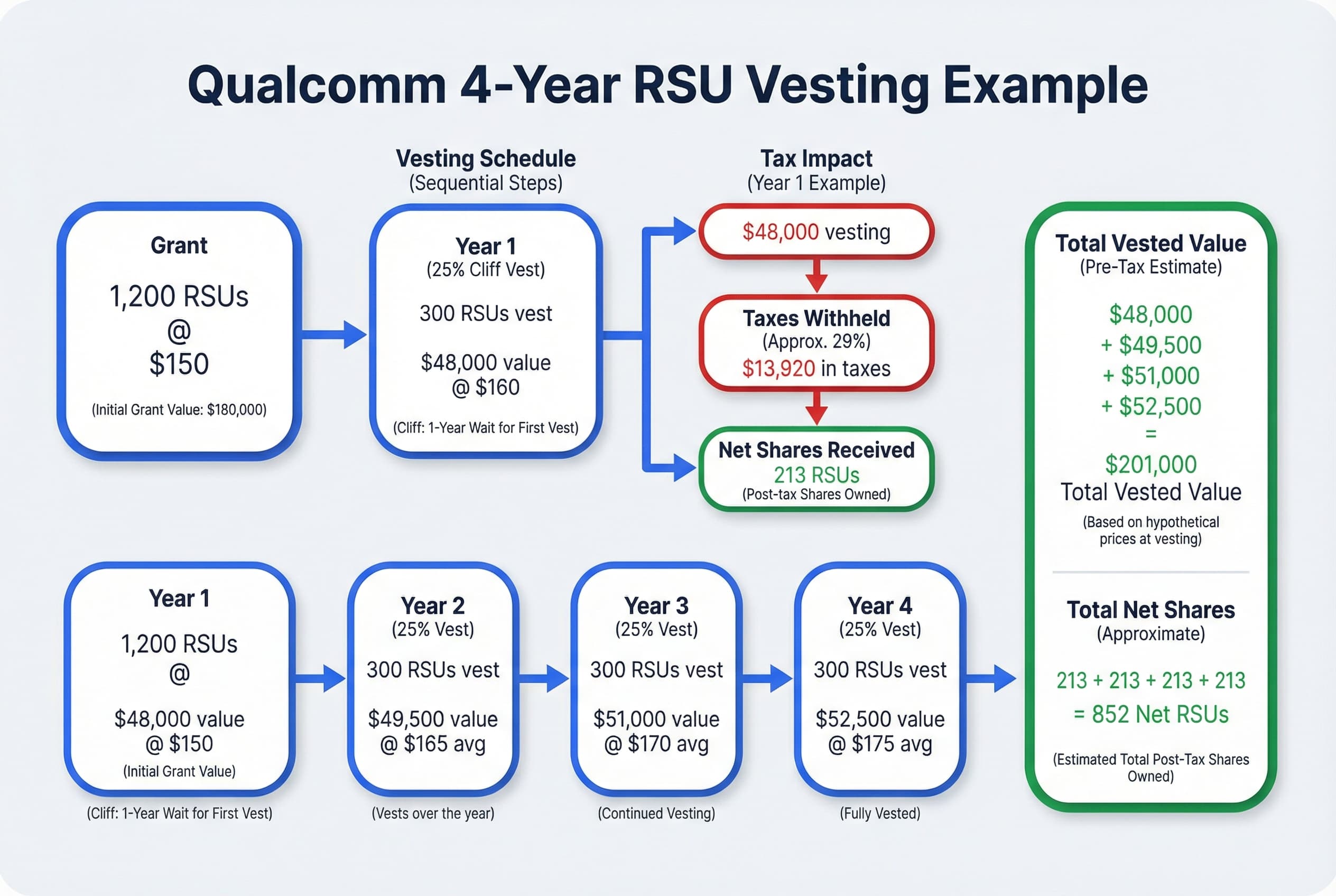
Let's walk through a realistic example of how RSU vesting works at Qualcomm using their 4-year vesting schedule with monthly vesting in years 2-4.
Sarah, a Senior Engineer at Qualcomm, receives a grant of 1,200 RSUs when she joins the company. The stock price at grant is $150 per share.
Year 1: 25% vests = 300 RSUs
Year 2: 25% vests = 300 RSUs
Year 3: 25% vests = 300 RSUs
Year 4: Final 25% vests = 300 RSUs
At each vesting event, Qualcomm withholds shares to cover taxes. Using the standard supplemental income tax rate of approximately 22% federal plus 7% state/local (varies by location) = 29% total:
Year 1 withholding: $48,000 × 29% = $13,920 in taxes
Over four years, Sarah receives approximately $201,000 in gross value from her RSU grant, with actual net proceeds depending on tax withholding and whether she sells or holds the vested shares.
Qualcomm employees often make avoidable mistakes with their equity compensation that can cost them significantly. Here are the most common pitfalls:
Many employees hold too much of their net worth in Qualcomm stock. When RSUs vest on schedules ranging from 3 to 4 years, it's easy to accumulate substantial holdings. This creates significant risk if the stock price declines or if your job and investments are both tied to the same company's performance.
RSUs are taxed as ordinary income at vesting, but Qualcomm's default withholding may not cover your full tax liability, especially if you're in a higher tax bracket. Employees often face unexpected tax bills because they didn't adjust their withholding elections during open trading windows or set aside additional funds.
Qualcomm's Employee Stock Purchase Plan offers a 15% discount with a lookback provision, yet many employees don't participate. This can provide immediate gains when shares are purchased at the lower of the offering period's start or end price. Remember to hold shares for two years from the offering date and one year from purchase for favorable tax treatment.
Employees with Incentive Stock Options often underestimate Alternative Minimum Tax (AMT) implications when exercising. The spread between exercise price and fair market value can trigger AMT, requiring careful planning before exercising options within their 10-year expiration window.
Understanding how your equity is affected when you leave Qualcomm is crucial for financial planning. Here's what you need to know:
When you leave Qualcomm, any unvested RSUs are typically forfeited, regardless of whether your departure is voluntary or involuntary. This means if you have RSUs scheduled to vest after your termination date, you'll lose those shares. Your termination date directly impacts what you keep - only RSUs that have vested on or before your last day of employment remain yours.
Qualcomm grants both Incentive Stock Options (ISOs) and Non-Qualified Stock Options (NSOs) with a 10-year expiration period. However, the specific post-termination exercise window is not publicly disclosed in standard plan documents, so you should review your individual grant agreements or consult HR to understand how long you have to exercise vested options after leaving.
If you leave mid-period during an ESPP offering period, specific termination rules apply. Generally, if you're no longer employed when the purchase date arrives, your accumulated contributions may be returned to you without completing the share purchase. Check with Qualcomm's benefits team for the exact treatment of your contributions based on your enrollment period.
Your equity documents and Qualcomm's equity policies contain the definitive rules for your specific situation. Review your grant agreements carefully and consider consulting with HR or a financial advisor before making your departure decision to fully understand the financial impact.
Qualcomm offers a Non-Qualified Deferred Compensation Plan (NQDCP) available to highly compensated employees or Directors. This program allows eligible participants to defer a portion of their salary into the plan, providing additional tax planning flexibility beyond the standard 401(k).
The NQDCP enables you to defer current compensation, which reduces your taxable income in the year of deferral. Taxes are instead paid when you receive distributions in the future, typically during retirement when you may be in a lower tax bracket. The plan includes matching contributions, though these follow a different vesting schedule than Qualcomm's RSU grants.
Benefits include immediate tax savings and the potential to accumulate more wealth tax-deferred. This can be particularly valuable if you're already maximizing your 401(k) contributions or expect to be in a lower tax bracket during retirement.
Risks are important to understand: Unlike 401(k) assets, deferred compensation is not held in a protected account. Your deferred funds remain company assets, meaning you're an unsecured creditor if Qualcomm faces financial difficulties. Additionally, once you elect to defer compensation, you typically cannot access these funds until your predetermined distribution date.
Consult with a financial advisor to determine if deferral aligns with your overall financial strategy and risk tolerance.
This content is for educational purposes only and does not constitute financial advice. The information provided is general in nature and may not appl...
YourEmployeeStock.com is not a registered investment advisor.
Qualcomm uses multiple vesting schedules depending on your grant. The most common are 3-year schedules (1/3 annually, then semi-annually for years 2-3) or 4-year schedules (25% annually in year 1, then 25% annually in years 2-4 with monthly vesting). Vesting dates are typically around October 1st for service-based grants, and refresher grants are generally discussed annually during review cycles in September/October.
When your RSUs vest, they're treated as ordinary income and subject to tax withholding at that time. You can adjust your withholding rate, but you must make these elections during an open trading window when you're not in possession of material nonpublic information. Managing the tax liability from vesting RSUs is one of the most common concerns for Qualcomm employees, especially if you hold large equity positions.
Qualcomm's ESPP offers a 15% discount on stock purchases with a lookback provision, meaning you get the discount on the lower of the price at the beginning or end of the 6-month offering period. You can contribute up to 15% of your eligible compensation, with a maximum of $25,000 per year. Enrollment periods occur twice annually (February 1 and August 1), and purchases happen semi-annually.
For the most favorable tax treatment, hold your ESPP shares for at least 2 years from the offering date and 1 year from the purchase date (qualifying disposition). This allows a portion of your gain to be taxed at lower long-term capital gains rates rather than entirely as ordinary income. However, always consider your overall financial situation and concentration risk when deciding whether to hold or sell.
Qualcomm stock options have a 10-year expiration period from the grant date. However, specific details about the post-termination exercise window aren't provided in standard plan documents, so you should review your grant agreement or contact HR to understand how long you have to exercise vested options after leaving the company. Only vested options can be exercised after termination.
Yes, Qualcomm offers both ISOs and Non-Qualified Stock Options (NSOs). ISOs can provide tax advantages if you meet holding requirements, but they carry Alternative Minimum Tax (AMT) risk when exercised. If you're a 10% or greater shareholder, the ISO exercise price must be at least 110% of fair market value at grant. Understanding the complex tax treatment of ISOs and managing AMT exposure is a common concern for employees.
Qualcomm provides a tiered matching structure: 100% match on the first $1,500 contributed, 50% on the next $1,500, 33% on the next $7,500, and 10% thereafter up to IRS limits. The maximum annual match is approximately $5,750-$6,400 depending on age. The company match vests after 2 years, and the plan offers Traditional, Roth, and After-tax contribution options, plus a BrokerageLink self-directed investment option through Fidelity.
You cannot sell shares when prohibited by applicable laws or Qualcomm's Insider Trading Policy, which typically includes blackout periods around earnings announcements and when you possess material nonpublic information. Always ensure you're in an open trading window before making any equity transactions. Check with your compliance team or the company's insider trading policy for specific blackout period dates.
Get a free personalized analysis from our equity compensation experts

