Free equity analysis
Complete guide to understanding your NVIDIA equity compensation, including RSU, ESPP, vesting schedules, and tax strategies.
Stock Price
$212.17
Closing price · Sep 15, 2026
Employees
22.8K
Worldwide
Equity Programs
2
programs
Vesting Period
4 years
RSU vesting
Closing price · Sep 15, 2026
NVIDIA offers 2 equity compensation programs to employees. Click on each program to learn more about eligibility, vesting, and tax implications.
NVIDIA RSUs vest quarterly over 4 years with a 1-year cliff. Given the explosive growth in AI and GPU demand, NVIDIA equity has been exceptionally valuable. The company provides annual refresh grants to retain talent.
NVIDIA's ESPP provides 15% discount with lookback. With NVIDIA's stock appreciation, the lookback provision can provide substantial additional gains.
NVIDIA RSUs vest on a 4-year schedule with 1-year cliff (25% vests) followed by quarterly vesting, or 4-year uniform vesting, or 4-year backloaded vesting (40/30/20/10) schedule with a 12-month cliff.
Example calculation based on 100 shares:
| Year | Vesting % | Shares Vesting | Estimated Value |
|---|---|---|---|
| Year 1 | 25% | 25 | $5,304.25 |
| Year 2 | 25% | 25 | $5,304.25 |
| Year 3 | 25% | 25 | $5,304.25 |
| Year 4 | 25% | 25 | $5,304.25 |
| Total | 100% | 100 | $21,217 |
* Based on NVIDIA stock price of $212.17 as of Sep 15, 2026. Actual values will vary.
25%
25 shares
$5,304.25
25%
25 shares
$5,304.25
25%
25 shares
$5,304.25
25%
25 shares
$5,304.25
NVIDIA vesting schedule based on 100 total shares
As an NVIDIA employee, you're part of a comprehensive equity compensation program designed to align your financial success with the company's performance in the semiconductor industry. NVIDIA offers three primary forms of equity compensation: Restricted Stock Units (RSUs), an Employee Stock Purchase Plan (ESPP), and Performance Stock Units (PSUs) for executives.
Your equity compensation represents a significant portion of your total rewards package. As NVIDIA has experienced substantial growth in the semiconductor sector, equity grants have become increasingly valuable for employees. The company's frequent refresher grants mean you'll continue receiving new equity awards based on your performance, creating ongoing opportunities to build wealth alongside the company's success.
RSUs typically vest over a 4-year period with a 1-year cliff, meaning 25% of your initial grant vests after your first year, with the remainder vesting quarterly thereafter. NVIDIA uses multiple vesting schedules, including uniform (25% annually) and backloaded structures (40/30/20/10). RSUs vest on specific dates: the third Wednesdays in March, June, and September, and the second Wednesday in December. Annual refresher grants also vest over 4 years and are determined by your performance rating.
The ESPP is particularly generous, offering a 15% discount with a rare 2-year lookback feature, allowing you to purchase shares at the lower price between the offering start date and each semi-annual purchase period.
Understanding these programs is essential for maximizing your compensation and managing important considerations like tax planning and concentration risk.
NVIDIA offers multiple vesting schedules for RSU grants, giving the company flexibility in how they structure equity compensation. Understanding which schedule applies to your grant is crucial for financial planning.
Most NVIDIA RSU grants follow a 4-year vesting schedule with a 1-year cliff. During the cliff period - the first 12 months of employment - no shares vest. This means if you leave NVIDIA before completing one full year, you forfeit your entire initial grant. After successfully completing the cliff period, 25% of your total grant vests all at once.
Following the initial cliff, shares vest on a quarterly basis. NVIDIA has specific vesting dates throughout the year: the third Wednesdays in March, June, and September, plus the second Wednesday in December. This predictable schedule helps employees plan for the tax implications of vesting events.
NVIDIA uses different vesting structures depending on the grant type and timing:
NVIDIA provides annual refresher grants to retain top talent, determined by performance ratings on a scale of 5 to 9. These refreshers also vest over 4 years and may follow a different structure, sometimes with 8 vesting dates spaced 6 months apart rather than quarterly vesting. The company also issues out-of-cycle bonus grants for exceptional performance.
This multi-schedule approach means NVIDIA employees often have multiple grants vesting simultaneously on different timelines, creating a steady stream of equity compensation - but also requiring careful tax planning to manage the ordinary income generated at each vesting event.
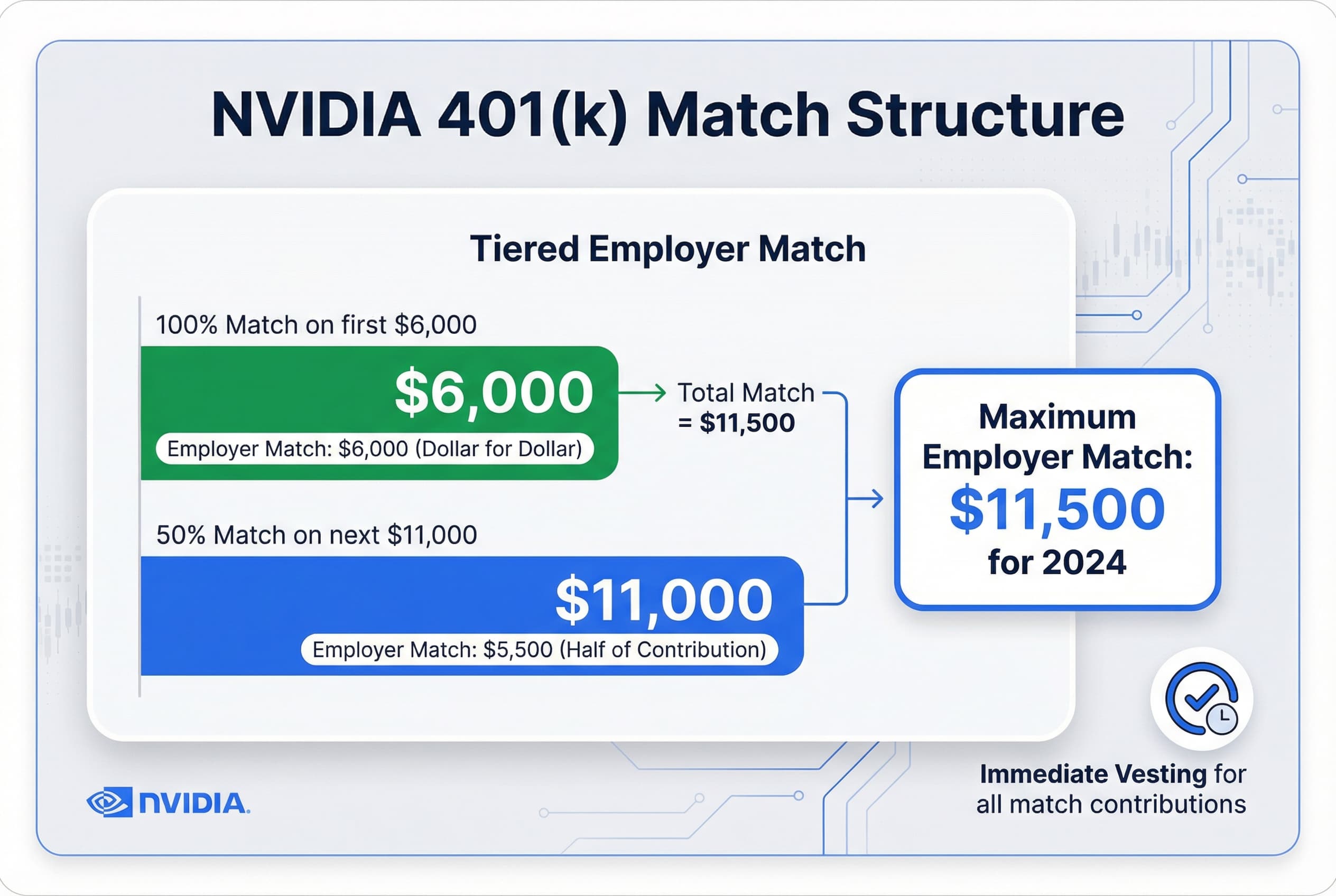
NVIDIA offers one of the most valuable ESPP programs in the tech industry, featuring a 15% discount combined with a rare 24-month lookback provision. This combination can generate substantial returns for participating employees.
The ESPP operates on 24-month offering periods with semi-annual purchase periods (every 6 months). You can enroll during February or August, or in the month you're hired. Through payroll deductions, you can contribute up to 15% of your salary, subject to the IRS annual maximum of $25,000.
The lookback provision is where NVIDIA's ESPP truly shines. At each purchase date, the plan compares the stock price at the beginning of the 24-month offering period with the current purchase date price, then applies the 15% discount to whichever is lower.
For example, if NVIDIA stock was $100 at the offering start and rises to $200 at purchase, you'd buy at $85 ($100 minus 15%). This means you'd receive an immediate 135% gain ($200 current value minus $85 purchase price). Even in flat or declining markets, you're guaranteed at least the 15% discount.
How you're taxed depends on when you sell:
Given NVIDIA's stock volatility and the potential for significant gains through the lookback provision, careful planning around selling strategy is essential to optimize your tax outcome while managing concentration risk.
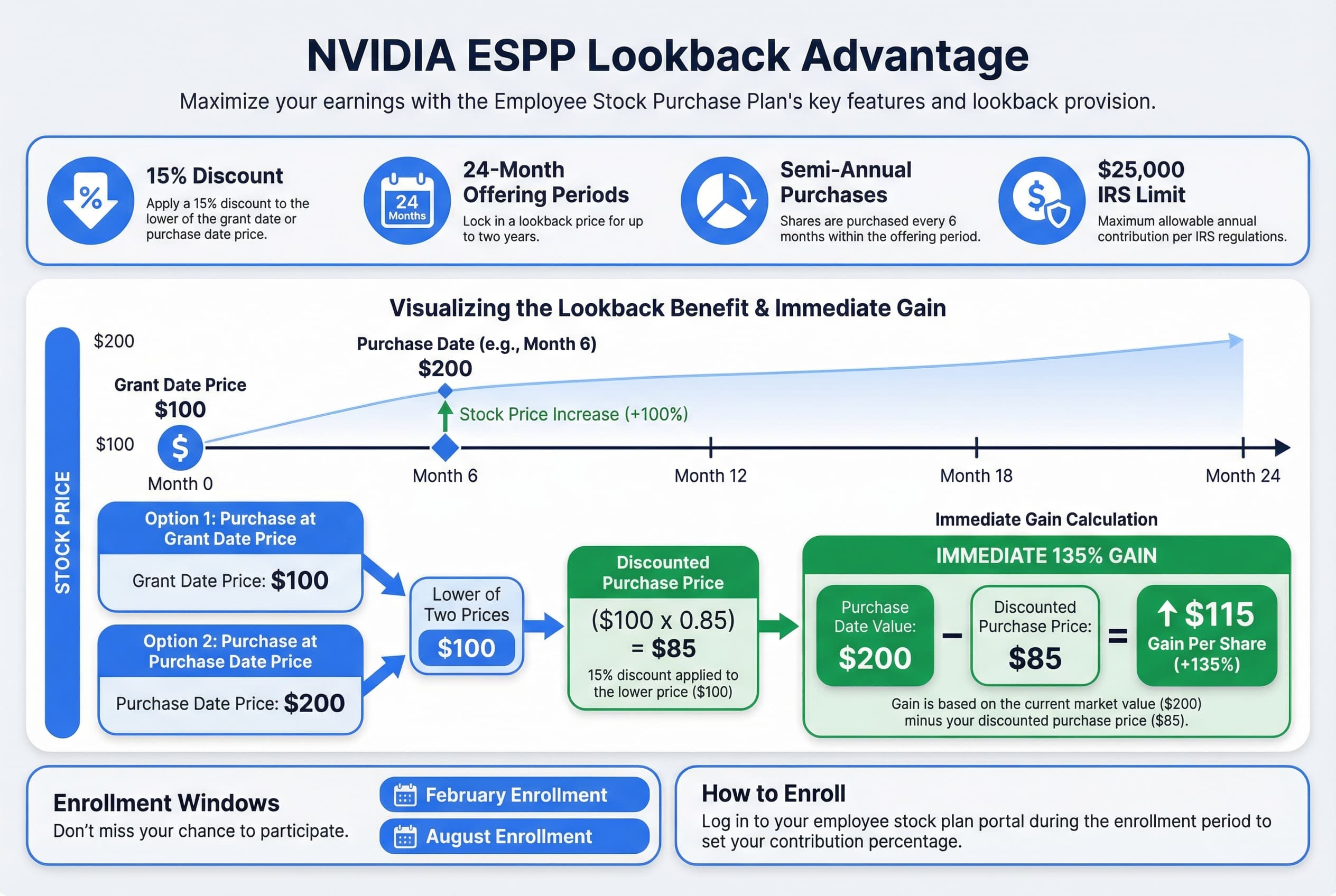
NVIDIA offers a highly competitive 401(k) plan with an exceptional employer match structure. The company provides a 100% match on the first $6,000 of employee contributions, followed by a 50% match on the next $11,000, resulting in a maximum employer match of $11,500 for 2024. This tiered matching formula is significantly more generous than typical tech company offerings.
All employer matching contributions are immediately vested, meaning you own 100% of NVIDIA's contributions from day one. This is a valuable benefit, particularly if you're considering career mobility.
NVIDIA's 401(k) plan supports mega backdoor Roth conversions, allowing high earners to build substantial tax-free retirement savings. The plan includes after-tax contribution options, enabling employees to contribute up to $70,000 total (for those under 50) in 2025 when combining pre-tax, Roth, after-tax, and employer match contributions. These after-tax contributions can typically be converted to Roth, providing a powerful strategy for tax diversification.
The 401(k) plan is administered through Fidelity, offering employees access to a robust investment platform and planning tools.
For NVIDIA employees receiving substantial RSU compensation, maximizing 401(k) contributions - especially through mega backdoor Roth strategies - can provide crucial tax diversification to balance the ordinary income generated by equity vesting.
Understanding the tax treatment of your NVIDIA equity compensation is crucial for effective financial planning. Here's what you need to know about when and how your stock benefits are taxed.
RSUs: You owe taxes at vesting, not when you sell. Each time your RSUs vest (on those quarterly vesting dates), the shares are treated as ordinary income based on their fair market value that day. This creates a taxable event even if you don't sell any shares.
ESPP: You'll face taxes when you sell ESPP shares. The discount you received (15% at NVIDIA) is generally taxed as ordinary income. Any additional gain may qualify for preferential capital gains treatment if you meet the qualifying disposition period (holding shares at least two years from the offering date and one year from the purchase date).
PSUs: Like RSUs, PSUs are taxed as ordinary income when they vest, based on the share value at vesting.
NVIDIA withholds at a default rate of 22% for supplemental income like RSU vesting. However, if you're in a higher tax bracket (which many NVIDIA employees are, given total compensation levels), this creates a significant gap. The supplemental withholding rate can reach 37% for high earners, and that doesn't include state taxes or Medicare surtax (0.9% on high earners). Many employees find themselves owing substantial additional taxes at year-end because the automatic withholding falls short. You can adjust your withholding rate to better match your actual tax liability.
RSU and PSU income at vesting is taxed as ordinary income at your marginal rate. Any subsequent appreciation after vesting is taxed as capital gains when you sell - short-term (ordinary rates) if held less than one year, or long-term (preferential rates of 0%, 15%, or 20%) if held longer.
NVIDIA is headquartered in California, which has some of the highest state income tax rates in the nation (up to 13.3%). California taxes RSU income at vesting, and this can significantly increase your total tax burden.
Disclaimer: This information is educational only and not tax advice. Tax situations vary based on individual circumstances. Please consult a qualified tax professional or financial advisor for personalized guidance.
As an NVIDIA employee, your equity compensation can create significant wealth - but concentrating too much of your net worth in a single stock, even one as successful as NVIDIA, exposes you to unnecessary risk. If the company faces challenges, both your job security and investment portfolio could suffer simultaneously.
The semiconductor industry is inherently cyclical and faces unique volatility. NVIDIA's business depends on rapid technological innovation, intense competition, changing customer demand (particularly in AI and gaming markets), and complex global supply chains. Regulatory changes, geopolitical tensions affecting chip manufacturing, or shifts in technology trends could significantly impact stock performance, regardless of the company's current success.
NVIDIA's generous annual RSU refreshers - a valuable benefit - can inadvertently increase concentration risk over time. As new grants vest quarterly alongside older ones, many employees find themselves with an increasingly large percentage of their wealth tied to NVDA stock, especially when combined with ESPP purchases.
Financial advisors commonly recommend limiting single-stock exposure to 10-20% of your total net worth. Consider establishing a systematic selling strategy during open trading windows to rebalance regularly. Remember: diversification isn't about doubting NVIDIA's future - it's about protecting yours. You can appreciate your employer's success while prudently managing risk through a well-diversified portfolio that includes other stocks, bonds, and asset classes.
NVIDIA's quarterly vesting schedule (typically on third Wednesdays in March, June, September, and second Wednesday in December) creates regular opportunities to reassess your equity position. However, quarterly blackout periods restrict when you can sell, making open trading windows critical for planning. Consider selling when your NVIDIA holdings exceed 10-15% of your net worth, as concentration risk can significantly impact your financial security regardless of company performance.
Given NVIDIA's generous refresher grants (awarded annually based on performance ratings of 5-9), employees often accumulate substantial equity positions quickly. This concentration risk is amplified in the semiconductor industry, which experiences cyclical volatility. Regular diversification during open trading windows helps protect against sector-specific downturns.
ESPP Optimization: NVIDIA's ESPP offers exceptional value with a 15% discount and rare 2-year lookback provision. To achieve qualifying disposition treatment (lower long-term capital gains rates), hold shares for at least two years from the offering date and one year from each purchase date. This requires careful tracking across multiple purchase periods.
RSU Tax Management: RSUs vest as ordinary income at your marginal rate (default 22% withholding, potentially 37% supplemental rate). This often creates under-withholding situations. Consider adjusting withholding rates or making estimated tax payments to avoid year-end surprises.
NVIDIA requires directors, VPs, and executives to use 10b5-1 trading plans for compliance. Even if not required, these plans allow you to establish predetermined selling schedules during open windows, providing discipline and removing emotion from selling decisions during blackout periods.
View your equity grants - including initial RSUs, annual refreshers, and ESPP - as significant compensation components, not bonuses. Factor these into your overall financial plan and diversification strategy from day one.
Let's walk through a typical NVIDIA RSU grant to see exactly how vesting works and what you'll receive after taxes.
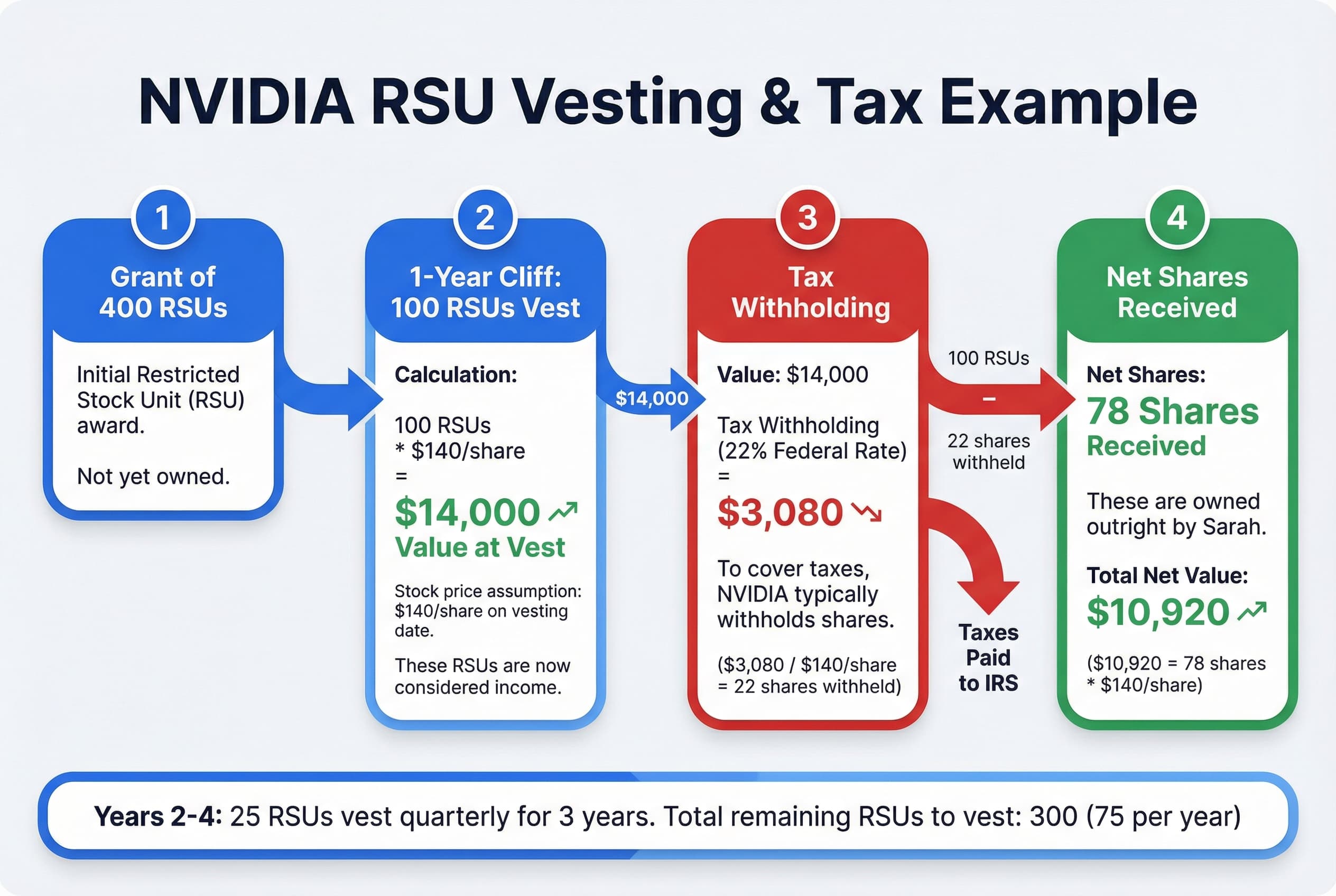
Sarah, a software engineer at NVIDIA, receives a new hire grant of 400 RSUs. Her grant follows the standard 4-year vesting schedule with a 1-year cliff and quarterly vesting thereafter.
After 12 months (First Cliff): 25% of Sarah's grant vests all at once. That's 100 RSUs that vest on the third Wednesday in March.
Years 2-4: The remaining 75% vests quarterly. Every three months (in March, June, September, and December's second Wednesday), Sarah receives 25 RSUs (6.25% of the original grant).
When RSUs vest, they're treated as ordinary income. Let's say NVIDIA stock is trading at $140 per share when Sarah's first cliff vests.
After the withholding, Sarah owns 78 shares of NVIDIA stock worth $10,920. She can hold these shares or sell them during the next open trading window (keeping in mind NVIDIA's quarterly blackout periods).
This same process repeats each quarter for the next three years, with 25 RSUs vesting each time, until all 400 RSUs have vested over the 4-year period.
NVIDIA employees often make several critical errors with their equity compensation that can cost them significantly:
Many new employees don't realize that RSUs at NVIDIA include a one-year cliff period - meaning nothing vests until you've been with the company for 12 months, when 25% vests at once. Leaving before this milestone means forfeiting your entire grant.
With annual refresher grants that also vest over four years, NVIDIA employees quickly accumulate overlapping RSU tranches. This creates significant concentration risk, where too much of your net worth becomes tied to a single stock. Diversification should be a priority as shares vest.
RSU vesting creates ordinary income taxed at your marginal rate. NVIDIA's default withholding is 22%, but if you're in a higher tax bracket (potentially 37% for supplemental income), you'll face a substantial tax bill. Many employees are caught off guard by owing thousands in additional taxes at year-end.
NVIDIA's ESPP offers a rare 2-year lookback provision with a 15% discount - one of the most valuable ESPPs in tech. Employees who don't enroll during the February or August windows miss out on this powerful wealth-building tool.
Quarterly blackout periods restrict when you can sell vested shares. Failing to plan around these windows can leave you unable to diversify or meet tax obligations when needed.
Understanding what happens to your equity compensation when you leave NVIDIA is crucial for making informed career decisions and financial planning.
When you leave NVIDIA, all unvested RSUs are forfeited, regardless of whether your departure is voluntary or involuntary. This applies to both your initial grant and any refresher grants. Since NVIDIA RSUs typically vest over four years with quarterly vesting dates (the third Wednesdays in March, June, and September, and the second Wednesday in December), your termination date relative to these vesting dates matters significantly. If you leave just before a vesting date, you'll forfeit those shares that would have vested days later.
If you're enrolled in NVIDIA's Employee Stock Purchase Plan and leave mid-offering period, your participation ends immediately. You'll receive a refund of your accumulated payroll contributions, but you won't receive any shares from that purchase period. This is particularly important given NVIDIA's valuable 2-year lookback provision - leaving before a purchase date means forfeiting the benefit of that lookback pricing.
The exact date of your termination determines which shares vest and which are forfeited. Even a difference of a few days can have substantial financial implications given NVIDIA's stock value. Review your vesting schedule carefully and consider timing if you have flexibility in your departure date.
Since NVIDIA doesn't offer traditional stock options to most employees, post-termination exercise windows don't typically apply.
NVIDIA offers a Nonqualified Deferred Compensation (NQDC) plan available to Directors, Vice Presidents, and Executives. This program allows eligible participants to defer a portion of their compensation beyond the standard 401(k) contribution limits.
The NQDC plan enables high-level employees to set aside additional compensation on a pre-tax basis, deferring income taxes until withdrawal. This can be particularly valuable for executives managing substantial RSU income and seeking to reduce their current-year tax burden.
Benefits include immediate tax deferral on deferred amounts, potential for tax-advantaged growth, and flexibility in timing distributions to lower-income years (such as retirement). This can be especially useful given NVIDIA's generous equity compensation, which often creates significant ordinary income tax events.
Risks are important to understand: deferred funds are considered unsecured company obligations, meaning participants become general creditors of NVIDIA if the company faces financial difficulties. Unlike 401(k) assets, NQDC funds aren't protected in bankruptcy.
Before participating, evaluate your current versus expected future tax rates, NVIDIA's financial stability, and your overall liquidity needs. The program works best for executives confident in the company's long-term health who want additional tax-deferred savings beyond standard retirement accounts.
This content is for educational purposes only and does not constitute financial advice. The information provided is general in nature and may not appl...
YourEmployeeStock.com is not a registered investment advisor.
Helpful videos explaining NVIDIA equity compensation, vesting, and tax strategies.
This is how you get paid in big tech
NVIDIA Employees, How to Buy NVDA Stock at a 15% or More Discount in Your ESPP
NVIDIA RSUs typically vest over 4 years with a 1-year cliff, meaning 25% vests after your first year. After the cliff, shares vest quarterly on specific dates: the third Wednesdays in March, June, and September, and the second Wednesday in December. Some grants may use different vesting schedules, including backloaded (40/30/20/10) or uniform vesting patterns.
NVIDIA defaults to a 22% federal tax withholding rate when your RSUs vest, though the supplemental wage rate can be as high as 37%. You can adjust your withholding rate if needed. Many NVIDIA employees find they're under-withheld at vesting, creating large tax liabilities at year-end, so consider increasing your withholding or setting aside additional funds for taxes.
NVIDIA's ESPP offers a 15% discount and features a valuable 2-year lookback provision, meaning you purchase stock at 85% of the lower price between the offering date and purchase date. You can contribute up to 15% of your salary (capped at $25,000 annually), with purchases occurring semi-annually. Enrollment periods are in February and August, plus the month you're hired.
You can only sell vested shares during open trading windows, as NVIDIA enforces quarterly blackout periods that restrict sales. The timing and duration of blackout periods vary depending on your classification level. Directors, VPs, and Executives typically need to establish 10b5-1 trading plans to sell shares in compliance with insider trading rules.
If you leave NVIDIA, you will forfeit any unvested RSUs. Only shares that have already vested by your termination date are yours to keep. This applies to both your initial grant and any annual refresher grants you've received.
NVIDIA provides annual RSU refreshers based on your performance, rated on a scale of 5 to 9. These refreshers vest over 4 years, sometimes with 8 vesting dates spaced 6 months apart. The company also issues out-of-cycle bonuses, which can lead to significant stock concentration risk as multiple grants vest simultaneously.
To receive favorable long-term capital gains tax treatment on ESPP shares, you must hold them for at least two years from the offering date AND at least one year from the purchase date. If you sell before meeting both requirements, it's a disqualifying disposition and a portion of your gain will be taxed as ordinary income.
Yes, NVIDIA offers a generous 401(k) match: 100% match on the first $6,000 you contribute, then 50% match on the next $11,000, for a maximum company match of $11,500 (2024 limits). The match vests immediately, and NVIDIA also offers Mega Backdoor Roth capabilities, allowing total contributions up to $70,000 for those under 50 in 2025.
Get a free personalized analysis from our equity compensation experts

