Free equity analysis
Complete guide to understanding your Walmart equity compensation, including RSU, ESPP, vesting schedules, and tax strategies.
Stock Price
$108.09
Closing price · Sep 15, 2026
Employees
2.1M
Worldwide
Equity Programs
2
programs
Vesting Period
3 years
RSU vesting
Closing price · Sep 15, 2026
Walmart offers 2 equity compensation programs to employees. Click on each program to learn more about eligibility, vesting, and tax implications.
Walmart RSUs vest on a Varies; common schedules include 4-year uniform (25% annually) or 3-year vesting (monthly or quarterly). Monthly vesting over three years is noted as most common recently. schedule with a 12-month cliff.
Example calculation based on 100 shares:
| Year | Vesting % | Shares Vesting | Estimated Value |
|---|---|---|---|
| Year 1 | 33% | 33 | $3,566.97 |
| Year 2 | 33% | 33 | $3,566.97 |
| Year 3 | 34% | 34 | $3,675.06 |
| Total | 100% | 100 | $10,809 |
* Based on Walmart stock price of $108.09 as of Sep 15, 2026. Actual values will vary.
33%
33 shares
$3,566.97
33%
33 shares
$3,566.97
34%
34 shares
$3,675.06
Walmart vesting schedule based on 100 total shares
As one of the world's largest retailers, Walmart offers a comprehensive equity compensation package designed to align employee interests with the company's long-term success. The program includes Restricted Stock Units (RSUs), Performance Stock Units (PSUs), Restricted Stock Awards (RSAs), and an Employee Stock Purchase Plan (ESPP).
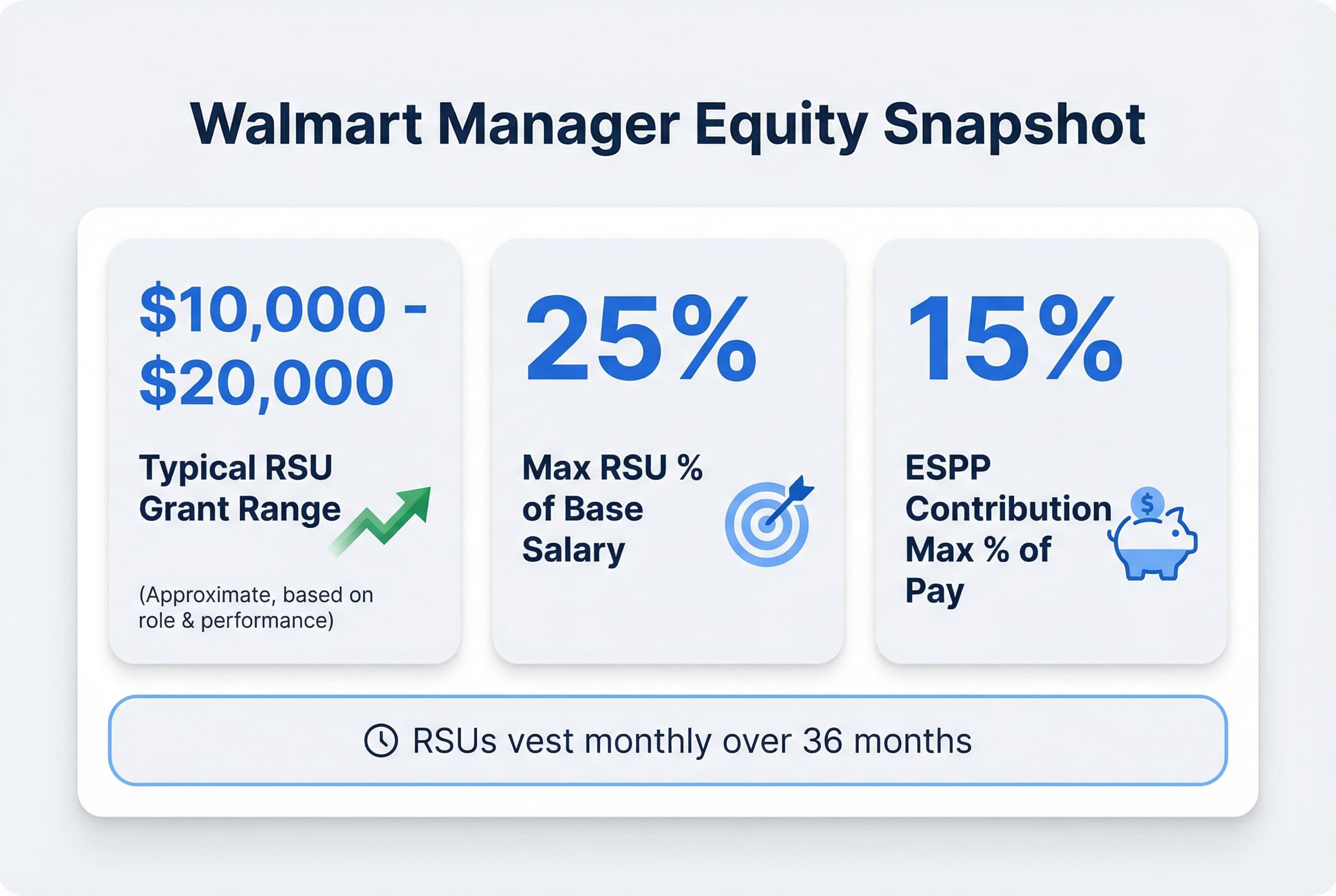
Equity compensation allows you to become a part-owner of Walmart, sharing in the company's growth alongside shareholders. For managers, RSU grants typically range between $10,000 and $20,000, and can represent up to 25% of base salary. As Walmart continues to evolve its retail and technology operations, equity compensation provides meaningful wealth-building opportunities beyond your base pay.
Walmart uses several vesting schedules depending on your grant. The most common approach recently is monthly vesting over three years (36 months total), providing a steady stream of shares becoming yours throughout the vesting period. Some grants may follow quarterly or annual schedules, with options including 3-year or 4-year uniform vesting (where you receive equal portions each period).
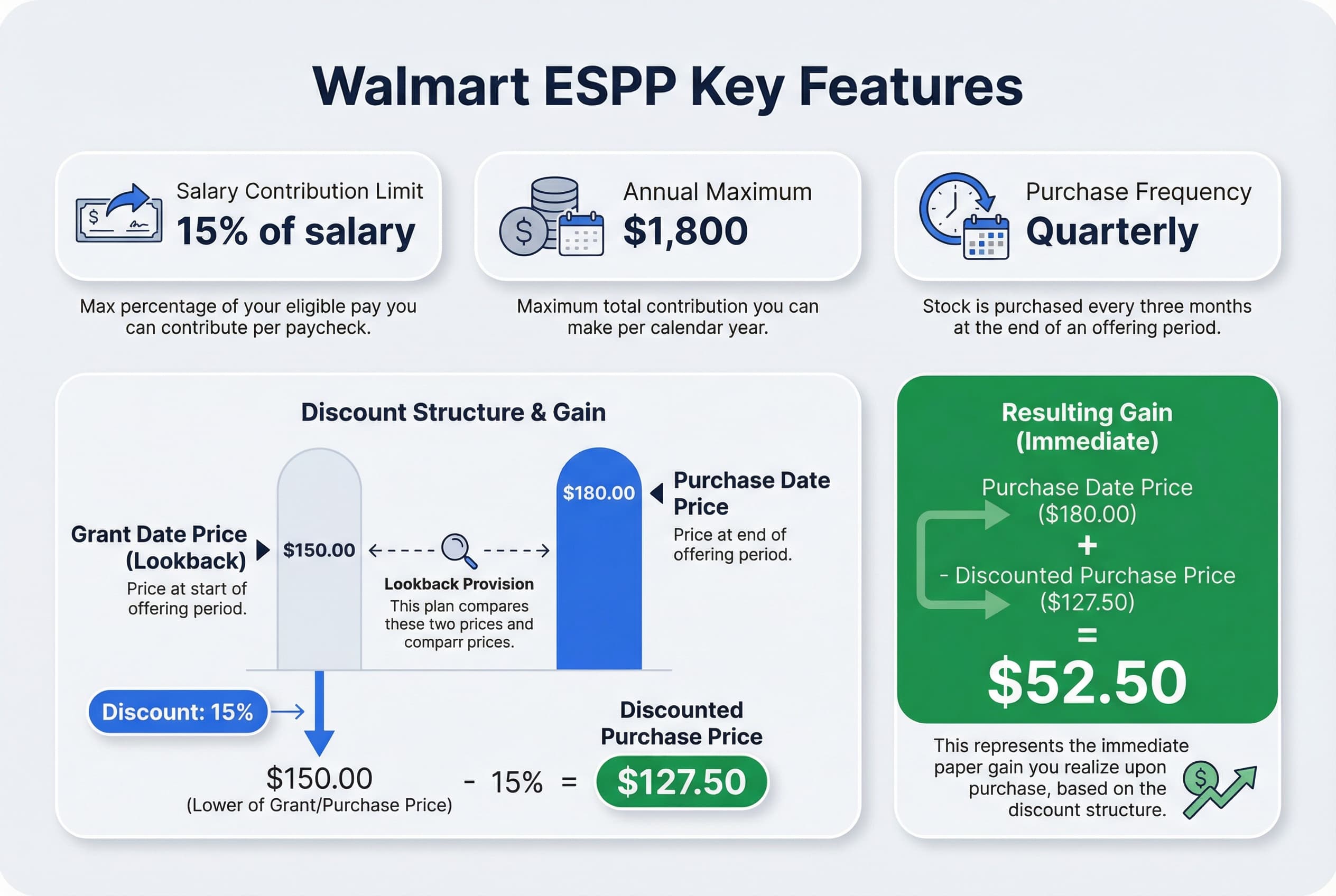
The ESPP offers a different opportunity: you can contribute up to 15% of your pay (maximum $1,800 annually) to purchase Walmart stock at a 15% discount with a lookback feature, allowing purchases quarterly.
Understanding these programs is essential to maximizing your total compensation. Each equity type serves a different purpose in your financial plan, from the predictable vesting of RSUs to the performance-based rewards of PSUs.
Walmart offers several vesting schedule options for Restricted Stock Units (RSUs), with the most common approach varying based on when you received your grant and your role within the company.
The most frequently used vesting schedule at Walmart is 3-year monthly vesting, which has become increasingly common for recent grants. Under this structure, your RSUs vest gradually over 36 months, with a small portion vesting each month. This provides a steady, predictable stream of shares becoming available throughout the vesting period.
Walmart also offers alternative vesting schedules, including:
Unlike many technology companies, Walmart's RSU vesting schedules typically do not include a cliff period. This means you begin vesting shares immediately according to your schedule - whether monthly, quarterly, or annually - rather than waiting a full year before any shares vest. This approach provides earlier access to your equity compensation.
Walmart's vesting schedules follow a uniform distribution pattern, meaning shares vest in equal increments throughout the vesting period. For example, with monthly vesting over three years, you'll receive approximately 1/36th of your total grant each month. This differs from backloaded schedules (common at some tech companies) where more shares vest in later years.
For managers, typical RSU grants range between $10,000 and $20,000 in value at the time of grant. RSUs may represent approximately 25% of base salary, though this varies by level and role within the organization.
The specific vesting schedule applied to your grant will be detailed in your equity award documents. Since multiple schedules exist across the company, it's essential to review your personal grant agreement to understand exactly when your shares will vest. Additionally, be aware that trading windows and blackout periods may restrict when you can sell vested shares, even after they've become yours.
Walmart offers an Employee Stock Purchase Plan that allows you to purchase company stock at a discount through payroll deductions. The plan provides a 15% discount and includes a lookback provision, which can significantly enhance your returns.
The lookback provision compares the stock price at two points: the beginning and end of the 6-month lookback period. You'll purchase shares at 85% of whichever price is lower. This means if Walmart's stock rises during the period, you benefit from buying at the lower starting price with your 15% discount applied.
You can contribute up to 15% of your salary, with a maximum annual contribution of $1,800. The plan features quarterly purchase periods, allowing you to buy shares four times per year. Enrollment windows occur twice annually, giving you regular opportunities to participate.
The combination of the 15% discount and 6-month lookback provision can generate immediate gains. In a rising market, your returns could exceed 15% since you're purchasing at the discounted price from the earlier date. For example, if the stock price increases during the lookback period, you effectively capture both the discount and the price appreciation.
When you sell ESPP shares, the tax treatment depends on your holding period. A qualifying disposition requires holding shares for at least two years from the grant date AND one year from the purchase date, which can result in more favorable tax treatment. A disqualifying disposition (selling before meeting both requirements) means the discount is taxed as ordinary income, with any additional gain taxed as capital gains.
Note that selling shares through Computershare incurs fees ($0.05 per share plus a $25.50 transaction fee).
Walmart offers a competitive 401(k) plan with a generous company match to help you build retirement savings. Understanding these benefits can help you maximize your long-term financial security.
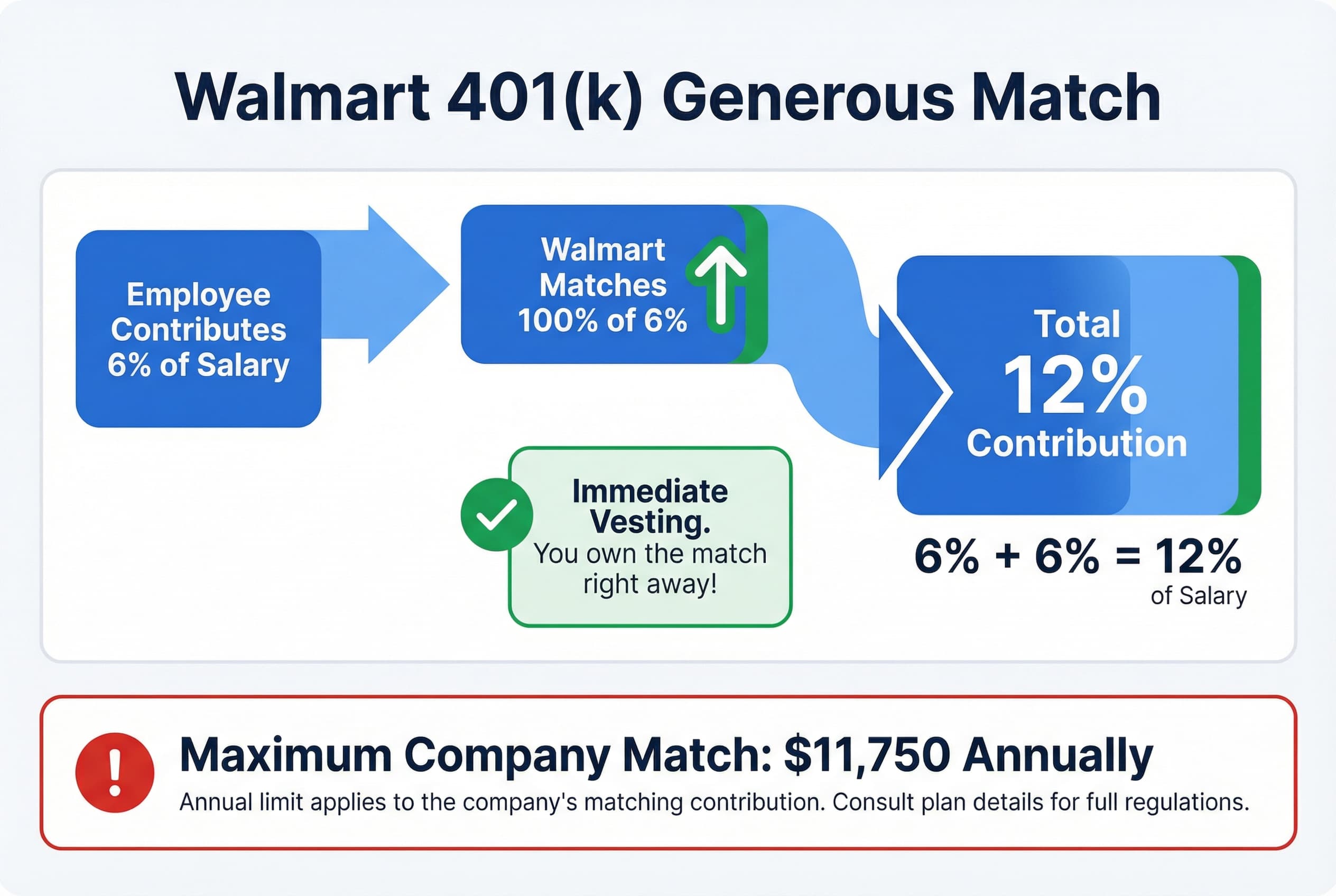
Walmart provides a 100% match on up to 6% of your salary. This means if you contribute 6% of your pay, Walmart will match the full 6%, effectively doubling your retirement contributions up to a maximum company match of $11,750 annually.
One of the standout features of Walmart's 401(k) is immediate vesting of the company match. Unlike many employers that require you to stay for several years before the match becomes yours, Walmart's contributions are yours right away, providing security even if you change jobs.
Associates are automatically enrolled at 10% of pay plus bonus (pre-tax) and benefit from an annual increase program that raises your contribution rate by 1% per year, helping you save more over time without having to think about it.
Walmart offers after-tax contribution options within the plan, including in-plan Roth conversion capability. However, the plan does not support mega backdoor Roth conversions. The total contribution limit across all sources (Traditional, Roth, company match, and after-tax) follows IRS guidelines, which was $69,000 in recent years.
A self-directed brokerage window is not available within Walmart's 401(k) plan, so investment options are limited to the plan's standard fund lineup.
Understanding the tax treatment of your Walmart equity awards is crucial for effective financial planning. Here's what you need to know about when and how your equity compensation will be taxed.
Restricted Stock Units (RSUs): You owe taxes when your RSUs vest, not when you eventually sell the shares. Whether vesting occurs monthly, quarterly, or annually, each vesting event is a taxable occurrence. The fair market value of the shares on the vesting date becomes taxable ordinary income.
Employee Stock Purchase Plan (ESPP): Taxes depend on how long you hold the shares. To qualify for favorable tax treatment, you must hold shares for at least two years from the grant date AND one year from the purchase date. If you meet these requirements, only a portion of your gain is taxed as ordinary income, with the remainder taxed as capital gains. Selling before meeting both requirements results in "disqualifying disposition," where more of your gain is taxed as ordinary income.
Performance Stock Units (PSUs): Like RSUs, PSUs are taxed when they vest (typically after a three-year cliff period), with the entire value treated as ordinary income.
Walmart's default withholding rate for equity compensation is 22%. However, this may be insufficient if you're in a higher tax bracket. For example, if your marginal tax rate is 32% or higher, you'll owe additional taxes when filing your return. While you can adjust your withholding rate, many employees face this "gap" between withholding and actual tax liability.
The value of RSUs and PSUs at vesting is always taxed as ordinary income at your marginal rate. However, any appreciation after vesting receives more favorable long-term capital gains treatment if you hold the shares for at least one year post-vesting.
This information is educational only and not tax advice. Tax situations vary significantly based on individual circumstances, state residency, and other factors. Always consult with a qualified tax professional to understand your specific tax obligations.
While Walmart equity compensation can be valuable, concentrating too much of your wealth in a single stock - even a retail giant - creates significant financial risk. If Walmart's stock price declines, your compensation, savings, and potentially your job could all be affected simultaneously.
As a retail company, Walmart faces unique challenges that could impact stock performance:
These sector-specific factors mean your Walmart stock could underperform even when the broader market performs well.
Financial advisors commonly recommend limiting single-stock exposure to 10-20% of your net worth. This guideline helps protect you from company-specific risks while still allowing you to benefit from your equity compensation.
Consider your total Walmart exposure: your unvested RSUs and PSUs, ESPP shares, any vested stock you've held, and your 401(k) match. If this combined value exceeds 20% of your net worth, consider developing a systematic selling strategy as shares vest.
Diversification doesn't mean avoiding Walmart stock entirely - it means balancing your portfolio across different companies, industries, and asset classes to reduce risk while maintaining growth potential.
With Walmart's monthly vesting schedule (most common recently), you'll receive small, regular equity grants throughout the year. Consider selling vested shares systematically rather than holding indefinitely, especially if Walmart stock represents a significant portion of your net worth. Many financial advisors recommend selling immediately upon vesting to reduce concentration risk, though this creates ordinary income tax treatment regardless of when you sell.
Retail is a competitive, evolving industry. If Walmart stock already represents your income source, benefits, and a large portion of your investment portfolio, you face significant concentration risk. As a general guideline, consider limiting any single stock to 10-15% of your total investment portfolio. This is particularly important for Walmart employees given the company's 2.1 million-person workforce and the potential impact of industry disruption.
Walmart's ESPP offers a 15% discount with a 6-month lookback feature. To qualify for favorable long-term capital gains treatment, you must hold shares for two years from the grant date AND one year from the purchase date. However, given the immediate 15% gain at purchase, many employees choose to sell immediately and accept ordinary income tax treatment on the discount, then reinvest proceeds in a diversified portfolio. Note that selling through Computershare incurs fees ($0.05/share + $25.50), so batch sales when possible.
Walmart's default 22% tax withholding on RSU vesting may be insufficient if you're in a higher tax bracket. Consider adjusting your withholding rate or setting aside additional funds for tax season to avoid surprises.
Be aware of blackout periods that restrict when you can sell vested shares. While 10b5-1 plans aren't specifically mentioned in available data, ask your HR or stock plan administrator whether they're available - these plans allow pre-scheduled sales during blackout periods.
Let's walk through a realistic scenario to see how Walmart's RSU vesting works in practice.
Sarah, a manager at Walmart, receives an RSU grant worth $15,000 when she joins the company. Based on Walmart's most common vesting schedule, her RSUs vest monthly over 36 months with no cliff period.
This means Sarah receives $417 worth of stock each month ($15,000 ÷ 36 months).
Here's what happens each month when her RSUs vest:
Month 1:
The withholding covers federal income tax on the vested amount. The $417 is treated as ordinary income and reported on Sarah's W-2.
After 12 months of vesting:
Sarah's full 3-year journey looks like this:
Total received: $11,700 in Walmart stock (after $3,300 in tax withholding)
The 22% default withholding may be less than Sarah's actual tax rate if she's in a higher tax bracket. She should plan to pay additional taxes when filing her return or adjust her withholding rate with HR.
Also note: This example assumes the stock price remains constant. The actual value Sarah receives will fluctuate based on Walmart's stock price at each monthly vesting date.
Walmart's equity compensation can be a significant wealth-building opportunity, but many employees leave money on the table through avoidable mistakes.
The Employee Stock Purchase Plan offers a 15% discount with a lookback feature, allowing you to contribute up to $1,800 annually. Many employees don't enroll or contribute less than the maximum, missing out on this immediate return on investment that purchases shares quarterly.
With monthly RSU vesting becoming increasingly common at Walmart, shares can accumulate quickly. Holding too much of your net worth in WMT stock creates unnecessary risk - your income and investments both depend on the same company's performance. Consider diversifying as shares vest.
Walmart's default 22% withholding on RSUs and PSUs often falls short of your actual marginal tax rate, especially for higher earners. This can lead to unexpected tax bills or underpaid quarterly estimates. Review your withholding settings and consider adjusting them or setting aside additional funds.
Blackout periods and trading windows limit when you can sell vested shares. Employees sometimes plan to sell during blackout periods, missing their intended timing. Senior leaders may also need pre-clearance before trading. Understanding these restrictions helps you plan sales strategically and avoid compliance issues.
Understanding what happens to your equity compensation when you leave Walmart is crucial for making informed career decisions.
When your employment ends, any unvested RSUs are typically forfeited. Since Walmart's RSUs commonly vest monthly over three years, your termination date directly impacts how much equity you retain. For example, if you leave after 18 months of a 3-year vesting schedule, you'll forfeit the remaining unvested portion. PSUs, which often have a three-year cliff vesting period, are also forfeited if you leave before the performance period completes.
If you leave mid-period while enrolled in the ESPP, your accumulated contributions will typically be returned to you, and you won't receive shares for that incomplete purchase period. Any shares already purchased in prior periods remain yours to keep or sell.
The exact timing of your departure matters significantly. Vesting events occur on specific dates (monthly for most RSU grants), so leaving just before a vesting date means forfeiting those shares. Review your vesting schedule carefully when planning your departure.
The available data doesn't specify different treatment for voluntary versus involuntary termination, so consult your equity plan documents or HR representative for clarity. Additionally, be aware of any trading restrictions or blackout periods that may affect when you can sell vested shares after departure.
Walmart offers a Deferred Compensation Matching Plan (DCMP) available to executives and officers. This program allows eligible participants to defer a portion of their current compensation to a future date, typically retirement.
The DCMP enables you to set aside pre-tax compensation, reducing your current taxable income while building additional retirement savings beyond 401(k) limits. Your deferred funds grow tax-deferred until distribution.
Carefully evaluate your current tax situation versus expected future tax rates, your confidence in Walmart's long-term financial stability, and whether you have sufficient liquid savings for near-term needs before committing to this program.
This content is for educational purposes only and does not constitute financial advice. The information provided is general in nature and may not appl...
YourEmployeeStock.com is not a registered investment advisor.
Walmart uses several vesting schedules for RSUs, with monthly vesting over three years being the most common recently. Some grants may vest quarterly or annually over 3 or 4 years, with typical schedules including 25% annually over 4 years or approximately 33% annually over 3 years. Your specific vesting schedule will be outlined in your grant agreement.
Walmart's default tax withholding rate for RSU vesting is 22% of the value. However, you can adjust this rate if needed, which may be important if your actual marginal tax rate is higher than 22%. Keep in mind that RSU vesting is treated as ordinary income and will be reported on your W-2.
Walmart's ESPP allows you to contribute up to $1,800 per year (15% of pay), and the company provides a 15% discount with a 6-month lookback feature. Purchases occur quarterly, and you can enroll twice a year. To qualify for favorable tax treatment, you must hold shares for at least two years from the grant date AND one year from the purchase date.
If you leave Walmart before your RSUs vest, you will typically forfeit any unvested shares. Only RSUs that have already vested by your departure date will remain yours to keep. This makes it important to understand your vesting schedule and consider the value of unvested equity when planning career moves.
Yes, Walmart has trading windows and blackout periods that restrict when employees can trade company stock. Senior leaders and some award recipients may also be subject to pre-clearance requirements before selling shares. Check with your stock plan administrator or HR for specific trading window dates and any restrictions that apply to your role.
For managers at Walmart, RSU grants typically range between $10,000 and $20,000 in value. RSUs can represent approximately 25% of base salary, though the exact amount varies based on level, performance, and role. Grant amounts for other levels may differ significantly.
When selling ESPP shares through Computershare (Walmart's plan administrator), you'll incur transaction fees of $0.05 per share plus a $25.50 fee. Additionally, the tax treatment of your sale depends on how long you've held the shares—holding for at least two years from grant and one year from purchase qualifies for more favorable tax treatment.
Over-concentration in Walmart stock is a common concern for employees, as having too much of your wealth tied to a single company increases risk. Financial advisors generally recommend diversifying your portfolio, especially since your income already depends on the company's success. Consider developing a plan to periodically sell vested shares and reinvest in a diversified portfolio.
Get a free personalized analysis from our equity compensation experts

