Free equity analysis
Complete guide to understanding your AMD equity compensation, including RSU, ISO, NSO, ESPP, vesting schedules, and tax strategies.
Stock Price
$493.41
Closing price · Sep 14, 2026
Employees
19.4K
Worldwide
Equity Programs
4
programs
Vesting Period
4 years
RSU vesting
Closing price · Sep 14, 2026
AMD offers 4 equity compensation programs to employees. Click on each program to learn more about eligibility, vesting, and tax implications.
Standard RSU program with 4-year vesting and 1-year cliff. Annual refresh grants available for eligible employees.
Learn about AMD's Incentive Stock Options program, including vesting schedules and tax treatment.
Learn about AMD's Non-Qualified Stock Options program, including vesting schedules and tax treatment.
Learn about AMD's Employee Stock Purchase Plan program, including vesting schedules and tax treatment.
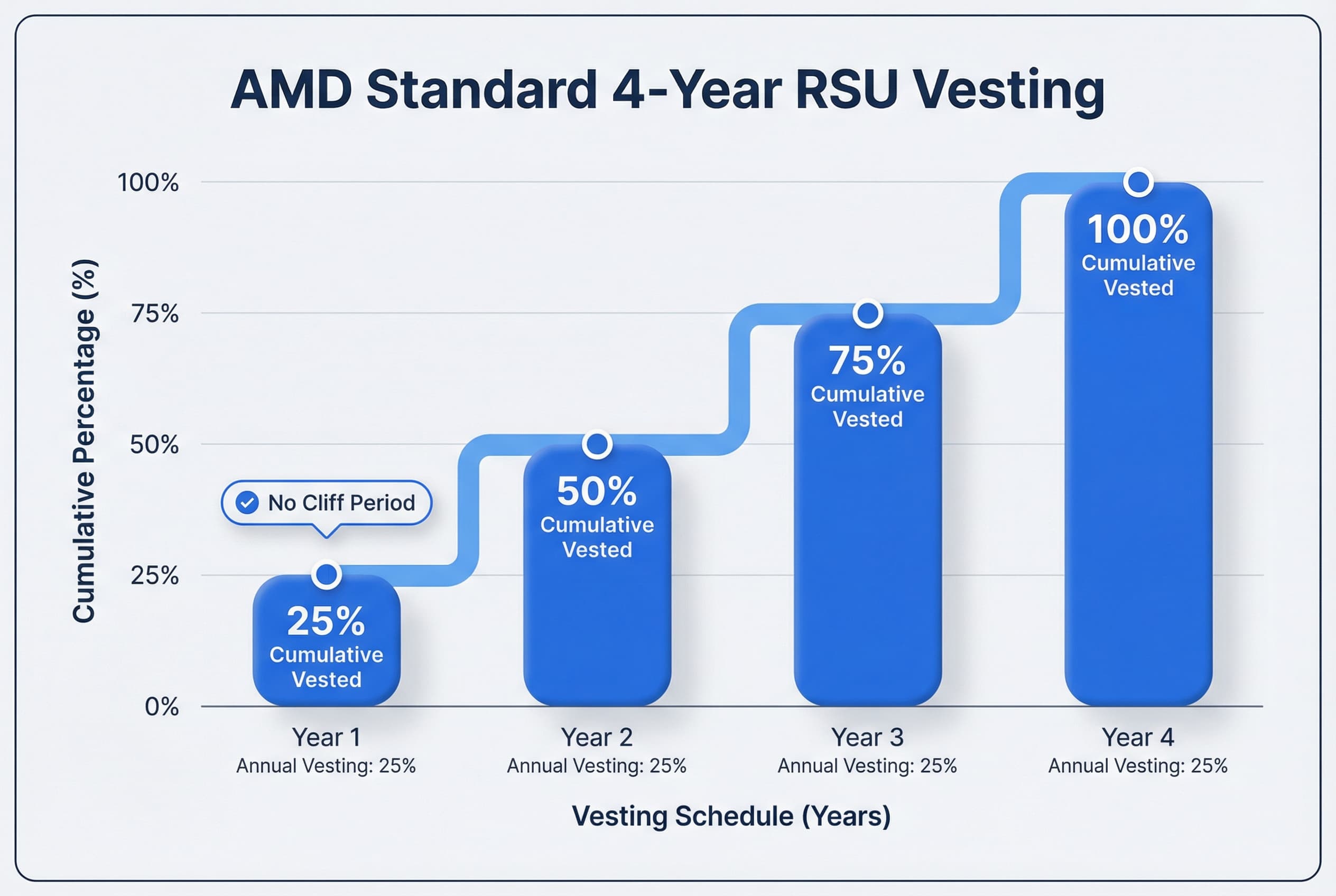
AMD RSUs vest on a 4-year uniform schedule reported for most roles (25% annually), but historical 3-year and complex 4-year schedules also mentioned. Executive grants show specific tranches. schedule with a 12-month cliff.
Example calculation based on 100 shares:
| Year | Vesting % | Shares Vesting | Estimated Value |
|---|---|---|---|
| Year 1 | 25% | 25 | $12,335.25 |
| Year 2 | 25% | 25 | $12,335.25 |
| Year 3 | 25% | 25 | $12,335.25 |
| Year 4 | 25% | 25 | $12,335.25 |
| Total | 100% | 100 | $49,341 |
* Based on AMD stock price of $493.41 as of Sep 14, 2026. Actual values will vary.
25%
25 shares
$12,335.25
25%
25 shares
$12,335.25
25%
25 shares
$12,335.25
25%
25 shares
$12,335.25
AMD vesting schedule based on 100 total shares
AMD offers a comprehensive equity compensation package designed to align employee interests with the company's long-term success in the semiconductor industry. As a publicly-traded company with approximately 19,400 employees, AMD provides several equity vehicles including Restricted Stock Units (RSUs), Performance Stock Units (PSUs), stock options (both Incentive Stock Options and Non-Qualified Stock Options), and an Employee Stock Purchase Plan (ESPP).
Equity compensation gives you the opportunity to share in AMD's growth and success. As the company continues to innovate in semiconductors and compete in the global technology market, your equity awards can become a significant component of your total compensation. Unlike cash bonuses, equity aligns your financial interests with the company's stock performance, potentially creating substantial long-term value.
Most AMD employees receive RSUs on a 4-year vesting schedule, with 25% of your grant vesting each year on your anniversary date. This means you'll receive one-quarter of your total RSU grant after each completed year of service. Executive grants may follow different vesting patterns with specific tranches. The company also offers refresher grants, particularly for more senior technical roles (MTS and above), typically on an annual basis to provide ongoing equity incentives.
The ESPP allows you to purchase AMD stock at a 15% discount with a favorable lookback provision, with quarterly purchase periods throughout the year.
AMD primarily uses a 4-year uniform vesting schedule for RSU grants across most employee levels. Under this structure, equity vests in equal installments of 25% annually over four years. This means you'll receive one-quarter of your total grant each year on your vesting anniversary.
Notably, AMD's standard vesting schedule does not include a cliff period. Unlike many tech companies that require you to stay for one year before any shares vest, AMD begins vesting your equity from the first anniversary of your grant date. This can be advantageous if you're considering shorter tenure, as you'll start receiving vested shares sooner.
Your RSUs vest on an annual basis, with 25% of your total grant becoming available each year. This uniform distribution means you receive the same number of shares each vesting period - the schedule is neither backloaded (more shares later) nor frontloaded (more shares upfront). This predictable pattern makes it easier to plan your financial strategy and tax obligations.
While the 4-year uniform schedule applies to most roles, executive-level grants may follow different structures. Some senior leadership grants use alternative vesting patterns, including a 3-tranche schedule with percentages of 16.67%, 33.33%, and 50%, while others maintain the standard 25% annual vest. If you're at the SVP level or above, review your specific grant agreement for exact terms.
AMD provides refresher grants to retain talent, though the details vary by level. Refreshers are discussed primarily for technical roles at the MTS (Member of Technical Staff) level and above, with annual refresher grants being the standard frequency. However, there's some ambiguity around timing - some sources suggest refreshers might only be granted at the end of your initial 4-year vesting period, while others indicate annual refreshers for eligible employees. If you're at the MTS, SMTS, or PMTS level, clarify your refresher eligibility and timing with your compensation team during performance reviews.
Remember that you must activate your brokerage account (currently E*Trade) before your first vesting date, or your award may be cancelled. This administrative step is crucial to receiving your vested shares.
AMD offers employees a valuable opportunity to purchase company stock at a discount through its Employee Stock Purchase Plan. This benefit can provide significant returns when used strategically.
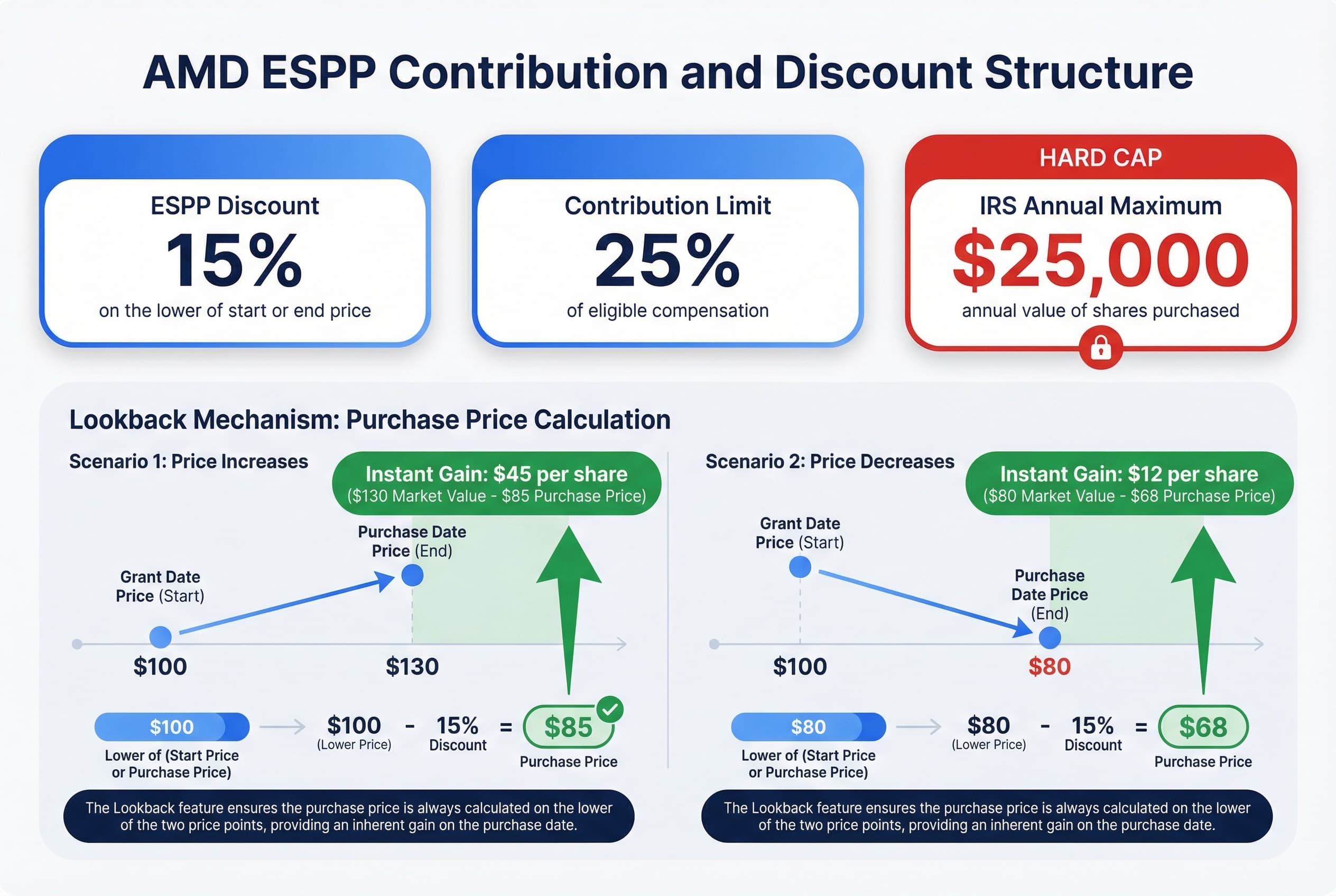
AMD's ESPP provides a 15% discount on the purchase price and includes a lookback provision, creating a powerful wealth-building opportunity. The plan operates on 3-month offering periods with purchases occurring quarterly (starting February 1, May 1, August 1, and November 1). Employees can enroll during four annual windows: February, May, August, and November.
You can contribute up to 25% of your compensation toward ESPP purchases, subject to the IRS annual maximum of $25,000 per calendar year. This allows you to maximize your participation based on your financial situation and comfort level.
The lookback provision means AMD calculates your purchase price using the lower of two values: the stock price at the beginning of the offering period or the price at the end (purchase date). Combined with the 15% discount, this creates substantial potential returns. For example, if the stock rises during the offering period, you'll purchase at the lower beginning price minus 15%. If it falls, you'll use the lower ending price minus 15%.
To receive favorable tax treatment as a qualifying disposition, you must hold shares for at least 2 years from the offering date AND 1 year from the purchase date. Selling before meeting both requirements results in a disqualifying disposition, where the discount is taxed as ordinary income. While disqualifying dispositions have less favorable tax treatment, many employees still benefit from immediate sale strategies, especially in volatile markets.
The combination of the 15% discount and lookback provision makes AMD's ESPP a compelling benefit worth considering as part of your overall compensation strategy.
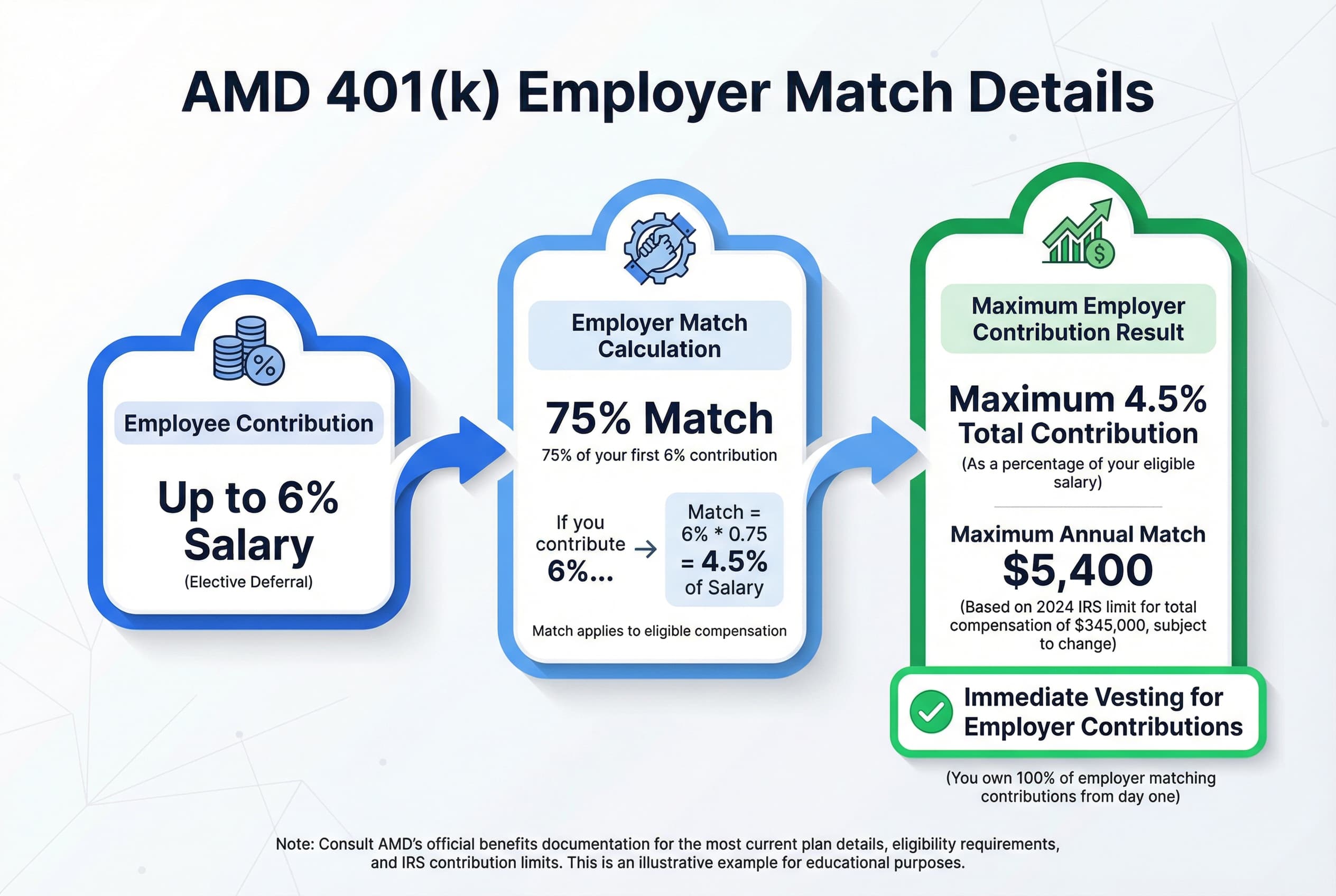
AMD offers a competitive 401(k) retirement plan with an attractive employer match to help you build long-term savings. The company provides a 75% match on up to 6% of your salary contributions, with a maximum annual match of $5,400. This means if you contribute the full 6%, AMD will add an additional 4.5% of your salary to your retirement account.
One of the standout features of AMD's 401(k) plan is immediate vesting of employer match contributions. Unlike many companies that require you to stay for several years before owning the match, you own AMD's contributions from day one. This provides valuable flexibility if you change jobs.
AMD offers both traditional (pre-tax) and Roth 401(k) options, allowing you to choose the tax treatment that best fits your financial strategy. For high earners who have maxed out standard contribution limits, the plan includes after-tax contribution options, giving you additional tax-advantaged savings opportunities.
However, it's important to note that mega backdoor Roth conversions are not available through AMD's 401(k) plan. Additionally, there is no brokerage window option for self-directed investments within the plan.
For Director-level employees and above, AMD offers a Deferred Income Account Plan (DIA) that allows you to defer compensation pre-tax beyond IRS 401(k) limits, providing additional tax planning flexibility for higher earners.
Understanding the tax treatment of your AMD equity awards is essential for effective financial planning. Different equity types trigger taxes at different times and rates, which can significantly impact your take-home value.
RSUs are taxed as ordinary income at vesting. When your AMD RSUs vest (typically 25% annually over four years), the fair market value of the shares becomes taxable compensation, just like your regular salary. This income is reported on your W-2 and subject to federal, state, Social Security, and Medicare taxes.
ESPP shares trigger taxes based on how long you hold them. If you meet the qualifying disposition requirements (holding shares for at least 2 years from the offering date AND 1 year from the purchase date), you'll receive favorable tax treatment. The 15% discount is taxed as ordinary income, while any additional gain is taxed at long-term capital gains rates. Selling earlier creates a "disqualifying disposition," where more of your gain is taxed as ordinary income.
Stock Options (ISOs and NSOs) have different tax treatments. NSOs are taxed as ordinary income when exercised, based on the spread between the exercise price and fair market value. ISOs receive preferential treatment if held properly, with no regular tax at exercise, but they may trigger Alternative Minimum Tax (AMT). The AMT calculation can result in unexpected tax bills, particularly if AMD's stock price increases significantly between exercise and sale.
AMD withholds taxes at vesting using supplemental wage rates. However, the default withholding may not cover your full tax liability, especially if you're in a higher tax bracket. This creates a common "gap" where you owe additional taxes at year-end. You can adjust your withholding rate to better align with your actual tax obligation.
Any appreciation in share value after vesting or exercise is taxed as capital gains when sold. Long-term capital gains rates (for shares held over one year) are typically lower than ordinary income rates, providing tax savings on post-vest appreciation.
AMD is headquartered in California, a high-tax state. If you work in California or other high-tax states, you'll face state income taxes on your equity compensation in addition to federal taxes, further increasing your overall tax burden.
Disclaimer: This information is educational only and not tax advice. Tax situations vary based on individual circumstances. Consult a qualified tax professional or financial advisor to understand your specific tax obligations.
As an AMD employee, equity compensation is likely a significant part of your total compensation package. However, holding too much of your wealth in a single stock - even your employer's - creates concentration risk that could jeopardize your financial security.
When your salary, benefits, and investment portfolio all depend on AMD's performance, you're essentially "doubling down" on one company. If AMD faces challenges, you could simultaneously experience reduced stock value, potential job insecurity, and diminished net worth.
AMD operates in the highly competitive semiconductor industry, which faces unique risks including:
Financial advisors typically recommend limiting exposure to any single stock to 10-20% of your net worth. This means regularly selling vested RSUs and ESPP shares to rebalance your portfolio, even if it feels counterintuitive when the stock is performing well.
Consider diversifying into:
Remember: believing in AMD as an employer doesn't require concentrating your entire financial future in its stock price.
AMD employees should think carefully about concentration risk, particularly given the semiconductor industry's cyclical nature. Consider selling vested RSUs when they represent more than 10-15% of your total investment portfolio. Since AMD RSUs vest annually over four years (25% per year), each vesting event provides a natural opportunity to rebalance. Many financial advisors recommend selling at least a portion of shares at vesting to avoid overconcentration in a single company, especially your employer.
Working in the semiconductor industry means your income already depends on AMD's performance. Holding significant equity compounds this risk - if the industry faces headwinds, both your job security and portfolio could suffer simultaneously. Consider establishing a systematic selling plan after each annual vest to diversify into broader market investments.
AMD's ESPP offers a 15% discount with a lookback provision on quarterly purchase periods. To maximize tax benefits, hold ESPP shares for at least two years from the offering date AND one year from the purchase date to qualify for favorable long-term capital gains treatment. However, given the immediate 15% gain, many employees choose to sell immediately and accept ordinary income tax on the discount, prioritizing diversification over tax optimization.
Remember that equity grants are part of your compensation package, not just investment opportunities. When evaluating your total comp, consider that unvested RSUs carry risk - they only have value if you remain employed and AMD's stock maintains value. Annual refreshers (rumored for MTS and above levels) help maintain equity compensation over time.
While the data doesn't specify AMD's 10b5-1 plan availability, these pre-scheduled trading plans can help insiders sell shares during blackout periods while maintaining compliance with insider trading rules.
Let's walk through a realistic scenario to see how AMD's RSU vesting works in practice.
Sarah joins AMD as a Senior Software Engineer and receives 1,000 RSUs as part of her new hire package. AMD uses a standard 4-year vesting schedule with 25% vesting annually (no cliff period).
Year 1: 250 RSUs vest (25% of 1,000)
Year 2: 250 RSUs vest
Year 3: 250 RSUs vest
Year 4: 250 RSUs vest (final tranche)
When RSUs vest, they're treated as ordinary income. While AMD's specific default withholding rate isn't publicly disclosed, employees can adjust their withholding rate. Let's assume Sarah uses a 35% withholding rate to cover federal, state, and payroll taxes.
Using Year 1 as an example:
The actual value Sarah receives depends on when she sells her remaining shares and AMD's stock price at that time. She can hold them for potential appreciation or sell immediately to diversify.
Important: Make sure to activate your brokerage account (currently E*Trade) before your first vesting date, or your award will be cancelled.
AMD employees often miss valuable opportunities or create unnecessary tax complications with their equity benefits. Here are the most frequent missteps to avoid:
Many employees hold too much of their net worth in AMD shares, creating excessive risk. As your RSUs vest annually over four years, regularly evaluate whether you're too concentrated in a single stock. Consider diversifying, especially as your equity compensation grows.
AMD's Employee Stock Purchase Plan offers a 15% discount with a lookback provision and quarterly purchase periods. Failing to enroll means leaving guaranteed returns on the table. Enrollment windows occur in February, May, August, and November - mark your calendar to avoid missing them.
RSUs are taxed as ordinary income when they vest. AMD allows you to adjust your withholding rate, but many employees stick with defaults that may not cover their full tax liability. This is especially critical if you're in a higher tax bracket or live in a high-tax state. Plan ahead to avoid underpayment penalties.
Selling ESPP shares before meeting the qualifying period (two years from offering date AND one year from purchase date) triggers higher ordinary income tax rates instead of favorable capital gains treatment. Understand the tax implications before selling.
Employees at MTS level and above may be eligible for annual RSU refreshers, but many don't proactively discuss equity during performance reviews. Don't assume refreshers happen automatically - advocate for yourself.
Understanding what happens to your equity compensation upon departure is crucial for making informed career decisions.
When you leave AMD, any unvested RSUs are forfeited, regardless of whether your departure is voluntary or involuntary. This is standard practice across the industry. Since AMD typically uses a 4-year vesting schedule with 25% vesting annually, timing your departure can significantly impact the value you retain. For example, leaving just before an annual vesting date means forfeiting that entire year's tranche.
While AMD does grant both ISOs and NSOs, specific post-termination exercise window details are not publicly available in AMD's standard documentation. Typically, companies provide 90 days to exercise vested options after termination, but you should confirm this timeframe with AMD's equity administration team or review your specific grant agreement. Options typically expire 10 years from the grant date.
If you leave AMD mid-offering period, your ESPP contributions will be returned to you without purchasing shares. Any shares already purchased in prior periods remain yours to hold or sell, though selling before meeting the qualifying period (2 years from offering date AND 1 year from purchase date) results in a disqualifying disposition with different tax treatment.
Important: Your official termination date determines your final vesting eligibility, so understanding exactly when your employment ends matters for equity purposes.
AMD offers a Deferred Income Account Plan (DIA) that allows eligible employees to defer compensation on a pre-tax basis above IRS limits for traditional 401(k) contributions.
The DIA plan is available to employees at the Director level and above. This makes it an executive-focused benefit designed for higher-earning employees who may want additional tax-advantaged savings options beyond standard retirement accounts.
The program allows you to defer a portion of your compensation before taxes are applied, which can then grow tax-deferred until withdrawal. This works in conjunction with AMD's 401(k) plan, which offers a 75% match on the first 6% of contributions (up to $5,400 annually).
Benefits include reducing your current taxable income and potentially deferring taxes until retirement when you may be in a lower tax bracket. Risks include limited liquidity - deferred funds are typically not accessible until specific triggering events - and creditor risk, as deferred compensation is generally considered an unsecured promise to pay.
Before participating, evaluate your current tax situation, retirement timeline, and liquidity needs. Consider consulting with a financial advisor to determine if deferring compensation aligns with your overall financial strategy, especially given the restrictions on accessing these funds.
This content is for educational purposes only and does not constitute financial advice. The information provided is general in nature and may not appl...
YourEmployeeStock.com is not a registered investment advisor.
AMD typically uses a 4-year vesting schedule with 25% of your RSUs vesting annually. This means you'll receive one-quarter of your total grant each year over four years. Executive grants may have different vesting structures with specific tranches, so always check your individual grant agreement for exact details.
If you leave AMD before your RSUs vest, you will typically forfeit any unvested shares. Only the shares that have already vested by your departure date are yours to keep. For senior executives (SVP and above), there are clawback provisions that may allow AMD to recover vested RSUs if you engage in activities against the company's interest within 12 months after leaving.
AMD's ESPP allows you to purchase company stock at a 15% discount with a lookback provision. The plan has quarterly purchase periods (February, May, August, November), and you can contribute up to 25% of your compensation, subject to a $25,000 annual IRS limit. The lookback feature means you get the discount based on the lower price between the offering date and purchase date.
To receive favorable tax treatment on your ESPP shares, you must hold them for at least 2 years from the offering date AND 1 year from the purchase date (a qualifying disposition). If you sell before meeting both requirements, it's a disqualifying disposition, and the discount you received will be taxed as ordinary income rather than potentially more favorable capital gains treatment.
Yes, AMD allows you to adjust your tax withholding rate when your RSUs vest. This gives you flexibility to withhold more or less than the default rate based on your individual tax situation. Keep in mind that you'll need to settle any tax liability when RSUs vest, typically through share withholding or cash payment.
AMD does provide annual refresher grants, though eligibility and amounts vary by role and level. There are reports that MTS (Member of Technical Staff) and above may be eligible for refreshers, and some discussions suggest refreshers might be granted at specific intervals rather than annually for all employees. Speak with your manager or HR about your specific eligibility.
AMD is subject to insider trading restrictions and has specific trading windows, especially for employees with material non-public information. If your RSU vesting falls outside an open trading window, blackout periods may apply. Additionally, you must activate your brokerage account (currently E*Trade) before your first vesting date, or your award may be cancelled.
Yes, AMD offers both Incentive Stock Options (ISOs) and Non-Qualified Stock Options (NSOs), though RSUs appear to be the primary equity compensation vehicle for most employees. Stock options at AMD have a 10-year expiration period. The specific vesting schedules and exercise terms for options may vary, so review your individual grant documents for details.
Get a free personalized analysis from our equity compensation experts

