Free equity analysis
We're still gathering complete information
Some details about Amazon's equity programs may be incomplete or based on general industry data. We recommend verifying specifics with your official plan documents or HR department.
Complete guide to understanding your Amazon equity compensation, including RSU, ISO, NSO, DSPP, vesting schedules, and tax strategies.
Stock Price
$248.42
Closing price · Sep 15, 2026
Employees
865.4K
Worldwide
Equity Programs
4
programs
Vesting Period
4 years
RSU vesting
Closing price · Sep 15, 2026
Amazon offers 4 equity compensation programs to employees. Click on each program to learn more about eligibility, vesting, and tax implications.
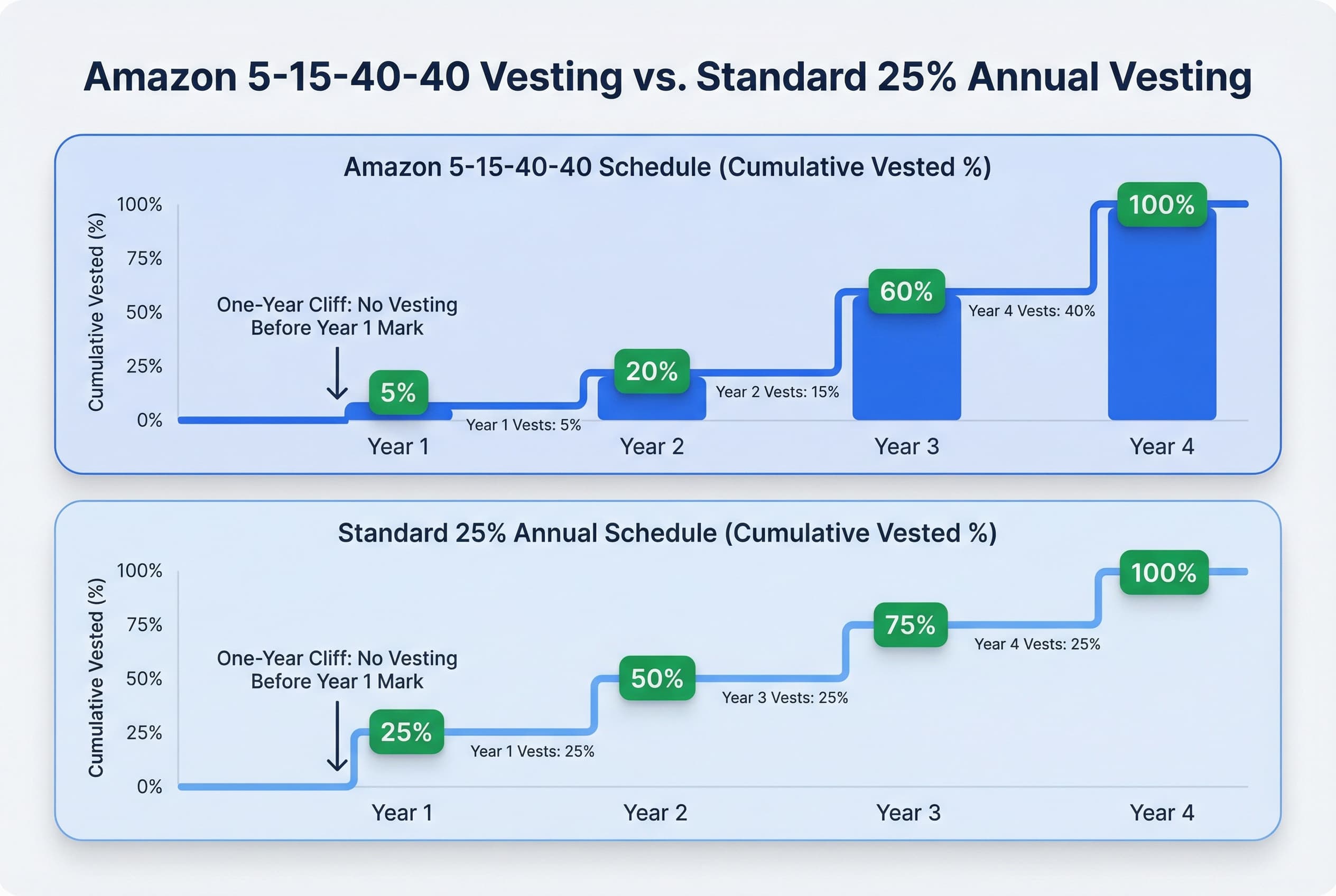
Amazon's RSU vesting is unique in tech with a heavily backloaded schedule: 5% in year 1, 15% in year 2, and 40% in each of years 3 and 4. This structure is designed to retain employees long-term. Amazon compensates for the slow start with sign-on bonuses in years 1 and 2.
Learn about Amazon's Incentive Stock Options program, including vesting schedules and tax treatment.
Learn about Amazon's Non-Qualified Stock Options program, including vesting schedules and tax treatment.
Amazon offers a Direct Stock Purchase Plan (DSPP) rather than a traditional ESPP. Unlike ESPPs, Amazon's DSPP allows employees to purchase company stock at market price with no discount. Purchases are made through payroll deductions, making it a convenient way to acquire Amazon stock, though without the built-in discount that ESPPs provide.
Amazon RSUs vest on a 4-year, 5-15-40-40 backloaded schedule with a 12-month cliff.
Example calculation based on 100 shares:
| Year | Vesting % | Shares Vesting | Estimated Value |
|---|---|---|---|
| Year 1 | 25% | 25 | $6,210.50 |
| Year 2 | 25% | 25 | $6,210.50 |
| Year 3 | 25% | 25 | $6,210.50 |
| Year 4 | 25% | 25 | $6,210.50 |
| Total | 100% | 100 | $24,842 |
* Based on Amazon stock price of $248.42 as of Sep 15, 2026. Actual values will vary.
25%
25 shares
$6,210.50
25%
25 shares
$6,210.50
25%
25 shares
$6,210.50
25%
25 shares
$6,210.50
Amazon vesting schedule based on 100 total shares
Amazon offers a comprehensive equity compensation program centered primarily on Restricted Stock Units (RSUs), along with stock options (both Incentive Stock Options and Non-Qualified Stock Options) and Performance Stock Units for certain roles. Notably, Amazon does not offer a traditional Employee Stock Purchase Plan with discounts.
Equity compensation represents a significant portion of total compensation at Amazon, particularly for technical roles where new hire grants can exceed $30,000 in annual value. As one of the world's leading e-commerce and technology companies, Amazon's equity program is designed to align employee interests with long-term company performance and reward sustained commitment.
Amazon's initial RSU grants follow a distinctive backloaded vesting schedule over four years: 5% in year one, 15% in year two, and 40% in each of years three and four. This structure includes a 12-month cliff, meaning no shares vest until you've completed your first year. After that, shares typically vest quarterly in February, May, August, and November.
To offset the lower vesting in years one and two, Amazon typically provides signing bonuses paid in two installments during your first two years. Additionally, the company awards annual refresher grants (often during Q1 reviews), which vest faster than your initial grant, helping to smooth out your equity income over time.
This backloaded approach rewards long-term employees but requires careful financial planning, especially as your initial grant completes its vesting cycle.
Amazon uses a highly distinctive backloaded vesting schedule for initial RSU grants that sets it apart from most tech companies. Instead of the standard 25% per year structure, Amazon follows a 5-15-40-40 pattern over four years. This means you'll receive just 5% of your total grant in year one, 15% in year two, then 40% in both years three and four.
Like many companies, Amazon includes a one-year cliff period before any shares vest. During this cliff, you won't receive any RSUs - you must remain employed for the full 12 months before your first vesting event occurs. After the cliff, shares typically vest quarterly on specific dates: February 21, May 21, August 21, and November 21 (though this pattern may vary by level or grant type).
The backloaded structure means your equity compensation increases dramatically in years three and four. While you'll only receive 20% of your grant total during the first two years combined, you'll receive 80% in the final two years. Amazon offsets this low early compensation by offering substantial signing bonuses ranging from $50,000 to over $200,000 (depending on your level and role), paid in two installments during years one and two.
Amazon awards refresher grants annually, typically during the Q1 performance review and promotion cycle. Importantly, these subsequent grants vest faster than your initial grant - often following a more traditional quarterly schedule for employees at levels L4-L7. This helps smooth out the income cliff that occurs when your initial four-year grant fully vests.
Executive grants follow a different pattern, vesting over ten years with 80% concentrated in the final five years - an even more extreme backloaded structure.
The backloaded schedule is designed to reward long-term commitment, but it creates financial planning challenges. Many employees experience a significant income drop after their initial grant completes, making it crucial to understand how refresher grants will supplement your compensation over time.
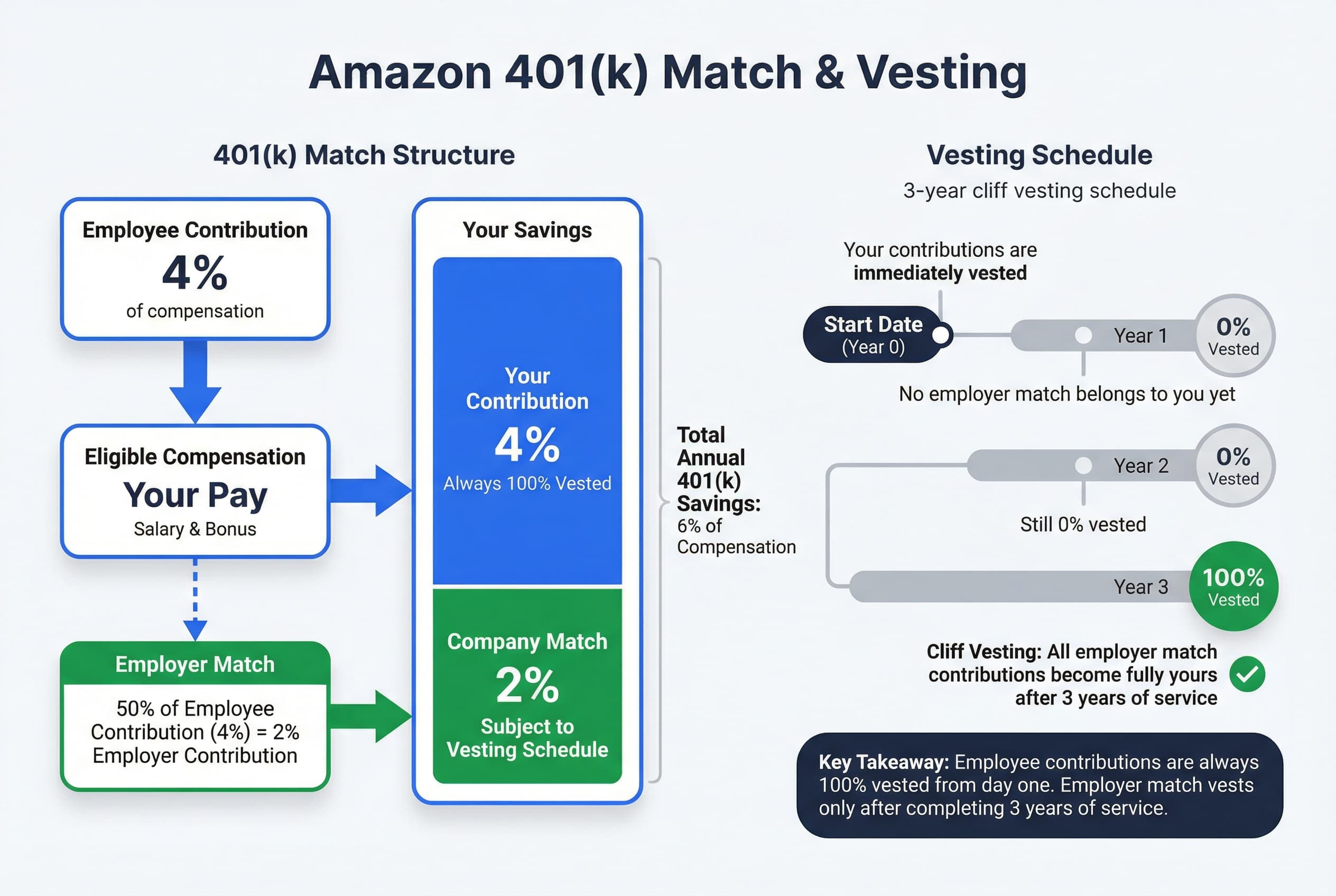
Amazon offers a competitive 401(k) plan to help employees save for retirement. The company provides a 50% match on up to 4% of your eligible compensation. For example, if you contribute 4% of your salary, Amazon will contribute an additional 2%.
The employer match follows a 3-year cliff vesting schedule. This means you need to complete three years of vesting service (defined as 1,000 hours worked per calendar year) before the company match becomes fully yours. If you leave Amazon before reaching three years of service, you'll forfeit the unvested match, though your own contributions are always 100% yours.
Amazon allows employees to contribute up to 90% of eligible pay through pre-tax, Roth, or traditional after-tax contributions, subject to IRS annual limits. This high contribution ceiling provides significant flexibility for aggressive savers.
The plan does support mega backdoor Roth conversions through after-tax contributions. This advanced strategy allows high earners to contribute beyond standard Roth IRA limits by making after-tax 401(k) contributions and converting them to Roth. This feature can be particularly valuable for employees with significant RSU income who want to maximize tax-advantaged retirement savings.
The combination of flexible contribution options and mega backdoor Roth availability makes Amazon's 401(k) a powerful tool for long-term wealth building, though the 3-year vesting cliff is something to consider in your overall financial planning.
Understanding the tax treatment of your Amazon equity awards is crucial for effective financial planning. Here's what you need to know about when and how you'll owe taxes on your compensation.
RSUs are taxed as ordinary income at vest, not when you sell the shares. Each time your RSUs vest (quarterly on dates like February 21, May 21, August 21, and November 21), the fair market value of the shares becomes taxable compensation. You'll owe taxes even if you don't sell the shares.
Stock options (ISOs and NSOs) have different tax treatments. NSOs are taxed as ordinary income when exercised, based on the difference between the exercise price and fair market value. ISOs receive preferential tax treatment if you meet holding requirements, but may trigger Alternative Minimum Tax (AMT) upon exercise - a complex calculation that can result in unexpected tax liability even without selling shares.
Amazon's default withholding rate is 22% on RSU vesting, which is the standard supplemental wage rate. However, this may be insufficient for many employees. If your total income places you in a higher tax bracket, you could face a significant tax bill at year-end. The supplemental rate can reach 37% for high earners, and you'll also owe Social Security, Medicare, and state taxes.
You can adjust your withholding rate with Amazon to better match your actual tax liability, helping avoid underpayment penalties and year-end surprises.
After RSUs vest and taxes are paid, any subsequent appreciation is taxed as capital gains when you sell. Shares held longer than one year qualify for long-term capital gains rates (typically 15-20%), which are lower than ordinary income rates. Shares sold within a year are taxed at ordinary income rates.
Amazon is headquartered in Washington state, which has no state income tax. However, if you work remotely from a high-tax state like California or New York, you'll owe state income taxes on your vesting RSUs at your state's rates, which can add significantly to your tax burden.
Disclaimer: This information is educational only and not tax advice. Tax situations vary based on individual circumstances. Consult a qualified tax professional or CPA familiar with equity compensation before making decisions.
When a significant portion of your wealth is tied to Amazon stock, you're exposed to concentration risk - the danger that your financial security depends too heavily on a single company's performance. This is particularly important for Amazon employees, where RSU compensation can represent a substantial portion of total earnings, especially in years three and four when the backloaded vesting schedule delivers 40% annually.
Amazon operates in the highly competitive e-commerce and technology sectors, facing specific risks including regulatory scrutiny, changing consumer behavior, competitive pressures from retailers and cloud providers, and potential antitrust challenges. While Amazon has diversified across retail, AWS, advertising, and other segments, these business lines can still be affected by common factors like economic downturns or shifts in technology spending.
Financial advisors commonly recommend limiting single-stock exposure to 10-20% of your total net worth. This helps ensure that a downturn in Amazon's stock price won't derail your broader financial goals like retirement, homeownership, or education funding.
Consider selling shares at each vesting event to rebalance your portfolio into diversified investments like index funds or bonds. While it may feel counterintuitive to sell company stock, remember that your salary and future equity grants already tie your financial future to Amazon's success. Diversification protects you while still allowing you to benefit from the company's growth through ongoing compensation.
Amazon's distinctive 5-15-40-40 vesting schedule requires careful planning. With only 5% of your initial RSU grant vesting in year one and 15% in year two, you'll receive the majority (80%) in years three and four. Consider selling shares quarterly as they vest to avoid excessive concentration in a single stock, regardless of your bullish outlook on the company.
Given Amazon's base salary cap of $350,000 and heavy reliance on equity compensation, many employees find 70-90% of their net worth concentrated in AMZN stock. This creates significant risk. As a general principle, consider limiting single-stock exposure to 10-20% of your investment portfolio. Selling vested shares systematically - even during strong market performance - helps protect against company-specific risks.
Amazon's default 22% tax withholding on RSU vesting may be insufficient, particularly for higher earners who face the 37% supplemental rate. Review your tax situation annually and consider adjusting withholding or making estimated tax payments to avoid penalties. Remember that RSUs are taxed as ordinary income at vesting, regardless of whether you sell immediately.
Factor in Amazon's sign-on bonuses (typically $50,000-$200,000+ over two years) when evaluating your compensation package. These bonuses offset the low early-year vesting but create an income cliff after year two. Plan your budget accordingly and consider the impact when annual refresher grants begin.
Amazon employees face trading windows and cannot sell shares whenever desired. While the data doesn't confirm 10b5-1 plan availability, these pre-scheduled trading plans can provide flexibility during blackout periods. Consult your HR team about eligibility.
Let's walk through a realistic scenario for a new software engineer joining Amazon at Level 5.
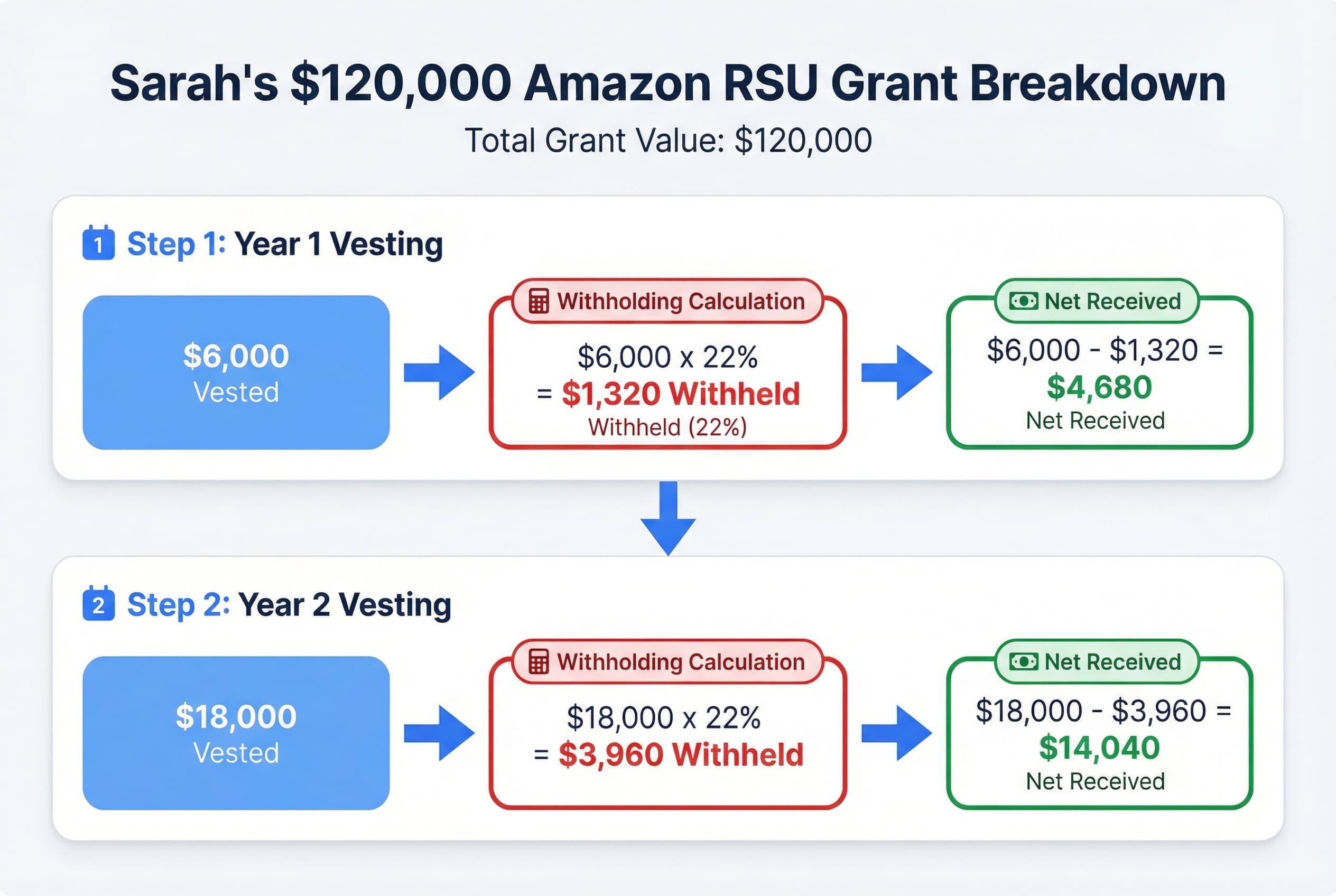
Sarah receives an initial RSU grant worth $120,000 total value spread over 4 years. Unlike many tech companies, Amazon uses a backloaded vesting schedule: 5% in Year 1, 15% in Year 2, 40% in Year 3, and 40% in Year 4. This means most of the value comes in the later years.
Year 1: After her 12-month cliff, Sarah vests 5% of her grant = $6,000 worth of shares. At the 22% default withholding rate, Amazon withholds $1,320 for taxes. Sarah receives shares worth approximately $4,680.
Year 2: She vests 15% = $18,000. With 22% withheld ($3,960), she receives shares worth approximately $14,040.
Year 3: Now the backloading kicks in. She vests 40% = $48,000. After 22% withholding ($10,560), she receives shares worth approximately $37,440.
Year 4: The final 40% vests = $48,000. After the same 22% withholding ($10,560), she receives approximately $37,440.
Note that Amazon typically provides signing bonuses in Years 1 and 2 (often $50,000-$200,000 depending on level) specifically to offset the low early vesting. Sarah's total compensation would include base salary (capped at $350,000) plus these bonuses.
The 22% default withholding may be insufficient if Sarah's total income pushes her into higher tax brackets - she can adjust this rate to avoid owing taxes at year-end.
After Year 4, Sarah will experience an "income cliff" unless she receives refresher grants, which Amazon awards annually and typically vest faster than the initial grant.
Amazon employees often stumble with their equity compensation despite generous grants. Here are key mistakes to avoid:
Your initial RSU grant has a 12-month cliff, meaning nothing vests until you've completed your first year. Leaving before this milestone means forfeiting your entire equity package - a costly mistake given typical grants exceed $30,000 in annual value for technical roles.
Amazon withholds 22% by default for federal taxes on RSU vesting, but this is often insufficient for higher earners who may face rates up to 37%. Many employees are caught off-guard by unexpected tax bills at year-end. While you can adjust your withholding rate, you'll need to plan for quarterly estimated tax payments to avoid penalties.
Amazon's compensation structure relies heavily on equity, creating significant concentration risk. The backloaded vesting schedule (5-15-40-40) intensifies this problem in years three and four when 80% of your grant vests. Failing to diversify as shares vest can leave your financial future overly dependent on a single stock's performance.
The backloaded schedule creates a dramatic income drop when your initial four-year grant completes - unless you've received refresher grants. Many employees don't plan for this compensation cliff, creating unexpected budget pressure.
Understanding what happens to your equity compensation when leaving Amazon is crucial for financial planning. Here's what you need to know:
All unvested RSUs are forfeited upon termination, regardless of whether you leave voluntarily or involuntarily. This is particularly important at Amazon given the backloaded vesting schedule (5-15-40-40), where 80% of your initial grant vests in years three and four. Leaving before completing the full four-year vesting period means losing a significant portion of your equity.
Your termination date relative to Amazon's quarterly vesting dates (February 21, May 21, August 21, and November 21) can significantly impact your final payout. RSUs only vest if you're employed on the actual vesting date. Leaving even one day before a scheduled vesting date means you forfeit that tranche entirely.
While Amazon offers both ISOs and NSOs, specific post-termination exercise windows aren't publicly disclosed in standard documentation. Consult your stock option agreement or HR for details on how long you have to exercise vested options after departure.
Once RSUs vest, they're yours to keep. You'll retain ownership of any shares that vested before your termination date, though you'll remain subject to Amazon's trading windows and insider trading policies when selling.
Important: Review your specific grant agreements and consult with HR or a financial advisor before making any termination decisions, as the financial impact can be substantial.
This content is for educational purposes only and does not constitute financial advice. The information provided is general in nature and may not appl...
YourEmployeeStock.com is not a registered investment advisor.
Helpful videos explaining Amazon equity compensation, vesting, and tax strategies.
Amazon RSUs Explained: Maximize Wealth, Minimize Taxes
Navigating Your AMAZON RSUs: New 25% Cash Option
Amazon uses a backloaded 5-15-40-40 vesting schedule over 4 years with a 1-year cliff. You'll receive 5% after year 1, 15% after year 2, then 40% in each of years 3 and 4. RSUs vest quarterly (typically in February, May, August, and November), meaning most of your equity compensation arrives in the final two years.
Amazon typically offers 2 years of signing bonuses (ranging from $50k-$200k+ depending on level and role) paid in two installments during years one and two. These bonuses are designed to offset the low RSU vesting in your first two years due to the backloaded 5-15-40-40 schedule, helping to smooth out your total compensation.
Only vested RSUs are yours to keep when you leave Amazon. Any unvested RSUs will be forfeited. Since Amazon's vesting schedule is heavily backloaded with 80% vesting in years 3 and 4, leaving before completing 4 years means giving up a significant portion of your initial grant.
RSUs are taxed as ordinary income at vesting based on the fair market value. Amazon withholds 22% by default for federal taxes, but you can adjust this rate. Higher earners should be aware that 22% may be insufficient, as the supplemental rate can go up to 37%, potentially resulting in additional taxes owed.
No, refresher grants typically vest faster than your initial grant. Amazon awards refresher grants annually (often during Q1 reviews or promotions), and these subsequent grants don't follow the same 5-15-40-40 backloaded schedule, helping to provide more consistent equity compensation after your first few years.
No, Amazon employees are subject to trading windows and cannot sell shares at any time. You must comply with insider-trading window restrictions and blackout periods. Amazon encourages employees to sell RSUs immediately upon vesting to help diversify their investment portfolio and reduce concentration risk.
No, Amazon does not offer a traditional discounted ESPP. While there may be a Direct Stock Purchase Plan (DSPP) available, it does not include the typical discount feature that most tech companies offer in their employee stock purchase programs.
Yes, Amazon matches 50% of your contributions up to 4% of eligible pay. The company match vests after 3 years of vesting service (defined as 1,000 hours per calendar year). Amazon also allows mega backdoor Roth conversions through after-tax contributions of up to 90% of eligible pay, subject to IRS limits.
Get a free personalized analysis from our equity compensation experts

