Free equity analysis
Complete guide to understanding your Target equity compensation, including RSU, ESPP, vesting schedules, and tax strategies.
Stock Price
$154.40
Closing price · Sep 15, 2026
Employees
409K
Worldwide
Equity Programs
2
programs
Vesting Period
4 years
RSU vesting
Closing price · Sep 15, 2026
Target offers 2 equity compensation programs to employees. Click on each program to learn more about eligibility, vesting, and tax implications.
Target RSUs vest on a 4-year vesting, 25% vests in the 1st-YR, 25% vests in the 2nd-YR, 25% vests in the 3rd-YR, and 25% vests in the 4th-YR OR 3 years of service with minimum performance target OR quarterly vesting after cliff schedule with a 12-month cliff.
Example calculation based on 100 shares:
| Year | Vesting % | Shares Vesting | Estimated Value |
|---|---|---|---|
| Year 1 | 25% | 25 | $3,860 |
| Year 2 | 25% | 25 | $3,860 |
| Year 3 | 25% | 25 | $3,860 |
| Year 4 | 25% | 25 | $3,860 |
| Total | 100% | 100 | $15,440 |
* Based on Target stock price of $154.40 as of Sep 15, 2026. Actual values will vary.
25%
25 shares
$3,860
25%
25 shares
$3,860
25%
25 shares
$3,860
25%
25 shares
$3,860
Target vesting schedule based on 100 total shares
Target offers equity compensation as a meaningful component of total rewards for eligible employees, primarily through Restricted Stock Units (RSUs) and an Employee Stock Purchase Plan (ESPP). As one of the nation's largest retailers with over 409,000 employees, Target uses equity compensation to align employee interests with company performance and long-term growth.
Restricted Stock Units (RSUs) represent the core of Target's equity program. These are company shares granted to you that convert to actual stock once they vest. Unlike stock options, RSUs have value even if the stock price fluctuates, making them a more straightforward form of equity compensation.
The Employee Stock Purchase Plan (ESPP) allows you to purchase Target stock at a 15% discount with a lookback feature, meaning you get the lower price between the offering period start and purchase date. The plan has a 12-month offering period and allows contributions up to $25,000 annually.
Target's RSU vesting typically follows a 4-year schedule with 25% vesting each year, though there are variations including performance-based vesting after 3 years of service. Most grants include a one-year cliff, meaning your first shares vest after 12 months of service, with quarterly vesting thereafter. Vesting occurs on the last day of each fiscal quarter (January, April, July, and October).
This structure rewards both immediate contribution and long-term commitment, helping you build meaningful ownership in Target's success over time.
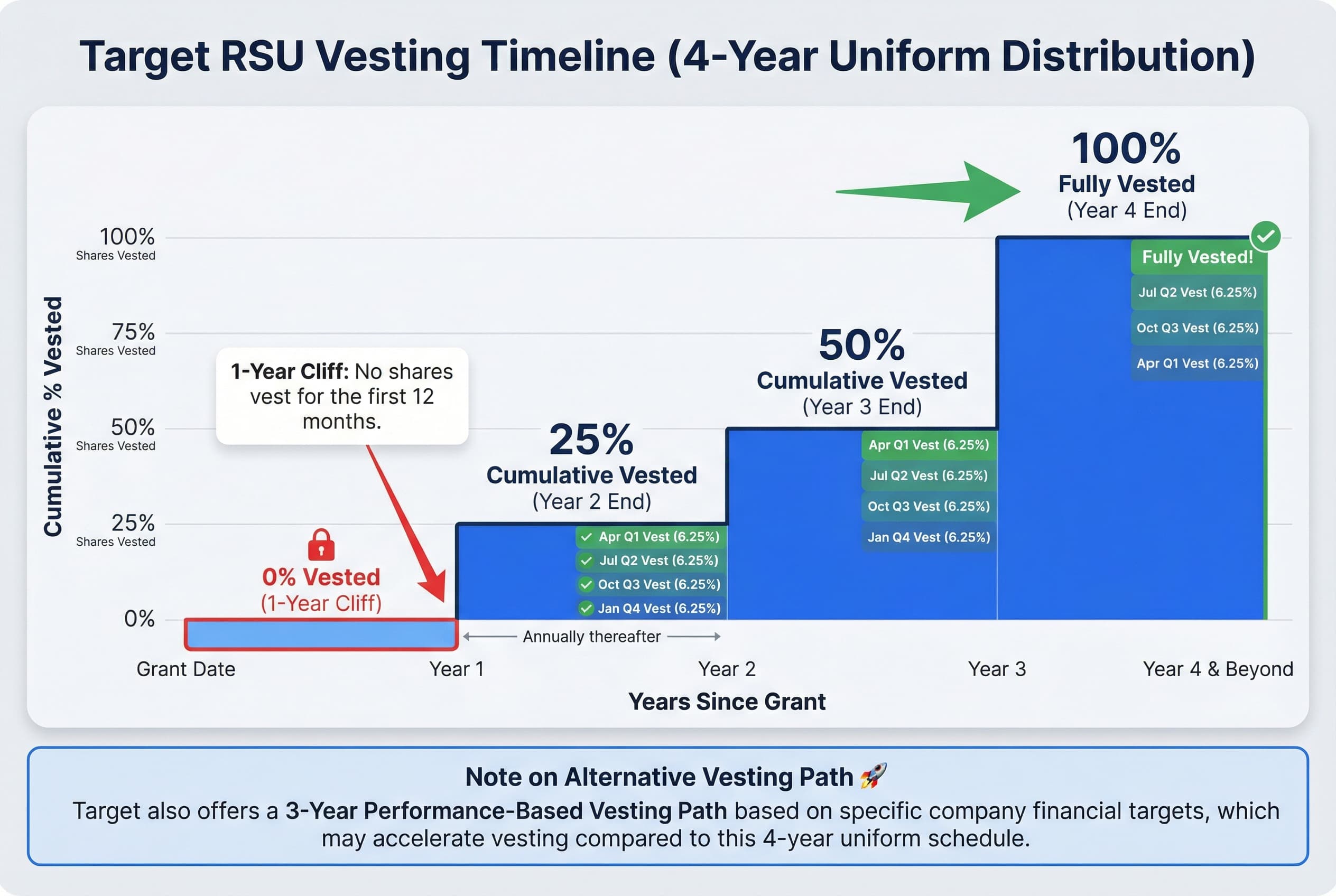
Target uses a 4-year vesting schedule for Restricted Stock Units (RSUs), structured as a uniform distribution with a one-year cliff. This means your equity grants vest evenly over the four-year period, with specific requirements you need to meet before receiving any shares.
Target's RSU vesting follows a straightforward pattern: 25% of your grant vests each year over four years. This uniform distribution means you'll receive an equal portion of your equity annually, rather than having vesting accelerate or slow down over time.
The vesting occurs quarterly on the last day of each fiscal quarter - specifically in April, July, October, and January. After your initial cliff period, you'll see shares vest four times per year on these dates.
During your first year at Target, no shares vest. This is called the "cliff period," and it's a standard practice in equity compensation. You must remain employed for the full 12 months before receiving any portion of your RSU grant. Once you pass this one-year mark, you'll receive your first 25% of shares, followed by quarterly vesting for the remaining three years.
Think of the cliff as a commitment period - if you leave Target before completing one year of service, you forfeit the entire grant. After the cliff, you'll begin receiving shares every quarter as you continue your employment.
Target offers an interesting alternative vesting path: RSUs may vest after 3 years of service if you meet minimum performance targets. This provides some flexibility in how your equity can vest, though the standard 4-year timeline with quarterly vesting after the cliff is the most common structure for general employees.
Since Target's vesting schedule is uniform (25% per year), you won't experience the "golden handcuffs" effect of backloaded schedules where most equity vests in later years. However, remember that vested shares are subject to tax withholding, and the default 22% federal withholding rate may not cover your full tax liability depending on your total income.
Note: Information about refresher grants - additional equity awards given to existing employees - was not available in the company data.
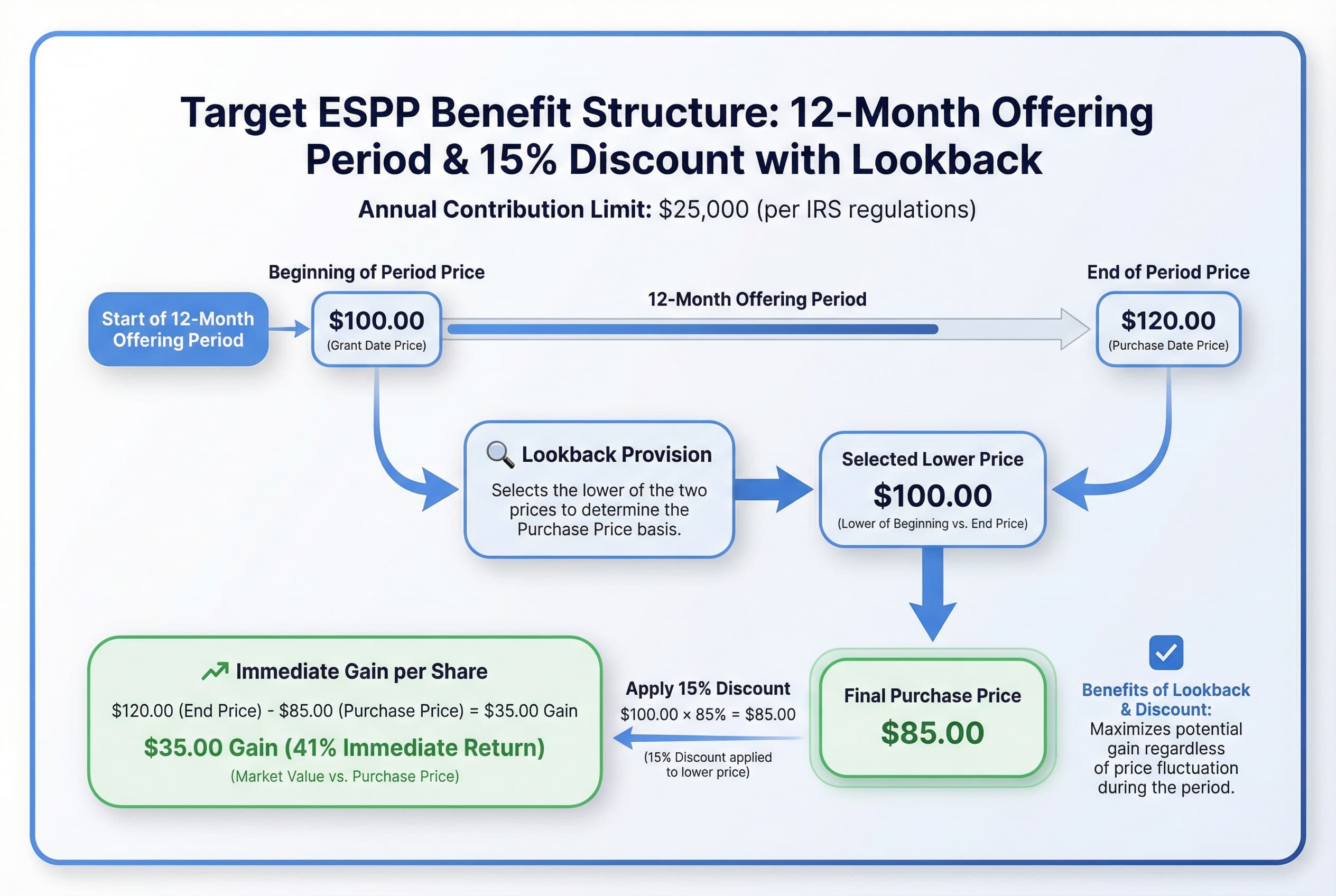
Target offers an Employee Stock Purchase Plan that provides team members with an attractive opportunity to build ownership in the company at a discount. The plan offers a 15% discount on Target stock, allowing you to purchase shares at below-market prices.
Target's ESPP includes a lookback provision, which can significantly enhance your potential returns. With this feature, the purchase price is calculated using the lower of two stock prices: the price at the beginning of the 12-month offering period or the price at the end of the period. This means if Target's stock price increases during the offering period, you'll purchase shares at the earlier, lower price - and still receive the 15% discount on top of that.
The ESPP operates on a 12-month offering period. You can contribute up to $25,000 annually to the plan, allowing you to maximize your discounted stock purchases within IRS limits. The combination of the lookback provision and 15% discount can result in substantial immediate gains, especially in rising market conditions.
How you're taxed on ESPP shares depends on when you sell them. A qualifying disposition occurs when you hold shares for more than one year after the purchase date and more than two years after the offering date. This allows favorable long-term capital gains treatment on a portion of your profit. A disqualifying disposition happens when you sell before meeting both holding periods, resulting in ordinary income tax on the discount and any appreciation during the offering period.
The ESPP can be a powerful wealth-building tool, particularly when the lookback provision is in effect during periods of stock price appreciation. Consider your personal financial situation and tax implications when deciding how much to contribute and when to sell your shares.
Target offers a competitive 401(k) plan with an attractive employer match to help you build long-term wealth. Understanding these benefits can significantly impact your retirement savings strategy.
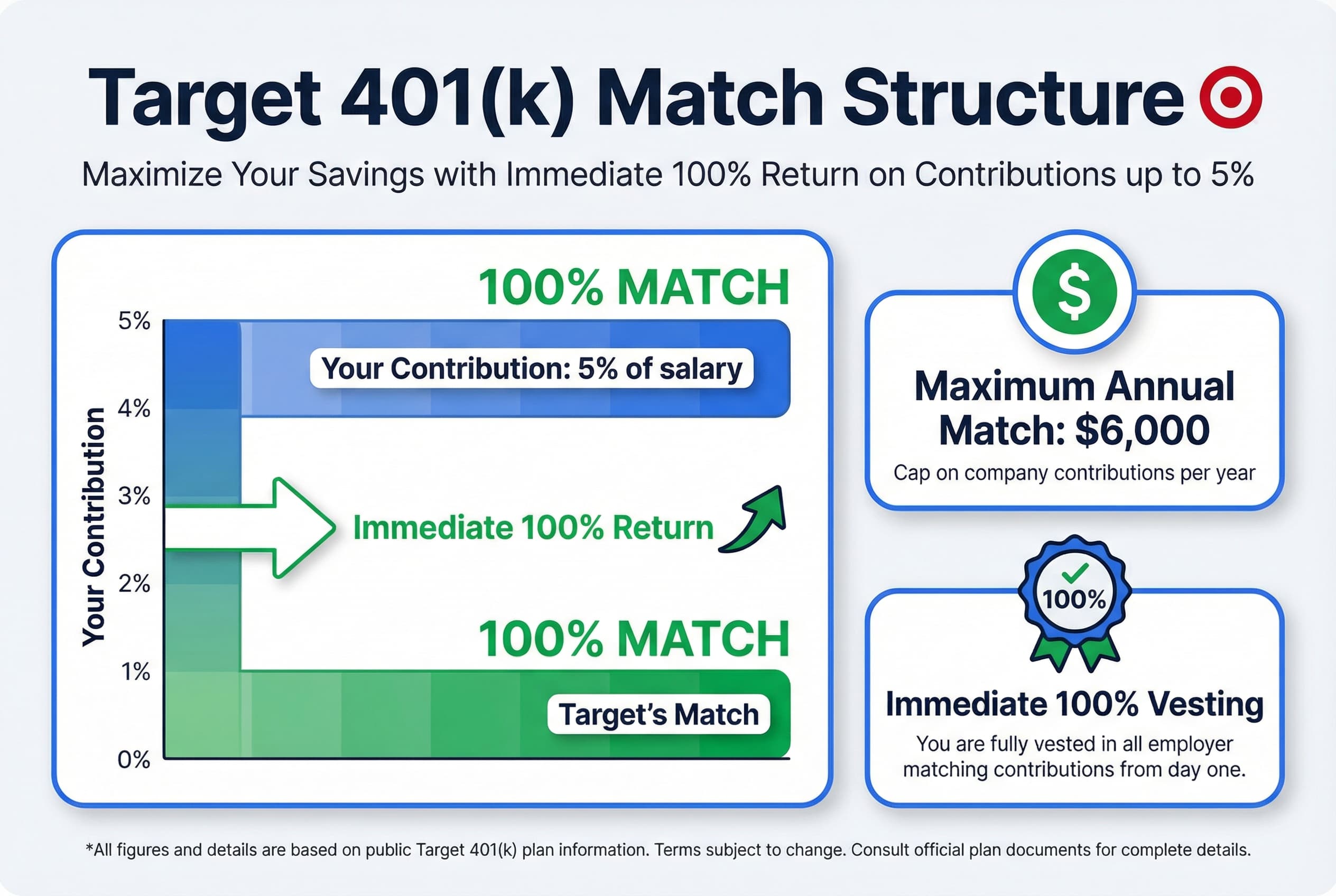
Target provides a 100% match on up to 5% of your salary contributions, with a maximum annual match of $6,000. This means if you contribute 5% or more of your salary to your 401(k), Target will match dollar-for-dollar up to that limit. This is one of the most generous match structures in the retail industry, effectively providing an immediate 100% return on your contributed dollars.
One of the standout features of Target's 401(k) is immediate 100% vesting of employer match contributions. Unlike many companies that require you to stay for several years before you own the match, Target's contributions are yours right away. This provides flexibility and security, especially valuable if you're earlier in your career.
Target's 401(k) plan supports both traditional pre-tax and Roth 401(k) contributions, giving you flexibility in your tax planning strategy. Additionally, the plan allows after-tax contributions and supports mega backdoor Roth conversions. This advanced feature enables high earners who max out standard 401(k) limits to contribute significantly more to tax-advantaged retirement accounts - potentially adding tens of thousands of additional dollars annually to your retirement savings in a Roth format.
These features make Target's 401(k) plan particularly valuable for employees focused on maximizing their retirement savings potential.
Understanding the tax treatment of your equity compensation is crucial for effective financial planning. Here's what Target employees need to know about taxes on RSUs and ESPP shares.
Restricted Stock Units (RSUs): You owe taxes at vesting, not when you sell. When your RSUs vest (quarterly on the last day of each fiscal quarter: April, July, October, and January), the shares convert to actual stock and become taxable as ordinary income based on their fair market value that day.
ESPP Shares: Taxes depend on how long you hold the shares. If you sell immediately after purchase, you'll owe ordinary income tax on the discount (15% at Target). For qualified dispositions - holding shares more than 1 year after purchase AND more than 2 years after the offering date - you may receive more favorable tax treatment.
Target's default withholding rate for RSUs is 22%, though the supplemental rate can reach 37% for high earners. This creates a common "gap" problem: if you're in a higher tax bracket, the 22% withheld may not cover your full tax liability. You can adjust your withholding rate, but many employees are surprised by additional taxes owed at year-end.
RSU value at vesting is taxed as ordinary income at your regular tax rate. Any subsequent gain (or loss) when you sell the shares is treated as capital gains. If you hold shares for more than one year after vesting, gains qualify for long-term capital gains rates, which are typically lower than ordinary income rates.
Target is headquartered in Minnesota, which has a top state income tax rate exceeding 9%. Minnesota residents will owe state taxes on RSU income at vesting and may face additional state tax obligations. If you relocate after receiving a grant, complex sourcing rules may apply.
Important Disclaimer: This information is educational only and not tax advice. Tax situations vary based on individual circumstances, income level, and state of residence. Always consult a qualified tax professional or CPA to understand your specific tax obligations.
When you receive equity compensation from Target, it's exciting to build ownership in your company. However, concentrating too much of your wealth in a single stock - even one you know well - creates significant financial risk.
Your financial situation is already tied to Target through your paycheck, benefits, and career advancement. If the company faces challenges, you could simultaneously experience job insecurity and declining stock value. This "double exposure" means both your income and investments are vulnerable to the same risks.
Target operates in the highly competitive retail sector, which faces unique pressures including:
These industry dynamics can create stock volatility that affects your net worth if you're overconcentrated.
Financial advisors commonly recommend limiting any single stock to 10-20% of your total net worth. As your RSUs vest quarterly and ESPP shares accumulate, regularly review your portfolio allocation. Consider selling vested shares systematically to fund diversified investments across different sectors, asset classes, and geographies.
Remember: diversification isn't about lacking confidence in Target - it's about building financial resilience regardless of any single company's performance.
Target RSUs vest quarterly over four years, with 25% vesting after your first-year cliff. Each vesting event creates a decision point. Consider selling some shares when they vest if Target stock represents more than 10-15% of your total investment portfolio. This is particularly important in retail, where company performance can be cyclical and tied to consumer spending patterns.
Working at Target means your salary, career growth, and equity compensation are all tied to retail sector performance. If the retail industry faces headwinds, you could experience both job insecurity and declining stock value simultaneously. This concentration risk makes diversification especially important - consider whether holding significant Target stock alongside your paycheck creates too much exposure to a single company and sector.
Target's ESPP offers a 15% discount with a lookback provision, providing built-in gains. To maximize tax benefits, hold ESPP shares for more than one year after purchase and more than two years after the offering date to qualify for favorable long-term capital gains treatment. However, this strategy requires holding retail stock through market volatility, so balance tax savings against concentration risk.
RSUs vest quarterly after your one-year cliff, becoming a regular component of your compensation. Factor this into your financial planning, but remember that vested shares are taxed at a 22% default rate (or 37% supplemental rate), which may not cover your full tax obligation. Adjust your W-4 withholding or set aside additional funds to avoid surprises.
Target's trading policy restricts transactions during certain periods. While specific 10b5-1 plan availability isn't detailed in company materials, these plans - if offered - can help you execute pre-planned trades during blackout periods, providing more flexibility for systematic diversification.
Let's walk through a realistic example of how Restricted Stock Units (RSUs) vest at Target.
Sarah, a mid-level employee at Target, receives a grant of 400 RSUs when she joins the company. At the time of grant, Target stock trades at $150 per share, making her total grant worth $60,000.
Target uses a 4-year vesting schedule with 25% vesting each year, distributed quarterly after a 1-year cliff:
Year 1: After 12 months, Sarah's first 25% vests (100 shares). These shares vest quarterly on the last day of Target's fiscal quarters (April, July, October, and January). Assuming the stock price is now $160 per share, this vesting is worth $16,000.
Tax Withholding: Target withholds 22% for taxes by default, which equals $3,520. This means Target keeps approximately 22 shares to cover the tax bill, and Sarah receives 78 shares (worth $12,480).
Years 2-4: Each subsequent year, another 25% (100 shares) vests quarterly following the same pattern. If the stock price rises to $170 in Year 2, that vesting would be worth $17,000, with $3,740 withheld for taxes.
By the end of four years, Sarah will have received all 400 shares (minus shares withheld for taxes). If stock prices averaged $165 across all vesting events, her total value would be approximately $66,000, with about $14,520 withheld for federal taxes.
The 22% withholding may not cover Sarah's full tax obligation, especially if she's in a higher tax bracket. She should plan to set aside additional funds to cover any tax shortfall when filing her annual return.
Target employees often miss opportunities or encounter pitfalls with their equity benefits. Here are the most frequent mistakes to avoid:
Target RSUs have a 12-month cliff, meaning nothing vests until you've completed your first year. Many employees leave before this milestone, forfeiting their entire grant. Mark your anniversary date and understand that quarterly vesting only begins after this initial period.
When your RSUs vest, Target withholds at a 22% default rate for federal taxes. However, depending on your total income, you may owe significantly more - potentially up to the 37% supplemental rate. This gap can create a surprise tax bill in April. Consider adjusting your withholding rate or setting aside additional funds for quarterly estimated tax payments.
As RSUs vest quarterly (in April, July, October, and January), many employees accumulate substantial Target stock positions. Holding too much of your net worth in your employer's stock creates significant risk. Consider diversifying by selling vested shares and reinvesting across different assets.
Target's Employee Stock Purchase Plan offers a 15% discount with a lookback provision, yet many employees don't participate. This benefit provides an immediate return on your contribution - essentially free money up to the annual contribution limit.
Plan proactively around vesting dates and tax obligations to maximize the value of your Target equity compensation.
Understanding what happens to your equity compensation when you leave Target is crucial for making informed career decisions.
Any unvested RSUs are forfeited upon termination. Target's RSUs typically vest over four years (25% annually) with quarterly vesting after a one-year cliff. Vesting occurs on the last day of each fiscal quarter (April, July, October, and January). This means your termination date matters significantly - leaving just before a vesting date means you'll forfeit those shares that were about to vest.
If you hold stock options at Target, you'll generally have 90 days after termination to exercise any vested options. Any unvested options are forfeited immediately upon departure. Options expire after 10 years from grant, but the post-termination exercise window is much shorter, so act quickly if you plan to exercise.
If you leave Target mid-offering period, your ESPP participation typically ends. The treatment of accumulated contributions varies - generally, you may either receive a refund of your contributions or have them applied to purchase shares at the next scheduled purchase date, depending on the timing of your departure and plan rules.
Based on available information, Target's standard equity forfeiture rules apply regardless of whether your departure is voluntary or involuntary, though specific circumstances may vary. Always review your grant agreements and consult HR for your specific situation.
This content is for educational purposes only and does not constitute financial advice. The information provided is general in nature and may not appl...
YourEmployeeStock.com is not a registered investment advisor.
Target RSUs typically vest over 4 years with 25% vesting each year. There's a 1-year cliff, meaning your first 25% vests after one year of service, then the remaining shares vest quarterly on the last day of each fiscal quarter (April, July, October, and January). Some grants may have alternative vesting based on 3 years of service with minimum performance targets.
After your initial 1-year cliff, your RSUs vest quarterly on specific dates: the last day of April, July, October, and January in each fiscal year. These dates align with Target's fiscal quarters, so mark your calendar for these months to track when shares become yours.
Target's default tax withholding rate for RSUs is 22%, though you can adjust this if needed. Keep in mind that this withholding may not cover your full tax liability, especially if you're in a higher tax bracket—the supplemental rate can go up to 37% for high earners.
Target's ESPP offers a 15% discount on company stock and includes a lookback provision, allowing you to purchase shares at the lower price between the offering period start and end dates. The offering period is 12 months, and you can contribute up to $25,000 per year to maximize your benefit.
If you leave Target, you typically have 90 days after your termination date to exercise any vested stock options. Options expire after 10 years from the grant date, so plan accordingly if you're considering leaving the company.
You must comply with Target's trading policy, which may restrict trading during certain blackout periods throughout the year. Check with your stock plan administrator or HR about current trading windows before attempting to sell your shares.
To qualify for favorable tax treatment on ESPP shares, you must hold them for more than 1 year after the purchase date AND more than 2 years after the offering date. Meeting these requirements allows you to potentially pay long-term capital gains rates on a portion of your profit instead of ordinary income rates.
Target offers a generous 401(k) match of 100% on the first 5% of your contributions (up to $6,000 maximum), and it vests immediately. This is separate from your equity compensation but is an important part of your total compensation package—consider maximizing both your ESPP and 401(k) contributions for optimal financial benefits.
Get a free personalized analysis from our equity compensation experts

