Free equity analysis
Complete guide to understanding your Broadcom equity compensation, including RSU, ISO, NSO, ESPP, vesting schedules, and tax strategies.
Employees
38K
Worldwide
Equity Programs
4
programs
Vesting Period
4 years
RSU vesting
Broadcom offers 4 equity compensation programs to employees. Click on each program to learn more about eligibility, vesting, and tax implications.
Standard RSU program with 4-year vesting and 1-year cliff. Annual refresh grants available for eligible employees.
Learn about Broadcom's Incentive Stock Options program, including vesting schedules and tax treatment.
Learn about Broadcom's Non-Qualified Stock Options program, including vesting schedules and tax treatment.
Learn about Broadcom's Employee Stock Purchase Plan program, including vesting schedules and tax treatment.
Broadcom offers a comprehensive equity compensation package designed to align employee interests with long-term company performance. As a semiconductor industry leader, the company provides several equity vehicles including Restricted Stock Units (RSUs), Performance Stock Units (PSUs), Stock Options (both ISOs and NSOs), and an Employee Stock Purchase Plan (ESPP).
Equity compensation represents a significant portion of total compensation at Broadcom, particularly for technical roles. With Broadcom's stock performance and position in the semiconductor industry, equity awards can substantially enhance your overall earnings beyond base salary. The company structures compensation to retain talent through multi-year vesting schedules, creating what some call "golden handcuffs" that reward employees who grow with the company.
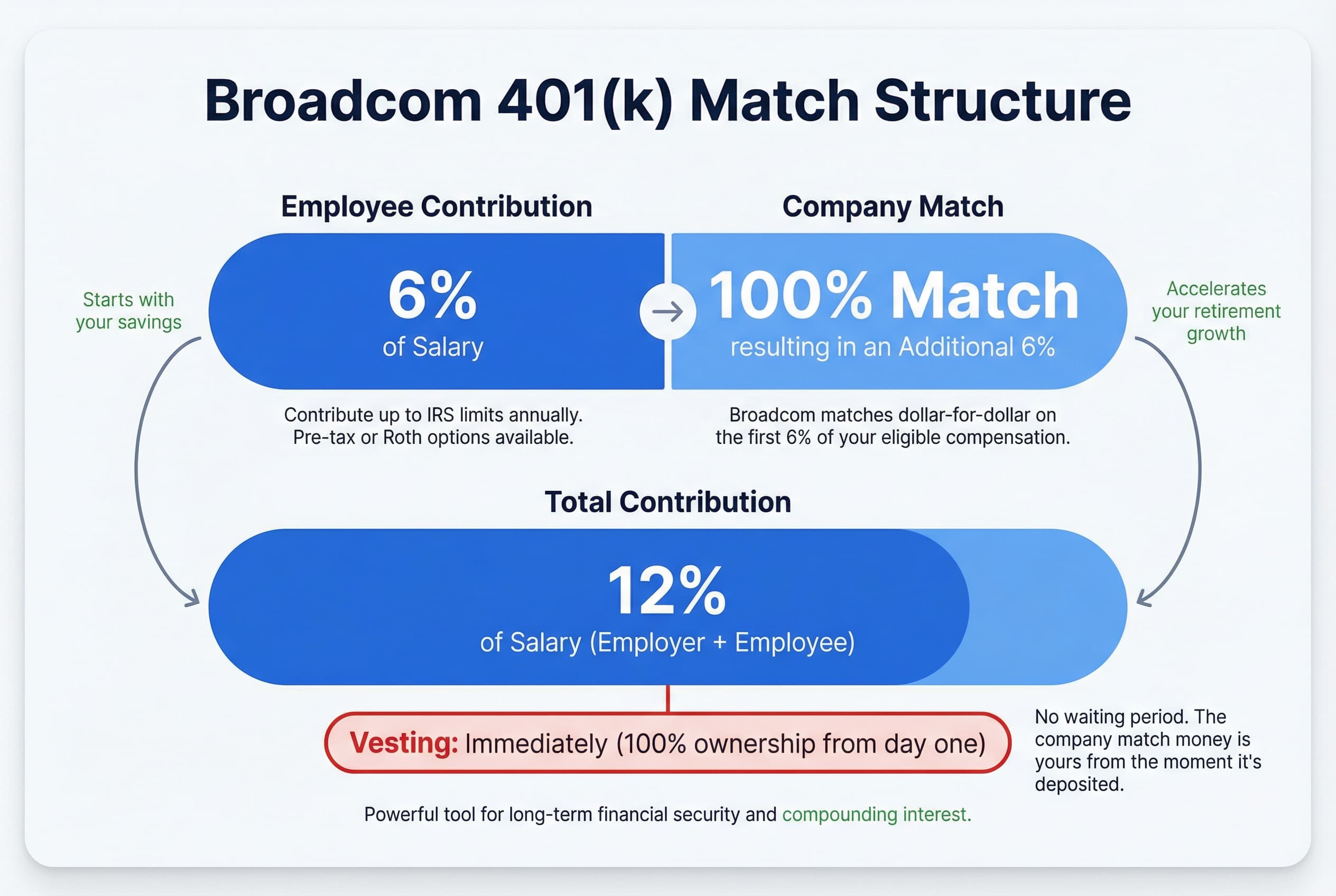
Most RSU grants follow a 4-year vesting schedule with either quarterly or annual installments in equal portions (25% per year). Quarterly vesting typically occurs on specific dates throughout the year, providing regular equity income. Broadcom provides annual refresher grants to ensure ongoing equity participation, with multi-year grants that vest over both the current and following year.
The ESPP offers a compelling benefit with a 15% discount and a 6-month lookback provision, allowing you to purchase stock at the lower price between the enrollment date and purchase date during semi-annual periods.
Important note: Unvested RSUs are forfeited entirely upon termination without acceleration, making it crucial to understand your vesting timeline when making career decisions.
Broadcom's equity compensation follows a 4-year vesting schedule with equal distribution across the vesting period, making it a uniform structure without front-loading or back-loading. This straightforward approach applies to both RSUs and stock options, though the specific vesting frequency can vary depending on your grant type.
Most Broadcom employees receive RSUs that vest quarterly over four years, with 25% of the total grant vesting each year. This breaks down to 6.25% of your total grant vesting every quarter. Some grants may vest annually instead, with a full 25% vesting once per year. The company has established specific vesting dates throughout the year, with some grants vesting on March 15, June 15, September 15, and December 15, while others follow a pattern of February 5, May 5, August 5, and November 5.
Notably, Broadcom's standard RSU grants do not include a cliff period. This means you begin vesting equity from your first vesting date, rather than waiting a full year before receiving any shares. This is different from many tech companies that require a one-year cliff before any equity vests.
Broadcom takes a distinctive approach to refresher grants by providing multi-year stock grants that ensure coverage for both the current and following year. These refreshers are distributed annually and vest in equal portions following the same 4-year schedule as initial grants. For example, employees at the IC5 level have historically received refresher grants in the $200,000 to $400,000 range, though the exact amount varies by performance and role.
An important consideration: in some cases, refresher units were locked for two years, which allowed employees to benefit significantly from stock price appreciation during that period.
Remember that at Broadcom, unvested RSUs are forfeited entirely upon termination without acceleration, making it crucial to understand your vesting schedule and the value at risk. Additionally, offers are made in RSU units rather than dollar values, so the actual value of your grant will fluctuate with Broadcom's stock price.
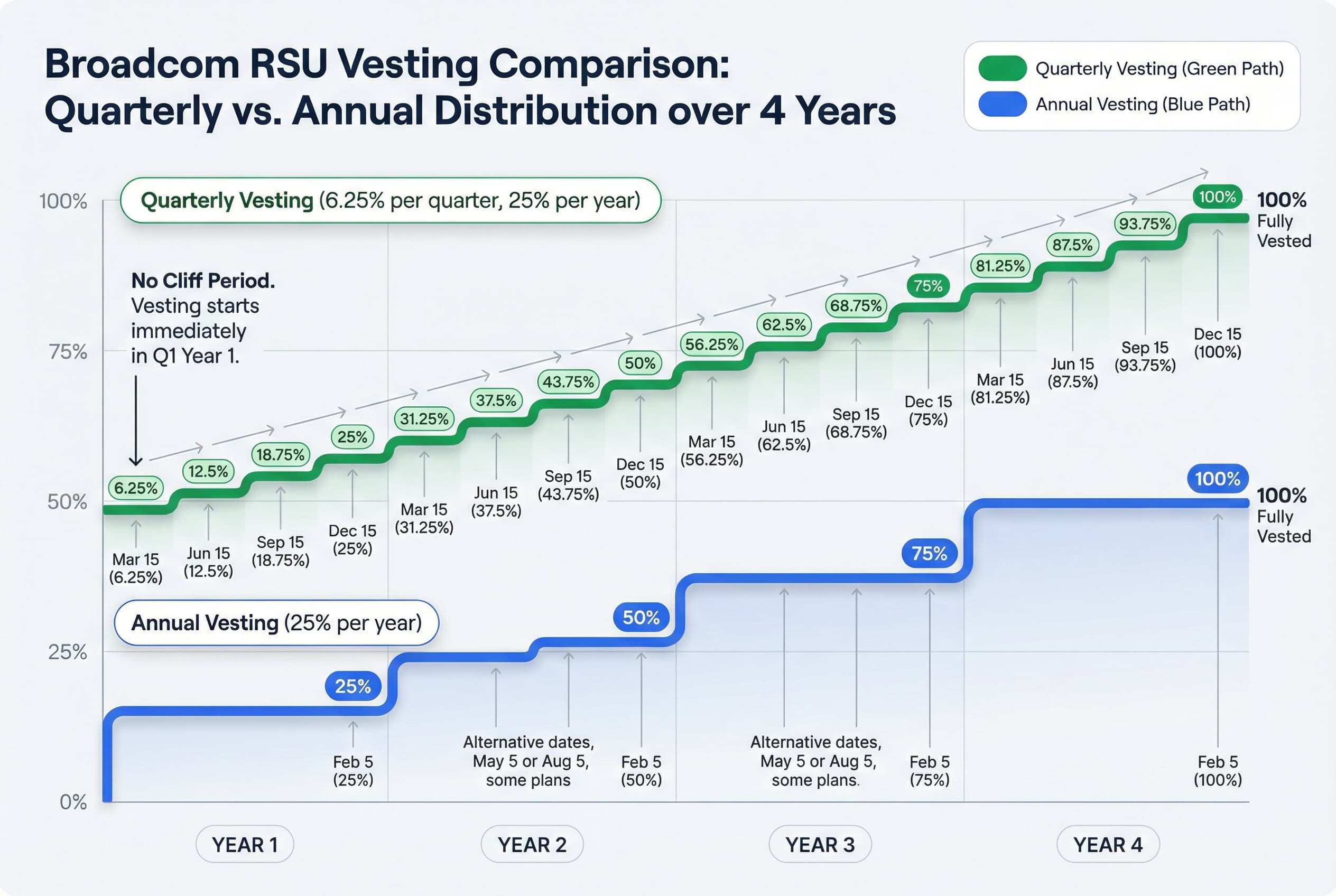
Broadcom offers a compelling ESPP that allows employees to purchase company stock at a significant discount. The plan provides a 15% discount and includes a 6-month lookback provision, creating substantial opportunities for returns.
The ESPP operates on 6-month offering periods beginning March 15 and September 15. Each offering period is also a purchase period, meaning you contribute throughout the 6 months and purchase shares at the end. The lookback provision is particularly valuable - your purchase price is based on whichever stock price is lower: the price at the beginning of the offering period or the price at the end. You then receive an additional 15% discount on that lower price.
You can contribute up to 10% of your eligible compensation, subject to a $25,000 annual maximum based on the fair market value of shares purchased. Enrollment windows open in March and September, coinciding with the start of each offering period.
The combination of the lookback provision and 15% discount can generate impressive returns. If Broadcom's stock price increases during the 6-month period, you benefit from purchasing at the lower starting price with the discount applied. Even if the stock price remains flat or decreases, you still receive the 15% discount.
To receive favorable long-term capital gains treatment (a qualifying disposition), you must hold the shares for at least two years from the offering period start date and one year from the purchase date. Selling before these thresholds results in a disqualifying disposition, where the discount is taxed as ordinary income.
The ESPP purchases occur semi-annually at the end of each 6-month period, providing regular opportunities to acquire Broadcom stock at a discount.
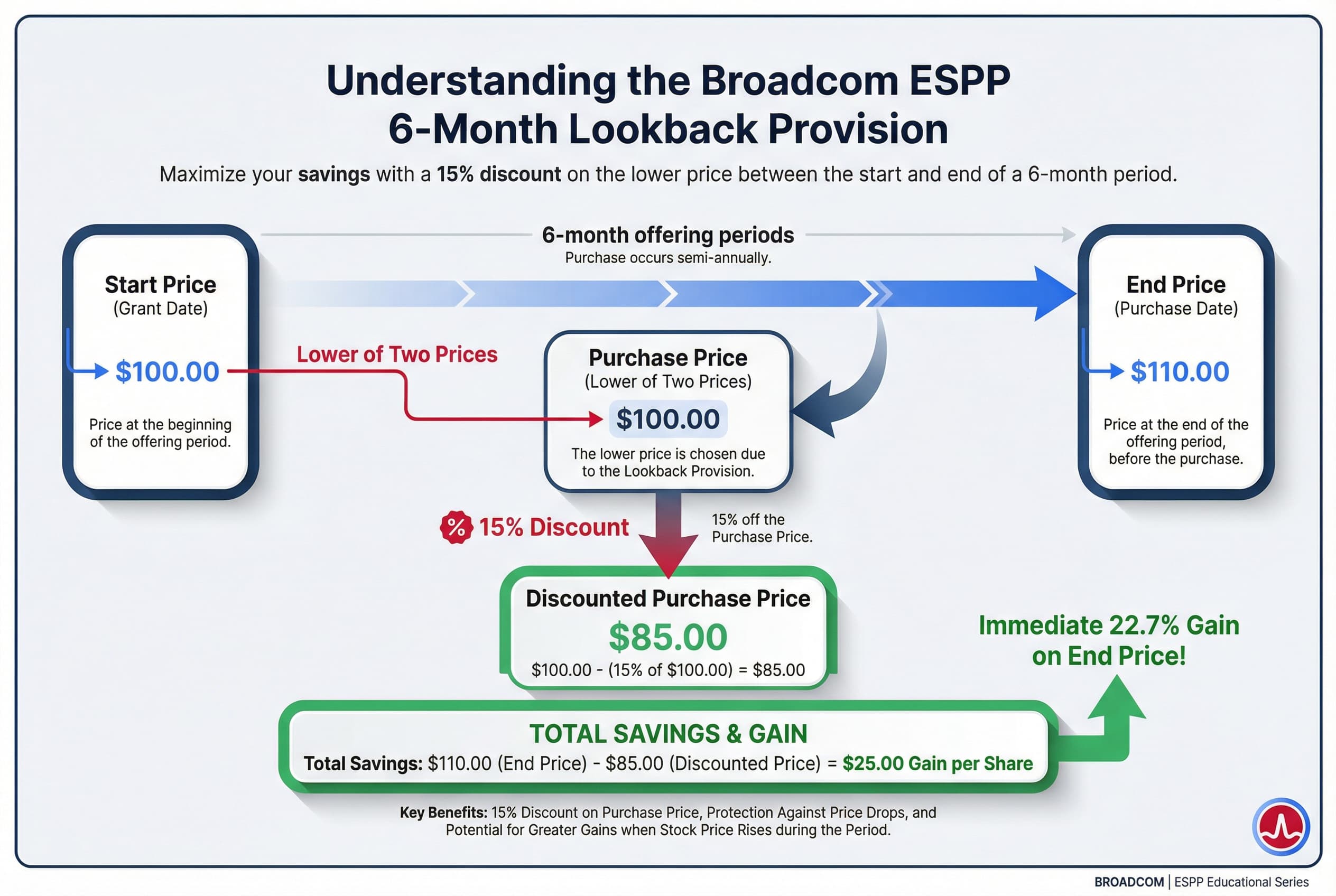
Broadcom offers a competitive 401(k) retirement savings plan with several valuable features for employees looking to maximize their retirement contributions.
Broadcom provides a 100% match on up to 6% of your salary. This means if you contribute 6% of your eligible compensation to your 401(k), the company will contribute an additional 6%, effectively doubling your retirement savings on that portion. The matching contributions vest immediately, which is a significant advantage - you have full ownership of the company match from day one, regardless of how long you stay with Broadcom.
The plan offers flexibility with multiple contribution types:
Broadcom supports the mega backdoor Roth strategy, allowing you to make after-tax contributions and potentially convert them to Roth savings. This advanced strategy can help high earners significantly boost their tax-advantaged retirement savings beyond typical 401(k) limits.
The plan includes BrokerageLink through Fidelity, giving you access to a broader range of investment options beyond the standard 401(k) fund menu. This feature is particularly valuable for employees who want more control over their investment strategy.
With immediate vesting, generous matching, and advanced contribution options, Broadcom's 401(k) plan is a strong component of the overall compensation package.
Understanding the tax treatment of your Broadcom equity awards is essential for effective financial planning. Different award types trigger taxes at different times and rates, which can significantly impact your take-home value.
Restricted Stock Units (RSUs) are taxed as ordinary income when they vest. At Broadcom, with quarterly or annual vesting schedules, each vesting event creates a taxable event. The fair market value of the shares on the vesting date is added to your W-2 income and taxed at your marginal tax rate, which can reach up to 37% federally, plus applicable state taxes.
Broadcom will withhold taxes at vesting, but standard withholding often falls short of your actual tax liability - this is the common "gap" issue. If you're in a higher tax bracket or have significant equity compensation, you may owe additional taxes when filing your return. You can adjust your withholding settings to cover this gap and avoid surprises at tax time.
When you eventually sell vested RSU shares, any gain or loss from the vesting date price is treated as a capital gain or loss. Shares held for more than one year after vesting qualify for long-term capital gains rates (0%, 15%, or 20%), which are generally more favorable than ordinary income rates.
Broadcom grants both Incentive Stock Options (ISOs) and Non-Qualified Stock Options (NSOs). NSOs are taxed as ordinary income on the spread between exercise price and fair market value at exercise. ISOs receive preferential treatment - no ordinary income tax at exercise if held properly - but may trigger Alternative Minimum Tax (AMT). The AMT calculation can be complex and catch employees by surprise, particularly when exercising large ISO grants.
The 15% discount on your Employee Stock Purchase Plan shares is taxed as ordinary income when you sell, with the timing and holding period determining whether you have a qualifying or disqualifying disposition.
California residents (where many semiconductor employees work) face additional state income tax up to 13.3%, significantly increasing your overall tax burden on equity compensation.
Disclaimer: This information is educational only and not tax advice. Tax rules are complex and individual circumstances vary. Consult a qualified tax professional or CPA familiar with equity compensation before making decisions about your Broadcom equity awards.
As a Broadcom employee, your equity compensation can become a significant portion of your wealth - especially with the company's multi-year RSU grants and annual refreshers. While this is exciting, concentrating too much of your net worth in a single stock creates substantial risk, regardless of how strong the company appears.
When your wealth is heavily concentrated in Broadcom stock, your financial security becomes tied to factors beyond your control. Your income, benefits, and equity are all dependent on the same company. If Broadcom experiences challenges, you could face job loss and portfolio decline simultaneously.
The semiconductor industry faces unique volatility from cyclical demand patterns, rapid technological change, geopolitical tensions affecting supply chains, and intense competition. Broadcom's business can be impacted by customer concentration, regulatory scrutiny of acquisitions, and shifts in enterprise spending on infrastructure and networking equipment.
Financial advisors commonly recommend limiting single-stock exposure to 10-20% of your total net worth. Consider diversifying through regular RSU sales at vesting, maximizing your 401(k) contributions (Broadcom offers a generous 100% match on 6% of salary), and building positions in other asset classes.
Remember: Broadcom's unvested RSUs forfeit entirely upon termination without acceleration, making diversification even more critical for protecting your realized gains.
Broadcom employees should evaluate selling vested shares when equity concentration exceeds 15-20% of total net worth. Given the company's quarterly vesting schedule (Feb 5, May 5, Aug 5, Nov 5), consider establishing a systematic selling pattern aligned with these dates. Be mindful of quarterly blackout periods - trading windows open on the third full trading day after earnings releases and close the Friday before the last three weeks of each fiscal quarter.
The semiconductor industry can be volatile, making diversification particularly important. A notable concern: unvested RSUs are forfeited entirely upon termination without acceleration, and promotion velocity slows dramatically when unvested RSUs exceed $2 million. This creates significant concentration risk that warrants proactive portfolio rebalancing as equity accumulates.
ESPP Timing: Broadcom's ESPP offers a 15% discount with a 6-month lookback provision and semi-annual purchase periods (March 15 and September 15). To maximize tax benefits, consider holding shares for at least one year from purchase and two years from the offering period start to qualify for favorable long-term capital gains treatment on the discount portion.
401(k) Coordination: Maximize the immediate 100% match on 6% of salary. Consider after-tax contributions and in-plan Roth conversions (mega backdoor Roth) to build tax-diversified retirement savings alongside equity compensation.
Broadcom offers 10b5-1 plans with a 90-day cooling-off period (maximum 120 days). These automated selling plans allow you to establish predetermined equity sales outside blackout windows, providing both discipline and compliance with insider trading regulations. This can be particularly valuable for managing concentrated positions systematically.
Remember that equity grants are made in units, not dollar values - meaning the number doesn't adjust for stock price changes. View your total compensation holistically, balancing the value of unvested equity against career mobility and financial security needs.
Let's walk through a realistic scenario to see how equity vesting works at Broadcom.
Sarah, an IC5 engineer, receives a refresher grant of 400 RSUs (valued at approximately $400,000 at the time of grant, based on typical IC5 refresher ranges). Her RSUs vest over 4 years on an annual schedule, with 25% vesting each year.
Year 1: On her first vesting date, 100 RSUs vest (25% of 400). At the time of vesting, Broadcom stock is trading at $1,100 per share.
Year 2: Another 100 RSUs vest at $1,200 per share.
Year 3: 100 RSUs vest at $1,150 per share.
Year 4: The final 100 RSUs vest at $1,300 per share.
At each vesting event, Broadcom withholds shares to cover taxes. Assuming a combined federal and state supplemental withholding rate of approximately 37%, here's what happens at the Year 1 vest:
Sarah can adjust her withholding rate if needed, though she should consult a tax advisor to ensure adequate coverage.
At Broadcom, unvested RSUs are forfeited entirely if you leave the company, with no acceleration. This makes understanding your vesting schedule critical for career planning decisions.
Broadcom employees often make avoidable errors with their equity benefits that can cost them significantly. Here are the most common pitfalls:
Many employees hold too much wealth in Broadcom shares, creating excessive risk. With RSUs vesting quarterly and a generous ESPP offering a 15% discount with a 6-month lookback, your portfolio can quickly become dominated by AVGO stock. Diversification is essential - consider selling vested shares systematically to reduce concentration risk.
Broadcom's ESPP is remarkably valuable, offering a 15% discount and lookback provision that purchases shares at the lower price between the offering period's start and end dates. The semi-annual purchase periods begin March 15 and September 15. Missing enrollment windows means leaving guaranteed returns on the table.
RSU vesting creates immediate taxable income, but Broadcom's withholding may not cover your full tax liability, especially if you're in a high tax bracket. This is particularly critical for California residents facing combined federal and state rates exceeding 50%. Plan ahead for quarterly estimated tax payments to avoid penalties.
Unlike many companies, Broadcom doesn't accelerate unvested RSUs upon termination - you forfeit them entirely. This makes understanding your vesting schedule and timing any career moves carefully essential, especially given that promotion velocity reportedly slows when unvested equity exceeds $2 million.
Broadcom's quarterly trading windows close during the final three weeks of each fiscal quarter. Failing to plan sales around these restrictions can leave you unable to diversify or meet tax obligations when needed.
Understanding how your equity is affected when you leave Broadcom is crucial for making informed career decisions.
Unvested RSUs are forfeited entirely upon termination at Broadcom, regardless of whether you resign voluntarily or are terminated involuntarily. There is no acceleration of unvested shares, making this one of the most important considerations when planning your departure. If you have significant unvested equity, the timing of your resignation can have substantial financial implications.
Your termination date directly impacts which RSUs you keep. Only shares that have vested by your last day of employment are yours to retain. Since Broadcom's RSU vesting typically occurs quarterly (on dates like Feb 5, May 5, Aug 5, and Nov 5), leaving just before a vesting date means forfeiting that tranche entirely.
For stock options, Broadcom grants have a 10-year expiration period from the grant date. However, specific post-termination exercise windows aren't clearly defined in standard documentation, so you should review your individual grant agreements or contact HR to understand how long you have to exercise vested options after leaving.
If you leave mid-period during an ESPP offering period, your contributions will typically be returned without completing the purchase. The ESPP operates on 6-month periods (enrolling in March and September), so timing your departure relative to purchase dates affects whether you benefit from that period's discount.
This content is for educational purposes only and does not constitute financial advice. The information provided is general in nature and may not appl...
YourEmployeeStock.com is not a registered investment advisor.
Helpful videos explaining Broadcom equity compensation, vesting, and tax strategies.
VMware – Important Tax Elections & Updates
Help! What To Do About My VMW & AVGO Cost Basis?!
Broadcom RSUs typically vest over 4 years with either quarterly or annual installments in equal portions (25% per year). Common vesting dates are on the 5th of February, May, August, and November, or the 15th of March, June, September, and December depending on your grant. You'll receive your shares in equal increments throughout the vesting period.
If you leave Broadcom, all unvested RSUs are forfeited entirely with no acceleration. This applies whether you resign, are terminated, or leave for any other reason. Only RSUs that have already vested by your departure date will remain yours.
Broadcom's ESPP offers a 15% discount with a 6-month lookback provision. The purchase price is the lower of the stock price at the beginning or end of the 6-month offering period. You can contribute up to 10% of your salary (maximum $25,000 per year), and purchases occur semi-annually on March 15 and September 15.
Broadcom has quarterly trading blackout periods that close on the Friday before the last three weeks of each fiscal quarter and reopen on the third full trading day after earnings are released. Restricted persons must pre-clear all trades, and the company prohibits hedging or pledging of stock unless pre-approved.
Broadcom provides multi-year stock grants annually, with refreshers covering both the current and following year. Refresher grants vest in equal portions over the vesting period. For example, IC5 employees have historically received refreshers in the $200k-$400k range, though the exact amount varies by level and performance.
Broadcom offers a 100% match on the first 6% of your salary contributions to the 401(k). The matching contributions vest immediately with no waiting period. The plan also supports after-tax contributions and offers a mega backdoor Roth option through Fidelity's BrokerageLink.
Broadcom stock options generally vest over 4 years from the grant date and expire 10 years (120 months) after grant. Both ISOs and NSOs are offered, though specific post-termination exercise windows vary by grant and employment agreement.
No, Broadcom offers are made in RSU units, not dollar value. This means the number of units you receive is fixed at the time of your offer and does not adjust if the stock price changes before your grant date or during vesting. The value of your grant will fluctuate with the stock price, but the unit count remains the same.
Get a free personalized analysis from our equity compensation experts

