Free equity analysis
We're still gathering complete information
Some details about Home Depot's equity programs may be incomplete or based on general industry data. We recommend verifying specifics with your official plan documents or HR department.
Complete guide to understanding your Home Depot equity compensation, including RSU, ISO, NSO, ESPP, vesting schedules, and tax strategies.
Equity Programs
4
programs
Vesting Period
N/A
RSU vesting
Home Depot offers 4 equity compensation programs to employees. Click on each program to learn more about eligibility, vesting, and tax implications.
Learn about Home Depot's Restricted Stock Units program, including vesting schedules and tax treatment.
Learn about Home Depot's Incentive Stock Options program, including vesting schedules and tax treatment.
Learn about Home Depot's Non-Qualified Stock Options program, including vesting schedules and tax treatment.
Learn about Home Depot's Employee Stock Purchase Plan program, including vesting schedules and tax treatment.
Home Depot offers a comprehensive equity compensation package designed to align employee interests with company performance and long-term growth. The program includes Restricted Stock Units (RSUs), Performance Stock Units (PSUs), stock options (both Incentive Stock Options and Non-Qualified Stock Options), Restricted Stock Awards (RSAs), and an Employee Stock Purchase Plan (ESPP).
As a leading retail company, Home Depot's equity compensation allows you to share in the company's success as a shareholder. These benefits complement your base salary and can represent significant long-term value, particularly as the company continues to grow its market position in the home improvement sector.
Home Depot uses several vesting structures depending on the award type and your role:
RSUs and Restricted Stock follow custom schedules that may include:
Stock Options typically vest 25% per year starting on the second anniversary of your grant date, with a two-year cliff period.
ESPP allows you to purchase Home Depot stock at a 15% discount with a lookback feature through semi-annual purchase periods in January and July. You can contribute up to 20% of your eligible compensation.
Understanding your specific vesting schedule is important, as unvested equity may be forfeited if you leave the company before vesting occurs.
Home Depot offers multiple vesting schedules depending on the type of equity award and your role within the company. Unlike many tech companies with standard four-year vesting, Home Depot employs several custom vesting structures that are important to understand.
Home Depot provides different RSU vesting schedules, primarily for executive-level employees:
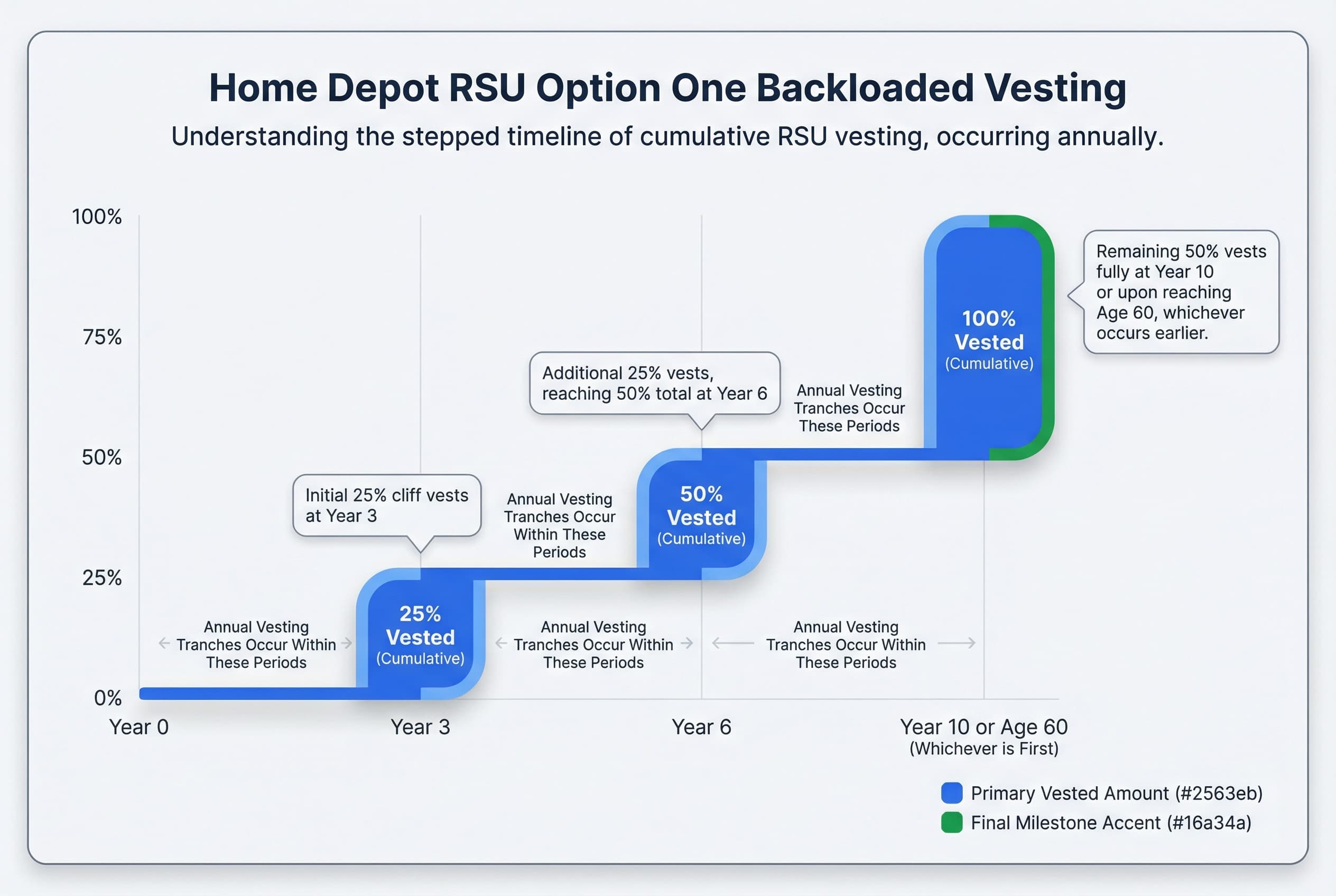
Option One features a unique, backloaded structure: 25% vests at the 3-year mark, another 25% at 6 years, and the remaining 50% vests either at age 60 or at the 10-year anniversary (whichever comes first). This schedule is heavily weighted toward long-term retention.
Option Two offers a simpler structure where 100% of your RSUs vest on either the 3rd, 4th, or 5th anniversary of the grant date, depending on your specific grant terms.
Performance-Based RSUs follow a different timeline entirely: 50% vests at 30 months and the remaining 50% at 60 months, but only if the company meets specific operating profit targets. This means vesting is contingent on both time and company performance.
Additionally, some employees may receive RSUs on a four-year schedule with 50% vesting in year 2 and 50% in year 4, skipping years 1 and 3 entirely.
All RSU vesting occurs annually rather than monthly or quarterly.
Stock options at Home Depot follow a more traditional pattern but with a notable twist: they vest 25% per year, but vesting doesn't begin until the second anniversary of your grant date. This means you have a 24-month cliff period during which no options vest. After that two-year mark, 25% vests immediately, then 25% each subsequent year until fully vested at five years total.
Options expire 10 years from the grant date.
There's no standard "cliff period" for RSUs since the vesting schedules vary significantly. The backloaded nature of several schedules means you'll receive the majority of your equity value only after staying with the company for an extended period. This is particularly true for Option One, where half your grant doesn't vest until year 10 or age 60.
Information about refresher grant policies is not publicly available in company documentation.
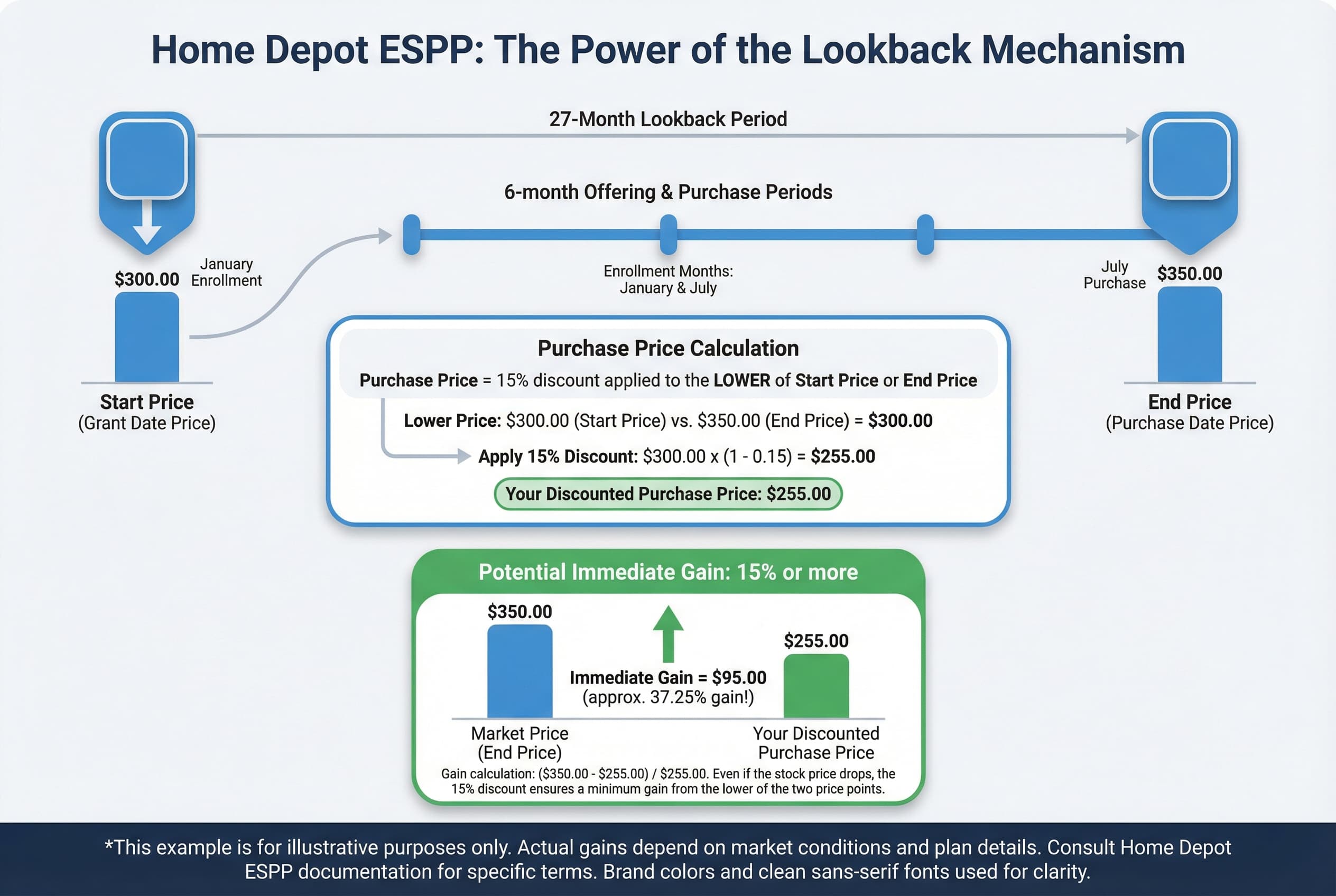
Home Depot offers employees an attractive ESPP that allows you to purchase company stock at a significant discount. The plan provides a 15% discount on the stock price and includes a lookback provision, creating substantial potential returns for participants.
The lookback provision is particularly valuable. With a 27-month lookback period, the plan compares the stock price at the beginning of the offering period to the price at the end of the purchase period. You'll purchase shares at 15% below whichever price is lower. This means if Home Depot's stock rises during the offering period, you benefit from both the lower starting price and the 15% discount - potentially generating immediate gains of 15% or more.
The ESPP operates on 6-month offering and purchase periods, with enrollment windows in January and July. Purchase periods end on December 31 and June 30, respectively, with purchases occurring semi-annually. You can contribute up to 20% of your eligible compensation through payroll deductions, though the plan does not specify a dollar maximum in available documentation.
When you sell your ESPP shares matters for tax purposes. A qualifying disposition occurs if you hold shares for at least 2 years from the offering date and 1 year from the purchase date. This treatment can result in more favorable long-term capital gains tax rates on a portion of your profit. A disqualifying disposition (selling before meeting both holding periods) means the discount is taxed as ordinary income, though any additional gains may still qualify for capital gains treatment.
The combination of the 15% discount and extended lookback provision makes Home Depot's ESPP a compelling benefit worth serious consideration for eligible employees.
Home Depot offers a 401(k) retirement savings plan to help employees build long-term financial security. The plan allows you to contribute on a pre-tax basis, reducing your current taxable income while saving for retirement.
While Home Depot does provide a company match on 401(k) contributions, the specific match percentage and structure are not publicly disclosed. The good news is that employer matching contributions vest immediately (0-year vesting period), meaning you have full ownership of any company match from day one. This is a significant advantage if you change jobs, as you won't lose any matched funds.
Home Depot's 401(k) plan does support after-tax contributions, which can be valuable for high earners who want to save beyond the standard pre-tax contribution limits. After-tax contributions allow you to put additional money into your 401(k) once you've maxed out your regular pre-tax or Roth 401(k) contributions.
Information about whether Home Depot's plan allows for mega backdoor Roth conversions (in-plan Roth conversions or in-service withdrawals of after-tax contributions) is not publicly available. If you're interested in this advanced tax strategy, contact your HR benefits team or the plan administrator to confirm whether this option is available.
For specific details about match percentages, contribution limits, and investment options, consult your benefits enrollment materials or reach out to Home Depot's HR department.
Understanding the tax treatment of your Home Depot equity compensation is crucial for effective financial planning. Different types of awards trigger taxes at different times and rates.
Restricted Stock Units (RSUs): You owe taxes at vesting, regardless of whether you sell the shares. When your RSUs vest, the fair market value of the shares becomes taxable as ordinary income. Home Depot will withhold taxes and deliver net shares to you.
Stock Options: For Non-Qualified Stock Options (NSOs), you owe ordinary income tax on the spread (difference between exercise price and fair market value) when you exercise. For Incentive Stock Options (ISOs), no regular tax is due at exercise, but the spread may trigger Alternative Minimum Tax (AMT). Both option types incur capital gains tax when you eventually sell the shares.
ESPP: Home Depot's 15% discount is taxed as ordinary income when you sell the shares. If you hold shares for the qualifying period (2 years from offering date, 1 year from purchase), some gain may qualify for favorable long-term capital gains treatment.
Home Depot withholds taxes on RSU vesting and option exercises, but the default withholding rate may not cover your full tax liability, especially if you're in a higher tax bracket. This creates a common "gap" where you may owe additional taxes at year-end. You can adjust your withholding rate to better match your actual tax obligation.
The initial value of vested RSUs and the spread on exercised options are taxed as ordinary income at your marginal rate. Any subsequent appreciation (or loss) after vesting or exercise is treated as capital gains - taxed at lower long-term rates if held over one year, or short-term rates if sold sooner.
Home Depot is headquartered in Georgia, which has state income tax. If you work in a different state, you may face complex multi-state tax issues, particularly if you relocate or vest shares while working in multiple jurisdictions.
Disclaimer: This information is educational only and not tax advice. Tax rules are complex and individual circumstances vary. Consult a qualified tax professional to understand your specific situation.
As a Home Depot employee receiving equity compensation through RSUs, stock options, and the ESPP, you're building wealth tied directly to your employer. While this is valuable, it creates concentration risk - having too much of your financial future dependent on a single company's performance.
When your paycheck, benefits, and investment portfolio all depend on Home Depot, you're essentially "doubling down" on one bet. If the company faces challenges, you could simultaneously experience job insecurity and declining investment value - exactly when you need financial stability most.
Home Depot operates in the retail sector, which faces specific risks including economic sensitivity (home improvement spending often declines during recessions), e-commerce disruption, housing market fluctuations, and competitive pressures. While Home Depot has demonstrated resilience, the retail landscape continues evolving rapidly.
Financial advisors typically recommend limiting any single stock to 10-20% of your net worth. This doesn't mean selling all your Home Depot equity, but rather developing a plan to diversify over time. Consider:
The goal isn't to avoid Home Depot equity - it's to ensure one company's performance doesn't disproportionately impact your financial security.
Home Depot's unique vesting schedules create specific selling opportunities. With RSU vesting occurring at irregular intervals (some plans vest 50% in year 2 and 50% in year 4, while others have long-dated vesting at years 3, 6, and even age 60), consider selling at each vesting event to lock in gains and reduce concentration risk. For stock options with a 2-year cliff and 25% annual vesting thereafter, evaluate selling exercised shares based on your overall portfolio allocation rather than holding indefinitely.
As a retail company, Home Depot's stock performance correlates with consumer spending and housing market trends. If you already have significant exposure to retail or real estate sectors through other investments, or if Home Depot equity represents more than 10-15% of your total net worth, prioritize diversification. The company's performance-based RSUs tied to operating profit targets add additional concentration risk, as your compensation becomes doubly dependent on company performance.
Home Depot's ESPP offers a 15% discount with a 27-month lookback period, creating substantial value. To maximize tax benefits, hold ESPP shares for the qualifying period (2 years from offering date, 1 year from purchase date) to receive long-term capital gains treatment on the discount. However, if the stock has appreciated significantly, selling immediately may be prudent despite higher short-term tax rates, particularly given concentration risk.
Factor in Home Depot's non-compete (18-24 months) and non-solicitation (36 months) clauses for executives when evaluating total compensation value. Unvested equity forfeited upon joining a competitor represents real economic cost. Additionally, executives should note that no gross-up is provided for excise taxes following a change in control.
Disclaimer: This information is educational only and not personalized financial advice. Consult a qualified financial advisor for guidance specific to your situation.
Let's walk through how stock option vesting works at Home Depot using their typical schedule.
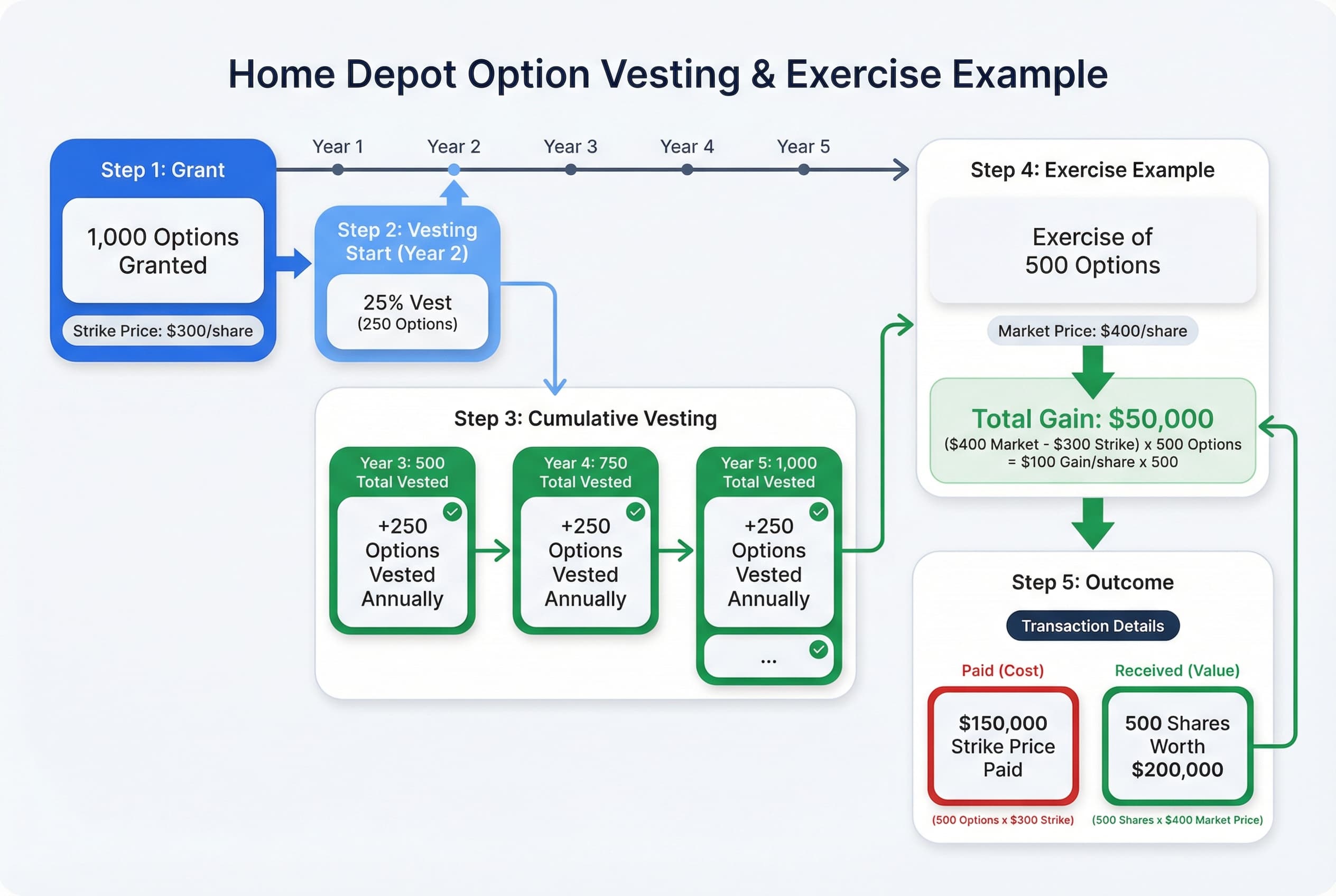
Sarah, a Home Depot manager, receives a grant of 1,000 stock options with a strike price of $300 per share. Her options follow the standard vesting schedule: 25% per year starting on the second anniversary of her grant date.
Years 0-1: No vesting occurs. Sarah's options remain unvested.
Year 2: 25% vest = 250 options become exercisable
Year 3: Another 25% vest = 250 options (500 total now exercisable)
Year 4: Another 25% vest = 250 options (750 total now exercisable)
Year 5: Final 25% vest = 250 options (all 1,000 now exercisable)
Three years after her grant, Sarah decides to exercise her 500 vested options. The stock price is now $400 per share.
When Sarah exercises, she'll owe ordinary income tax on the $50,000 gain (the difference between the market price and strike price). Federal and state taxes will be withheld based on supplemental wage rates in her jurisdiction.
Sarah pays the $150,000 strike price ($300 × 500 shares) to exercise her options and receives 500 shares worth $200,000 at the current market price. After tax withholding, she nets shares or cash equivalent based on her exercise method.
This example demonstrates how Home Depot's two-year cliff and four-year total vesting period rewards employee retention while building long-term wealth.
Understanding your Home Depot equity benefits is crucial to maximizing their value. Here are common mistakes employees make and how to avoid them:
Home Depot stock options typically have a 24-month cliff, meaning nothing vests until your second anniversary. Leaving before this date means forfeiting all options. Plan your career moves carefully, especially during your first two years.
While Home Depot has been a strong performer, holding too much company stock creates unnecessary risk. Your salary already depends on the company's success - don't let your entire financial future hinge on it. Diversify after shares vest, especially if you participate in the ESPP.
Home Depot's ESPP offers a 15% discount with a generous 27-month lookback period. This can generate significant returns, yet many employees don't enroll. Mark your calendar for the January and July enrollment windows, and consider contributing up to the 20% maximum if financially feasible.
Equity compensation creates tax events that may not be fully covered by withholding. RSUs are taxed at vesting, and ESPP sales can trigger unexpected tax bills depending on your holding period. Set aside cash for estimated taxes, especially if you have performance-based RSUs vesting at 30 and 60 months.
Home Depot offers multiple RSU vesting options, including schedules tied to age 60 or performance targets. Review your specific grant agreement carefully to understand when shares actually become yours.
Understanding what happens to your equity awards upon termination is crucial for financial planning. Here's what you need to know:
When you leave Home Depot, unvested RSUs and restricted stock are typically forfeited, regardless of whether your departure is voluntary or involuntary. This applies to all of Home Depot's various vesting schedules, including the multi-year options and performance-based awards. The shares simply don't become yours if you haven't reached the vesting date.
Special consideration for executives: If you're an executive who has retired, unvested RSUs and restricted stock can still be forfeited if you go to work for a competitor.
For stock options, the post-termination exercise window depends on your termination circumstances:
Any unvested options are forfeited upon termination. All options expire 10 years from the grant date regardless of employment status.
If you leave during an ESPP offering period, your accumulated payroll deductions will typically be used to purchase shares at the next purchase date, or returned to you, depending on the plan rules and timing of your departure.
Important: Your termination date determines which equity you keep, so understanding your vesting schedule is essential when planning a departure.
This content is for educational purposes only and does not constitute financial advice. The information provided is general in nature and may not appl...
YourEmployeeStock.com is not a registered investment advisor.
Home Depot's ESPP allows you to purchase company stock at a 15% discount through payroll deductions of up to 20% of your salary. The plan has 6-month offering periods starting in January and July, with a 27-month lookback provision that uses the lower of the stock price at the beginning of the offering period or the purchase date. You can enroll during the January or July enrollment windows for periods ending June 30 or December 31.
Home Depot offers multiple RSU vesting schedules depending on your role and grant type. Common schedules include: Option One (25% at 3 years, 25% at 6 years, 50% at age 60 or 10 years), Option Two (100% at your 3rd, 4th, or 5th anniversary), and a 4-year schedule (50% in year 2, 50% in year 4). Some RSUs are performance-based, vesting 50% at 30 months and 50% at 60 months contingent on meeting profit targets.
Stock options at Home Depot typically vest 25% per year starting on the second anniversary of your grant date, with a 2-year cliff. This means you'll receive no vested options in the first two years, then 25% will vest in year 2, and the remaining 75% will vest 25% annually over the next three years. Options expire 10 years from the grant date.
If you leave Home Depot, unvested RSUs and restricted stock are typically forfeited. For stock options, you generally have 3 months after termination without cause to exercise vested options, or 1 year if you leave due to death or disability. Executives should note that unvested RSUs can be forfeited if you work for a competitor after retirement.
To qualify for favorable tax treatment on your ESPP shares, you must hold them for at least 2 years from the offering date and 1 year from the purchase date. If you meet these requirements, a portion of your gain may be taxed as long-term capital gains rather than ordinary income.
Restricted shares and RSUs cannot be sold, transferred, or pledged until they vest. Once vested, employees with access to material nonpublic information must comply with Home Depot's insider trading policies, which include blackout periods (typically before earnings announcements). Regular employees can generally sell vested shares outside of blackout periods.
Performance-based RSUs at Home Depot vest contingent on the company meeting specific operating profit targets. These typically vest 50% at 30 months and 50% at 60 months, but only if the performance goals are achieved. If targets aren't met, you may receive fewer shares or none at all.
Yes, executives should be aware that unvested RSUs and restricted stock can be forfeited if you work for a competitor after retirement. Additionally, executive awards may include non-competition provisions lasting 18-24 months and non-solicitation agreements lasting 36 months. These restrictive covenants can result in forfeiture or clawback of equity compensation if violated.
Get a free personalized analysis from our equity compensation experts

