Free equity analysis
We're still gathering complete information
Some details about Deloitte's equity programs may be incomplete or based on general industry data. We recommend verifying specifics with your official plan documents or HR department.
Complete guide to understanding your Deloitte equity compensation, including RSU, NSO, ESPP, vesting schedules, and tax strategies.
Employees
335K
Worldwide
Equity Programs
3
programs
Vesting Period
4 years
RSU vesting
Deloitte offers 3 equity compensation programs to employees. Click on each program to learn more about eligibility, vesting, and tax implications.
Learn about Deloitte's Restricted Stock Units program, including vesting schedules and tax treatment.
Learn about Deloitte's Non-Qualified Stock Options program, including vesting schedules and tax treatment.
Learn about Deloitte's Employee Stock Purchase Plan program, including vesting schedules and tax treatment.
As one of the world's largest professional services firms with over 335,000 employees, Deloitte offers equity compensation as a strategic tool for retention and alignment with firm success. The company provides several equity award types, including Restricted Stock Units (RSUs), Non-Qualified Stock Options (NSOs), Performance Stock Units (PSUs), and an Employee Stock Purchase Plan (ESPP).
Unlike publicly traded tech companies, Deloitte operates as a global network of separate member firms, which means equity awards are used selectively rather than universally. These awards are typically reserved for senior hires, partner-track employees, and strategic retention purposes, often combined with cash incentives and deferred bonus arrangements.
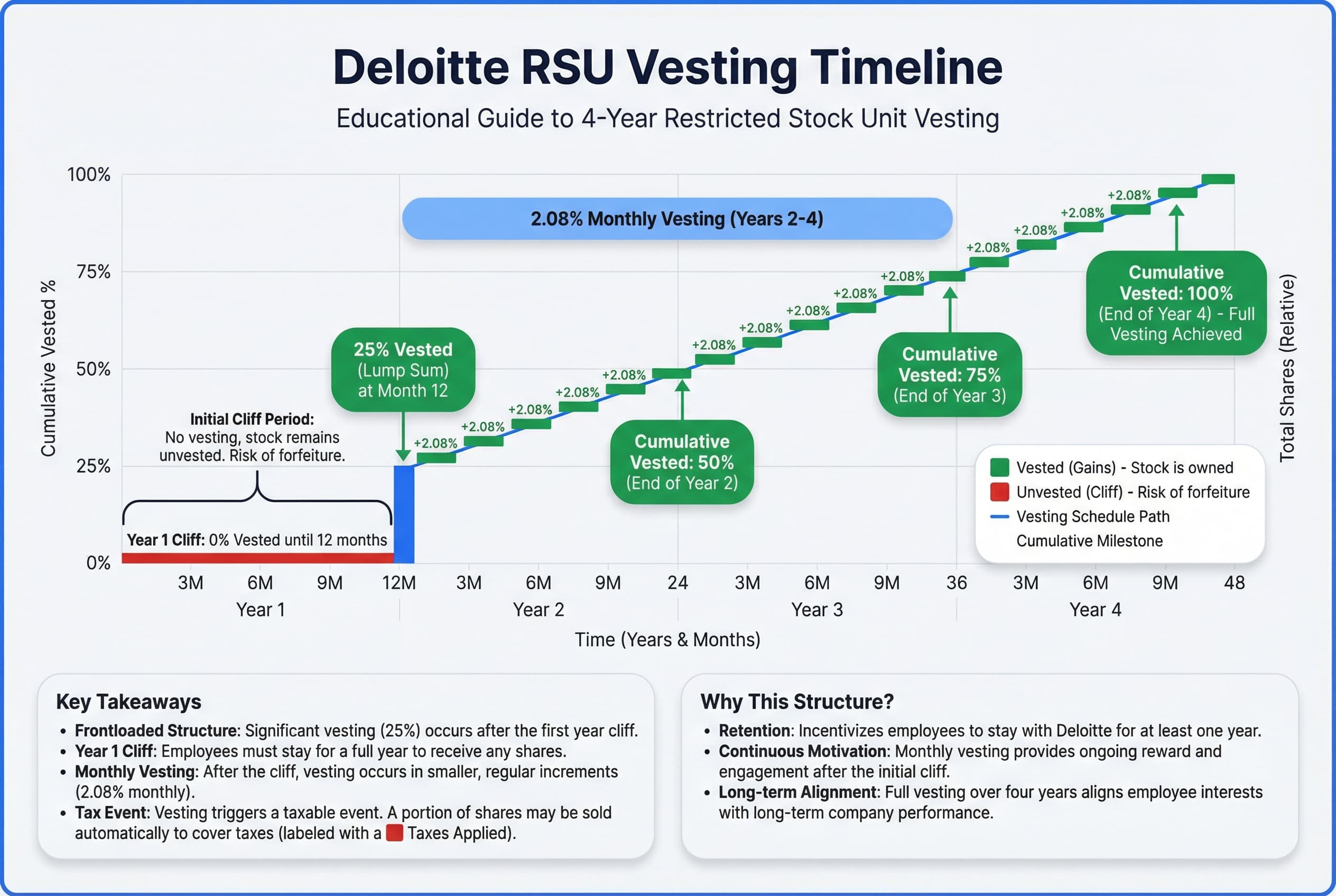
If you receive RSUs, you'll follow a 4-year vesting schedule with a one-year cliff. Here's how it works: 25% of your grant vests after your first year, then the remaining 75% vests monthly over the next three years (approximately 2.08% per month). This structure rewards both your initial commitment and continued tenure with the firm.
The ESPP allows you to purchase company shares at a 15% discount through semi-annual purchase periods, with a lookback feature that can maximize your benefit.
Keep in mind that Deloitte employees face unique stock restrictions, particularly regarding audit clients. If you work on an audit client for more than 10 hours, you may be restricted from owning that company's stock - an important compliance requirement in the professional services industry.
Deloitte uses a distinctive vesting structure for its Restricted Stock Units (RSUs) that differs from the typical uniform vesting schedule you might find at other companies. Understanding how and when your shares vest is crucial for planning your financial future.
Deloitte's RSU grants follow a 4-year vesting schedule with a 1-year cliff. This means you'll receive 25% of your total grant each year, but the structure changes after your first year. Here's how it works:
Year 1: The first 25% of your grant vests as a single block after you complete one full year of service (25% annually). This is your "cliff" period - you must remain with the company for the entire 12 months to receive any shares.
Years 2-4: The remaining 75% of your grant vests monthly at a rate of 2.08% per month. This monthly vesting continues throughout years two, three, and four, with each year delivering another 25% of your total grant.
The cliff period is the first 12 months of your grant. During this time, no shares vest - even though you're earning them. If you leave Deloitte before completing your first year, you'll forfeit the entire grant. However, once you cross that one-year threshold, you'll receive your first 25% all at once, and then begin receiving shares monthly thereafter.
This vesting structure is frontloaded compared to purely monthly schedules. You receive a larger portion upfront (25% at the one-year mark), which can be advantageous for employees who want earlier access to equity value. After the first year, the monthly vesting of 2.08% provides regular, predictable equity income over the remaining three years.
This schedule ensures strong retention during your first year while providing ongoing incentive to stay through the full four-year period. The monthly vesting after year one also means you're continuously earning shares, making it less likely you'll have long gaps without vesting events.
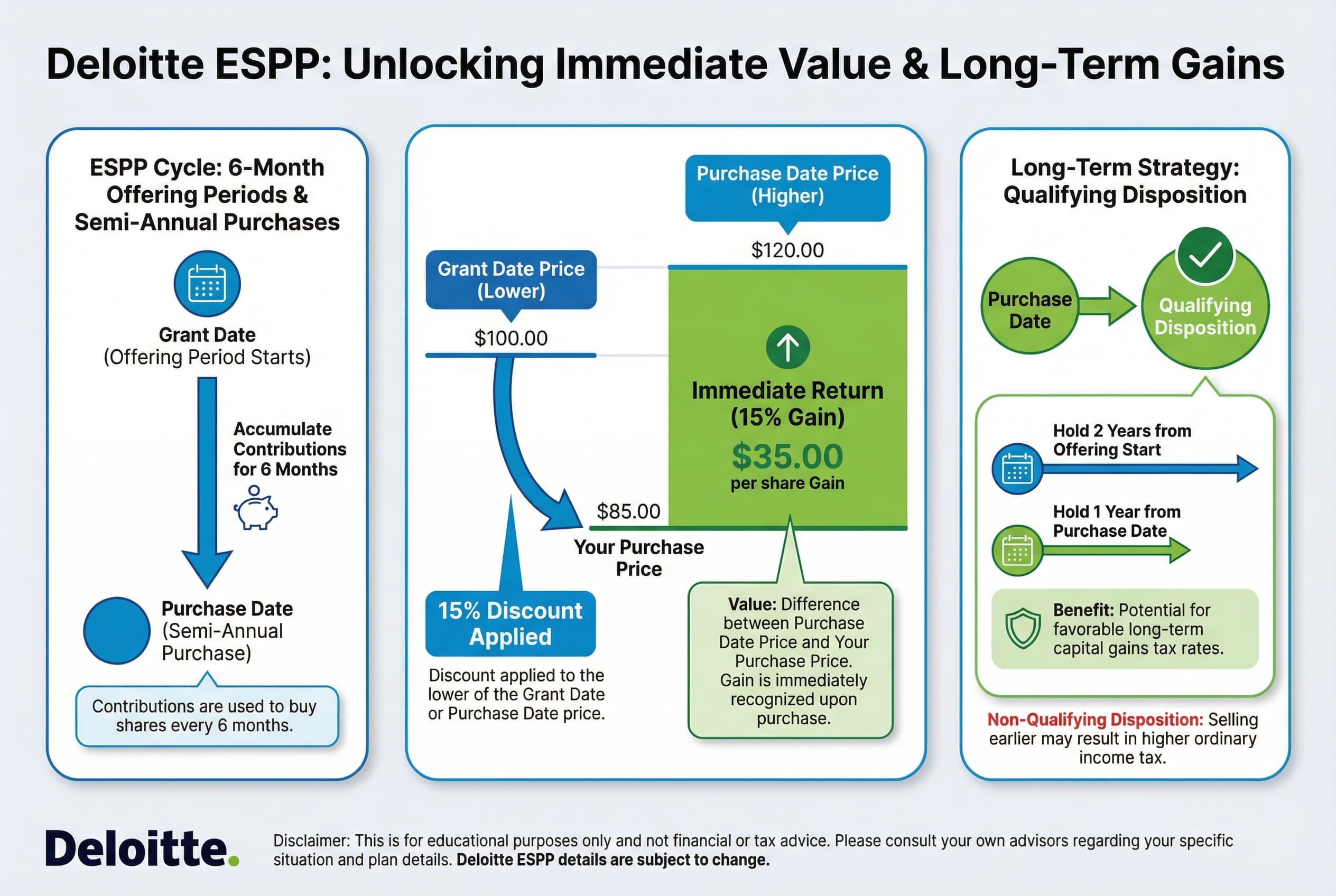
Deloitte offers an Employee Stock Purchase Plan that allows employees to purchase company shares at a discount through convenient payroll deductions. The plan provides a 15% discount on the purchase price, making it an attractive benefit for building ownership in the firm.
The plan includes a lookback provision, which can significantly enhance your potential returns. With this feature, your purchase price is based on the lower of two prices: the stock price at the beginning of the offering period or the price at the end. This means if the stock price increases during the offering period, you'll purchase shares at the earlier, lower price - plus receive your 15% discount on top of that.
Deloitte's ESPP operates on 6-month offering periods with semi-annual purchases. This means you'll have two opportunities each year to purchase shares through the plan.
The combination of the lookback provision and 15% discount can generate substantial immediate returns. In a rising market, if the stock price increases during the offering period, you benefit from both the lower starting price and the discount. Even in a flat market, the 15% discount alone provides an immediate gain upon purchase.
When you eventually sell your ESPP shares, the tax treatment depends on how long you hold them. A qualifying disposition occurs when you hold shares for at least two years from the offering period start date and one year from the purchase date, potentially resulting in more favorable tax treatment. A disqualifying disposition happens when you sell before meeting these holding periods, with different tax implications on your discount and any gains.
Given Deloitte's unique structure as a network of member firms, specific plan details may vary by jurisdiction, so consult your local benefits team for region-specific information.
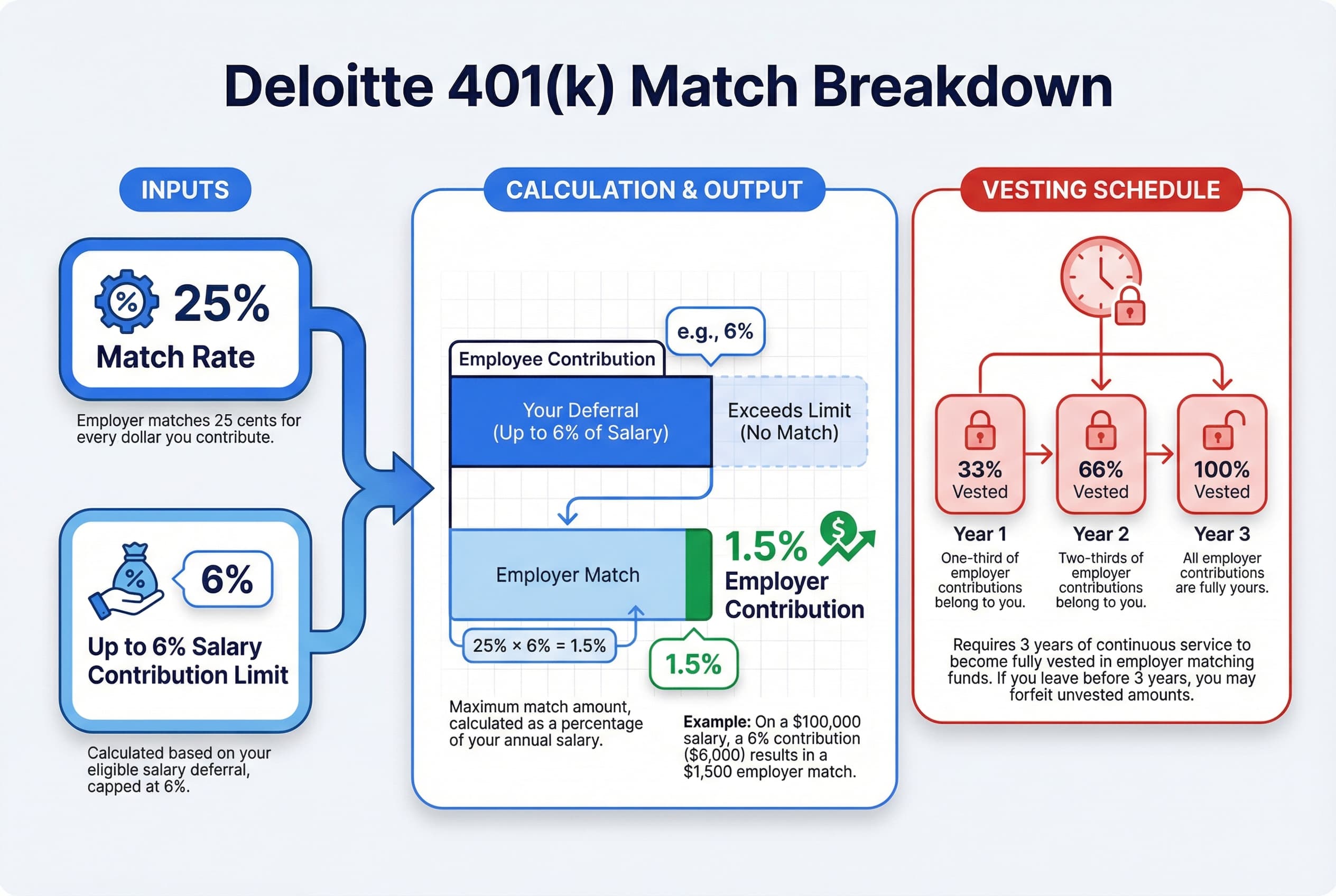
Deloitte offers a 401(k) plan with employer matching to help you build retirement savings. The company provides a 25% match on up to 6% of your salary contributions. This means if you contribute the full 6%, Deloitte will add an additional 1.5% of your salary to your account.
The employer match follows a 3-year vesting schedule. You'll need to complete three years of continuous service before the company contributions are fully yours. This vesting period also applies to Deloitte's pension plan, which becomes fully vested after 3 years of service or when you reach age 62 while employed.
The plan includes after-tax contribution options, giving you flexibility in how you structure your retirement savings. Additionally, Deloitte offers a Roth 401(k) option, allowing you to make after-tax contributions that can grow tax-free in retirement.
However, mega backdoor Roth conversions are not available through Deloitte's 401(k) plan. While you can make after-tax contributions, the plan structure doesn't support the in-plan conversion feature needed for this advanced tax strategy.
These retirement benefits complement Deloitte's broader compensation package, which includes equity awards and other financial benefits designed to support long-term wealth building throughout your career.
Understanding the tax treatment of your equity compensation is crucial for effective financial planning. Here's what Deloitte employees should know about their equity awards.
Restricted Stock Units (RSUs): You owe ordinary income tax at the time your RSUs vest. Each vesting event - whether at your first-year cliff or during subsequent monthly vests - triggers a taxable event based on the fair market value of the shares on that date. You don't pay taxes when RSUs are granted, only when they convert to actual shares.
Non-Qualified Stock Options (NSOs): You'll face two potential taxable events. First, when you exercise your options, you owe ordinary income tax on the "spread" (the difference between the exercise price and the current market value). Second, when you sell the shares, you'll owe capital gains tax on any additional appreciation.
Employee Stock Purchase Plan (ESPP): With Deloitte's 15% discount and lookback feature, taxation depends on how long you hold the shares. Selling immediately triggers ordinary income on the discount. Holding shares for qualifying periods (two years from offering date and one year from purchase) can result in more favorable tax treatment.
When RSUs vest, Deloitte typically withholds shares to cover taxes. However, standard withholding may not cover your full tax obligation, especially if you're in a higher tax bracket. This creates a potential "gap" where you might owe additional taxes when filing your return. Consider setting aside extra funds or adjusting your W-4 withholding to avoid surprises.
The discount and spread on equity awards are taxed as ordinary income (at your marginal rate). However, any appreciation after you own the shares qualifies for capital gains treatment - either short-term (held less than one year) or long-term (held more than one year), with long-term rates being significantly lower.
As a global professional services firm, Deloitte uses specialized solutions like GAIN to manage complex cross-border tax compliance. If you work internationally or relocate, tax implications can become particularly complex.
Disclaimer: This information is educational only and not tax advice. Tax situations vary based on individual circumstances, state of residence, and current tax law. Always consult with a qualified tax professional before making decisions about your equity compensation.
While equity compensation can be a valuable part of your total rewards, concentrating too much wealth in any single company's stock - including Deloitte's - creates significant financial risk. If the company faces challenges, both your job security and investment portfolio could be affected simultaneously.
As a professional services firm in the financial services sector, Deloitte faces specific risks including economic downturns that reduce client spending on consulting and advisory services, regulatory changes affecting audit requirements, and intense competition from other major firms. Additionally, Deloitte operates as a global network of separate member firms, which can create unique structural and jurisdictional complexities.
Financial advisors commonly recommend limiting single-stock exposure to 10-20% of your total net worth. This guideline helps protect you from company-specific risks while still allowing you to benefit from equity compensation. Consider your complete financial picture: include your RSUs, ESPP shares, NSOs, and PSUs when calculating your Deloitte exposure.
Regularly review your holdings and consider selling vested shares to rebalance your portfolio. Use your ESPP's 15% discount and lookback feature strategically, but sell shares soon after purchase periods to capture the benefit without increasing concentration. Diversify proceeds into a mix of asset classes - stocks from different industries, bonds, and other investments - to build a more resilient financial foundation.
At Deloitte, equity awards are used strategically for retention and selective reward rather than as universal compensation. View your RSUs, NSOs, and PSUs as a meaningful but variable component of your total package. Since Deloitte operates as a private company without publicly traded shares, your equity's liquidity and value may differ significantly from typical public company stock.
After your initial 12-month cliff, RSUs vest monthly over the remaining three years. Consider selling vested shares when you need to rebalance your portfolio or when a significant portion of your net worth becomes concentrated in Deloitte equity. Unlike public company stock, private company shares may have limited liquidity windows, so plan ahead for when selling opportunities arise.
Working at Deloitte means both your salary and equity come from the same source. This concentration risk is particularly important in professional services, where both compensation and equity value are tied to firm performance. Consider diversifying into other asset classes as shares vest to reduce overexposure to a single employer.
Deloitte's ESPP offers a 15% discount with a lookback provision and semi-annual purchase periods. To maximize tax benefits, consider holding ESPP shares for at least two years from the offering date and one year from purchase to qualify for favorable long-term capital gains treatment on the discount portion. However, immediate sale may make sense if you're already overconcentrated in Deloitte equity.
Be mindful of stock restrictions related to audit clients - if you work more than 10 hours on a client audit, you may be prohibited from owning that company's stock. This unique constraint requires careful attention to avoid compliance issues.
This information is educational only and not personalized financial advice. Consult a financial advisor for guidance specific to your situation.
Let's walk through a realistic scenario to see how Deloitte's RSU vesting schedule works in practice.
Sarah, a senior consultant at Deloitte, receives a grant of 1,200 RSUs as part of her compensation package. Deloitte uses a 4-year vesting schedule with a unique structure: 25% vests annually, but the vesting frequency changes after the first year.
Year 1 (Cliff Period): After 12 months of service, Sarah hits her first vesting milestone. 25% of her grant vests all at once:
Years 2-4 (Monthly Vesting): The remaining 75% vests monthly at 2.08% per month. This means:
By the end of four years, Sarah will have vested all 1,200 RSUs, receiving them in this pattern:
Since Deloitte is a private partnership structure operating as a network of member firms, the actual value and tax treatment of these RSUs may vary based on your specific employment entity and jurisdiction. Unlike publicly-traded companies, there isn't a daily stock price to reference.
Note on taxes: Tax withholding requirements will apply at each vesting event. The specific withholding rate depends on your location and the structure of your particular equity award. Consult with your HR team or tax advisor to understand the tax implications specific to your grant.
This monthly vesting structure after the first year provides earlier access to equity value compared to traditional annual vesting schedules.
Even experienced professionals can stumble when managing equity compensation. Here are the most common missteps Deloitte employees make:
Deloitte RSUs include a 12-month cliff period, meaning nothing vests until you've completed your first year. Leaving at 11 months means forfeiting your entire grant. Many employees don't realize this timing is critical when considering early career moves.
Deloitte's Employee Stock Purchase Plan offers a 15% discount with a lookback provision on semi-annual purchases. This combination can generate immediate returns of 15% or more, yet many employees don't enroll or contribute the maximum they can afford. This is often the easiest equity benefit to capitalize on.
RSU vesting triggers ordinary income tax, but default withholding may not cover your full tax liability - especially if you're in a higher tax bracket. Many employees face unexpected tax bills because they didn't plan for this gap or pay estimated quarterly taxes.
As RSUs vest monthly after your first year, it's easy to accumulate significant company stock holdings. Holding too much of your net worth in your employer's stock creates unnecessary risk. Consider diversifying as shares vest.
Unique to Deloitte, working more than 10 hours on an audit client can restrict you from owning that stock. Failing to track these restrictions can create compliance issues and forced sales.
Understanding how your equity is affected when you leave Deloitte is crucial for financial planning. Here's what you need to know:
If you leave Deloitte, any unvested RSUs will typically be forfeited. Given Deloitte's vesting structure - 25% after your first year, then monthly vesting over the remaining three years - your departure date significantly impacts how much equity you keep. For example, leaving shortly before your one-year anniversary means forfeiting all RSUs, while leaving at two years means keeping only 50% of your original grant.
While Deloitte offers non-qualified stock options (NSOs), specific details about the post-termination exercise window are not publicly available. You should review your grant documents or consult with HR to understand how long you have to exercise vested options after leaving.
If you're participating in Deloitte's Employee Stock Purchase Plan when you leave, mid-period terminations typically result in your contributions being returned without completing the purchase. Since Deloitte's ESPP operates on six-month offering periods with a 15% discount and lookback provision, timing your departure could mean missing out on these benefits.
The available data doesn't specify different treatment based on whether your departure is voluntary or involuntary. However, your specific equity agreements may contain provisions for different scenarios, so carefully review your grant documents or speak with Deloitte's benefits team before making any decisions.
This content is for educational purposes only and does not constitute financial advice. The information provided is general in nature and may not appl...
YourEmployeeStock.com is not a registered investment advisor.
Deloitte uses a 4-year vesting schedule with a 1-year cliff. In your first year, 25% of your RSUs vest annually. After that, the remaining 75% vests monthly at 2.08% per month over years 2, 3, and 4. This means you won't receive any shares until you've completed your first year with the company.
Deloitte's ESPP offers a 15% discount on the stock purchase price. The plan includes a lookback provision and operates on a 6-month offering period with semi-annual purchases. This allows you to purchase company stock at a discount, potentially at the lower of the price at the beginning or end of the offering period.
No, you may face restrictions on owning stock in Deloitte's audit clients. If you work on an audit client for more than 10 hours, you may be prohibited from owning that company's stock. These restrictions are important independence requirements in the professional services industry.
Deloitte offers several types of equity compensation including RSUs (Restricted Stock Units), NSOs (Non-Qualified Stock Options), and PSUs (Performance Stock Units). The company uses equity awards strategically for retention, alignment, and selective reward rather than as a universal pay element for all employees.
Generally, unvested RSUs are forfeited when you leave the company before they vest. Since Deloitte has a 1-year cliff, if you leave before completing your first year, you won't receive any shares from your initial grant. Any RSUs that haven't vested by your departure date are typically cancelled.
Deloitte offers a 401(k) match of 25% on up to 6% of your eligible compensation. The match vests after 3 years of continuous service. The company also offers a Roth 401(k) option and allows after-tax contributions, though mega backdoor Roth conversions are not available.
Yes, there are blackout periods during which selling or exercising equity awards may be contractually or legally prohibited. The specific timing of these periods isn't publicly detailed, but they typically occur around earnings announcements and other material company events to prevent insider trading.
Yes, Deloitte may combine cash sign-on bonuses with equity awards, particularly for senior hires and partner-track employees. As a large professional services firm, Deloitte often uses a mix of cash incentives, deferred bonus arrangements, and share-based awards to attract experienced talent.
Get a free personalized analysis from our equity compensation experts

