Free equity analysis
We're still gathering complete information
Some details about UnitedHealth Group's equity programs may be incomplete or based on general industry data. We recommend verifying specifics with your official plan documents or HR department.
Complete guide to understanding your UnitedHealth Group equity compensation, including RSU, NSO, ESPP, vesting schedules, and tax strategies.
Stock Price
$383.55
Closing price · Sep 14, 2026
Employees
400K
Worldwide
Equity Programs
3
programs
Vesting Period
4 years
RSU vesting
Closing price · Sep 14, 2026
UnitedHealth Group offers 3 equity compensation programs to employees. Click on each program to learn more about eligibility, vesting, and tax implications.
Standard RSU program with 4-year vesting and 1-year cliff. Annual refresh grants available for eligible employees.
Learn about UnitedHealth Group's Non-Qualified Stock Options program, including vesting schedules and tax treatment.
Learn about UnitedHealth Group's Employee Stock Purchase Plan program, including vesting schedules and tax treatment.
UnitedHealth Group RSUs vest on a 4-year ratably/annually (25% per year) schedule with a 12-month cliff.
Example calculation based on 100 shares:
| Year | Vesting % | Shares Vesting | Estimated Value |
|---|---|---|---|
| Year 1 | 25% | 25 | $9,588.75 |
| Year 2 | 25% | 25 | $9,588.75 |
| Year 3 | 25% | 25 | $9,588.75 |
| Year 4 | 25% | 25 | $9,588.75 |
| Total | 100% | 100 | $38,355 |
* Based on UnitedHealth Group stock price of $383.55 as of Sep 14, 2026. Actual values will vary.
25%
25 shares
$9,588.75
25%
25 shares
$9,588.75
25%
25 shares
$9,588.75
25%
25 shares
$9,588.75
UnitedHealth Group vesting schedule based on 100 total shares
UnitedHealth Group offers employees multiple ways to build ownership in the company through equity compensation. The program includes Restricted Stock Units (RSUs), Non-Qualified Stock Options (NSOs), Performance Stock Units (PSUs) for executives, and an Employee Stock Purchase Plan (ESPP) available to eligible employees.
As a leading healthcare company, UnitedHealth Group's equity compensation allows you to share in the company's growth and success. These benefits complement your base salary and can represent a significant portion of your total compensation, particularly as you advance in your career. For long-term employees, equity can become a substantial component of retirement savings and wealth building.
RSUs and NSOs typically vest ratably over four years, with 25% vesting each year on your anniversary date. This means you'll receive one-quarter of your grant each year, encouraging long-term commitment to the company. Notably, RSU vesting continues during severance pay periods based on the duration of your severance.
The ESPP operates on a different schedule, with two 26-week enrollment periods per year (January 2 to July 1, and July 2 to January 1). You can contribute up to 10% of your eligible compensation (maximum $25,000 annually) and purchase company stock at a 10% discount to the end-of-period price.
Understanding these programs helps you make informed decisions about your financial future and maximize the value of your total compensation package.
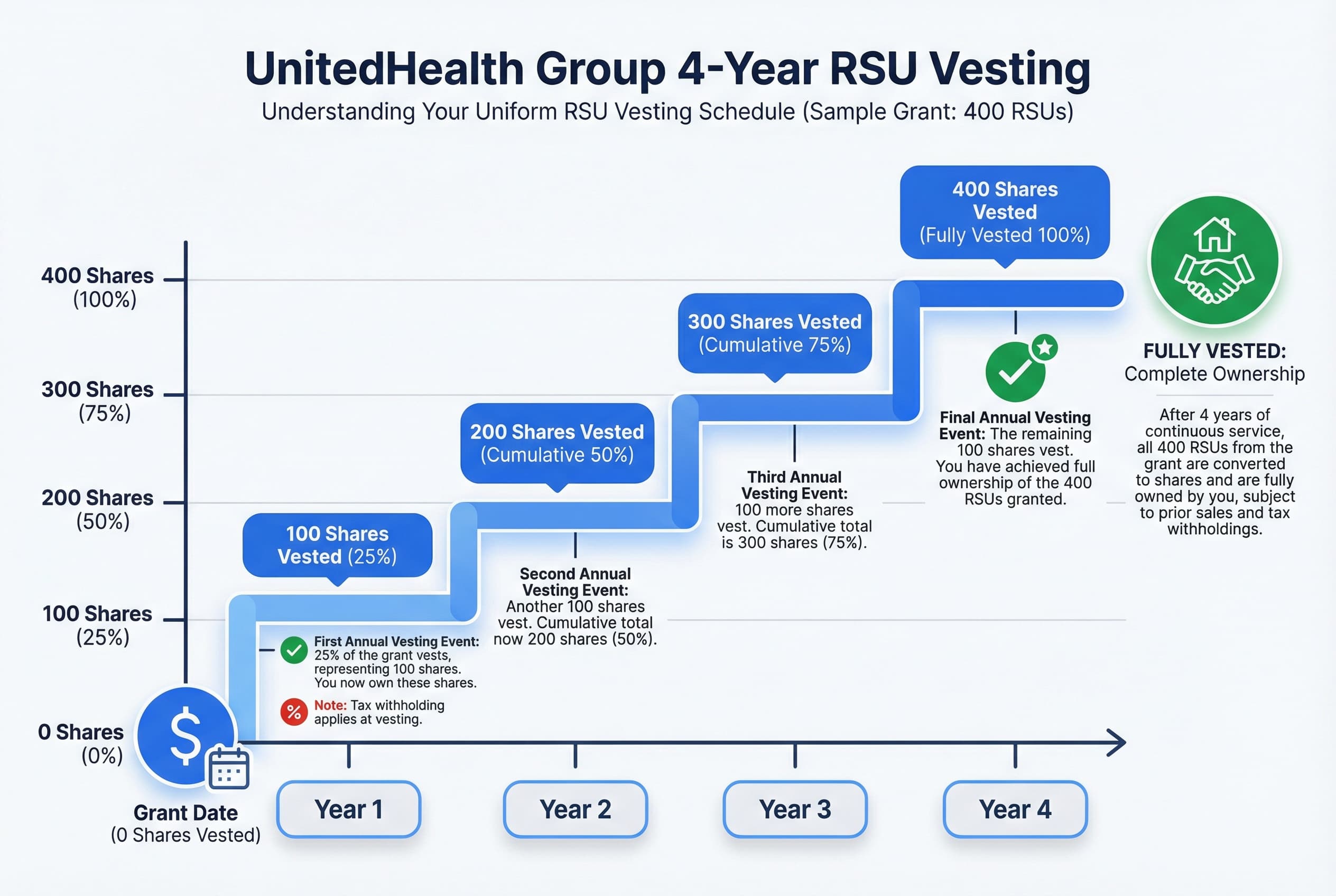
UnitedHealth Group follows a 4-year uniform vesting schedule for Restricted Stock Units (RSUs). Under this structure, your equity vests in equal installments of 25% per year over the four-year period. This means that each year on your vesting anniversary, one-quarter of your total RSU grant becomes yours.
Unlike many tech companies that vest equity monthly or quarterly, UnitedHealth Group uses annual vesting. Your shares vest once per year on the anniversary of your grant date. For example, if you receive a grant of 400 RSUs, you would receive:
Based on available data, UnitedHealth Group's standard RSU grants do not appear to include a cliff period. This means your first 25% of shares should vest at the end of your first year of employment, rather than requiring you to wait through an initial waiting period before any vesting occurs. This structure provides earlier access to your equity compared to grants with one-year cliffs.
UnitedHealth Group's vesting schedule is classified as uniform, meaning the same percentage vests each year. This differs from backloaded schedules (where more shares vest in later years) or frontloaded schedules (where more vest upfront). The uniform approach provides predictable, consistent equity compensation throughout your four-year vesting period.
For employees receiving Non-Qualified Stock Options (NSOs), the vesting follows a similar pattern, vesting ratably over four years. Executive compensation packages, such as sign-on bonuses that include both RSUs and NSOs, typically follow this same four-year ratable vesting structure.
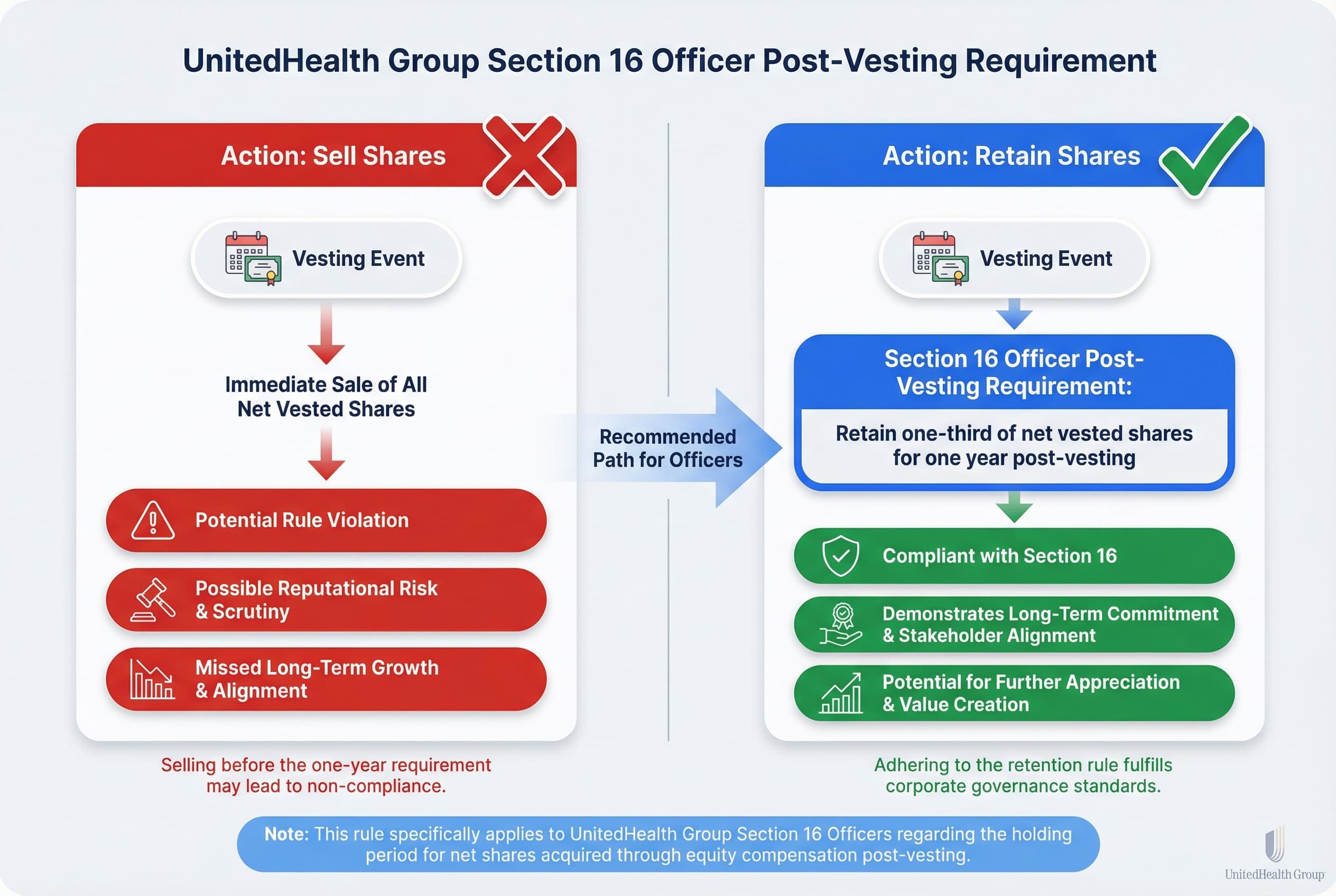
If you're a Section 16 Officer, additional restrictions apply: you must retain one-third of your net vested shares for at least one year following each vesting date. Additionally, RSU vesting may continue during severance pay periods, depending on your severance duration.
UnitedHealth Group offers an ESPP that allows employees to purchase company stock at a discount through regular payroll deductions. The program operates with two 26-week offering periods each year: January 2 to July 1, and July 2 to January 1. Employees can enroll during windows in January and July.
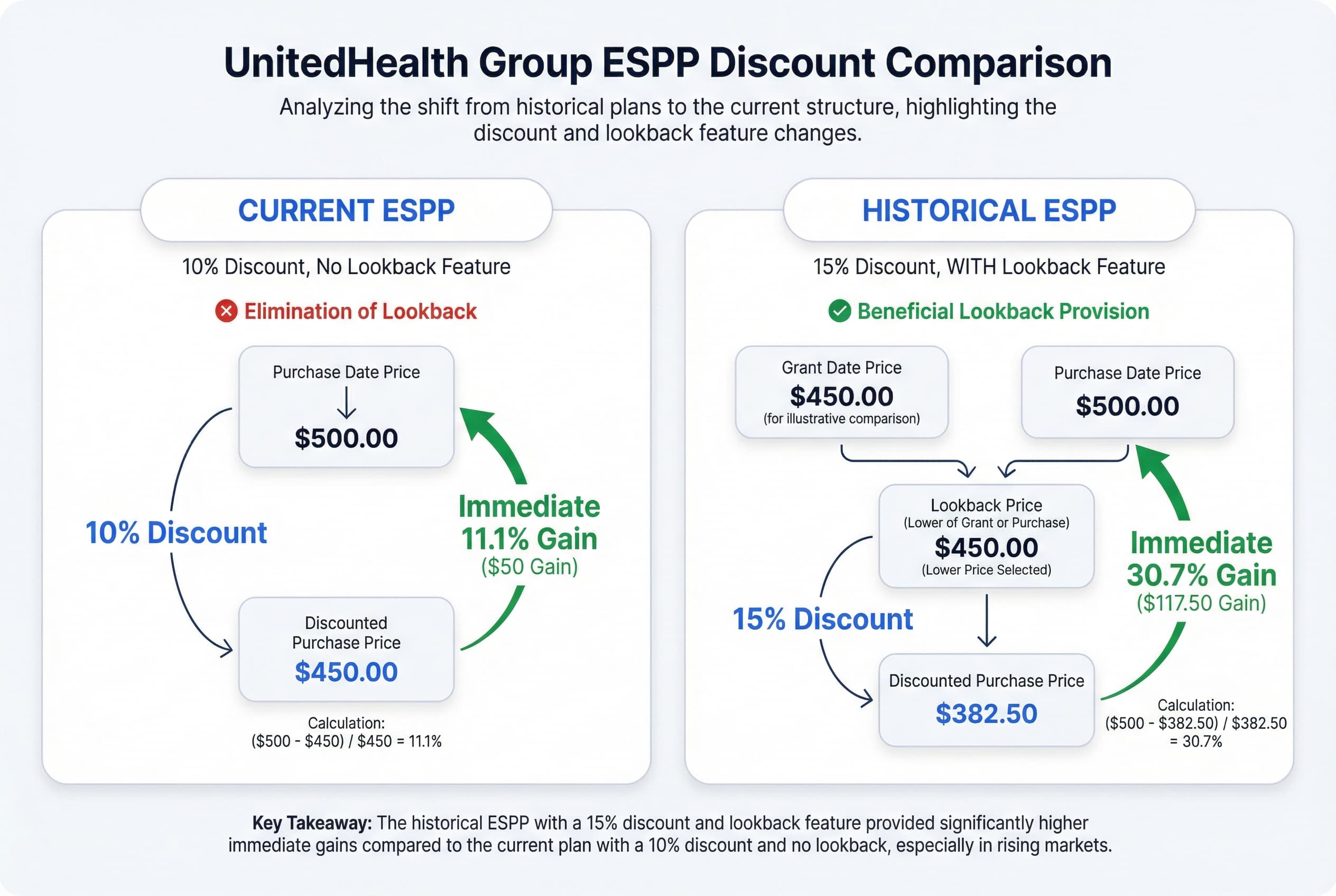
The ESPP provides a 10% discount on UnitedHealth stock. It's important to note that UnitedHealth does not offer a lookback provision - the purchase price is based solely on the stock price at the end of each 6-month purchase period. This represents a change from the company's historical ESPP structure, which previously offered a 15% discount with a lookback feature.
Employees can contribute up to 10% of their salary toward ESPP purchases, with a maximum annual contribution of $25,000. Both the offering period and purchase period are 6 months in length, with purchases occurring semi-annually.
Without a lookback provision, your return is limited to the 10% discount. For example, if the stock price is $500 at the end of the purchase period, you'd purchase shares at $450 (a 10% discount), representing an immediate 11.1% gain on your investment if you sold immediately.
How you're taxed depends on how long you hold the shares. For a qualifying disposition that receives favorable long-term capital gains treatment, you must hold the shares for at least two years from the first day of the offering period and at least one year from the purchase date. Selling before meeting both requirements results in a disqualifying disposition, where the discount is taxed as ordinary income.
The ESPP can be a valuable benefit, offering guaranteed returns through the discount, though the recent elimination of the lookback feature has reduced the program's potential upside compared to its previous structure.
UnitedHealth Group offers a 401(k) plan with employer matching to help employees save for retirement. The company provides matching contributions, though the specific match percentage and structure are not publicly disclosed in available documentation.
One notable advantage of UnitedHealth Group's 401(k) is immediate vesting of employer match contributions. This means you own 100% of the company's matching contributions from day one, with no waiting period required.
The plan supports both traditional pre-tax and Roth 401(k) contributions, allowing employees to choose their preferred tax treatment. Many UnitedHealth employees report utilizing the Roth 401(k) option as part of their retirement strategy.
However, mega backdoor Roth conversions are not available through UnitedHealth Group's 401(k) plan, as it does not offer after-tax contribution options beyond the standard pre-tax and Roth limits.
UnitedHealth Group emphasizes retirement planning support as part of their benefits package, offering "savings, retirement and investing support" to employees. Financial advisors working with UnitedHealth employees typically recommend contributing enough to capture the full employer match before allocating additional funds to other investment vehicles like the ESPP.
While the 401(k) match details aren't publicly specified, the immediate vesting and availability of Roth options make this a valuable component of UnitedHealth Group's total compensation package.
Understanding the tax treatment of your equity compensation is essential for effective financial planning. Here's what UnitedHealth Group employees should know about taxes on RSUs, NSOs, and ESPP purchases.
Restricted Stock Units are taxed as ordinary income at vesting. When your RSUs vest (25% annually over four years at UnitedHealth Group), the fair market value of the shares becomes taxable compensation, just like your salary. Your employer will withhold taxes at vesting, but be aware of the common "withholding gap" issue: supplemental income withholding rates may not cover your full tax liability, especially if you're in a higher tax bracket or live in a high-tax state like California or New York.
Any subsequent gain (or loss) when you sell the shares is treated as a capital gain (or loss). If you hold the shares for more than one year after vesting, you'll qualify for long-term capital gains rates, which are typically lower than ordinary income rates.
Non-Qualified Stock Options trigger ordinary income tax when you exercise them. The taxable amount is the difference between the exercise price and the fair market value at exercise. You'll then owe capital gains tax on any appreciation when you sell the shares. Note that ISOs are not offered at UnitedHealth Group, so AMT (Alternative Minimum Tax) considerations don't apply to stock options.
The 10% discount on ESPP purchases is generally taxed as ordinary income when you sell the shares. However, if you meet the qualifying disposition requirements (holding at least two years from the offering period start date OR at least one year from the purchase date), any gain beyond the discount may qualify for favorable long-term capital gains treatment.
This information is educational only and not tax advice. Tax situations vary based on individual circumstances, state residency, and other factors. Always consult with a qualified tax professional or financial advisor to understand your specific tax obligations and develop appropriate strategies for your equity compensation.
While UnitedHealth Group equity compensation can be valuable, concentrating too much of your wealth in any single stock - including your employer's - creates significant risk. If UNH's stock price declines, you could simultaneously face both portfolio losses and potential job insecurity, a double impact that diversified investors avoid.
UnitedHealth Group operates in a heavily regulated healthcare industry facing unique challenges. Regulatory changes, healthcare policy reforms, Medicare reimbursement adjustments, and political scrutiny can all impact stock performance. The company's size and prominence in the insurance sector also make it subject to ongoing legislative and public attention that can create volatility.
Financial advisors commonly recommend limiting single-stock exposure to 10-20% of your total net worth. For UnitedHealth employees, this is particularly important given that your income, benefits, and equity compensation are all tied to the company's success.
As your RSUs vest annually and ESPP shares accumulate semi-annually, develop a systematic plan to sell shares and reinvest proceeds across different asset classes, industries, and geographies. This doesn't mean you lack confidence in UnitedHealth - it means you're protecting your financial future from concentrated risk.
Consider working with a financial advisor to create a diversification strategy that balances tax efficiency with risk management, especially if you're a long-time employee who has accumulated substantial UnitedHealth holdings over the years.
With RSUs vesting annually at 25% per year over four years, each vesting event creates a natural opportunity to reassess your holdings. Consider selling at least a portion of vested shares to reduce concentration risk, particularly after you've accumulated multiple years of grants. If you're a Section 16 Officer, remember you must retain one-third of net vested shares for one year post-vesting, which should factor into your planning.
Healthcare sector volatility can significantly impact UnitedHealth Group's stock price. Long-tenured employees commonly express concerns about portfolios becoming overly concentrated in company stock by retirement. As a general guideline, many financial professionals suggest limiting any single stock position to 10-15% of your total investment portfolio. Evaluate your exposure regularly, especially as equity grants accumulate over time.
The ESPP offers a 10% discount with semi-annual purchase periods (January-July and July-January). To qualify for favorable long-term capital gains treatment, hold shares for at least two years from the offering period start date and one year from the purchase date. However, immediate sales still capture the 10% discount (taxed as ordinary income), which may be preferable if you're already overexposed to company stock. Prioritize maxing your 401(k) match before contributing to the ESPP.
View your equity as deferred, at-risk compensation rather than a pure investment. When evaluating job offers or retention, calculate the expected value of unvested grants, but discount them appropriately for risk and time-based uncertainty. Performance Stock Units (PSUs) for executives add additional variability.
While specific plan availability isn't confirmed, UnitedHealth Group has standard blackout periods around earnings as a public company. If available, a 10b5-1 plan allows pre-scheduled sales during blackout windows, providing helpful flexibility for systematic diversification.
Let's walk through a realistic scenario to see how equity vesting works at UnitedHealth Group.
Sarah joins UnitedHealth Group and receives 1,000 RSUs as part of her compensation package. At the time of grant, UNH stock is trading at $500 per share, giving her grant a total value of $500,000.
UnitedHealth Group uses a 4-year vesting schedule with 25% vesting annually. Here's how Sarah's RSUs vest:
On Sarah's first anniversary, 250 RSUs vest. Let's assume UNH stock has grown to $550 per share.
Gross value: 250 shares × $550 = $137,500
Tax withholding: When RSUs vest, they're treated as ordinary income and subject to tax withholding. Sarah needs to cover federal, state, and payroll taxes. Assuming a combined withholding rate of approximately 37% (federal supplemental rate plus payroll taxes):
Taxes withheld: $137,500 × 37% = $50,875
To cover taxes, UnitedHealth withholds approximately 92 shares ($50,875 ÷ $550).
Net shares received: 250 - 92 = 158 shares
Final value: 158 shares × $550 = $86,900
If Sarah is a Section 16 Officer, she must retain one-third of her net vested shares (approximately 53 shares) for at least one year following the vesting date, as per UnitedHealth's retention requirements.
This pattern repeats annually until all 1,000 RSUs have vested over the four-year period.
UnitedHealth Group employees often make preventable mistakes with their equity compensation. Here are the most common pitfalls to avoid:
Many long-tenured UHG employees find their portfolios heavily concentrated in company stock at retirement. This creates significant risk - if UnitedHealth's stock declines, both your job and retirement savings are affected. Aim to diversify by selling vested RSUs regularly and investing proceeds across different asset classes.
The ESPP offers a 10% discount on UnitedHealth stock through semi-annual purchases. However, many employees don't understand the qualifying disposition rules. To maximize tax benefits, hold shares for at least two years from the offering period start date and one year from the purchase date. Selling earlier triggers ordinary income tax on the full discount.
Before maximizing ESPP contributions, ensure you're contributing enough to your 401(k) to capture the full employer match. The match is immediate, guaranteed money - unlike the ESPP's 10% discount, which carries market risk.
Section 16 Officers must retain one-third of net vested shares for one year after vesting. Failing to plan for this requirement can create liquidity issues or forced holding during market downturns.
RSU vesting triggers ordinary income tax, but default withholding may not cover your full tax liability, especially in higher tax brackets. Review your withholding settings and consider making estimated tax payments to avoid penalties.
Understanding how your equity is affected by termination is crucial for financial planning. Here's what happens to your UnitedHealth Group equity awards when you leave the company.
Unvested RSUs are typically forfeited upon termination. However, UnitedHealth Group has a notable exception: RSU vesting continues during severance pay periods based on the duration of your severance package. This means if you receive severance, you may continue to vest in RSUs during that time.
For stock options (NSOs), unvested options are generally forfeited at termination. The data does not specify a post-termination exercise window for vested options, so you should confirm this detail with HR or your equity plan documents.
If you leave during an ESPP offering period (UnitedHealth has two 26-week periods annually: January 2 to July 1, and July 2 to January 1), your accumulated contributions typically stop, and you may be removed from the current purchase period. Check your plan documents for specific withdrawal or refund procedures.
UnitedHealth Group offers special treatment for retirement-eligible employees. Retirement eligibility requires age 55+ and 10+ years of Recognized Employment. Employees meeting these criteria may have different vesting treatment upon departure.
Your termination date directly impacts vesting. Since RSUs vest annually (25% per year over four years), leaving just before a vesting date means forfeiting that tranche. Always review your vesting schedule before making departure decisions.
UnitedHealth Group offers a deferred compensation plan designed for executives and Section 16 Officers. This program allows eligible employees to designate a portion of their compensation to be withheld and distributed at a later date, typically for tax planning purposes.
The deferred compensation plan enables participants to defer receiving income until a future date, such as retirement or separation from the company. This strategy can help manage tax liability by postponing income recognition to years when you may be in a lower tax bracket.
Benefits: The primary advantage is tax deferral - you delay paying taxes on the deferred amount until you actually receive it. This can result in significant tax savings if your income and tax rate are lower in retirement.
Risks: Deferred compensation plans are unsecured obligations of the company. Unlike 401(k) funds, your deferred compensation isn't held in a separate account; it remains company property until distributed. If UnitedHealth faces financial difficulties, you could lose your deferred compensation as an unsecured creditor.
Before participating, evaluate your current versus anticipated future tax rates, your confidence in the company's long-term financial stability, and your overall liquidity needs. Consider consulting with a tax advisor to determine if deferral aligns with your broader financial strategy.
This content is for educational purposes only and does not constitute financial advice. The information provided is general in nature and may not appl...
YourEmployeeStock.com is not a registered investment advisor.
RSUs at UnitedHealth Group typically vest over a 4-year period on an annual schedule, with 25% vesting each year. This means you'll receive one-quarter of your total grant on each anniversary of your grant date for four consecutive years.
If you're eligible for retirement (age 55+ with 10+ years of service), your unvested RSUs may continue to vest. Additionally, RSU vesting continues during severance pay periods based on the duration of your severance. If you don't meet these criteria, you'll typically forfeit unvested RSUs upon departure.
UnitedHealth Group's ESPP allows you to purchase company stock at a 10% discount through payroll deductions of up to 10% of your salary (maximum $25,000 per year). The plan has two 26-week offering periods per year: January 2 to July 1, and July 2 to January 1. Note that the plan no longer includes a lookback feature, so the discount applies only to the end-of-period price.
You can enroll in the ESPP during two enrollment windows each year: one in January and one in July. Each enrollment period corresponds to a 6-month offering period where your contributions will accumulate before shares are purchased.
To qualify for favorable long-term capital gains treatment on your ESPP shares, you must hold them for at least two years from the first day of the offering period OR at least one year from the purchase date. If you sell before meeting these requirements, a portion of your gain will be taxed as ordinary income.
If you're a Section 16 Officer, you must retain one-third of your net vested shares (after taxes) for at least one year following the vesting date. All employees should be aware of blackout periods around earnings announcements when trading is restricted, which is standard for public companies.
Non-qualified stock options (NSOs) at UnitedHealth Group vest ratably over four years, similar to RSUs. This means your options become exercisable in equal installments over the four-year period, allowing you to purchase company stock at your predetermined grant price.
Financial advisors generally recommend contributing enough to your 401(k) to receive the full employer match before investing in the ESPP. UnitedHealth Group offers a 401(k) match with immediate vesting, making it a valuable benefit to maximize first before allocating funds to the ESPP.
Get a free personalized analysis from our equity compensation experts

