Free equity analysis
We're still gathering complete information
Some details about Intel's equity programs may be incomplete or based on general industry data. We recommend verifying specifics with your official plan documents or HR department.
Complete guide to understanding your Intel equity compensation, including RSU, ESPP, vesting schedules, and tax strategies.
Stock Price
$97.19
Closing price · Sep 14, 2026
Employees
124.8K
Worldwide
Equity Programs
2
programs
Vesting Period
3 years
RSU vesting
Closing price · Sep 14, 2026
Intel offers 2 equity compensation programs to employees. Click on each program to learn more about eligibility, vesting, and tax implications.
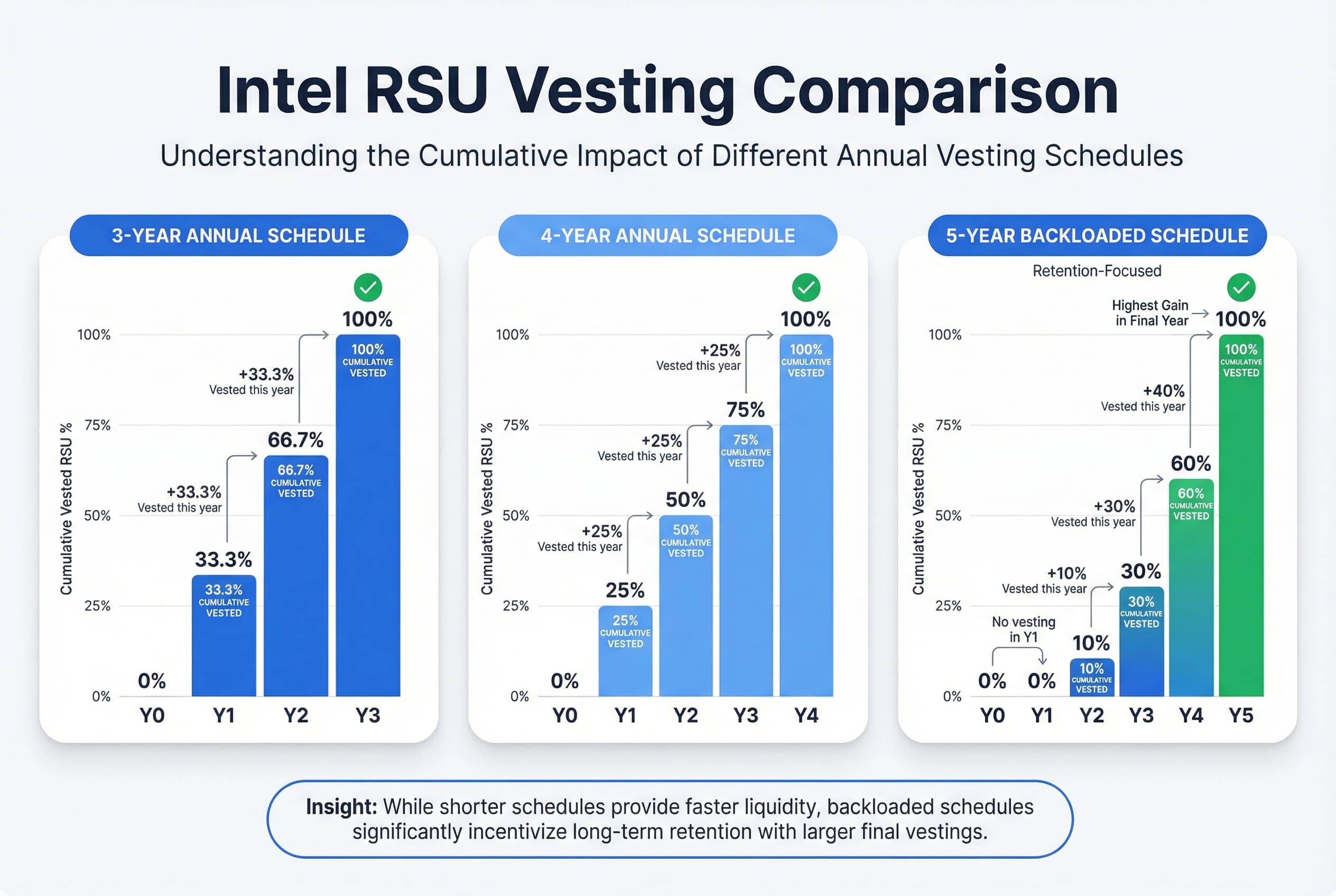
Intel RSUs vest on a Multiple schedules exist: 3-year annual (33.3% per year), 4-year annual (25% per year), 5-year backloaded (10/20/30/40%), and 3-year quarterly (12 equal installments). schedule with a 12-month cliff.
Example calculation based on 100 shares:
| Year | Vesting % | Shares Vesting | Estimated Value |
|---|---|---|---|
| Year 1 | 33% | 33 | $3,207.27 |
| Year 2 | 33% | 33 | $3,207.27 |
| Year 3 | 34% | 34 | $3,304.46 |
| Total | 100% | 100 | $9,719 |
* Based on Intel stock price of $97.19 as of Sep 14, 2026. Actual values will vary.
33%
33 shares
$3,207.27
33%
33 shares
$3,207.27
34%
34 shares
$3,304.46
Intel vesting schedule based on 100 total shares
Intel offers a comprehensive equity compensation package designed to align employee interests with long-term company performance. As a major player in the semiconductor industry, Intel primarily grants Restricted Stock Units (RSUs) and Performance Stock Units (PSUs) to employees, along with access to an Employee Stock Purchase Plan (ESPP).
Equity compensation represents a significant portion of your total compensation package at Intel, giving you direct ownership in one of the world's leading semiconductor companies. As Intel stock performs, so does the value of your equity grants. This creates a powerful incentive structure where your financial success is directly tied to the company's market performance.
Intel uses multiple vesting schedules depending on your grant type and circumstances. The most common structures include:
Additionally, Intel offers an ESPP that allows you to purchase company stock at a 15% discount with a lookback provision, enabling you to buy shares at favorable prices through semi-annual purchase periods in January and July. You can contribute up to 10% of your salary, capped at $25,000 annually.
Intel offers multiple RSU vesting schedules depending on your role, level, and grant type. Understanding which schedule applies to your equity is crucial for planning your compensation timeline.
Intel primarily uses four different vesting schedules:
3-Year Annual Vesting: This schedule distributes your shares in three equal installments of 33.3% each year over three years.
4-Year Annual Vesting: Under this structure, you receive 25% of your grant each year for four consecutive years.
5-Year Backloaded Schedule: Used primarily for inducement grants (typically offered to new hires at senior levels), this schedule is heavily weighted toward later years. You receive nothing in year one, then 10% in year two, 20% in year three, 30% in year four, and 40% in the final year.
3-Year Quarterly Vesting: This schedule distributes shares in 12 equal quarterly installments over three years, providing more frequent vesting events.
For the quarterly vesting schedule, shares vest every three months, commencing on the three-month anniversary of your grant date. This means if you receive a grant on March 15, your first vesting would occur on June 15, with subsequent vesting events every quarter thereafter.
The annual vesting schedules distribute shares once per year on the anniversary of your grant date.
Notably, Intel's standard RSU grants do not include a traditional one-year cliff. This differs from many tech companies where you must remain employed for one full year before any shares vest. Under Intel's quarterly schedule, you begin receiving shares after just three months. However, the backloaded 5-year schedule effectively creates a one-year cliff, as no shares vest during the first year.
The 5-year backloaded schedule is explicitly structured to reward retention over time, with significantly more shares vesting in years four and five. The other schedules provide more uniform distribution, though the annual schedules concentrate vesting into single yearly events rather than spreading it throughout the year.
Intel offers a competitive Employee Stock Purchase Plan that allows you to purchase company stock at a significant discount. The program provides a 15% discount on Intel shares, combined with a lookback provision that can substantially increase your potential returns.
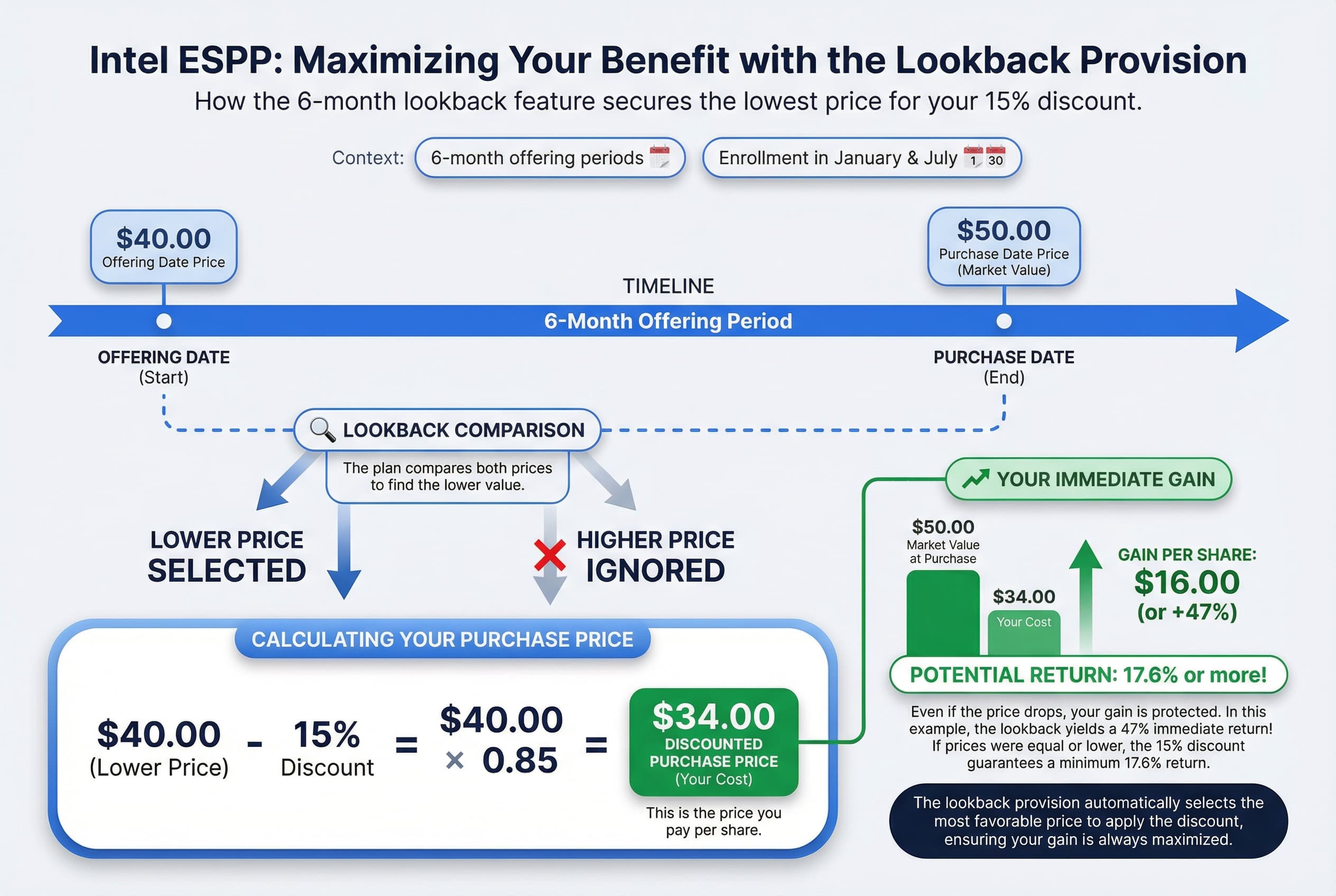
The lookback provision is a powerful feature that maximizes your discount. Intel's ESPP operates on 6-month offering periods with enrollment windows in January and July. At the end of each purchase period, the plan compares the stock price on the first day of the offering period with the price on the purchase date, then applies the 15% discount to whichever price is lower. This means if Intel's stock price increases during the offering period, you benefit from both the lower starting price and the discount - potentially yielding returns of approximately 17.6% or more on your investment before considering any additional stock appreciation.
You can contribute up to 10% of your salary through payroll deductions, subject to an annual IRS maximum of $25,000 per year. Enrollment occurs twice annually during the January and July windows, with purchases happening semi-annually at the end of each 6-month period.
Understanding the tax implications is important for maximizing your ESPP benefits. A qualifying disposition occurs when you hold shares for over 2 years from the offering date AND over 1 year from the purchase date. Qualifying dispositions receive more favorable tax treatment, with a portion taxed as long-term capital gains. Disqualifying dispositions (selling before meeting both holding periods) result in the discount being taxed as ordinary income, though you may still benefit from short-term or long-term capital gains on any additional appreciation.
Intel offers a competitive 401(k) plan with a generous employer match to help you build retirement savings. Understanding these benefits can significantly impact your long-term financial planning.
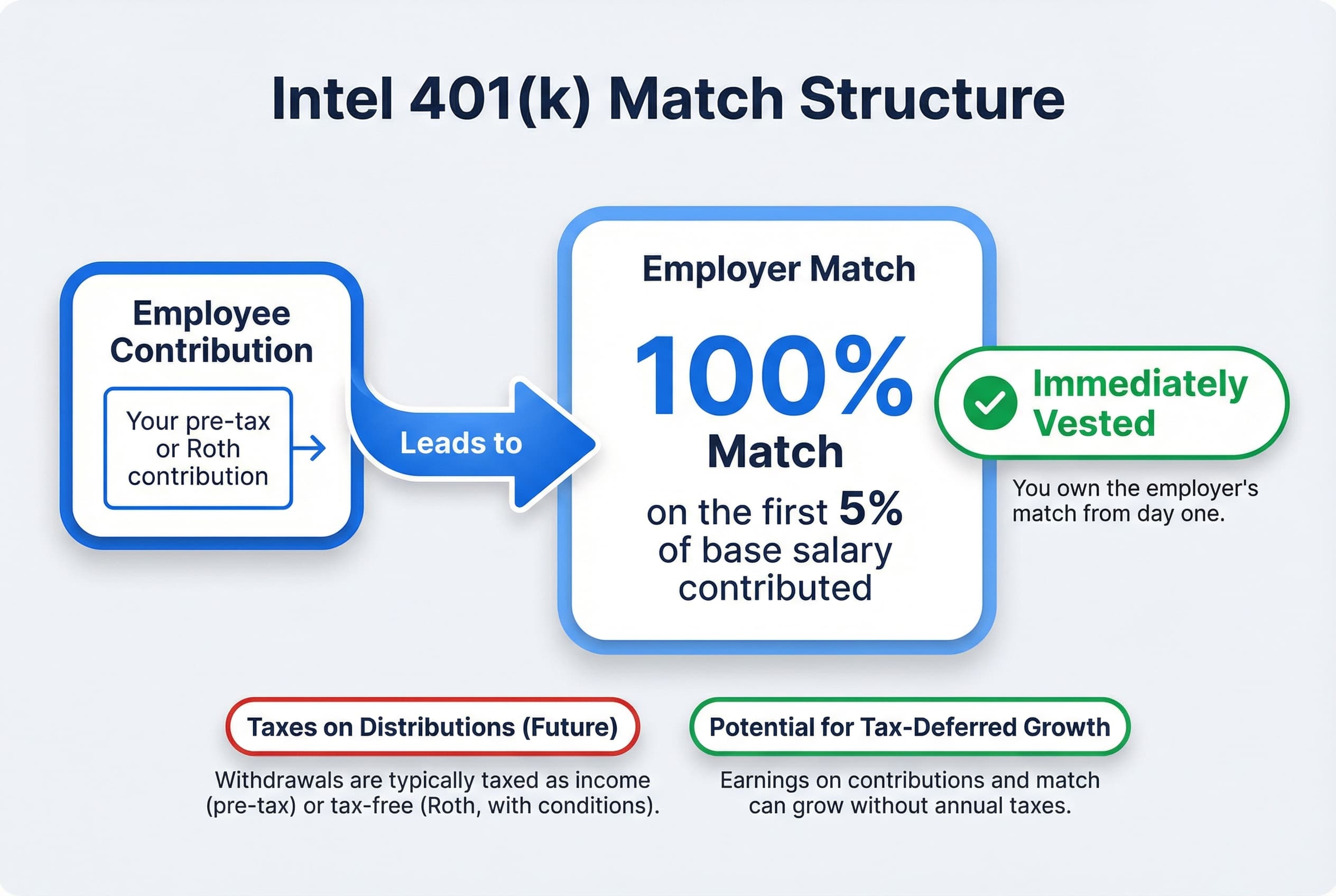
Intel provides a 100% match on the first 5% of your base salary that you contribute to the 401(k). This means if you contribute at least 5% of your salary, Intel will match that contribution dollar-for-dollar. The best part? The company match is immediately vested, meaning you own those employer contributions from day one with no waiting period.
Intel's 401(k) plan includes both traditional pre-tax and Roth 401(k) options. The plan also supports after-tax contributions, which enables the mega backdoor Roth strategy. This advanced tax planning technique allows high earners to contribute beyond the standard 401(k) limits and potentially convert those after-tax dollars to Roth savings. For 2024, the total contribution limit (employee + employer) is $69,000 if you're under 50, or $76,500 if you're 50 or older.
The plan includes a brokerage window, giving you access to investment options beyond the standard fund lineup. Intel also makes discretionary profit-sharing contributions to eligible employees, providing an additional retirement benefit beyond the standard match.
To maximize this benefit, contribute at least 5% of your salary to receive the full company match - it's essentially free money for your retirement.
Understanding the tax treatment of your Intel equity compensation is crucial for effective financial planning. Here's what you need to know about when and how you'll be taxed.
RSUs (Restricted Stock Units): You'll owe taxes at vesting, not when you receive the grant. When your RSUs vest - whether on Intel's quarterly schedule or annual vesting dates - the shares are treated as ordinary income based on their fair market value on the vesting date. You'll owe taxes even if you don't sell the shares.
ESPP (Employee Stock Purchase Plan): Tax treatment depends on how long you hold the shares. For a "qualifying disposition" (holding shares over 2 years from the offering date AND over 1 year from the purchase date), you'll receive favorable tax treatment with part of the gain taxed as ordinary income and part as long-term capital gains. Selling before meeting these requirements results in a "disqualifying disposition," with the discount and gains taxed as ordinary income.
Intel withholds taxes when RSUs vest, but the default withholding rate may not cover your full tax liability, especially if you're in a higher tax bracket. This creates a common "gap" where you owe additional taxes at year-end. Many Intel employees sell a portion of vested shares immediately to cover the shortfall.
RSU income at vesting is taxed as ordinary income at your marginal tax rate. However, any appreciation (or loss) after vesting is taxed as capital gains when you sell - short-term if held less than one year, long-term if held longer. Long-term capital gains rates are typically more favorable than ordinary income rates.
Intel is headquartered in California, a high-tax state. If you work in California or other states with income tax, you'll owe state taxes on your equity compensation in addition to federal taxes, further increasing your total tax burden.
Disclaimer: This information is educational only and not tax advice. Tax situations vary based on individual circumstances. Please consult a qualified tax professional or financial advisor for personalized guidance on your equity compensation.
While Intel equity compensation can be valuable, concentrating too much of your wealth in a single stock - especially your employer's - creates significant financial risk. If Intel's stock price declines, you could simultaneously face reduced portfolio value and potential job insecurity, a double exposure that diversification is designed to prevent.
Intel operates in the highly competitive semiconductor industry, which faces unique volatility factors. The sector experiences rapid technological change, intense competition from companies like AMD and NVIDIA, cyclical demand patterns, and significant capital expenditure requirements. Manufacturing challenges, geopolitical tensions affecting chip supply chains, and shifts in customer preferences can all impact Intel's stock performance independent of broader market trends.
Financial advisors commonly recommend limiting single-stock exposure to 10-20% of your net worth, including both vested and unvested equity compensation. This guideline becomes especially important when that single stock is also your income source.
Consider developing a systematic approach: sell a portion of your RSUs shortly after they vest to lock in gains and reduce concentration. Use your ESPP strategically, potentially selling shares soon after purchase to capture the 15% discount while minimizing long-term exposure. Reinvest proceeds into diversified investments like index funds or bonds to build a more resilient financial foundation that isn't dependent on Intel's performance alone.
Consider selling vested RSUs shortly after they vest to avoid concentration risk in a single semiconductor stock. Since RSUs are taxed as ordinary income at vesting, you've already paid taxes on that value - holding them longer exposes you to market risk without additional tax benefits. For short-term needs, selling immediately can make sense. For long-term holdings, evaluate Intel's position in the competitive semiconductor industry before maintaining a large position.
Intel operates in the cyclical semiconductor industry, which can experience significant volatility. As a general guideline, avoid having more than 10-15% of your total investment portfolio concentrated in your employer's stock. This protects you from both company-specific risks and industry downturns while reducing the correlation between your job security and investment portfolio.
Intel's ESPP offers a 15% discount with a lookback provision over 6-month offering periods. To maximize tax benefits, hold ESPP shares for qualifying disposition periods: over 2 years from the offering date AND over 1 year from the purchase date. This converts some gains to long-term capital gains rates. However, weigh this tax benefit against concentration risk - immediate sales after purchase still capture the 15% discount, just at ordinary income rates.
Intel offers multiple vesting schedules (3-year, 4-year, and 5-year backloaded), so understand your specific grant terms. Factor in the Quarterly Profit Bonus and Annual Performance Bonus when evaluating total compensation. Remember that unvested equity isn't guaranteed - it requires continued employment and company performance (especially for PSUs).
While specific 10b5-1 plan availability isn't confirmed in Intel's public information, these automated trading plans can help you sell shares systematically while avoiding insider trading concerns. Consult with your HR or legal compliance team about availability and enrollment windows.
Let's walk through how Restricted Stock Units (RSUs) vest at Intel using their 3-year quarterly vesting schedule.
Sarah, a software engineer at Intel, receives a grant of 1,200 RSUs when she joins. Her grant follows the 3-year quarterly vesting schedule, meaning her RSUs vest in 12 equal installments every three months.
Quarterly vesting amount: 1,200 RSUs ÷ 12 = 100 RSUs per quarter
Sarah's RSUs begin vesting three months after her grant date and continue every quarter:
When RSUs vest, they're taxed as ordinary income. Let's look at what happens when Sarah's first 100 RSUs vest, assuming Intel stock is trading at $25 per share:
Gross value: 100 RSUs × $25 = $2,500
Since Intel doesn't specify a standard withholding rate in available data, taxes will be withheld according to supplemental wage withholding requirements. Assuming a typical combined withholding of approximately 37% (federal, state, and payroll taxes):
Taxes withheld: $2,500 × 37% = $925
Net shares received: Sarah receives approximately 63 shares after tax withholding (the remaining 37 shares are sold to cover taxes)
Value received: 63 shares × $25 = $1,575
Remember that tax withholding may not cover your full tax liability depending on your total income. You'll need to account for vested RSUs when filing your annual tax return, and you may owe additional taxes or receive a refund based on your specific situation.
Intel employees often miss valuable opportunities or create unnecessary tax problems with their equity compensation. Here are the most frequent mistakes to avoid:
Many employees hold too much of their net worth in Intel shares, creating unnecessary risk. When your salary, bonuses, and equity are all tied to one company, you're overexposed. Consider diversifying by selling vested RSUs rather than holding them indefinitely.
RSUs are taxed as ordinary income when they vest, but the default withholding may not cover your full tax liability. This is one of the most common concerns among Intel employees. You could face a significant tax bill at year-end if you're in a higher tax bracket or live in a state with additional income taxes. Plan ahead by setting aside extra cash or selling shares at vesting.
Intel's Employee Stock Purchase Plan offers a 15% discount with a lookback provision, allowing you to purchase shares at 85% of the lower price between enrollment and purchase dates. This is essentially free money, yet many employees don't participate or contribute less than the maximum allowed.
Intel uses multiple RSU vesting schedules - including 3-year, 4-year, and 5-year backloaded structures. Not understanding your specific schedule can lead to poor planning around major purchases, career moves, or retirement timing. Always verify your grant details before making financial decisions.
Understanding how your equity is affected when you leave Intel is crucial for financial planning. Here's what you need to know:
When you leave Intel, all unvested RSUs are forfeited, regardless of whether your departure is voluntary or involuntary. This applies to all of Intel's vesting schedules, including the 3-year annual, 4-year annual, 5-year backloaded, and 3-year quarterly options. Your termination date determines which shares have vested - only RSUs that vested on or before your last day of employment are yours to keep.
If you hold stock options, you have a 90-day post-termination exercise window to exercise any vested options. After this period, unexercised options expire and are forfeited. Unvested options are immediately forfeited upon termination.
If you leave Intel during an ESPP offering period, your participation typically ends, and accumulated payroll deductions may be returned to you without purchasing shares. The specific treatment depends on when you terminate relative to the semi-annual purchase dates in the enrollment periods (January and July).
Intel offers a Retirement Rule of 75 (age plus years of service equals 75 or more), which may provide accelerated vesting or enhanced benefits for qualifying employees. Additionally, employees under age 63.5 may receive Intel-paid COBRA coverage upon separation, though this doesn't directly affect equity treatment.
Always review your specific grant agreements and consult with HR or a financial advisor before making decisions about your departure.
Intel offers a deferred compensation plan called SERPLUS to eligible employees at Grade Level 10 and above (approximately Director level and higher). This non-qualified plan allows senior employees to defer a portion of their current compensation to reduce their taxable income today.
Through SERPLUS, eligible employees can defer up to 60% of their base salary and 75% of bonuses and commissions. The deferred amounts grow tax-deferred until distribution, typically at retirement or separation from Intel.
Benefits include immediate tax savings by reducing current taxable income and the potential for tax-deferred growth. This can be particularly valuable if you expect to be in a lower tax bracket in retirement.
Risks include the lack of FDIC or ERISA protections - deferred amounts are unsecured obligations of Intel, meaning you're a general creditor if the company faces financial difficulty. Additionally, you lose access to this money until the predetermined distribution date.
Before participating, evaluate Intel's financial stability, your current versus expected future tax rates, and your liquidity needs. Consider whether maxing out your 401(k) first (which offers creditor protection) might be more appropriate. Consult with a tax advisor to determine if SERPLUS aligns with your overall financial strategy.
This content is for educational purposes only and does not constitute financial advice. The information provided is general in nature and may not appl...
YourEmployeeStock.com is not a registered investment advisor.
Intel uses multiple RSU vesting schedules depending on your grant type. The most common include: 3-year annual vesting (33.3% per year), 4-year annual vesting (25% per year), 3-year quarterly vesting (12 equal installments every quarter), and a 5-year backloaded schedule for inducement grants (0%, 10%, 20%, 30%, 40%). Your specific grant agreement will indicate which schedule applies to you.
Intel's ESPP allows you to purchase company stock at a 15% discount through payroll deductions of up to 10% of your salary (maximum $25,000 per year). The plan has 6-month offering periods with enrollment windows in January and July, and includes a lookback feature that uses the lower of the stock price at the beginning or end of the offering period. Purchases occur semi-annually.
Your RSUs are taxed as ordinary income when they vest, based on the fair market value of the shares on the vesting date. It's important to note that Intel's tax withholding may not cover your full tax liability, potentially leaving you with a shortfall at tax time. Consider selling enough shares at vesting to cover your total tax obligation or adjusting your W-4 withholding.
If you leave Intel, you typically have 90 days after your termination date to exercise any vested stock options. Any unvested options are generally forfeited upon departure. Make sure to review your grant agreements and plan ahead, as the 90-day window can pass quickly.
Yes, Intel offers a generous 401(k) match of 100% on the first 5% of your base salary contributions, with immediate vesting. The company also offers Roth 401(k) options, discretionary profit-sharing contributions, and supports mega backdoor Roth conversions through after-tax contributions (up to the IRS limit of $69,000 for 2024 if under 50, or $76,500 if 50+).
Intel's Rule of 75 is a retirement provision where your age plus years of service must equal at least 75. Meeting this threshold provides enhanced retirement benefits, including accelerated vesting of equity awards. This can be particularly valuable if you're planning retirement, as it may allow you to retain equity that would otherwise be forfeited.
For grants with quarterly vesting, your RSUs begin vesting on the three-month anniversary of your grant date and continue every quarter thereafter according to your vesting schedule. The specific vesting dates and schedule will be detailed in your equity grant agreement.
Yes, if you're at Grade Level 10 or above (Director+ equivalent), you're eligible for Intel's SERPLUS deferred compensation plan. This program allows you to defer up to 60% of your salary and 75% of your bonus or commissions, which can be a valuable tax planning tool for high earners.
Get a free personalized analysis from our equity compensation experts

