Free equity analysis
We're still gathering complete information
Some details about Uber's equity programs may be incomplete or based on general industry data. We recommend verifying specifics with your official plan documents or HR department.
Complete guide to understanding your Uber equity compensation, including RSU, ISO, NSO, ESPP, vesting schedules, and tax strategies.
Stock Price
$72.63
Closing price · Sep 14, 2026
Employees
26.9K
Worldwide
Equity Programs
4
programs
Vesting Period
4 years
RSU vesting
Closing price · Sep 14, 2026
Uber offers 4 equity compensation programs to employees. Click on each program to learn more about eligibility, vesting, and tax implications.
Uber RSUs vest over 4 years with a 1-year cliff followed by quarterly vesting. As a post-IPO company, Uber provides RSUs as the primary equity vehicle with annual refresh grants.
Learn about Uber's Incentive Stock Options program, including vesting schedules and tax treatment.
Learn about Uber's Non-Qualified Stock Options program, including vesting schedules and tax treatment.
Uber's ESPP provides 15% discount with lookback. Good complement to RSU program for building Uber equity position.
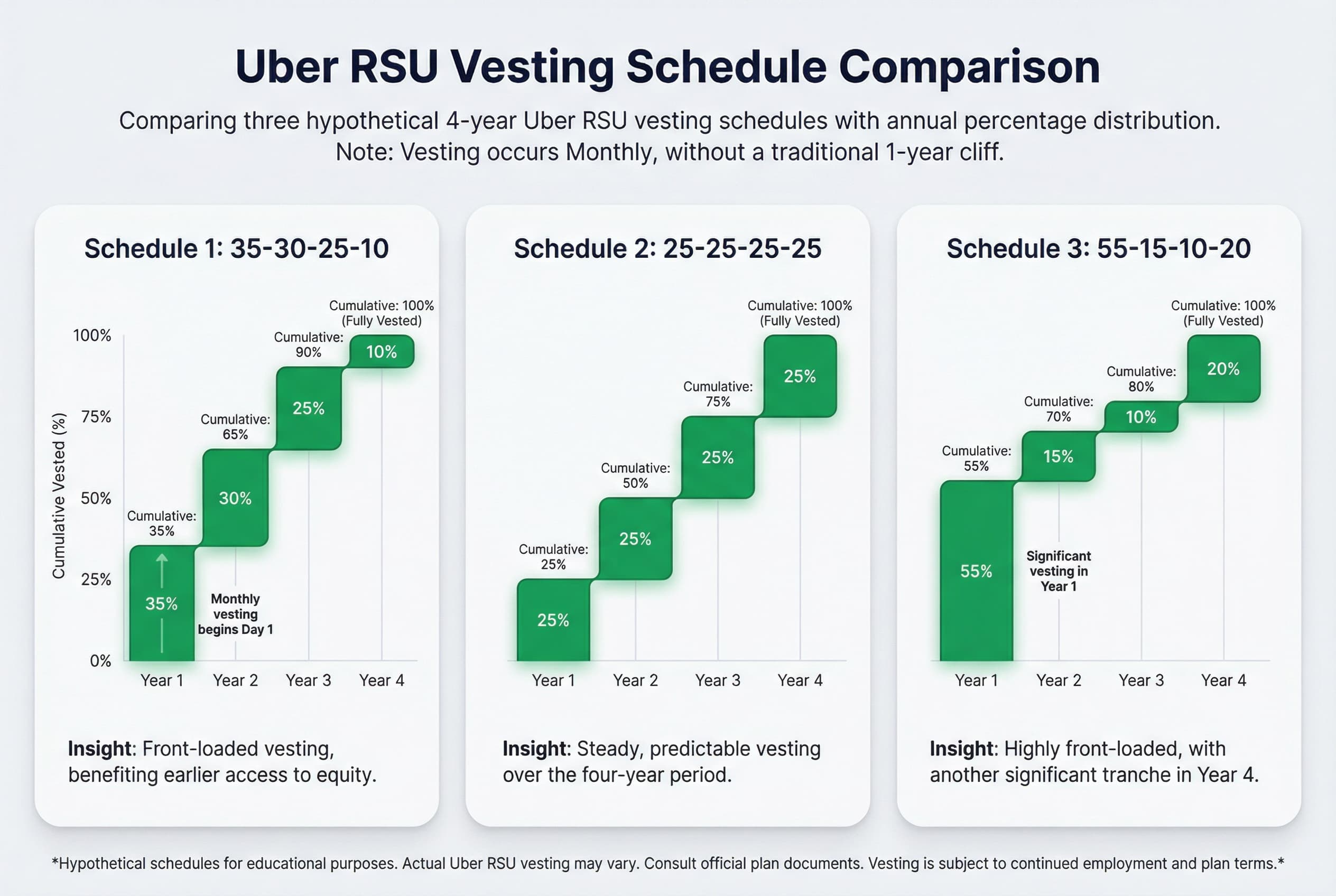
Uber RSUs vest on a 4-year schedules common, including 35-30-25-10, 25-25-25-25, and 55-15-10-20. Monthly vesting is standard for employees. schedule with a 12-month cliff.
Example calculation based on 100 shares:
| Year | Vesting % | Shares Vesting | Estimated Value |
|---|---|---|---|
| Year 1 | 25% | 25 | $1,815.75 |
| Year 2 | 25% | 25 | $1,815.75 |
| Year 3 | 25% | 25 | $1,815.75 |
| Year 4 | 25% | 25 | $1,815.75 |
| Total | 100% | 100 | $7,263 |
* Based on Uber stock price of $72.63 as of Sep 14, 2026. Actual values will vary.
25%
25 shares
$1,815.75
25%
25 shares
$1,815.75
25%
25 shares
$1,815.75
25%
25 shares
$1,815.75
Uber vesting schedule based on 100 total shares
Uber offers a comprehensive equity compensation package designed to align employee interests with the company's long-term success. As a publicly traded technology company, Uber provides Restricted Stock Units (RSUs) as the primary equity vehicle for most employees, along with both Incentive Stock Options (ISOs) and Non-Qualified Stock Options (NSOs). Additionally, employees can participate in the Employee Stock Purchase Plan (ESPP), which allows you to purchase Uber shares at a discount.
Equity compensation represents a significant portion of your total compensation package at Uber. As the company continues to grow and evolve in the competitive technology and transportation sectors, your equity grants give you direct ownership in the company's future performance. This means you benefit directly when Uber's stock price increases, making equity a powerful wealth-building tool alongside your base salary and bonuses.
Uber uses several RSU vesting schedules over a standard 4-year period with monthly vesting. Common schedules include 35-30-25-10, 25-25-25-25, and 55-15-10-20 distributions across the four years. Unlike some companies that require you to wait a full year before any shares vest (a "cliff"), Uber's monthly vesting means you begin accumulating vested shares each month. The company also provides stock refreshers to retain talent, though specific targets vary.
Understanding your equity compensation is crucial to maximizing your total rewards at Uber, and this guide will help you navigate the details of each program.
Uber uses a 4-year vesting schedule for RSUs, but unlike many tech companies, they offer multiple vesting structures rather than a single standard approach. The most common schedules are 35-30-25-10, 25-25-25-25, and 55-15-10-20, where the numbers represent the percentage of shares that vest each year.
One distinctive feature of Uber's equity compensation is that RSUs vest monthly rather than quarterly. This means you receive a portion of your grant every month over the 4-year period. Notably, there's no traditional one-year cliff mentioned in the available data, which differs from many tech companies where you must wait a full year before any shares vest. With monthly vesting, you begin receiving shares after your first month of employment.
The variation in vesting schedules creates different timing patterns for when you receive your equity:
Backloaded schedules like 35-30-25-10 give you more shares earlier (35% in year one), while frontloaded schedules like 55-15-10-20 heavily concentrate vesting in the first year. The uniform schedule of 25-25-25-25 distributes shares evenly across all four years.
Your specific vesting schedule may depend on your role, level, or when you joined the company. It's important to review your offer letter to understand which schedule applies to your grant, as this significantly impacts your compensation timeline.
Uber provides stock refreshers as part of ongoing compensation, though specific targets and frequency aren't publicly disclosed. These refresher grants help maintain competitive total compensation as your initial grant vests, but the amount and timing vary based on performance and company practices.
The monthly vesting cadence provides more regular equity income compared to quarterly schedules, and the lack of a cliff means you start building equity ownership immediately. However, understanding your specific vesting schedule percentage is crucial for financial planning, as the timing of when you receive the majority of your shares varies significantly between the different structures Uber uses.
Uber offers employees a valuable Employee Stock Purchase Plan that allows you to purchase company stock at a significant discount. The plan provides a 15% discount on the stock price, which already represents meaningful savings on your investment.
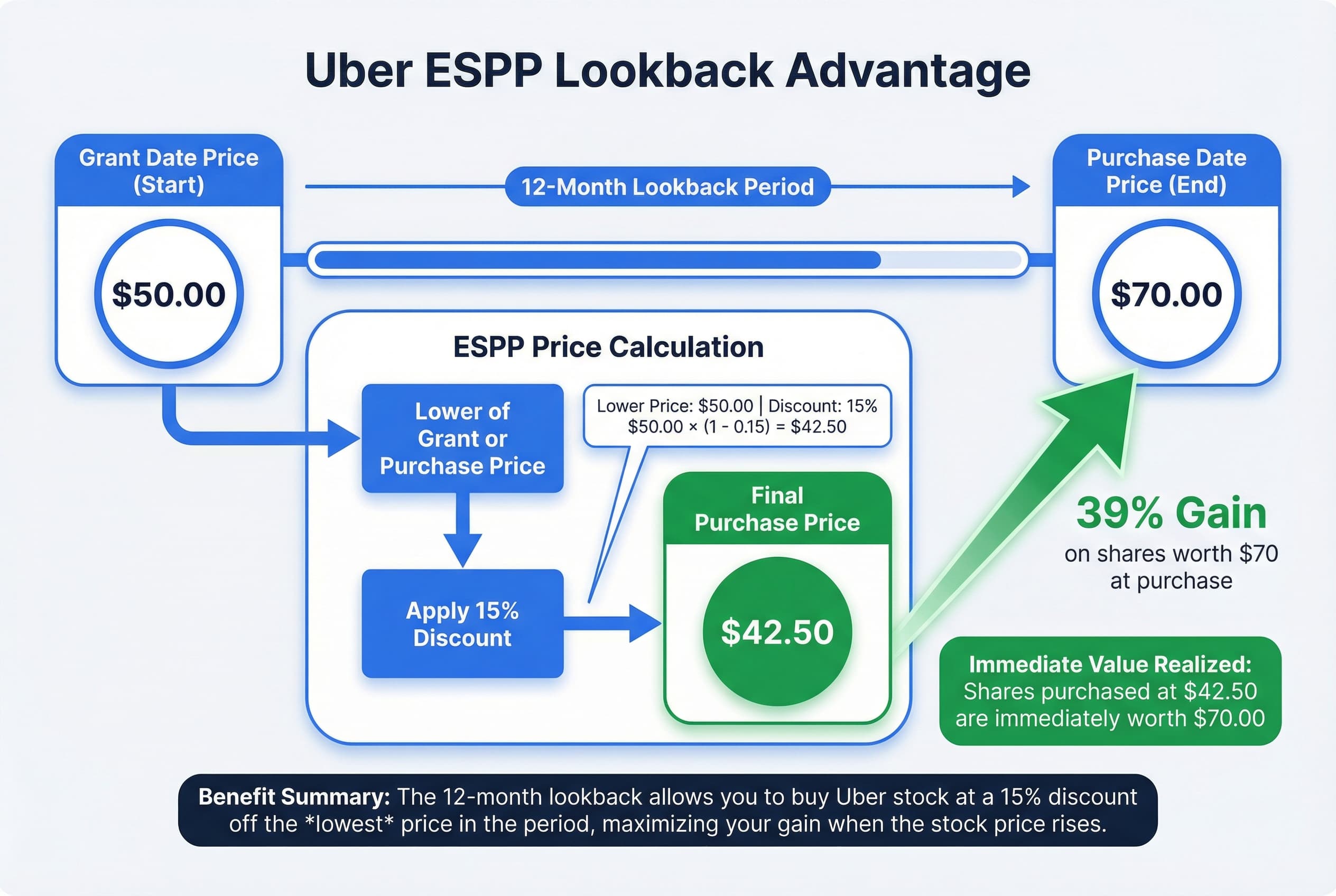
What makes Uber's ESPP particularly attractive is its lookback provision. With a 12-month lookback period, the purchase price is calculated using the lower of the stock price at either the beginning of the offering period or the purchase date. This means if Uber's stock price increases during the year, you benefit from both the lower starting price and the 15% discount applied to that price.
For example, if the stock starts at $50 and rises to $70 by purchase date, you'd buy at $42.50 (15% off the $50 starting price), giving you an immediate 39% gain on shares worth $70. This combination of the lookback and discount can generate substantial returns in a rising market.
You can contribute up to 15% of your base salary to the ESPP through payroll deductions. This allows you to systematically build your stock position while taking advantage of the discount and lookback feature.
When you eventually sell your ESPP shares, the tax treatment depends on your holding period. For a qualifying disposition under the Section 423 plan, you must hold the shares for over two years after the offering date. Qualifying dispositions receive more favorable long-term capital gains treatment on a portion of your gains. Disqualifying dispositions (selling earlier) result in the discount being taxed as ordinary income, though any additional appreciation may still qualify for capital gains treatment.
The combination of Uber's 15% discount and 12-month lookback makes this benefit worth serious consideration as part of your overall compensation strategy.
Understanding the tax treatment of your Uber equity awards is crucial for effective financial planning. Here's what you need to know about when and how your compensation will be taxed.
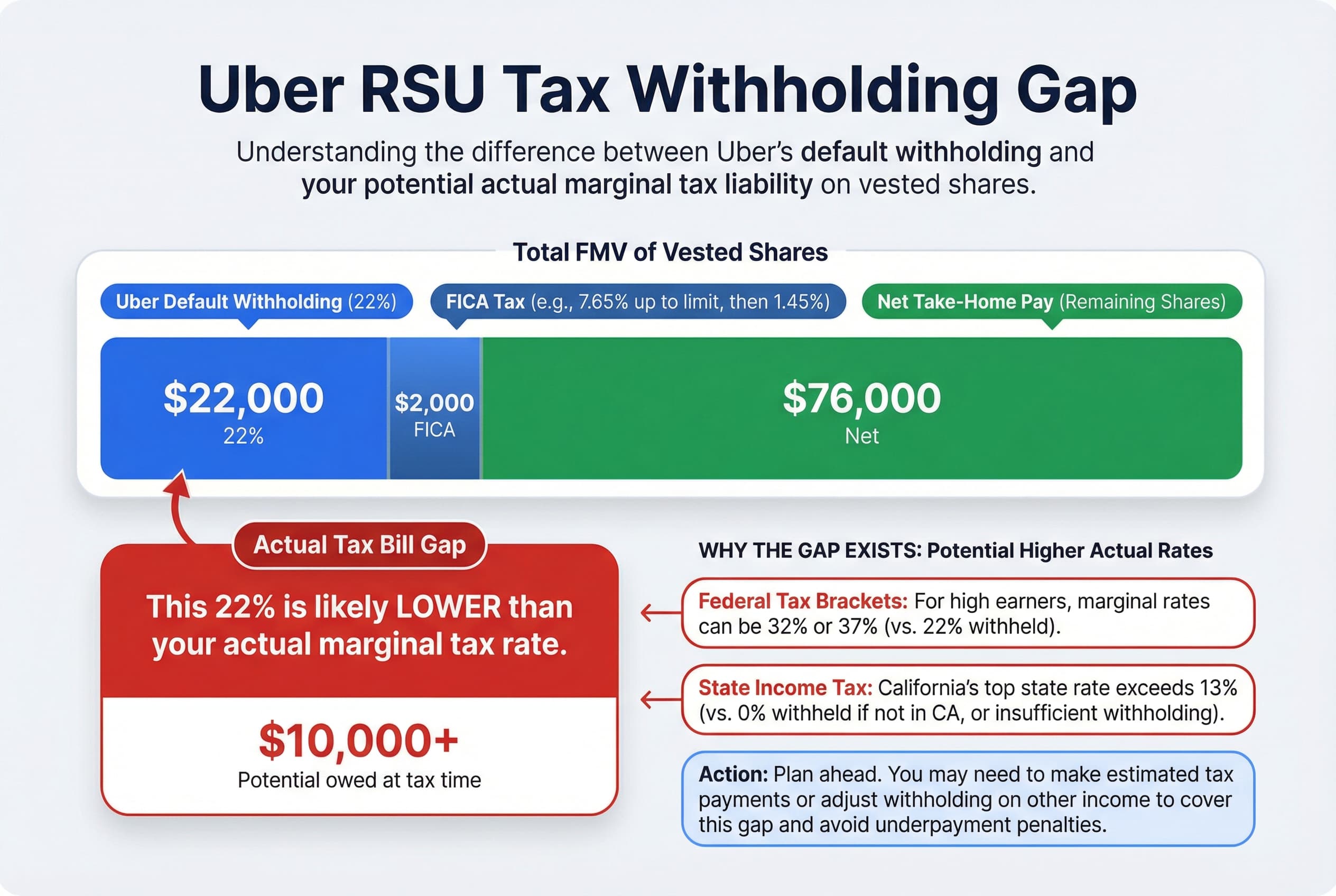
RSUs: You owe taxes at vesting, not when you sell. Since Uber RSUs vest monthly, you'll face tax obligations each month shares vest. The fair market value of vested shares is treated as ordinary income, just like your salary. Uber withholds at a default rate of 22%, though you can adjust this rate.
Stock Options (ISOs and NSOs): For NSOs, you owe ordinary income tax when you exercise based on the spread between the exercise price and current market value. ISOs receive preferential treatment - no regular tax at exercise, but you may trigger Alternative Minimum Tax (AMT) on the spread. You'll owe capital gains tax on both types when you eventually sell the shares.
ESPP: With Uber's 15% discount and 12-month lookback, you'll owe ordinary income tax on the discount (and potentially additional gain) when you sell shares. Holding shares for over two years from the offering date qualifies for more favorable tax treatment.
The 22% default withholding rate often falls short of your actual tax obligation, especially for higher earners. If you're in the 32% or 37% federal bracket, you could face a significant tax bill at year-end. California residents should be particularly mindful, as Uber is based in a high-tax state with top rates exceeding 13%, creating an even larger gap between withholding and actual liability.
RSU income at vest and option exercise spreads are taxed as ordinary income at your marginal rate. However, if you hold shares after vesting or exercise, subsequent appreciation qualifies for long-term capital gains treatment (currently 0%, 15%, or 20% federally) if held for more than one year.
Exercising ISOs can trigger AMT based on the spread between exercise price and fair market value. This is particularly relevant given Uber's stock volatility and the 10-year option expiration period.
Disclaimer: This information is educational only and not tax advice. Equity compensation taxation is complex and varies based on individual circumstances. Consult a qualified tax professional or CPA familiar with equity compensation before making decisions.
When Uber equity becomes a significant portion of your net worth, you're exposed to concentration risk - the danger of having too much wealth tied to a single company's performance. If Uber's stock declines, your compensation, retirement savings, and financial security could all suffer simultaneously.
As a technology company in the ride-sharing and delivery space, Uber faces unique challenges. The company operates in a highly competitive, regulation-sensitive industry with evolving profitability dynamics. Regulatory changes in different markets, shifts in consumer behavior, competitive pressures, and broader economic conditions can all significantly impact stock performance. Uber employees experienced this volatility firsthand when shares dropped from the $45 IPO price to around $27 during the lockup period, creating unexpected tax burdens for many.
Financial advisors commonly recommend keeping single-stock exposure under 10-20% of your total net worth. As your Uber RSUs vest monthly, consider regularly selling shares and reinvesting proceeds into diversified index funds, bonds, or other asset classes. This approach, sometimes called "diversify as you vest," helps you capture the value of your equity compensation while reducing company-specific risk.
Remember: your human capital - your job and future earnings - is already concentrated in Uber. Diversifying your investment portfolio provides crucial protection if the company faces headwinds, ensuring your financial future isn't entirely dependent on a single stock's performance.
With Uber's monthly vesting schedule, you'll receive shares regularly throughout your four-year grant period. Consider selling at least some shares upon vesting to reduce concentration risk, especially since tech stocks can be volatile. Many Uber employees use the auto-sell feature to treat RSUs as immediate income, which simplifies tax planning and prevents overexposure to a single stock.
Be aware of blackout periods if you're in a senior role or have access to sensitive information - these typically begin a couple weeks before quarterly earnings calls and end shortly after.
Uber equity represents both your income source and investment portfolio. Financial advisors often recommend limiting any single stock to 10-15% of your total investments. Since your salary already depends on Uber's success, holding too much stock compounds your risk. Consider establishing a systematic selling strategy to gradually diversify into broader market investments.
ESPP Optimization: Uber's ESPP offers a 15% discount with a 12-month lookback period, making it potentially valuable. However, holding shares for over two years after the offering date (qualifying disposition) can reduce your tax burden by converting ordinary income to capital gains. Balance this tax benefit against concentration risk.
RSU Tax Planning: RSUs are taxed as ordinary income at vesting (defaulting to 22% withholding, though you can adjust this). If you expect to be in a higher tax bracket, consider increasing withholding to avoid surprises at tax time.
Uber offers 10b5-1 trading plans, which allow you to establish predetermined selling schedules. These plans are particularly valuable if you're subject to blackout periods, as they permit sales during otherwise restricted windows. They also remove emotion from selling decisions and demonstrate compliance with insider trading rules.
Remember: equity should complement - not replace - traditional retirement savings and emergency funds.
Let's walk through how RSU vesting works for a new Uber employee to see exactly what you'd receive over time.
Sarah joins Uber as a software engineer and receives 40,000 RSUs as part of her offer. Her grant follows Uber's 35-30-25-10 vesting schedule over 4 years with monthly vesting (a common structure at the company).
Year 1: 35% of her grant vests = 14,000 RSUs
This equals approximately 1,167 RSUs per month
Year 2: 30% vests = 12,000 RSUs
Approximately 1,000 RSUs per month
Year 3: 25% vests = 10,000 RSUs
Approximately 833 RSUs per month
Year 4: 10% vests = 4,000 RSUs
Approximately 333 RSUs per month
Let's say in her first month, 1,167 RSUs vest when Uber stock is trading at $75 per share.
Gross value: 1,167 RSUs × $75 = $87,525
Tax withholding (22%): $87,525 × 0.22 = $19,256
Shares sold for taxes: $19,256 ÷ $75 = 257 shares
Net shares received: 1,167 - 257 = 910 shares
Net value: 910 × $75 = $68,250
Sarah receives 910 shares in her brokerage account, which she can hold or sell during open trading windows (outside of blackout periods). The process repeats monthly as more RSUs vest, with the actual value depending on Uber's stock price at each vesting date.
Uber allows employees to auto-sell RSUs upon vesting, making the equity function like additional cash income if preferred. The 22% withholding rate can be adjusted based on your tax situation.
Uber employees often miss opportunities or face unexpected challenges with their equity compensation. Here are key mistakes to avoid:
Many employees hold too much Uber stock, creating unnecessary risk. While monthly vesting provides regular opportunities to diversify, failing to sell shares over time can leave your financial future overly dependent on a single company's performance. Consider establishing a systematic selling strategy to maintain a balanced portfolio.
RSUs are taxed as ordinary income when they vest monthly. Uber withholds at a 22% default rate, which may fall short of your actual tax liability, especially for higher earners. This can lead to underpaying estimated taxes and facing a large bill at year-end. Review your total tax situation and adjust withholding or make quarterly estimated payments if needed.
Uber's ESPP offers a 15% discount with a 12-month lookback provision, allowing you to purchase shares at 85% of the lower price between the start and end of the offering period. This represents guaranteed value that many employees overlook. Even if you sell immediately, you're capturing significant gains.
Senior employees and those with access to sensitive information face trading blackouts around quarterly earnings. Waiting until you need cash to plan your sales can leave you unable to trade. Establish a Rule 10b5-1 trading plan in advance to sell shares automatically during blackout windows.
Understanding how your equity is affected when you leave Uber is crucial for making informed career decisions.
Unvested RSUs are forfeited upon termination. Since Uber uses monthly vesting schedules (commonly 35-30-25-10, 25-25-25-25, or 55-15-10-20 over four years), your termination date matters significantly. You'll keep any RSUs that vested through your last day of employment, but lose all unvested shares regardless of whether you leave voluntarily or are terminated.
Uber grants both ISOs and NSOs with a 10-year expiration period. However, specific details about the post-termination exercise window aren't publicly documented. Generally, you'll have a limited window (often 90 days) to exercise vested options after leaving, but you should confirm this timeframe with HR before your departure. Unvested options are typically forfeited.
If you leave mid-period while enrolled in Uber's ESPP, your contributions generally stop, and you may be able to withdraw accumulated funds or have them applied to a purchase at the end of the period, depending on the plan rules. Since Uber's ESPP offers a 15% discount with a 12-month lookback, timing your departure relative to purchase dates can impact your benefits.
Action item: Review your equity details in your grant documents and consult with Uber's HR or stock plan administrator before making any departure decisions to understand your specific situation.
This content is for educational purposes only and does not constitute financial advice. The information provided is general in nature and may not appl...
YourEmployeeStock.com is not a registered investment advisor.
Helpful videos explaining Uber equity compensation, vesting, and tax strategies.
𝐑𝐒𝐔 & 𝐄𝐒𝐏𝐏 Explained : Product Based Companies Benifits
Uber RSUs typically vest over 4 years with monthly vesting and no cliff. Common vesting schedules include 25-25-25-25 (equal quarterly amounts), 35-30-25-10 (front-loaded), or 55-15-10-20 (heavily front-loaded). The specific schedule depends on your offer and role level.
You keep any RSUs that have already vested by your departure date, but you forfeit all unvested RSUs. Vested RSUs remain yours as shares of Uber stock, which you can hold or sell according to your financial goals. Make sure to understand your vesting schedule before making employment decisions.
Uber's ESPP offers a 15% discount on stock purchases and includes a 12-month lookback provision, meaning you purchase at 85% of the lower price between the start and end of the offering period. You can contribute up to 15% of your base salary to the plan.
When your RSUs vest, they're taxed as ordinary income at their fair market value on the vesting date. Uber withholds 22% by default for federal taxes, though you can adjust this rate. You may owe additional taxes depending on your total income and tax bracket, and you'll also owe capital gains tax on any appreciation if you sell shares later.
Blackout periods at Uber typically start a couple weeks before quarterly earnings calls and end a couple days after. However, these restrictions generally only apply to employees above a certain level or those with access to sensitive information. If you're subject to blackouts, you can set up a Rule 10b5-1 trading plan to sell during blackout periods.
Stock options at Uber expire 10 years from the grant date. However, the specific post-termination exercise window (how long you have to exercise after leaving the company) is not publicly specified and will be detailed in your option agreement. Review your grant documents carefully before leaving to understand your deadline.
Yes, Uber provides stock refreshers as part of ongoing compensation, though specific targets and frequency are not publicly disclosed. Refresher grants help retain employees and supplement your initial equity grant as it vests over time.
For a qualifying disposition under Uber's ESPP, you must hold shares for over 2 years after the offering date (and 1 year after purchase). If you meet these requirements, you'll receive favorable tax treatment on the discount. Selling earlier results in a disqualifying disposition, where the discount is taxed as ordinary income.
Get a free personalized analysis from our equity compensation experts

