Free equity analysis
Complete guide to understanding your Apple equity compensation, including RSU, ESPP, vesting schedules, and tax strategies.
Stock Price
$333.08
Closing price · Sep 14, 2026
Employees
147K
Worldwide
Equity Programs
2
programs
Vesting Period
4 years
RSU vesting
Closing price · Sep 14, 2026
Apple offers 2 equity compensation programs to employees. Click on each program to learn more about eligibility, vesting, and tax implications.
Apple RSUs typically vest over 4 years with a 1-year cliff, followed by semi-annual vesting. Apple is known for selective but meaningful refresh grants for top performers. The company maintains a culture of rewarding long-term commitment.
Apple's ESPP offers standard 15% discount with lookback. A solid addition to the RSU program for building Apple stock position.
Apple RSUs vest on a 4-year vesting with semiannual vesting every April and October (12.5% every six months) schedule with a 12-month cliff.
Example calculation based on 100 shares:
| Year | Vesting % | Shares Vesting | Estimated Value |
|---|---|---|---|
| Year 1 | 25% | 25 | $8,327 |
| Year 2 | 25% | 25 | $8,327 |
| Year 3 | 25% | 25 | $8,327 |
| Year 4 | 25% | 25 | $8,327 |
| Total | 100% | 100 | $33,308 |
* Based on Apple stock price of $333.08 as of Sep 14, 2026. Actual values will vary.
25%
25 shares
$8,327
25%
25 shares
$8,327
25%
25 shares
$8,327
25%
25 shares
$8,327
Apple vesting schedule based on 100 total shares
Apple offers its employees two primary forms of equity compensation: Restricted Stock Units (RSUs) and an Employee Stock Purchase Plan (ESPP). These benefits allow you to share in the company's success and can represent a significant portion of your total compensation package.
As one of the world's most valuable technology companies, Apple's equity compensation gives you the opportunity to build wealth alongside the company's growth. RSUs represent actual shares of Apple stock that become yours over time, while the ESPP allows you to purchase shares at a discount. Both programs can be powerful wealth-building tools, especially given Apple's position as an industry leader.
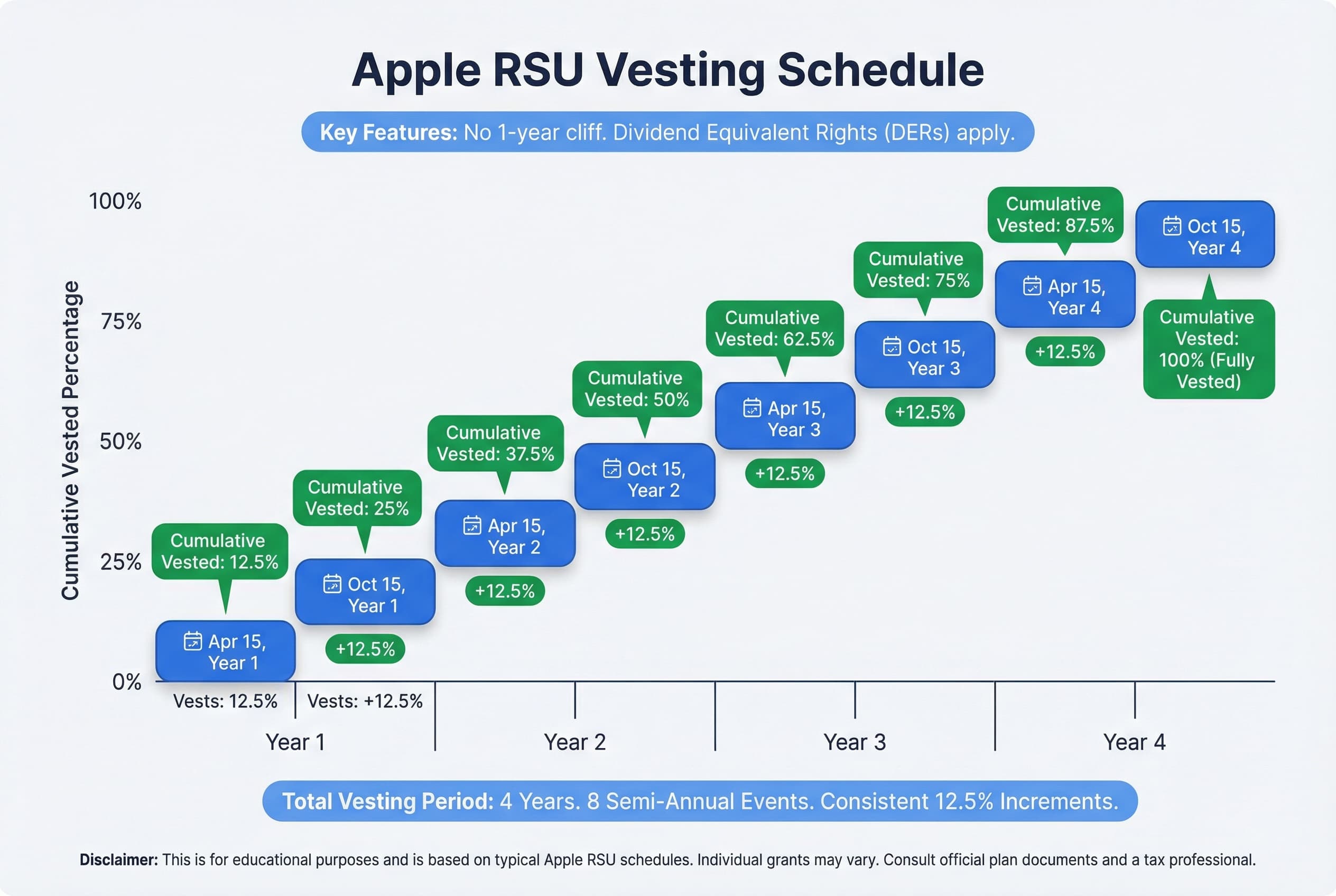
Apple's RSU program follows a 4-year vesting schedule with shares releasing semi-annually every April 15th and October 15th. You'll receive 12.5% of your total grant every six months, meaning you'll have eight vesting events over four years. The company also provides refresher grants to eligible employees to maintain ongoing equity incentives.
The ESPP operates on 6-month offering periods starting February 1st and August 1st. You can contribute up to 10% of your eligible compensation, and the plan includes a 15% discount with a lookback provision - meaning you'll purchase shares at 15% off the lower price between the offering start date and purchase date.
Understanding these programs is essential to maximizing your total compensation and making informed financial decisions throughout your Apple career.
Apple uses a straightforward 4-year vesting schedule for Restricted Stock Units (RSUs), with shares vesting uniformly throughout the period. Unlike many tech companies that use a 1-year cliff, Apple's vesting schedule does not include a cliff period, meaning you begin receiving shares from your very first vesting event.
Your RSUs vest semi-annually on specific dates: April 15th and October 15th each year. At each vesting event, you receive 12.5% of your total grant. This means you'll have eight vesting events over the four-year period, with equal portions releasing at each milestone.
This uniform distribution is advantageous because you start building equity ownership immediately without waiting through a cliff period. From your first April or October following your grant date, you'll receive shares every six months in equal installments.
Since Apple's RSU grants don't include a cliff, there's no waiting period where you must remain employed before any shares vest. This differs from companies with 1-year cliffs, where leaving before the one-year mark means forfeiting the entire grant. At Apple, if you leave after your first vesting date, you keep whatever has already vested - though you will forfeit any unvested portions.
Apple issues refresher grants in addition to your initial on-hire stock award. These refresher grants help maintain your equity compensation as your initial grant vests over time. However, specific details about refresher frequency and typical grant sizes vary by role and performance, and aren't publicly standardized.
Apple RSUs include Dividend Equivalent Rights (DERs), meaning you receive cash payments equivalent to dividends on your unvested shares. Additionally, if you take a personal leave of absence, your vesting schedule is tolled (paused) starting on the 31st day of leave.
Be aware that employees are subject to blackout periods that may restrict when you can sell vested shares, potentially limiting your ability to time sales around vesting dates. Planning ahead with a 10b5-1 trading plan can help navigate these restrictions.
Apple offers a compelling ESPP that allows employees to purchase company stock at a significant discount. The plan provides a 15% discount off the stock price, combined with a lookback provision that can substantially increase your potential returns.
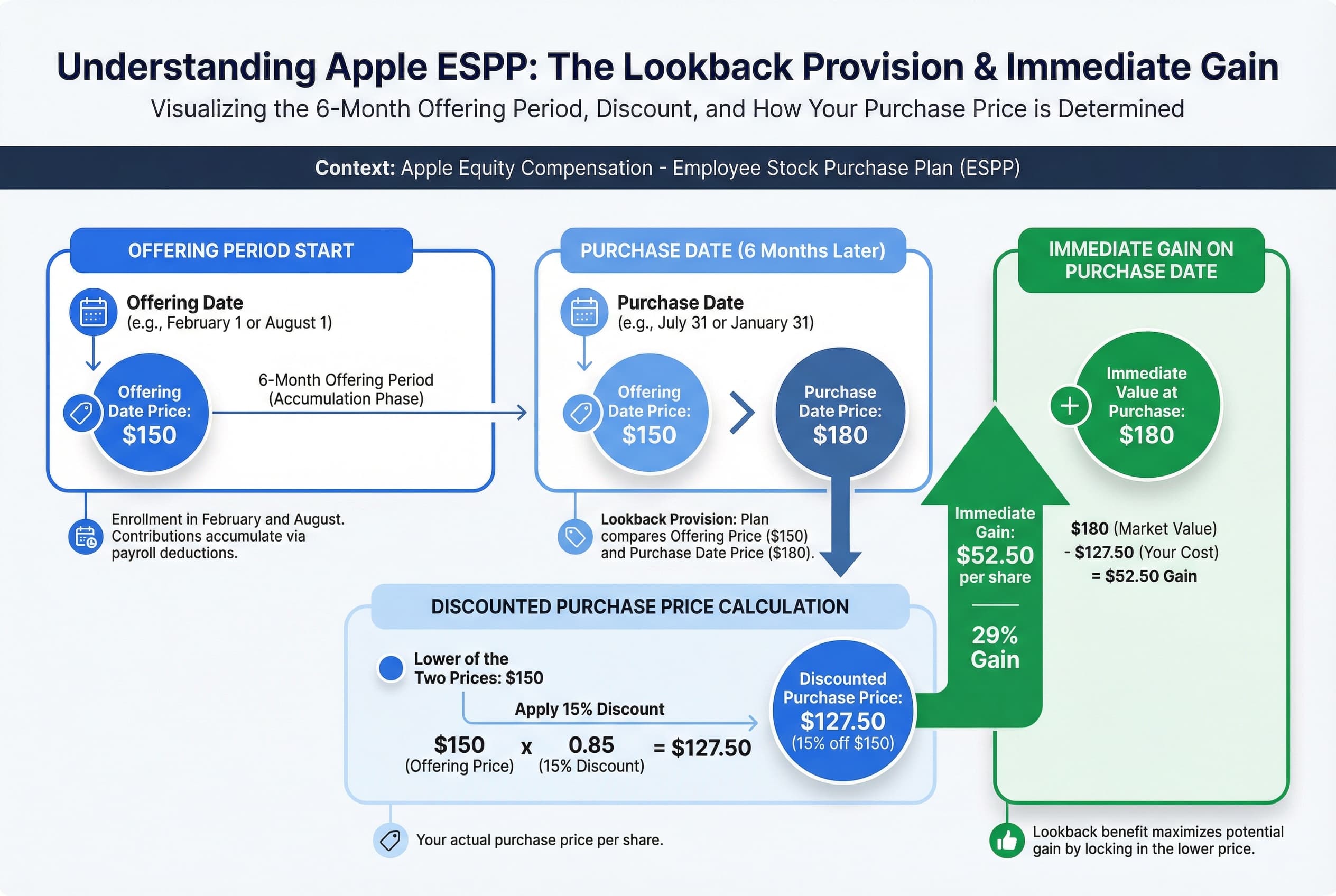
Apple's ESPP operates on 6-month offering periods starting February 1 and August 1. The lookback provision means you'll purchase shares at 15% off whichever price is lower: the stock price at the beginning of the offering period or the price at the end when shares are purchased. This feature can amplify your gains significantly when Apple's stock price rises during the offering period.
For example, if Apple stock is $150 at the start of the period and rises to $180 at purchase, you'd buy at $127.50 (15% off the $150 starting price), giving you an immediate 29% gain rather than just the 15% discount.
You can contribute up to 10% of your eligible compensation through payroll deductions. Due to IRS rules capping ESPP purchases at $25,000 in fair market value per year, combined with the 15% discount, your effective annual contribution limit is approximately $21,250.
Enrollment windows open twice per year in February and August, aligning with the offering period start dates.
To receive favorable long-term capital gains treatment on your ESPP shares, you must hold them for at least 1 year after purchase AND 2 years after the offering period start date (qualifying disposition). Selling before meeting both requirements results in a disqualifying disposition, where the discount is taxed as ordinary income.
Given the lookback provision and discount combination, Apple's ESPP represents one of the most valuable benefits available to employees.
Apple offers a competitive 401(k) plan with a company match that increases based on your tenure. The match structure is tiered by years of service: employees with less than 2 years receive a 50% match, those with 2-5 years get a 75% match, and employees with 5+ years of service receive a 100% match on up to 6% of base salary.
One of the standout features of Apple's 401(k) is immediate vesting - there's no waiting period to own your employer match contributions. This means you keep 100% of Apple's contributions even if you leave the company shortly after joining.
Apple's 401(k) plan includes robust features for sophisticated savers:
Beyond the 401(k), Apple contributes $750 annually to employee Health Savings Accounts (HSAs), providing another tax-advantaged savings opportunity for those enrolled in high-deductible health plans.
The combination of a generous match, immediate vesting, and mega backdoor Roth availability makes Apple's 401(k) plan particularly valuable for employees looking to maximize their retirement savings.
At Apple, you'll face taxes on your equity compensation at different times depending on the type of award. For RSUs, taxes are owed at vesting - specifically on each vesting date (April 15th and October 15th). The value of shares vesting is treated as ordinary income, just like your salary. For the ESPP, you'll owe taxes when you sell the shares, with the tax treatment depending on how long you hold them after purchase.
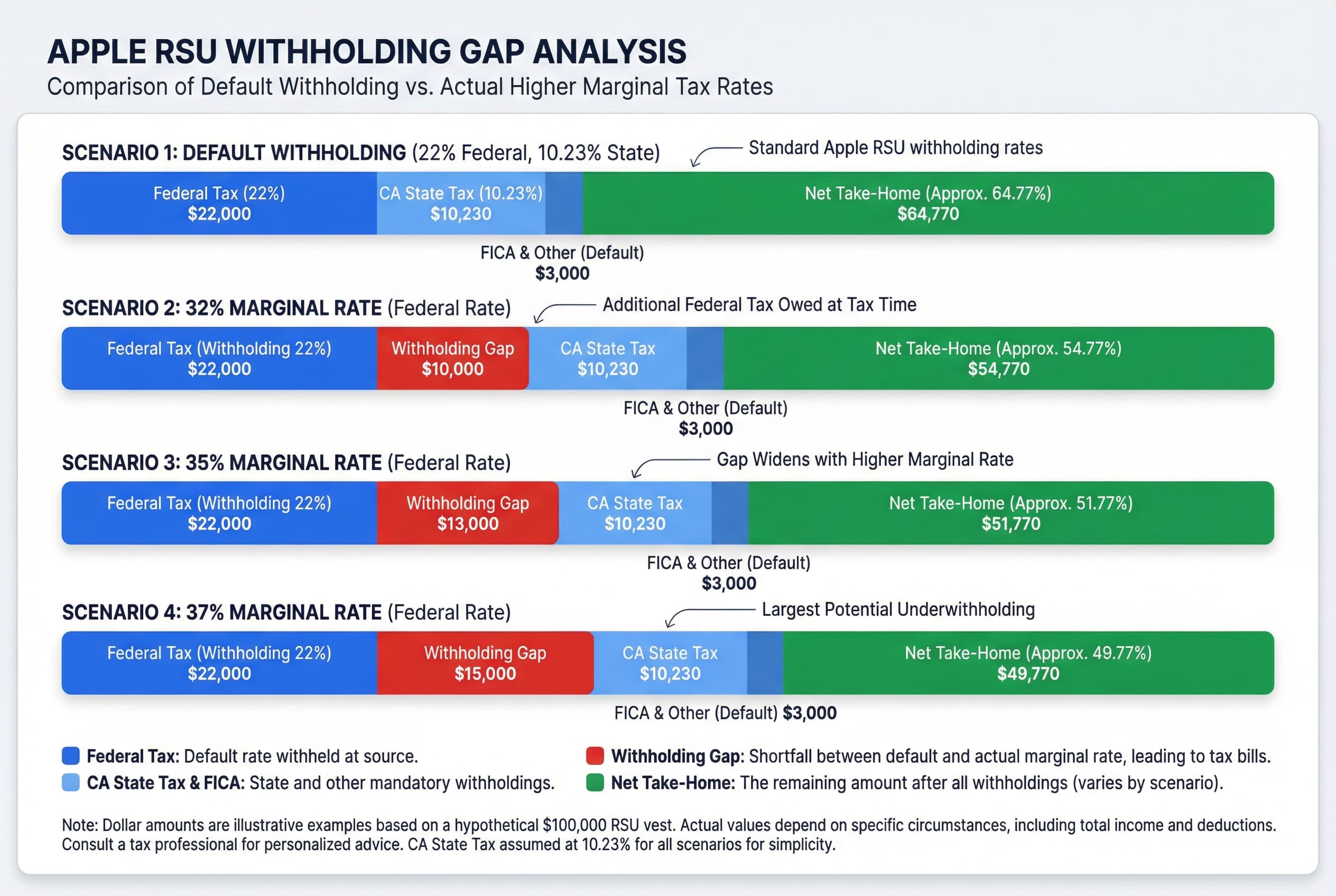
Apple's default tax withholding on RSUs is 22% for federal taxes (plus 10.23% for California state taxes if applicable). However, this creates a common problem: if your marginal tax rate is higher than 22% - which it likely is for many Apple employees - you'll be under-withheld. The supplemental withholding rate can go as high as 37% for high earners. This means you may owe additional taxes when filing your return. The good news is that Apple allows you to adjust your withholding rate to better match your actual tax liability.
RSU income at vesting is always taxed as ordinary income at your marginal rate. However, any appreciation from the vesting date to when you sell is taxed as capital gains - long-term if you hold for more than one year after vesting, short-term if less.
For ESPP shares, qualifying dispositions (holding at least 1 year after purchase AND 2 years after the offering period start) receive favorable tax treatment, with a portion taxed as long-term capital gains.
If you work in California, you'll face state income taxes in addition to federal taxes. California taxes ordinary income (including RSU vesting) at rates up to 13.3%, making the total tax burden on equity compensation substantial for high earners.
Disclaimer: This information is educational only and not tax advice. Tax situations vary based on individual circumstances. Please consult a qualified tax professional for personalized guidance on your equity compensation.
While Apple is one of the world's most valuable companies, concentrating too much of your wealth in any single stock - including your employer's - exposes you to significant risk. If Apple's stock declines, you could simultaneously face reduced net worth and potential job insecurity, creating a double impact on your financial well-being.
As a technology company, Apple faces unique challenges including rapid product cycles, intense competition, regulatory scrutiny, supply chain vulnerabilities, and shifting consumer preferences. The tech sector can experience heightened volatility compared to broader markets, making concentration risk particularly important to manage.
Financial advisors commonly recommend limiting single-stock exposure to 10-20% of your investable assets. With Apple's semi-annual RSU vesting schedule (every April and October) and ESPP purchases, your Apple holdings can grow quickly. Regular rebalancing becomes essential.
Consider selling shares after vesting to diversify into a broader portfolio of stocks, bonds, and other asset classes. While you may have confidence in Apple's future, remember that even successful companies can experience prolonged downturns. Note that blackout periods may restrict when you can sell, so plan your diversification strategy accordingly.
Balancing loyalty to your employer with prudent financial planning isn't disloyal - it's smart risk management that protects your long-term financial security.
Apple RSUs vest semi-annually on April 15th and October 15th, creating natural selling opportunities. Consider selling at vesting if Apple stock represents more than 20% of your investable assets - a common threshold for concentration risk. Be aware that blackout periods may restrict when you can trade, making 10b5-1 plans particularly valuable for planned sales.
As an Apple employee, you already have significant exposure to the company through your salary and future equity grants. When RSUs vest (remember, they include Dividend Equivalent Rights paid in cash), evaluate whether holding the shares aligns with your overall investment strategy. Diversifying into other sectors and asset classes reduces the risk of your wealth being tied to a single company's performance.
RSUs: Default withholding is 22% federal (plus 10.23% California if applicable), which may be insufficient if you're in a higher tax bracket. Consider adjusting your withholding or setting aside additional funds for tax time.
ESPP: Apple's plan offers a 15% discount with a 6-month lookback provision. To qualify for favorable long-term capital gains treatment, hold shares for at least one year after purchase and two years from the offering period start date. This qualifying disposition can significantly reduce your tax burden compared to selling immediately.
Factor in both your base salary and the value of vesting equity when evaluating total compensation. With semi-annual vesting at 12.5% per period and potential refresher grants, your equity can represent a substantial portion of annual income - plan your budget and tax obligations accordingly.
Apple offers 10b5-1 plans, which allow you to establish predetermined selling schedules. These plans let you sell shares during blackout periods and remove emotion from selling decisions, making them valuable tools for systematic diversification.
Let's walk through a typical RSU grant to see exactly how vesting works and what you'll receive.
Imagine you join Apple and receive 800 RSUs as part of your compensation package. At Apple, RSUs vest over 4 years with 12.5% vesting every six months on April 15th and October 15th.
Here's how your 800 RSUs vest:
This pattern continues every six months until all 800 shares vest after 4 years.
When your first 100 shares vest in April, they're treated as ordinary income. Let's say Apple stock is trading at $180 per share on that vesting date.
Gross value: 100 shares × $180 = $18,000
Apple withholds taxes automatically at their default rate of 22% federal (plus state taxes if applicable):
Federal withholding: $18,000 × 22% = $3,960
Shares withheld for taxes: approximately 22 shares
After withholding, you'll receive approximately 78 shares deposited into your brokerage account. At $180/share, that's worth $14,040.
You can hold these shares or sell them immediately. Remember that if your actual tax rate is higher than 22%, you'll owe additional taxes when you file your return. Apple also pays Dividend Equivalent Rights in cash for any dividends during the vesting period.
This process repeats every six months until your full grant vests over four years.
Even experienced Apple employees can stumble when managing their equity benefits. Here are the most frequent missteps to avoid:
The biggest risk is holding too much company stock. Financial advisors often recommend keeping no more than 20% of your investable assets in a single stock. With RSUs vesting every six months and potential ESPP purchases, Apple stock can quickly dominate your portfolio, exposing you to unnecessary risk if the company's performance declines.
Apple's default federal withholding rate is 22%, but if you're in a higher tax bracket, you'll owe additional taxes at filing. Employees in the 32%, 35%, or 37% brackets often face unexpected tax bills because the withholding doesn't cover their actual liability. Consider adjusting your withholding rate or setting aside cash to cover the gap.
Apple's ESPP offers a 15% discount with a six-month lookback provision - a powerful benefit that many employees overlook. Enrollment happens only twice yearly (February and August), so missing these windows means waiting months to participate.
Blackout periods can prevent you from selling shares when you'd like. Plan your stock sales strategically and consider using a 10b5-1 trading plan to execute sales during blackout windows.
Apple RSUs include cash dividend payments, which are taxable income when received - don't overlook this additional tax obligation.
Understanding how your equity is affected when you leave Apple is crucial for financial planning, as the timing and circumstances of your departure can significantly impact your compensation.
When you leave Apple, any unvested RSUs are forfeited, regardless of whether your departure is voluntary or involuntary. This is one of the most important considerations when planning your exit. Apple's RSUs vest semi-annually on April 15th and October 15th, so the timing of your termination date matters significantly. If you leave on April 14th, you'll miss that vesting event, but if you wait until April 15th, those shares will vest before your departure.
It's worth noting that Apple's RSU vesting is tolled (paused) starting on the 31st day of a personal leave of absence, which could affect your vesting timeline if you take extended leave before terminating employment.
If you leave Apple during an active ESPP offering period, your participation typically ends, and you'll forfeit any contributions made during that period. The ESPP operates on six-month cycles starting February 1st and August 1st, so timing your departure around purchase dates can help you avoid losing accumulated contributions.
Based on available data, Apple does not appear to grant stock options as part of standard employee compensation packages, so post-termination exercise windows are not applicable for most employees.
This content is for educational purposes only and does not constitute financial advice. The information provided is general in nature and may not appl...
YourEmployeeStock.com is not a registered investment advisor.
Helpful videos explaining Apple equity compensation, vesting, and tax strategies.
Getting the Most from Your Apple RSUs
Equity Compensation 101: How RSUs, ISOs, NSOs, and ESPP Plans Work
Apple RSUs vest semi-annually over 4 years, with 12.5% vesting every six months. Vesting occurs on the 15th day of April and October, meaning you'll receive eight equal installments starting six months after your grant date. You'll also receive Dividend Equivalent Rights (DERs) paid in cash during the vesting period.
Apple defaults to withholding 22% for federal taxes (plus 10.23% for California state taxes if applicable) when your RSUs vest. However, if your actual marginal tax rate is higher than 22%, you may owe additional taxes at year-end. You can adjust your withholding rate to better match your tax situation.
If you voluntarily leave Apple, you will forfeit any unvested RSUs. Only the RSUs that have already vested by your departure date will remain yours to keep. This is a common concern for employees considering leaving before their full 4-year vesting schedule is complete.
Apple's ESPP allows you to contribute up to 10% of your salary to purchase Apple stock at a 15% discount. The plan has 6-month offering periods starting February 1 and August 1, and includes a lookback provision that applies the discount to whichever price is lower—the offering date or purchase date. This can result in significant savings if the stock price increases during the period.
You can enroll in Apple's ESPP twice per year during enrollment windows that begin in February and August. Each offering period lasts 6 months, with purchases occurring semi-annually. Plan ahead to ensure you don't miss the enrollment window for the period you want to participate in.
To qualify for long-term capital gains treatment on your ESPP shares, you must hold them for at least 1 year after the purchase date AND 2 years after the start of the offering period. Meeting both requirements allows you to pay lower long-term capital gains rates on a portion of your profit instead of ordinary income tax rates.
Yes, Apple employees are subject to blackout periods during which you cannot trade Apple stock. These blackout periods may cause you to miss opportunities to sell shares when you'd prefer to. Apple does offer 10b5-1 trading plans, which allow you to set up pre-scheduled trades that can execute even during blackout periods.
Yes, Apple issues both on-hire stock awards and stock refresher grants to employees. While the specific frequency and amounts vary, refresher grants help ensure ongoing equity compensation beyond your initial grant. These refreshers follow the same semi-annual vesting schedule as your original RSU grants.
Get a free personalized analysis from our equity compensation experts

