Free equity analysis
Complete guide to understanding your Oracle equity compensation, including RSU, NSO, ESPP, vesting schedules, and tax strategies.
Employees
212.6K
Worldwide
Equity Programs
3
programs
Vesting Period
4 years
RSU vesting
Oracle offers 3 equity compensation programs to employees. Click on each program to learn more about eligibility, vesting, and tax implications.
Standard RSU program with 4-year vesting and 1-year cliff. Annual refresh grants available for eligible employees.
Learn about Oracle's Non-Qualified Stock Options program, including vesting schedules and tax treatment.
Learn about Oracle's Employee Stock Purchase Plan program, including vesting schedules and tax treatment.
Oracle offers a comprehensive equity compensation package designed to align employee interests with long-term company performance. As a major technology company with over 212,000 employees, Oracle provides several equity vehicles including Restricted Stock Units (RSUs), Non-Qualified Stock Options (NSOs), Restricted Stock Awards (RSAs), and an Employee Stock Purchase Plan (ESPP).
Equity compensation represents a significant portion of total compensation at Oracle, with typical RSU grants ranging from $100,000 to $550,000 in target value. Annual refresher grants are offered to most employees (though not guaranteed), with examples of $100,000-$200,000 refreshers over four years at mid-level positions. This equity component allows you to participate in Oracle's growth as a leading enterprise software and cloud infrastructure provider.
Oracle uses multiple vesting schedules for RSUs, which can vary by grant:
Stock options (NSOs) vest at 25% per year over four years and remain exercisable for 90 days after employment ends. The ESPP offers a 5% discount on Oracle stock through semi-annual purchase periods, allowing contributions up to $25,000 or 10% of compensation annually.
Understanding these vesting schedules is crucial, as unvested equity is forfeited upon separation from the company.
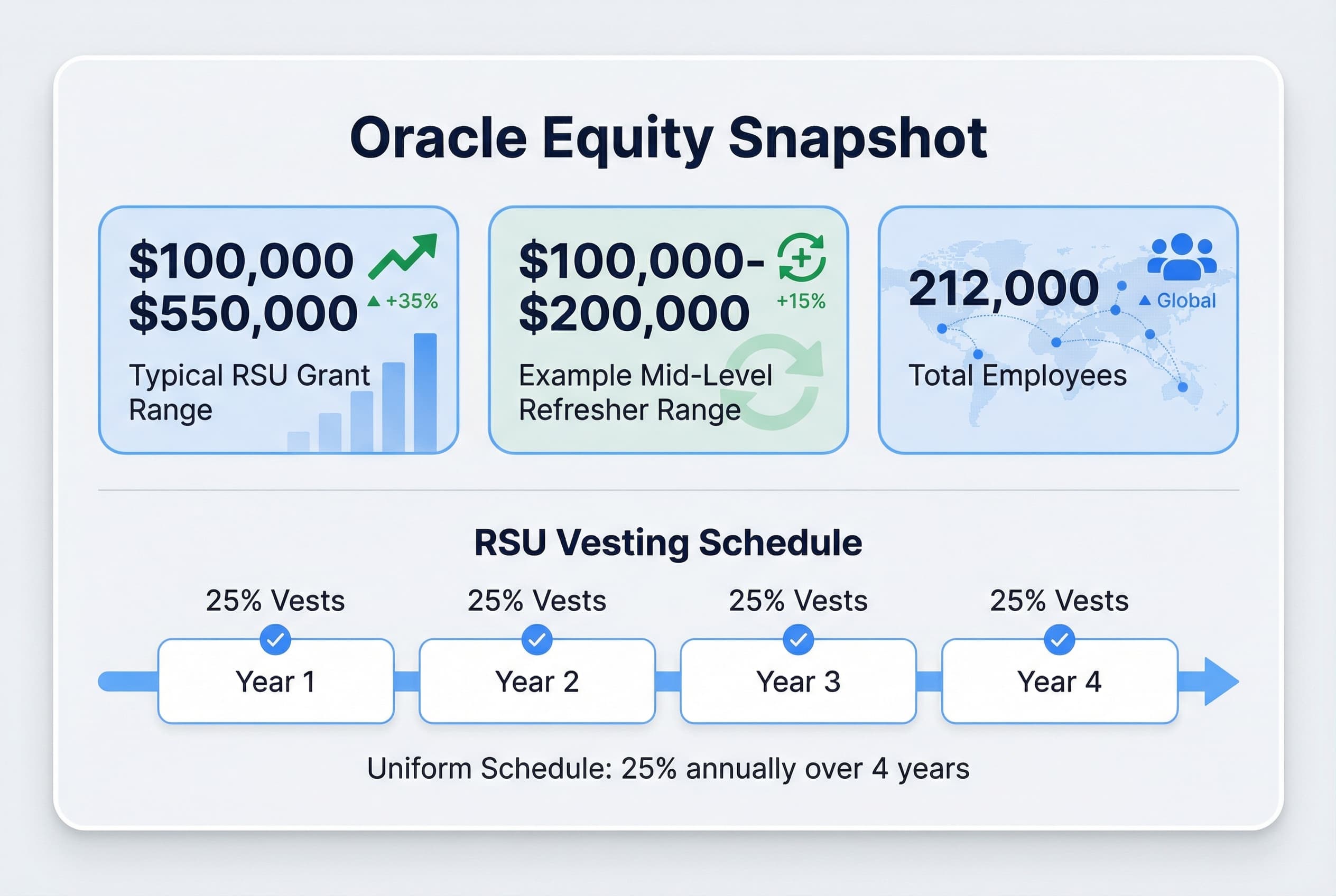
Oracle uses multiple vesting schedule variants for RSU grants, which can make understanding your equity timeline more complex than at some other tech companies. Unlike many competitors that use quarterly vesting, Oracle primarily vests RSUs on an annual basis, though the specific pattern varies by grant type.
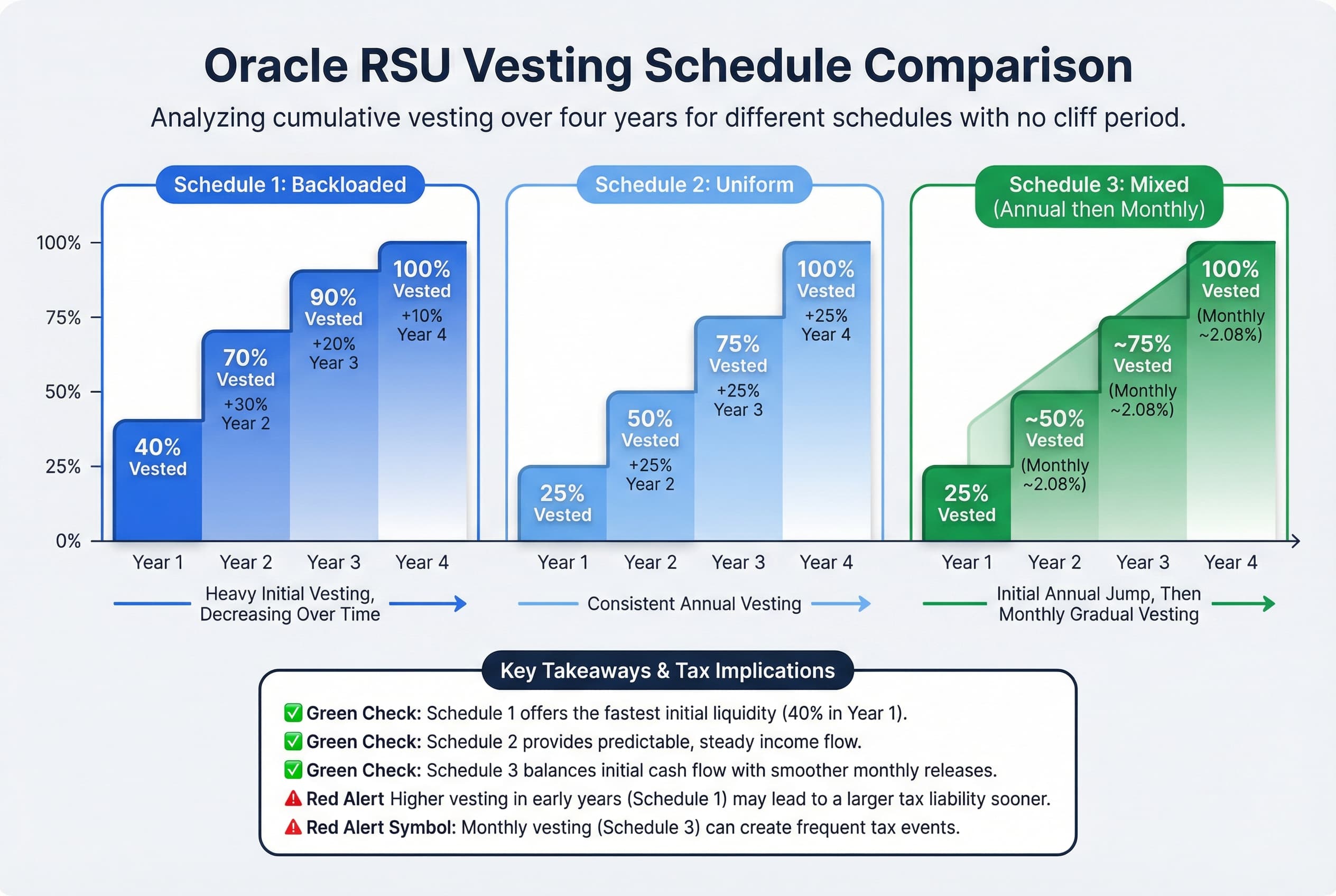
Most Oracle RSU grants follow a 4-year vesting schedule with no cliff period. However, the company employs three distinct vesting patterns:
Schedule 1 (Backloaded): 40% in year one, 30% in year two, 20% in year three, and 10% in year four. This frontloads your compensation significantly.
Schedule 2 (Uniform): A straightforward 25% annually over four years, providing equal amounts each year.
Schedule 3 (Mixed): 25% vests after the first year, then the remaining 75% vests monthly at approximately 2.08% per month over the following three years.
The vesting frequency depends on which schedule applies to your grant. Schedules 1 and 2 vest annually, while Schedule 3 transitions to monthly vesting after the first year. Reports suggest vesting may occur approximately one year and one month after your start date for the first tranche, with some grants tied to fixed dates like October, though specific vesting dates can vary.
Important: Oracle's vesting dates are fixed and inflexible. Missing your vesting date means forfeiting that portion of your grant, so staying aware of your schedule is critical.
Unlike some companies that require you to stay for one year before any equity vests, Oracle RSU grants typically have no cliff period. This means vesting begins according to your schedule from the start, whether that's after one year for annual schedules or sooner for mixed schedules.
Oracle offers annual refresher grants to most employees, though they're not guaranteed. These can be quite generous - for example, IC3-level employees might receive $100,000-$200,000 in refresher grants. Refreshers typically vest over 4 years using one of the same vesting schedules as your initial grant.
Oracle offers an Employee Stock Purchase Plan that allows you to purchase company stock at a discount through payroll deductions. However, it's important to understand that Oracle's ESPP is notably less generous than many other technology companies.
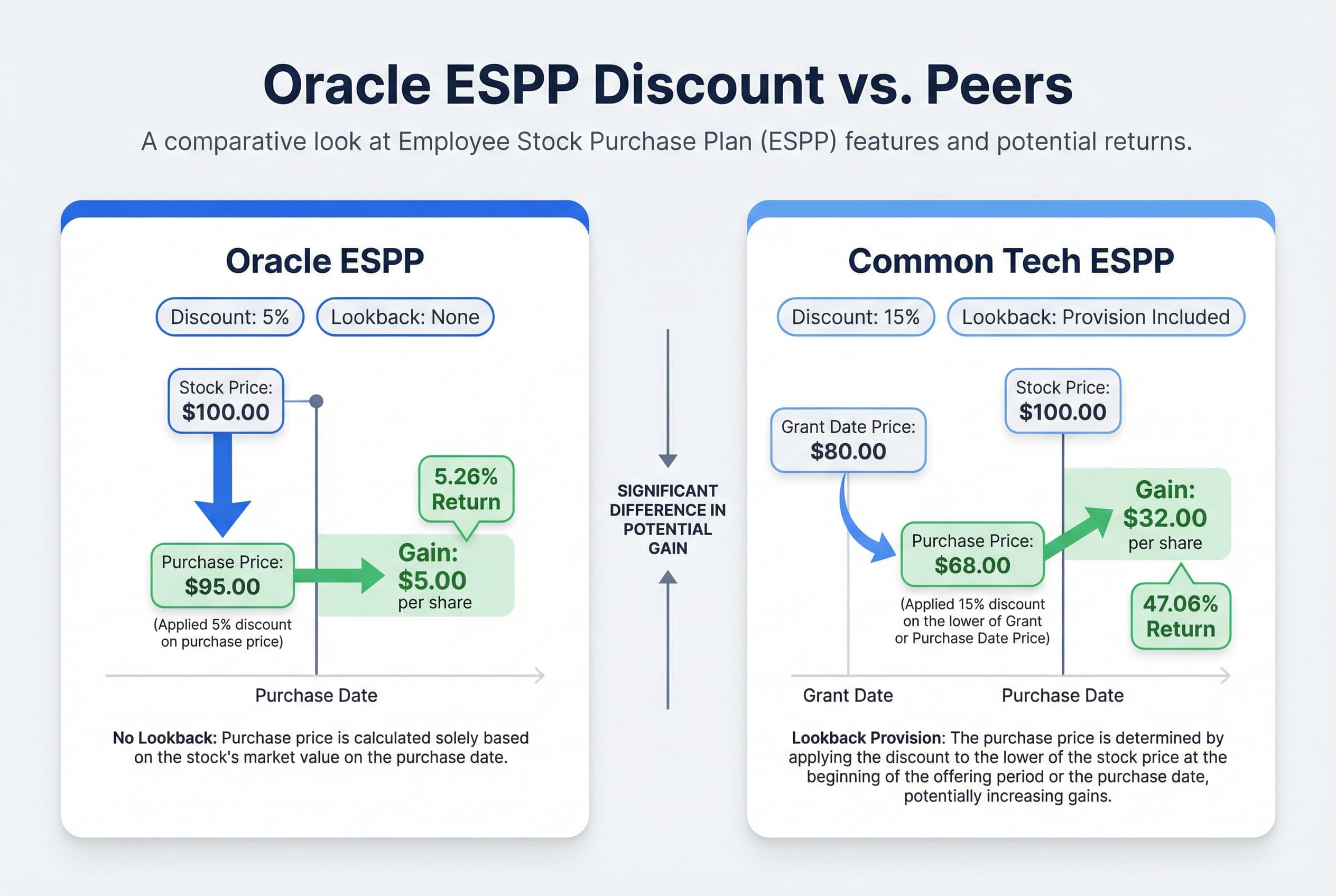
Oracle's ESPP provides a 5% discount on the stock purchase price, which is significantly lower than the 15% discount commonly offered at other tech companies. Additionally, there is no lookback provision, meaning you don't benefit from comparing prices at the beginning and end of the offering period. You simply receive a 5% discount on the market price at the time of purchase.
The ESPP operates on 6-month offering periods, with purchases occurring semi-annually. Enrollment windows typically open twice per year, around January and July, corresponding to offering periods starting approximately April 1 and October 1.
You can contribute up to 10% of your eligible compensation, with a maximum annual contribution of $25,000 across all purchase periods. This aligns with IRS regulations for employee stock purchase plans.
With only a 5% discount and no lookback provision, your immediate gain is limited to that 5% discount. For example, if Oracle stock is trading at $100 per share at the purchase date, you'd pay $95 per share - a guaranteed 5.26% return on your contribution. While this is still a positive return for essentially no risk, it's considerably less attractive than ESPPs at peer companies that offer 15% discounts with lookback provisions, which can generate returns of 15% or higher.
To receive favorable tax treatment (qualifying disposition), you must hold the shares for at least 2 years from the offering date AND at least 1 year from the purchase date. Selling before these periods results in a disqualifying disposition, where the discount is taxed as ordinary income.
Oracle offers a 401(k) plan with employer matching to help you build long-term retirement savings. The company provides a 50% match on up to 6% of your salary, with a maximum annual match of $5,100. This means if you contribute 6% of your salary, Oracle will add an additional 3%, helping accelerate your retirement savings.
The employer match follows a 4-year vesting schedule at 25% per year. This means you'll own 25% of Oracle's contributions after one year, 50% after two years, 75% after three years, and be fully vested after four years of service. Your own contributions are always 100% vested immediately.
Oracle's 401(k) plan includes several advanced features for tax optimization:
Note that equity compensation (such as RSU values) is explicitly excluded from 401(k) contribution calculations, so your match is based solely on base salary and eligible cash compensation.
While Oracle does not currently offer a brokerage window for self-directed investments within the 401(k), the combination of employer matching and Roth conversion options provides solid retirement planning flexibility.
Understanding the tax treatment of your Oracle equity compensation is crucial for effective financial planning. Here's what you need to know about when and how your stock benefits are taxed.
Restricted Stock Units (RSUs): You owe taxes at vesting, not when you sell the shares. When your RSUs vest (whether annually or monthly, depending on your schedule), Oracle treats the value of the shares as ordinary income. This is true regardless of whether you immediately sell the shares or hold them.
Non-Qualified Stock Options (NSOs): You face two potential tax events. First, when you exercise your options, the difference between the exercise price and the fair market value is taxed as ordinary income. Second, when you sell the shares, any additional gain or loss is treated as a capital gain or loss.
Employee Stock Purchase Plan (ESPP): Oracle's ESPP with its 5% discount creates taxable income. If you meet the qualifying disposition period (holding for at least 2 years after the offering date AND at least 1 year after the purchase date), the discount is taxed as ordinary income, and any additional gain receives favorable long-term capital gains treatment. Non-qualifying dispositions result in the bargain element being taxed as ordinary income.
Oracle can adjust tax withholding rates on equity compensation. However, the supplemental wage withholding rate may not cover your full tax liability, especially if you're in a higher tax bracket. This creates a common "gap" where you may owe additional taxes at year-end. Consider setting aside extra funds or adjusting your W-4 withholding to avoid surprises.
The distinction matters significantly. Ordinary income (RSU vesting, NSO exercise spread, ESPP discount) is taxed at your regular income tax rate. Capital gains on shares held longer than one year qualify for lower long-term capital gains rates, potentially saving you substantial tax dollars.
This information is educational only and not tax advice. Tax laws are complex and individual situations vary. Always consult with a qualified tax professional or financial advisor to understand your specific tax obligations and optimize your equity compensation strategy.
While Oracle equity compensation can be valuable, concentrating too much of your wealth in a single stock - even a major enterprise software company - exposes you to significant risk. If Oracle's stock price declines, you could simultaneously face reduced net worth and potential job insecurity, creating a double financial impact.
As a technology company, Oracle faces sector-specific challenges including intense competition in cloud infrastructure, shifts in enterprise software preferences, and rapid technological change. The enterprise software market is highly competitive, and Oracle's performance is tied to business technology spending cycles. These industry dynamics can create volatility that affects your equity value independently of your job performance.
Financial advisors commonly recommend limiting single-stock exposure to 10-20% of your total net worth. This guideline helps protect you from company-specific risks while still allowing you to benefit from Oracle's growth potential. Consider your entire financial picture: if Oracle stock represents your equity grants, ESPP holdings, and any shares you've retained after vesting, the concentration may be higher than you realize.
Regularly review your Oracle holdings across all programs - RSUs, NSOs, and ESPP shares. As equity vests, consider selling portions to rebalance your portfolio into diversified investments. This approach lets you capture the value of your compensation while managing risk prudently.
Oracle's RSU vesting structure - which can be annual, backloaded (40/30/20/10), or mixed - creates concentrated vesting events that warrant strategic planning. Consider selling a portion of vested RSUs immediately upon vesting to avoid overconcentration in a single stock. This is particularly important given Oracle's annual vesting schedules, where you may receive large blocks of shares at once rather than the quarterly vesting common at other tech companies.
As a technology company employee, your human capital (salary and career prospects) is already tied to the tech sector. Holding significant Oracle stock creates a "double exposure" risk - if the tech sector struggles, both your job security and equity value could decline simultaneously. Financial advisors typically recommend limiting any single stock to 10-15% of your investment portfolio. Review your holdings after each vesting event and consider whether your Oracle concentration exceeds prudent levels.
ESPP Timing: Oracle's ESPP offers a modest 5% discount with no lookback provision and semi-annual purchase periods (enrolling around January and July). To qualify for favorable long-term capital gains treatment, hold shares for at least two years from the offering date AND one year from the purchase date. However, given the small discount, immediate sale upon purchase (quick flip) may be reasonable to capture the guaranteed 5% return without market risk.
RSU Tax Planning: RSUs are taxed as ordinary income at vesting. You can adjust your withholding rate, so consider whether the default withholding adequately covers your tax liability, especially if you're in a high tax bracket.
Oracle's compensation structure relies heavily on RSUs, with grants ranging from $100k-$550k. Factor vesting schedules into your cash flow planning, recognizing that annual vesting creates lumpy income rather than steady quarterly payments.
Let's walk through a typical Oracle RSU grant to see how vesting works in practice.
Sarah, an IC3 engineer, receives a new hire RSU grant worth $360,000 over 4 years. Oracle uses a backloaded vesting schedule (40/30/20/10), which means:
Year 1 Anniversary (October 2024) Sarah's first vesting occurs. Oracle stock is trading at $120 per share.
Tax Withholding Oracle must withhold taxes when RSUs vest. Using a typical supplemental wage rate of 22% federal plus 8% state (30% total):
Year 2: $108,000 vests (similarly taxed, net ~$75,600)
Year 3: $72,000 vests (net ~$50,400)
Year 4: $36,000 vests (net ~$25,200)
At Oracle, vesting dates are fixed and annual for this schedule type. If Sarah leaves Oracle before a vesting date - even one day before - she forfeits all unvested shares. The shares have no voting rights or dividends until they vest and settle.
Oracle also offers annual refresher grants (typically $100K-$200K for IC3 roles), which vest over another 4 years, creating overlapping vesting schedules that smooth out the backloaded structure over time.
Oracle employees frequently make avoidable errors that can cost them thousands in equity value. Here are the most critical mistakes to watch for:
Oracle uses multiple RSU vesting schedules - some vest uniformly (25% annually), others are backloaded (40/30/20/10), and some vest monthly after the first year. Not knowing your specific schedule can lead to poor financial planning and surprise tax bills when larger portions vest.
With RSUs representing a significant portion of total compensation, many employees become overly concentrated in ORCL stock. This creates unnecessary risk - if the company underperforms, both your job security and investment portfolio suffer simultaneously. Diversify as shares vest.
Oracle's Employee Stock Purchase Plan offers a 5% discount with semi-annual purchase periods. While the discount is modest compared to some tech companies, it's still an immediate return on investment. Many employees skip enrollment entirely, leaving free money on the table.
RSU vesting creates ordinary income, but default withholding may not cover your full tax liability, especially if you're in a higher tax bracket. Failing to adjust withholding or pay estimated taxes can result in penalties and a significant tax bill at year-end.
If you have stock options and leave Oracle, you have only 90 days to exercise vested options before they expire. Many departing employees miss this deadline and forfeit valuable equity.
Understanding what happens to your equity compensation when you leave Oracle is crucial for financial planning. Here's what you need to know:
All unvested RSUs are forfeited immediately upon separation, regardless of whether you resign voluntarily or are terminated involuntarily. This applies to all termination scenarios except death. Oracle's vesting dates are fixed, and missing a vesting date - even by days - means losing that portion of your grant entirely.
If you hold vested stock options, you have 90 days (3 months) from your termination date to exercise them. Any unvested options are forfeited. After the 90-day window closes, you lose the right to exercise even vested options. All options expire 10 years from the original grant date.
If you leave Oracle during an active ESPP offering period, your participation typically ends, and accumulated payroll deductions are returned to you. You won't receive shares for that incomplete period.
Your exact termination date matters significantly. If you leave just before a scheduled vesting date, you forfeit that entire vesting tranche. With Oracle's annual or less-frequent vesting schedules (compared to quarterly vesting at many tech companies), timing your departure strategically can have substantial financial implications.
Key takeaway: Oracle's equity forfeiture policies are strict, with no grace periods for unvested awards, making careful departure planning essential.
Oracle offers a deferred compensation program that allows eligible employees to defer a portion of their RSU compensation for future distribution. This can be a valuable tax planning tool for those looking to manage their income strategically.
The program allows you to place some RSUs into a deferred compensation bucket rather than receiving them immediately upon vesting. The deferred shares are distributed at a later date you specify, potentially in a year when you're in a lower tax bracket (such as during retirement or a sabbatical).
Benefits:
Risks:
Before participating, consult with a tax advisor to understand how deferral fits your overall financial strategy. Consider your current versus expected future tax bracket, your confidence in Oracle's long-term financial stability, and your liquidity needs.
This content is for educational purposes only and does not constitute financial advice. The information provided is general in nature and may not appl...
YourEmployeeStock.com is not a registered investment advisor.
Oracle uses multiple vesting schedules for RSUs over 4 years. The most common are: uniform (25% annually), backloaded (40/30/20/10% annually), or mixed (25% in year 1, then monthly for the remaining 3 years). Your specific schedule depends on your offer, and vesting typically occurs annually or monthly depending on the variant you receive.
Yes, Oracle offers an ESPP with a 5% discount on the purchase price and no lookback provision. The offering period is 6 months with enrollment windows around April 1 and October 1. You can contribute up to 10% of your salary or $25,000 annually, whichever is less.
You will forfeit all unvested RSUs immediately upon separation for any reason other than death. If you have vested stock options (NSOs), you must exercise them within 90 days of leaving the company or they will expire.
When your RSUs vest, they are treated as ordinary income and subject to federal, state, and Social Security taxes. Oracle will withhold taxes at vesting, and you can adjust your withholding rate. The value of vested RSUs is explicitly excluded from 401(k) contribution calculations.
Oracle offers annual refresher grants to most employees, though they are not guaranteed. Refreshers can be generous—for example, IC3 level employees may receive $100K-$200K in RSU value vesting over 4 years—but eligibility and amounts vary by performance and level.
To receive favorable tax treatment (qualifying disposition), you must hold ESPP shares for at least 2 years after the offering date AND at least 1 year after the purchase date. This allows the discount and any gains to potentially be taxed at lower long-term capital gains rates rather than ordinary income rates.
Yes, sign-on bonuses at Oracle are subject to an 18-month clawback period. If you leave the company within 18 months of your start date, you may be required to repay some or all of your sign-on bonus.
Yes, Oracle matches 50% of your contributions up to 6% of your salary, with a maximum annual match of $5,100. The 401(k) match vests at 25% per year over 4 years, and Oracle also offers Roth 401(k) and after-tax contribution options for mega backdoor Roth strategies.
Get a free personalized analysis from our equity compensation experts

