Free equity analysis
Complete guide to understanding your Cisco equity compensation, including RSU, ISO, NSO, ESPP, vesting schedules, and tax strategies.
Stock Price
$110.06
Closing price · Sep 14, 2026
Employees
98.1K
Worldwide
Equity Programs
4
programs
Vesting Period
4 years
RSU vesting
Closing price · Sep 14, 2026
Cisco offers 4 equity compensation programs to employees. Click on each program to learn more about eligibility, vesting, and tax implications.
Learn about Cisco's Restricted Stock Units program, including vesting schedules and tax treatment.
Learn about Cisco's Incentive Stock Options program, including vesting schedules and tax treatment.
Learn about Cisco's Non-Qualified Stock Options program, including vesting schedules and tax treatment.
Learn about Cisco's Employee Stock Purchase Plan program, including vesting schedules and tax treatment.
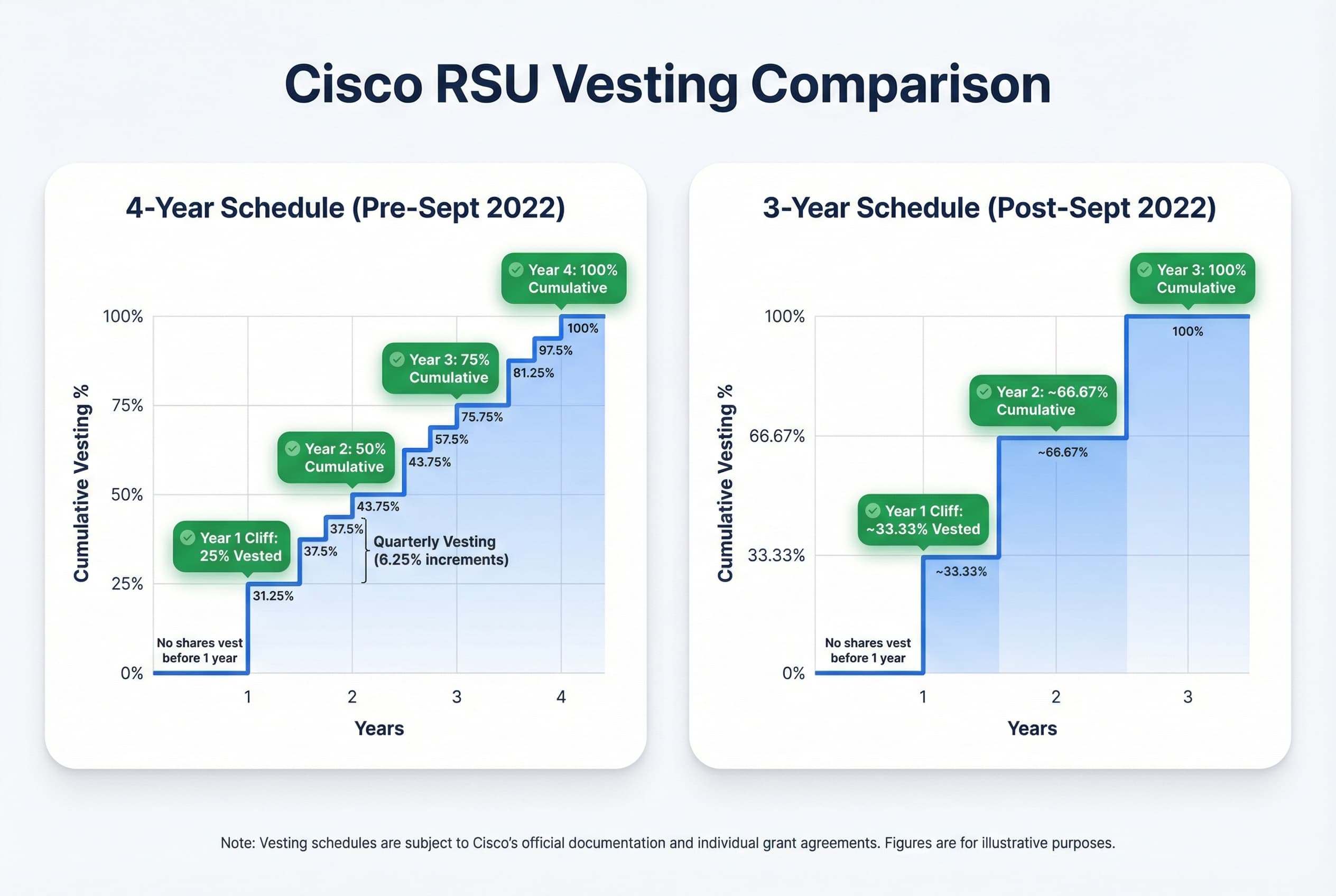
Cisco RSUs vest on a 4-year vesting (25% cliff, then 6.25% quarterly for 3 years) OR 3-year vesting for new grants (1/3 cliff, then 2/3 over 2 years) schedule with a 12-month cliff.
Example calculation based on 100 shares:
| Year | Vesting % | Shares Vesting | Estimated Value |
|---|---|---|---|
| Year 1 | 25% | 25 | $2,751.50 |
| Year 2 | 25% | 25 | $2,751.50 |
| Year 3 | 25% | 25 | $2,751.50 |
| Year 4 | 25% | 25 | $2,751.50 |
| Total | 100% | 100 | $11,006 |
* Based on Cisco stock price of $110.06 as of Sep 14, 2026. Actual values will vary.
25%
25 shares
$2,751.50
25%
25 shares
$2,751.50
25%
25 shares
$2,751.50
25%
25 shares
$2,751.50
Cisco vesting schedule based on 100 total shares
Cisco offers a comprehensive equity compensation package designed to align your success with the company's long-term growth. As a Cisco employee, you have access to several equity vehicles, including Restricted Stock Units (RSUs), stock options (both Incentive Stock Options and Non-Qualified Stock Options), Performance Stock Units (PSUs), and an Employee Stock Purchase Plan (ESPP).
Equity compensation represents a significant portion of your total rewards, particularly as you advance in your career. These grants give you actual ownership in Cisco, meaning you benefit directly as the company's stock value grows. For context, typical RSU grants range from approximately $40,000 over three years for mid-level engineers to $800,000 over four years for Distinguished Engineers, making equity a substantial component of your overall compensation package.
Cisco has recently updated its RSU vesting approach. Grants issued after September 2022 typically follow a 3-year vesting schedule with a one-year cliff (meaning one-third vests after your first year, then the remaining two-thirds vest over the following two years). Older grants follow a traditional 4-year schedule with 25% vesting after one year, then 6.25% vesting quarterly for the remaining three years.
The ESPP offers an attractive benefit with a 15% discount and a 24-month lookback provision, allowing you to purchase Cisco stock at favorable terms. Additionally, Cisco provides stock options with a 10-year expiration period, giving you flexibility in how you manage your equity over time.
Cisco offers Restricted Stock Units (RSUs) to employees across various levels, but it's important to note that the company has recently changed its vesting structure. The vesting schedule you receive depends on when your grant was approved.
For RSU grants approved before September 2022, Cisco follows a traditional 4-year vesting schedule with a 1-year cliff. Here's how it works:
This creates a uniform vesting pattern where you receive 25% of your total grant each year, distributed evenly across four quarterly payments after the initial cliff.
For RSU grants issued after September 2022, Cisco shifted to a 3-year vesting schedule:
This accelerated schedule means you'll fully vest in your equity three years from your grant date rather than four.
During your first year - the "cliff period" - no shares vest. This means if you leave Cisco before completing one full year from your grant date, you forfeit your entire RSU grant. Once you pass the one-year mark, you immediately receive your cliff vesting (either 25% or 33.33% depending on your grant type), and subsequent shares vest according to the quarterly schedule.
Grant approval dates at Cisco commonly fall on dates like November 10th and June 10th, with vesting beginning from the grant date. If you start in August but your grant isn't approved until November, your vesting clock begins in November, not on your start date - a detail that has caused confusion for some employees.
While refresher grants are discussed at Cisco, specific policies regarding frequency and amounts aren't consistently documented across all levels and roles.
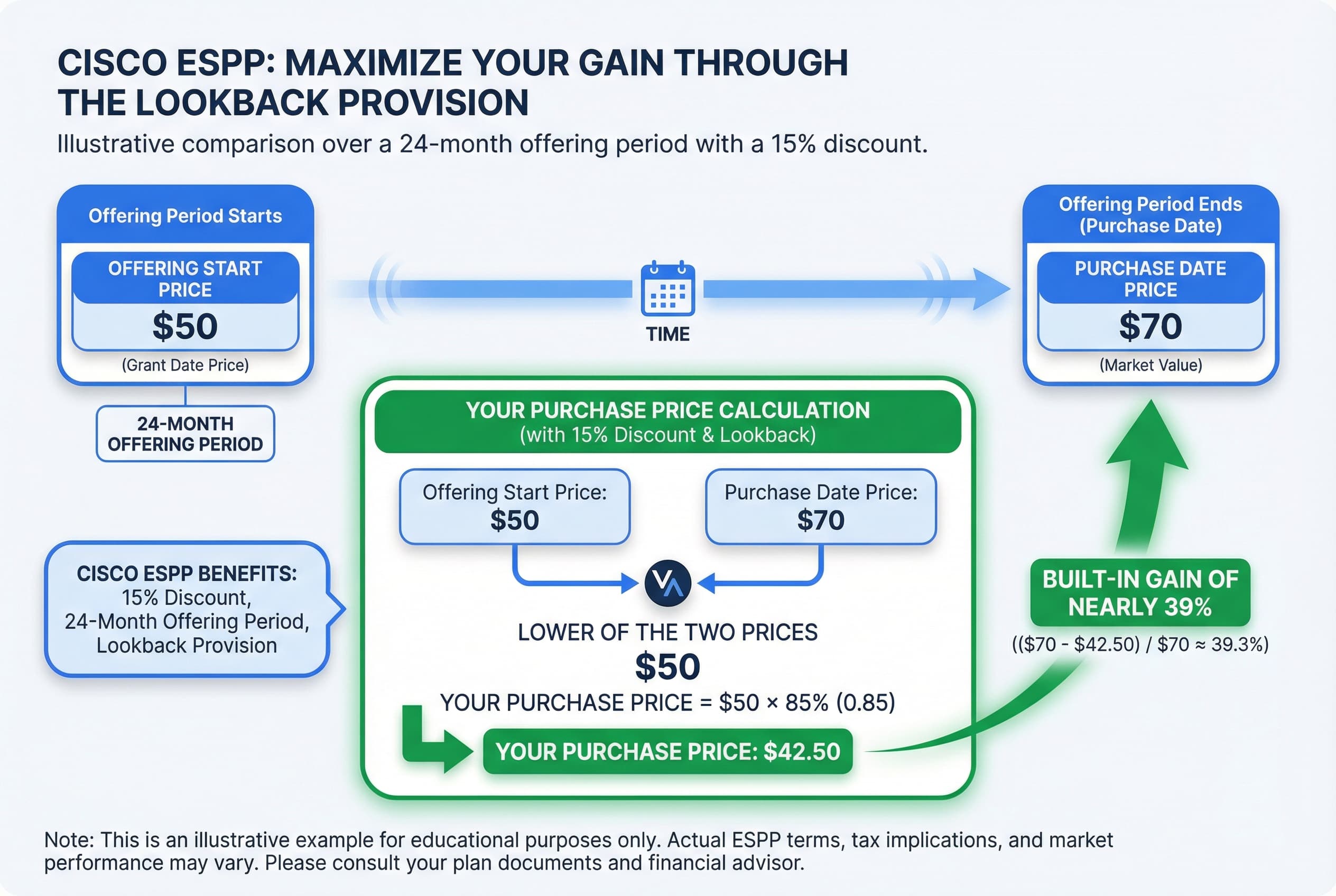
Cisco offers a compelling ESPP that allows employees to purchase company stock at a significant discount. The plan provides a 15% discount and includes a lookback provision, creating substantial potential returns for participants.
The lookback provision is particularly valuable. Cisco's ESPP operates on a 24-month offering period with 6-month purchase periods. At each semi-annual purchase date, you'll buy shares at 85% of the lower price between the offering period start date (24 months earlier) and the purchase date. This means if Cisco's stock price increases during the offering period, you benefit from both the 15% discount and the lower historical price.
For example, if the stock was $50 at the offering start and $70 at purchase, you'd pay just $42.50 per share (85% of $50) - a built-in gain of nearly 39% before even considering the discount alone.
You can contribute up to 10% of your compensation, subject to an annual maximum of $25,000 based on the grant date fair market value. Purchases occur semi-annually, allowing you to accumulate shares twice per year throughout the offering period.
Understanding the tax treatment is important for maximizing your ESPP benefits. A qualifying disposition occurs when you hold shares for at least 2 years from the offering period start date and at least 1 year from the purchase date. This favorable tax treatment can significantly reduce your tax liability compared to selling immediately (a disqualifying disposition), where the discount is taxed as ordinary income.
Given the combination of the 15% discount and 24-month lookback, Cisco's ESPP represents one of the most valuable benefits available to employees, often providing better risk-adjusted returns than many other investment options.
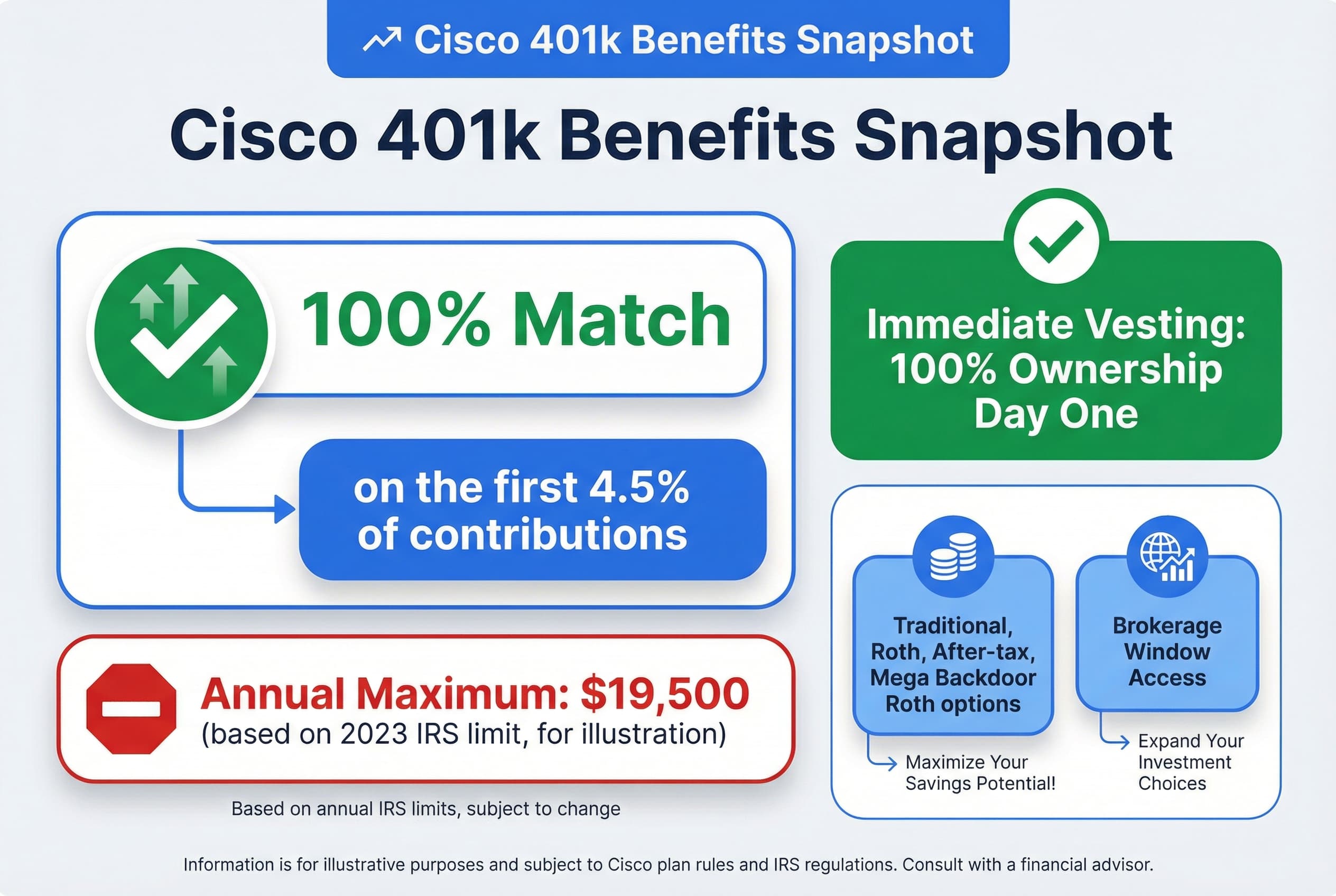
Cisco offers a competitive 401(k) plan with an attractive employer match structure. The company provides a 100% match on the first 4.5% of your contributions, calculated based on your eligible compensation (base salary plus bonuses), up to an annual maximum of $19,500.
One of the standout features of Cisco's 401(k) is that employer matching contributions are immediately vested. This means you have full ownership of all matched funds from day one, with no waiting period required. If you leave the company, you take 100% of both your contributions and Cisco's matching contributions with you.
Cisco supports both traditional and Roth 401(k) contributions, giving you flexibility in your tax planning strategy. Additionally, the plan offers after-tax contribution options and supports the mega backdoor Roth strategy. This powerful feature allows high earners who've maxed out their standard 401(k) contributions to make additional after-tax contributions and potentially convert them to Roth, significantly increasing your tax-advantaged retirement savings potential.
The plan also includes a brokerage window option, providing access to a broader range of investment choices beyond the standard 401(k) fund menu. This gives you greater control over your investment strategy and the ability to customize your portfolio to match your specific financial goals and risk tolerance.
Understanding the tax treatment of your Cisco equity compensation is crucial for effective financial planning. Different equity types trigger taxes at different times and rates.
RSUs are taxed as ordinary income at vesting, based on the fair market value of shares on the vesting date. This occurs whether you sell the shares or hold them. For Cisco's quarterly vesting schedule, you'll face tax events multiple times per year.
Stock Options (ISOs and NSOs) have different treatment. NSOs trigger ordinary income tax when exercised, based on the difference between the exercise price and fair market value. ISOs receive preferential treatment - no regular tax at exercise if holding requirements are met, though they may trigger Alternative Minimum Tax (AMT).
ESPP purchases create a tax event when shares are sold. For a qualifying disposition (holding shares at least 2 years from the offering date and 1 year from purchase), the 15% discount is taxed as ordinary income, while any additional gain receives long-term capital gains treatment.
Cisco typically withholds taxes on RSU vesting, but you can adjust withholding rates. The common "gap" issue occurs because default withholding may not cover your full tax liability, especially if equity compensation pushes you into a higher tax bracket. This can result in an unexpected tax bill or underpayment penalties.
Equity compensation is generally taxed as ordinary income when received (at vesting for RSUs, exercise for NSOs). However, any appreciation after that taxable event qualifies for capital gains treatment when sold. Long-term capital gains rates (lower than ordinary income rates) apply if you hold shares for more than one year after the taxable event.
If you exercise ISOs and don't sell the shares in the same year, the spread may trigger AMT. This parallel tax system can create unexpected liabilities, particularly for large ISO exercises. Careful planning around exercise timing is essential.
Important Disclaimer: This information is educational only and not tax advice. Tax situations vary based on individual circumstances, income levels, and state residency. Consult a qualified tax professional or financial advisor for personalized guidance on your Cisco equity compensation.
While Cisco equity compensation is valuable, concentrating too much wealth in a single stock - even a well-established technology company - creates significant financial risk. If Cisco's stock price declines, your compensation, retirement savings, and net worth could all fall simultaneously.
As a technology company in the networking and infrastructure space, Cisco faces sector-specific challenges including rapid technological change, intense competition, cyclical enterprise spending patterns, and evolving cloud computing trends. The technology sector can experience heightened volatility, and companies that dominated one era don't always lead the next. These industry dynamics can impact stock performance regardless of your job performance.
Financial advisors commonly recommend limiting single-stock exposure to 10-20% of your net worth. This guideline helps protect against company-specific and industry-specific risks. For Cisco employees, this means regularly selling vested RSUs and diversifying proceeds into a broader portfolio of stocks, bonds, and other assets.
Consider your total Cisco exposure: your unvested equity, vested shares you're holding, ESPP purchases, and even your job security (your "human capital"). These all depend on Cisco's success.
Review your holdings quarterly. When RSUs vest, consider selling enough shares to maintain your target allocation. Use your 401(k) - which offers diversified investment options including the brokerage window - to build wealth outside of Cisco stock. Diversification isn't about lacking confidence in Cisco; it's about prudent risk management for your family's financial security.
Consider selling RSUs immediately upon vesting to avoid concentration risk, especially if Cisco stock already represents a significant portion of your net worth. Since RSUs are taxed as ordinary income at vest regardless of whether you sell, there's no additional tax penalty for immediate sale. However, if you believe in Cisco's long-term prospects and can afford the risk, holding shares may provide upside potential - just be mindful that you're essentially making an investment decision with after-tax dollars.
As a Cisco employee, you already depend on the company for your salary and future equity grants. Holding substantial vested shares creates "double exposure" - if Cisco faces challenges, both your income and portfolio could suffer simultaneously. Financial advisors typically recommend keeping individual company stock to no more than 10-15% of your investment portfolio. Given that equity compensation can feel "low" at junior to mid-level positions, diversifying what you do receive becomes even more important.
Cisco's ESPP offers a 15% discount with a 24-month lookback provision, potentially providing substantial gains. For maximum tax efficiency, hold ESPP shares for at least two years from the offering date AND one year from the purchase date to qualify for favorable long-term capital gains treatment on the discount portion. However, this holding requirement increases concentration risk. Many employees choose to sell immediately after each 6-month purchase period, capturing the guaranteed 15% discount (minus taxes) and reinvesting proceeds in a diversified portfolio.
While specific details about Cisco's 10b5-1 plan availability aren't confirmed in company materials, these pre-scheduled trading plans can help you sell shares systematically during blackout periods. If available, they're particularly valuable for senior employees subject to trading restrictions.
Let's walk through a realistic scenario for a new Software Engineer at grade G12 who receives a $100,000 RSU grant with Cisco's standard 4-year vesting schedule.
Sarah joins Cisco in August 2023 and receives her equity grant on November 10, 2023. Her offer includes $100,000 in RSUs vesting over 4 years. At the grant date, Cisco stock trades at $50 per share, so she receives 2,000 RSUs.
For the first year, nothing vests. Sarah must wait until November 10, 2024, when her one-year cliff occurs. On that date, 25% of her grant (500 shares) vests. If the stock price is now $52 per share, the gross value is $26,000.
Tax withholding: Cisco withholds shares to cover taxes. While the specific withholding rate varies, assuming a typical supplemental wage rate of approximately 37% (federal) plus state and FICA taxes totaling around 45%, Cisco withholds roughly 225 shares, leaving Sarah with approximately 275 shares worth $14,300.
After the cliff, Sarah's remaining 1,500 shares vest quarterly at 6.25% per quarter (125 shares every three months). Each quarter, she receives shares minus tax withholding.
For example, in February 2025, another 125 shares vest. At $53 per share ($6,625 gross), approximately 56 shares are withheld for taxes, netting her 69 shares worth $3,657.
Over four years, Sarah receives her full 2,000-share grant, with the actual number of shares she keeps depending on tax withholding at each vesting event. The final value depends on Cisco's stock price at each vesting date - it could be worth more or less than the original $100,000 grant value.
Important reminder: All unvested RSUs are forfeited if Sarah leaves Cisco before they vest.
Cisco employees often make avoidable mistakes with their equity compensation. Here are the most critical pitfalls to watch for:
Many employees don't realize that RSUs at Cisco have a one-year cliff period. Whether you're on the 4-year schedule (25% after year one) or the newer 3-year schedule for grants issued after September 2022 (33% after year one), nothing vests until you complete that first year. If you leave before the cliff, you forfeit your entire grant.
As your RSUs vest quarterly and accumulate, it's easy to become overexposed to Cisco stock. Holding too much of your net worth in a single company - especially your employer - creates unnecessary risk. Consider diversifying as shares vest.
Cisco's ESPP offers a 15% discount with a 24-month lookback period, meaning you purchase at 85% of the lower price between the offering start or purchase date. This can generate immediate gains, yet many employees don't participate or contribute below the maximum allowed percentage.
RSU vesting triggers ordinary income tax, but Cisco's withholding may not cover your full tax liability, especially if you're in a higher tax bracket. Employees often face surprise tax bills because they didn't plan for quarterly estimated payments or adjust their W-4 withholding.
Selling ESPP shares before meeting the qualified disposition period (two years from offering start and one year from purchase) converts favorable long-term capital gains into higher-taxed ordinary income.
Understanding what happens to your equity compensation when you leave Cisco is crucial for financial planning. Here's what you need to know:
All unvested RSUs are immediately forfeited upon termination, regardless of whether you leave voluntarily or involuntarily. This is a critical consideration - if you have RSUs scheduled to vest soon, the timing of your departure can significantly impact your compensation. For example, if you're on Cisco's 4-year vesting schedule with quarterly vesting periods, leaving just before a vesting date means losing that tranche entirely.
Stock options at Cisco have a 10-year expiration from grant, but specific details about post-termination exercise windows are not publicly documented. You should consult your specific grant agreements or contact HR to understand exactly how long you have to exercise vested options after leaving.
If you leave Cisco mid-offering period, you'll typically be withdrawn from the Employee Stock Purchase Plan. Your accumulated contributions may be returned, and you won't participate in the upcoming purchase date. However, any shares you've already purchased through the ESPP remain yours. Remember that to avoid a disqualifying disposition and maximize tax benefits, you should hold ESPP shares for at least two years from the offering period start date and one year from the purchase date.
Your termination date directly impacts vesting. Cisco's RSUs vest quarterly, so even being employed through your official termination date matters for that quarter's vesting eligibility.
This content is for educational purposes only and does not constitute financial advice. The information provided is general in nature and may not appl...
YourEmployeeStock.com is not a registered investment advisor.
Cisco has two main RSU vesting schedules depending on when your grant was issued. Older grants typically vest over 4 years with a 25% cliff after one year, then 6.25% quarterly for the remaining three years. New grants issued after September 2022 vest over 3 years with a 1/3 cliff after one year, then the remaining 2/3 over the next two years.
If you leave Cisco for any reason, all unvested RSUs are immediately forfeited. Only shares that have already vested by your termination date will remain yours. This makes it important to consider your vesting schedule when planning any job transition.
Cisco's ESPP allows you to purchase company stock at a 15% discount. The plan uses a 24-month lookback provision, meaning you get the discount applied to whichever price is lower: the stock price at the beginning of the 24-month offering period or at the end of each 6-month purchase period. You can contribute up to 10% of your eligible compensation, with a maximum of $25,000 per year.
To receive favorable tax treatment on ESPP shares, you must hold them for at least 2 years from the offering date AND at least 1 year from the purchase date (qualifying disposition). If you sell before meeting both requirements, it's a disqualifying disposition, and a portion of your gain will be taxed as ordinary income rather than capital gains.
Equity grants vary significantly by level at Cisco. For example, a G10 role might receive around $40,000 over 3 years, a G12 role could get $100,000 over 4 years, and a Distinguished Engineer might receive approximately $800,000 over 4 years. Note that many employees report equity values being relatively modest for junior to mid-level positions.
Refresher grants are discussed at Cisco, but there is no confirmed company-wide policy regarding frequency or amounts. The availability and size of refresher grants may depend on factors like performance and level, but specific details are not standardized across all roles and departments.
You can generally sell vested shares at any time, but sales may be restricted during trading blackout periods or if you possess material nonpublic information. It's important to be aware of Cisco's insider trading policy and any pre-clearance requirements that may apply to your role before executing any trades.
Yes, Cisco offers a generous 401(k) match of 100% on the first 4.5% of your base salary, up to a maximum match of $19,500. The match vests immediately with no waiting period. Cisco also offers Roth 401(k) options and supports mega backdoor Roth conversions through after-tax contributions.
Get a free personalized analysis from our equity compensation experts

