Free equity analysis
Complete guide to understanding your Alphabet (Google) equity compensation, including RSU, NSO, ESPP, vesting schedules, and tax strategies.
Stock Price
$344.98
Closing price · Sep 15, 2026
Employees
258.8K
Worldwide
Equity Programs
3
programs
Vesting Period
4 years
RSU vesting
Closing price · Sep 15, 2026
Alphabet (Google) offers 3 equity compensation programs to employees. Click on each program to learn more about eligibility, vesting, and tax implications.
Google's GSUs (the company's term for RSUs) vest over 4 years with a 1-year cliff. After the cliff, shares vest monthly. Google is known for generous refresh grants that can exceed the original grant over time.
Learn about Alphabet (Google)'s Non-Qualified Stock Options program, including vesting schedules and tax treatment.
Google's ESPP provides a 15% discount with a 24-month lookback provision. Contributions are made through payroll deduction with purchases occurring every 6 months.
Alphabet (Google) RSUs vest on a Varies by grant size, common new hire schedule is 38/32/20/10 over 4 years, front-loaded. Another common schedule is 25/25/25/25 over 4 years. schedule with a 12-month cliff.
Example calculation based on 100 shares:
| Year | Vesting % | Shares Vesting | Estimated Value |
|---|---|---|---|
| Year 1 | 25% | 25 | $8,624.50 |
| Year 2 | 25% | 25 | $8,624.50 |
| Year 3 | 25% | 25 | $8,624.50 |
| Year 4 | 25% | 25 | $8,624.50 |
| Total | 100% | 100 | $34,498 |
* Based on Alphabet (Google) stock price of $344.98 as of Sep 15, 2026. Actual values will vary.
25%
25 shares
$8,624.50
25%
25 shares
$8,624.50
25%
25 shares
$8,624.50
25%
25 shares
$8,624.50
Alphabet (Google) vesting schedule based on 100 total shares
Alphabet (Google) offers a comprehensive equity compensation package that forms a significant portion of total compensation for its employees. The program includes Restricted Stock Units (RSUs), which the company calls "Google Stock Units" or GSUs, along with an Employee Stock Purchase Plan (ESPP) and stock options (NSOs). For most employees, RSUs represent the primary equity benefit.
As a publicly traded technology leader with ticker symbol GOOGL, Alphabet's equity compensation allows you to share directly in the company's success. Given the substantial size of equity grants - which can range from hundreds of thousands to over a million dollars over four years depending on your level - this benefit often represents a larger portion of your total compensation than base salary alone.
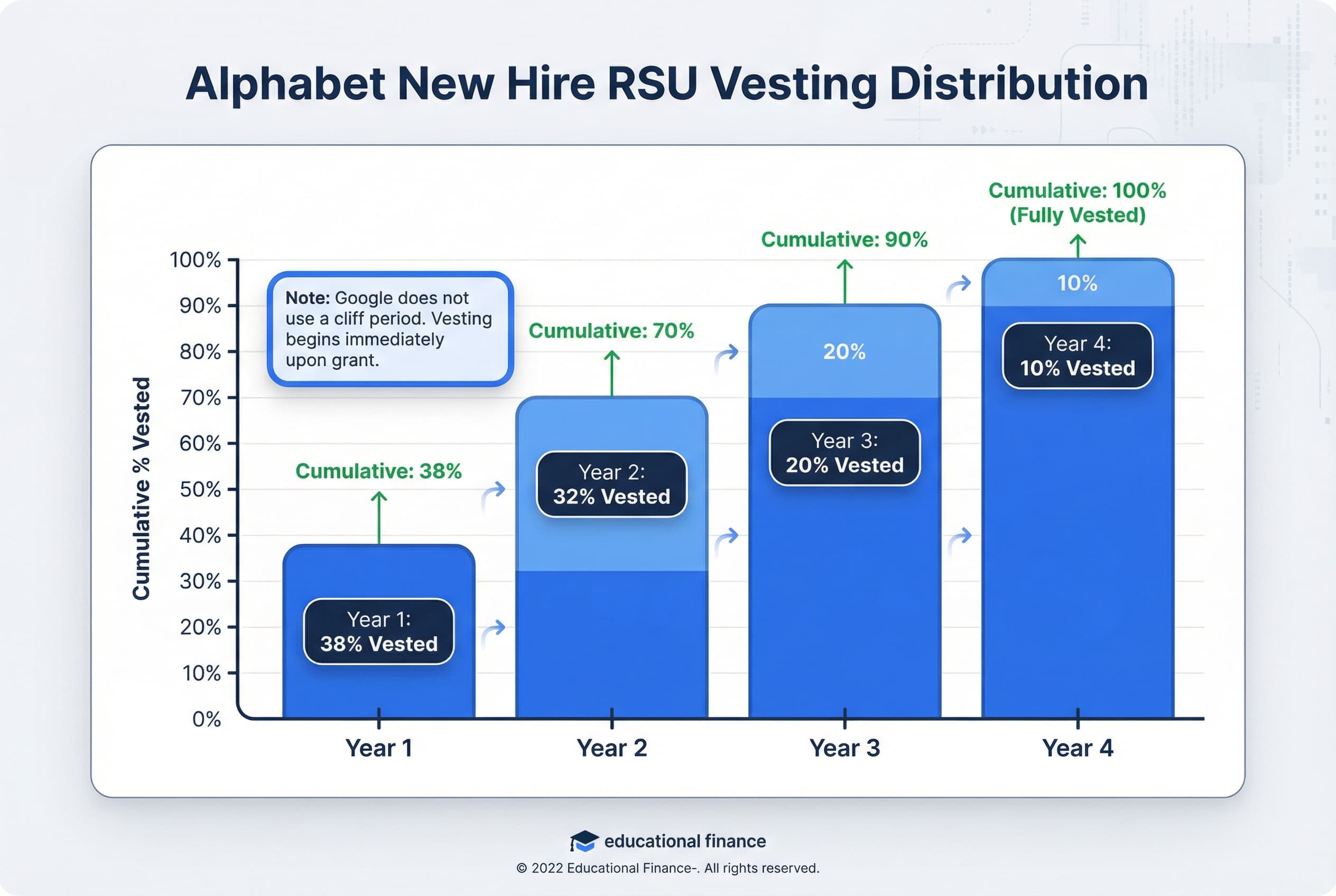
Alphabet uses a front-loaded vesting schedule for new hire RSU grants, with a common structure of 38% in year one, 32% in year two, 20% in year three, and 10% in year four. This means you receive more shares earlier in your tenure. The frequency of vesting varies based on grant size - you might vest monthly, quarterly, semi-annually, or annually.
Refresher grants help maintain your equity compensation over time, typically awarded annually or every six months (and potentially larger upon promotion). These refreshers usually vest evenly at 25% per year over four years.
The ESPP allows you to purchase Alphabet stock at a 15% discount with a lookback provision, providing an additional wealth-building opportunity through semi-annual purchase periods.
Google (Alphabet) uses a distinctive approach to equity vesting that differs from typical Silicon Valley practices. The company's vesting schedules vary based on grant type and size, with initial grants following a front-loaded structure that accelerates compensation in your early years.
For new hire grants, Google commonly uses a front-loaded 4-year vesting schedule with the following annual distribution: 38% in year one, 32% in year two, 20% in year three, and 10% in year four. This means you'll receive the majority of your equity grant during your first two years, rather than waiting for equal portions over time.
Notably, Google does not use a cliff period for RSUs. Unlike many tech companies that require you to wait a full year before any shares vest, your equity begins vesting immediately based on the grant's specific frequency.
The frequency at which your shares vest depends on your grant size. Smaller grants may vest monthly, while larger grants might vest quarterly, semi-annually, or annually. This variation means two employees could have different vesting frequencies even if they started on the same day, based on their compensation packages.
Google provides annual refresher grants to retain talent and reward performance. These refreshers follow a different vesting pattern than new hire grants, typically using a uniform 25/25/25/25 schedule over four years. This means refreshers vest evenly rather than front-loaded. Employees may receive larger refresher grants upon promotion, creating overlapping vesting schedules as you progress in your career.
The front-loaded initial vesting schedule means your total compensation peaks in years one and two, then declines in years three and four if you don't receive refreshers or promotions. This structure is designed to attract top talent with strong early compensation while using refresher grants to encourage retention. Understanding this pattern is crucial for financial planning, as your equity income won't be consistent year-over-year without additional grants.
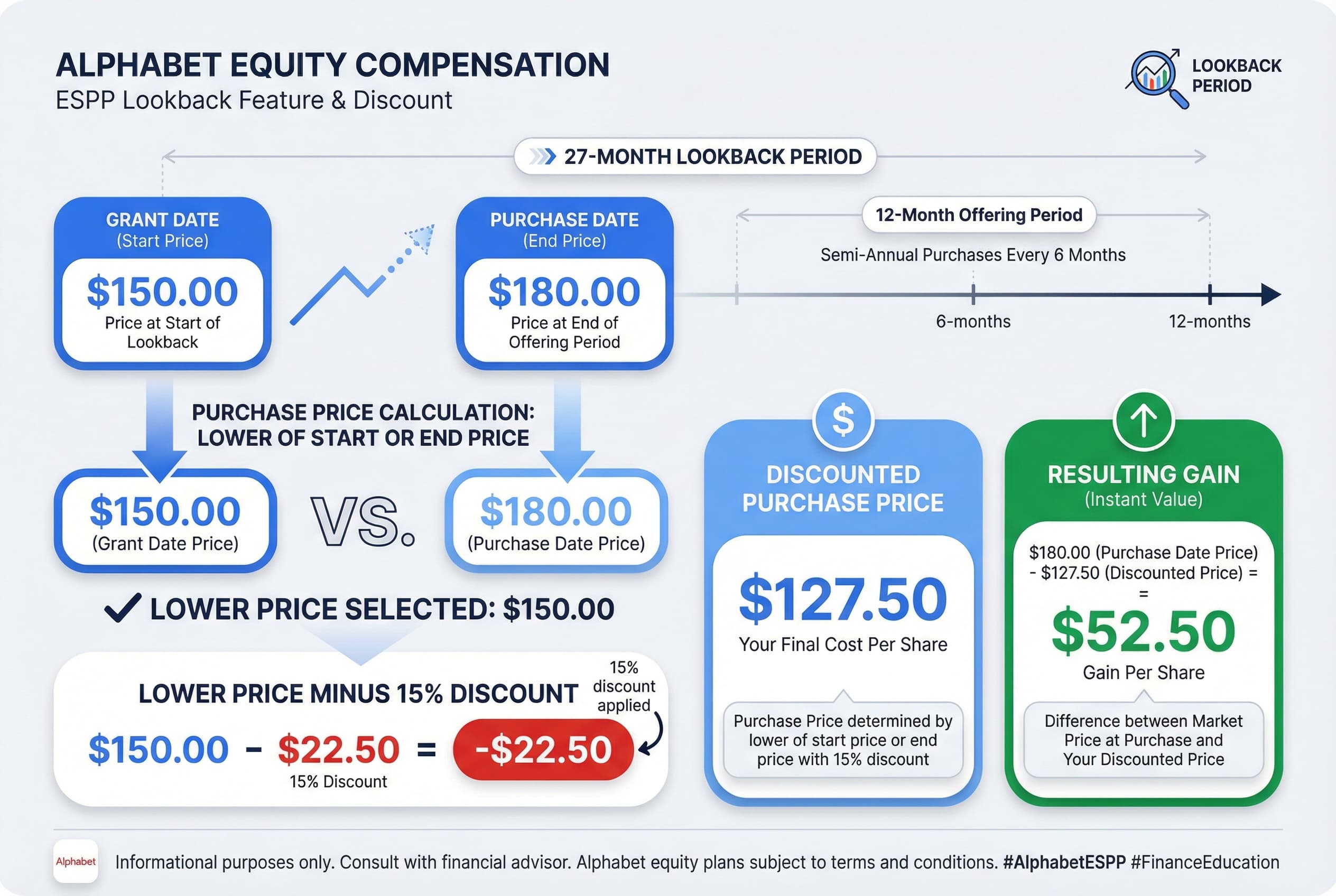
Alphabet offers a compelling Employee Stock Purchase Plan that allows you to purchase company stock at a significant discount. The program provides a 15% discount off the stock price, combined with a powerful lookback provision that can substantially increase your potential returns.
The lookback feature is particularly valuable. With a 27-month lookback period, your purchase price is based on the lower of two prices: the stock price at the beginning of the offering period or the price at the end of each 6-month purchase period. This means if Alphabet's stock price increases during the offering period, you benefit from purchasing at the earlier, lower price - plus the 15% discount.
The ESPP operates on a 12-month offering period with semi-annual purchases every 6 months. You can contribute up to 15% of your eligible compensation, subject to the IRS annual maximum of $25,000 (based on the discounted purchase price).
The combination of the 15% discount and lookback provision can generate substantial returns. For example, if the stock price rises during the offering period, you could see immediate gains of 15% or more upon purchase, depending on the price movement. This makes the ESPP one of the most valuable benefits available.
How you're taxed depends on when you sell your shares. A qualifying disposition occurs when you hold shares for at least one year after purchase and at least two years after the offering date. This treatment can result in more favorable long-term capital gains tax rates on a portion of your gain. A disqualifying disposition (selling before meeting both holding periods) results in ordinary income tax on the discount received, with any additional gain taxed as capital gains.
Given the attractive terms, participating in Alphabet's ESPP is often considered a high-priority financial decision for eligible employees.
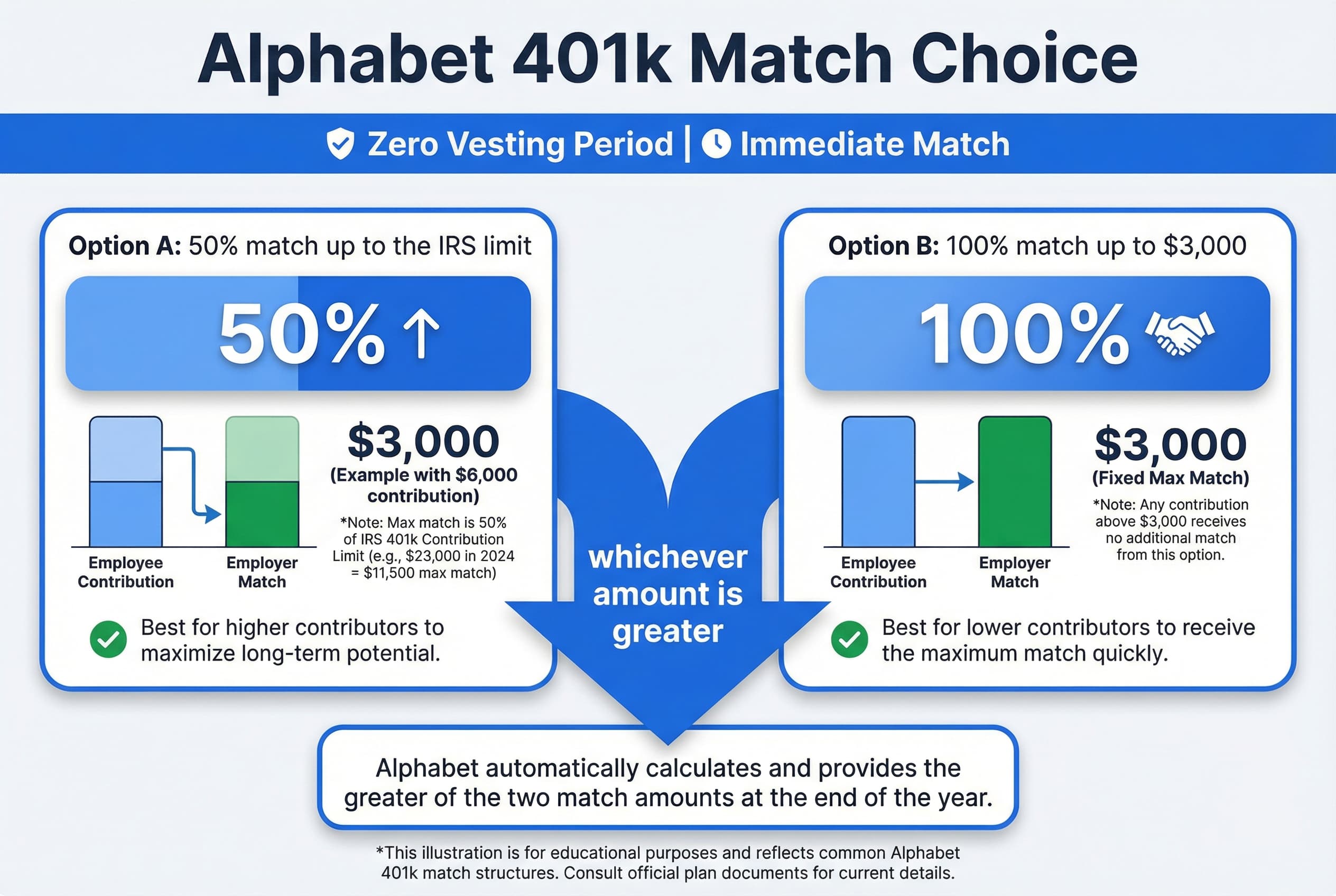
Alphabet offers a competitive 401(k) plan with immediate employer matching and no vesting period. The company matches 50% of your contributions up to 6% of your salary, with a unique structure: you'll receive either 50% of your contributions up to the IRS limit or 100% match up to $3,000 - whichever amount is greater. This means the match is immediately yours with zero vesting period, allowing you to keep all employer contributions even if you leave the company.
The plan includes valuable features for tax optimization. Mega backdoor Roth conversions are available through after-tax 401(k) contributions, enabling high earners to contribute significantly more toward retirement savings beyond the standard pre-tax and Roth limits. This strategy allows you to convert after-tax contributions to Roth, creating tax-free growth potential.
The 401(k) is administered through Vanguard and offers diverse investment options, including target date funds, index tracking funds, and actively traded options. This flexibility allows you to build a portfolio aligned with your risk tolerance and retirement timeline.
Beyond the 401(k), Alphabet also provides HSA matching contributions of $1,000 per year for individual coverage or $2,000 per year for family coverage, further enhancing your ability to save for healthcare expenses in retirement on a tax-advantaged basis.
Understanding the tax treatment of your Alphabet equity compensation is crucial for effective financial planning. Here's what you need to know about when and how you'll owe taxes.
Your Google Stock Units (GSUs/RSUs) are taxed as ordinary income at vesting. The taxable amount equals the fair market value of shares on the vesting date, regardless of whether you sell them. Alphabet withholds taxes at a default rate of 22% for federal taxes, though you can adjust this rate. However, this creates a common "gap" problem: the 22% withholding may fall short of your actual tax obligation, especially if you're in a higher tax bracket or subject to the 37% supplemental rate. This gap can result in a surprise tax bill or underpayment penalties at year-end.
After vesting, any subsequent appreciation (or depreciation) in your RSU shares is treated as a capital gain (or loss) when you sell. If you hold shares for more than one year after vesting, you'll qualify for long-term capital gains rates, which are typically lower than ordinary income rates. Shares sold within a year are subject to short-term capital gains, taxed at ordinary income rates.
Alphabet's ESPP has specific tax rules. To achieve a "qualifying disposition" and receive favorable tax treatment, you must hold shares for at least one year after purchase and at least two years after the offering date. Disqualifying dispositions (selling earlier) result in ordinary income treatment on the discount portion.
California-based employees face additional complexity, as California has some of the highest state income tax rates in the nation. You'll owe California state taxes on your equity compensation, which can significantly increase your total tax burden beyond federal obligations.
This information is educational only and not tax advice. Tax rules are complex and vary based on individual circumstances. Always consult with a qualified tax professional or CPA who understands equity compensation to ensure you're meeting your obligations and optimizing your tax strategy.
As an Alphabet employee, your equity compensation can be substantial - with grants potentially worth hundreds of thousands or even millions of dollars over four years. While this is excellent compensation, concentrating too much wealth in a single stock creates significant risk, regardless of how strong the company appears today.
When your income, benefits, and investment portfolio all depend on one company, you're exposed to "double jeopardy." If Alphabet faces challenges, you could simultaneously see your stock value decline and your job security threatened. Even excellent companies experience volatility - no stock moves only upward.
The technology industry faces unique challenges including rapid innovation cycles, regulatory scrutiny (particularly around antitrust and data privacy), competitive threats from emerging technologies, and sensitivity to economic cycles affecting advertising revenue. These factors can impact Alphabet's stock price independent of your individual performance.
Financial advisors commonly recommend limiting any single stock to 10-20% of your net worth. As your RSUs vest - particularly with Alphabet's front-loaded schedule where 38% vests in year one - consider selling shares systematically to reinvest in diversified holdings. You can use Alphabet's Employee Trading Plan or a 10b5-1 plan to automate sales even during blackout periods.
Diversification doesn't mean you lack confidence in Alphabet; it means protecting your financial future from risks beyond your control.
Google's front-loaded vesting schedule (typically 38/32/20/10 for new hires) means you'll receive substantial equity early. Consider selling some shares at each vesting event to avoid overconcentration in a single stock, regardless of your confidence in the company. A common approach is establishing a consistent percentage to sell at vesting - such as 50-75% - to balance diversification with potential upside.
Large RSU grants can quickly make Alphabet stock your largest asset. When equity represents more than 10-20% of your net worth, concentration risk increases significantly. Remember that your salary, benefits, and career growth are already tied to the company's success - doubling down with concentrated stock holdings amplifies that risk.
ESPP Timing: Google's ESPP offers a 15% discount with a lookback provision. To maximize tax benefits, hold shares for the qualifying period (at least one year after purchase AND two years after the offering date). This converts ordinary income into long-term capital gains, though you'll recognize some ordinary income on the discount regardless.
10b5-1 Plans: Alphabet offers both 10b5-1 plans and an Employee Trading Plan (ETP) that allow automatic selling during blackout periods. These are particularly valuable for employees at higher levels who face extended trading restrictions (6-8 weeks post-earnings). Setting up a 10b5-1 plan enables systematic diversification without timing concerns.
View your equity grants as deferred cash compensation, not optional investments. When evaluating job offers or promotions, convert RSU values to annual amounts and add them to base salary for accurate total compensation comparisons. Annual refresher grants (typically vesting 25/25/25/25 over four years) should factor into your ongoing compensation expectations.
Let's walk through how RSU vesting works for a new Software Engineer (L5) at Google who receives a typical equity grant.
Sarah joins Google as an L5 engineer and receives $400,000 in RSUs as part of her new hire package. At the time of grant, Google stock trades at $125 per share, giving her 3,200 shares.
Google uses a front-loaded vesting schedule for new hires, meaning more stock vests in the early years to encourage retention.
Year 1 (38%): Sarah vests 1,216 shares worth $152,000 (assuming the stock price remains at $125)
Year 2 (32%): She vests 1,024 shares worth $128,000
Year 3 (20%): She vests 640 shares worth $80,000
Year 4 (10%): She vests 320 shares worth $40,000
When RSUs vest, they're treated as ordinary income. Google withholds 22% by default for federal taxes (you can adjust this rate if needed).
In Year 1, when $152,000 vests:
Over four years, Sarah receives the full value of her grant (assuming stable stock price). However, the front-loaded schedule means she gets significantly more equity in Years 1-2, helping her build wealth faster and reducing the risk if she decides to leave before Year 4.
Note that actual withholding may be higher (up to 37% supplemental rate) depending on your total income, and you may owe additional taxes at year-end.
Even experienced Googlers can stumble when managing their equity compensation. Here are the most frequent missteps to avoid:
With substantial RSU grants (potentially $800k+ over four years at L5, or $1.3M at L6), many employees find themselves dangerously overweight in Alphabet stock. Holding too much of your net worth in a single company - especially your employer - creates unnecessary risk. Consider diversifying as shares vest.
Alphabet's ESPP offers a 15% discount with a generous lookback provision spanning up to 27 months. This benefit can generate immediate returns, yet many employees either don't participate or fail to maximize their 15% contribution limit (up to $25,000 annually). This is essentially leaving guaranteed money on the table.
Default withholding on RSU vesting is 22%, but if you're in a higher tax bracket, you'll face a surprise bill at tax time. The supplemental rate can reach 37% for high earners. You can adjust your withholding rate to better match your actual tax liability and avoid underpayment penalties.
To qualify for favorable long-term capital gains treatment on ESPP shares, you must hold them for at least one year after purchase and two years after the offering date. Selling too early triggers a disqualifying disposition, converting potential long-term gains into ordinary income.
Alphabet's blackout periods (typically 6-8 weeks post-earnings) can restrict when you sell. Setting up a 10b5-1 plan or Employee Trading Plan allows automatic sales upon vesting, helping you diversify regardless of blackout windows.
Understanding what happens to your equity compensation when you leave Alphabet is crucial for making informed career decisions.
When you leave Google, all unvested RSUs are forfeited, regardless of whether your departure is voluntary or involuntary. This applies to both your initial grant and any refresher grants. Since Google uses front-loaded vesting schedules (commonly 38/32/20/10 for new hires), leaving early means forfeiting a significant portion of your total grant. Your termination date determines your final vesting event - only shares that have vested by that date are yours to keep.
While Google does grant NSOs (non-qualified stock options), specific post-termination exercise windows are not publicly documented. Standard practice at most companies provides 90 days to exercise vested options after termination, but you should confirm this timeline with your equity plan documents or HR before leaving.
If you leave mid-offering period, you'll typically be withdrawn from the ESPP. Any contributions made during that period are usually returned to you, and you won't participate in the upcoming purchase. You retain any shares previously purchased through the plan.
The impact of your termination date on vesting can be substantial. If you're close to a vesting date, the timing of your departure could mean the difference of hundreds of thousands of dollars in equity value, particularly given Google's large grant sizes.
This content is for educational purposes only and does not constitute financial advice. The information provided is general in nature and may not appl...
YourEmployeeStock.com is not a registered investment advisor.
Helpful videos explaining Alphabet (Google) equity compensation, vesting, and tax strategies.
Google RSU Strategies to Avoid Taxes & Build Wealth (10-Year Case Study)
How Restricted Stock Units Actually Work (Taxes & Selling in India)
Google's most common new hire RSU schedule vests 38% in year 1, 32% in year 2, 20% in year 3, and 10% in year 4. This front-loaded approach means you receive more equity earlier in your tenure. The actual vesting frequency (monthly, quarterly, semi-annually, or annually) varies depending on your grant size.
Only vested RSUs are yours to keep when you leave Google. Any unvested RSUs will be forfeited upon your departure. Make sure to understand your vesting schedule and consider the timing of your departure, especially if you have significant equity vesting soon.
Google's default tax withholding rate on RSU vesting is 22%, though the supplemental wage rate can be as high as 37%. You can adjust your withholding rate if needed. Remember that RSUs are taxed as ordinary income at vesting, based on the fair market value on the vesting date.
Google's ESPP allows you to purchase stock at a 15% discount with a lookback provision over a 27-month period. You can contribute up to 15% of your salary or $25,000 annually, whichever is less. Purchases occur semi-annually, and the offering period is 12 months with 6-month purchase periods.
Trading blackout windows typically occur 6-8 weeks following quarterly earnings announcements, depending on your level and share type. However, you can set up an Employee Trading Plan (ETP) or a 10b5-1 plan to sell automatically upon vesting, which allows you to bypass blackout windows.
Google provides refresher RSU grants annually (or potentially every 6 months), with larger grants typically given upon promotion. Unlike the front-loaded new hire schedule, annual refreshers typically vest evenly at 25% per year over four years. This creates overlapping vesting schedules that help maintain steady equity compensation.
To achieve a qualifying disposition for favorable tax treatment, you must hold ESPP shares for at least one year after purchase AND at least two years after the offering date. If you sell before meeting both requirements, it's a disqualifying disposition, and the discount is taxed as ordinary income rather than receiving more favorable capital gains treatment.
Yes, Google matches 50% of your 401(k) contributions up to the IRS limit, or 100% up to $3,000, whichever is greater. The match vests immediately with no waiting period. Google also offers Mega Backdoor Roth conversions through after-tax 401(k) contributions, administered through Vanguard.
Get a free personalized analysis from our equity compensation experts

