Free equity analysis
Complete guide to understanding your Microsoft equity compensation, including RSU, NSO, ESPP, vesting schedules, and tax strategies.
Stock Price
$497.12
Closing price · Sep 15, 2026
Employees
182.3K
Worldwide
Equity Programs
3
programs
Vesting Period
4 years
RSU vesting
Closing price · Sep 15, 2026
Microsoft offers 3 equity compensation programs to employees. Click on each program to learn more about eligibility, vesting, and tax implications.
Microsoft RSUs vest annually over 4 years, with 25% vesting each year on your anniversary date. Microsoft provides consistent annual refresh grants that often match or exceed initial grants for high performers.
Learn about Microsoft's Non-Qualified Stock Options program, including vesting schedules and tax treatment.
Microsoft's ESPP provides a 15% discount with a 24-month lookback. One of the most employee-friendly ESPP programs in tech with automatic enrollment options.
Microsoft RSUs vest on a Varies: 4-year uniform (25% annually) or 5-year uniform (20% annually) for annual awards. On-hire awards are typically 4-year annual vesting. schedule with a 12-month cliff.
Example calculation based on 100 shares:
| Year | Vesting % | Shares Vesting | Estimated Value |
|---|---|---|---|
| Year 1 | 25% | 25 | $12,428 |
| Year 2 | 25% | 25 | $12,428 |
| Year 3 | 25% | 25 | $12,428 |
| Year 4 | 25% | 25 | $12,428 |
| Total | 100% | 100 | $49,712 |
* Based on Microsoft stock price of $497.12 as of Sep 15, 2026. Actual values will vary.
25%
25 shares
$12,428
25%
25 shares
$12,428
25%
25 shares
$12,428
25%
25 shares
$12,428
Microsoft vesting schedule based on 100 total shares
Microsoft offers a comprehensive equity compensation package designed to align employee success with company performance. As a Microsoft employee, you'll primarily receive Restricted Stock Units (RSUs) as your equity award, with additional opportunities to purchase company stock through the Employee Stock Purchase Plan (ESPP). The company also grants Restricted Stock Awards (RSAs) and Non-Qualified Stock Options (NSOs) in certain situations.
Equity compensation represents a significant portion of total compensation at Microsoft, particularly as you advance in your career. As a publicly traded technology leader (NASDAQ: MSFT), Microsoft stock has historically provided substantial value to employees. Your equity awards give you direct ownership in the company, meaning you benefit when Microsoft succeeds in the market.
Microsoft's RSU vesting structure varies based on award type. Your initial on-hire grant typically follows a 4-year schedule with 25% vesting annually. Annual refresher grants, which you may receive after performance reviews (typically in August), vest over 5 years at 20% annually - longer than the industry standard of 4 years. RSUs vest monthly throughout the year, with vesting events occurring in February, May, August, and November.
The ESPP allows you to purchase Microsoft stock at a 10% discount with a lookback provision, offering quarterly purchase opportunities when you enroll during the May or November enrollment windows.
Understanding these programs helps you maximize the value of your total compensation package at Microsoft.
Microsoft uses different vesting schedules depending on the type of RSU grant you receive, making it important to understand which applies to your specific awards.
When you join Microsoft, your initial RSU grant typically follows a 4-year vesting schedule with uniform distribution. This means 25% of your shares vest each year over four years. Unlike many tech companies, Microsoft has no cliff period - you don't need to wait a full year before receiving your first shares. Instead, shares vest monthly, providing a steady stream of equity compensation throughout your tenure.
Your shares vest on specific dates throughout the year: February, May, August, and November. This quarterly vesting pattern means you'll receive portions of your annual allocation in these months, though the actual vesting occurs monthly behind the scenes.
Microsoft provides refresher grants annually, typically following performance reviews in August. However, these refresher awards follow a different timeline: they vest over five years at 20% annually. This is notably longer than the industry standard of four years, which means your refresher grants will take an extra year to fully vest compared to your initial grant.
This extended vesting schedule creates an important planning consideration - your equity compensation becomes increasingly backloaded over time as you accumulate multiple overlapping grants, each on its own five-year schedule.
Since there's no cliff period, you'll begin receiving vested shares relatively quickly after joining Microsoft. The monthly vesting mechanism provides consistent equity income, though shares are distributed on the quarterly vesting dates mentioned above.
The combination of 4-year initial grants and 5-year refreshers creates a complex vesting landscape. After several years at Microsoft, you'll have multiple grants vesting simultaneously, each on different schedules. This overlapping structure means your total annual vesting amount will grow over time, assuming consistent refresher grants, creating what's sometimes called a "golden handcuffs" effect that rewards longer tenure.
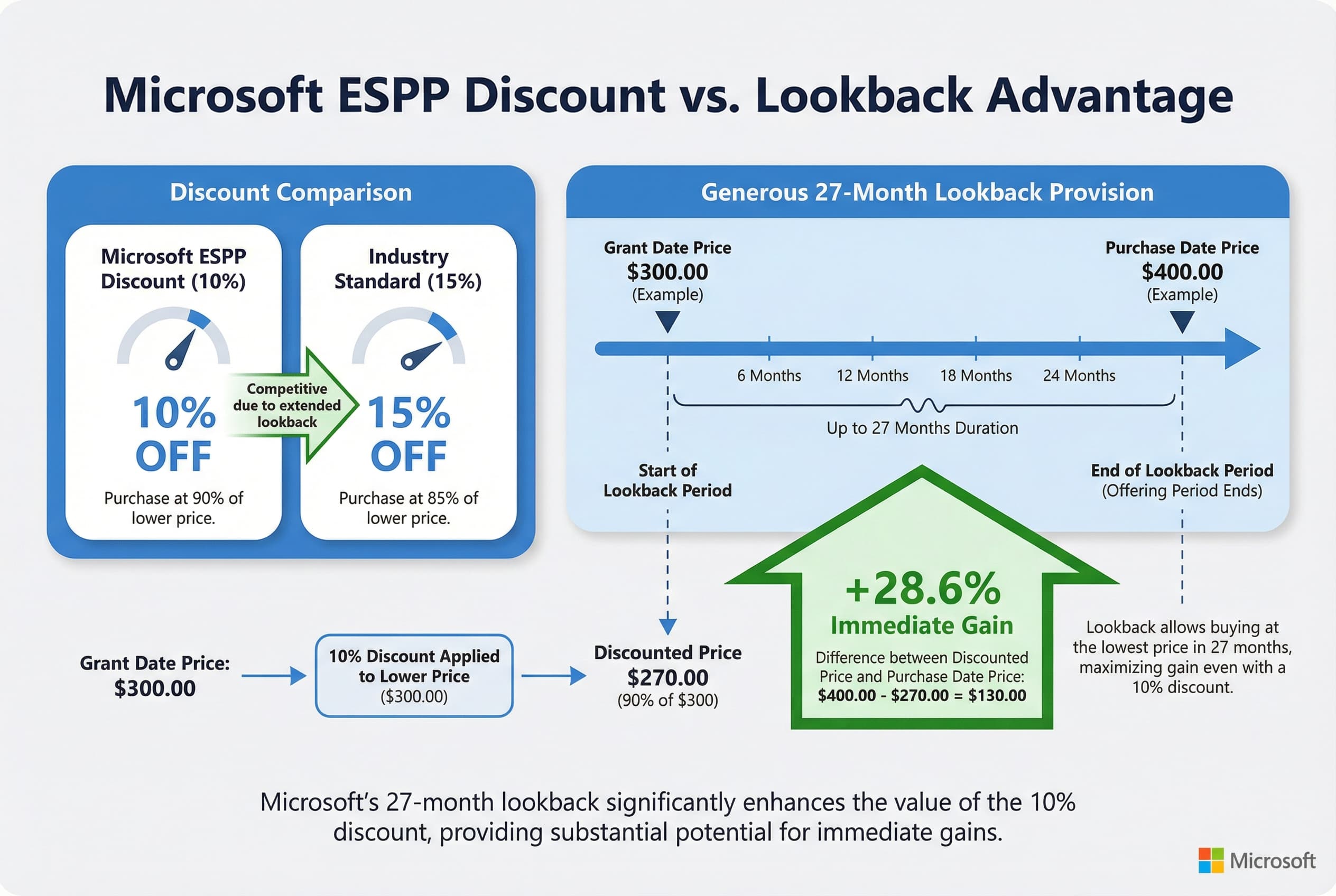
Microsoft's ESPP offers employees a valuable opportunity to purchase company stock at a discount through payroll deductions. The program provides a 10% discount on the stock price, which is lower than the typical 15% offered by many tech companies, but includes additional features that can significantly enhance returns.
The ESPP includes a lookback provision spanning 27 months, which is notably generous compared to industry standards. This means the purchase price is based on whichever is lower: the stock price at the beginning of the 27-month offering period or the price at the end of each quarterly purchase period. With quarterly purchases throughout the year, you have multiple opportunities to benefit from this favorable pricing mechanism.
The combination of the 10% discount and the lookback provision can generate substantial returns, particularly in a rising stock market. If Microsoft's stock appreciates significantly over the offering period, you could purchase shares at the lower historical price minus the 10% discount, resulting in immediate gains upon purchase.
You can contribute up to 15% of your eligible compensation, subject to an annual maximum of $25,000. Enrollment windows occur in May and November, allowing you to join or adjust your participation twice per year.
Understanding the tax treatment is crucial for maximizing your ESPP benefits. A qualifying disposition requires holding shares for at least 2 years from the offering date AND 1 year from the purchase date. Meeting these requirements allows a portion of your gain to be taxed as long-term capital gains rather than ordinary income. A disqualifying disposition occurs when you sell before meeting both holding periods, resulting in the discount and any appreciation being taxed as ordinary income.
Given Microsoft's strong market position, the ESPP represents a compelling benefit worth serious consideration.
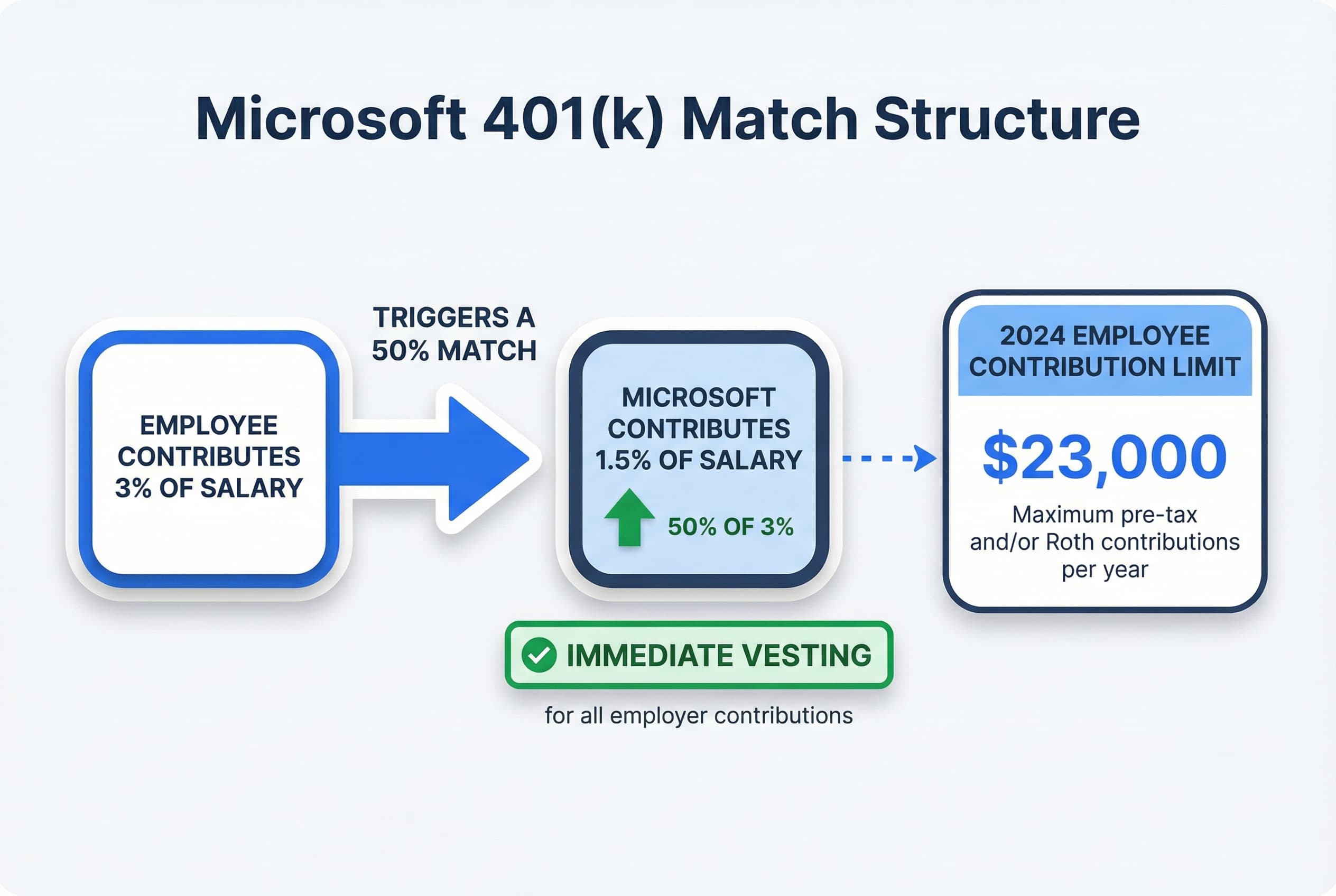
Microsoft offers a competitive 401(k) plan with an employer match to help you build retirement savings. The company provides a 50% match on up to 3% of your eligible salary. This means if you contribute at least 3% of your salary, Microsoft will add an additional 1.5% to your account.
One of the standout features of Microsoft's 401(k) is immediate vesting of employer matching contributions. Unlike many companies that require you to stay for several years before you own the match, you have full ownership of Microsoft's contributions from day one.
Microsoft offers both traditional and Roth 401(k) options, giving you flexibility in how you want to be taxed. The employee contribution limit is $23,000 for 2024, with additional catch-up contributions available if you're 50 or older.
Microsoft's plan supports after-tax contributions and mega backdoor Roth conversions, which is a valuable feature for high earners looking to maximize tax-advantaged retirement savings. This strategy allows you to potentially contribute significantly more to a Roth account beyond the standard limits, though it requires careful coordination with your financial advisor.
Your matching contributions are invested proportionately to match your voluntary contribution allocations, ensuring your entire 401(k) follows your chosen investment strategy.
Understanding the tax treatment of your Microsoft equity awards is crucial for effective financial planning. Different award types trigger taxes at different times and rates.
RSUs: You owe taxes at vesting, not when you sell. When your RSUs vest (monthly at Microsoft, with distributions in February, May, August, and November), the shares are treated as ordinary income based on their fair market value. This happens automatically - you don't need to take any action to trigger the tax event.
ESPP: Taxation depends on how long you hold the shares. For a "qualifying disposition" (holding shares for at least 2 years from the offering date AND 1 year from the purchase date), you'll pay ordinary income tax on the lesser of: (1) the discount at purchase, or (2) the gain from offering date to sale. Any additional gain is taxed as long-term capital gains. If you sell earlier (a "disqualifying disposition"), the discount and any appreciation during the offering period are taxed as ordinary income.
NSOs: You'll owe ordinary income tax when you exercise based on the spread between the exercise price and fair market value. Any subsequent gain or loss when you sell is treated as capital gains.
Microsoft withholds at a default rate of 22% for supplemental income (like RSU vesting), though this can be adjusted. However, if your actual tax bracket is higher - which is common for Microsoft employees - you may face a significant tax bill at year-end. The supplemental rate can reach 37% for high earners, creating a substantial withholding "gap."
The distinction matters significantly. Ordinary income (RSU vesting, ESPP discounts, NSO exercise spreads) is taxed at your marginal rate, which can exceed 37% federally. Long-term capital gains (for shares held over one year after acquisition) are taxed at preferential rates of 0%, 15%, or 20%, depending on income.
Washington State, where Microsoft is headquartered, has no state income tax. However, if you work remotely from a high-tax state, you'll owe state income taxes based on your work location.
Disclaimer: This information is educational only and not tax advice. Tax situations vary significantly based on individual circumstances. Consult a qualified tax professional or financial advisor for guidance specific to your situation.
While Microsoft equity compensation is valuable, concentrating too much wealth in a single stock - even a leading technology company - exposes you to unnecessary risk. If Microsoft's stock price declines significantly, you could see both your compensation and net worth drop simultaneously, a double impact that diversified investors avoid.
Microsoft operates in the fast-moving technology sector, which faces unique challenges including rapid innovation cycles, regulatory scrutiny, competitive threats from emerging technologies, and market volatility. Even industry leaders can experience significant stock price swings based on product cycles, cloud computing competition, or shifts in enterprise spending patterns.
Financial advisors commonly recommend limiting any single stock to 10-20% of your total net worth. This guideline helps protect you from company-specific risks while still allowing you to benefit from Microsoft's growth. Consider your total exposure: combine vested RSUs you're holding, unvested grants, ESPP shares, and any additional Microsoft stock purchases.
Review your holdings quarterly, especially around Microsoft's vesting dates in February, May, August, and November. When RSUs vest, consider selling a portion to rebalance your portfolio. The goal isn't to eliminate Microsoft exposure entirely - it's to ensure that your financial future doesn't depend too heavily on any single company's performance, regardless of how strong that company appears today.
As a Microsoft employee, your equity compensation likely represents a significant portion of your total compensation package. Here's how to think strategically about managing your RSUs and ESPP participation.
Microsoft RSUs vest quarterly in February, May, August, and November. Many financial advisors recommend selling at least a portion of shares immediately upon vesting to avoid over-concentration in a single stock. This is particularly important if Microsoft stock already represents more than 10-15% of your total investment portfolio. Remember that RSUs are taxed as ordinary income at vest, so there's no additional tax penalty for selling immediately.
Over-concentration in Microsoft stock is a common concern among employees. While the company has strong fundamentals, remember that both your income and a significant portion of your wealth would be tied to one company's performance. Consider establishing a systematic selling strategy to gradually diversify into a broader investment portfolio, especially as refresher grants vest over five years - longer than the industry standard.
Microsoft's ESPP offers a 10% discount with a 27-month lookback provision and quarterly purchases. To maximize tax benefits, hold ESPP shares for the qualifying disposition period (2 years from offering date AND 1 year from purchase date). This allows the discount and any additional gains to be taxed partly as long-term capital gains rather than entirely as ordinary income. However, balance this tax benefit against concentration risk.
View your equity as part of your complete financial picture. With refreshers vesting over five years, you'll accumulate overlapping grants. Consider contributing to Microsoft's 401(k) with 50% match (up to 3% of salary) and utilizing the mega backdoor Roth option if you're maximizing other tax-advantaged accounts.
Let's walk through a realistic scenario to see how Microsoft's RSU vesting works in practice.
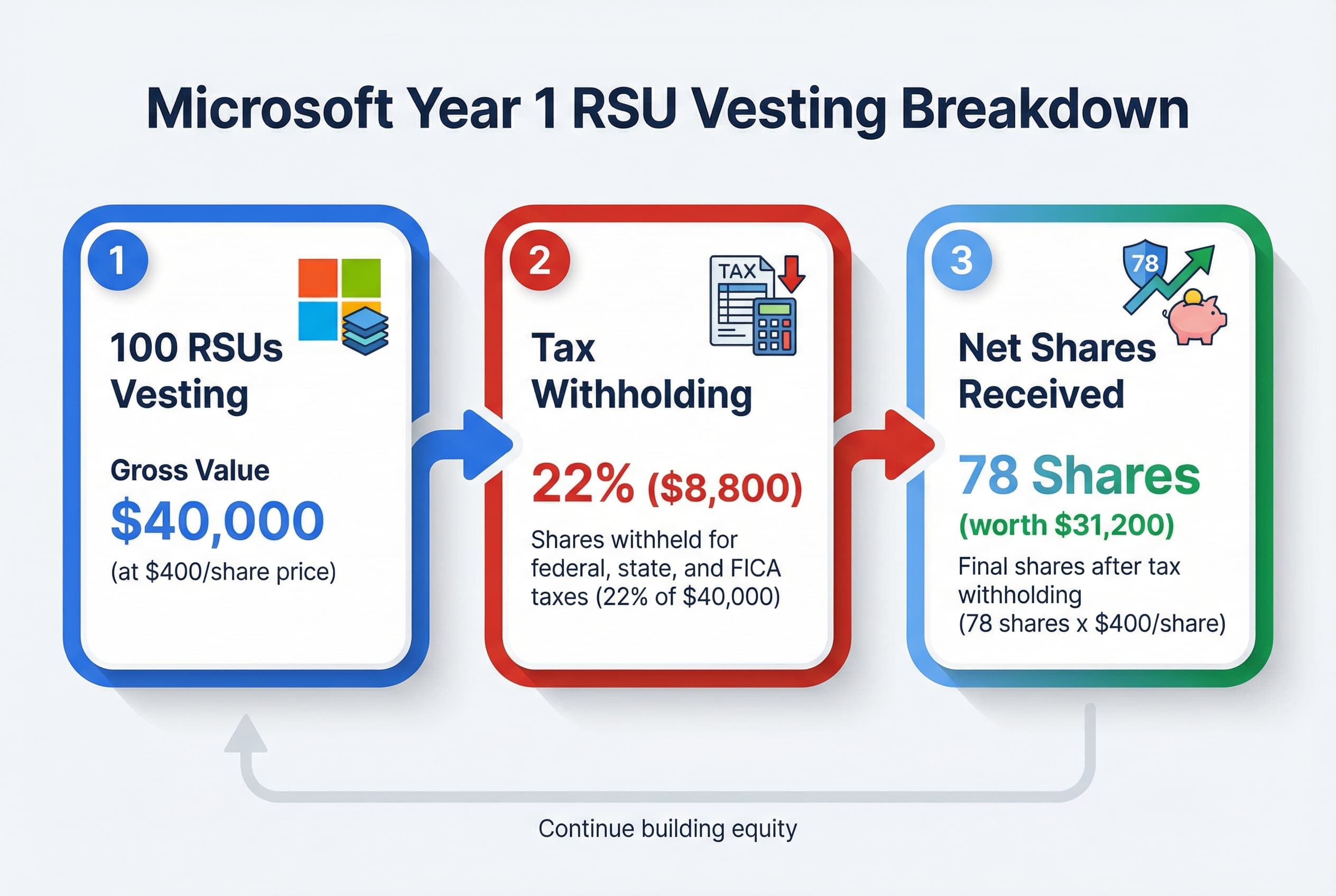
Sarah joins Microsoft and receives an on-hire grant of 400 RSUs. These vest over 4 years at 25% annually (100 RSUs per year). Her RSUs vest monthly on a specific date in February, May, August, and November.
Year 1: 100 RSUs vest throughout the year
Year 2: Another 100 RSUs vest
Year 3: 100 RSUs vest
Year 4: Final 100 RSUs vest
Over four years, Sarah's 400 RSUs generated $175,000 in gross income. After the 22% withholding, she received 312 shares worth approximately $136,500 (plus she paid $38,500 in withheld taxes).
Microsoft can adjust withholding rates based on your situation. The 22% rate is standard, but high earners may face the 37% supplemental rate. You'll owe additional taxes at year-end if your total tax liability exceeds what was withheld.
Microsoft employees often make costly errors with their equity compensation. Here are the most common pitfalls to avoid:
The biggest mistake is holding too much Microsoft stock. As your RSUs vest quarterly (in February, May, August, and November), it's easy to accumulate significant concentration risk. Many employees have both their income and wealth tied to Microsoft's performance, which amplifies risk if the stock declines.
Microsoft withholds at a default rate of 22% for RSU vesting, but depending on your total income, you may owe at the supplemental rate of 37%. This withholding gap can result in a significant tax bill at year-end. Many employees forget to increase withholding or pay estimated quarterly taxes to cover the shortfall.
Microsoft's ESPP offers a 10% discount with a valuable 27-month lookback provision and quarterly purchases. Despite the substantial potential returns, many employees don't participate or contribute below the 15% maximum, leaving free money on the table.
Annual refresher grants vest over five years (longer than the industry standard four years), creating overlapping vesting schedules. Employees often lose track of multiple grants vesting simultaneously, making tax planning more complex and increasing the risk of over-concentration if shares aren't sold strategically.
Plan proactively to avoid these mistakes and maximize your equity compensation benefits.
Understanding what happens to your equity compensation when you leave Microsoft is crucial for financial planning.
Unvested RSUs are forfeited upon termination, regardless of whether you leave voluntarily or involuntarily. This applies to both your initial on-hire grant and any annual refresher awards. Since Microsoft RSUs vest monthly, your termination date matters significantly - you'll receive any shares that vested through your last day of employment, but lose all unvested portions.
Important exception: Microsoft offers an early retirement milestone that allows vesting continuation if you meet specific criteria: age 55 with 15 years of service, or age 65. If you qualify, your unvested RSUs may continue vesting after departure.
While Microsoft does grant non-qualified stock options (NSOs) and restricted stock awards (RSAs) to some employees, specific post-termination exercise windows are not publicly documented. If you hold options, review your individual grant agreement for exercise deadlines after termination.
If you leave Microsoft during an ESPP offering period, you'll typically be withdrawn from the plan. Your accumulated payroll deductions are usually refunded, and you won't participate in the next quarterly purchase. Any shares already purchased remain yours to keep or sell.
Key takeaway: Your termination date directly impacts how much equity you keep. Shares vest monthly at Microsoft, so even a few days can affect your final payout.
Microsoft offers a Deferred Compensation Plan (DCP) available to employees at Level 67 and above. This executive benefit provides significant flexibility in managing your income and tax liability.
The DCP allows you to defer up to 100% of your annual bonus and 75% of your base salary. You can choose when to receive these deferred amounts, with withdrawals that can be scheduled up to five years in the future. However, you must schedule your withdrawal date at least one year in advance from the initial deferral date.
Benefits include potential tax savings by deferring income to years when you may be in a lower tax bracket, such as retirement. The program also provides additional retirement planning flexibility beyond traditional 401(k) limits.
Risks include the fact that deferred amounts are unsecured company obligations, meaning they're subject to creditor claims if Microsoft faces financial difficulties. Additionally, once you commit to a deferral schedule, changing it is restricted.
Before participating, consider your current and future tax situations, liquidity needs, and overall financial plan. The one-year advance notice requirement means you need to plan carefully. Consult with a financial advisor to determine if deferring compensation aligns with your long-term goals.
This content is for educational purposes only and does not constitute financial advice. The information provided is general in nature and may not appl...
YourEmployeeStock.com is not a registered investment advisor.
Helpful videos explaining Microsoft equity compensation, vesting, and tax strategies.
Your cheat sheet to Microsoft RSUs (and all you need to know)
RSUs vs NSOs vs ISOs | Options taxation | Common pitfalls and benefits
Microsoft RSUs typically vest monthly over 4 or 5 years depending on the award type. On-hire grants usually vest 25% annually over 4 years, while annual refresher grants vest over 5 years (5% quarterly). Vesting occurs in February, May, August, and November.
If you meet the early retirement milestone (age 55 with 15 years of service, or age 65), your unvested RSUs will continue to vest according to the original schedule even after you leave. Otherwise, unvested RSUs are typically forfeited upon departure.
Microsoft withholds 22% by default for federal taxes when RSUs vest, though you can adjust this rate. If your total supplemental income is high, the withholding rate may be 37%. You'll also owe Social Security, Medicare, and state taxes where applicable.
This depends on your personal financial situation and risk tolerance. Selling immediately avoids concentration risk in a single stock, while holding for at least one year after vesting allows you to pay long-term capital gains rates (typically lower) on any appreciation. Many employees worry about over-concentration in Microsoft stock.
Microsoft's ESPP allows you to contribute up to 15% of your salary (maximum $25,000 annually) to purchase stock at a 10% discount. The plan has quarterly purchase periods and includes a 27-month lookback provision, meaning you get the discount from the lower price at either the beginning of the offering period or the purchase date.
A qualifying disposition occurs when you hold ESPP shares for at least 2 years from the offering date AND at least 1 year from the purchase date. Meeting these requirements allows you to receive more favorable long-term capital gains treatment on a portion of your gains.
Yes, Microsoft matches 50% of your contributions up to 3% of your salary (essentially a 1.5% match). The company also offers Roth 401(k) options and allows mega backdoor Roth conversions through after-tax contributions, with immediate vesting of all matching contributions.
Microsoft's annual refresher RSU grants vest over 5 years (at 5% quarterly), which is longer than the typical 4-year industry standard. This extended vesting schedule is designed to encourage longer-term retention, though it means refreshers vest more slowly than your initial on-hire grant.
Get a free personalized analysis from our equity compensation experts

