Free equity analysis
We're still gathering complete information
Some details about Palantir's equity programs may be incomplete or based on general industry data. We recommend verifying specifics with your official plan documents or HR department.
Complete guide to understanding your Palantir equity compensation, including RSU, ISO, NSO, ESPP, vesting schedules, and tax strategies.
Stock Price
$173.31
Closing price · Sep 14, 2026
Employees
3K
Worldwide
Equity Programs
4
programs
Vesting Period
5 years
RSU vesting
Closing price · Sep 14, 2026
Palantir offers 4 equity compensation programs to employees. Click on each program to learn more about eligibility, vesting, and tax implications.
Learn about Palantir's Restricted Stock Units program, including vesting schedules and tax treatment.
Learn about Palantir's Incentive Stock Options program, including vesting schedules and tax treatment.
Learn about Palantir's Non-Qualified Stock Options program, including vesting schedules and tax treatment.
Learn about Palantir's Employee Stock Purchase Plan program, including vesting schedules and tax treatment.
Palantir RSUs vest on a Multiple schedules reported: 5-year (20% Y1, then 20% monthly over Y2-Y5); 4-year uniform (25% annually); 4-year (25% annually, remainder monthly or quarterly in Y2-Y4). schedule.
Example calculation based on 100 shares:
| Year | Vesting % | Shares Vesting | Estimated Value |
|---|---|---|---|
| Year 1 | 25% | 25 | $4,332.75 |
| Year 2 | 25% | 25 | $4,332.75 |
| Year 3 | 25% | 25 | $4,332.75 |
| Year 4 | 25% | 25 | $4,332.75 |
| Total | 100% | 100 | $17,331 |
* Based on Palantir stock price of $173.31 as of Sep 14, 2026. Actual values will vary.
25%
25 shares
$4,332.75
25%
25 shares
$4,332.75
25%
25 shares
$4,332.75
25%
25 shares
$4,332.75
Palantir vesting schedule based on 100 total shares
Palantir offers a comprehensive equity compensation package designed to align employee success with company growth. As a publicly traded technology company (ticker: PLTR), Palantir provides several equity vehicles including Restricted Stock Units (RSUs), stock options (both Incentive Stock Options and Non-Qualified Stock Options), Restricted Stock Awards (RSAs), and an Employee Stock Purchase Plan (ESPP).
Equity compensation represents a significant component of total compensation at Palantir. Historically, the company has embraced an "equity-first compensation model," pairing competitive stock grants with base salary to give employees meaningful ownership in the company's future. As a publicly traded company, your equity has real market value that you can track daily, providing transparency and liquidity opportunities that weren't available during Palantir's private years.
Palantir uses multiple vesting schedules depending on your grant type and timing. RSU grants typically vest over 4-5 years with monthly vesting frequency. Common structures include a 5-year schedule (20% in year one, then monthly over years 2-5) or 4-year schedules with 25% vesting annually. Stock options may vest over longer periods, with some grants vesting over up to 8 years.
Refresher grants are available but are performance-based - only high performers receive annual refreshers, making continued strong performance important for building long-term equity value. The ESPP allows semi-annual purchases with a maximum annual contribution of $25,000.
Palantir uses multiple vesting schedules for RSU grants, which can vary depending on your role, level, and when you joined the company. Understanding your specific vesting timeline is crucial for planning your financial future.
Palantir employs several different vesting structures for RSUs:
Five-Year Schedule: Some grants vest over five years with a frontloaded structure. You'll receive 20% of your total grant in the first year, then the remaining 80% vests monthly at approximately 1.67% per month over years 2-5.
Four-Year Uniform Schedule: Other grants follow a traditional four-year schedule with 25% vesting annually, providing equal distribution across all four years.
Four-Year Variable Schedule: A third option also spans four years with 25% vesting in year one, but the remaining 75% vests either monthly (at approximately 2.08% per month) or quarterly (at 6.25% per quarter) during years 2-4.
Unlike many tech companies that enforce a one-year cliff, Palantir's RSU schedules don't appear to include a traditional cliff period based on available data. Shares typically vest monthly or quarterly depending on your specific grant terms, allowing you to receive portions of your equity throughout the vesting period rather than waiting a full year.
For stock options, Palantir uses different schedules, including some that extend up to eight years. Executive grants may include immediate vesting of 2.5% or 5.0% on the grant date, with the remainder vesting quarterly. Options remain exercisable for 90 days after termination and expire after 10 years.
Palantir offers annual refresher grants, but these are reserved exclusively for high performers. Don't expect automatic refreshers - you'll need to demonstrate strong performance to receive additional equity awards beyond your initial grant.
When reviewing your offer letter or equity agreement, pay close attention to which vesting schedule applies to your specific grant, as this significantly impacts when you'll actually receive your shares.
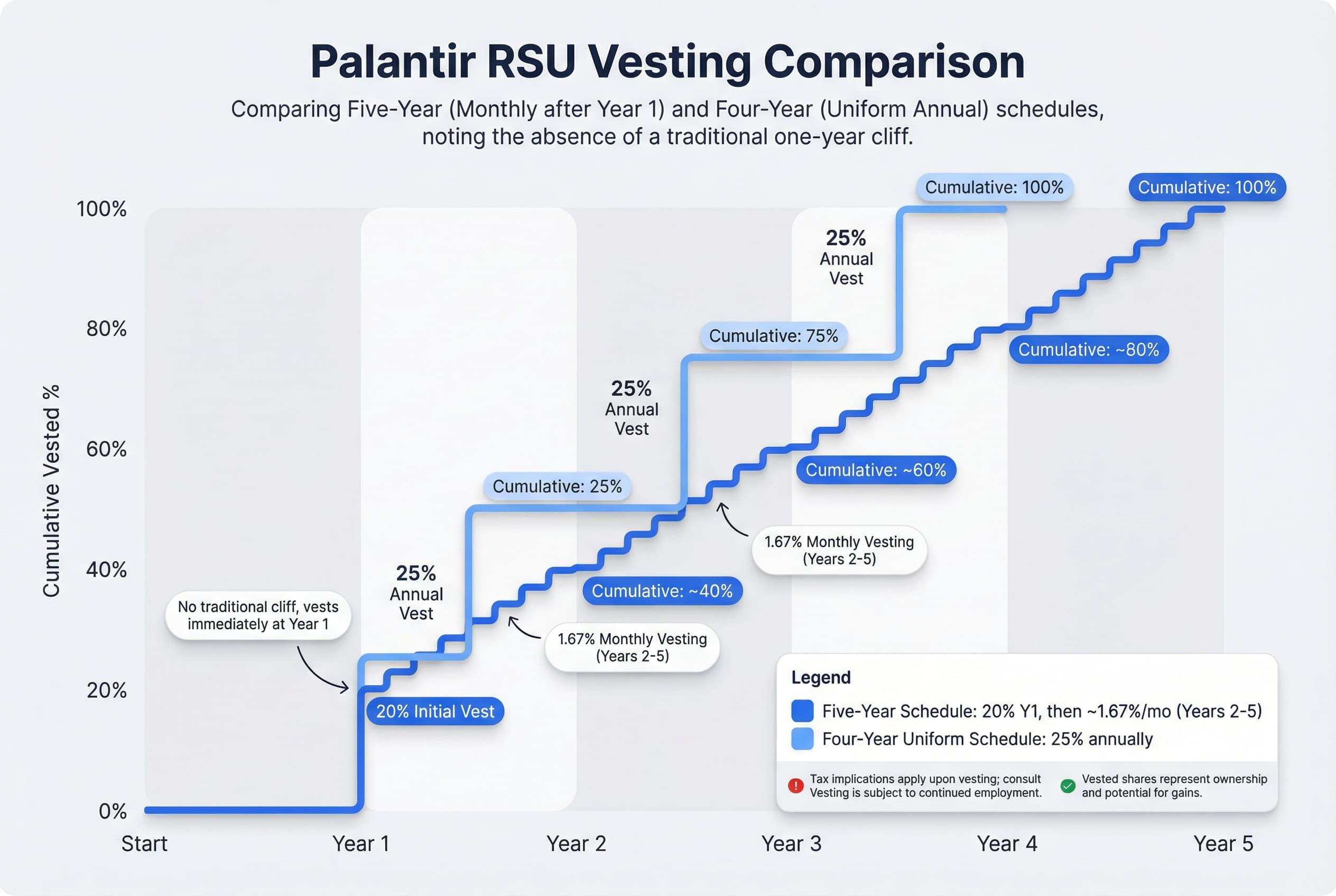
Palantir offers an Employee Stock Purchase Plan that allows you to purchase company stock at a discount through payroll deductions. The program operates on a 12-month offering period with semi-annual purchase periods of 6 months each, giving you two opportunities per year to buy shares.
You can contribute up to $25,000 per year to the ESPP through payroll deductions. While specific enrollment windows aren't detailed in available data, most ESPPs allow enrollment at the beginning of each offering period.
The tax treatment of your ESPP shares depends on how long you hold them. For a qualifying disposition (which receives more favorable tax treatment), you must hold the shares for more than one year after the purchase date and more than two years after the offering date. If you sell before meeting both requirements, it's a disqualifying disposition, and a portion of your gain will be taxed as ordinary income.
Unfortunately, specific details about Palantir's ESPP discount rate and whether the plan includes a lookback provision are not available in current data. These features are critical for understanding the program's potential value. A typical ESPP offers a 15% discount, and many include a lookback provision that lets you purchase shares at the lower of the price at the beginning or end of the purchase period - but we cannot confirm these details for Palantir's specific plan.
Before enrolling, request the official ESPP plan document from HR to understand the exact discount rate, lookback provisions, and potential returns. Be aware that insider trading restrictions and blackout periods may affect when you can sell your shares.
Understanding the tax treatment of your Palantir equity compensation is crucial for effective financial planning. Different equity types trigger taxes at different times and rates.
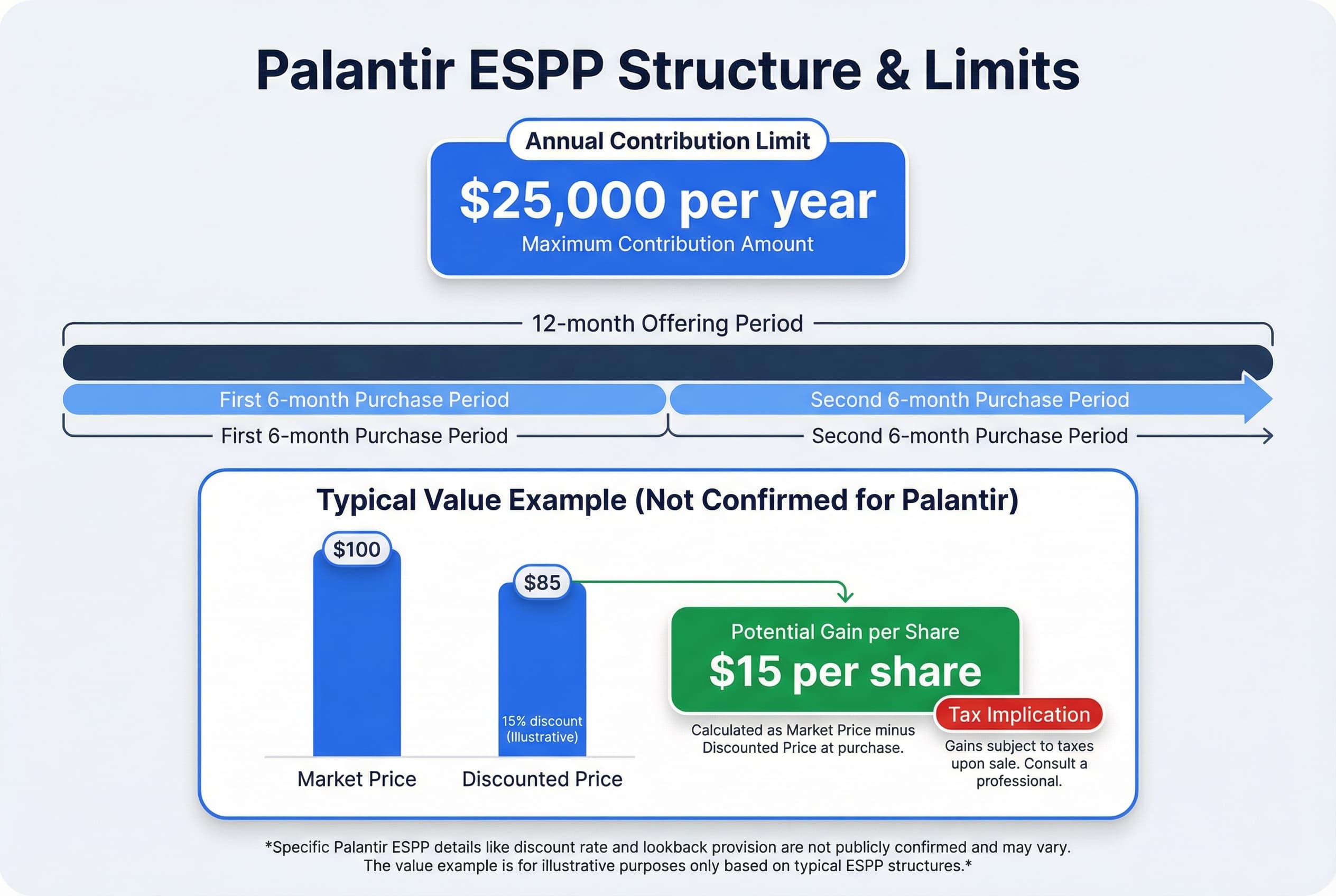
Restricted Stock Units (RSUs) are taxed as ordinary income at vesting. When your RSUs vest - whether monthly, quarterly, or annually depending on your schedule - the full value becomes taxable compensation, just like your salary. You'll owe taxes even if you don't sell the shares.
Stock Options have more complex timing. For Incentive Stock Options (ISOs), no regular tax is owed at exercise if you hold the shares. However, the spread between exercise price and fair market value may trigger Alternative Minimum Tax (AMT). Non-Qualified Stock Options (NSOs) are taxed as ordinary income on the spread at exercise. Both option types incur capital gains tax when you eventually sell the shares.
ESPP shares purchased at a discount are taxed differently depending on whether you meet the qualifying disposition period (over one year after purchase and over two years after the offering date). Qualifying dispositions receive favorable capital gains treatment on the discount, while disqualifying dispositions treat the discount as ordinary income.
Palantir withholds taxes when RSUs vest, but the standard supplemental income withholding rate may not cover your full tax liability. This creates a common "gap" problem - especially for high earners in elevated tax brackets. If you're in the 35% or 37% federal bracket but only 22% is withheld, you'll owe additional taxes at year-end.
RSU income at vest and option spreads at exercise are taxed as ordinary income at your marginal rate. However, gains from selling shares you've held long-term (over one year) qualify for lower long-term capital gains rates, making your holding period strategically important.
While specific state tax information isn't available in the data provided, employees should consider their state's income tax treatment of equity compensation, particularly if working remotely from a high-tax state.
Disclaimer: This information is educational only and not tax advice. Equity compensation taxation is complex and highly individual. Consult a qualified tax professional or financial advisor familiar with equity compensation to understand your specific situation.
As a Palantir employee, your equity compensation can become a substantial portion of your wealth - but concentrating too much in a single stock creates significant risk. If Palantir's stock declines, you could face a double impact: reduced equity value and potential job loss, both tied to the same company's performance.
Palantir operates in the competitive technology sector, where companies face unique volatility. Key risks include:
Financial advisors typically recommend keeping single-stock exposure to 10-20% of your total net worth. This means regularly selling vested shares to rebalance, even when you're bullish on Palantir's future.
Consider these steps:
Remember: believing in your company doesn't require betting your entire financial future on it.
Given Palantir's extended vesting schedules (up to 5 years with monthly vesting), you'll receive shares regularly rather than in large chunks. Consider selling portions of vested shares when they represent more than 15-20% of your total net worth to reduce concentration risk. Since stock options have a 30-month post-termination exercise window, plan ahead if you're considering leaving - exercise decisions require careful tax planning.
Palantir employees face unique concentration risk due to the company's "equity-first compensation model" that historically emphasized stock grants over cash salary. If your equity compensation significantly exceeds your annual cash salary, prioritize diversification. The technology sector's volatility makes this especially important - don't let company stock dominate your portfolio simply because it's convenient to hold.
ESPP Timing: With semi-annual purchase periods, plan for qualifying dispositions by holding shares over one year from purchase and two years from the offering date to receive favorable long-term capital gains treatment.
10b5-1 Plans: Palantir encourages executives to use 10b5-1 trading plans, and these are available to employees. These pre-scheduled selling plans help you navigate blackout periods systematically while removing emotional decision-making from the equation.
Mega Backdoor Roth: Take advantage of Palantir's 401(k) after-tax contributions (up to $57,000 total annually) to build tax-free retirement savings alongside your equity compensation.
View your equity as deferred, variable compensation rather than a bonus. Since refresher grants go primarily to high performers, don't assume automatic equity increases. Calculate your effective annual compensation by dividing total unvested equity by remaining vesting years, then add base salary to understand your true compensation picture.
Let's walk through how RSU vesting works at Palantir using their common 5-year vesting schedule.
Sarah joins Palantir as a software engineer and receives an RSU grant worth $100,000 at the current stock price. This grant vests over 5 years with a front-loaded schedule: 20% in Year 1, then the remaining 80% vesting monthly over Years 2-5.
Year 1: Sarah receives 20% of her grant upfront = $20,000 worth of shares. At vesting, these shares are taxed as ordinary income. Assuming a typical supplemental withholding rate of 37% for federal taxes plus state taxes, approximately $7,400-$9,000 is withheld, and Sarah receives the remaining shares.
Years 2-5: The remaining $80,000 vests monthly at 1.67% per month. Each month, Sarah receives approximately $1,667 in shares. With the same tax withholding, she nets roughly $1,000-$1,250 per month in actual shares after taxes.
By the end of Year 2, Sarah has vested 40% total ($40,000). By Year 3, she's at 60% ($60,000), and so on. The monthly vesting provides regular equity income rather than waiting for annual cliff dates.
The actual value Sarah receives depends on Palantir's stock price at each vesting date. If the stock price doubles, her unvested RSUs become worth more. Conversely, if it drops, they're worth less. The tax withholding happens automatically through share withholding - some shares are sold to cover taxes, and Sarah receives the net amount.
This front-loaded schedule means Sarah gets significant equity value early, which is more favorable than traditional 4-year schedules with 1-year cliffs.
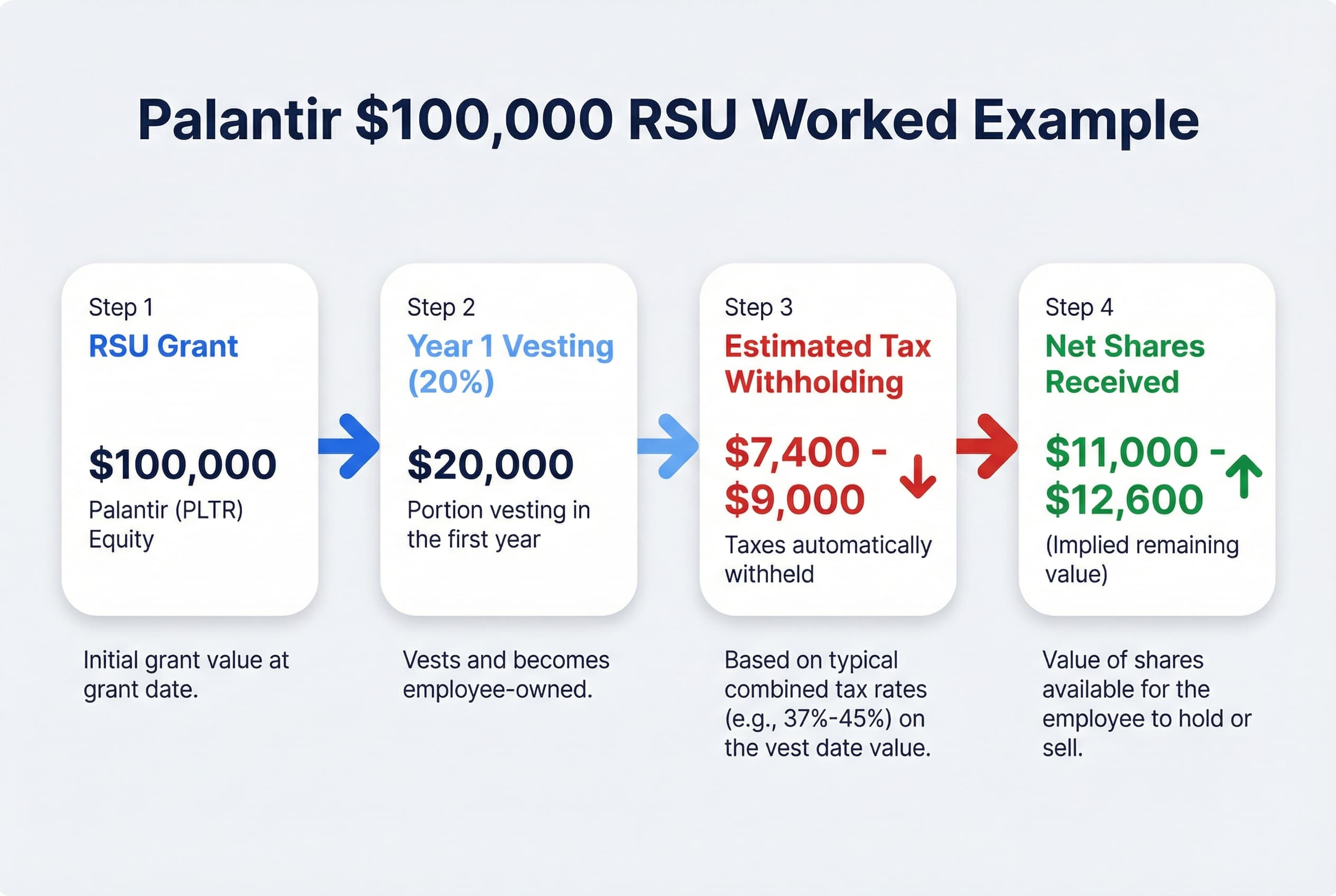
Palantir's equity compensation can be complex, and employees often make costly mistakes that impact their financial outcomes. Here are the most common pitfalls to avoid:
With only a 90-day post-termination exercise window, many departing employees face tight deadlines to exercise vested options. This can force difficult decisions or require taking out personal loans to cover exercise costs and taxes. Plan ahead by understanding your exercise obligations well before any potential departure.
Palantir's equity-heavy compensation model can lead to portfolios dangerously concentrated in PLTR stock. As your RSUs vest over 4-5 years, regularly assess whether you're holding too much company stock relative to your overall net worth. Consider diversifying as shares vest to manage risk.
RSU vesting creates immediate taxable income, and employees often underestimate their tax burden. Without proper planning for estimated tax payments, you could face penalties and large bills at year-end. Review your withholding strategy and consider quarterly estimated payments, especially during high-vesting years.
Palantir offers an ESPP with semi-annual purchase periods and a $25,000 annual contribution limit. Many employees overlook this benefit entirely. Even without knowing the exact discount, participating can provide additional equity accumulation opportunities.
Given Palantir's blackout periods and trading restrictions, failing to establish a 10b5-1 plan can limit your ability to sell shares strategically. These plans allow predetermined sales during otherwise restricted periods.
Understanding how your equity is affected when leaving Palantir is crucial for financial planning. Here's what happens to each component:
Any unvested RSUs are forfeited upon termination, regardless of whether you leave voluntarily or involuntarily. Your termination date determines your final vesting event - only shares that have vested by that date remain yours. Given Palantir's various vesting schedules (ranging from 4 to 5 years with monthly or quarterly vesting), even a few days can impact how many shares you keep.
For vested stock options, you have a 90-day post-termination exercise window. This means you must decide within three months whether to purchase your vested options at the strike price. Any unvested options are forfeited. This tight timeline can create financial pressure, as you'll need cash available to exercise options you want to keep. Options typically expire 10 years from the grant date if not exercised.
If you leave mid-offering period, you'll typically be withdrawn from the ESPP. Your accumulated payroll deductions are usually returned to you, and you won't receive shares for that incomplete purchase period.
The 90-day exercise window for options is particularly significant at Palantir, where historically employees have needed personal loans to exercise before the deadline. Plan ahead by understanding your option strike prices and the cash required to exercise them well before any potential departure.
Palantir offers a deferred compensation plan as part of its overall benefits package, though specific details about the program's structure are limited in available public information.
A deferred compensation plan allows eligible employees to defer a portion of their income to a future date, typically retirement. This can include salary, bonuses, or other forms of compensation. The deferred amounts grow tax-deferred until withdrawal.
Benefits:
Risks:
Before participating, consider your current tax situation, retirement timeline, and confidence in Palantir's long-term financial stability. Since deferred compensation isn't protected like 401(k) assets, it's generally most appropriate for employees with strong confidence in the company's future and who have already maximized other retirement savings options.
Consult with a financial advisor to determine if deferral makes sense for your specific situation.
This content is for educational purposes only and does not constitute financial advice. The information provided is general in nature and may not appl...
YourEmployeeStock.com is not a registered investment advisor.
Palantir uses multiple vesting schedules depending on your grant. The most common are a 5-year schedule (20% in year 1, then monthly vesting over years 2-5) or a 4-year schedule (25% annually, with remaining shares vesting monthly or quarterly). Your offer letter will specify which schedule applies to your specific grant.
Yes, Palantir offers annual refresher grants, but they are only given to high performers. These refreshers can be generous for top contributors, but they are not guaranteed for all employees regardless of tenure or level.
You typically have 90 days after your termination date to exercise any vested stock options. Options generally expire 10 years from the grant date, but the post-termination exercise window is only 90 days, so you'll need to act quickly if you want to exercise after leaving.
Yes, Palantir offers an ESPP with semi-annual purchase periods and a 12-month offering period. You can contribute up to $25,000 per year, and purchases occur twice per year. Specific discount percentages are not publicly disclosed in standard plan documents.
Yes, Palantir has blackout periods that restrict when you can trade, and you can only sell during open trading windows. Executives are encouraged to use 10b5-1 trading plans. Additionally, employees selling shares may need to agree to 12-month non-compete and non-solicitation restrictions.
No, Palantir does not offer a 401(k) match. However, the plan (administered by Fidelity) does allow after-tax contributions up to $57,000 total annually, which enables the Mega Backdoor Roth conversion strategy for high earners.
When your RSUs vest, they are treated as ordinary income and taxed at your regular income tax rate. Palantir will withhold taxes at vesting, and the fair market value of the shares on the vesting date is included in your W-2 income for that year.
Signing bonuses at Palantir are typically around $15,000 and may be split over two years. If your signing bonus is paid over multiple years, you may need to repay a portion if you leave the company before the full payout period is complete.
Get a free personalized analysis from our equity compensation experts

