Free equity analysis
Complete guide to understanding your Intuit equity compensation, including RSU, NSO, ESPP, vesting schedules, and tax strategies.
Employees
17K
Worldwide
Equity Programs
3
programs
Vesting Period
4 years
RSU vesting
Intuit offers 3 equity compensation programs to employees. Click on each program to learn more about eligibility, vesting, and tax implications.
Standard RSU program with 4-year vesting and 1-year cliff. Annual refresh grants available for eligible employees.
Learn about Intuit's Non-Qualified Stock Options program, including vesting schedules and tax treatment.
Learn about Intuit's Employee Stock Purchase Plan program, including vesting schedules and tax treatment.
Intuit offers a comprehensive equity compensation package designed to align employee interests with long-term company success. As an employee, you may receive several types of equity awards, including Restricted Stock Units (RSUs), Non-Qualified Stock Options (NSOs), Restricted Stock Awards (RSAs), and Performance Stock Units (PSUs). Additionally, Intuit provides an Employee Stock Purchase Plan (ESPP) that allows you to purchase company stock at a 15% discount with a lookback provision.
Equity compensation represents a significant portion of your total compensation at Intuit, particularly as you advance in your career. As a publicly-traded technology company (NASDAQ: INTU), Intuit's stock performance directly impacts the value of your equity awards. Beyond your initial grant, Intuit offers annual equity refreshers based on performance and level, helping you build wealth over time as you contribute to the company's growth.
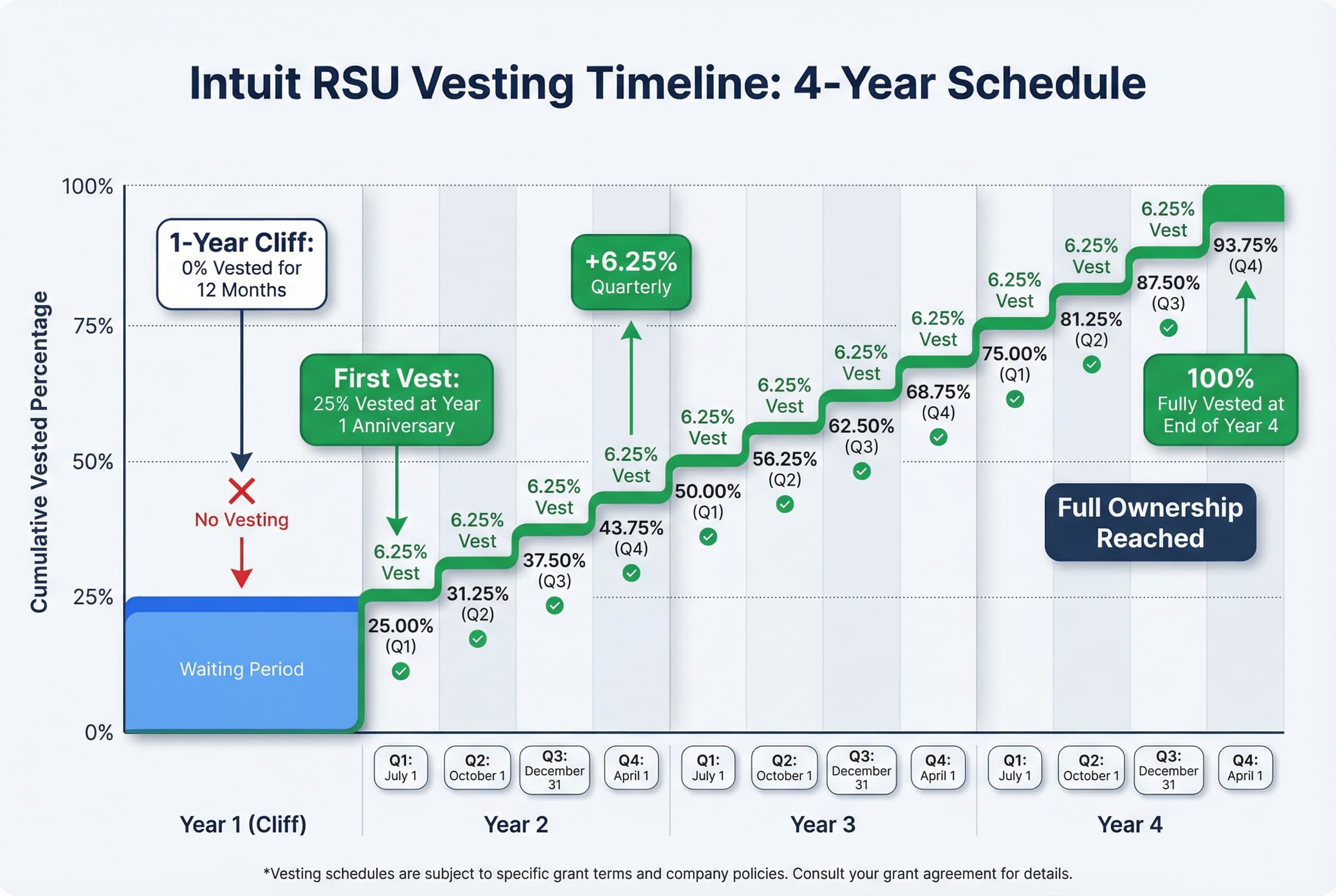
RSUs at Intuit typically follow a 4-year vesting schedule with a 1-year cliff, meaning 25% of your grant vests after your first year, then the remaining shares vest quarterly (6.25% each quarter) over the following three years. Vesting occurs on specific dates: July 1, October 1, December 31, and April 1. NSOs follow a similar pattern with 25% vesting after one year, followed by monthly vesting at 2.125% until fully vested over three years total.
Understanding how your equity vests and the tax implications is crucial to maximizing this valuable component of your compensation package.
Intuit follows a 4-year vesting schedule with a 1-year cliff for Restricted Stock Units (RSUs). This means you'll need to complete one full year of employment before receiving your first batch of shares. At that point, 25% of your total grant will vest. After the initial cliff, the remaining shares vest quarterly at a rate of 6.25% per quarter until you reach 100% vesting at the end of four years.
This structure is considered uniform vesting, as you receive an equal 25% of your grant each year when viewed annually, though the delivery happens in quarterly installments after the first year.
Intuit has set quarterly vesting dates: July 1, October 1, December 31, and April 1. For most employees, the initial 25% cliff vests on July 1, followed by quarterly vests on the subsequent dates (October 1, December 31, April 1, and back to July 1). Note that retirement-eligible employees and certain executive roles may have different vesting start dates or structures.
During your first year at Intuit - the cliff period - no shares vest. If you leave the company before completing 12 months, you forfeit your entire grant. This protects both you and the company by ensuring mutual commitment. Once you pass the one-year mark, you'll receive that full 25% at once, and then continue earning shares every quarter thereafter.
Intuit offers annual RSU refresher grants based on your performance review and level. These additional equity grants help retain employees and reward strong performance. The size of refresher grants varies depending on your performance rating and position. For example, one report mentioned an expected annual refresher of approximately $100,000 for a Staff Engineer in Bangalore, though this varies by location, level, and performance.
Refresher grants typically follow the same 4-year vesting schedule as your initial grant, creating overlapping vesting schedules that can result in quarterly vests from multiple grants simultaneously.
For employees receiving stock options (NSOs), Intuit uses a similar structure: 25% vesting after the first year, followed by monthly vesting at 2.125% until fully vested over approximately 36 months total.
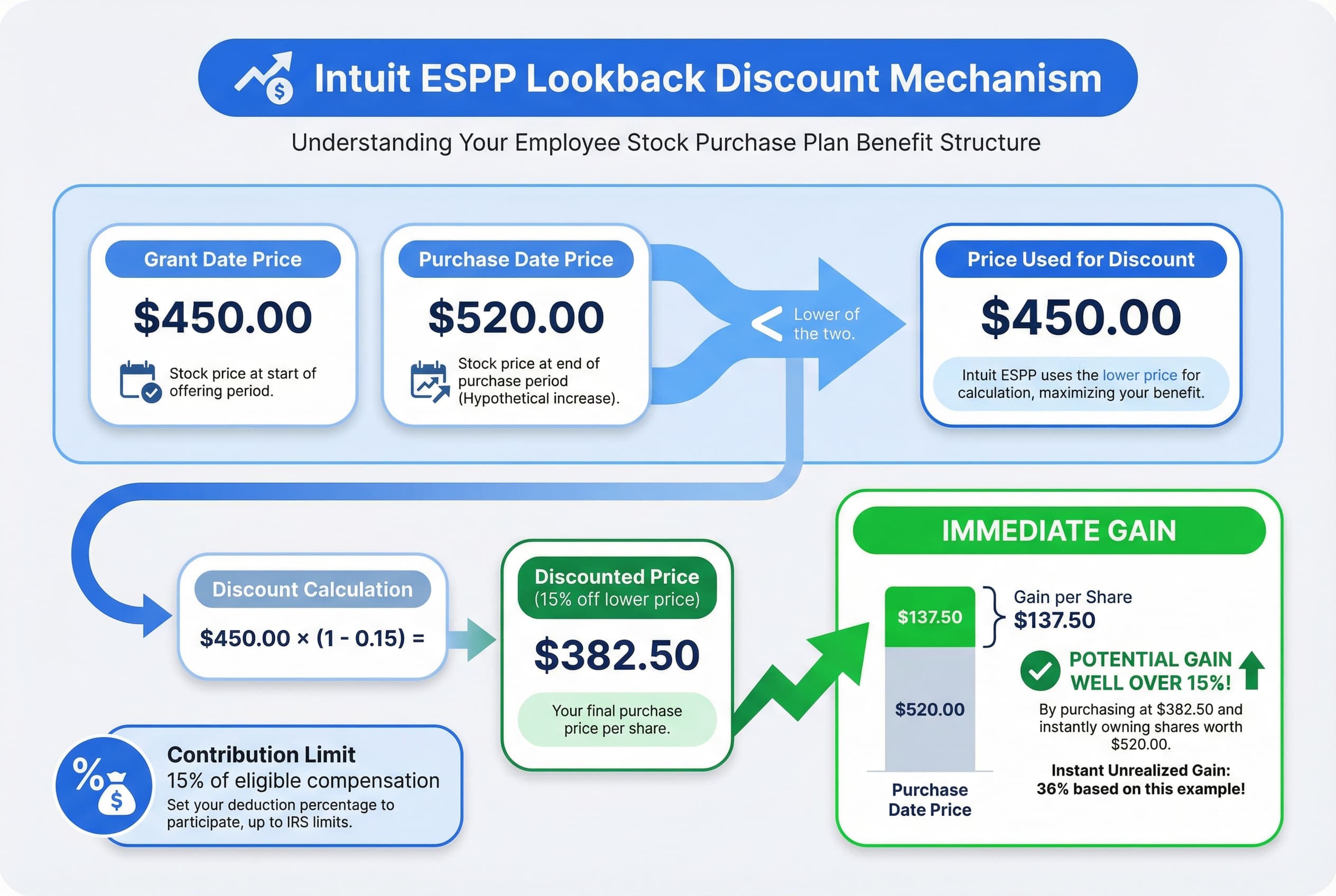
Intuit offers an Employee Stock Purchase Plan that allows you to purchase company stock at a discount through payroll deductions. The plan provides a 15% discount on the stock price and includes a lookback provision, which can significantly enhance your potential returns.
The lookback provision is a valuable feature that allows you to purchase stock at 15% off the lower of two prices: the stock price at the beginning of the offering period or the price at the end of the purchase period. This means if Intuit's stock price increases during the offering period, you'll benefit from purchasing at the lower starting price with the discount applied.
You can contribute up to 15% of your eligible compensation through payroll deductions. This allows you to systematically build a position in Intuit stock while taking advantage of the discount and lookback features.
The combination of the 15% discount and lookback provision can generate immediate gains. In a rising stock price environment, your returns can be substantial. For example, if the stock rises during the offering period, you could purchase shares at 15% off the lower starting price, potentially creating a gain of well over 15% when you sell.
When you sell ESPP shares, the tax treatment depends on your holding period. A qualifying disposition occurs when you hold shares for at least two years from the offering date and one year from the purchase date, which can provide more favorable tax treatment. A disqualifying disposition (selling before meeting these requirements) results in a portion of your gain being taxed as ordinary income.
The ESPP represents a valuable benefit that can complement your other equity compensation, though you should consider your overall stock concentration when determining your contribution level.
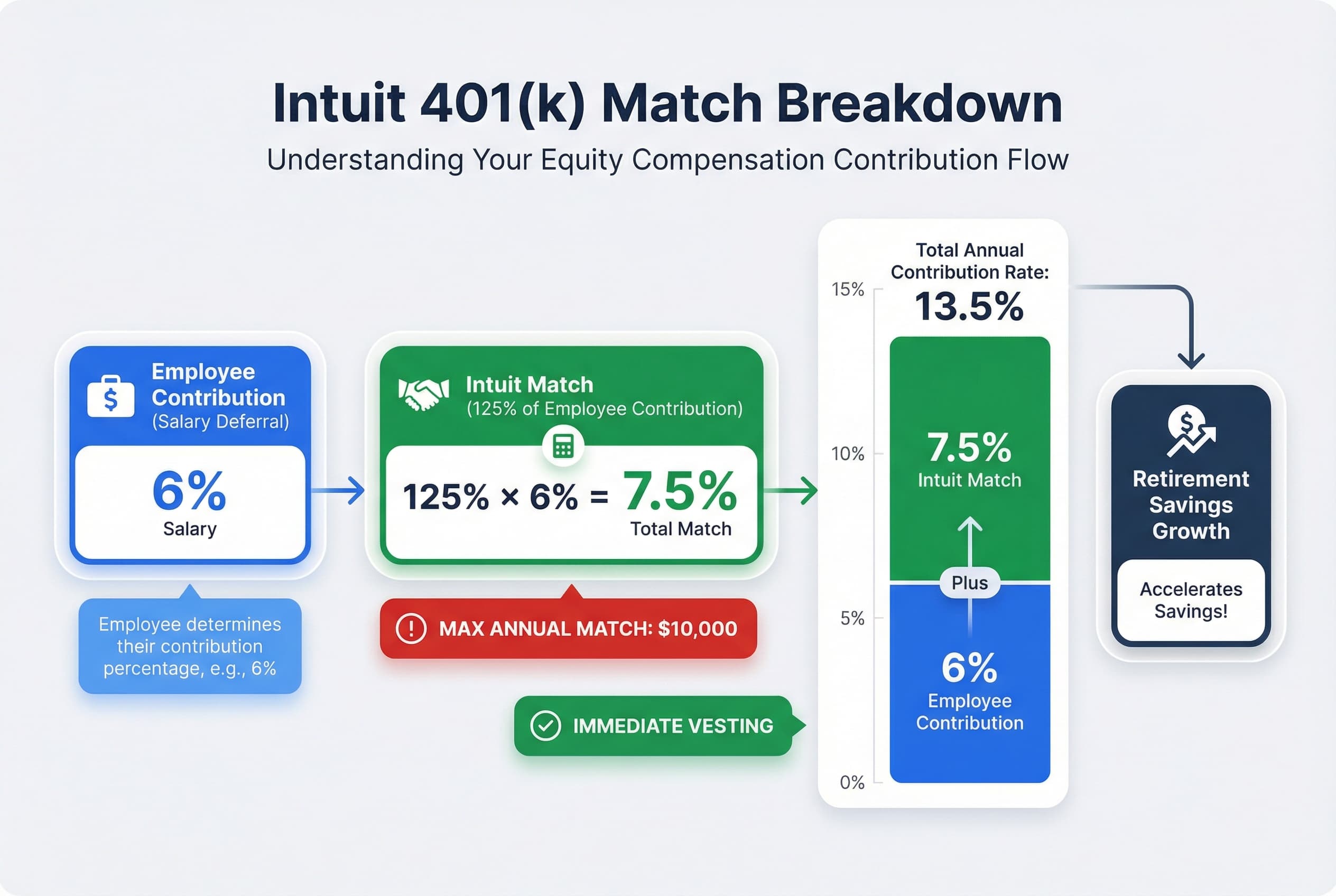
Intuit offers a competitive 401(k) plan with an exceptional employer match structure. The company provides a 125% match on up to 6% of your salary contributions, with a maximum annual match of $10,000. This means if you contribute 6% of your salary, Intuit will contribute 7.5% (125% of your 6%), making it one of the more generous match programs in the tech industry.
The employer match vests immediately, meaning you have full ownership of Intuit's contributions from day one. This is a significant advantage compared to many companies that require multi-year vesting periods for their 401(k) match.
Intuit supports both traditional and Roth 401(k) contributions, giving you flexibility in your tax planning strategy. The plan also offers after-tax contributions and supports the mega backdoor Roth strategy, which allows high earners to contribute significantly more to Roth accounts beyond standard limits. For 2023, the IRS contribution limit was $22,500 (or $30,000 if you're 50 or older).
The plan includes a brokerage window through Charles Schwab, providing access to a wider range of investment options beyond the standard 401(k) fund menu. This feature is particularly valuable for employees who want more control over their investment strategy or prefer specific securities not available in the core plan offerings.
Understanding the tax treatment of your Intuit equity awards is essential for effective financial planning. Here's what you need to know about when and how you'll owe taxes on your stock compensation.
RSUs and RSAs: You owe ordinary income tax at vesting. When your RSUs vest quarterly (on dates like July 1, October 1, December 31, and April 1), the fair market value of the shares becomes taxable income, just like your salary. RSAs work similarly unless you make an 83(b) election, which allows you to pay tax at grant instead of vesting - potentially beneficial if you expect the stock price to increase significantly.
NSOs (Non-Qualified Stock Options): You owe ordinary income tax when you exercise, based on the difference between the exercise price and the current market value (the "spread"). When you later sell the shares, you'll owe capital gains tax on any additional appreciation.
ESPP: Tax treatment depends on your holding period. For a qualifying disposition (holding shares for the required period), you'll pay ordinary income tax on the discount portion and capital gains on any additional appreciation. Disqualifying dispositions result in ordinary income tax on the full gain at exercise.
Intuit withholds at a default rate of 22% for supplemental income, though this can be adjusted. However, if you're in a higher tax bracket, this withholding may fall short. For high earners facing the 37% supplemental rate, this creates a significant "gap" that results in additional taxes owed at year-end. Many Intuit employees report surprise tax bills due to insufficient withholding on RSUs.
The distinction matters: ordinary income (applicable to RSU vesting and NSO exercise) is taxed at your marginal rate (up to 37% federally), while long-term capital gains (for shares held over one year after acquisition) are taxed at preferential rates (0%, 15%, or 20%).
Intuit is headquartered in California, a high-tax state with rates up to 13.3%. California taxes all equity income, and apportionment rules may apply if you work in multiple states during the vesting period.
Disclaimer: This information is educational only and not tax advice. Tax situations vary based on individual circumstances. Please consult a qualified tax professional to understand your specific tax obligations.
As an Intuit employee receiving RSUs, NSOs, and potentially participating in the ESPP, it's easy to accumulate significant wealth in a single stock. While this reflects your confidence in the company, concentration risk is one of the most important financial considerations to manage.
When too much of your net worth is tied to one company, you're essentially doubling down: your income and your investments depend on the same source. If Intuit faces challenges, you could experience job insecurity and portfolio losses simultaneously.
As a technology company, Intuit faces specific risks including intense competition in financial software, regulatory changes affecting tax and accounting products, cybersecurity threats, and rapid technological disruption. The technology sector can also experience significant volatility, with stock prices sometimes moving dramatically based on market sentiment or earnings reports.
Financial advisors commonly recommend limiting single-stock exposure to 10-20% of your total net worth, though your personal risk tolerance may vary. Consider diversifying by selling vested shares systematically rather than holding everything long-term.
Review your equity concentration at each vesting date (July 1, October 1, December 31, and April 1). Take advantage of Intuit's generous 401(k) match (125% on the first 6%, up to $10,000 annually) to build diversified retirement savings. Consider whether maximizing ESPP participation makes sense given your overall Intuit exposure, and develop a plan to regularly rebalance your portfolio.
As your RSUs vest quarterly following the initial 25% cliff at one year, you'll face regular decisions about whether to hold or sell. Consider selling vested shares when Intuit stock represents more than 10-15% of your total investment portfolio, or when you need to rebalance toward your target asset allocation. The quarterly vesting schedule (July 1, October 1, December 31, and April 1) provides natural decision points.
Technology sector concentration is a key risk for Intuit employees. Your salary, annual refresher grants, and existing equity are all tied to the company's performance. This creates significant concentration risk that can impact both your income and net worth simultaneously. Regularly selling vested shares to diversify into other asset classes and sectors helps protect against this single-company dependency.
ESPP Timing: Intuit's ESPP offers a 15% discount with a lookback provision. To achieve qualifying disposition tax treatment (lower long-term capital gains rates), hold shares for at least two years from the offering date and one year from purchase. However, evaluate whether the tax savings justify the concentration risk of holding longer.
RSU Tax Management: RSUs are taxed as ordinary income at vesting with a default 22% withholding rate (37% for amounts over $1 million). This may be insufficient for your actual tax liability. Consider adjusting withholding or setting aside additional funds to avoid year-end surprises. Note that some brokerages incorrectly report cost basis as $0, which could lead to double taxation - verify your Form 1099-B carefully.
Intuit offers 10b5-1 trading plans, which allow you to set up automatic sales on a predetermined schedule. These plans provide legal protection for insider trading concerns and remove emotional decision-making from selling decisions, helping you maintain a disciplined diversification strategy.
Let's walk through how equity vesting works for a Senior Software Engineer joining Intuit with a $200,000 RSU grant.
You receive 200 RSUs (assuming a stock price of $1,000 per share at grant = $200,000 total value). Your grant follows Intuit's standard 4-year vesting schedule with a 1-year cliff.
On July 1 of your first year, you hit the 1-year cliff and 25% vests immediately:
After the initial cliff, the remaining 150 shares vest quarterly at 6.25% per quarter:
October 1 (Year 1):
This pattern continues every quarter on October 1, December 31, April 1, and July 1 until all shares are vested.
Assuming the stock price averages $1,200 over the vesting period, you'd receive approximately 155 net shares after tax withholding (from the original 200 granted), worth around $186,000.
The 22% withholding may not cover your full tax liability if you're in a higher tax bracket. Plan to set aside additional funds or adjust your withholding rate with Intuit's payroll team to avoid a surprise tax bill at year-end.
Even experienced employees can stumble when managing equity compensation. Here are the most frequent mistakes Intuit employees make:
Intuit's RSUs and NSOs include a 12-month cliff period before your first vesting event. If you leave before completing one full year, you forfeit your entire equity grant. Plan your career moves carefully around this milestone.
Intuit's default withholding rate is 22% for equity compensation, but if you're in a higher tax bracket, you could face a significant tax bill at year-end. You can adjust your withholding rate, and many employees should consider doing so to avoid underpayment penalties and surprise tax obligations.
Brokerages sometimes incorrectly report RSU cost basis as $0 on Form 1099-B, which can result in double taxation if you're not careful. Always verify your cost basis when filing taxes to ensure you're only taxed on the actual gain from sale, not the entire proceeds.
Holding too much company stock creates unnecessary risk. As your RSUs vest quarterly after the first year, develop a systematic selling strategy to diversify your portfolio and reduce concentration in a single company.
Intuit's ESPP offers a 15% discount with a lookback provision, providing significant value. Many employees either don't enroll or contribute less than the 15% maximum, leaving money on the table.
Understanding what happens to your equity compensation when you leave Intuit is crucial for making informed career decisions and maximizing your financial outcomes.
Unvested RSUs are forfeited upon termination. This applies regardless of whether you leave voluntarily or involuntarily. Given Intuit's quarterly vesting schedule (25% after the first year, then 6.25% quarterly thereafter), your termination date matters significantly. If you leave just before a vesting date, you'll forfeit that tranche. Intuit's vesting occurs on specific dates: July 1, October 1, December 31, and April 1.
For stock options, you have 90 days after termination to exercise any vested options. This is a standard post-termination exercise window. Any unvested options are forfeited immediately upon leaving. Note that options expire seven years from the grant date, so if you're close to that expiration, it takes precedence over the 90-day window.
If you leave Intuit during an ESPP offering period, you'll typically be withdrawn from the plan. Any contributions made during that period are usually returned to you, and you won't participate in the upcoming purchase. The specific handling depends on your termination date relative to the purchase date.
Your equity compensation is tied to active employment. Plan strategically around vesting dates when possible, and understand that unvested equity represents golden handcuffs - valuable compensation you'll lose by leaving early.
This content is for educational purposes only and does not constitute financial advice. The information provided is general in nature and may not appl...
YourEmployeeStock.com is not a registered investment advisor.
Helpful videos explaining Intuit equity compensation, vesting, and tax strategies.
Turbotax: RSU ESPP Reporting - Simplified
如何理解员工购股计划 (How to understand ESPP)
Intuit RSUs follow a 4-year vesting schedule with a 1-year cliff. You'll receive 25% of your grant after the first year (typically on July 1), then 6.25% quarterly thereafter on a set schedule (October 1, December 31, April 1, and July 1). This means you'll vest the remaining 75% evenly over the next three years through quarterly releases.
Yes, RSUs are taxed as ordinary income when they vest, based on the stock's fair market value on the vesting date. Intuit typically withholds 22% for federal taxes by default (or 37% for supplemental income), but this may not cover your full tax liability depending on your tax bracket. You can adjust your withholding rate, and you should plan for potential additional taxes owed at year-end to avoid surprises.
Yes, Intuit offers an ESPP with a 15% discount on the stock price and a lookback provision. You can contribute up to 15% of your eligible compensation to purchase Intuit stock at a discount. The lookback feature allows you to purchase at the lower price between the beginning and end of the offering period.
If you have NSOs (non-qualified stock options), you typically have 90 days after leaving Intuit to exercise any vested options. Options expire 7 years from the grant date. Any unvested options are generally forfeited when you leave the company, so consider your vesting status before making employment decisions.
Intuit NSOs vest over approximately 3 years with a 1-year cliff. You'll receive 25% of your options after the first anniversary of your grant date, then 2.125% monthly thereafter until fully vested. Early exercise is not allowed, so you must wait until options vest before exercising them.
Yes, Intuit provides annual RSU equity grants (stock refreshers) based on your performance review. The size of these refreshers varies based on your performance rating and level. These refresher grants follow the same 4-year vesting schedule as your initial equity grant.
When RSUs vest, shares are automatically withheld to cover taxes, and you can sell the remaining shares immediately. Be aware that brokerages sometimes incorrectly report RSU cost basis as $0 on Form 1099-B, which could result in double taxation if not corrected. Your actual cost basis is the fair market value on the vesting date, which was already taxed as income.
Yes, Intuit offers a generous 401(k) match of 125% on the first 6% of your contributions, up to a maximum of $10,000 annually. The match vests immediately with no waiting period. Intuit also offers Roth 401(k) options, after-tax contributions for mega backdoor Roth conversions, and a brokerage window through Charles Schwab.
Get a free personalized analysis from our equity compensation experts

