Free equity analysis
Complete guide to understanding your Airbnb equity compensation, including RSU, ISO, NSO, ESPP, vesting schedules, and tax strategies.
Employees
5.5K
Worldwide
Equity Programs
4
programs
Vesting Period
4 years
RSU vesting
Airbnb offers 4 equity compensation programs to employees. Click on each program to learn more about eligibility, vesting, and tax implications.
Standard RSU program with 4-year vesting and 1-year cliff. Annual refresh grants available for eligible employees.
Learn about Airbnb's Incentive Stock Options program, including vesting schedules and tax treatment.
Learn about Airbnb's Non-Qualified Stock Options program, including vesting schedules and tax treatment.
Learn about Airbnb's Employee Stock Purchase Plan program, including vesting schedules and tax treatment.
Airbnb offers a comprehensive equity compensation package that includes Restricted Stock Units (RSUs), stock options (both Incentive Stock Options and Non-Qualified Stock Options), and an Employee Stock Purchase Plan (ESPP). For most employees, RSUs form the core of their equity compensation, representing a significant portion of total compensation alongside base salary and cash bonuses.
As a publicly-traded technology company (ticker: ABNB), Airbnb's equity compensation allows you to become a partial owner in the company you help build. Your RSU grants typically range from $175,000 to $800,000 over four years, depending on your level and role. This equity component can represent a substantial part of your total compensation package and potential wealth creation, especially as the company grows and performs well in the market.
Most RSU grants at Airbnb follow a 4-year vesting schedule with a 1-year cliff, meaning you'll receive your first 25% of shares after completing one full year of service. After that, shares vest quarterly on specific dates: February 25, May 25, August 25, and November 25. The standard vesting pattern is 25% per year, though some roles may have irregular schedules.
Airbnb also offers annual stock refreshers that begin vesting after your first year, with grant amounts determined by your performance rating (ranging from 1x to 3x multipliers). Additionally, the ESPP allows you to purchase Airbnb stock at a 15% discount with a lookback provision, making it an attractive benefit for building additional equity holdings.
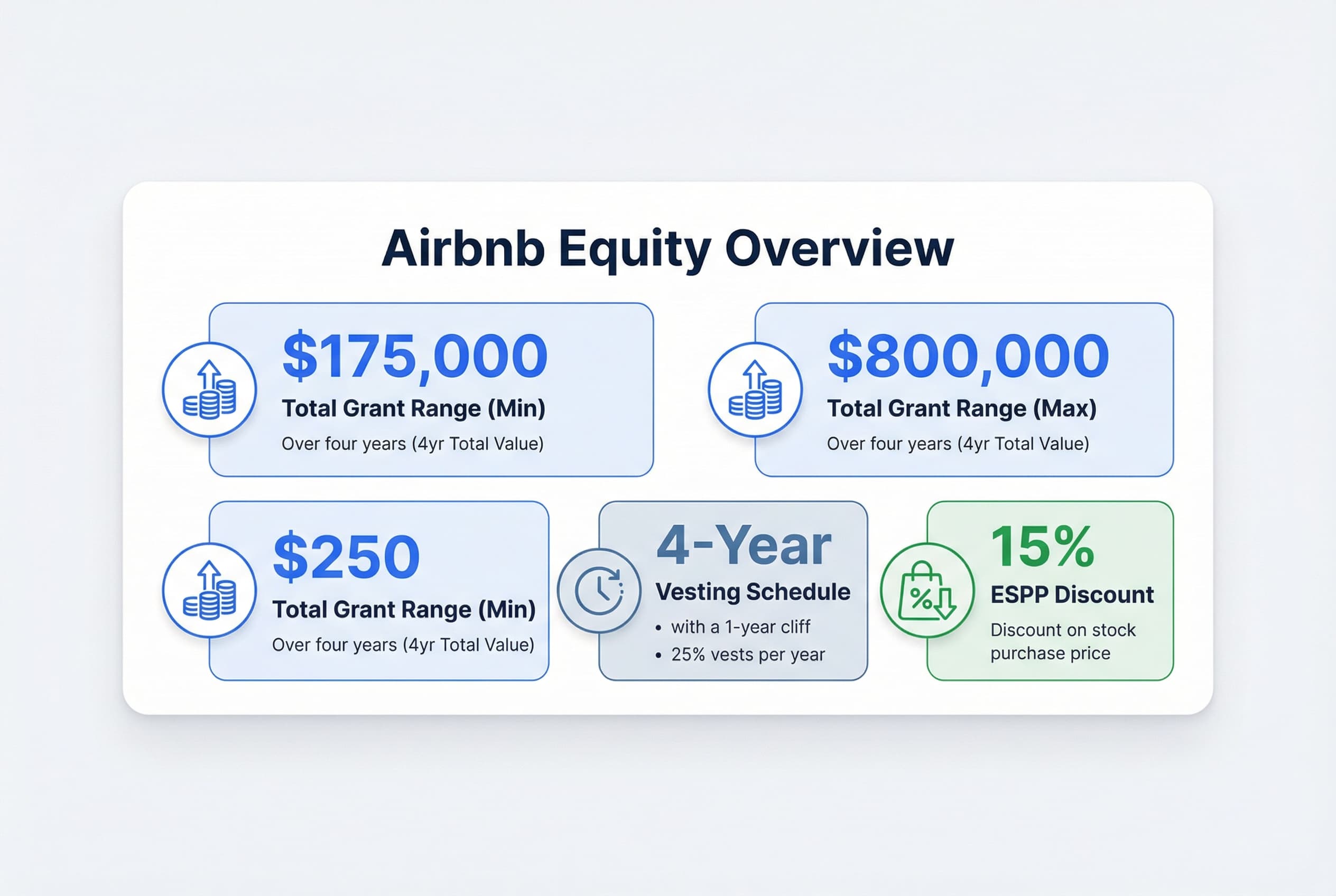
Airbnb primarily uses a 4-year vesting schedule with a 1-year cliff for its Restricted Stock Units (RSUs). This means you must complete one full year of service before any of your equity vests. Once you pass this cliff period, you'll receive your first tranche of shares, and the remainder will continue vesting over the following three years.
Airbnb RSUs vest quarterly on specific dates throughout the year: February 25, May 25, August 25, and November 25. These quarterly installment dates provide predictable timing for when your shares will become yours.
The company offers multiple vesting schedule variants. The most common is a uniform distribution where you receive 25% of your grant each year (or 6.25% per quarter). However, some employees - particularly Product Managers - may receive an irregular vesting schedule that's frontloaded, distributing 35% in year one, 30% in year two, 20% in year three, and 15% in year four. This frontloaded approach accelerates more equity into your hands earlier in your tenure.
During your first year at Airbnb, no shares vest. If you leave the company before completing 12 months of service, you forfeit your entire initial equity grant. Once you pass the one-year mark, you'll receive the full first year's worth of shares (25% of your total grant under the standard schedule) on the next quarterly vesting date.
Airbnb issues annual stock refreshers that vest evenly over 4 years, beginning after your first year. These refreshers stack on top of your initial grant, creating an ongoing equity pipeline. The size of your refresher depends on your performance rating, with multipliers ranging from 1x for "Meets" performance to 3x for "Redefines" performance. Refreshers are also subject to a company-wide performance multiplier, aligning your rewards with Airbnb's overall success.
This structure ensures that high-performing employees build substantial equity over time, with multiple grants vesting simultaneously after your initial years at the company.
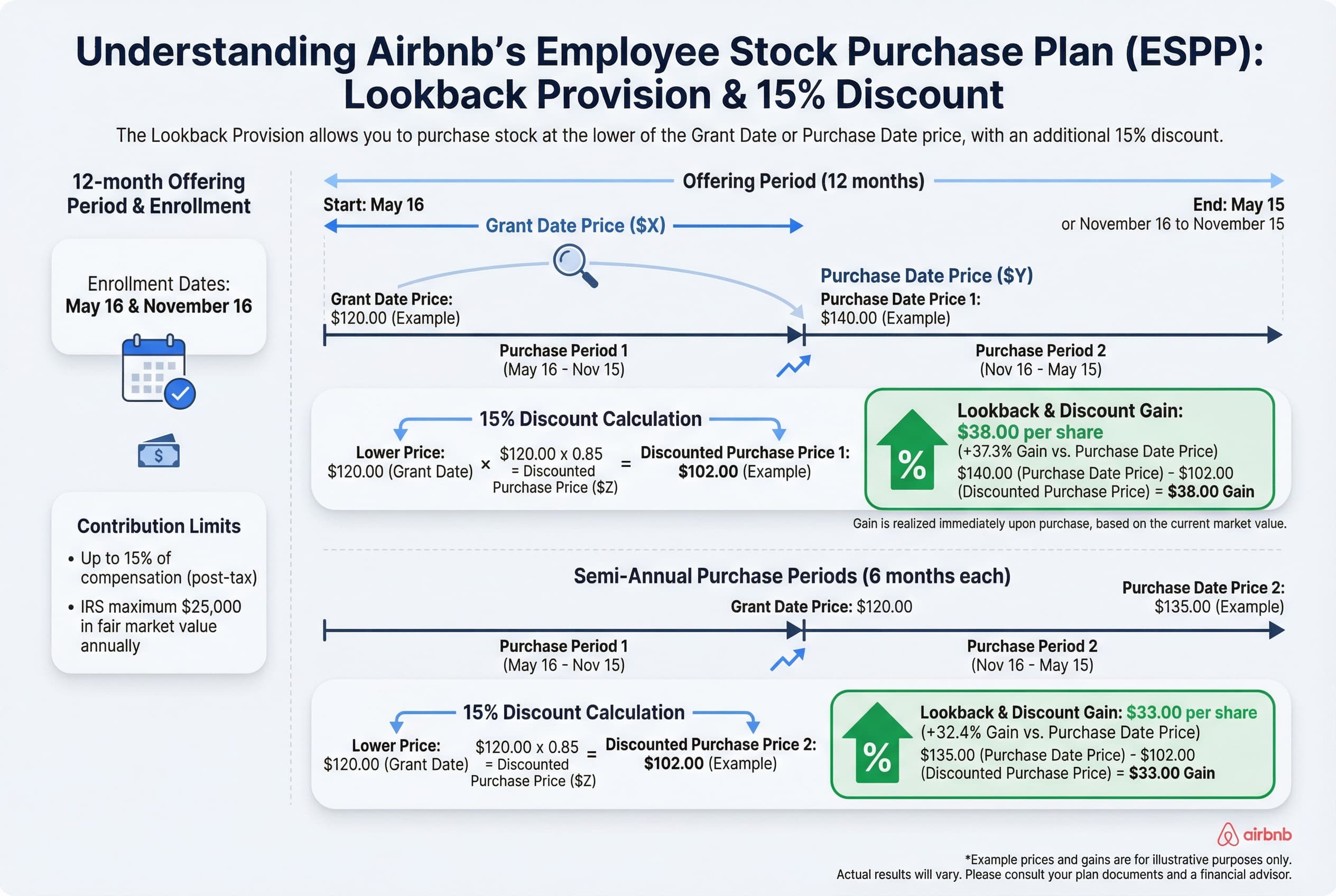
Airbnb offers an Employee Stock Purchase Plan that provides employees with an attractive opportunity to purchase company stock at a discount. The plan features a 15% discount on the purchase price, allowing you to buy ABNB shares for less than market value.
The ESPP includes a lookback provision, which significantly enhances the plan's value. With this feature, your purchase price is based on the lower of two prices: the stock price at the beginning of the 12-month offering period or the price at the end of each 6-month purchase period. This means if Airbnb's stock price increases during the offering period, you benefit from purchasing at the earlier, lower price - plus the 15% discount.
You can contribute up to 15% of your eligible compensation, subject to the IRS annual maximum of $25,000 per calendar year. The plan operates on 12-month offering periods with semi-annual purchases every 6 months. Enrollment windows open on May 16 and November 16 each year, giving you two opportunities annually to join or adjust your participation.
The combination of the lookback provision and 15% discount can generate substantial returns. For example, if the stock price rises during the offering period, you could see an immediate gain of more than 15% upon purchase - potentially much higher depending on stock performance.
To receive favorable long-term capital gains treatment on gains above the discount amount, you must hold shares for at least 1 year after purchase AND 2 years after the start of the offering period (qualifying disposition). Selling before these thresholds results in a disqualifying disposition, where the discount is taxed as ordinary income.
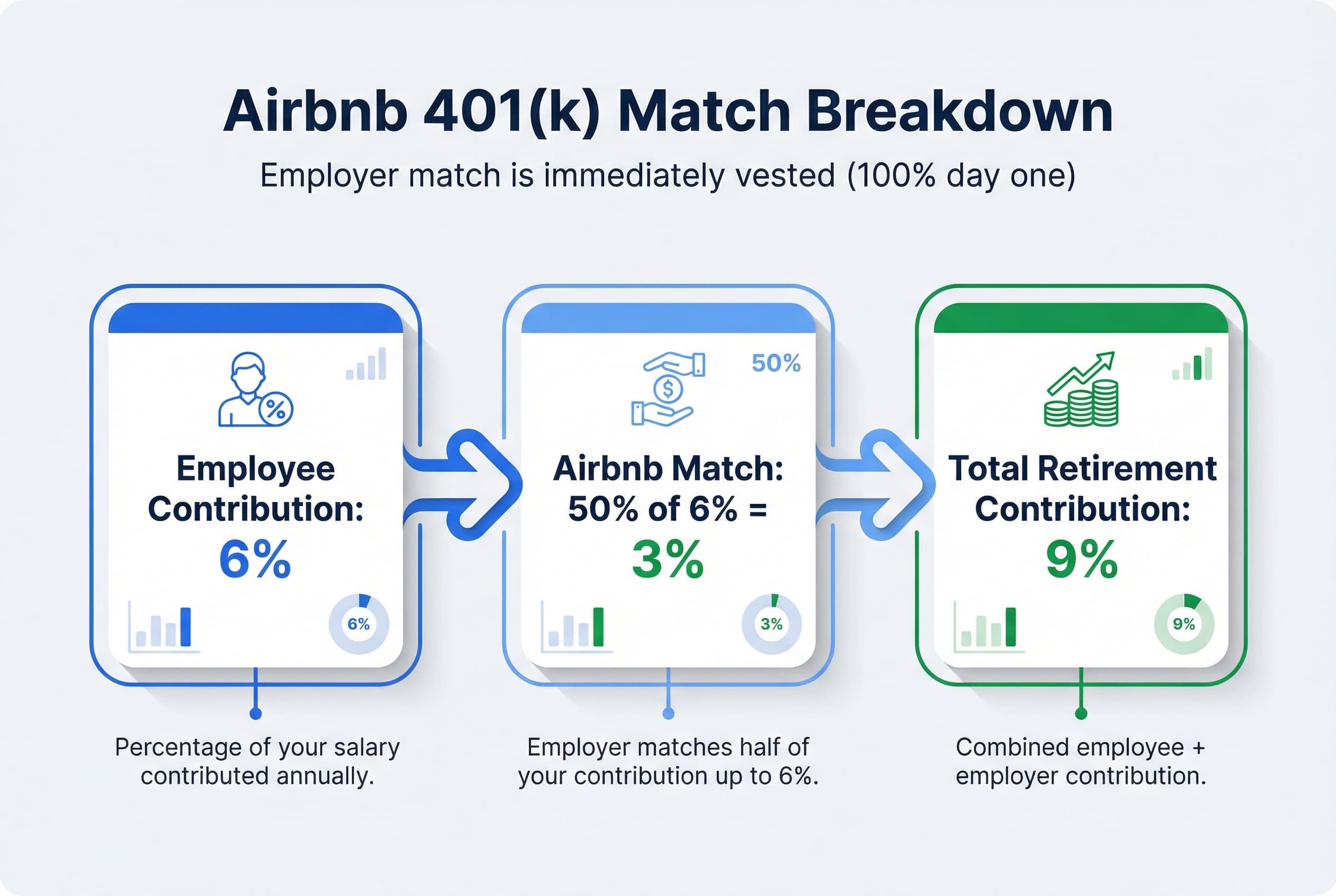
Airbnb offers a competitive 401(k) retirement plan to help employees build long-term wealth beyond their equity compensation. The company provides a 50% match on the first 6% of your base salary that you contribute. For example, if you contribute 6% of your salary, Airbnb will add an additional 3%, giving you a total retirement contribution of 9%.
One of the standout features of Airbnb's 401(k) is that employer matching contributions are immediately vested. This means you own 100% of the company match from day one - there's no waiting period. If you leave Airbnb for any reason, you take the full employer match with you, making this benefit particularly valuable for employees at all career stages.
Airbnb offers both traditional pre-tax and Roth 401(k) contribution options, allowing you to choose the tax treatment that best fits your financial situation. The plan also supports after-tax contributions, which can be beneficial for high earners who've maxed out their standard 401(k) limits and want to save additional funds for retirement.
When combined with Airbnb's RSU compensation, the 401(k) match provides important portfolio diversification. Since RSUs concentrate your wealth in Airbnb stock, maximizing your 401(k) contributions - especially to capture the full employer match - helps balance your overall financial picture with diversified retirement investments.
Understanding the tax treatment of your Airbnb equity awards is crucial for effective financial planning. Different types of awards trigger taxes at different times and rates.
Restricted Stock Units (RSUs) are taxed as ordinary income at vest, not when you sell the shares. Each time your RSUs vest on Airbnb's quarterly vesting dates (February 25, May 25, August 25, and November 25), the fair market value of the shares becomes taxable compensation. This income is reported on your W-2 and taxed at your marginal income tax rate.
Airbnb withholds taxes at a default rate of 22% for federal income tax on RSU vesting. However, this creates a common problem: if you're in a higher tax bracket (24%, 32%, 35%, or 37%), the 22% withholding won't cover your full tax liability. This "withholding gap" means you may owe additional taxes when you file your return. You can adjust your withholding rate if you anticipate being in a higher bracket.
Additionally, you'll owe Social Security (6.2% up to the wage base limit), Medicare (1.45%, plus 0.9% for high earners), and state income taxes. California residents, where Airbnb is headquartered, face state tax rates up to 13.3%, significantly increasing the total tax burden on vested RSUs.
After your RSUs vest and taxes are paid, any subsequent appreciation (or loss) is treated as a capital gain or loss when you sell. If you hold shares for more than one year after vesting, gains qualify for long-term capital gains rates (0%, 15%, or 20%), which are typically lower than ordinary income rates.
For Incentive Stock Options (ISOs), exercising triggers Alternative Minimum Tax (AMT) considerations. The spread between the exercise price and fair market value at exercise is an AMT preference item, potentially creating tax liability even without selling shares.
The 15% discount on Airbnb's ESPP is taxed as ordinary income. To achieve long-term capital gains treatment on gains above the discount, you must hold shares for at least one year after purchase AND two years after the offering period start date.
Disclaimer: This information is educational only and not tax advice. Tax situations vary based on individual circumstances. Consult a qualified tax professional or CPA familiar with equity compensation for personalized guidance.
As an Airbnb employee, your equity compensation can represent a significant portion of your wealth. While this is exciting, concentrating too much of your net worth in a single stock - especially your employer's - creates substantial risk. If Airbnb faces challenges, you could simultaneously experience job insecurity and declining portfolio value.
Airbnb operates in the technology and travel sectors, both known for volatility. The company is particularly sensitive to economic downturns, travel restrictions, regulatory changes, and shifts in consumer behavior. The COVID-19 pandemic demonstrated how quickly travel demand can evaporate, directly impacting Airbnb's business and stock price. Additionally, increased competition and evolving regulations around short-term rentals in major cities could affect long-term growth.
Financial advisors commonly recommend keeping single-stock exposure under 10-20% of your total net worth. This guideline helps ensure that your financial security isn't overly dependent on one company's performance. As your RSUs vest quarterly and you participate in the ESPP (which offers a 15% discount with lookback), consider selling shares regularly to rebalance your portfolio.
Diversification doesn't mean you lack confidence in Airbnb - it means you're managing risk prudently. Consider reinvesting proceeds into a diversified portfolio of index funds or other assets to build long-term financial resilience while still maintaining some Airbnb exposure.
As your RSUs vest quarterly (February 25, May 25, August 25, and November 25), evaluate whether to hold or sell based on your overall financial picture. Consider selling vested shares if Airbnb stock represents more than 10-15% of your total investment portfolio, or if you need funds for important financial goals like building an emergency fund, paying down high-interest debt, or purchasing a home. Remember that holding company stock means you're already concentrated in one company through both your paycheck and investments.
Since your income depends on Airbnb's success, concentrating your wealth in Airbnb stock creates significant risk. If the company faces challenges, you could simultaneously experience job insecurity and portfolio losses. Consider establishing a systematic selling strategy after each vesting date to gradually diversify into a broader investment portfolio.
Airbnb's ESPP offers a 15% discount with a lookback provision and semi-annual purchase periods. Enrollment windows occur on November 16 and May 16, with contributions capped at 15% of salary (up to $25,000 annually). For qualifying disposition treatment, hold shares for at least one year after purchase and two years after the offering period start date. However, even immediate sales can be profitable due to the discount and lookback feature - calculate whether the guaranteed 15%+ gain outweighs potential tax savings from longer holding periods.
Factor in annual refresher grants when evaluating your compensation. Airbnb's refreshers vest over four years beginning after year one, with performance multipliers ranging from 1x to 3x. This means your total equity value extends beyond your initial grant, particularly if you perform well. View equity as variable compensation rather than guaranteed income when making major financial decisions.
Let's walk through a typical RSU grant to see how vesting works in practice.
Sarah joins Airbnb as a G9 software engineer and receives a $600,000 RSU grant over 4 years. Her RSUs vest quarterly on Airbnb's standard vesting dates: February 25, May 25, August 25, and November 25.
Airbnb uses a 1-year cliff followed by quarterly vesting. Here's how Sarah's grant vests:
After her first year, Sarah receives $150,000 worth of stock all at once. Then, every quarter after that, she receives $37,500 worth of shares ($450,000 ÷ 12 quarters = $37,500).
When RSUs vest, they're treated as ordinary income. Airbnb withholds 22% for federal taxes by default.
On Sarah's first vesting event (Year 1 cliff):
For each quarterly vest afterward:
The 22% withholding may not cover your full tax liability, especially if you're in a higher tax bracket. You can adjust your withholding rate if needed. Also, remember that RSU refreshers stack on top of your initial grant, vesting over an additional 4 years with multipliers based on your performance rating.
Even with generous equity packages, Airbnb employees often stumble into costly mistakes. Here are the most common pitfalls to watch for:
Many employees don't realize that RSUs at Airbnb typically include a 12-month cliff, meaning you receive nothing if you leave before your first anniversary. That first 25% vests all at once after one year, so timing departures carefully matters significantly.
Airbnb withholds 22% federally on RSU vesting by default, but if you're in a higher tax bracket, you'll owe more at tax time. Many employees are caught off-guard by unexpected tax bills. Consider adjusting your withholding rate or making quarterly estimated tax payments to avoid penalties.
It's easy to accumulate substantial holdings in ABNB stock, especially with quarterly vesting and annual refreshers that stack on top of your initial grant. Holding too much company stock creates unnecessary risk - consider diversifying as shares vest to protect your financial future.
Airbnb's Employee Stock Purchase Plan offers a 15% discount with a lookback provision, essentially providing an immediate return on your investment. With semi-annual purchase periods starting in May and November, this benefit is often overlooked despite being one of the most valuable.
RSUs vest quarterly on specific dates (February 25, May 25, August 25, November 25). Failing to plan for the tax impact or selling strategy around these predictable dates can lead to rushed decisions and missed opportunities.
Understanding what happens to your equity when you leave Airbnb is crucial for making informed career decisions.
Unvested RSUs are forfeited upon termination. This is standard practice across the industry. Since Airbnb RSUs vest quarterly on specific dates (February 25, May 25, August 25, and November 25), your termination date relative to these vesting dates significantly impacts how much equity you keep. For example, if you leave on November 20, you'll forfeit RSUs that would have vested just five days later.
For employees with stock options (ISOs or NSOs), the available data doesn't specify Airbnb's post-termination exercise window. At many companies, you typically have 90 days to exercise vested options after leaving, but you should verify this in your specific grant agreement or with HR, as policies can vary.
If you leave Airbnb during an ESPP offering period, your contributions will typically cease, and you may be withdrawn from the plan. The specific treatment of accumulated contributions depends on your plan documents, so review these carefully if you're participating in the ESPP.
The available data doesn't distinguish between voluntary and involuntary termination treatment. However, your equity agreement and company policies may contain specific provisions, so review your documents or consult with HR when planning your departure.
Key takeaway: Your termination date matters significantly, especially relative to quarterly vesting dates. Plan accordingly to maximize your vested equity.
This content is for educational purposes only and does not constitute financial advice. The information provided is general in nature and may not appl...
YourEmployeeStock.com is not a registered investment advisor.
Helpful videos explaining Airbnb equity compensation, vesting, and tax strategies.
WTF is Stock-Based Compensation (SBC)? EASY guide
FAANG Employee Turns $200K in RSUs Into Tax-Free Income (Alex Bagne, JD, CPA Explains How)
Airbnb RSUs typically vest quarterly on February 25, May 25, August 25, and November 25. Most grants follow a 4-year schedule with a 1-year cliff (25% after year 1, then 25% each year), though some employees may have irregular schedules like 35/30/20/15. You'll need to complete one full year before your first vesting occurs.
Airbnb grants annual stock refreshers that vest evenly over 4 years, beginning after your first year. The refresher amount is based on your performance rating with multipliers: Meets = 1x, Exceeds = 1.25x, Greatly Exceeds = 2x, and Redefines = 3x. Refreshers are also subject to a company performance multiplier and stack on top of your initial grant.
If you leave Airbnb before your RSUs vest, you will forfeit any unvested shares. Only RSUs that have vested by your termination date are yours to keep. This is a common concern, especially for employees who joined with back-loaded vesting schedules or are considering leaving before completing their full vesting period.
Airbnb's Employee Stock Purchase Plan offers a 15% discount on stock purchases with a lookback provision. The plan has 12-month offering periods with semi-annual purchase periods, and you can contribute up to 15% of your salary (capped at $25,000 annually). Enrollment windows open on May 16 and November 16 each year.
Airbnb uses a default 22% federal tax withholding rate when your RSUs vest. This rate can be adjusted if needed, but many employees find this insufficient to cover their actual tax liability, especially those in higher tax brackets. You may want to set aside additional funds or adjust your withholding to avoid an unexpected tax bill.
To receive long-term capital gains treatment on ESPP gains above the discount, you must hold the shares for at least 1 year after the purchase date AND 2 years after the start of the offering period. If you sell before meeting both requirements, it's considered a disqualifying disposition and more of your gain will be taxed as ordinary income.
The data doesn't specify Airbnb's post-termination exercise window for stock options. However, stock options at Airbnb expire 10 years from the grant date. You should review your specific option agreement or contact HR to understand the exact timeframe you have to exercise after leaving the company.
Airbnb has insider trading restrictions and may impose window-period limitations on when you can exercise or sell shares. Additionally, a Market Standoff Agreement applied for up to 180 days (plus potentially 35 additional days) following the IPO. Check with your equity administrator about current blackout periods and trading windows before making any transactions.
Get a free personalized analysis from our equity compensation experts

