Free equity analysis
Complete guide to understanding your Bank of America equity compensation, including RSU, ISO, NSO, ESPP, vesting schedules, and tax strategies.
Stock Price
$59.47
Closing price · Sep 14, 2026
Employees
274.2K
Worldwide
Equity Programs
4
programs
Vesting Period
4 years
RSU vesting
Closing price · Sep 14, 2026
Bank of America offers 4 equity compensation programs to employees. Click on each program to learn more about eligibility, vesting, and tax implications.
Learn about Bank of America's Restricted Stock Units program, including vesting schedules and tax treatment.
Learn about Bank of America's Incentive Stock Options program, including vesting schedules and tax treatment.
Learn about Bank of America's Non-Qualified Stock Options program, including vesting schedules and tax treatment.
Learn about Bank of America's Employee Stock Purchase Plan program, including vesting schedules and tax treatment.
Bank of America RSUs vest on a 4-year vesting, 25% annually, starting Feb 15, 2027 for specific grants; generally ratably annually over three years for others schedule.
Example calculation based on 100 shares:
| Year | Vesting % | Shares Vesting | Estimated Value |
|---|---|---|---|
| Year 1 | 25% | 25 | $1,486.75 |
| Year 2 | 25% | 25 | $1,486.75 |
| Year 3 | 25% | 25 | $1,486.75 |
| Year 4 | 25% | 25 | $1,486.75 |
| Total | 100% | 100 | $5,947 |
* Based on Bank of America stock price of $59.47 as of Sep 14, 2026. Actual values will vary.
25%
25 shares
$1,486.75
25%
25 shares
$1,486.75
25%
25 shares
$1,486.75
25%
25 shares
$1,486.75
Bank of America vesting schedule based on 100 total shares
Bank of America offers a comprehensive equity compensation package designed to align employee success with company performance. As one of the largest financial services employers with over 274,000 employees, the bank provides several equity vehicles including Restricted Stock Units (RSUs), Performance Stock Units (PSUs), stock options (both ISOs and NSOs), and an Employee Stock Purchase Plan (ESPP).
Equity compensation represents a significant opportunity to build wealth alongside the company's growth. Through the broad-based "Sharing Success Program," approximately 97% of the workforce receives RSU awards, making equity ownership accessible across all levels. RSUs also earn dividend equivalents that accrue with interest until they vest, providing additional value beyond the stock price appreciation.
Most employee RSU awards vest ratably over three years on an annual basis, typically on February 15th each year. Some specific grants, particularly for executives, follow a four-year schedule with 25% vesting annually. PSUs, reserved for performance-based compensation, vest based on multi-year financial metrics including return on assets and tangible book value growth.
The ESPP allows eligible employees to purchase Bank of America stock at a 15% discount with a lookback feature, contributing up to 5% of compensation (maximum $25,000 annually). Stock options, while no longer granted since 2008, have a 10-year expiration period for existing holders.
Understanding these programs helps you maximize the value of your total compensation package and participate in the bank's long-term success.
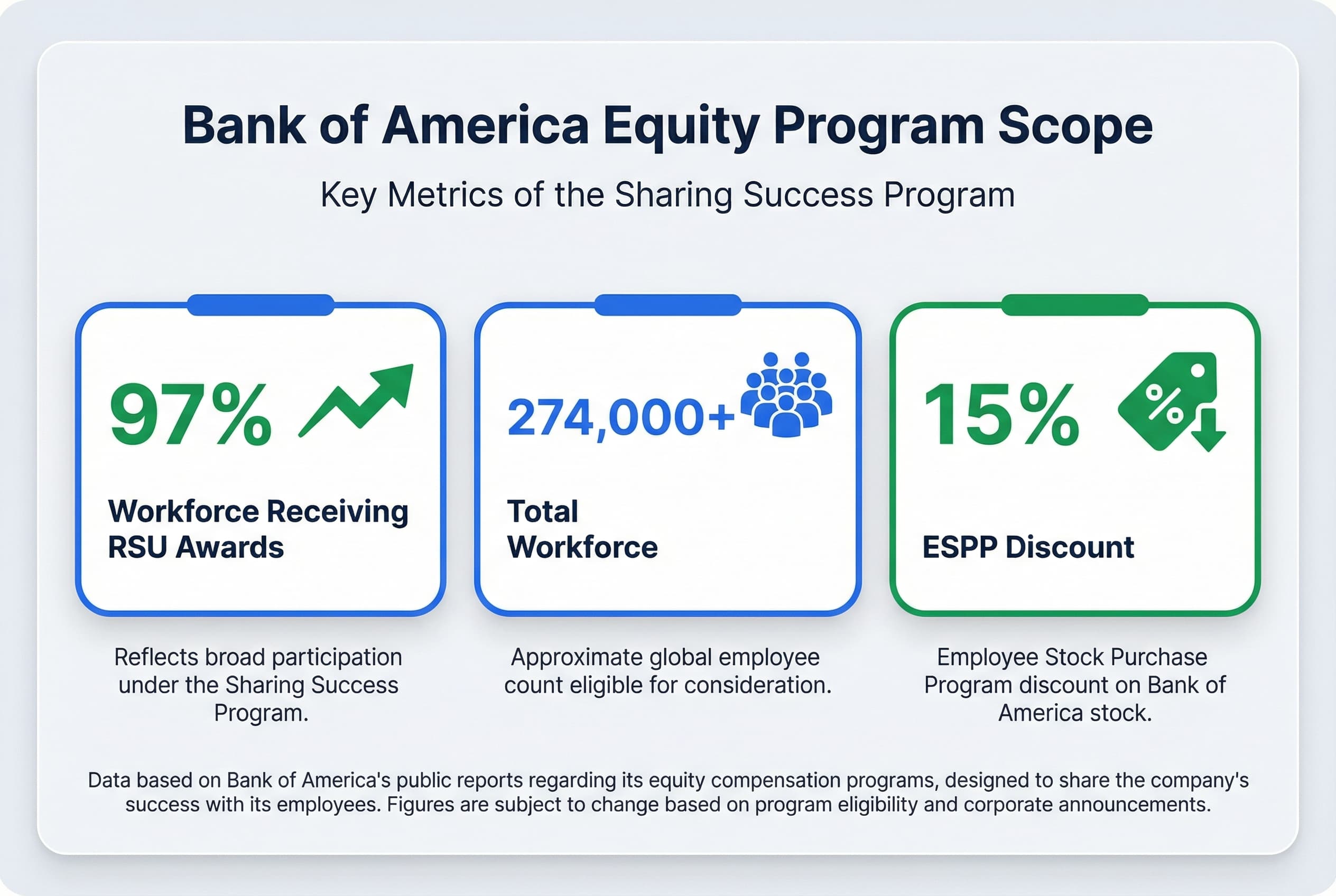
Bank of America uses different vesting schedules depending on the type of equity award and employee level. Understanding these timelines is crucial for planning your financial future with the company.
For most employees receiving RSUs through Bank of America's broad-based "Sharing Success Program," awards typically vest ratably annually over a three-year period. This means your grant is divided into equal portions that vest each year for three consecutive years.
However, certain executive-level grants follow a four-year vesting schedule with 25% vesting annually. These specific grants vest in four equal installments, with a notable pattern of vesting occurring on February 15 each year, starting February 15, 2027 for certain awards.
Unlike many technology companies that use a one-year cliff, Bank of America's standard vesting schedules do not include a cliff period. This means you'll begin receiving vested shares at the end of your first year rather than waiting a full year before any shares vest. Your equity begins accumulating value for you from the first annual vesting date.
Bank of America's RSUs vest annually, not monthly or quarterly. This uniform distribution means you receive the same percentage of your grant each year throughout the vesting period. For the four-year schedule, that's 25% per year. For the three-year schedule, it's approximately 33.3% per year.
The vesting date pattern centers around February 15, allowing for predictable planning around tax obligations and potential selling decisions.
Bank of America provides annual refresher grants through its Sharing Success Program, which covers approximately 97% of the workforce. RSUs are also a significant component of variable incentive deferrals for more highly compensated employees, with award amounts increasing based on compensation levels according to a predetermined grid. This means eligible employees can expect new grants each year, creating overlapping vesting schedules that provide regular equity compensation over time.
The combination of annual grants with multi-year vesting creates a steady stream of vesting equity once you've been with the company for a full vesting cycle.
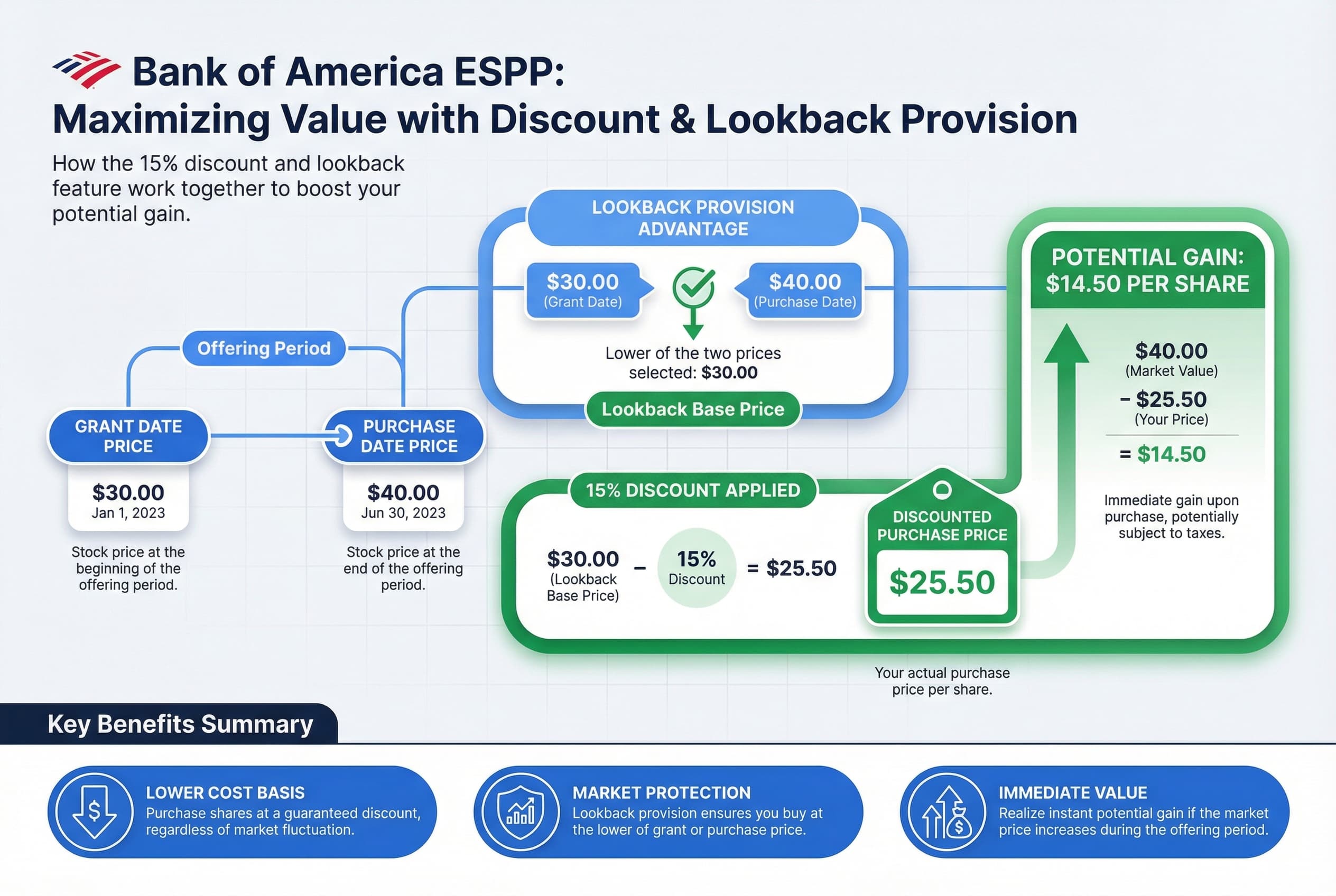
Bank of America offers an Employee Stock Purchase Plan that allows you to purchase company stock at a discount through payroll deductions. The plan provides a 15% discount on the stock price, making it an attractive benefit for building equity in the company.
The ESPP includes a lookback provision, which can significantly enhance your potential returns. With a lookback, the purchase price is based on the lower of the stock price at either the beginning of the offering period or the end of the purchase period. Combined with the 15% discount, this feature can generate substantial gains even in volatile markets.
For example, if the stock price increases during the offering period, you'll purchase at the lower beginning price minus the 15% discount. If the stock price decreases, you'll buy at the lower ending price minus the discount. This built-in downside protection makes the ESPP particularly valuable.
You can contribute up to 5% of your eligible compensation through payroll deductions, subject to an annual maximum of $25,000 (based on IRS regulations for qualified ESPPs). This allows you to regularly accumulate shares while managing your cash flow.
Understanding the tax implications is crucial for maximizing your ESPP benefits. A qualifying disposition occurs when you hold the shares for more than one year after the purchase date AND more than two years after the offering date. Qualifying dispositions receive favorable long-term capital gains treatment on a portion of your gain.
A disqualifying disposition happens when you sell before meeting both holding period requirements. While you'll pay ordinary income tax on the discount, you may still realize gains, especially if the lookback provision worked in your favor. Consult with a tax advisor to determine the best strategy for your situation.
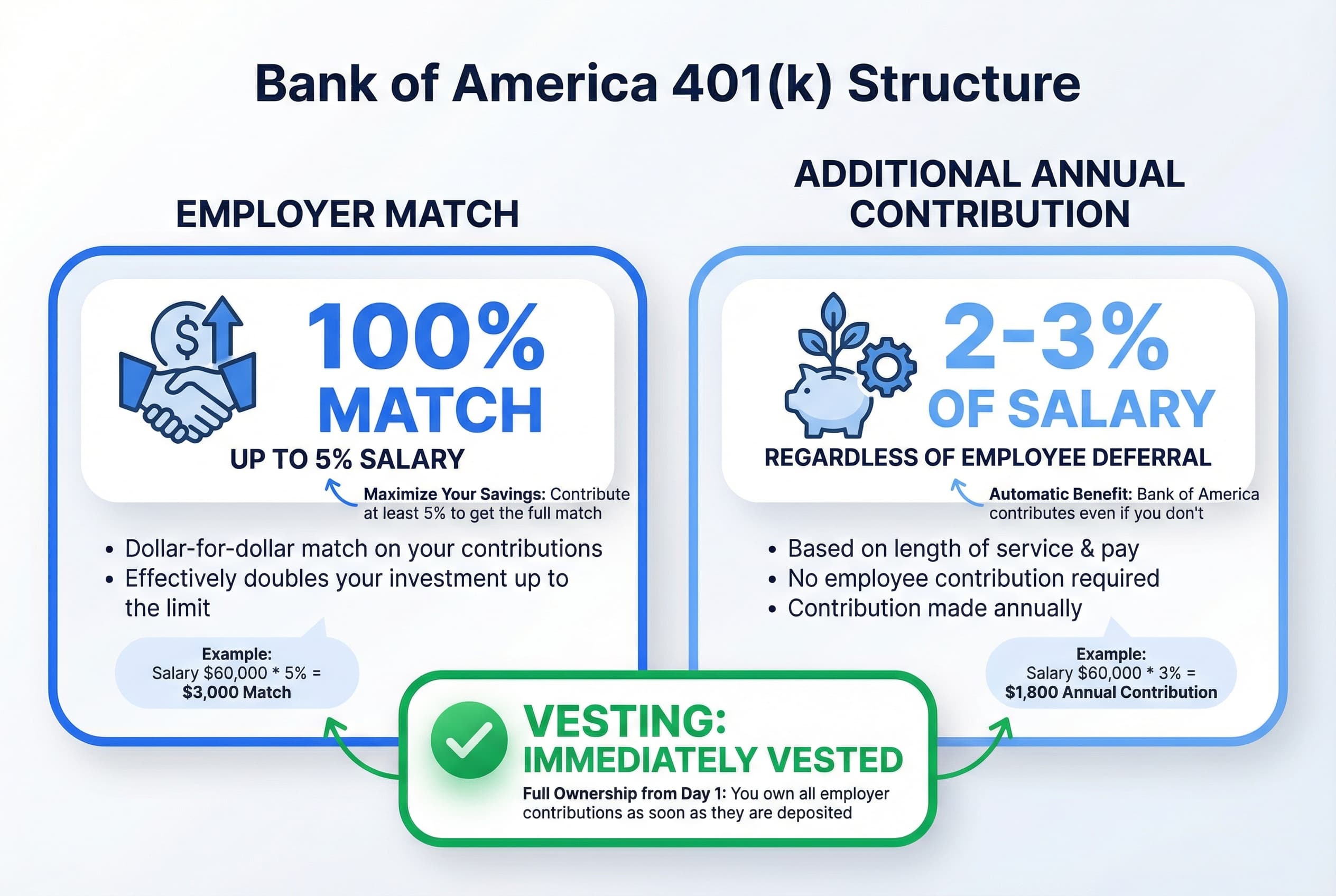
Bank of America offers a competitive 401(k) plan with both employer matching and additional contributions to help you build long-term retirement savings.
The company provides a 100% match on up to 5% of your salary that you contribute to the plan. This means if you contribute at least 5% of your eligible compensation, Bank of America will match that full amount dollar-for-dollar.
Beyond the match, Bank of America also makes an annual contribution of 2-3% of your salary regardless of whether you contribute to the plan yourself. This additional contribution provides retirement savings even if you're unable to maximize your own contributions.
The employer match and contributions are immediately vested, meaning you own these funds right away with no waiting period. This is a significant advantage compared to many employers that require several years of service before you fully own employer contributions.
The plan offers both traditional pre-tax and Roth 401(k) options, giving you flexibility in your tax planning strategy. You can also make after-tax contributions to the plan beyond the standard contribution limits.
However, based on available information, the plan does not currently offer a mega backdoor Roth conversion option, and a self-directed brokerage window does not appear to be available.
The combination of generous matching, additional employer contributions, and immediate vesting makes Bank of America's 401(k) plan a valuable component of your total compensation package.
Understanding the tax treatment of your equity compensation is crucial for effective financial planning. At Bank of America, different equity awards trigger taxes at different times and rates.
Restricted Stock Units (RSUs) are taxed as ordinary income at vesting. When your RSUs vest (typically annually on February 15), the fair market value of the shares becomes taxable compensation, just like your regular salary. You owe taxes whether you sell the shares or hold them.
Employee Stock Purchase Plan (ESPP) purchases create two potential tax events. At purchase, if you receive a discount (Bank of America offers a 15% discount), you may owe ordinary income tax on that discount. When you eventually sell the shares, you'll owe capital gains tax on any appreciation. If you hold shares for over one year after purchase AND over two years after the offering date (a "qualifying disposition"), some of the gain may receive favorable long-term capital gains treatment.
Stock Options (ISOs and NSOs) are taxed differently. NSOs trigger ordinary income tax when exercised, based on the difference between the exercise price and fair market value. ISOs generally aren't taxed at exercise for regular tax purposes, but may trigger Alternative Minimum Tax (AMT), which can create unexpected tax liabilities if you exercise and hold shares.
Bank of America's default withholding rate for RSUs is 22% for federal taxes. However, this often creates a "gap" problem: if your total income places you in a higher tax bracket, 22% withholding may be insufficient to cover your actual tax liability. You can adjust your withholding rate to avoid owing additional taxes at year-end.
Because Bank of America has operations in North Carolina and other locations, state tax obligations depend on where you work. Some states don't tax equity compensation, while others have rates exceeding 10%, significantly impacting your net proceeds.
Important Disclaimer: This information is educational only and not tax advice. Equity compensation tax rules are complex and depend on your individual circumstances. Please consult a qualified tax professional or financial advisor before making decisions about your equity awards.
While Bank of America equity compensation can be valuable, concentrating too much of your wealth in any single stock - including your employer's - creates significant financial risk. If BAC stock declines, you could face a double impact: reduced portfolio value and potential job insecurity during the same economic downturn.
As a financial services company, Bank of America faces specific vulnerabilities you should consider:
Financial advisors commonly recommend limiting single-stock exposure to 10-20% of your net worth. This is especially important when that stock is your employer's, since your income and equity compensation are already tied to the company's success.
Consider these strategies:
Remember: diversification protects your financial future even as you benefit from Bank of America's success.
Bank of America employees should evaluate selling RSUs soon after vesting to manage concentration risk, particularly given that vesting occurs annually on February 15. Since RSUs are taxed at vest as ordinary income, there's no additional tax penalty for immediate sale. Consider your overall portfolio allocation - if Bank of America stock represents more than 10-15% of your net worth, diversification becomes increasingly important.
Working at Bank of America creates a unique "double exposure" to the financial services sector: your income and equity are tied to the company's performance. During industry downturns, you could face both compensation pressure and declining stock value simultaneously. This makes diversification particularly critical for financial services employees. Consider gradually reducing your position as shares vest to build a more balanced portfolio.
Bank of America's ESPP offers a 15% discount with a lookback provision, making it an attractive benefit. To maximize value, contribute up to the 5% maximum (capped at $25,000 annually). For optimal tax treatment, hold shares for over one year after purchase and over two years after the offering date to qualify for favorable long-term capital gains treatment on the discount. However, weigh this tax benefit against concentration risk - sometimes selling immediately makes more sense despite the higher tax rate.
RSUs represent a significant portion of total compensation at Bank of America, especially as you advance. Through the Sharing Success Program, approximately 97% of employees receive annual RSU grants. When evaluating job offers or promotions, calculate the expected value of equity grants (not just base salary) and consider vesting timelines in your financial planning.
Bank of America offers 10b5-1 plans, which allow you to establish pre-scheduled stock sales regardless of blackout periods. These plans are particularly valuable given the company's trading restrictions and your potential access to material non-public information.
Let's walk through a typical scenario for a Bank of America employee receiving RSUs through the company's Sharing Success Program.
Sarah, a mid-level employee, receives 200 RSUs as part of her annual compensation. Based on Bank of America's stock price of $45 per share at grant, her total award is worth $9,000.
Bank of America typically uses a 4-year vesting schedule with 25% vesting annually. Here's how Sarah's shares vest each February 15:
When Sarah's first 50 shares vest in Year 1, the stock price has risen to $50 per share. The value of her vesting shares is $2,500 (50 shares × $50).
Bank of America withholds 22% for taxes by default:
Sarah receives 39 shares worth $1,950 in her brokerage account after the first vesting. She'll repeat this process three more times over the next three years.
Bank of America also credits dividend equivalents on unvested RSUs, which accrue interest at the 3-year Treasury rate until the shares vest - adding extra value to Sarah's total compensation.
This example shows how RSU vesting provides ongoing value as you continue your career at Bank of America, with shares delivered annually over four years.
Bank of America employees often miss valuable opportunities or create unnecessary tax complications with their equity benefits. Here are the most common missteps to avoid:
The Employee Stock Purchase Plan offers a 15% discount with a lookback feature, yet many employees don't participate or contribute less than the 5% maximum. This effectively leaves guaranteed returns on the table - especially powerful when the lookback provision is in your favor.
With the broad-based Sharing Success Program covering approximately 97% of the workforce, many employees accumulate significant BAC holdings through RSUs. Failing to diversify after vesting creates unnecessary portfolio risk, particularly in the financial services sector which can be volatile.
RSUs are taxed as ordinary income at vesting, with a default 22% withholding rate. Many employees don't realize this may fall short of their actual tax liability, especially if RSU income pushes them into higher brackets. The result: unexpected tax bills at filing time.
Bank of America uses different vesting schedules - some RSUs vest over three years, while certain grants vest 25% annually over four years starting on specific dates like February 15. Misunderstanding your timeline can lead to poor financial planning or premature departures that forfeit unvested awards.
RSU dividend equivalents accrue with interest at the 3-year Treasury rate until payment. While this is a benefit, employees sometimes forget to account for this additional taxable income when shares are finally delivered.
Understanding what happens to your equity compensation when you leave Bank of America is crucial for financial planning. Here's what you need to know:
Unvested RSUs are typically forfeited upon termination. Whether you're participating in the Sharing Success Program or have received other RSU grants, any shares that haven't vested by your termination date will generally be lost. This applies regardless of whether you leave voluntarily or involuntarily.
Your termination date is critical. Bank of America RSUs typically vest annually on February 15, so leaving just before a vesting date means forfeiting that tranche. If you're planning a departure, consider the timing relative to your vesting schedule to maximize the value you receive.
Bank of America hasn't granted stock options since 2008, so most current employees won't have options to consider. If you do hold older options, they have a 10-year expiration period, though specific post-termination exercise windows aren't detailed in available documentation.
If you're enrolled in the Employee Stock Purchase Plan and leave mid-period, specific termination rules will apply. Your contributions will cease, though the exact handling of accumulated funds may depend on the timing within the offering period.
RSU awards are subject to non-solicitation and detrimental conduct covenants. Additionally, awards may be subject to clawback provisions under the company's Incentive Compensation Recoupment Policy, which could affect payments even after termination.
Always consult with a financial advisor or tax professional before making termination decisions involving equity compensation.
This content is for educational purposes only and does not constitute financial advice. The information provided is general in nature and may not appl...
YourEmployeeStock.com is not a registered investment advisor.
Bank of America uses different vesting schedules depending on the award type. Most general employee RSUs vest ratably over three years annually, while certain executive grants vest over four years at 25% per year. RSUs typically vest on February 15th each year, and dividend equivalents are credited with interest until the payment date.
Your unvested RSUs are generally forfeited when you leave the company. Additionally, RSU awards are subject to non-solicitation and detrimental conduct covenants, meaning certain behaviors after departure could impact your awards. It's important to review your specific grant agreements to understand any post-termination restrictions or exceptions.
Bank of America's ESPP allows you to purchase company stock at a 15% discount with a lookback feature, meaning you get the discount from the lower of the price at the beginning or end of the offering period. You can contribute up to 5% of your eligible compensation, with a maximum annual contribution of $25,000.
When your RSUs vest, the full value is treated as ordinary income and subject to federal, state, and local taxes. Bank of America withholds 22% by default for federal taxes, though you can adjust this rate. You should consult a tax advisor to ensure adequate withholding, as 22% may not cover your full tax liability depending on your total income.
While you generally can sell shares after vesting, you must comply with all securities laws and Bank of America's Code of Conduct, including restrictions on hedging and derivative transactions. There may be blackout periods around earnings announcements or other material events. Bank of America offers 10b5-1 trading plans that allow you to set up predetermined selling schedules.
The Sharing Success Program is Bank of America's broad-based RSU program that covers approximately 97% of the workforce. Under this program, eligible employees receive annual RSU grants ranging from 65 to 600 units, depending on their role and compensation level. This demonstrates the company's commitment to sharing success with employees across all levels.
To receive favorable tax treatment on ESPP shares, you must hold them for more than one year after the purchase date AND more than two years after the offering date. If you meet both requirements, a portion of your gain may be taxed as long-term capital gains rather than ordinary income, potentially reducing your tax liability.
Yes, your equity awards are subject to Bank of America's Incentive Compensation Recoupment Policy and clawback rules under Dodd-Frank Rule 954. The company may delay payment or recover awards if there's a conduct review or investigation, or if compensation was erroneously awarded. Awards can also be forfeited for detrimental conduct or violation of non-solicitation agreements.
Get a free personalized analysis from our equity compensation experts

