Free equity analysis
We're still gathering complete information
Some details about Goldman Sachs's equity programs may be incomplete or based on general industry data. We recommend verifying specifics with your official plan documents or HR department.
Complete guide to understanding your Goldman Sachs equity compensation, including RSU, ESPP, vesting schedules, and tax strategies.
Stock Price
$988.45
Closing price · Sep 14, 2026
Employees
67.4K
Worldwide
Equity Programs
2
programs
Vesting Period
3 years
RSU vesting
Closing price · Sep 14, 2026
Goldman Sachs offers 2 equity compensation programs to employees. Click on each program to learn more about eligibility, vesting, and tax implications.
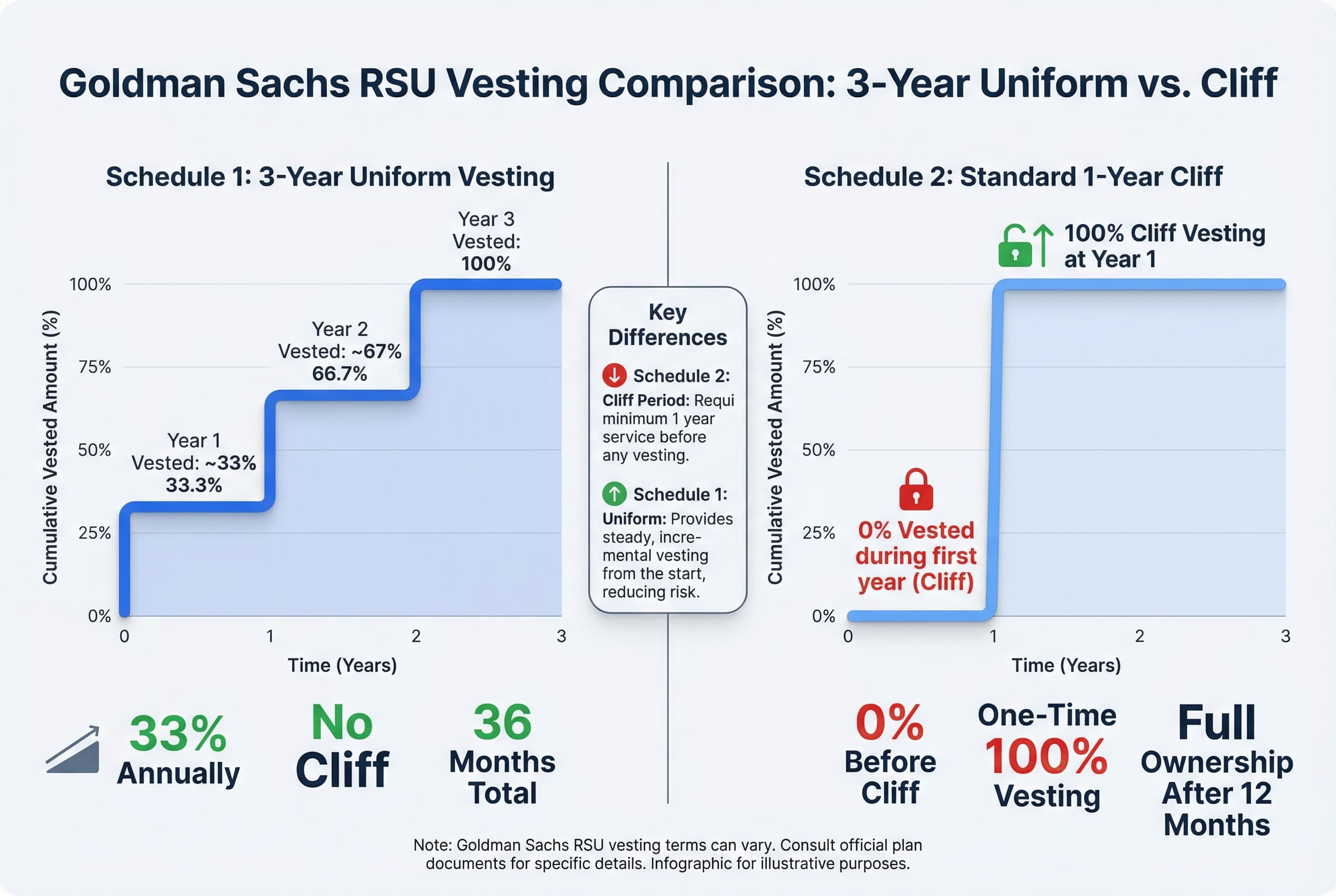
Goldman Sachs RSUs vest on a 3-year vesting (33% annually) OR Vested on Date of Grant (Year-End RSUs) OR Vesting on specific dates (Base RSUs) schedule with a 12-month cliff.
Example calculation based on 100 shares:
| Year | Vesting % | Shares Vesting | Estimated Value |
|---|---|---|---|
| Year 1 | 33% | 33 | $32,618.85 |
| Year 2 | 33% | 33 | $32,618.85 |
| Year 3 | 34% | 34 | $33,607.30 |
| Total | 100% | 100 | $98,845 |
* Based on Goldman Sachs stock price of $988.45 as of Sep 14, 2026. Actual values will vary.
33%
33 shares
$32,618.85
33%
33 shares
$32,618.85
34%
34 shares
$33,607.30
Goldman Sachs vesting schedule based on 100 total shares
Goldman Sachs offers a comprehensive equity compensation program designed to align employee interests with long-term company performance. The program primarily includes Restricted Stock Units (RSUs), Performance Stock Units (PSUs), and an Employee Stock Purchase Plan (ESPP), providing multiple ways for employees to build ownership in one of the world's leading financial services firms.
Equity compensation represents a significant component of total compensation at Goldman Sachs, particularly for professionals at the Associate level and above. As a publicly traded company in the financial services industry, Goldman Sachs stock (ticker: GS) offers employees the opportunity to participate in the firm's success. Given the firm's position as a market leader, equity grants can become a substantial portion of your wealth over time, making it essential to understand how these benefits work.
Goldman Sachs uses several RSU vesting structures depending on the award type. The most common structure for Year-End RSUs follows a three-year vesting schedule with 33% vesting annually. Interestingly, some Year-End RSUs are technically vested immediately upon grant but remain subject to delivery and transfer restrictions. The firm also offers Base RSUs that vest on specific dates, and executive-level grants may follow different schedules (such as five-year vesting for CEO/COO awards).
The ESPP allows employees to purchase company stock at a 15% discount with a lookback provision, featuring 12-month offering periods with semi-annual purchase periods. This benefit is capped at $25,000 in contributions annually.
Goldman Sachs employs multiple RSU vesting structures depending on the type of grant and employee level, making it important to understand which applies to your specific equity awards.
The most common vesting schedule for Goldman Sachs employees follows a 3-year uniform vesting structure with no cliff period. Under this arrangement, your RSUs vest in three equal installments of 33% annually over 36 months. This means that one-third of your grant becomes yours each year on the anniversary of the grant date.
Importantly, there is no cliff period for these grants. Unlike many tech companies that require you to wait 12 months before any shares vest, Goldman's standard structure begins vesting in the first year. This provides earlier access to your equity compensation.
Goldman Sachs has a unique feature where certain Year-End RSUs are actually vested immediately upon the grant date. However, don't confuse "vested" with "available to sell." While these shares are technically vested on day one, they remain subject to delivery schedules and transfer restrictions that prevent immediate sale. This structure is relatively uncommon in the industry and primarily applies to year-end compensation awards.
For senior executives, particularly at the CEO and COO level, Goldman uses a different vesting schedule. These grants vest over 5 years at 20% annually, creating a longer retention period for top leadership.
Your RSUs vest annually rather than monthly or quarterly. The vesting schedule follows a uniform pattern, meaning you receive equal amounts each year rather than a backloaded or frontloaded structure. This predictability makes it easier to plan for tax obligations and financial decisions.
Goldman also issues "Base RSUs" that vest on specific predetermined dates, and "Supplemental RSUs" that may vest immediately (100% on grant). The specific vesting terms will be detailed in your individual grant agreement.
The data does not provide information about refresher grant policies or their vesting schedules at this time.
Goldman Sachs offers an Employee Stock Purchase Plan that allows you to purchase company stock at a discount through payroll deductions. The plan provides a 15% discount on the stock price, which is considered standard among competitive ESPP programs.
The plan includes a lookback provision, which can significantly enhance your returns. This feature allows you to purchase stock at 15% off the lower of two prices: the stock price at the beginning of the offering period or the price at the end of the purchase period. For example, if GS stock is at $400 when the offering period begins and rises to $500 at purchase, you'd buy at $340 (15% off $400). If the stock drops to $350, you'd buy at $297.50 (15% off $350).
The ESPP operates on a 12-month offering period with two 6-month purchase periods within each offering. This means you can purchase stock semi-annually, giving you two opportunities per year to acquire shares at a discount.
You can contribute up to $25,000 annually to the plan, which is the IRS maximum for ESPPs. Enrollment periods occur semi-annually, aligning with the purchase period structure.
The combination of the 15% discount and lookback provision can generate substantial returns. In a rising market, you could see immediate gains of 17.6% or more (the discount divided by the discounted price), plus any additional appreciation from the lookback feature.
To receive favorable long-term capital gains treatment (a qualifying disposition), you must hold shares for over two years from the offering date and over one year after the purchase date. Selling earlier results in a disqualifying disposition, where the discount is taxed as ordinary income.
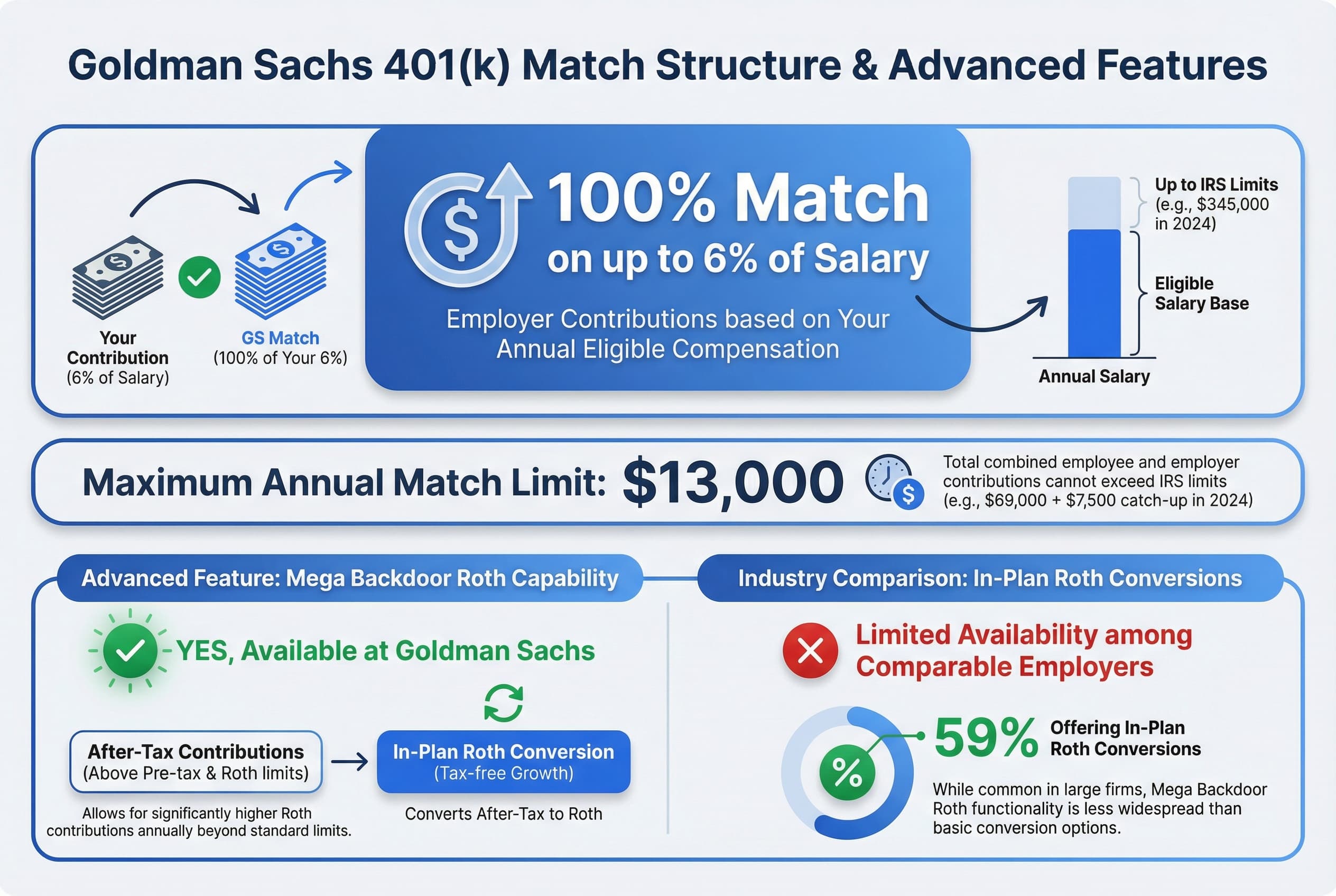
Goldman Sachs offers a competitive 401(k) plan with a 100% match on up to 6% of your salary. This means if you contribute 6% of your eligible compensation, the firm will match dollar-for-dollar, effectively providing you with an additional 6% in retirement savings. The maximum annual match is capped at $13,000.
While the data indicates that vesting schedules for employer contributions may follow either graded or cliff vesting structures, the specific vesting period for Goldman Sachs' 401(k) match is not definitively specified in available information. Be sure to confirm the exact vesting schedule with HR or your plan documentation.
Goldman Sachs supports after-tax contributions and offers mega backdoor Roth capability through in-plan Roth conversions. This feature allows high earners to potentially contribute significantly more to Roth accounts beyond standard Roth 401(k) limits - a valuable tax planning tool if you're maximizing your retirement savings.
Approximately 59% of comparable employers offer in-plan Roth conversion options, positioning Goldman Sachs favorably in this regard. The plan also provides managed account options, available at 46% of peer firms, which can help you optimize your investment strategy.
Information about brokerage window availability (self-directed investment options beyond the standard fund lineup) is not currently available in the plan details.
Understanding the tax treatment of your equity compensation is crucial for effective financial planning. Here's what you need to know about taxes on your Goldman Sachs equity awards.
RSUs: You owe taxes at vesting, regardless of whether you sell the shares. Goldman Sachs offers different RSU types with varying vesting schedules. Year-End RSUs are vested immediately upon grant (though delivery and transfer restrictions apply), meaning taxes are due right away. Other RSUs vest annually over three years (33% per year), triggering taxes at each vesting event. The value of the shares at vesting is treated as ordinary income.
ESPP: Taxes depend on how long you hold the shares after purchase. For favorable tax treatment, you must hold shares for over two years from the offering date and over one year after the purchase date (qualifying disposition). If you meet these requirements, only the discount is taxed as ordinary income, and any additional gain receives long-term capital gains treatment. Selling earlier (disqualifying disposition) results in the discount being taxed as ordinary income.
Goldman Sachs withholds taxes at vesting, though specific default rates aren't publicly disclosed. A common challenge is the "gap" between what's withheld and what you actually owe. If you're in a higher tax bracket, the withholding may be insufficient, leaving you with a tax bill at year-end.
The value of RSUs at vesting is taxed as ordinary income at your marginal tax rate. Any subsequent appreciation (or loss) after vesting is taxed as capital gains when you sell - short-term if held less than one year, long-term if held longer. Long-term capital gains rates are typically lower than ordinary income rates, providing potential tax savings.
Goldman Sachs is headquartered in New York, a high-tax state. If you work in New York, New York City, or other high-tax jurisdictions, you'll face additional state and potentially local income taxes on your equity compensation, which can significantly increase your total tax burden.
Disclaimer: This information is educational only and not tax advice. Tax laws are complex and individual circumstances vary. Please consult a qualified tax professional to understand your specific tax situation and obligations.
As a Goldman Sachs employee, your equity compensation can become a significant portion of your wealth, particularly as RSUs vest annually and ESPP purchases accumulate. While this reflects your contributions to the firm's success, concentrating too much wealth in a single stock - even your employer's - creates substantial risk.
When your career income and investment portfolio both depend on Goldman Sachs, you're exposed to "double risk." If the financial services industry faces headwinds or the firm experiences challenges, both your job security and investment value could decline simultaneously.
Goldman Sachs operates in a highly regulated, cyclical industry sensitive to economic conditions, interest rate changes, and market volatility. Financial services firms face unique risks including regulatory changes, litigation exposure, and reputational concerns that can significantly impact stock performance.
Financial advisors commonly recommend limiting any single stock to 10-20% of your net worth. Consider selling vested shares systematically and reinvesting in diversified index funds or other asset classes. You might also explore the Section 351 exchange strategy, which some Goldman Sachs employees use to manage concentrated positions while deferring taxes.
Given Goldman Sachs's Year-End RSUs vest immediately and ESPP purchases occur semi-annually, create a regular review schedule to rebalance your portfolio and maintain appropriate diversification as your equity compensation grows.
At Goldman Sachs, equity represents a significant portion of total compensation, particularly as you advance from Analyst to Managing Director levels. Year-End RSUs typically vest over three years (33% annually), creating a meaningful retention incentive. Remember that concentrated positions in a single financial services stock - even a premier institution - introduces risk that should be actively managed.
Goldman Sachs operates trading window periods, meaning you can only transact during specific open windows. Plan your selling strategy around these windows rather than trying to time the market. Consider selling vested shares when they represent more than 10-15% of your total investment portfolio, or when you need funds for major financial goals. Note that some Year-End RSUs vest immediately upon grant but may have transfer restrictions based on your tax withholding elections.
Working in financial services while holding significant Goldman Sachs stock creates concentration risk - both your income and investments depend on the same industry. Systematically diversifying by selling a portion of vested shares during each trading window can reduce this exposure. The company's clawback and forfeiture provisions for certain roles add another layer of risk to consider.
Goldman Sachs offers an ESPP with a 15% discount and lookback provision on semi-annual purchase periods. To qualify for favorable long-term capital gains treatment, hold shares for over two years from the offering date and over one year after purchase. However, immediate sale still captures the discount benefit, though taxed as ordinary income.
While not explicitly confirmed in available data, consider whether Goldman Sachs offers 10b5-1 trading plans. These pre-scheduled selling programs can help you diversify systematically while navigating blackout periods and avoiding insider trading concerns.
Let's walk through a realistic example of how Year-End RSUs vest at Goldman Sachs.
Sarah, a Vice President at Goldman Sachs, receives 300 Year-End RSUs as part of her annual compensation. At the time of grant, Goldman Sachs stock is trading at $500 per share, making her total grant value $150,000.
Goldman Sachs typically uses a 3-year annual vesting schedule with 33% vesting each year:
Let's assume the stock price has grown to $550 per share when Year 1 vesting occurs.
When 100 RSUs vest:
Some Goldman Sachs Year-End RSUs are vested immediately on the grant date, though transfer restrictions still apply. Additionally, employees can only trade shares during designated "window periods" due to Goldman's blackout policy.
Sarah will repeat this process in Years 2 and 3, with the actual value depending on the stock price at each vesting date. Over three years, she'll receive all 300 shares (minus tax withholding), building meaningful equity ownership in Goldman Sachs.
Goldman Sachs employees often make avoidable mistakes with their equity compensation. Here are the most critical pitfalls to watch for:
The biggest risk at Goldman Sachs is accumulating too much wealth in GS stock. With RSUs vesting annually (typically 33% per year over three years) and an ESPP offering a 15% discount with a lookback provision, your portfolio can quickly become overweighted in a single stock. This concentration exposes you to significant risk if the company or financial services sector underperforms.
Year-End RSUs at Goldman Sachs vest immediately on the grant date, creating an immediate tax liability. Many employees don't realize that default withholding may not cover their full tax obligation, especially if you're in a high tax bracket. This can lead to unexpected tax bills and potential underpayment penalties.
Goldman Sachs offers an ESPP with a 15% discount and lookback feature, allowing you to purchase stock at the lower price between the offering start and purchase dates. Despite this generous benefit (with potential returns of 15-30%+), many employees don't participate or contribute less than they could afford.
Goldman Sachs restricts trading to specific "window periods." Attempting to sell shares outside these windows violates company policy and can result in serious consequences, including forfeiture of unvested equity.
Understanding how your departure affects your equity compensation is crucial for financial planning. Here's what typically happens to each component:
Unvested RSUs are generally forfeited when you leave Goldman Sachs, regardless of whether your departure is voluntary or involuntary. This applies to both Year-End RSUs (which vest annually at 33% per year over three years) and Base RSUs with specific vesting dates. Since Goldman Sachs has extensive forfeiture provisions, particularly for Material Risk Takers under regulatory frameworks, it's essential to understand your vesting schedule before making any departure decisions.
While Goldman Sachs' equity plan permits stock options, specific post-termination exercise window details are not publicly available. If you hold options, review your grant agreement carefully to understand your exercise timeline after termination.
If you're enrolled in the Employee Stock Purchase Plan (ESPP) with its 15% discount and semi-annual purchase periods, leaving mid-period typically results in the return of your accumulated contributions without a stock purchase. You won't receive shares for the partial period, though you'll retain any shares previously purchased.
Your termination date directly impacts vesting. Since Goldman Sachs RSUs vest annually, leaving even a day before a vesting date means forfeiting that tranche. Additionally, be aware of Goldman Sachs' anti-hedging policies and transfer restrictions that may apply to vested shares you already own.
Always consult your specific grant agreements and HR for personalized guidance.
This content is for educational purposes only and does not constitute financial advice. The information provided is general in nature and may not appl...
YourEmployeeStock.com is not a registered investment advisor.
Goldman Sachs uses different vesting schedules depending on the type of RSU grant. Year-End RSUs typically vest over 3 years at 33% annually, though some Year-End RSUs are actually vested immediately on the grant date (with delivery and transfer restrictions still applying). Base RSUs and Additional RSUs vest on specific dates determined at grant, while CEO/COO grants may vest over 5 years at 20% annually.
Goldman Sachs has extensive forfeiture provisions that may apply when you leave the company, particularly if you're classified as a Material Risk Taker under EU/UK frameworks. Unvested RSUs are typically forfeited upon departure, and even vested shares may be subject to clawback provisions related to misconduct or risk events. The specific treatment depends on your role, reason for departure, and the terms of your grant agreement.
Yes, Goldman Sachs offers an ESPP with a 15% discount and a lookback feature. The plan has a 12-month offering period with two 6-month purchase periods (semi-annual purchases), allowing you to contribute up to $25,000 per year. To receive favorable tax treatment, you must hold shares for over 2 years from the offering date and over 1 year after the purchase date.
Goldman Sachs employees can only trade company stock during designated "window periods" due to blackout restrictions. Additionally, the company has an anti-hedging policy that prohibits all employees from hedging their RSUs, including shares subject to transfer restrictions. Specific window periods depend on your role and access to material non-public information.
When your RSUs vest, they're treated as ordinary income and subject to tax withholding at that time. Goldman Sachs allows you to adjust your tax withholding rate, though specific default rates vary. The choice of withholding rate may also affect transfer restrictions on your delivered shares, so it's important to consider both tax and liquidity implications.
Goldman Sachs offers a 100% match on the first 6% of eligible compensation you contribute to your 401(k). The company also offers mega backdoor Roth capabilities through after-tax contributions and Roth in-plan conversion options. Employer contributions may be subject to either graded or cliff vesting schedules.
Yes, new hires at Goldman Sachs may receive equity grants as part of their compensation package. The company's policy limits guaranteed variable remuneration (including sign-on bonuses) to exceptional circumstances and restricts it to new hires within their first year of employment. Specific grant amounts vary by level, which follows the progression: Analyst, Associate, Vice President (VP), and Managing Director (MD).
Concentrated stock positions are a common concern for Goldman Sachs employees due to large RSU and ESPP grants over time. The company's Year-End RSUs that vest immediately (though with delivery restrictions) can particularly contribute to concentration risk. Some employees use strategies like Section 351 exchanges to manage concentrated positions, though you should consult with a financial advisor about the best approach for your situation.
Get a free personalized analysis from our equity compensation experts

