

Understanding Your Offer Letter Equity: A Complete Guide to Stock Compensation
How to decode stock compensation and know what you're really getting
Published March 14, 2026 · Updated March 14, 2026
Your job offer includes equity compensation, but what does it actually mean? This guide breaks down every line of equity language in offer letters, from stock options to RSUs, helping you understand what you're getting, when you'll get it, and what it could be worth.
You Just Got an Offer With Equity - Now What?
Sarah just got her dream job offer. Base salary: $120,000. Sign-on bonus: $15,000. She's thrilled. Then she scrolls down and sees this:
"You will receive an equity grant of 5,000 RSUs with a 4-year vesting schedule and 1-year cliff."
Her excitement turns to panic. What does that even mean? Is it worth $5,000? $50,000? More? And what's a cliff?
You're not alone if this sounds like gibberish. Most people have no idea how to read the equity section of their offer letter. It's like getting a menu in a foreign language. You know it's food, but what are you actually ordering?
Here's why this matters: that confusing equity section could be worth more than your entire first year's salary. Or it could be worth nothing. The difference depends on understanding what you're actually getting.
This guide will help you decode your offer letter so you can:
- Figure out what your equity is actually worth today (in real dollars)
- Understand when you'll get your shares and what could speed that up or slow it down
- Spot red flags that mean you should negotiate or walk away
- Compare offers from different companies apples-to-apples
- Know exactly what happens to your equity if you leave or get laid off
By the end, you'll read "5,000 RSUs with a 4-year vest and 1-year cliff" and know exactly what that means for your bank account.
Let's start with the basics: what type of equity are you actually getting?
Decoding Your Offer Letter: A Line-by-Line Equity Breakdown | The Breakdown Lane
The Types of Equity You'll See in Offer Letters
Think of equity compensation like different payment methods. Cash, check, gift card, store credit. They all have value, but they work in different ways. The same goes for the equity in your offer letter.
Most offer letters include one (or sometimes two) of these equity types:
Restricted Stock Units (RSUs)
RSUs are the simplest type. Your company promises to give you actual shares of stock for free over time.
Example: Your offer says "5,000 RSUs vesting over 4 years." This means you'll receive 5,000 shares of company stock at no cost to you. You just have to stick around to earn them.
RSUs are like a loyalty rewards program. Stay at the company, and you collect shares. No money out of your pocket.
Where you'll see them: Almost all large public companies use RSUs. Google, Amazon, Meta, Microsoft. If the company is already public when you join, you're probably getting RSUs.
Stock Options (ISOs and NSOs)
Stock options are different. They give you the right to buy company stock at a fixed price (called the strike price or exercise price).
Example: Your offer says "10,000 stock options with a $5 strike price." This means you can buy 10,000 shares at $5 each, even if the stock price later hits $50. You lock in that $5 price today.
Options are like a Costco membership coupon that locks in a sale price. The regular price might go up, but your price stays the same.
The catch: You have to pay money to actually get the shares. If your strike price is $5 and you want 1,000 shares, you need $5,000 to exercise them.
ISOs vs NSOs: There are two flavors of stock options. Incentive Stock Options (ISOs) come with better tax treatment but strict rules. Non-Qualified Stock Options (NSOs) are more flexible but taxed differently. Your offer letter will specify which type you're getting.
Where you'll see them: Startups and private companies love options. They save the company cash while giving you upside potential.
Employee Stock Purchase Plan (ESPP)
Some offers mention an ESPP as a separate benefit. This lets you buy company stock at a discount (usually 15% off) through payroll deductions.
Example: "You're eligible for our ESPP with a 15% discount." You can set aside part of each paycheck to buy stock at 15% below market price.
This is a bonus perk, not your main equity compensation. We cover ESPPs in detail in a separate guide.
How to Spot Which Type You Have
Your offer letter will use specific language:
- RSUs: Look for "Restricted Stock Units," "RSUs," or "you will be granted X shares."
- Stock options: Look for "stock options," "the right to purchase," "strike price," or "exercise price."
- ESPP: Usually mentioned separately as "eligible to participate in our Employee Stock Purchase Plan."
Public company pattern: If you're joining a company that's already traded on the stock market, expect RSUs. About 90% of public tech companies use RSUs as their primary equity compensation.
Startup pattern: If you're joining a private company (not yet public), expect stock options. Most startups use ISOs for employees and NSOs for contractors.
Now that you know what type of equity you're getting, the next question is: when do you actually get it? That's where your vesting schedule comes in.
The Insider's Guide to Startup Equity in Job Offer Negotiations
Decoding Your Vesting Schedule: When You Actually Get Your Equity
Vesting is the process of earning your equity over time. Think of it like a loyalty rewards program at your favorite coffee shop. You don't get all your free drinks on day one. You earn them by coming back month after month.
When your offer letter says "4,000 RSUs with a 4-year vesting schedule," that means you'll receive those 4,000 shares gradually over four years. You don't own them all on your first day. You earn them by staying at the company.
The 1-Year Cliff: Your First Big Payday
Most tech companies include something called a "1-year cliff." This means you get zero shares for your entire first year. Then, on your one-year work anniversary, you receive 25% of your total grant all at once.
Why do companies do this? It protects them from employees who join, collect equity, and leave quickly. The cliff ensures you're committed for at least a year.
Here's How It Works in Real Life
Maria joins TechCo on January 1, 2024. Her offer includes 4,000 RSUs with a 4-year vesting schedule and 1-year cliff.
Here's when Maria actually receives her shares:
- January 1, 2024 to December 31, 2024: 0 shares (the cliff period)
- January 1, 2025: 1,000 shares vest all at once (25% of 4,000)
- February 1, 2025 through December 1, 2027: 83 shares vest each month (the remaining 3,000 shares spread over 36 months)
The math: 4,000 total shares divided by 4 years equals 1,000 shares per year. After the cliff, that's roughly 83 shares per month (1,000 divided by 12).
Monthly, Quarterly, or Annual Vesting
After your cliff, shares typically vest on one of these schedules:
- Monthly vesting: You receive shares every month (most common at tech companies)
- Quarterly vesting: You receive shares every three months
- Annual vesting: You receive shares once per year
Monthly vesting is better for you. If you leave the company, you've earned more of your equity than you would with annual vesting.
What Happens on Your Vest Date
On each vesting date, the shares officially become yours. They appear in your brokerage account, usually through companies like E*TRADE, Fidelity, or Schwab. You can sell them immediately, hold them, or do anything else you want with them.
But here's the catch: the moment shares vest, you owe taxes on them. We'll cover that surprise in a later section.
Now that you understand when you'll receive your equity, let's look at what happens if your company gets acquired before your shares finish vesting.
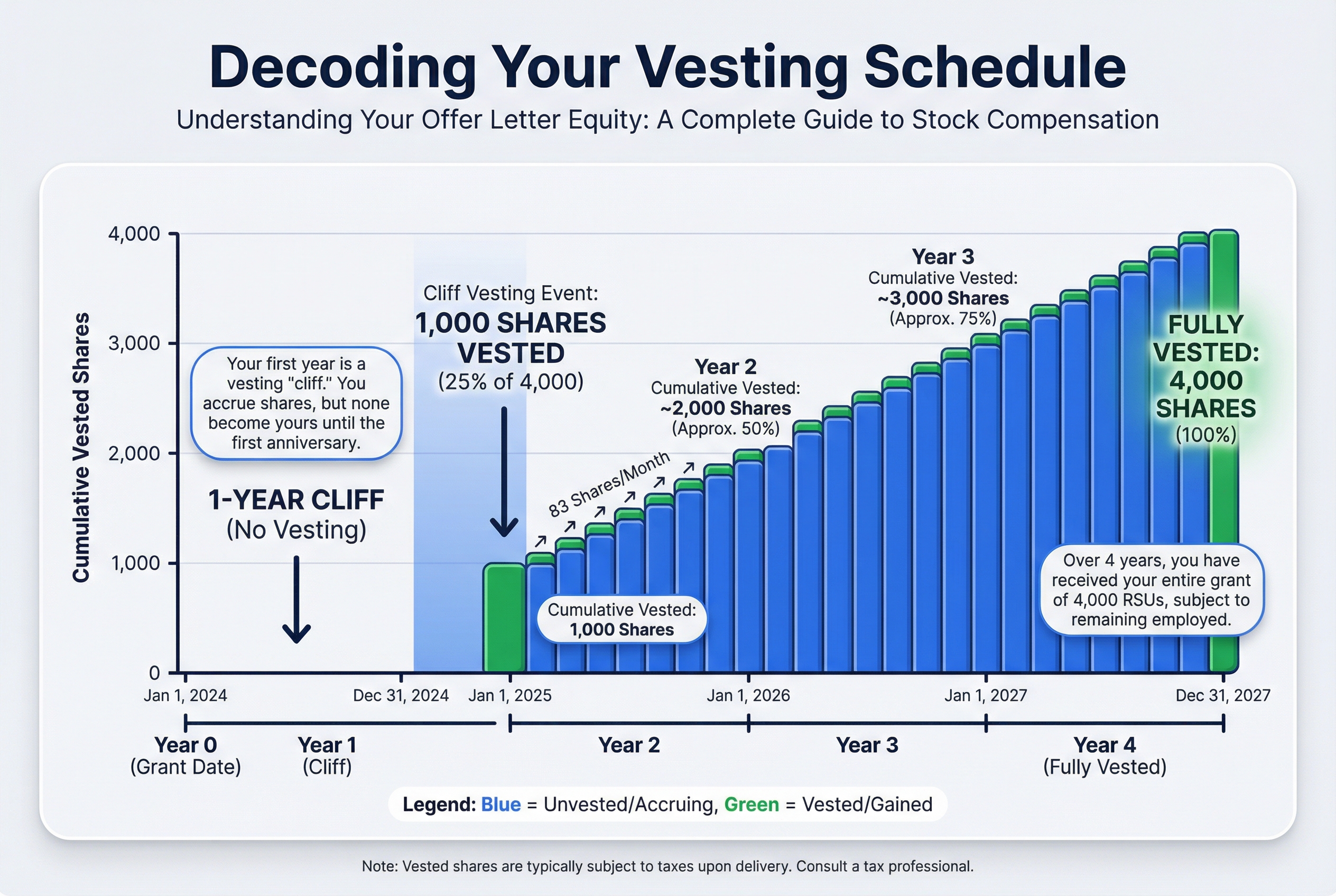 The 1-year cliff means you receive 25% of your total grant only after completing your first full year of service.
Acceleration Clauses: Your Safety Net If the Company Gets Acquired
Acceleration is like an insurance policy for your unvested equity. It speeds up your vesting schedule if your company gets bought, so you don't lose shares you've been counting on.
Here's why it matters: When Facebook bought Instagram in 2012, some employees had years of unvested equity. Acceleration clauses determined whether they got those shares immediately or lost them.
Single-Trigger Acceleration: The Instant Payout
With single-trigger acceleration, all your unvested shares vest the moment your company gets acquired. That's it. One trigger (the acquisition), and you get everything.
Let's say you're James. You have 2,000 unvested RSUs worth $50 each (that's $100,000 sitting on the table). Your company gets acquired. With single-trigger acceleration, all 2,000 shares vest immediately. You walk away with $100,000.
Double-Trigger Acceleration: Two Things Must Happen
Double-trigger acceleration requires two events:
- Your company gets acquired (first trigger)
- You get fired or laid off within a set timeframe, usually 12-18 months (second trigger)
Both must happen for your unvested shares to accelerate.
Using James's example again: His company gets acquired, but he keeps his job. His unvested RSUs don't accelerate yet. Six months later, the new owner eliminates his position. Now both triggers hit. His 2,000 shares vest, and he gets his $100,000.
Why Double-Trigger Is Standard Now
Most companies use double-trigger acceleration today. Why? It protects the acquiring company. They don't want to pay out millions in accelerated equity to employees who might quit the next day.
Single-trigger acceleration is rare outside executive packages. If you see it in your offer, that's a nice bonus.
Finding Acceleration Language in Your Offer
Look for these phrases in your equity documents:
- "Change of control provisions"
- "Acceleration upon acquisition"
- "Single-trigger" or "double-trigger"
If you don't see any acceleration language, assume you have none. Your unvested shares disappear if you're terminated after an acquisition.
The Real Impact on Your Wealth
Without any acceleration clause, James loses his entire $100,000 if he's let go after the acquisition. That's a huge financial hit.
Acceleration clauses turn your unvested equity into real money when your company's ownership changes. They're your safety net during the chaos of acquisitions.
Now that you understand when you get your equity, let's figure out what it's actually worth today.
Calculating What Your Equity Is Actually Worth Today
You need to know what your equity is worth right now, not just what it might be worth someday. Think of it like appraising a house. When houses on your street sell every day, you know exactly what yours is worth. When no houses have sold in years, you're just guessing.
Public companies are the easy case. Private companies? Much harder.
Valuing Public Company Equity
If you got an offer from Microsoft, Google, or any company traded on the stock market, the math is simple:
Number of shares × Current stock price = Current value
Example: You receive 1,000 RSUs at Microsoft. The stock trades at $370 today. Your equity is worth $370,000 right now (before taxes, which we'll cover later).
You can find the current stock price on Google Finance, Yahoo Finance, or your broker's app. It updates every second the market is open.
Valuing Stock Options at Public Companies
Options are trickier because you have to subtract your strike price. The difference is called your "spread."
Formula: (Current stock price - Strike price) × Number of options = Current spread value
Example: You get 5,000 stock options with a $10 strike price. The company's stock trades at $30 today. Your spread is $20 per share. Total value: ($30 - $10) × 5,000 = $100,000.
This is what you'd make if you exercised all your options today and immediately sold the shares. If the stock price is below your strike price, your options are "underwater" and worth $0 right now.
Valuing Private Company Equity (Much Less Certain)
Private companies don't have a stock price. Instead, they use something called a 409A valuation. This is an independent appraisal that happens every 12 months or when something big changes.
Your offer letter should tell you the 409A price per share. If it doesn't, ask.
Example: You get 2,000 RSUs at a startup. The 409A valuation is $25 per share. On paper, that's $50,000. But here's the catch: you can't sell these shares yet. There's no market for them.
The 409A price is an educated guess, not a real market price. It's like a realtor estimating your home's value without any recent sales to compare it to. The number could be close, or it could be way off.
Private company valuations are especially uncertain because they're based on assumptions about future fundraising, growth, and exit scenarios that may never happen.
Now that you know what your equity is worth today, let's talk about what it could be worth tomorrow.
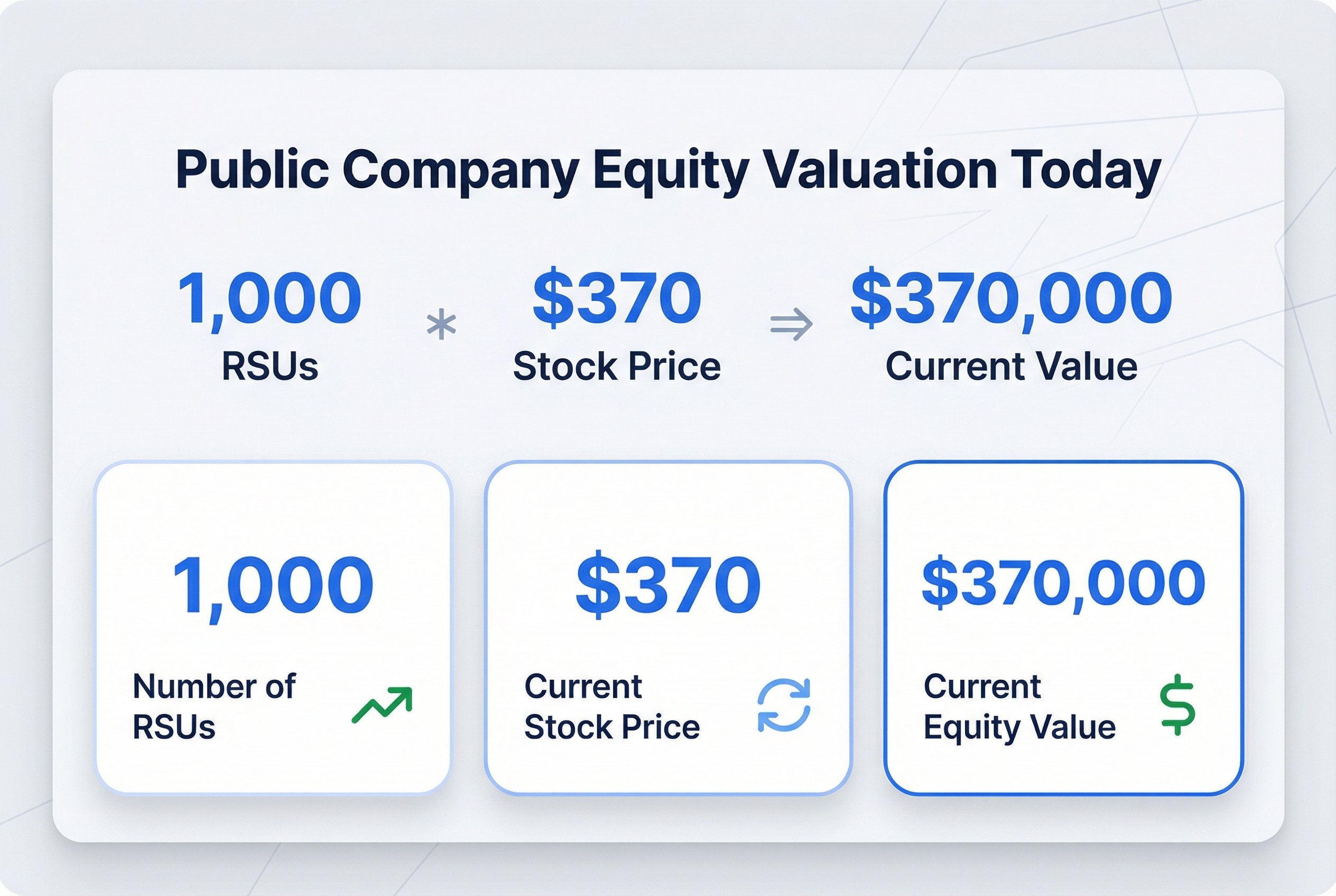 Calculating the current value of public company equity is straightforward: multiply your shares by the current market price.
What Your Equity Could Be Worth in the Future (And Why That's Uncertain)
Trying to predict what your equity will be worth in four years is like predicting the weather next month. You can make educated guesses based on patterns, but surprises happen. The stock market doesn't follow a script.
Your equity's future value depends entirely on the stock price. If the stock goes up, your equity becomes more valuable. If it goes down, you get less. If you're at a startup that fails, you could get nothing.
Running the Numbers: What Could Happen
Let's say you have 1,000 RSUs worth $50,000 today (stock trading at $50 per share). Here's what could happen over four years:
Scenario 1: Steady Growth (10% per year)
- Year 1: $50 × 1.10 = $55
- Year 2: $55 × 1.10 = $60.50
- Year 3: $60.50 × 1.10 = $66.55
- Year 4: $66.55 × 1.10 = $73.21
- Your 1,000 shares = $73,210
Scenario 2: Stock Stays Flat
- Your 1,000 shares = $50,000 (same as today)
Scenario 3: Stock Drops 20%
- $50 × 0.80 = $40
- Your 1,000 shares = $40,000
The difference between these scenarios is $33,210. That's real money you can't count on until it's actually in your account.
Public Companies vs. Startups: Different Levels of Uncertainty
Public companies have track records you can study. You can see how their stock performed during recessions, what analysts predict, and how the industry is trending. But even Microsoft and Apple have years where their stock drops 30%.
Private companies are pure guesswork. Your 10,000 stock options could become:
- $0 if the company fails (happens to most startups)
- $100,000 if the company has a modest exit
- $1,000,000+ if you join the next big success story
Instagram employees who joined early saw their equity turn into millions. WeWork employees saw their equity become nearly worthless when the IPO collapsed. Both seemed like great bets at the time.
Real Examples From the Past Decade
The winners:
- Netflix stock grew from $50 to $400 (2013-2021). Your $50,000 in RSUs would have become $400,000.
- Shopify grew 3,000% in five years. Early employees became millionaires.
The losers:
- Peloton stock dropped from $160 to $10 (2021-2023). Your $160,000 grant became worth $10,000.
- Countless startups shut down, making all employee equity worthless.
How to Think About This Risk
Never count unvested equity as money in the bank. It's a potential bonus, not guaranteed salary. When you're budgeting for a house or planning your finances, use your base salary. Treat equity as upside that might happen.
Think of it this way: if someone offered you a lottery ticket or $100 cash, you'd take the cash. Your equity is somewhere between those extremes. It has better odds than a lottery ticket but worse odds than cash in hand.
Consider your risk tolerance. If you're joining a startup for $100k salary plus $200k in options, you're betting on that equity paying off. If you need the money to be real, negotiate for more salary instead.
The younger the company, the higher the risk and potential reward. A pre-IPO startup could 10x your equity or zero it out. A stable public company probably won't do either.
Understanding potential value is important, but there's another critical question: what happens to your equity if you decide to leave? That's what we'll cover next.
What Happens to Your Equity When You Leave the Company
Here's the hard truth: when you leave your job, you lose more equity than you keep.
Think of it like this. Vested equity is money already in your bank account. It's yours. Unvested equity is like a promised bonus you haven't earned yet. Walk away before you earn it, and it disappears.
What You Keep When You Leave
RSUs (Restricted Stock Units): You keep every vested share. They're already yours. The company can't take them back.
Stock Options: You keep the right to buy vested shares, but there's a catch. You typically have just 90 days to exercise them (buy the shares at your strike price) or they vanish forever.
What You Lose When You Leave
Unvested RSUs: Gone. All of them. Doesn't matter if they were about to vest next week.
Unvested Options: Also gone. You can't exercise options you haven't earned yet.
This is true whether you quit, get fired, or take another job. The only exception is sometimes retirement, which may have special rules at your company.
The 90-Day Pressure Cooker
That 90-day exercise window for vested options creates real financial stress. Let's look at Lisa's situation.
Lisa leaves her job after three years. Here's what she has:
RSUs:
- 1,000 vested shares at $50 each = $50,000 she keeps
- 3,000 unvested shares at $50 each = $150,000 she loses
Stock Options:
- 2,000 vested options with $20 strike price (stock trading at $40)
- To exercise: she must pay $40,000 within 90 days
- If she exercises: she owns shares worth $80,000 (profit of $40,000)
- If she doesn't exercise: she loses everything
Lisa has to find $40,000 in cash in three months or walk away from $40,000 in potential profit. That's the pressure cooker. Many people can't come up with that much cash that quickly, so they lose vested options they worked years to earn.
Why This Matters for Your Offer
Before you accept any equity offer, ask yourself: can I afford to stay long enough to vest? Can I afford to exercise options if I leave?
If you're planning to stay just two years but your equity vests over four, you're walking away from half your compensation. That $200,000 equity package in your offer letter is really a $100,000 package.
Now that you understand what happens when you leave, let's talk about the other surprise that catches people off guard: taxes.
The Tax Surprise Nobody Tells You About in Your Offer Letter
Here's the shock: your equity gets taxed like a regular paycheck, but you might not have any cash to pay those taxes.
Think of equity taxes like winning a car on a game show. It's exciting and valuable, but you owe taxes on that $30,000 prize before you can drive it home. The IRS doesn't care that you haven't sold the car yet. They want their cut based on what it's worth today.
RSUs: Taxed When They Vest (Not When You Sell)
When your RSUs vest, the IRS treats them as ordinary income. Just like your salary.
Let's see how this plays out with real numbers:
Marcus's RSU Vesting Day:
- 1,000 RSUs vest
- Stock price: $50 per share
- Total value: $50,000 (taxed as income)
- Marcus's tax rate: 35% federal + state
- Total tax owed: $17,500
What actually happens:
- His company automatically withholds 22% for taxes
- They sell 220 shares ($11,000) to cover withholding
- Marcus receives only 780 shares (worth $39,000)
- At tax time, he still owes $6,500 more
Marcus thought he was getting 1,000 shares. He actually got 780. And he still has a tax bill coming.
The Private Company Tax Trap
At private companies, this gets worse. Your RSUs vest and you owe taxes immediately. But you can't sell the shares because there's no public market.
You literally owe the IRS money for stock you can't convert to cash. Some people have to pay thousands in taxes out of their savings for equity they can't touch.
Stock Options: Taxes Hit When You Exercise
NSOs (non-qualified stock options) create a tax bill the moment you exercise. If you buy 1,000 shares at a $10 strike price when they're worth $50, you owe taxes on that $40,000 gain. Before you sell anything.
ISOs (incentive stock options) can trigger the Alternative Minimum Tax (AMT). This is incredibly complex and can create surprise tax bills of $20,000 or more.
Why You Need a Tax Professional
Equity compensation taxes are not DIY territory. A qualified tax advisor costs $500 to $2,000. Making a mistake can cost you $10,000 or more.
Before your first vesting date, talk to a CPA who specializes in equity compensation. Not all tax professionals understand this stuff.
Now that you know the tax reality, let's look at warning signs that an equity offer might not be as good as it seems.
Everything you need to know about ESOPs
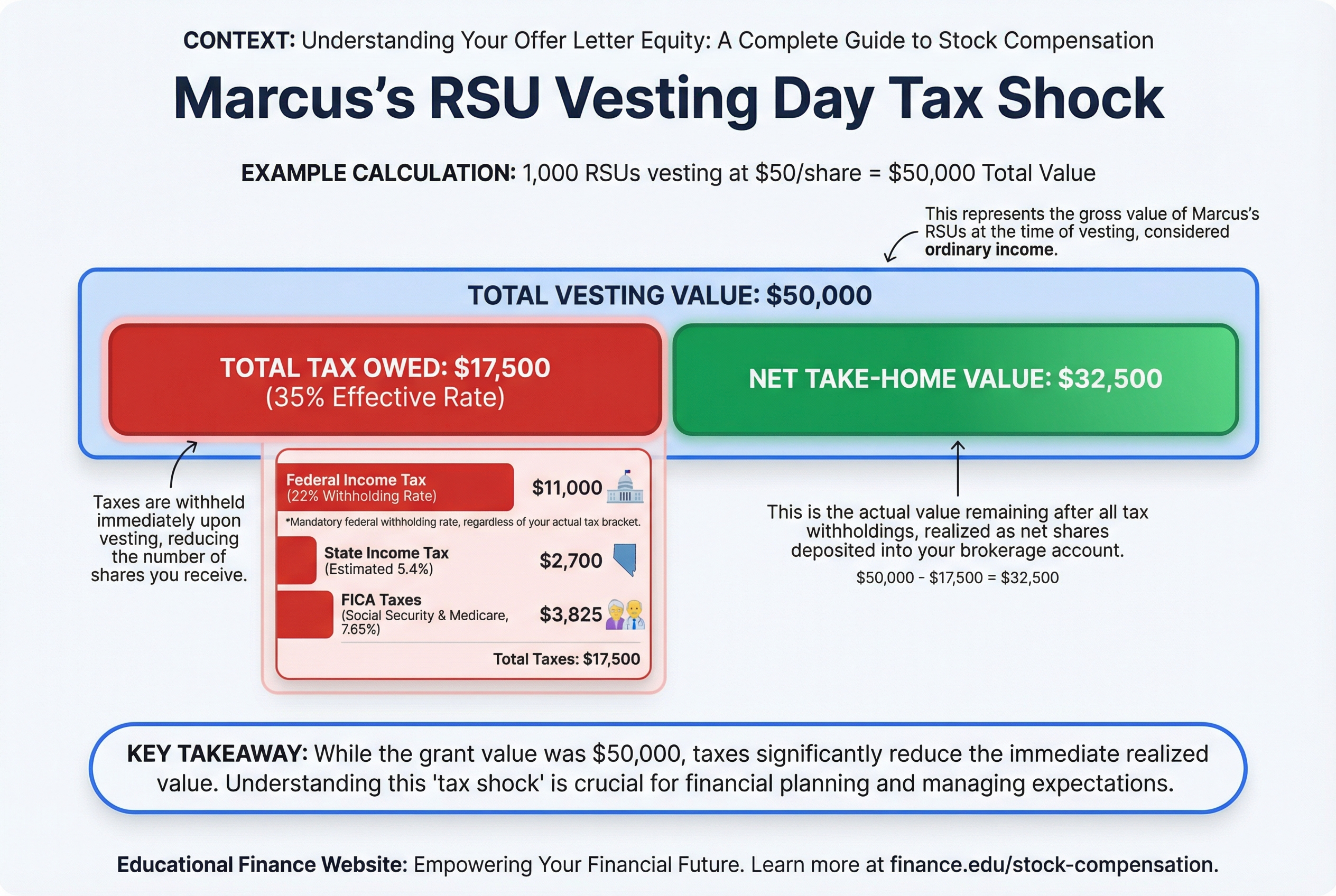 When RSUs vest, the full market value is treated as ordinary income, triggering immediate tax liability.
Red Flags to Watch For in Your Equity Offer
Red flags in equity offers are like warning lights on your car dashboard. They don't always mean disaster, but you need to investigate before moving forward.
Vesting periods longer than 4 years are unusual. Standard vesting is 4 years with a 1-year cliff. If you see 5 or 6-year vesting, ask why. You're locking yourself in for longer than industry standard.
Example: A startup offers you $80,000 salary when market rate is $120,000, plus 20,000 options with 6-year vesting. You're trading $40,000 per year in guaranteed cash for uncertain equity that takes extra-long to earn. That's $240,000 in lost cash over 6 years.
No acceleration clause is a major warning sign. If the company gets acquired and your new boss fires you, you could lose all unvested equity. You need at least single-trigger or double-trigger acceleration protection.
Strike prices close to or above the current valuation mean you start underwater. If your options have a $30 strike price but the latest 409A valuation is $28, you're already losing money on paper. The stock needs to rise just for you to break even.
Equity that replaces too much base salary concentrates your risk. Your paycheck and your savings would both depend on one company succeeding. If you're taking a $30,000+ pay cut for equity, you're betting your entire financial life on one outcome.
At private companies, ask when they last got a 409A valuation. If it's more than 12 months old, the strike price might not reflect current reality. Stale valuations can hide problems.
Vague or non-standard language is always concerning. If the offer letter says "subject to board approval" or uses confusing terms, get clarification in writing. Standard equity grants use standard language.
Now that you know what to watch for, let's cover the specific questions you should ask before signing anything.
Questions to Ask Before You Sign Your Offer Letter
Asking questions about your equity is like inspecting a house before you buy it. It's not rude. It's smart. Good companies expect these questions and have clear answers ready.
Who should you ask? Start with your recruiter. They handle these questions daily. If they can't answer something specific (like the 409A valuation), they'll connect you with someone who can. Don't wait until you've signed to get curious.
Your Essential Equity Questions Checklist
Here are the questions you need answered, with scripts you can use:
1. What type of equity am I getting?
Why it matters: RSUs, stock options, and restricted stock all work differently for taxes and value.
How to ask: "I see the offer mentions stock options. Can you confirm these are ISOs or NSOs?"
2. What's the exact vesting schedule?
Why it matters: You need to know when you actually own your shares.
How to ask: "Can you help me understand the vesting schedule? I see it mentions a 1-year cliff. Does that mean I receive 25% of the shares after one year, then monthly vesting after that?"
3. Is there any vesting acceleration?
Why it matters: Protection if the company gets acquired.
How to ask: "If the company is acquired, what happens to my unvested equity? Is there single-trigger or double-trigger acceleration?"
4. What's the exercise window for stock options?
Why it matters: Standard 90-day windows can force expensive decisions if you leave.
How to ask: "If I leave the company, how long do I have to exercise my vested options? Is it 90 days or longer?"
5. What's the current 409A valuation? (Private companies)
Why it matters: This determines your strike price and how much profit you could make.
How to ask: "For the stock options, what's the current 409A valuation, and when was it last updated?"
6. How many total shares are outstanding?
Why it matters: Helps you calculate your ownership percentage.
How to ask: "To understand my potential ownership, can you share the total number of shares outstanding? I'm trying to calculate what percentage of the company my 20,000 options represent."
7. What's the company's exit timeline? (Private companies)
Why it matters: Affects when you might actually sell your shares for cash.
How to ask: "Does the company have any plans for an IPO or acquisition in the next few years? I'm trying to understand the potential timeline for liquidity."
8. How was my equity amount determined?
Why it matters: Helps you understand if there's room to negotiate.
How to ask: "Can you help me understand how the equity amount was calculated? Is it based on my level, location, or other factors?"
9. What's the current stock price? (Public companies)
Why it matters: Lets you calculate the current value of your offer.
How to ask: "For the 500 RSUs, what's the current stock price you're using to calculate the grant value?"
10. Are there any repurchase rights?
Why it matters: Some private companies can buy back your shares at set prices.
How to ask: "Does the company have any rights to repurchase my vested shares if I leave? If so, at what price?"
Questions That Might Be Too Aggressive
Avoid asking about executive compensation packages or demanding to see the cap table. You can ask about total shares outstanding (that's your ownership percentage), but don't push for detailed breakdowns of who owns what.
Don't ask "Is this company going to succeed?" Instead, ask specific questions about funding, revenue growth, or customer metrics that help you assess that yourself.
What Good Answers Sound Like
Strong companies give you clear numbers. "Our 409A valuation is $15 per share as of March 2024" is better than "We're valued quite well."
They don't dodge questions about vesting or exercise windows. If a recruiter says "I'll have to check on that," that's fine. If they say "That's proprietary information" about basic vesting terms, that's a red flag.
They provide written documentation. Ask for the stock plan documents, not just a verbal summary.
Make It a Conversation, Not an Interrogation
Spread these questions across multiple conversations. Ask 3-4 during your offer call. Follow up with a few more over email. Save the detailed ones (like 409A valuation) for when you're seriously considering the offer.
Frame your questions positively: "I'm really excited about this offer and want to make sure I fully understand the equity component."
Now that you know what questions to ask, let's look at how to compare equity offers from different companies, especially when one is offering RSUs and another is offering stock options.
Comparing Multiple Offers: How to Evaluate Equity Across Different Companies
You have three job offers on the table. Each one promises different equity. How do you actually compare them?
Think of it like comparing apartments. You can't just look at the monthly rent. You need to see the total cost, factor in utilities, and consider whether the landlord is reliable or might disappear. Same with equity offers.
Start With Total Compensation
Add up everything you'll actually receive in year one:
Offer A (Google):
- Salary: $150,000
- RSUs vesting year 1: $25,000 (current market value)
- Total year 1: $175,000
Offer B (Pre-IPO Startup):
- Salary: $130,000
- Options vesting year 1: $50,000 (paper value if IPO happens)
- Total year 1: $130,000 to $180,000
Offer C (Early Startup):
- Salary: $110,000
- Options vesting year 1: $100,000 (paper value if startup succeeds)
- Total year 1: $110,000 to $210,000
Notice the range? That's your first clue about risk.
Risk-Adjust the Equity Value
Here's the hard truth: not all equity is equal. You need to discount private company equity for uncertainty.
A simple framework:
- Public company RSUs: 100% of current value (you can sell them)
- Pre-IPO company options: 30-50% of paper value (moderate chance of payout)
- Early startup options: 10-30% of paper value (high risk of zero)
Let's apply this to our three offers:
Offer A risk-adjusted equity: $25,000 × 100% = $25,000
Offer B risk-adjusted equity: $50,000 × 40% = $20,000
Offer C risk-adjusted equity: $100,000 × 20% = $20,000
Suddenly, Offer A looks a lot more competitive. You're getting similar value with way less risk.
Consider Time to Money
When can you actually spend this equity?
- Public company RSUs: Sell the day they vest
- Pre-IPO options: Wait for IPO (could be 1-5 years, or never)
- Early startup options: Wait for IPO or acquisition (could be 5-10 years, or never)
Money you can access in 30 days is worth more than money locked up for 5 years. Factor this into your decision.
Build Your Comparison Spreadsheet
Create a simple table:
| Factor | Offer A | Offer B | Offer C |
|---|---|---|---|
| Year 1 salary | $150k | $130k | $110k |
| Year 1 equity (risk-adjusted) | $25k | $20k | $20k |
| Total comp (realistic) | $175k | $150k | $130k |
| Time to liquidity | 30 days | 2-4 years | 5+ years |
| Upside potential | Low | Medium | High |
| Risk of $0 equity | None | Medium | High |
Match the Offer to Your Life
Your personal situation matters:
Choose public company equity if:
- You need certainty (mortgage, kids, debt)
- You want to sell shares regularly
- You value sleep over potential millions
Choose private company equity if:
- You can live on salary alone
- You're okay with possible $0 outcome
- You want lottery ticket upside
There's no wrong answer. Just honest assessment of your risk tolerance.
Don't Forget the Tax Hit
Remember: you'll pay taxes on equity when it vests or when you exercise options. A $200,000 equity package might only net you $120,000 after taxes. Factor this into your total comp calculations.
The best offer isn't always the biggest number. It's the one that matches your financial needs and risk appetite.
Now that you know how to compare offers, let's talk about what to do once you've made your choice.
Your Next Steps: What to Do After Reading Your Offer Letter
Evaluating your offer is like planning a road trip. You need a checklist, a timeline, and you need to know when to ask for directions. Let's break down exactly what to do next.
Your Action Checklist (Do These in Order)
Immediate actions (Day 1):
- Read your entire offer letter twice. Highlight anything confusing.
- Identify your equity type (RSUs, stock options, etc.).
- Calculate the current value using the formulas from Section 5. Write it down.
- List any questions or terms you don't understand.
Within 48 hours (Days 2-3):
- Email your recruiter with your questions. Use the question list from Section 10.
- Research the company's stock price or recent valuation news.
- Check Glassdoor or Blind to see what others at this company say about their equity.
- If you have other offers, pull them out for comparison.
Within 1 week (Days 4-7):
- Compare all your offers using the framework from Section 11.
- Talk to someone you trust (spouse, mentor, financially savvy friend).
- Decide if you want to negotiate. Most people don't negotiate equity, but you can.
- Make your final decision.
After accepting (Week 2):
- Set up your equity account (usually Schwab, E*Trade, or Fidelity).
- Add all vesting dates to your calendar with reminders.
- Take screenshots of your equity grant details. Save them in a folder.
- Note the tax withholding percentage so you're not surprised later.
A Real Timeline Example
Here's how Sarah handled her $150,000 RSU offer:
Day 1: Read offer. Calculated current value ($150,000 ÷ 4 years = $37,500 per year). Highlighted confusing terms like "double-trigger acceleration."
Day 2: Emailed recruiter asking: "What's the current stock price? When exactly do my first RSUs vest? What happens if I leave after 2 years?"
Day 3: Googled the company. Found recent funding news. Stock up 20% this year.
Day 4: Compared to other offer (Company B offered $120,000 RSUs but stock seemed riskier). Talked to her partner.
Day 5: Decided not to negotiate. The offer was already strong.
Day 7: Accepted the offer.
Week 2: Set up her Schwab account. Added calendar reminder for her 1-year cliff date. Saved offer letter PDF.
When to Get Professional Help
You probably DON'T need a professional if:
- Your total compensation is under $200,000
- You're getting standard RSUs with a normal 4-year vest
- You have one straightforward offer
- You're comfortable with basic math
You SHOULD talk to a professional if:
- You're getting ISOs or NSOs worth over $100,000
- You're joining a pre-IPO company with complex terms
- Your offer includes unusual acceleration clauses
- You're comparing 3+ offers with different equity types
- Your total comp is over $300,000 (tax planning matters more)
A one-time consultation with a fee-only financial advisor costs $200 to $500. It's worth it for complex situations. Look for someone who specializes in equity compensation, not just general financial planning.
For tax questions about ISOs or AMT, find a CPA who works with tech employees. Don't rely on TurboTax alone when you're dealing with six-figure equity grants.
Don't Forget These Important Details
Before you sign anything:
- Confirm you understand what happens if you leave before your cliff
- Double-check the vesting schedule math yourself
- Make sure you know the tax withholding rate (usually 22% federal for RSUs)
- Ask about the company's typical stock price volatility
Common mistakes to avoid:
- Assuming your equity will definitely be worth more later (it might not be)
- Forgetting to factor in taxes when calculating take-home value
- Not reading the actual equity plan document (ask for it if it's not attached)
- Accepting without asking a single question
Setting Yourself Up for Success
Once you accept, you're not done. Here's how to stay on top of your equity:
Set up tracking:
- Bookmark your equity portal login
- Create a simple spreadsheet with vesting dates and share amounts
- Set calendar reminders 2 weeks before each vest date
- Note the tax withholding amount for each vest
Understand your dashboard:
Your equity account will show you several numbers. Here's what they mean:
- Granted: Total shares promised to you (example: 1,000 RSUs)
- Vested: Shares you own right now (example: 250 after one year)
- Unvested: Shares you'll get if you stay (example: 750 remaining)
- Current value: What your vested shares are worth today (example: 250 × $150 = $37,500)
Check your account quarterly, not daily. Watching stock prices every day will drive you crazy and won't change your vesting schedule.
You've Got This
Reading this guide puts you ahead of 90% of people who get equity offers. Most people just sign without understanding what they're getting.
Take your time with the checklist above. There's no prize for accepting in 24 hours. A week to evaluate a job offer is completely normal and expected.
And remember: if something in your offer letter still confuses you after reading this guide, that's okay. Email your recruiter. That's literally their job. They'd rather answer your questions now than have you confused later.
Your equity can become a huge part of your wealth over time. Taking a few days to understand it properly is time well spent.
Related resources to check out next:
- "How to Negotiate Your Equity Offer" (coming soon)
- "Managing Your Equity After You Start" (for after you accept)
- "Tax Planning for Your First RSU Vest" (before your cliff date)
Good luck with your decision. You're going to do great.
Frequently Asked Questions
[ANSWER NEEDED]
[ANSWER NEEDED]
[ANSWER NEEDED]
[ANSWER NEEDED]
[ANSWER NEEDED]
[ANSWER NEEDED]
[ANSWER NEEDED]
[ANSWER NEEDED]
Educational Content Only
This content is for educational purposes only and does not constitute financial advice. The information provided is general in nature and may not appl...
YourEmployeeStock.com is not a registered investment advisor.
Related Articles
ESPP Tax Rules: A Simple Guide to What You'll Owe (With Examples)
ESPP taxes confuse even smart employees because the rules change based on how long you hold your shares. This guide walks you through the two types of sales (qualifying vs. disqualifying), shows you exactly what you'll owe with real examples, and helps you avoid the most common costly mistakes.
BasicsEquity Compensation Basics: A Simple Guide to Understanding Your Stock Benefits
Equity compensation means getting paid partly in company stock instead of just cash. This guide breaks down what equity compensation is, the main types you'll encounter (RSUs, stock options, ESPP), how it affects your total pay, and what you need to know to make smart decisions about your stock benefits.
ESPPHow ESPP Works: Your Complete Guide to Employee Stock Purchase Plans
An Employee Stock Purchase Plan (ESPP) lets you buy your company's stock at a discount, usually 10-15% off. This guide explains how ESPP works from enrollment through selling shares, including the tax rules that determine how much money you keep. You'll learn the exact steps, see real dollar examples, and discover strategies competitors don't share.
Not sure what to do with your equity?
Get a free personalized analysis