

Stock Option Expiration Deadlines: When Your Options Expire and What to Do
Understanding when your employee stock options expire and how to take action before time runs out
Published March 1, 2026 · Updated March 1, 2026
Employee stock options don't last forever. They have expiration deadlines that determine when you must exercise them or lose them entirely. This guide explains the different types of expiration deadlines, what happens when options expire, and how to make smart decisions before time runs out.
Why Stock Option Expiration Deadlines Matter More Than You Think
Maria worked at a tech company for three years. When she left for a new job, she had 5,000 vested stock options with a $10 strike price. The stock was trading at $45 per share.
Do the math: that's $35 profit per share, times 5,000 shares. Maria was sitting on $175,000 in potential value.
She figured she had plenty of time to decide what to do. Maybe she'd wait for the stock to go even higher. Maybe she'd exercise when she had more cash saved up.
Two months after leaving, a letter arrived. Her options would expire in 30 days. She had to scramble to find $50,000 (5,000 shares times $10 strike price) to exercise them before the deadline, or lose everything.
Think of stock options like concert tickets. They have real value, but only if you use them before the expiration date. After that date, they become worthless paper. It doesn't matter if your favorite band is playing. The ticket says April 15th, and on April 16th, you're not getting in.
Here's what most employees don't realize: stock options have multiple expiration deadlines. Some happen when you leave your job. Some happen years after your grant date. Different events trigger different timelines.
Missing a deadline means your options vanish, even if they're worth hundreds of thousands of dollars. The company doesn't send reminder emails. Your phone doesn't ping you. The deadline just passes, and your options disappear.
Understanding these deadlines helps you plan ahead and avoid expensive mistakes. Let's look at exactly which deadlines you need to watch.
UNDERSTANDING EXPIRATION DATES WHEN IT COMES TO STOCK OPTIONS .
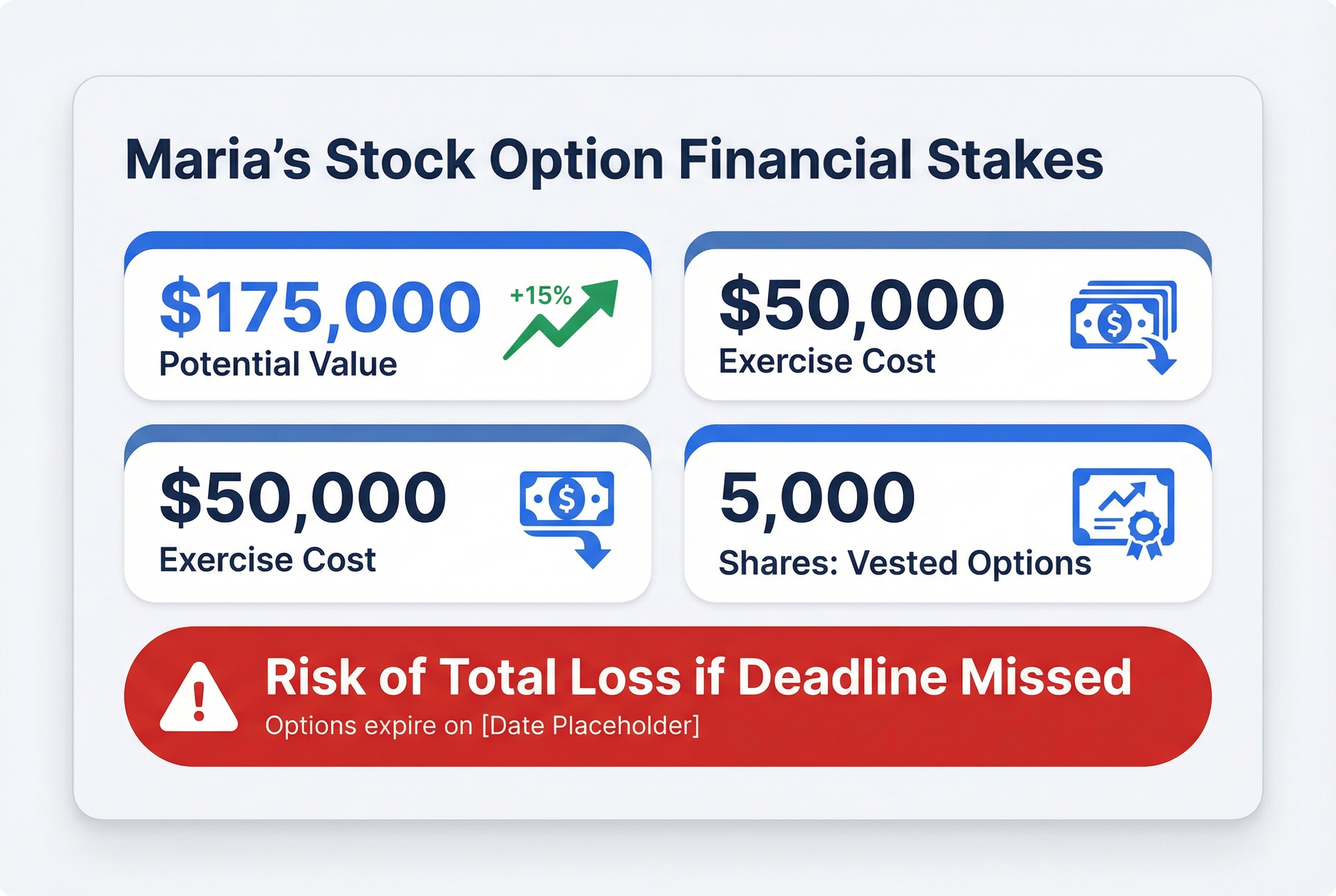 The immediate financial pressure: Maria faced needing $50,000 in cash to secure $175,000 in potential value before her options expired.
The Three Types of Expiration Deadlines You Need to Know
Think of your stock options like three different alarm clocks, each set for a different time. You need to know which one will ring first, because that's the deadline that actually matters.
Here are the three types of expiration deadlines:
1. Original Grant Term (Usually 10 Years)
This is the maximum lifetime of your options. Most companies grant options that expire 10 years from the grant date. If you stay at the company and keep your options the whole time, this is your final deadline.
2. Post-Termination Exercise Period (Usually 90 Days)
This is the most urgent deadline. When you leave your company for any reason, you typically have just 90 days to exercise your vested options. After that, they vanish. This deadline overrides the 10-year term.
3. Vesting Expiration
Options must vest before you can exercise them. If you leave before options vest, they disappear immediately. You can only exercise the options that have already vested.
Here's a simple comparison:
| Deadline Type | Typical Timeframe | When It Applies |
|---|---|---|
| Original Grant Term | 10 years from grant | If you stay at the company |
| Post-Termination Period | 90 days after leaving | As soon as you quit or get laid off |
| Vesting Deadline | 25% per year (4 years total) | Ongoing while employed |
The Earliest Deadline Wins
Let me show you how this works with a real example.
James received 10,000 stock options on January 1, 2020, with a $20 strike price. His options vest 25% per year. Here are his three deadlines:
- Original term: January 1, 2030 (10 years out)
- Vesting deadline: The last 2,500 options vest on January 1, 2024
- Post-termination period: 90 days after he leaves
If James stays at the company until 2030, he can exercise all 10,000 options anytime before January 1, 2030.
But if James leaves in March 2023, everything changes. Only 7,500 options have vested by then (3 years × 2,500 per year). The other 2,500 unvested options disappear immediately. And he must exercise those 7,500 vested options by June 2023, not 2030.
Your grant agreement lists your exact deadlines. The dates in your paperwork are what count, not the typical timeframes.
Now let's look at that 90-day post-termination deadline more closely, because it catches more people off guard than any other expiration rule.
Stock Option Agreement Explained: Terms You NEED to Know
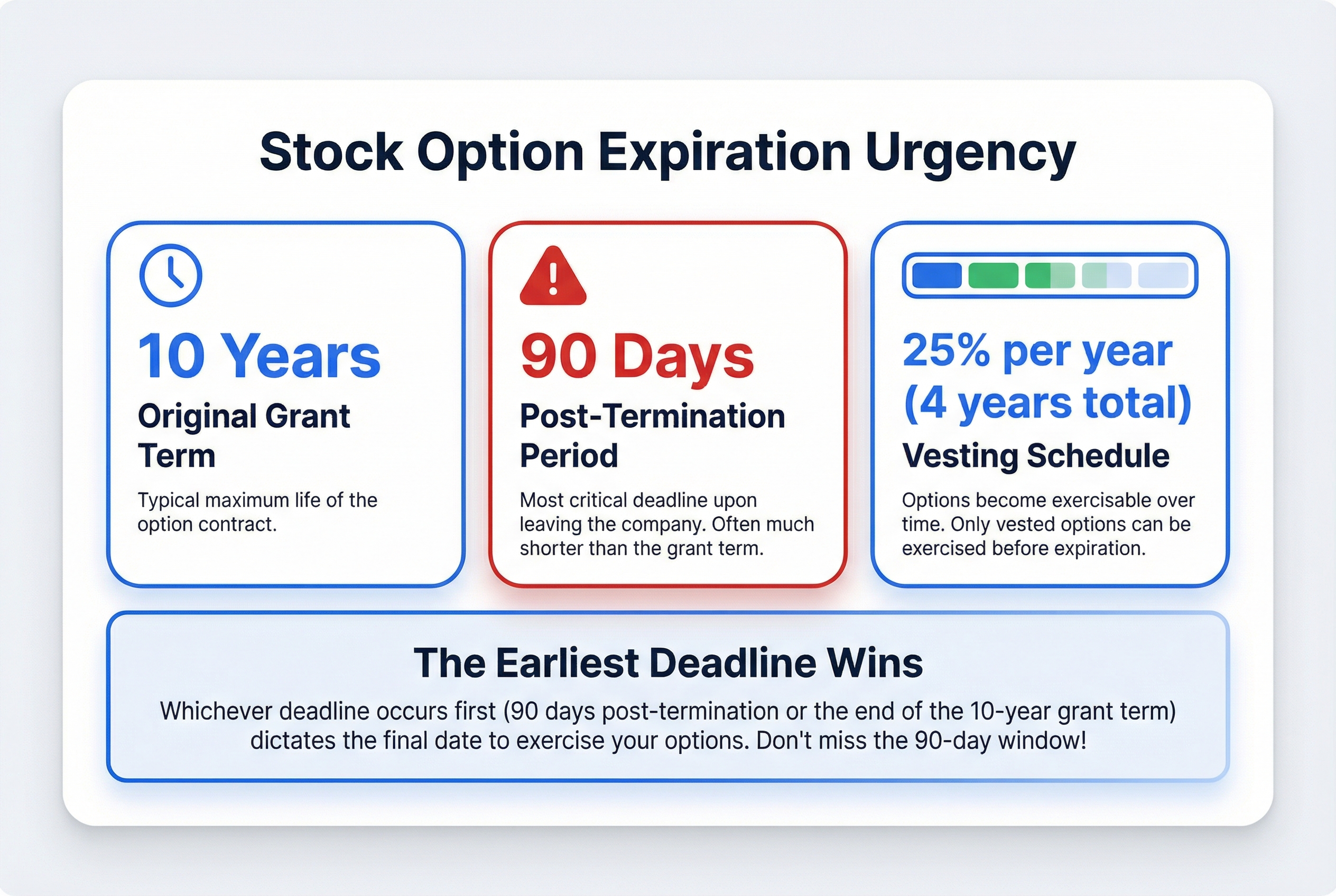 The three clocks governing your options: The 90-day post-termination window often overrides the 10-year grant term.
The 90-Day Post-Termination Deadline: The Most Dangerous Expiration
Think of your post-termination exercise period like a parking meter that starts running the second you leave your job. You can't add more time once it expires. And unlike a parking ticket, the penalty isn't a $50 fine. It's losing options that could be worth hundreds of thousands of dollars.
Here's the standard rule: Most companies give you 90 days to exercise your vested stock options after you leave. Some companies are stricter and only give 30 days. A few generous companies (like Coinbase and Cloudflare) give up to 10 years. But 90 days is what you should expect.
The clock starts ticking on your last official day of employment. Not when you receive your termination paperwork. Not when you clean out your desk. Your actual last day on the company's payroll.
What Counts as Leaving
The 90-day countdown starts whether you:
- Quit for a new job
- Get laid off
- Get fired
- Leave for any other reason (except death, disability, or retirement, which have special rules we'll cover later)
It doesn't matter if you left on good terms or bad terms. The clock starts either way.
The Sarah Example: A $280,000 Decision in 90 Days
Sarah was laid off on March 1, 2024. She has 8,000 vested stock options with a $15 strike price. The company stock trades at $50 per share.
Her deadline: May 30, 2024 at 5:30 PM.
To exercise all her options, she needs $120,000 in cash (8,000 shares x $15 strike price). If she exercises, she'll own stock worth $400,000. That's a profit of $280,000 on paper.
But here's the brutal part: if she doesn't have the cash or misses the deadline, those options become worthless on May 31. All $280,000 of potential value disappears.
Here's how fast 90 days passes:
- March 1 (Day 0): Last day of work. The meter starts.
- April 1 (Day 31): One month gone. 59 days left.
- May 1 (Day 61): Two months gone. Less than 30 days left.
- May 30 (Day 90): Final deadline at 5:30 PM. After this, options expire.
Critical Details That Catch People Off Guard
Weekends and holidays count. Your 90 days includes Saturdays, Sundays, and company holidays. If day 90 falls on a weekend, your deadline might be the Friday before. Check your stock plan documents.
You can only exercise vested options. If you have 10,000 total options but only 6,000 have vested, you can only exercise those 6,000. The unvested 4,000 disappear immediately when you leave.
You need actual cash. Unlike RSUs that automatically convert to shares, you must pay the strike price in cash to exercise options. Sarah needs to wire $120,000 to the company or stock plan administrator. Credit cards don't work. Payment plans don't exist.
Most people underestimate how quickly 90 days passes, especially when you're job hunting or dealing with the stress of a layoff. The deadline sneaks up fast.
Now let's look at the other end of the timeline: the 10-year maximum term that applies even if you never leave your company.
The 10-Year Grant Term: Your Longest (But Not Infinite) Deadline
Stock options come with an expiration date stamped on them from day one. For most employee stock options, that date is exactly 10 years from the grant date.
Think of it like a gift card that expires in 10 years. When you first get it, a decade feels like forever. But time passes, and eventually that expiration date arrives. If you haven't used the gift card by then, it becomes worthless. Same with your options.
The 10-Year Clock Starts Immediately
The countdown begins on your grant date, not when your options vest.
Let's say you receive options on January 15, 2024. They expire on January 15, 2034. Period. It doesn't matter that they vest over four years. It doesn't matter if you stay at the company the entire decade. The 10-year clock is ticking from day one.
Here's How It Works in Real Life
David received 12,000 stock options on June 15, 2015, with a $25 strike price. The options vested over four years, fully vested by June 2019. The expiration date: June 15, 2025.
Fast forward to 2024. David is still at the company. The stock trades at $100 per share. His options are worth $900,000 in profit: 12,000 × ($100 - $25).
But here's the problem. If he doesn't exercise by June 15, 2025, they become worthless. All $900,000 vanishes.
Exercising requires planning. David needs $300,000 in cash (12,000 × $25) to buy the shares. Plus, he'll owe taxes on the $900,000 gain.
David sets two calendar reminders: June 2024 (one year before expiration) and March 2025 (three months before). This gives him time to gather cash and plan for taxes.
Why Companies Set This Limit
Companies can't leave options outstanding forever. The 10-year term balances two goals: giving you plenty of time to benefit, while keeping the company's equity structure manageable.
For ISOs (Incentive Stock Options), special tax rules can actually shorten this period in certain situations. But the standard employee stock option? 10 years from grant date.
You Can Exercise Anytime (Once Vested)
The good news: you don't have to wait until year 10. Once your options vest, you can exercise them whenever you want before expiration. Year 2, year 5, year 9.5. Your choice.
The key is knowing your deadline and planning ahead. A 10-year deadline seems distant until it's not.
Now let's look at how vesting schedules interact with these expiration dates, because timing matters more than you might think.
How Vesting Schedules Affect Your Expiration Timeline
Vesting and expiration are two different clocks running at the same time. Vesting determines which options you can exercise. Expiration determines how long you have to exercise them.
Think of it like a subscription service. Each month, you unlock new features (vesting). But if you cancel your subscription (leave the company), you only keep what you've already unlocked. Everything still locked disappears instantly.
The Standard 4-Year Vesting Schedule
Most companies use the same basic schedule:
- Year 1 (the cliff): Nothing vests for 12 months, then 25% vests all at once
- Years 2-4: The remaining 75% vests monthly (about 2% per month)
Here's what this looks like in practice.
Rachel received 20,000 options on January 1, 2022, with a $30 strike price. Her vesting schedule:
Year 1 cliff:
- January 1, 2023: 5,000 options vest (25%)
Years 2-4:
- February 1, 2023 through January 1, 2026: 416 options vest each month (5,000 per year / 12 months)
Now let's say Rachel leaves on July 1, 2024. She's been at the company for 2.5 years. Here's what she has:
- Year 1 cliff: 5,000 vested options
- Year 2: 5,000 vested options (12 months x 416)
- Year 3 (partial): 2,500 vested options (6 months x 416)
- Total vested: 12,500 options
- Total forfeited: 7,500 unvested options
If the stock is at $70, Rachel has $500,000 in potential profit from her vested options (12,500 x $40 gain per share). But she loses $300,000 in potential profit from the unvested options that disappeared.
She now has 90 days to decide what to do with those 12,500 vested options.
The Critical Rule About Unvested Options
When you leave a company, unvested options vanish immediately. No grace period. No partial credit for the current month. They're just gone.
Only your vested options enter the post-termination exercise period. Only vested options can expire in 90 days (or whatever your deadline is).
How to Track Your Vesting Progress
You can see exactly how many options have vested in your equity compensation portal (like E*TRADE, Fidelity, or Schwab). Look for:
- Total options granted
- Options vested to date
- Next vesting date
- Vesting schedule details
Remember: vesting only continues while you're employed. The day you leave, the vesting clock stops permanently.
Now that you understand how vesting affects which options you can exercise, let's look at what actually happens when an expiration deadline arrives.
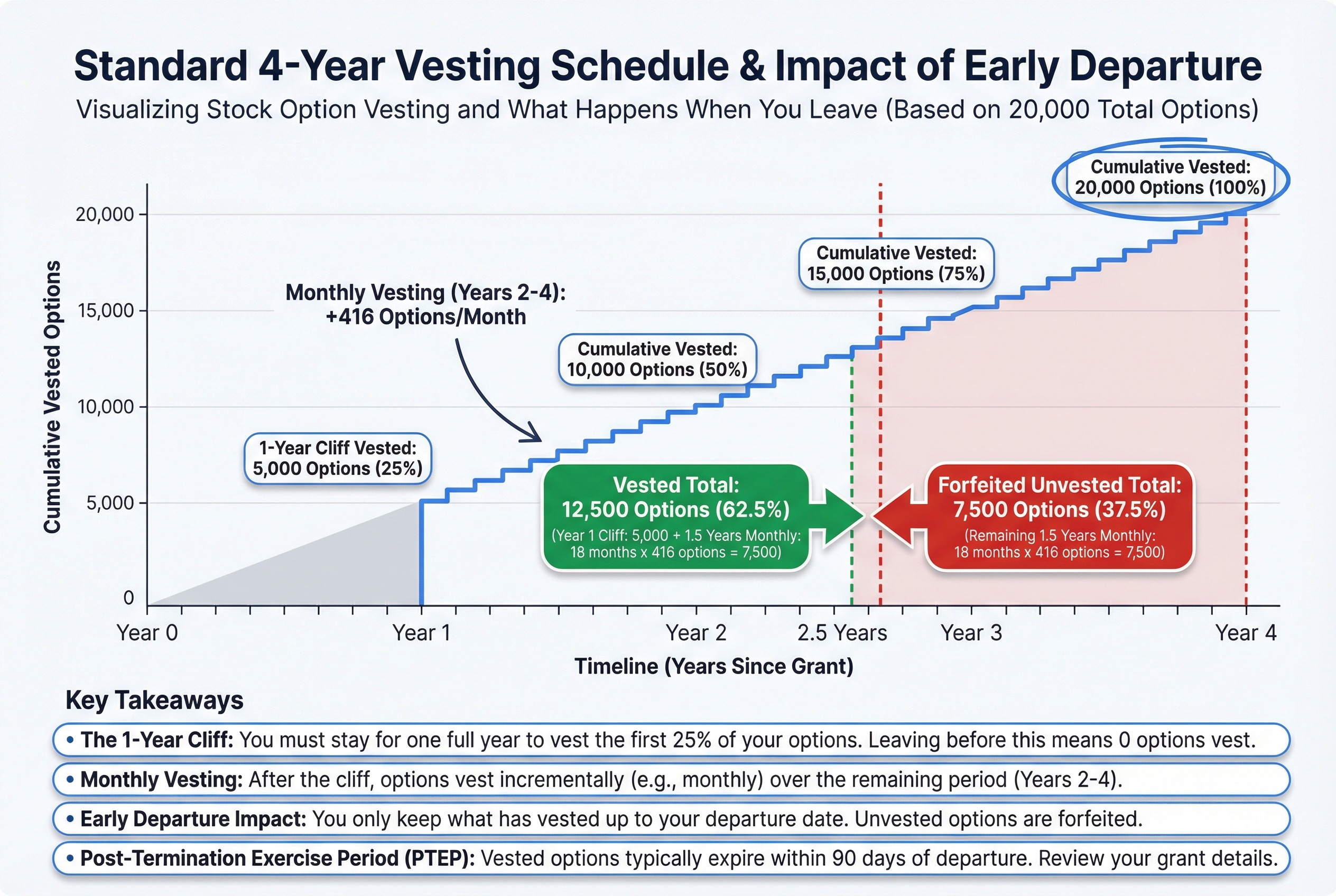 Vesting determines what you own; expiration determines how long you have to keep it.
What Happens at 5:30 PM on Expiration Day (The Exact Mechanics)
Think of option expiration like a store that closes at 5:30 PM sharp. The doors lock at exactly 5:30 PM Eastern Time. If you show up at 5:31 PM, you're out of luck. The store doesn't care that you were stuck in traffic or forgot your wallet. Once those doors lock, your options are gone forever.
The Critical Timeline
Employee stock options expire at 5:30 PM Eastern Time on the expiration date. This is 90 minutes after the stock market closes at 4:00 PM. You have that extra time to make your final decision and submit your exercise instructions.
Here's what happens during those final hours:
- By 4:00 PM ET: The stock market closes. The final closing price determines if your options are in-the-money or out-of-the-money.
- 4:00 PM to 5:30 PM: You have 90 minutes to notify your company or broker that you want to exercise. Most companies require you to log into your equity portal and submit an exercise request.
- 5:30 PM ET sharp: Expiration deadline passes. No more actions possible. Your options either get exercised or disappear.
What Happens to Your Options
Your options fall into one of three categories at expiration:
In-the-money options (stock price above strike price): Some companies automatically exercise these for you. Others require you to take action before 5:30 PM. Check your plan documents. Don't assume anything.
Out-of-the-money options (stock price below strike price): These expire worthless automatically. No action needed. You lose nothing because they had no value anyway.
At-the-money options (stock price exactly equals strike price): These almost always expire worthless. Even if the stock closes at exactly your strike price, there's no profit to capture.
A Real Example: Tom's Expiration Day
Tom has 3,000 stock options expiring on Friday, June 14, 2024. His strike price is $40 per share. Here's how his day unfolds:
4:00 PM: The stock market closes. Final price is $65 per share. Tom's options are in-the-money by $25 per share. His total potential profit is $75,000 (3,000 options × $25 profit per share).
5:00 PM: Tom logs into his company's equity portal. He submits exercise instructions for all 3,000 options. He confirms he has $120,000 in his bank account to cover the exercise cost (3,000 options × $40 strike price).
5:15 PM: Tom receives a confirmation email that his exercise request was received and will be processed.
5:30 PM: Expiration deadline passes. Tom's exercise goes through. He'll own 3,000 shares by Monday.
What if Tom's situation was different? If he had options with a $70 strike price instead, they'd be out-of-the-money. The stock closed at $65, which is below his $70 strike price. Those options would expire worthless automatically. Tom would do nothing.
If the stock closed exactly at $40 (his strike price), his options would be at-the-money. These would also expire worthless because there's no profit to capture.
The Notification Process
Most companies require you to take one of these actions before 5:30 PM:
- Log into your equity compensation portal and submit an exercise request
- Call your broker or stock plan administrator with verbal instructions
- Email a signed exercise form (check if your company accepts this)
- Submit a cashless exercise request through your portal
Don't wait until 5:29 PM. Systems can be slow. Portals can crash. Aim to submit your exercise request by 5:00 PM to give yourself a buffer.
The Auto-Exercise Wild Card
Some companies automatically exercise in-the-money options at expiration. Others don't. This policy varies by company and sometimes by option type (ISOs vs. NSOs).
If your company auto-exercises, they'll typically exercise all options that are at least $0.01 in-the-money. But you still need to have enough cash in your account to cover the exercise cost and taxes.
Don't rely on auto-exercise. Confirm your company's policy in writing. If you want to exercise, submit your own request before 5:30 PM.
After the deadline passes, you move into the settlement process. But that 5:30 PM cutoff is absolute. Miss it, and your options vanish, even if they were worth thousands of dollars.
Special Expiration Rules: Death, Disability, Retirement, and M&A
Think of standard expiration deadlines like a store's regular return policy. You get 30 days. But what about special circumstances? Most stores give you longer during the holidays or if you received a gift. Stock option plans work the same way. When life throws a curveball (death, disability, retirement, or your company gets bought), different rules kick in.
These special rules usually give you more time or immediate value. But "usually" is the key word. Every company's plan is different, and you need to check your specific stock plan document.
When Someone Dies
If you pass away with vested options, your beneficiaries don't get stuck with the standard 90-day deadline. Most plans give them 12 months to exercise. Some generous plans even allow three years.
Here's a real example: Lisa's spouse Mark passed away with 15,000 vested options. Strike price: $20 per share. Current stock price: $55. The standard post-termination period is 90 days, but the death provision gives Lisa 12 months to exercise.
Why this matters: Lisa needs $300,000 to exercise (15,000 shares x $20). The profit is $525,000 (15,000 x $35 gain per share). That 12-month window gives her time to gather the cash and plan for the massive tax bill. With only 90 days, she might have had to let valuable options expire.
If You Become Disabled
Most plans treat disability like death. You typically get one year to exercise your vested options instead of 90 days. This gives you time to focus on your health and figure out your finances without panic.
The definition of "disability" varies by plan. Some use the same definition as Social Security. Others have their own criteria. Check your plan document.
When You Retire
Retirement can trigger special treatment, but only if you meet specific requirements. Most plans define retirement as reaching a certain age (like 55 or 65) and having worked at the company for a minimum number of years (often 5 or 10).
If you qualify, you might get:
- Extended exercise periods (sometimes several years instead of 90 days)
- Continued vesting of unvested options for a limited time
- The full 10-year grant term to exercise
If you don't meet the age and service requirements? You're treated like any other termination. You get the standard 90-day window.
When Your Company Gets Acquired
Mergers and acquisitions (M&A) flip the script. Instead of getting more time, you often get less time but more options.
Many plans include "acceleration" clauses. When the company is acquired, your unvested options suddenly vest. It's like getting all your loyalty rewards points at once instead of waiting.
Here's how this plays out: Mike has 10,000 options. Strike price: $35 per share. Current stock price: $80. Of those 10,000 options, only 6,000 have vested. The other 4,000 are still unvested.
When his company gets acquired, his plan includes "single-trigger acceleration." All 10,000 options vest immediately. Sounds great, right?
The catch: He must exercise within 30 days of the acquisition closing. Mike suddenly has $450,000 in profit potential (10,000 shares x $45 gain per share). But he needs $350,000 in cash within 30 days to exercise.
Without acceleration, Mike would have lost the $180,000 from those 4,000 unvested options (4,000 x $45). With acceleration, he keeps it all. But only if he can come up with the money fast.
Not All Acquisitions Are the Same
Some acquisitions give you choices:
- Exercise your options for cash (you get the difference between strike price and acquisition price)
- Roll your options into the acquiring company's stock (keeps the clock running)
- Let them expire if the acquisition price is below your strike price (your options are "underwater")
The acquiring company decides which option you get. You usually don't have a choice.
The Fine Print Matters
Every company's plan handles these situations differently. Some are generous. Others are stingy.
Where to find your specific rules:
- Your stock plan document (search for "death," "disability," "retirement," or "change in control")
- Your equity compensation team or HR
- Your most recent grant agreement
Don't assume your plan works like your friend's plan at another company. The differences can cost you hundreds of thousands of dollars.
Now that you understand how special circumstances change the rules, let's talk about how to find your exact expiration dates for every option you own.
How to Find Your Exact Expiration Dates (Step-by-Step)
Finding your option expiration dates is like checking your passport before booking a flight. You need to know where to look and what you're looking for. The good news? Your dates are waiting for you in two places: your equity portal and your original grant agreements.
Step 1: Log Into Your Equity Compensation Portal
Your company uses one of these platforms to manage stock options:
- E*TRADE
- Schwab (formerly Morgan Stanley)
- Fidelity
- Carta
- Shareworks
Log in with your company credentials. If you've never logged in, check your email for the welcome message from when you got your grant.
Step 2: Navigate to Your Holdings or Grants
Look for tabs labeled "My Grants," "Holdings," "Equity Awards," or "Stock Plan." This is where all your option grants live.
Step 3: Review Each Grant's Details
Each grant shows four critical pieces of information:
- Grant date: When you received the options
- Vesting schedule: When shares become exercisable
- Expiration date: Your final deadline
- Shares vested: How many you can exercise right now
Real Example: Jennifer's Search
Jennifer logs into her E*TRADE equity portal to find her expiration dates.
Step 1: She clicks "Stock Plan" then "Holdings."
Step 2: She sees three grants listed:
- Grant A (1/1/2020, 5,000 shares, expires 1/1/2030)
- Grant B (1/1/2021, 8,000 shares, expires 1/1/2031)
- Grant C (1/1/2022, 10,000 shares, expires 1/1/2032)
Step 3: She clicks on Grant A and sees all 5,000 shares are fully vested.
Step 4: She downloads her original grant agreement PDF. It confirms the 1/1/2030 expiration date and notes the 90-day post-termination provision.
Step 5: She sets calendar reminders for 1/1/2029 (1 year before), 7/1/2029 (6 months before), and 10/1/2029 (3 months before) to review her options and make a decision.
Find Your Grant Agreements
Your grant agreements are the legal source of truth. They're usually PDFs sent when you first received your options. Check your email or the "Documents" section of your equity portal.
These agreements spell out every rule: expiration dates, post-termination deadlines, and special provisions for retirement or disability.
Set Up Your Alert System
Once you know your dates, create a safety net:
- One year before expiration: Start thinking about your strategy
- Six months before: Get serious about your decision
- Three months before: Make your final choice and prepare to act
Use your phone's calendar, Google Calendar, or Outlook. Set the reminders to repeat annually so you never forget.
If You Left the Company
Calculate your 90-day deadline from your last day of employment. This overrides the 10-year expiration for unvested options. Mark this date in red. It's the most dangerous deadline you'll face.
Can't Find Your Information?
Contact your company's stock plan administrator. Their email is usually in your equity portal's help section. They can send you grant statements and clarify any confusing dates.
Now that you know exactly when your options expire, you need to understand one more hidden deadline that catches thousands of employees off guard each year.
The Hidden Expiration Trap: The $100,000 ISO Limit
Here's an expiration deadline most people don't know exists. ISOs (incentive stock options) have a hidden $100,000 annual limit that can turn your tax-advantaged ISOs into regular NSOs without warning.
Think of it like a bucket that can only hold $100,000 worth of water per year. Any ISOs that overflow that bucket automatically become NSOs, which means worse tax treatment.
How the $100,000 Limit Works
The IRS limits how much in ISOs can vest in any single calendar year. The limit is based on the strike price value, not the current stock price.
Here's what counts toward your limit:
- The calculation uses your strike price times the number of shares vesting
- The limit applies per calendar year (January 1 to December 31)
- Options that push you over $100,000 are automatically reclassified as NSOs
- The reclassification follows grant order (first grants stay ISOs, later grants become NSOs)
Example: You have 15,000 ISOs with a $10 strike price vesting on January 1. That's $150,000 worth vesting (15,000 x $10). Only the first 10,000 shares ($100,000 worth) remain ISOs. The other 5,000 shares become NSOs, even though they were granted as ISOs.
The M&A Acceleration Trap
This limit becomes a huge problem during acquisitions. When your company gets acquired, all your unvested options often accelerate and vest immediately.
Let's look at what happened to Carlos:
Carlos's situation:
- Has 30,000 ISOs with a $10 strike price
- Normal vesting: 7,500 shares per year over 4 years
- Year 1: 7,500 shares vest = $75,000 worth (all stay ISOs)
- Year 2: 7,500 shares vest = $75,000 worth (all stay ISOs)
Then the acquisition happens in year 3:
- All remaining 15,000 shares accelerate and vest immediately
- Value vesting: 15,000 x $10 = $150,000
- Problem: Only $100,000 worth (10,000 shares) can vest as ISOs in one year
- The remaining $50,000 worth (5,000 shares) are reclassified as NSOs
The Tax Impact Carlos Didn't Expect
By the time Carlos exercises his options, the stock is worth $80 per share. Here's what the reclassification cost him:
The 10,000 shares that stayed ISOs:
- Gain per share: $70 ($80 current price minus $10 strike price)
- If he holds them long enough: taxed at 23.8% long-term capital gains rate
- Total tax on 10,000 shares: about $166,000
The 5,000 shares reclassified as NSOs:
- Same $70 gain per share
- Taxed as ordinary income at exercise: 37% federal rate plus state taxes
- Total tax on 5,000 shares: about $129,000 (federal only)
The difference: Carlos paid an extra $33,000 in federal taxes on those 5,000 shares because they were reclassified as NSOs. He didn't realize this had happened until he got his tax forms the following year.
Why This Matters for Your Exercise Strategy
You can't prevent the reclassification. It happens automatically based on IRS rules. But knowing about it changes how you should plan:
- Check your vesting schedule before any M&A announcement
- Calculate how much will vest in the acquisition year
- Understand which options will become NSOs (your later grants get reclassified first)
- Plan your exercise timing differently for ISOs versus NSOs
The $100,000 limit doesn't make your options expire. But it does create a hidden deadline for ISO tax benefits that most people miss.
Now let's look at what actually happens if you do miss a deadline, and the specific steps you can take to avoid it.
Best ISO guide for Beginners | Avoid these 7 TRAPS
What Happens If You Miss the Deadline (And How to Avoid It)
Missing your option expiration deadline is like missing your flight. Once that plane takes off, your ticket becomes worthless. It doesn't matter if you paid $1,000 for it or if you were only five minutes late. The plane is gone.
Your stock options work the same way. Miss the deadline by even one day, and they expire worthless. Forever.
The Brutal Reality: Total Loss
When your options expire, you lose everything. Not some of the value. All of it.
If your options were worth $500,000, that $500,000 disappears at 5:30 PM on your deadline day. The next morning, you own nothing. The company keeps the shares. You get zero.
There are no second chances. No appeals. No exceptions for "I didn't know" or "I was going through a hard time."
Why Companies Can't Make Exceptions
This might seem harsh, but companies are legally required to enforce these deadlines. The IRS sets strict rules about stock option expiration. If a company lets you exercise late, your options could lose their tax status. The company could face penalties.
So even if your HR team feels bad for you, they can't help. The deadline is absolute.
How Alex Lost $600,000
Alex left his job on March 1 with 12,000 vested options. His strike price was $25. The stock traded at $75. His 90-day deadline was May 30.
Here's what happened:
March: Alex was busy starting his new job. He put off thinking about his options.
April: He knew he needed to decide but thought he had plenty of time. He'd deal with it "soon."
May 15: Alex finally did the math. He needed $300,000 to exercise (12,000 shares x $25). The potential profit was $600,000 (12,000 shares x $50 gain).
May 25: He scrambled to get a loan. Banks said they needed more time to process it. Five days wasn't enough.
May 30: Deadline day. Alex still didn't have the money. His options expired at 5:30 PM.
May 31: His options were worthless. Alex lost $600,000 in potential value.
The worst part? If Alex had set calendar reminders on March 1, he would have had 90 full days to explore financing, save money, or sell stock from his new company. He just needed to start early.
Common Reasons People Miss Deadlines
You might think "I'd never forget something worth hundreds of thousands of dollars." But it happens all the time.
Here's why:
"I didn't know the exact date." Many people know they have 90 days but don't calculate the specific deadline. They think "sometime in May" instead of "May 30 at 5:30 PM."
"I couldn't get the cash together." Exercising options costs real money upfront. If you wait until the last minute, you won't have time to get a loan, sell other assets, or save up.
"I thought I had more time." 90 days sounds like a lot. But when you're starting a new job or dealing with life changes, three months disappears fast.
"I was waiting for the stock to go higher." Some people gamble that the stock will jump before their deadline. Then they run out of time.
"I got overwhelmed and froze." When the numbers are big and the decision is complex, some people just avoid it. Avoidance leads to missed deadlines.
Your Prevention Checklist
The good news? Missing deadlines is 100% preventable. You just need a system.
Use this checklist the day you leave your company or get your option grant:
Immediate actions (Day 1):
- Calculate your exact expiration date
- Set three calendar alerts: 30 days before, 14 days before, 7 days before
- Add the deadline to your phone calendar with notifications
- Write the deadline on a physical calendar you see daily
- Calculate how much cash you need to exercise
Within the first 30 days:
- Tell a family member or friend about your deadline for accountability
- Research financing options (personal loan, stock option loan, home equity line)
- Consult a financial advisor or tax professional
- Review your budget to see if you can save enough money
30 days before deadline:
- Make your final decision: exercise or let them expire
- If exercising, confirm you have the money or financing lined up
- Contact your company's stock plan administrator to understand the process
- Ask about payment methods and processing time
7 days before deadline:
- Double-check the exact deadline time (usually 5:30 PM Eastern)
- Confirm your payment method works
- Have a backup plan if something goes wrong
Think of these reminders as insurance. They cost you nothing but could save you hundreds of thousands of dollars.
The Stakes Are Real
We've seen people lose $50,000. We've seen people lose $500,000. The amount doesn't matter to the deadline. It treats everyone the same.
Don't let yourself become another cautionary tale. Set your reminders today. Start planning early. Treat your expiration deadline like the hard stop it is.
Now that you know what happens if you miss the deadline, let's talk about what to do before your options expire. The next section gives you a complete action plan.
Your Action Plan: What to Do Before Your Options Expire
Think of managing option expiration like a NASA countdown. Astronauts don't wait until T-minus 10 seconds to check their systems. They start months in advance with detailed checklists. You need the same approach.
Here's your timeline-based action plan.
12 Months Before Expiration
Start planning now if you have time. This is when you gather information and explore options.
Action items:
- Calculate your exercise cost (
number of options × strike price) - Calculate your potential profit (
number of options × (current stock price - strike price)) - Check your cash situation. Can you afford to exercise?
- Schedule a meeting with a financial advisor
- Research exercise-and-sell financing if you don't have cash
- Start learning about tax implications
At this stage, you're just gathering facts. No decisions yet.
6 Months Before Expiration
Now you start making real plans.
Action items:
- Meet with a CPA to estimate your tax bill
- Get pre-approved for financing if you need it
- Decide which options you'll exercise (maybe not all of them)
- Create a preliminary plan for what you'll do with shares
- Set calendar reminders for 3 months, 1 month, and 1 week out
This is when you turn information into a strategy.
3 Months Before Expiration
Time to finalize your decision.
Action items:
- Make your final decision: exercise or let expire
- If exercising, confirm your funding source
- Review all paperwork requirements
- Double-check your expiration date (mistakes happen)
- Set aside money for taxes if exercising
Don't change your plan after this unless something major happens with the stock.
1 Month Before Expiration
Execute your plan.
Action items:
- Submit exercise paperwork to your company
- Confirm loan funding if using financing
- Verify everything is processing correctly
- Contact HR if anything seems unclear
Never wait until the last week. Systems fail. Paperwork gets lost. You need buffer time.
Real Example: Diana's Countdown
Diana has 20,000 options expiring in 12 months. Strike price: $30. Current stock price: $85.
12 months out: She calculates she needs $600,000 to exercise (20,000 × $30). If she exercises, she'll have stock worth $1.7 million (20,000 × $85). That's $1.1 million in profit. She meets with a financial advisor.
6 months out: She researches exercise-and-sell financing and gets pre-approved for a loan. She consults a CPA who estimates a $350,000 tax bill. Reality check: she can't afford to exercise all 20,000 options.
3 months out: She decides to exercise 10,000 options using a loan and hold the stock. She'll let the other 10,000 expire because she can't afford to exercise them all. It's painful, but it's better than doing nothing.
1 month out: She submits exercise paperwork for 10,000 shares, confirms loan funding, and sets aside money for taxes.
1 week out: She verifies everything is processing correctly.
Expiration day: Her 10,000 shares are exercised successfully. She captured $550,000 in value (10,000 × $55 profit).
Yes, she lost potential value on the other 10,000 options. But she made an informed decision based on her financial situation and had time to execute properly.
Your Decision Framework
Ask yourself these questions in order:
- Can I afford to exercise? If no, explore financing or plan to let them expire.
- Do I believe the stock will go higher? If yes, consider exercising and holding. If no, consider exercise-and-sell.
- Can I handle the tax bill? If no, you may need to sell some shares immediately to cover taxes.
- What's my backup plan if something goes wrong? Always have one.
Where to Get Help
You don't have to figure this out alone.
Financial advisors: Look for fee-only advisors who specialize in equity compensation. They can help you model different scenarios.
CPAs and tax professionals: Essential for understanding your tax bill. Find someone who knows equity comp, not just general taxes.
Your company's stock plan administrator: They can clarify deadlines, exercise procedures, and paperwork requirements. They can't give financial advice, but they know the mechanics.
Estate planning attorneys: If you're dealing with expiration after death or disability, you need legal help.
Final Pre-Expiration Checklist
Before your deadline, confirm:
- You know your exact expiration date and time
- You've calculated exercise cost and tax bill
- You have funding arranged (cash or loan)
- You've submitted all required paperwork
- You've received confirmation from your company
- You have a plan for the shares after exercise
The biggest mistake is waiting until the last minute. Start your countdown early. Give yourself time to make good decisions and fix problems if they arise.
Your options represent real money. Treat the expiration deadline with the seriousness it deserves.
Frequently Asked Questions
[ANSWER NEEDED]
[ANSWER NEEDED]
[ANSWER NEEDED]
[ANSWER NEEDED]
[ANSWER NEEDED]
[ANSWER NEEDED]
[ANSWER NEEDED]
[ANSWER NEEDED]
Educational Content Only
This content is for educational purposes only and does not constitute financial advice. The information provided is general in nature and may not appl...
YourEmployeeStock.com is not a registered investment advisor.
Related Articles
ESPP Tax Rules: A Simple Guide to What You'll Owe (With Examples)
ESPP taxes confuse even smart employees because the rules change based on how long you hold your shares. This guide walks you through the two types of sales (qualifying vs. disqualifying), shows you exactly what you'll owe with real examples, and helps you avoid the most common costly mistakes.
BasicsEquity Compensation Basics: A Simple Guide to Understanding Your Stock Benefits
Equity compensation means getting paid partly in company stock instead of just cash. This guide breaks down what equity compensation is, the main types you'll encounter (RSUs, stock options, ESPP), how it affects your total pay, and what you need to know to make smart decisions about your stock benefits.
ESPPHow ESPP Works: Your Complete Guide to Employee Stock Purchase Plans
An Employee Stock Purchase Plan (ESPP) lets you buy your company's stock at a discount, usually 10-15% off. This guide explains how ESPP works from enrollment through selling shares, including the tax rules that determine how much money you keep. You'll learn the exact steps, see real dollar examples, and discover strategies competitors don't share.
Not sure what to do with your equity?
Get a free personalized analysis