

Stock Option Exercise Taxes: A Simple Guide to What You'll Owe
Everything you need to know about taxes when exercising ISOs and NSOs
Published March 14, 2026 · Updated March 14, 2026
Exercising stock options triggers different taxes depending on whether you have ISOs or NSOs, and what you do with the shares afterward. This guide breaks down exactly what you'll owe, when you'll owe it, and how to avoid surprise tax bills with real-world examples and simple explanations.
The Tax Surprise That Catches Everyone Off Guard
Meet Sarah, a software engineer at a public tech company. She has 1,000 stock options with a $10 strike price. The stock just hit $50 per share. She does the math: pay $10,000, get $50,000 worth of stock. That's a $40,000 gain, right?
Sarah exercises all her options in January, excited about her windfall. Then April arrives. Her accountant drops the bad news: she owes $14,000 in taxes. Sarah only has $3,000 in her savings account. She never sold the stock, so she has no cash to pay the bill.
This happens to thousands of employees every year. Stock options create taxes at two different moments: when you exercise (buy the shares) and when you sell them. Think of it like buying a house. You pay property taxes when you own it, then capital gains taxes when you sell it. Both events trigger separate tax bills.
Here's what makes stock options extra confusing: the type of option completely changes your tax treatment. You might have Incentive Stock Options (ISOs) or Non-Qualified Stock Options (NSOs). Same company, same stock price, but wildly different tax consequences.
With NSOs, you pay regular income tax the moment you exercise. The IRS treats your gain like a bonus. With ISOs, you might pay nothing at exercise, or you might trigger the Alternative Minimum Tax (AMT), a parallel tax system most people have never heard of.
The timing of when you sell matters enormously. Sell too soon after exercising ISOs? You lose the tax break. Hold too long during a stock price drop? You might owe taxes on gains that disappeared.
Your tax bill can actually exceed your cash gain if you exercise and the stock price later crashes. You can owe money on phantom gains you never actually received.
Let's break down exactly how each type of option gets taxed, starting with the key difference between ISOs and NSOs.
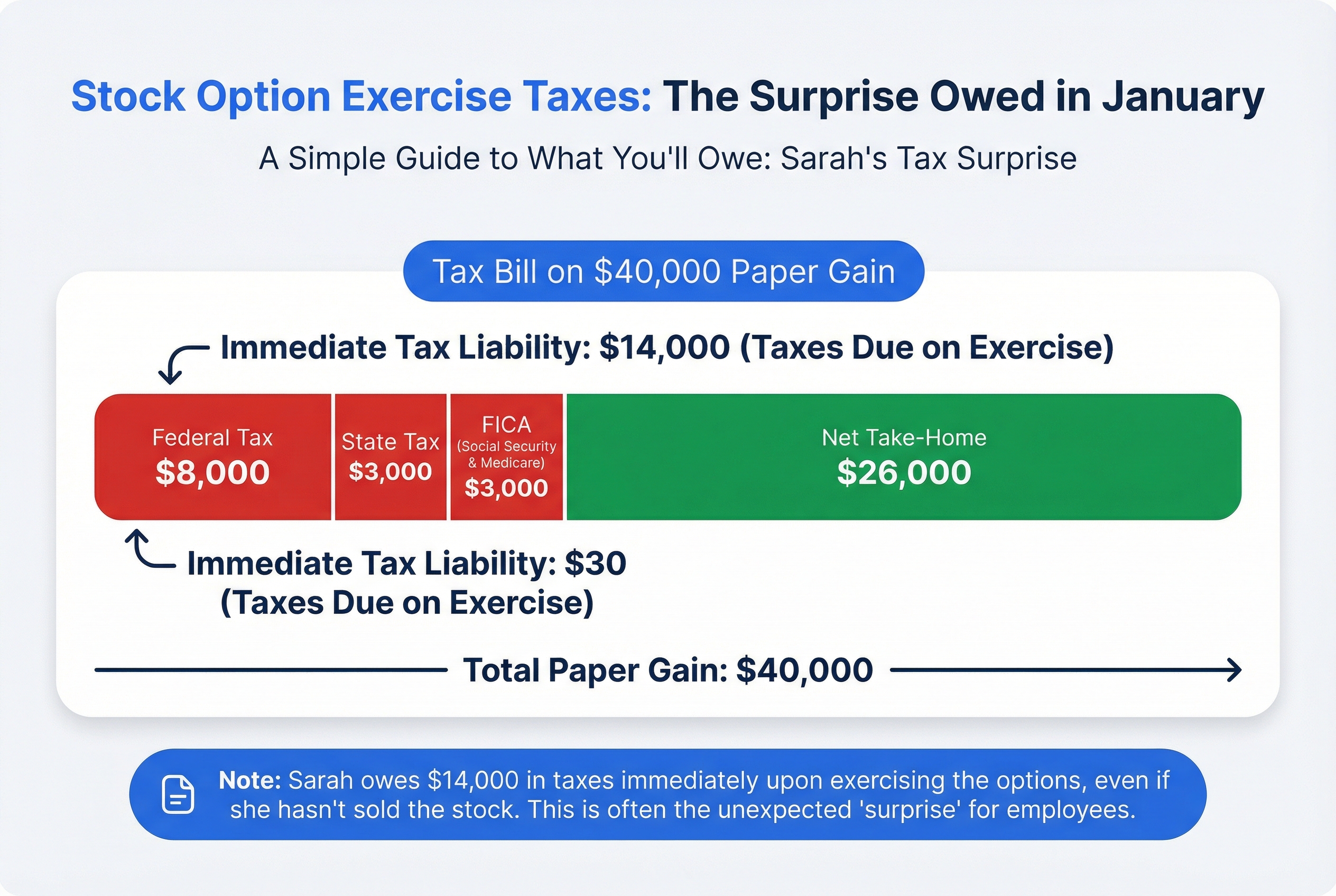 The Cash Crunch: Even without selling, exercising options can trigger a large, immediate tax bill.
ISO vs NSO: The Two Types That Change Everything
Your stock options fall into one of two buckets: Incentive Stock Options (ISOs) or Non-Qualified Stock Options (NSOs). The difference between them can cost you tens of thousands of dollars in taxes on the exact same exercise.
Think of ISOs like a Roth IRA and NSOs like a regular paycheck. ISOs have special rules and restrictions, but follow them correctly and you might pay zero tax at exercise. NSOs are simpler but get taxed as regular income immediately, just like your salary.
Here's the key difference:
| Feature | ISOs | NSOs |
|---|---|---|
| Tax at exercise | Potentially $0 (AMT risk exists) | Taxed as ordinary income immediately |
| Who can get them | Employees only | Employees, contractors, advisors |
| Rules to follow | Strict requirements | Few restrictions |
| Potential savings | Can save 20-37% in taxes | No special tax treatment |
How to tell which type you have: Look at your grant documents. They'll clearly state "Incentive Stock Option" or "Non-Qualified Stock Option." If you're a contractor or board member, you automatically have NSOs (ISOs are only for employees).
Here's what the difference looks like in real dollars:
James and Maria both exercise 1,000 options. Their strike price is $20 per share. The current stock price is $50. They're both exercising $20,000 worth of options on stock now worth $50,000.
James has ISOs. At exercise, he pays $0 in regular income tax. (He might face AMT, which we'll cover later, but no immediate tax bill.)
Maria has NSOs. She immediately owes income tax on her $30,000 gain ($30 profit per share x 1,000 shares). At a 35% tax rate, that's $10,500 due when she files taxes next April. Plus payroll taxes of about $2,300. Her total tax bill: $12,800.
Same exercise. $12,800 difference in taxes owed.
Now let's break down exactly how NSO taxes work.
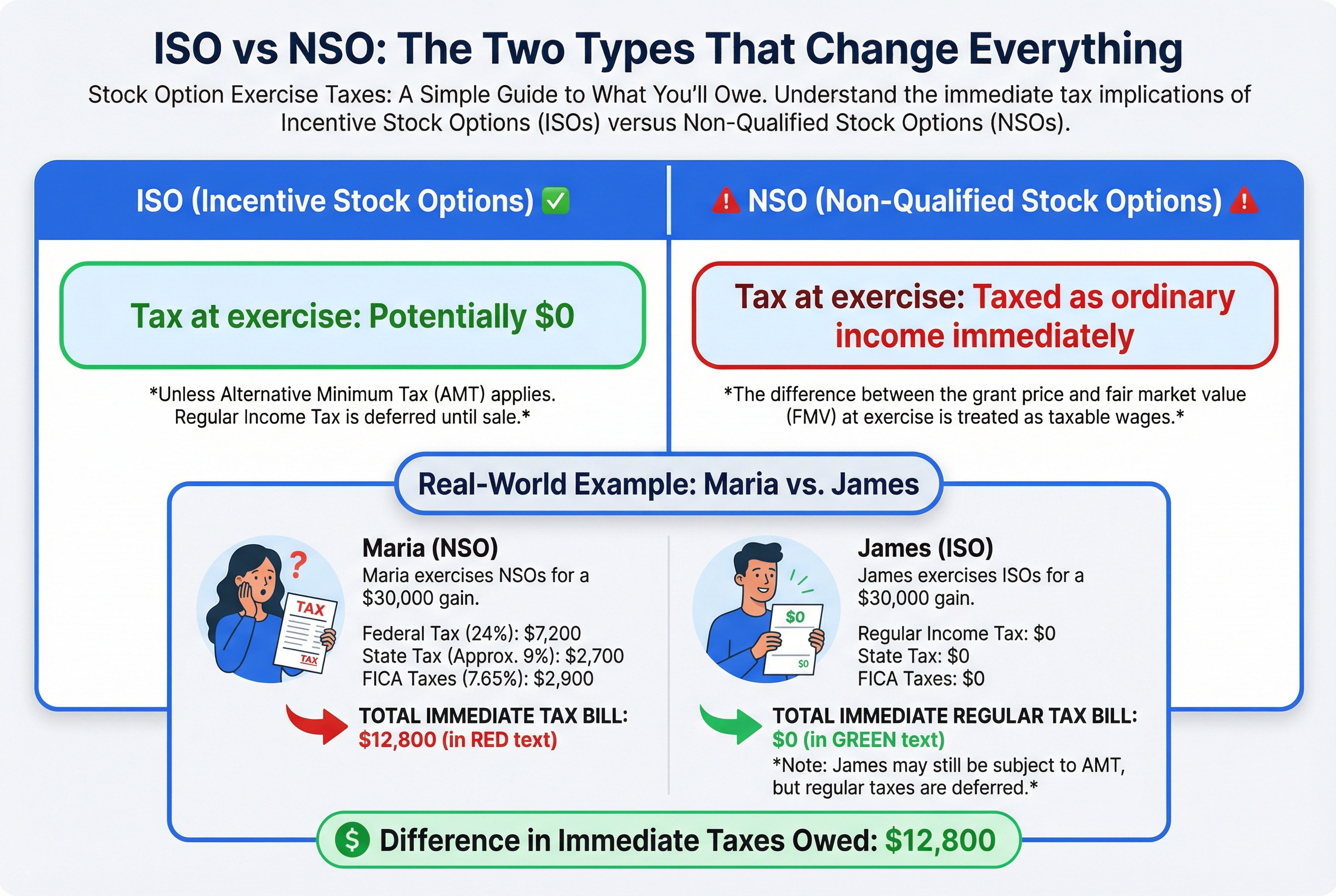 ISO vs NSO: The critical difference in tax timing upon exercise.
NSO Exercise Taxes: The Straightforward (But Expensive) Path
When you exercise NSOs, the IRS treats you like you just got a cash bonus at work. That's the simplest way to think about it.
The moment you exercise, you owe taxes on the "spread." That's the difference between what you pay (your strike price) and what the shares are worth today.
Here's the math:
Current share price: $40
Your strike price: $15
Spread per share: $25 ($40 - $15)
If you exercise 2,000 options, your spread is $50,000 (2,000 × $25). The IRS considers that $50,000 as ordinary income, just like your salary.
What You'll Actually Pay
You pay two types of taxes on that spread:
Federal income tax: Your normal tax rate. For most people exercising significant options, that's 22% to 37%.
FICA taxes: Social Security (6.2%) and Medicare (1.45%). That's 7.65% total on the spread.
Let's say you're in the 32% federal bracket. Your total tax hit is roughly 39.65% (32% + 7.65%).
On that $50,000 spread, you owe about $19,825 in taxes.
Two Ways to Handle the Tax Bill
Exercise-and-hold: You keep the shares after exercising. You need $30,000 to buy the shares (2,000 × $15 strike price). Plus you'll owe $19,825 in taxes come April. That's nearly $50,000 out of pocket.
Exercise-and-sell: You sell the shares immediately. Your broker withholds the taxes automatically and sends you what's left. You'd net about $30,175 ($50,000 spread minus $19,825 taxes).
The Withholding Reality
Your company typically withholds taxes when you exercise, usually around 22% federal plus 7.65% FICA. That's 29.65% total.
But here's the catch: if you're in a higher tax bracket (say, 35%), that automatic withholding won't cover your full bill. You'll owe more when you file your tax return.
This is why many people choose to sell at least enough shares to cover the full tax hit. Otherwise, you're betting your own cash that the shares will go up enough to justify the tax bill.
The good news? Unlike ISOs (which we'll cover next), there are no surprise tax traps with NSOs. You pay once at exercise, and you're done with this part of the tax story.
ISO Exercise Taxes: The Potential Tax Break (With a Catch)
Here's the good news about ISOs: when you exercise them, you don't owe ordinary income tax. Zero. Unlike NSOs, there's no immediate 40%+ tax hit.
But before you celebrate, there's a catch. A big one.
Meet the Alternative Minimum Tax (AMT)
Think of AMT like a parallel tax system running in the background. The IRS calculates your taxes two ways: the regular way and the AMT way. You pay whichever is higher.
It's like having two GPS routes to the same destination. You don't get to choose the faster one. You're stuck with whichever takes longer.
AMT was designed to catch high earners who use too many deductions. But it also catches people who exercise large ISO grants, even if they're not wealthy.
How ISOs Trigger AMT
When you exercise ISOs, the spread (current share price minus strike price) gets added to your AMT income. This is called an AMT preference item.
Here's a real example:
You exercise 3,000 ISOs with a $10 strike price when shares are worth $35. Your spread is $25 per share, which equals $75,000 total.
For regular tax: $0 due at exercise.
For AMT: That $75,000 spread gets added to your income. If you already earn $200,000 in salary, your AMT income jumps to $275,000. This could trigger $20,000 or more in AMT.
You won't owe ordinary income tax, but you might owe AMT instead. Many people exercise ISOs expecting zero taxes and get blindsided by a massive AMT bill.
Who Gets Hit With AMT?
You're more likely to trigger AMT if you:
- Earn over $150,000 per year
- Exercise a large number of ISOs in one year
- Live in a high-tax state like California or New York
- Have other AMT preference items (like state tax deductions)
A general rule: if your ISO spread exceeds your annual salary, expect AMT.
The Holding Period Requirements
To get the full ISO tax benefit (long-term capital gains rates when you sell), you must hold the shares for:
- Two years from the grant date, AND
- One year from the exercise date
Miss either deadline and your ISOs become taxed like NSOs. All that AMT planning goes out the window.
Think of it like a savings bond that only pays the full interest if you hold it long enough. Cash it early and you lose the benefit.
The Bottom Line
ISOs offer a real tax advantage, but AMT is the price of admission. The next section breaks down exactly how to calculate whether you'll owe AMT and how much.
The AMT Trap: When Your ISO Tax Break Becomes a Tax Bill
Here's the cruel irony of ISOs: the tax break that makes them special can trigger a completely different tax system that costs you thousands.
It's called the Alternative Minimum Tax (AMT). Think of it like a shadow tax system running parallel to regular taxes. You calculate your taxes both ways, and the IRS makes you pay whichever number is higher. It's like being charged for a hotel room even when you sleep in your car.
How AMT Hits ISO Exercises
When you exercise ISOs, your regular taxes ignore the spread. That's the good news. But AMT treats that spread as income.
Here's what happens:
- You calculate regular taxes (ISO spread = $0 income)
- You calculate AMT (ISO spread = taxable income)
- You pay whichever is higher
AMT has its own rates: 26% on the first $220,000 of AMT income, then 28% above that. Not terrible, but not zero either.
The AMT Exemption (And Why It Disappears)
AMT gives you an exemption before it kicks in. For 2024:
- $85,700 if you're single
- $133,300 if you're married
Sounds generous, right? The catch: this exemption phases out as your income climbs. High earners often lose most or all of it.
A Real Example
You earn $180,000 at your tech job. You exercise ISOs with a $100,000 spread (10,000 shares at $10 strike, current FMV $20).
Regular tax calculation:
- Income: $180,000
- ISO spread: $0 (ISOs don't count)
- Tax owed: ~$35,000
AMT calculation:
- Regular income: $180,000
- Add ISO spread: $100,000
- AMT income: $280,000
- After exemption phase-out: AMT = ~$52,000
You pay $52,000 (the higher number). That's an extra $17,000 just because you exercised ISOs.
The Silver Lining: AMT Credit
That extra $17,000 doesn't vanish forever. It becomes an AMT credit you can use in future years when your regular tax exceeds your AMT.
Think of it like this: you're prepaying taxes. When you eventually sell those ISO shares (and pay regular capital gains tax), you'll likely get that $17,000 credit back. It reduces your future tax bills.
Multi-year example:
- Year 1: Exercise ISOs, pay $17,000 extra AMT, earn $17,000 credit
- Year 2: Normal year, no AMT, credit sits waiting
- Year 3: Sell ISO shares, owe $30,000 in regular taxes, use your $17,000 credit, actually pay only $13,000
You get the money back, but it can take years. And if you never have a year where regular tax exceeds AMT, you might never use the full credit.
Will You Trigger AMT?
High-risk situations:
- You earn over $150,000 and exercise ISOs with a spread over $50,000
- You exercise ISOs worth more than your annual salary
- You're married, both earn high incomes, and either of you exercises ISOs
Lower-risk situations:
- You earn under $100,000 and exercise small amounts
- Your ISO spread is under $30,000
- You have lots of deductions (mortgage interest, state taxes)
The brutal truth: if you work at a successful tech company and exercise a meaningful number of ISOs, you'll probably owe AMT. The math almost always works against you.
Why This Catches People Off Guard
Your company's equity dashboard shows your ISOs are worth $200,000. You think "I'll exercise and pay nothing until I sell!" Then April arrives with a $40,000 AMT bill.
The ISO tax break is real, but AMT takes a big bite out of it. You're not avoiding taxes. You're just paying a different tax at a different rate.
Now let's look at what happens when you actually sell those shares, because that's when the second tax event hits.
Stock Compensation Tax Traps & How to Avoid Them | RSUs, Stock Options, and Performance Shares
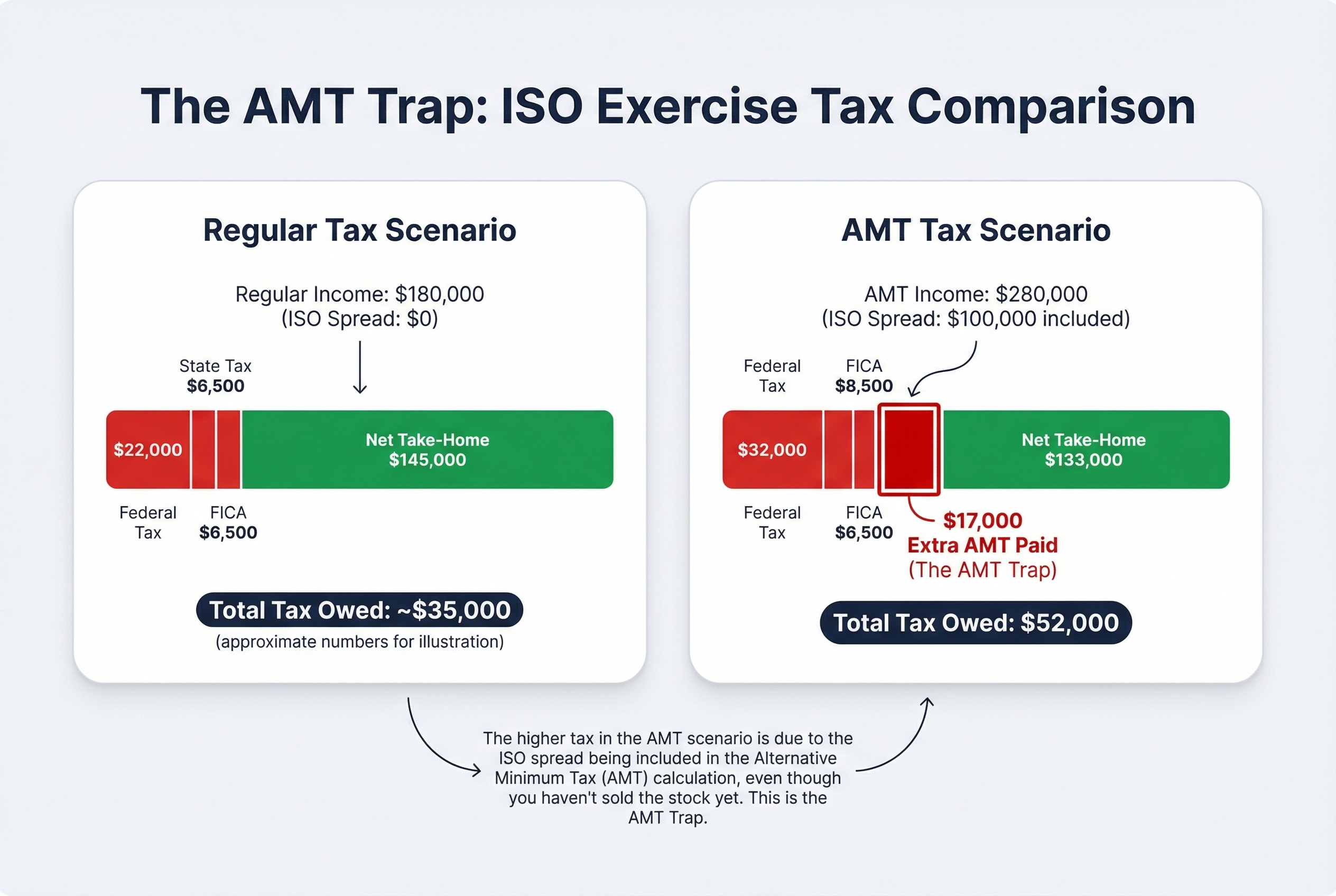 The AMT Trap: Why your ISO spread is taxed under the parallel AMT system.
Taxes When You Sell: The Second Tax Event
Exercising your options triggers one tax bill. Selling the shares you got triggers another.
Think of it like selling a house. You pay capital gains tax on your profit (sale price minus what you paid). How long you owned it determines your tax rate.
Short-Term vs Long-Term: The Rate Difference
Your holding period starts the day after you exercise. The clock matters because the tax rates are wildly different:
Short-term gains (held 1 year or less):
- Taxed as ordinary income
- Same rates as your salary: 22%, 24%, 32%, 35%, or 37%
- No tax benefit for waiting
Long-term gains (held over 1 year):
- Taxed at preferential rates
- Most people pay 15%
- High earners pay 20%
- Low earners pay 0%
The difference is huge. A $50,000 gain could cost you $18,500 in short-term taxes (37% bracket) or $7,500 in long-term taxes (15% rate). That's $11,000 saved just by waiting.
NSO Shares: Your Cost Basis Includes Taxes Already Paid
Here's where NSOs give you a break. Remember that spread you paid ordinary income tax on at exercise? That becomes part of your cost basis.
Example: You exercised 100 NSO shares at a $20 strike price when the stock was worth $40. You paid ordinary income tax on the $2,000 spread ($20 × 100 shares).
Your cost basis is $40 per share, not $20. You already paid tax on that first $20 of gain.
One year later, you sell at $60 per share. Your profit for capital gains purposes is $20 per share ($60 - $40), not $40.
Your tax bill:
- Capital gain: $2,000 ($20 × 100 shares)
- Long-term rate: 15%
- Tax owed: $300
Total taxes paid across both events: Ordinary income tax on $2,000 at exercise (around $740 if you're in the 37% bracket) plus $300 now = $1,040 total.
ISO Shares: Your Cost Basis Is Just the Strike Price
ISOs work differently. If you meet the holding requirements (covered in the next section), your cost basis is only your strike price.
Example: You exercised 100 ISO shares at a $20 strike price when the stock was worth $40. You paid AMT on the $2,000 spread.
Eighteen months later, you sell at $60 per share (this is a qualifying disposition). Your profit is $40 per share ($60 - $20).
Your tax bill:
- Capital gain: $4,000 ($40 × 100 shares)
- Long-term rate: 15%
- Tax owed: $600
Total taxes paid: AMT on $2,000 at exercise (around $560 at 28% AMT rate) plus $600 now = $1,160 total.
Notice the ISO total is higher because you pay capital gains tax on the full spread, not just the gain after exercise.
The Wash Sale Trap
If your stock drops after you exercise and you sell at a loss, watch out for wash sale rules. If you buy the same stock within 30 days before or after selling, you can't claim the loss.
This catches people who exercise, sell immediately, then buy more shares through their ESPP or 401(k). The IRS considers that a wash sale.
But what if you sell your ISO shares too early and trigger a disqualifying disposition? That changes everything about how your taxes work.
The Disqualifying Disposition: When ISOs Lose Their Special Status
ISOs come with special tax benefits, but only if you follow the rules. Break the rules, and you lose the benefits. It's like having a VIP pass that expires if you leave the concert early.
A disqualifying disposition means you sold your ISO shares before meeting both required holding periods. When this happens, your ISOs get taxed like regular NSOs. You lose the preferential tax treatment you were hoping for.
The Two Holding Periods You Must Meet
To keep your ISO tax benefits, you need to hold your shares for:
- At least 2 years from the grant date (when you received the options)
- At least 1 year from the exercise date (when you bought the shares)
You must satisfy BOTH requirements. Miss either one, and it's a disqualifying disposition.
Timeline example: You received ISOs on January 1, 2022. You exercised them on January 1, 2024. To qualify for special ISO tax treatment, you must hold the shares until at least January 2, 2026 (2 years from grant, 1 year from exercise).
What Changes When You Disqualify
When you sell too early, the tax treatment switches to NSO rules:
- The spread at exercise (FMV minus strike price) becomes ordinary income
- You pay your regular income tax rate on this amount (22%, 32%, or higher)
- Any additional gain or loss is treated as capital gains
- Your company reports the ordinary income portion on your W-2
Think of it like this: you had a coupon for 50% off, but you didn't read the fine print. Now you pay full price.
A Real Example: The Cost of Selling Early
Let's say you received ISOs on January 1, 2022 with a $25 strike price. You exercised on January 1, 2024 when the stock was worth $60. The spread was $35 per share.
To get the ISO tax break, you need to hold until January 2, 2026. But the stock keeps climbing, and you get nervous. You sell on July 1, 2024 at $70 per share.
What you owe on this disqualifying disposition:
- Ordinary income: $35 spread (taxed at 32% = $11,200)
- Short-term capital gains: $10 additional gain ($70 sale price minus $60 FMV at exercise, taxed at 32% = $3,200)
- Total tax: $14,400
If you had waited for a qualifying disposition:
- Long-term capital gains: $45 total gain ($70 minus $25 strike, taxed at 15% = $6,750)
- Total tax: $6,750
Selling early cost you $7,650 in extra taxes. That's more than double.
When Breaking the Rules Actually Makes Sense
Sometimes a disqualifying disposition is the smart move. Here are scenarios where selling early might save you money:
The stock dropped after exercise. Say you exercised at $60 FMV but the stock fell to $40. Selling now triggers a disqualifying disposition, but you'll report a loss that reduces your tax bill. If you wait and the stock keeps falling, you could lose even more.
You need the cash urgently. Medical emergency, down payment on a house, or other critical need. The tax hit might be worth it to access your money now.
You're leaving the company. You might have only 90 days to exercise before your options expire. If you can't afford to hold for both periods, selling early is better than losing the options entirely.
How to Report a Disqualifying Disposition
Your company tracks when you sell ISO shares. If you trigger a disqualifying disposition, they will:
- Add the ordinary income portion to your W-2 in Box 1
- Include it in your Social Security and Medicare wages
- Withhold payroll taxes on that amount
You'll report the sale on Schedule D of your tax return, just like any stock sale. Your tax software will ask if this was a disqualifying disposition and adjust your cost basis accordingly.
Important: Your cost basis increases by the amount reported as ordinary income. This prevents you from being taxed twice on the same money. In our example, your cost basis becomes $60 (the FMV at exercise), not $25 (your strike price).
The Bottom Line on Disqualifying Dispositions
Breaking the holding period rules costs you real money in most cases. But the tax code doesn't penalize you beyond converting your ISO tax treatment to NSO treatment. You're not paying a fine, you're just losing a benefit you didn't fully earn.
Before you sell ISO shares, check your grant date and exercise date. Calculate what you'll owe under both scenarios. Sometimes waiting a few more months can save you thousands of dollars.
Next, we'll look at another complication that affects employees at public companies: lock-up periods and insider trading rules that might prevent you from selling even when you want to.
Lock-Up Periods and Insider Trading Rules: The Public Company Complications
Your company just went public. The stock price looks amazing. You're ready to exercise and sell.
Not so fast.
Lock-up periods are like a mandatory waiting room after your company goes public. Everyone has to sit there before they can leave (sell their shares). This waiting period typically lasts 180 days, about six months.
Here's the problem: You can exercise options during the lock-up period. You just can't sell the shares. This creates a brutal cash crunch.
The Lock-Up Cash Trap
Let's say your company goes public on March 1, 2024. You have 5,000 ISOs with a $15 strike price. On IPO day, the stock opens at $45. Lock-up expires September 1, 2024.
You exercise on March 15 when the stock hits $50:
- Exercise cost: $75,000 ($15 x 5,000 shares)
- AMT triggered: ~$45,000 on the $35 spread (due April 2025)
- Total cash needed: $120,000
- Shares you can sell: Zero until September 1
You need $120,000 in cash while holding shares you legally can't touch for six months. If the stock drops to $30 by September, you've paid $120,000 for shares now worth $150,000. But if it had dropped to $20, you'd be underwater.
Extra Rules for Insiders
If you're an executive, director, or own 10% of the company, you face additional restrictions:
Blackout periods prevent you from trading around earnings announcements. Think of these like special traffic laws that only apply to certain drivers. Typically, you can't trade for 2-4 weeks before earnings are released.
Form 4 filings must be submitted within two business days of any transaction. This is a public document. Everyone can see what you bought or sold.
Pre-clearance requirements mean you need approval from your legal team before any trade.
The 10b5-1 Plan Workaround
A 10b5-1 trading plan lets you set up automatic sales in advance. You decide today that you'll sell 1,000 shares on the first trading day of each quarter for the next year. Once the plan is active (usually after a 30-90 day cooling-off period), those sales happen automatically, even during blackout periods.
This removes the guesswork and legal risk. But you're locked into the schedule, even if the stock price tanks.
Why This Matters for Exercise Timing
These restrictions can force you to hold shares much longer than you planned. That extends your risk. The stock could drop between when you exercise and when you're finally allowed to sell.
The key question: Do you have enough cash to exercise AND pay taxes while waiting months to sell? If not, you might need to wait until after lock-up expires to exercise at all.
Now that you understand the restrictions on when you can sell, let's look at smart strategies for timing your exercise to minimize taxes.
Exercise Strategies: Timing Your Taxes Smartly
Choosing how to exercise your options is like choosing how to pay for a car. You can pay all cash upfront, finance part of it, or trade in your old car to cover the cost. Each approach has different upfront costs and long-term results.
You have four main choices when you exercise:
Hold (Don't Exercise Yet)
- Keep your options until later
- No cash needed today
- No taxes owed yet
- Risk: Stock price could drop before you exercise
Exercise-and-Hold
- Buy and keep all your shares
- Need cash for the exercise price AND taxes
- For ISOs: Could qualify for long-term capital gains later
- For NSOs: You own shares that could grow in value
Exercise-and-Sell-to-Cover
- Sell just enough shares to pay for everything
- No cash needed out of pocket
- Keep the remaining shares
- Taxes still owed on the spread (for NSOs) or AMT (for ISOs)
Exercise-and-Sell (Cashless)
- Sell all shares immediately
- Walk away with cash after taxes
- No ongoing stock risk
- Miss out if stock keeps rising
Real Numbers: The Same Options, Three Different Outcomes
You have 1,000 NSOs with a $30 strike price. Your company stock trades at $80 today.
Option 1: Exercise-and-Hold
- Pay $30,000 to buy the shares
- Owe ~$17,500 in taxes (35% tax rate on $50,000 spread)
- Total cash needed: $47,500
- You keep: 1,000 shares worth $80,000
Option 2: Exercise-and-Sell-to-Cover
- Sell 594 shares for $47,520
- This covers your $30,000 exercise cost and $17,500 tax bill
- Cash needed: $0
- You keep: 406 shares worth $32,480
Option 3: Exercise-and-Sell
- Sell all 1,000 shares for $80,000
- Pay $30,000 exercise cost and $17,500 taxes
- Cash needed: $0
- You keep: $32,500 cash and 0 shares
Notice that exercise-and-sell-to-cover and exercise-and-sell give you similar value ($32,480 vs $32,500). The difference is whether you want cash or shares.
Timing Moves That Save You Money
The January vs December Decision
Exercising in January instead of December pushes your tax bill back 15 months. You file taxes in April of the following year, so January 2024 exercises get reported in April 2025. December 2024 exercises also get reported in April 2025, but you had one less month to prepare.
For ISOs, this timing matters even more. If you exercise ISOs in January, you have until December 31st of the next year to decide whether to sell. That's almost two full years to watch the stock and make your choice.
Example: You exercise ISOs in January 2024. You can sell anytime through December 2025 and still have it count as a disqualifying disposition for 2024 taxes. But if the stock rises and you don't sell, you might qualify for long-term capital gains treatment in 2026.
The Year-End Scramble
Many people exercise in December because their options are expiring or they're leaving the company. But December exercises mean:
- Less time to gather cash for taxes
- Potential AMT surprises on ISOs (you won't know until you file in April)
- Tax forms that might not arrive until January, making filing harder
If you can exercise earlier in the year, you give yourself more options and less stress.
ISO Special Timing: The Two-Year Watch
For ISOs, when you exercise changes your potential tax savings. Remember, you need to hold shares for two years from the grant date AND one year from exercise to get long-term capital gains rates.
Let's say you were granted ISOs on March 1, 2023. You exercise them on June 1, 2024. To get the ISO tax break:
- You must hold until March 2, 2025 (two years from grant)
- You must hold until June 2, 2025 (one year from exercise)
- The later date wins, so you need to hold until June 2, 2025
If you exercise those same ISOs on January 15, 2024 instead, you only need to hold until March 2, 2025. Exercising earlier can shorten your required holding period.
Matching Strategy to Your Situation
Choose Exercise-and-Hold if:
- You have cash available and believe in the company
- You want maximum upside potential
- For ISOs: You want to try for long-term capital gains rates
- You can handle the risk of the stock dropping
Choose Exercise-and-Sell-to-Cover if:
- You want to keep some shares but lack cash
- You want to diversify (some cash, some stock)
- You're moderately bullish on the company
Choose Exercise-and-Sell if:
- You need the cash now
- You want to eliminate stock concentration risk
- You're worried about the stock price dropping
- You're leaving the company and need to exercise soon
Choose to Hold (Don't Exercise) if:
- You have time before expiration
- You think the stock might drop
- You don't have cash for an exercise-and-hold
- You're waiting to see how the company performs
Now that you understand your exercise options, let's talk about the things your HR department probably hasn't explained clearly.
What Your HR Department Won't Tell You (But Should)
Your HR team is great at explaining how stock options work. They'll walk you through vesting schedules, exercise windows, and how to use the stock plan portal. But here's what they won't tell you: they're not tax advisors, and the tax implications can be brutal.
Think of HR like a car salesman. They'll show you all the features of the car, but they won't warn you about insurance costs, maintenance bills, or how much you'll pay for parking. That's not their job. The same goes for your stock options.
The Withholding Gap Nobody Mentions
When you exercise NSOs, your company automatically withholds taxes. Sounds great, right? The problem: they typically withhold at 22% for federal taxes. If you're in the 32% or 35% tax bracket (which many option holders are), that's nowhere near enough.
Real example: David's HR told him his 10,000 vested options were worth $500,000 ($50 current price, $0 strike price). He exercised all NSOs at once using exercise and sell to cover. The broker withheld 22% ($110,000) for taxes. David received $390,000 cash and thought he was done.
April came, and his CPA delivered bad news. David's in the 35% federal bracket, plus 10% state tax. He actually owes $225,000 in taxes. After the $110,000 already withheld, he owes another $115,000. David had spent $300,000 of his $390,000 and now faced a six-figure tax bill he wasn't prepared for.
The AMT Black Hole
HR rarely mentions AMT when explaining ISOs. They'll tell you ISOs have "potential tax advantages" but not that exercising too many can trigger a parallel tax system that catches people completely off guard.
You can exercise ISOs in January, pay AMT in April, and then watch the stock price crater in June. Now you've paid tax on gains that vanished. HR won't warn you about this because it's a tax issue, not a plan administration issue.
The Bracket Jump Problem
Exercising all your options at once sounds efficient. One transaction, done. But it can push you from the 24% tax bracket straight into the 35% bracket.
Here's what that looks like in dollars:
- Exercise $200,000 worth of NSOs
- Your regular salary is $150,000
- Your total income for the year: $350,000
- You just jumped two tax brackets
The extra $200,000 gets taxed at your highest rate, not your average rate. That's a distinction HR won't explain.
The Cash Flow Crunch
If you want to exercise and hold your options (keep the shares instead of selling immediately), you need serious cash on hand. You'll need money for:
- The strike price (what you pay to buy the shares)
- Federal income tax (up to 37%)
- State income tax (0% to 13% depending on your state)
- Social Security and Medicare tax (7.65% on the first $160,200)
- AMT if you're exercising ISOs
Bottom line: You might need 50% to 60% of your exercise value in cash. Exercise $100,000 worth of options? Have $50,000 to $60,000 ready to cover everything.
HR won't mention this because they assume you'll do a cashless exercise (sell immediately to cover costs). But if you want to hold the shares for potential gains, the cash requirement shocks most people.
The Stock Price Volatility Risk
Your company's stock price can swing wildly. HR will show you today's price and calculate what your options are "worth." But that number can evaporate fast.
You exercise when the stock is at $100. You owe taxes on a $75 gain per share. Two months later, the stock drops to $60. You still owe taxes on that $75 gain, even though your shares are now worth less than you paid for them.
This isn't theoretical. It happened to thousands of employees during the dot-com crash and again during the 2008 financial crisis. HR won't bring this up because it's uncomfortable and outside their scope.
Questions to Ask Before You Exercise
Don't rely on HR for tax guidance. Here's your checklist:
Before any exercise:
- What tax bracket am I in this year?
- Will this exercise push me into a higher bracket?
- Is the automatic withholding enough to cover my actual tax bill?
- Do I have enough cash to cover taxes if I exercise and hold?
- Am I triggering AMT with this ISO exercise?
- What happens if the stock price drops after I exercise?
- Should I spread this exercise across multiple years?
The answer to all of these: Talk to a CPA or tax advisor who specializes in equity compensation. Yes, it costs money. But it's way cheaper than David's surprise $115,000 tax bill.
The Professional Advice Gap
Your company provides HR support for free. They don't provide tax advice. That's the gap that catches people.
A good tax professional will cost you $500 to $2,000 for a consultation on a large exercise. That feels expensive until you realize they might save you $20,000 or $50,000 in taxes through better timing and strategy.
HR can tell you the mechanics. A tax pro tells you the consequences.
Now that you know what HR won't tell you, let's look at the actual tax forms you'll receive and what they mean.
Tax Reporting: What Forms You'll See and What They Mean
Tax forms are like receipts for different transactions. Each one tells the IRS about a specific event with your stock options. You'll get different forms depending on what you did, and knowing which is which will save you headaches at tax time.
Form 3921: Your ISO Exercise Receipt
When you exercise ISOs, your company sends you Form 3921. It shows:
- How many shares you exercised
- Your strike price
- The fair market value on exercise date
- The date you exercised
Think of this as your AMT calculation worksheet. You need these numbers to complete Form 6251 (the AMT form) on your tax return. File this away carefully. You'll need it again when you sell the shares.
Form W-2: Where NSO Income Shows Up
NSO exercises appear right on your regular W-2 in Box 1 (wages). The income gets added to your salary automatically.
You'll also see disqualifying disposition income here. If you sold ISO shares too early, that income shows up in Box 1 too. Your company already withheld taxes on this amount.
Form 1099-B: Your Stock Sale Report
When you sell shares, your broker sends Form 1099-B. This form reports:
- Sale proceeds (how much you received)
- Cost basis (what the broker thinks you paid)
- Date of sale
Critical warning: The cost basis is often wrong for ISOs. Brokers don't know about your AMT adjustment.
The ISO Cost Basis Problem (With Real Numbers)
Here's where people lose money by overpaying taxes.
In 2024, you exercised 1,000 ISOs at a $20 strike price when shares were worth $60. In January 2025, you receive Form 3921 showing the exercise. You file your 2024 taxes and complete Form 6251 for AMT, reporting the $40,000 spread ($60 minus $20, times 1,000 shares). You paid AMT on that $40,000.
In 2025, you sell the shares for $80 each. In January 2026, you receive Form 1099-B showing proceeds of $80,000 but cost basis of $20,000. That's wrong. It doesn't include your AMT adjustment.
You must manually correct this on Form 8949. Your actual cost basis is $60,000 (because you already paid AMT on the difference between $20 and $60). Your taxable gain is only $20,000 ($80,000 minus $60,000), not $60,000.
If you don't fix this, you'll pay tax twice on the same $40,000.
Form 3922: For ESPP Purchases
If your company offers an Employee Stock Purchase Plan, you'll get Form 3922. It shows your ESPP purchases and the discount you received. This helps calculate whether you have a qualifying or disqualifying disposition.
Where Everything Goes on Your Return
Your tax return pulls all these forms together:
Form 1040 (your main return):
- NSO income flows through from W-2
- Stock sale gains go on Schedule D
Schedule D and Form 8949:
- Report all stock sales here
- Manually adjust ISO cost basis on Form 8949
- Short-term vs long-term gains get calculated
Form 6251:
- Calculate AMT for ISO exercises
- Report the spread between strike price and FMV
- Determine if you owe AMT
Common Mistakes That Cost Real Money
Wrong cost basis on ISOs. This is the number one error. People trust their 1099-B and pay tax twice on AMT amounts.
Forgetting to report ISO exercises. You exercised in December but forgot to complete Form 6251. Now the IRS thinks you owe AMT.
Mixing up short-term and long-term gains. You sold ISO shares 11 months after exercise (disqualifying disposition) but reported it as long-term. You paid the wrong tax rate.
Not reporting disqualifying dispositions. Your W-2 shows the ordinary income, but you also reported the full gain on Schedule D. You paid tax twice.
Your Tax Form Checklist
If you exercised ISOs:
- Form 3921 (from company)
- Form 6251 (you complete for AMT)
- Keep ISO exercise records until you sell
If you exercised NSOs:
- Form W-2 showing income (from company)
- No other special forms needed
If you sold shares:
- Form 1099-B (from broker)
- Form 8949 (you complete to adjust cost basis)
- Schedule D (you complete for gains/losses)
If you had a disqualifying disposition:
- Form W-2 showing ordinary income
- Form 1099-B for the sale
- Form 8949 to avoid double taxation
Keep Everything (Seriously)
Save all stock option forms for at least three years after you file. For ISOs, keep your Form 3921 and exercise records until you sell the shares, plus three years after that. You'll need them to prove your cost basis.
Think of these records like a home improvement receipt. You need proof of what you paid to show the IRS you don't owe tax on money you already spent.
Tax software can help with the basic reporting, but ISO cost basis adjustments often need manual entry. Many people hire a CPA for the year they first exercise ISOs or have a disqualifying disposition.
Now that you know what forms to expect and where the traps are, let's put together your complete action plan for exercising options smartly.
Your Action Plan: What to Do Before You Exercise
Planning an option exercise is like planning a home renovation. You need to know your budget, timeline, and potential surprises before you start. Otherwise, you might end up halfway through with no money to finish.
Here's your step-by-step checklist before you click that exercise button.
Calculate Your Total Cash Needs
First, figure out how much money you actually need. This isn't just the exercise price.
For NSOs:
- Exercise cost: Strike price x number of shares
- Tax withholding: Usually 22-37% of the spread (your employer withholds this)
- Total: Exercise cost + tax withholding
For ISOs:
- Exercise cost: Strike price x number of shares
- Potential AMT: Use an online calculator or ask a CPA
- Total: Exercise cost + AMT (if applicable)
Example: You want to exercise 5,000 ISOs at a $15 strike price. Current fair market value is $45 per share.
- Calculate the spread: $45 - $15 = $30 per share. Total spread: $30 x 5,000 = $150,000
- Estimate AMT: Use an online AMT calculator. It shows you might owe around $39,000 in AMT
- Check your cash: You need $75,000 to exercise (5,000 x $15) plus $39,000 for AMT = $114,000 total
- Verify lock-up periods: Check your grant agreement. No lock-up? You can sell anytime
- Check insider status: Are you an executive or director? If not, you probably have no trading restrictions
- Review your finances: You have $150,000 in savings and no high-interest debt. You can afford this
- Make your decision: Exercise in January. This gives you a full year to decide whether to sell before triggering a disqualifying disposition
- Set calendar reminders: Mark the dates when you hit the ISO holding periods (1 year from exercise, 2 years from grant)
- Create a filing system: Start a dedicated folder for all option-related documents
- Schedule a CPA appointment: Book time before tax season to review your situation
Use the Right Tools
Don't guess at your tax bill. Use these resources:
Free online calculators: Search for "AMT calculator" or "stock option tax calculator." They give you ballpark estimates.
Your company's stock plan administrator: Many offer tax estimation tools in their portal.
Tax software: Programs like TurboTax have ISO and AMT calculators built in.
Important: These tools give estimates, not exact numbers. They're good for planning, but a CPA gives you precision.
Red Flags That Mean Get Professional Help
Some situations are too complex to DIY. Consult a tax professional if:
- You're exercising ISOs worth more than $100,000 (the AMT gets complicated fast)
- You're exercising in the same year you got a big bonus, sold a house, or had other major income
- You're an executive or insider subject to trading restrictions
- You're considering early exercising unvested options
- Your company is about to go public or get acquired
- You live in a high-tax state like California or New York
- You're not a US citizen or resident
Think of it this way: If the tax bill might be five figures or more, spending $500-$1,000 on a CPA is cheap insurance.
Gather Your Documentation
Before you exercise, collect these documents:
From your employer:
- Original stock option grant agreement
- Current vesting schedule
- Fair market value on the date you plan to exercise
- Any lock-up or trading window information
For your records:
- Your most recent tax return
- Your current year-to-date income
- Other investment income or capital gains this year
- Your emergency fund balance
Keep everything. You'll need these details when you file taxes and when you eventually sell the shares.
Real-World Example: Two Different Outcomes
Sarah's smart approach: Sarah wanted to exercise 3,000 ISOs (strike $20, FMV $60). She followed the checklist:
- Calculated her spread: $40 x 3,000 = $120,000
- Used an AMT calculator: Estimated $31,000 AMT
- Checked her cash: Had $95,000 available (enough for $60,000 exercise + $31,000 AMT, with cushion)
- Verified no lock-up or insider restrictions
- Scheduled a CPA appointment before exercising
- Her CPA caught that she'd already had high income this year and recommended waiting until January
- She waited, exercised in January, and spread her tax burden across two years
- Total saved by planning: Around $8,000 in unnecessary AMT
Mike's rushed approach: Mike exercised 3,000 ISOs in December without planning:
- Didn't calculate AMT beforehand
- Got hit with a $35,000 AMT bill at tax time
- Only had $40,000 in savings (he'd used $60,000 to exercise)
- Had to put his tax bill on a credit card at 18% interest
- Paid $6,300 in credit card interest over the next year
- Total cost of not planning: $6,300 in avoidable interest, plus stress
The difference? Sarah spent two hours and $400 on a CPA consultation. Mike spent nothing on planning and paid for it later.
Your Pre-Exercise Timeline
Here's when to do what:
3-6 months before exercising:
- Review your grant agreement and vesting schedule
- Start tracking the stock price
- Build up your cash reserves
- Research AMT and holding period rules
1-2 months before:
- Use online calculators to estimate your tax bill
- Decide if you need a CPA (if exercising significant amounts, you do)
- Check for any company trading windows or blackout periods
- Verify your current fair market value
2-4 weeks before:
- Confirm you have enough cash for exercise price plus taxes
- Set up your brokerage account if you don't have one
- Review your overall financial situation one more time
- Make sure you're not about to need this cash for something else
1 week before:
- Double-check all calculations
- Verify the exercise process with your stock plan administrator
- Set calendar reminders for important tax dates
- Prepare your filing system
Day of exercise:
- Save all confirmation emails and forms
- Screenshot the fair market value on that date
- Note the exact date in your calendar
- File everything in your dedicated folder
Questions to Ask Yourself
Before you pull the trigger, answer these honestly:
Can I afford this? Do you have enough cash for the exercise and the taxes without touching your emergency fund?
Am I doing this for the right reasons? Are you exercising because it makes financial sense, or just because the options are about to expire?
Do I understand the tax consequences? Can you explain to a friend what taxes you'll owe and when?
What's my plan after exercising? Will you hold the shares for favorable tax treatment? Sell immediately? Sell some and hold some?
What if the stock drops? Can you stomach losing money on this, or will it keep you up at night?
Have I considered my whole financial picture? Do you have high-interest debt? Enough in your 401(k)? An emergency fund?
If you can't answer these questions confidently, you're not ready to exercise yet.
Don't Let Expiration Pressure You
The worst reason to exercise is "my options are expiring soon." Yes, you'll lose them if you don't act. But exercising without proper planning can cost you more than letting them expire.
Think of it like this: If you can't afford to exercise properly (including taxes), those options aren't actually valuable to you right now. It's like having a coupon for 50% off a car. Great deal, but if you can't afford the other 50%, the coupon doesn't help.
Better approach: If options are expiring and you're not prepared, let them go. Focus on planning properly for your next batch.
Your Next Steps
Here's what to do right now:
-
Pull out your stock option grant agreement. Read it. Understand your strike price, vesting schedule, and expiration date.
-
Calculate your potential tax bill. Use an online calculator or spreadsheet. Write down the number.
-
Check your savings. Can you cover exercise cost plus taxes and still have 3-6 months of expenses saved?
-
Decide if you need help. If you're exercising more than $50,000 worth of options, find a CPA who specializes in equity compensation.
-
**Create a
Frequently Asked Questions
[ANSWER NEEDED]
[ANSWER NEEDED]
[ANSWER NEEDED]
[ANSWER NEEDED]
[ANSWER NEEDED]
[ANSWER NEEDED]
[ANSWER NEEDED]
[ANSWER NEEDED]
Educational Content Only
This content is for educational purposes only and does not constitute financial advice. The information provided is general in nature and may not appl...
YourEmployeeStock.com is not a registered investment advisor.
Related Articles
ESPP Tax Rules: A Simple Guide to What You'll Owe (With Examples)
ESPP taxes confuse even smart employees because the rules change based on how long you hold your shares. This guide walks you through the two types of sales (qualifying vs. disqualifying), shows you exactly what you'll owe with real examples, and helps you avoid the most common costly mistakes.
BasicsEquity Compensation Basics: A Simple Guide to Understanding Your Stock Benefits
Equity compensation means getting paid partly in company stock instead of just cash. This guide breaks down what equity compensation is, the main types you'll encounter (RSUs, stock options, ESPP), how it affects your total pay, and what you need to know to make smart decisions about your stock benefits.
ESPPHow ESPP Works: Your Complete Guide to Employee Stock Purchase Plans
An Employee Stock Purchase Plan (ESPP) lets you buy your company's stock at a discount, usually 10-15% off. This guide explains how ESPP works from enrollment through selling shares, including the tax rules that determine how much money you keep. You'll learn the exact steps, see real dollar examples, and discover strategies competitors don't share.
Not sure what to do with your equity?
Get a free personalized analysis