

RSU Vesting Explained: When Your Stock Actually Becomes Yours
The complete guide to understanding when and how your restricted stock units become real shares
Published March 14, 2026 · Updated March 14, 2026
RSU vesting is the process that transforms your stock grant from a promise into actual shares you own. This guide explains vesting schedules, tax triggers, what happens on vesting day, and the critical decisions you'll need to make, all in plain English with real dollar examples.
Your First RSU Grant: What Just Happened?
Your offer letter says you're getting 1,000 RSUs worth $50,000, but when you check your brokerage account, there's nothing there. Did HR forget to process your grant? Did you miss a step?
Nope. This is exactly how RSUs work.
RSUs are promises, not immediate ownership. Think of them like a gift card with a future activation date. You know it's worth something, but you can't use it yet.
Here's what actually happened: Your company promised to give you shares of stock in the future. The "restricted" part means there are conditions you must meet first, usually staying at the company for a certain amount of time.
Let's look at a real example:
Maria receives an offer from a tech company:
- Base salary: $120,000
- RSU grant: 1,000 units
- Current stock price: $50/share
- Grant value on paper: $50,000
Maria can't sell these shares. She can't transfer them to her spouse. She can't vote with them at shareholder meetings. She doesn't technically own them yet.
Your grant letter tells you the number of units, not their guaranteed value. Those 1,000 RSUs might be worth $50,000 today, $80,000 next year, or $30,000 if the stock price drops. The value floats with the stock price.
The date you received this promise? That's your grant date. It's important for tracking purposes, but it's not when you actually get the stock.
So when DO you get the stock? That's where vesting comes in.
What Is Vesting? (The Simple Version)
Vesting is the process of earning the right to own your RSUs. When your company grants you RSUs, they're making a promise: "We'll give you these shares, but only if you stick around." Vesting is how that promise becomes reality.
Think of it like a loyalty punch card at your favorite coffee shop. You get a card with 10 empty circles. Each month you stay employed, you earn another punch. After 10 punches, you get your free coffee - \1xcept in this case, the "coffee" is actual company stock worth real money.
Here's why companies use vesting: They want you to stay. If they gave you all your stock on day one, you could quit the next week and walk away with everything. Vesting spreads out the reward over several years (usually 4) to keep talented people from leaving.
The golden rule: Unvested RSUs can be taken back if you leave the company. Vested RSUs are yours to keep forever, even if you quit tomorrow.
Let's make this concrete. Say you get 400 RSUs with 4-year vesting:
- After 1 year: 100 RSUs vest → You own these 100 shares
- After 2 years: Another 100 vest → You own 200 total
- If you quit after 2 years: You keep your 200 vested shares, but you lose the 200 unvested ones
The best part? Vesting happens automatically. You don't need to file paperwork or click "accept." Just stay employed, and on your vesting dates, shares become yours.
Now let's look at exactly when those vesting dates happen - \1nd why the first year is different from the rest.
How Restricted Stock Units (RSUs) Work | RSU Vesting | RSU Risks Explained
The Most Common RSU Vesting Schedule: 4-Year with 1-Year Cliff
If you work at a big tech company or any large public company, your RSU grant probably follows the same schedule everyone else gets: 4 years total with a 1-year cliff.
Think of the cliff like a probation period at a new job. You don't get anything until you prove you're staying. But once you pass that first milestone, the rewards start flowing regularly.
What the 1-Year Cliff Means
Here's the harsh reality: if you leave before your first anniversary, you get zero shares. None. It doesn't matter if you leave at 11 months or 11.5 months.
The cliff exists to keep you around. Companies don't want to give equity to people who leave in six months.
How the Schedule Actually Works
Let's say you get 1,000 RSUs with the standard 4-year vest and 1-year cliff. Here's exactly what happens:
Month 0-11: You own 0 shares. Nothing vests.
Month 12 (your 1-year anniversary): BOOM. 250 shares vest all at once. That's 25% of your total grant.
Months 13-48: The remaining 750 shares vest gradually. Most companies do this monthly or quarterly:
- Monthly vesting: About 21 shares per month (750 ÷ 36 months)
- Quarterly vesting: About 63 shares per quarter (750 ÷ 12 quarters)
The Math in Real Dollars
Let's add stock price to make this concrete. If your company's stock is trading at $50 per share, here's what James from accounting receives:
- At 12 months: 250 shares × $50 = $12,500 (before taxes)
- Each month after: 21 shares × $50 = $1,050 (if monthly vesting)
- Each quarter after: 63 shares × $50 = $3,150 (if quarterly vesting)
After you survive that first year, you're earning shares every single month or quarter you stay. It's a golden handcuff that keeps getting tighter.
Now, the 4-year cliff schedule is standard, but it's not universal. Some companies get creative with their vesting timelines.
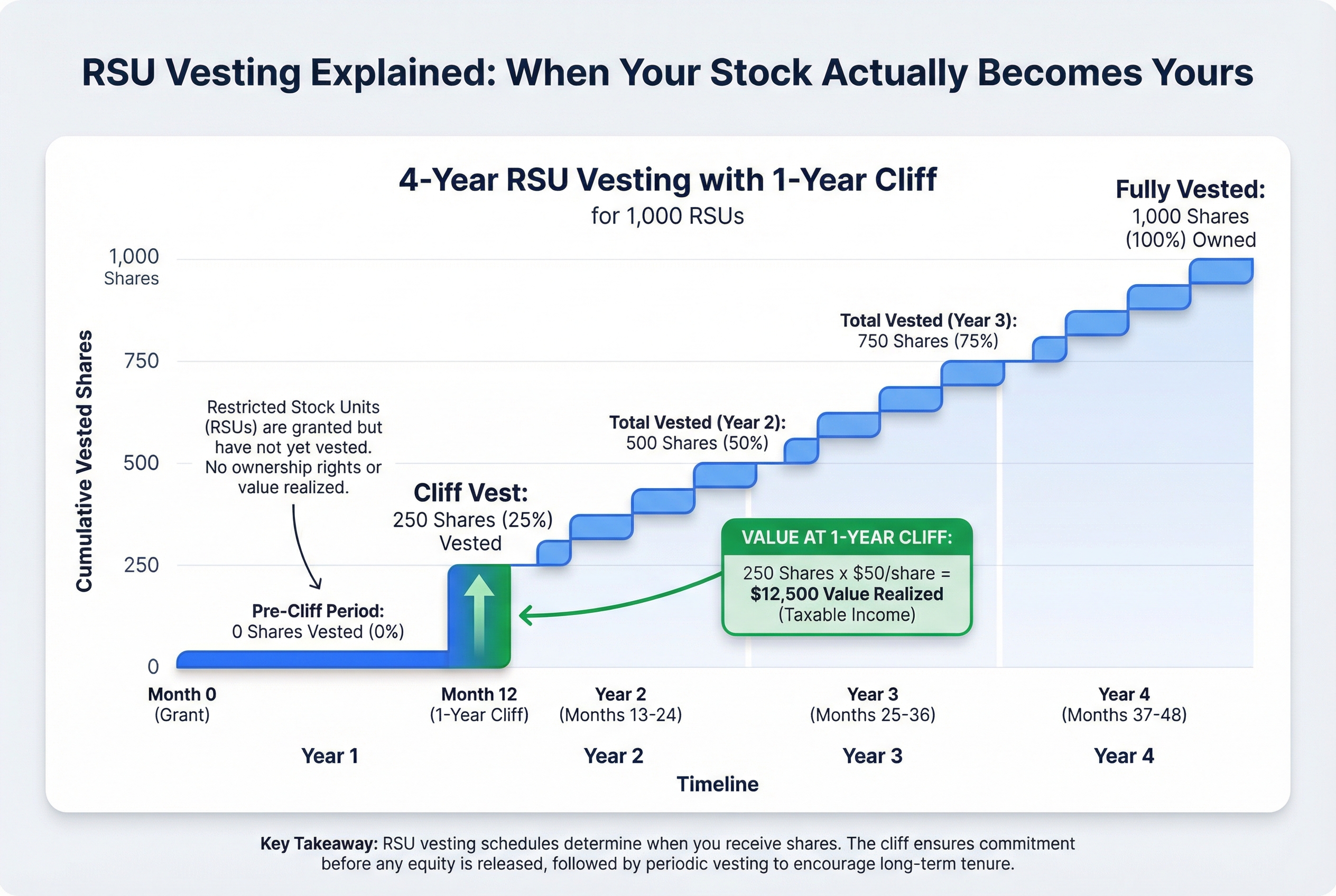 The standard 4-year vesting schedule includes a 1-year cliff, meaning you receive zero shares until your first anniversary.
The Complete Guide to RSUs | 15 Common Questions ❓Answered | What People Get Wrong...
Other Vesting Schedules You Might See
Not all companies use the 4-year quarterly schedule. Think of vesting schedules like payment plans for the same TV - \1ou're getting the same total, but the timing changes dramatically.
Here are the other common patterns you might encounter:
Annual Vesting (Straight-Line)
You get 25% of your shares once per year on your grant anniversary. That's it. No quarterly check-ins.
Example: 1,000 RSUs = 250 shares on year 1, 250 on year 2, 250 on year 3, 250 on year 4.
This is simpler to track but means waiting longer between vesting events. Some older companies and non-tech firms prefer this approach.
Back-Weighted Vesting (The "Amazon Model")
Most shares vest in years 3 and 4. Amazon famously uses 5% / 15% / 40% / 40%.
Why companies do this: It's a retention handcuff. You have to stick around to see the big payoff. Think of it like a signing bonus that arrives three years late.
Front-Loaded Vesting
More shares vest early - \1aybe 40% / 30% / 20% / 10%. Companies use this to provide immediate value to new hires or compete for talent.
Quarterly Vesting with No Cliff
Shares start vesting every three months from day one. No waiting a full year for your first batch.
Why this matters: You start building equity immediately, but you never get a big chunk all at once.
Comparing the Schedules: Same Grant, Different Timing
Three employees each receive 1,000 RSUs. Here's what they actually own over time:
| Timeline | Employee A (Standard) | Employee B (Back-Weighted 5/15/40/40) | Employee C (Quarterly No Cliff) |
|---|---|---|---|
| Year 1 | 250 shares | 50 shares | 250 shares |
| Year 2 | 500 shares total | 200 shares total | 500 shares total |
| Year 3 | 750 shares total | 600 shares total | 750 shares total |
| Year 4 | 1,000 shares total | 1,000 shares total | 1,000 shares total |
At 18 months, Employee A has 375 shares, Employee B has only 125 shares, and Employee C has 375 shares. Same total grant, wildly different cash in hand.
The bottom line: Your vesting schedule determines when you can actually use your equity. A back-weighted schedule might look generous on your offer letter, but you'll wait years to see most of it.
Now let's talk about what actually happens on the day shares vest - \1nd why it's not as simple as "you get stock."
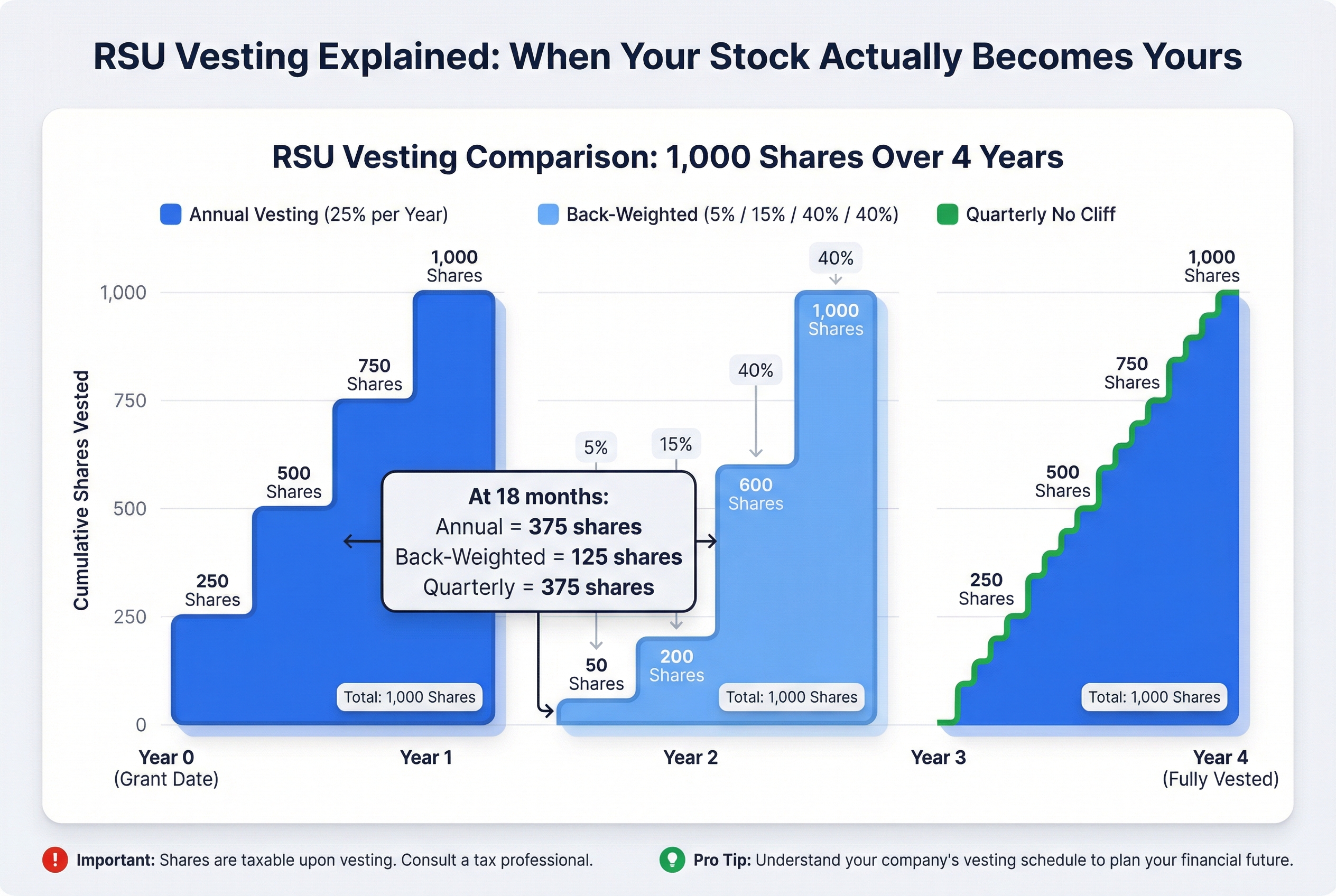 Vesting schedules dictate when you receive your shares; the 'Amazon Model' heavily weights vesting toward later years for retention.
What Actually Happens on Vesting Day
Vesting day is like payday - \1xcept instead of cash hitting your checking account, shares land in your brokerage account. And just like payday, taxes get taken out before you see what's yours.
Here's the timeline of what actually happens:
Morning of vesting day: Your RSUs convert to real shares. They appear in your brokerage account (Schwab, E*TRADE, Fidelity, or wherever your company holds them). At this moment, you technically own them.
Same day (usually within hours): Your company automatically sells some of your shares to cover tax withholding. This is called "sell-to-cover," and it happens without asking you first. Think of it like automatic tax withholding from your paycheck - \1he IRS gets their cut before you do.
Next business day: You receive your net shares. These are yours to keep, sell, or transfer. The shares sold for taxes are gone forever.
A Real Example: Sarah's Vesting Day
On March 15, 250 of Sarah's RSUs vest. The stock price that day is $60 per share.
Gross value: 250 shares × $60 = $15,000
Her company withholds taxes at these rates:
- 22% federal income tax
- 6% state income tax
- 7.65% FICA (Social Security and Medicare)
- Total: 35.65%
Shares sold for taxes: $15,000 × 35.65% = $5,340 ÷ $60 = 89 shares
Net shares Sarah receives: 250 - 89 = 161 shares (worth $9,660)
That $15,000 also appears on Sarah's W-2 as ordinary income, just like her salary.
What You Can Do With Your Net Shares
Once those 161 shares hit Sarah's account, she has three options:
- Sell immediately - \1ock in the $9,660 cash value
- Hold - \1eep the shares and hope the price goes up
- Transfer - \1ove them to a different brokerage account
Most brokerage platforms let you do any of these the moment your net shares arrive.
The Key Number: Vesting Day Price
The stock price on vesting day determines everything. It sets your taxable income. It determines how many shares get sold for taxes. It becomes your "cost basis" for future capital gains calculations.
If the stock is at $60 when your RSUs vest, you're taxed on $60 per share - \1ven if the stock drops to $40 the next day. The IRS doesn't care what happens after vesting day.
Now here's the painful part: that automatic tax withholding usually isn't enough to cover your full tax bill. Let's look at why vesting day can create an unexpected tax bomb.
The Tax Bomb: Why Vesting Day Creates a Tax Bill
Here's the surprise that catches most people off guard: when your RSUs vest, the IRS treats them exactly like a cash bonus. You owe income tax on the full value, even though you didn't sell anything.
Think of it like this: automatic tax withholding is like a restaurant adding an 18% tip to your bill. Sounds good, right? Except you actually owe a 25% tip. You'll pay the difference later - \1nd it won't be pleasant.
Your Company Withholds, But Probably Not Enough
On vesting day, your company automatically withholds shares to cover taxes. The standard federal withholding is 22%. They'll also take out for Social Security, Medicare, and state taxes.
Here's the problem: 22% might not be your actual tax rate.
If you're in the 24%, 32%, or 35% federal tax bracket (which many tech employees are), that automatic withholding leaves you short. Way short.
The Math That Creates April Surprises
Marcus earns $180,000 in salary. This year, $50,000 worth of RSUs vest. His total income is now $230,000.
- His actual federal tax bracket: 32%
- What his company withheld: 22% ($11,000)
- What he actually owes: 32% ($16,000)
- The April surprise: $5,000 extra owed
And that's just federal taxes. Add state taxes (up to 13% in California), and Marcus could owe $10,000+ when he files.
Even worse? That extra $50,000 in income pushed part of Marcus's salary into a higher bracket too. His total tax bill went up more than just the RSU taxes.
Why This Happens
Your RSUs are taxed as ordinary income - \1he same rate as your paycheck. The stock price on vesting day determines how much income you report. If 100 shares vest at $150 each, you report $15,000 in income. Period.
The withholding gap happens because your company uses a flat 22% rate for "supplemental income" (bonuses, RSUs, etc.). But your marginal tax rate - \1he rate on your last dollar earned - \1s based on your total income for the year.
Now that you understand the tax hit, let's look at what happens to your RSUs if you leave the company before they fully vest.
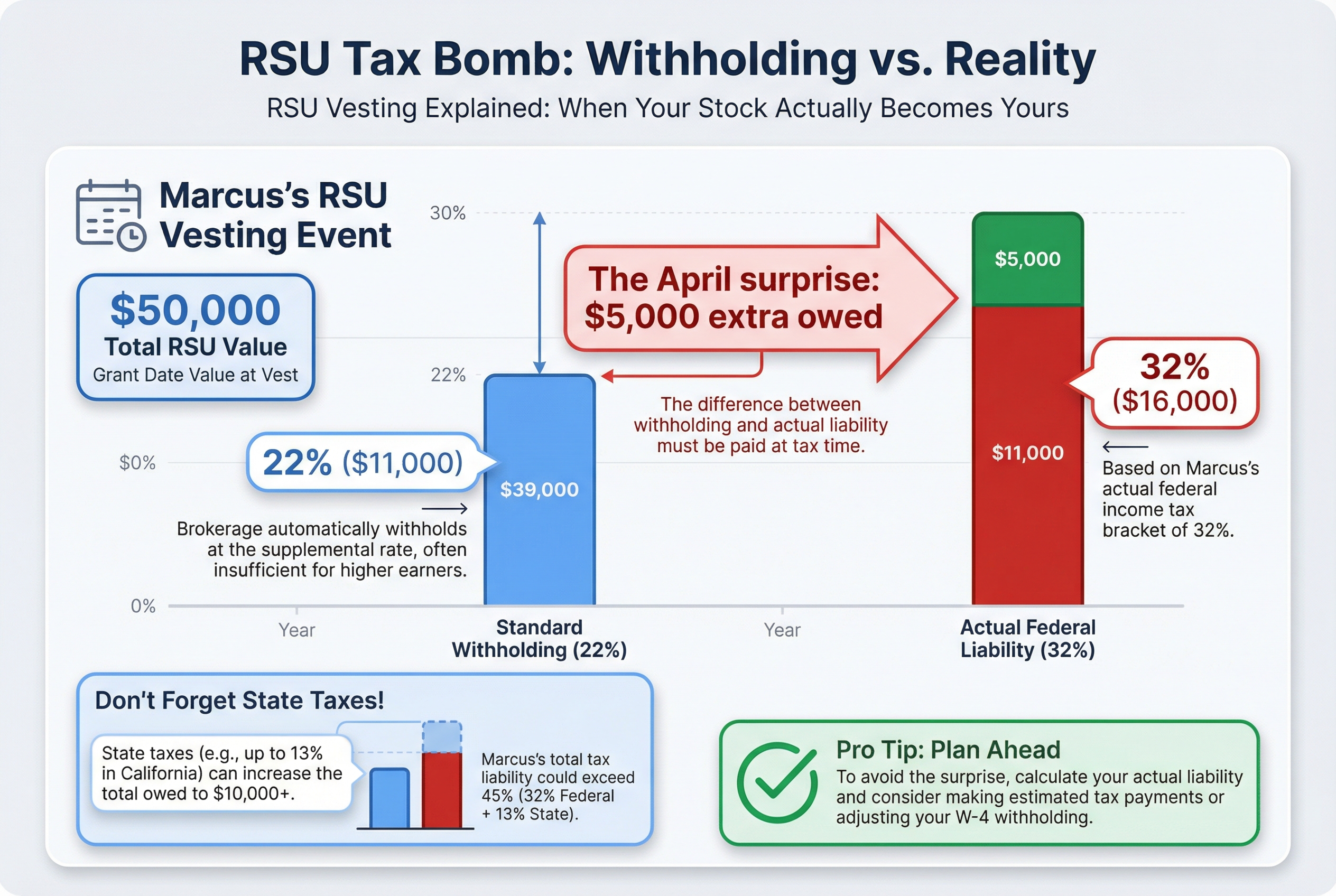 The IRS treats vested RSUs like a cash bonus. While companies withhold a standard 22% federally, your actual tax liability may be higher.
RSU Taxes Explained + 5 Strategies for 2024
What Happens to Your RSUs When You Leave the Company
Here's the rule that catches most people off guard: unvested RSUs disappear completely when you leave. Vested RSUs stay yours forever.
Think of unvested RSUs like airline miles you haven't earned yet. If you stop flying Delta, you don't get the miles you would have earned on future flights. They're gone.
The Simple Rules
Unvested RSUs: You lose them all. Doesn't matter if you're one day away from vesting or three years away. If they haven't vested by your last day, they vanish.
Vested RSUs: You keep them. They're in your brokerage account and they're yours to hold or sell whenever you want.
Your last day of employment is what counts. Not your resignation date. Not your two-week notice. The actual last day you're on payroll.
The $12,500 Timing Mistake
Two employees both have 1,000 RSUs on a 4-year schedule with a 1-year cliff. Both decide to leave at 11.5 months. Stock price: $50/share.
Employee A gives two weeks notice. Her last day falls two weeks before the 1-year mark. She loses all 1,000 RSUs. Cost: $50,000.
Employee B negotiates a last day two weeks after the 1-year mark. He keeps 250 vested RSUs worth $12,500 and loses 750 unvested RSUs.
Same resignation timing. Two-week difference in last day. $12,500 difference in outcome.
Layoffs and Terminations Follow the Same Rules
Getting laid off doesn't change the vesting rules. Neither does getting fired. Your unvested RSUs are gone. Your vested RSUs stay yours.
Some companies offer vesting acceleration as part of severance packages, but it's rare. Don't count on it. If you're negotiating severance, you can ask, but most companies will say no.
The Bottom Line
If you're planning to leave and have RSUs vesting soon, time your departure carefully. Check your vesting schedule. A few extra weeks can mean thousands of dollars. Or tens of thousands.
But what if you're not leaving voluntarily? What if your company gets acquired? The vesting rules change completely, and sometimes in your favor.
Special Vesting Situations: Mergers, Acquisitions, and IPOs
Big company events can throw your normal vesting schedule out the window. Here's what happens when your company gets bought, merges, or goes public.
The Double-Trigger Rule at Private Companies
If you work at a startup, your RSUs probably need two keys to unlock. Think of it like a safe deposit box - \1ou need both your key and the bank's key to open it.
Key #1: Time passing (your normal vesting schedule) Key #2: A "liquidity event" (company IPO or acquisition)
Priya works at a startup for 3 years with 4,000 RSUs on a 4-year vest. Time-wise, she's "earned" 3,000 RSUs. But her shares-owned count? Zero. The company is still private, so the second key hasn't turned yet.
This is called double-trigger vesting. Public company employees don't deal with this - \1heir shares vest on schedule because the stock is already tradeable.
What Happens During an Acquisition
When another company buys your employer, one of three things happens to your unvested RSUs:
1. Full acceleration - \1ll your RSUs vest immediately, even future ones. If Priya's grant has this clause, all 4,000 RSUs vest on acquisition day, not just the 3,000 she's earned time-wise.
2. Partial acceleration - \1nly your time-earned RSUs vest. Priya gets her 3,000 RSUs. The remaining 1,000 disappear or convert to the new company's vesting schedule.
3. Assumption - \1he acquiring company converts your RSUs to their stock. You keep vesting on your original schedule, just in different shares. Priya's 1,000 unvested RSUs become equivalent value in the buyer's stock.
Your grant agreement determines which happens. "Acceleration clause" is the term to search for in your paperwork.
What Happens at IPO
An IPO is simpler for private company employees. The second key finally turns.
All your time-vested RSUs become actual shares on IPO day. If you've worked 2 years of a 4-year grant, 50% of your RSUs vest when the company goes public. The other 50% vest on your normal schedule.
One catch: Most companies impose a lockup period (usually 90-180 days) where you can't sell your newly vested shares. You own them, but you can't touch them yet. Think of it like money in a savings account with a withdrawal freeze.
The Cash-Out Scenario
Some acquisitions skip the stock conversion entirely. The buyer pays cash for your RSUs based on the acquisition price.
Example: Your company sells for $50 per share. You have 2,000 unvested RSUs with full acceleration. You receive $100,000 cash (2,000 × $50) minus taxes. No new company stock involved.
This creates an immediate tax bill since all that vesting happens at once. See Section 6 for why this matters.
Your Action Item
Find your grant agreement right now. Look for these terms:
- "Acceleration upon change of control"
- "Double-trigger" or "liquidity event"
- "Assumption of equity awards"
If your company is in acquisition talks or planning an IPO, these words determine whether you're about to have a very good day or just a normal vesting day.
Next, let's look at RSUs that don't vest based on time at all - \1erformance-based grants that require you to hit specific targets.
Performance-Based Vesting: When Time Isn't Enough
Most RSUs vest based on time alone - \1tay at the company, get your shares. But some RSUs add another hurdle: you have to hit performance targets too.
Think of it like a sales commission. Showing up to work every day isn't enough. You only get paid if you hit your numbers.
How Performance-Based RSUs Work
These grants require you to meet both conditions to vest:
- Time requirement: Stay employed for the full vesting period
- Performance requirement: Company or you must hit specific goals
If you stay but miss the performance target, you lose those shares. Period.
Common Performance Metrics
Companies tie RSU vesting to measurable goals:
- Company stock price targets: "Stock must hit $100/share by year 3"
- Revenue milestones: "Company must reach $500M in annual revenue"
- EBITDA goals: "Hit $50M in earnings before interest, taxes, depreciation, and amortization"
- Individual performance: "Maintain 'exceeds expectations' rating for 2 consecutive years"
Your grant agreement will clearly spell out any performance conditions. If you don't see them listed, your RSUs are time-based only.
Real Example: When Performance Targets Aren't Met
Diego receives 2,000 RSUs with mixed conditions:
- 1,000 shares: Time-based only (standard 4-year vesting)
- 1,000 shares: Vest only if stock hits $100/share by year 3 AND he's still employed
At year 3, Diego is still at the company. The stock is at $85. He's vested 750 of his time-based shares by now. But the stock never hit $100.
Result: Diego gets his 750 time-based shares. The 1,000 performance-based shares? Gone. He loses them entirely, even though he stayed and did his job well.
If the stock had hit $100, he'd get both.
Who Gets Performance-Based RSUs?
These grants are most common for executives and senior leadership - \1Ps, C-suite, directors. Some companies also use them for critical roles or company-wide grants during turnarounds.
If you're a mid-level employee at a stable public company, your RSUs are probably time-based only. But always check your grant agreement to be sure.
Stretch Goals: Bonus Shares for Exceeding Targets
Some performance grants include upside. Hit a "stretch goal" that exceeds the base target, and you earn extra shares.
Example: Your grant says you'll get 500 RSUs if the company hits $400M revenue, but 750 RSUs if it hits $500M. The extra 250 shares are your bonus for crushing the target.
Now that you understand how vesting works - \1ncluding these trickier performance conditions - \1et's look at the costly mistakes employees make with their vesting schedules.
Common RSU Vesting Mistakes That Cost Employees Money
RSU vesting is confusing. That confusion costs employees real money - \1ometimes tens of thousands of dollars. Here are the biggest mistakes and what they actually cost you.
Mistake #1: Leaving Just Before a Vesting Date
The mistake: You quit or get a new job without checking your vesting calendar.
What it costs: Sarah gave her two-week notice on March 15th. Her last day was March 29th. Her next vesting date? April 15th - \1ust 17 days after she left. She forfeited $25,000 worth of RSUs because she didn't look at her schedule.
Think of this like canceling your gym membership the day before they credit you a $500 loyalty bonus. The money was almost yours, but "almost" counts for nothing.
The fix: Check your vesting dates before you give notice. Sometimes waiting two more weeks is worth $25,000.
Mistake #2: Not Saving for the April Tax Bill
The mistake: Your company withholds 22% when RSUs vest, but you might owe more when you file taxes.
What it costs: Marcus had $60,000 in RSUs vest in May. His company withheld $13,200 (22%). In April, his accountant told him he actually owed $15,000 in taxes on that vesting. He didn't have the extra $1,800 saved. He put it on a credit card at 22% interest.
The real cost: $1,800 plus interest charges. Even worse - \1ome employees owe $10,000+ in April and have zero savings.
The fix: Assume you'll owe 30-40% in total taxes if you make over $100k. Set aside the difference between what was withheld and what you'll actually owe.
Mistake #3: Confusing Grant Date with Vesting Date
The mistake: You think you got shares on the day they granted them to you.
What it costs: You don't actually lose money here, but you overestimate your net worth. Jessica thought she had 1,000 shares worth $50,000. She actually had 250 vested shares ($12,500) and 750 unvested shares ($0 if she leaves). She planned a down payment on a house based on $50,000. She only had $12,500 available.
Grant date = the day you get a promise. Vesting date = the day you actually own shares.
The fix: Only count vested shares in your net worth. Unvested RSUs are a future possibility, not current money.
Mistake #4: Assuming You Can Negotiate Vesting Acceleration
The mistake: You ask your manager to let your RSUs vest early because you need the money.
What it costs: Wasted time and awkwardness. Vesting schedules are almost never negotiable after you accept the job. The only exceptions: mergers, acquisitions, or executive-level negotiations.
The fix: Don't ask. The answer is no. Plan your finances around the actual vesting schedule.
Mistake #5: Not Checking Your Actual Vesting Schedule
The mistake: You assume you know when shares vest without looking at your brokerage account.
What it costs: Missed planning opportunities and surprises. Your vesting schedule is in your equity portal (E*TRADE, Fidelity, Morgan Stanley, etc.). Many employees have never logged in.
Think of this like not knowing when your bills are due. You'll miss important deadlines and make bad timing decisions.
The fix: Log into your brokerage account today. Find the "Vesting Schedule" or "Equity Awards" section. Screenshot it. Put the dates in your calendar.
Mistake #6: Thinking Unvested RSUs Have Any Value If You Leave
The mistake: You count unvested RSUs as part of your compensation when comparing job offers.
What it costs: Bad career decisions. If you leave Company A for Company B, you lose 100% of unvested RSUs at Company A. They're worth $0. Gone.
David had $100,000 in unvested RSUs. He took a job paying $20,000 more in salary. He thought he was coming out ahead. He wasn't - \1e lost $100,000 in unvested shares and gained $20,000 in salary. Net loss: $80,000.
The fix: Only count vested RSUs as real money. Unvested RSUs are golden handcuffs - \1hey only have value if you stay.
Now that you know what mistakes to avoid, let's talk about how to stay organized. In the next section, we'll show you how to build a vesting calendar so you always know what's coming and when.
Your RSU Vesting Calendar: How to Track What's Coming
Your vesting schedule is like a concert calendar - \1ou need to know when each show happens and what tickets you're holding. Missing a vesting date won't make your shares disappear, but not tracking them means you can't plan around them.
Here's how to find and track your vesting schedule:
Step 1: Log Into Your Brokerage Account
Your company uses a platform like Schwab, E*TRADE, Fidelity, Morgan Stanley, or UBS. You should have received login credentials when you got your first grant. Can't find them? Ask your HR department.
Step 2: Find Your Equity Awards Section
Look for tabs labeled "Equity Awards," "Stock Plan," "My Equity," or "RSU Holdings." This is where your vesting schedule lives. You'll see every grant you've received and when shares vest.
Step 3: Download Your Full Schedule
Most platforms let you export your vesting calendar to Excel or PDF. Do this. Screenshot it. Save it somewhere you won't lose it.
Step 4: Build Your Personal Vesting Calendar
Take Lisa's approach. She logs into Schwab and finds her schedule: March 15, 2025 (250 shares, $15,000 at today's stock price), then 21 shares monthly ($1,260/month). She adds every date to her Google Calendar with estimated dollar amounts.
Lisa's planning to buy a house. Now she knows she'll have $15,000 vesting in March that could cover closing costs. She also knows if she gets a job offer, she should try to start after March 15 to capture that big vesting.
Step 5: Update Your Estimates Quarterly
Your stock price changes. Your $15,000 vesting event might become $18,000 or $12,000. Check quarterly and update your calendar. This keeps your financial planning realistic.
Step 6: Plan Major Decisions Around Vesting Dates
Considering a job change? Look at what you'd leave on the table. Planning a down payment? Time it with a large vesting event. Getting married? Your unvested RSUs aren't marital property yet in most states, but vested ones might be.
Think of your vesting calendar as your personal payday schedule - \1xcept these paydays can be worth months of salary. You wouldn't ignore when your paycheck arrives. Don't ignore when your equity vests.
Now that you know how to track your vesting schedule, let's pull everything together with a concrete action plan.
What to Do Next: Your RSU Vesting Action Plan
Managing your RSU vesting is like maintaining a car, regular check-ups prevent expensive surprises. Here's your prioritized action plan.
Do Today (30 Minutes)
Action 1: Find your RSU grant agreement. Check your HR portal or search your email for "restricted stock unit" from your start date. This document lists your total shares, vesting schedule, and grant price.
Action 2: Log into your brokerage account. Companies use platforms like E*TRADE, Fidelity, or Schwab. Screenshot your vesting schedule. You need this.
Do This Week (1 Hour)
Action 3: Create your vesting calendar. Make a simple spreadsheet:
- Column A: Vesting date
- Column B: Number of shares vesting
- Column C: Current stock price
- Column D: Estimated value (B × C)
- Column E: Estimated tax bill (D × your tax rate)
Example: If 100 shares vest on March 15 at $150 each, that's $15,000 in income. At a 35% total tax rate, you'll owe roughly $5,250.
Action 4: Set calendar reminders. Add alerts 30 days before each vesting date. This gives you time to plan.
Do This Month (2 Hours)
Action 5: Calculate your tax withholding gap. Your company typically withholds 22% federal. If you're in the 32% bracket, you'll owe more in April. Start saving now.
Action 6: Decide your default strategy. Will you sell immediately, hold everything, or decide case-by-case? Having a plan prevents emotional decisions on vesting day.
Action 7: If you're job hunting, check vesting dates first. Leaving two weeks before a $20,000 vesting hurts. Time your exit strategically.
Your 30-Day Action Plan Summary
- Today: Find grant agreement, log into brokerage (30 min)
- This week: Build vesting spreadsheet (1 hour)
- This month: Calculate tax bracket, set aside money for April (2 hours)
- Quarterly: Update spreadsheet as stock price changes
Done. You now understand your RSU vesting better than 90% of employees.
One final note: Review this annually. Each new RSU grant adds complexity. Companies often grant RSUs every year, so you'll soon have multiple vesting schedules overlapping. Update your spreadsheet each time.
If your vesting creates a tax bill above $10,000, talk to a CPA. The cost of one consultation ($200-500) beats an IRS surprise bill.
Frequently Asked Questions
[ANSWER NEEDED]
[ANSWER NEEDED]
[ANSWER NEEDED]
[ANSWER NEEDED]
[ANSWER NEEDED]
[ANSWER NEEDED]
[ANSWER NEEDED]
[ANSWER NEEDED]
Educational Content Only
This content is for educational purposes only and does not constitute financial advice. The information provided is general in nature and may not appl...
YourEmployeeStock.com is not a registered investment advisor.
Related Articles
ESPP Tax Rules: A Simple Guide to What You'll Owe (With Examples)
ESPP taxes confuse even smart employees because the rules change based on how long you hold your shares. This guide walks you through the two types of sales (qualifying vs. disqualifying), shows you exactly what you'll owe with real examples, and helps you avoid the most common costly mistakes.
BasicsEquity Compensation Basics: A Simple Guide to Understanding Your Stock Benefits
Equity compensation means getting paid partly in company stock instead of just cash. This guide breaks down what equity compensation is, the main types you'll encounter (RSUs, stock options, ESPP), how it affects your total pay, and what you need to know to make smart decisions about your stock benefits.
ESPPHow ESPP Works: Your Complete Guide to Employee Stock Purchase Plans
An Employee Stock Purchase Plan (ESPP) lets you buy your company's stock at a discount, usually 10-15% off. This guide explains how ESPP works from enrollment through selling shares, including the tax rules that determine how much money you keep. You'll learn the exact steps, see real dollar examples, and discover strategies competitors don't share.
Not sure what to do with your equity?
Get a free personalized analysis