

NSO Tax Treatment: When You Pay Taxes and How Much You'll Owe
A complete guide to understanding and planning for taxes on your non-qualified stock options
Published March 1, 2026 · Updated March 1, 2026
Non-qualified stock options (NSOs) create taxes at two different times: when you exercise and when you sell. Understanding exactly when you owe taxes and how much you'll pay helps you make smarter decisions about your equity compensation and avoid surprise tax bills.
The Tax Surprise That Catches Most NSO Holders Off Guard
Sarah thought she was making a smart move. Her startup had just raised a Series C, and her 5,000 stock options were finally worth something. The stock was trading at $50, and her strike price was just $10. She did the math: $40 profit per share times 5,000 shares equals $200,000. Life changing money.
She exercised all her options, paying $50,000 to buy the shares. Then April came.
Her accountant delivered the bad news: she owed $70,000 in taxes. On money she never actually received. Sarah still owned the shares, but the IRS wanted its cut based on the $200,000 "spread" between her $10 strike price and the $50 fair market value.
This is the NSO tax trap that catches thousands of employees every year.
Think of NSOs like a two-toll bridge. You pay the first toll when you cross onto the bridge (when you exercise). You pay the second toll when you reach your destination (when you sell). Most people only think about that second toll. The first one blindsides them.
Here's what makes NSOs tricky: you face taxes at two completely separate moments.
First tax hit: When you exercise your options. The IRS treats the difference between your strike price and the current stock value as regular income, just like your salary. You owe taxes immediately, whether you sell the shares or not.
Second tax hit: When you eventually sell the shares. You pay capital gains tax on any profit above the value at exercise.
The problem? That first tax bill is based on paper gains. You're holding stock, not cash. But the IRS still wants payment in actual dollars.
Understanding when these taxes hit and how much you'll owe is critical. It's the difference between a smart financial move and a tax nightmare that drains your savings. Let's break down exactly what NSOs are and why they work this way.
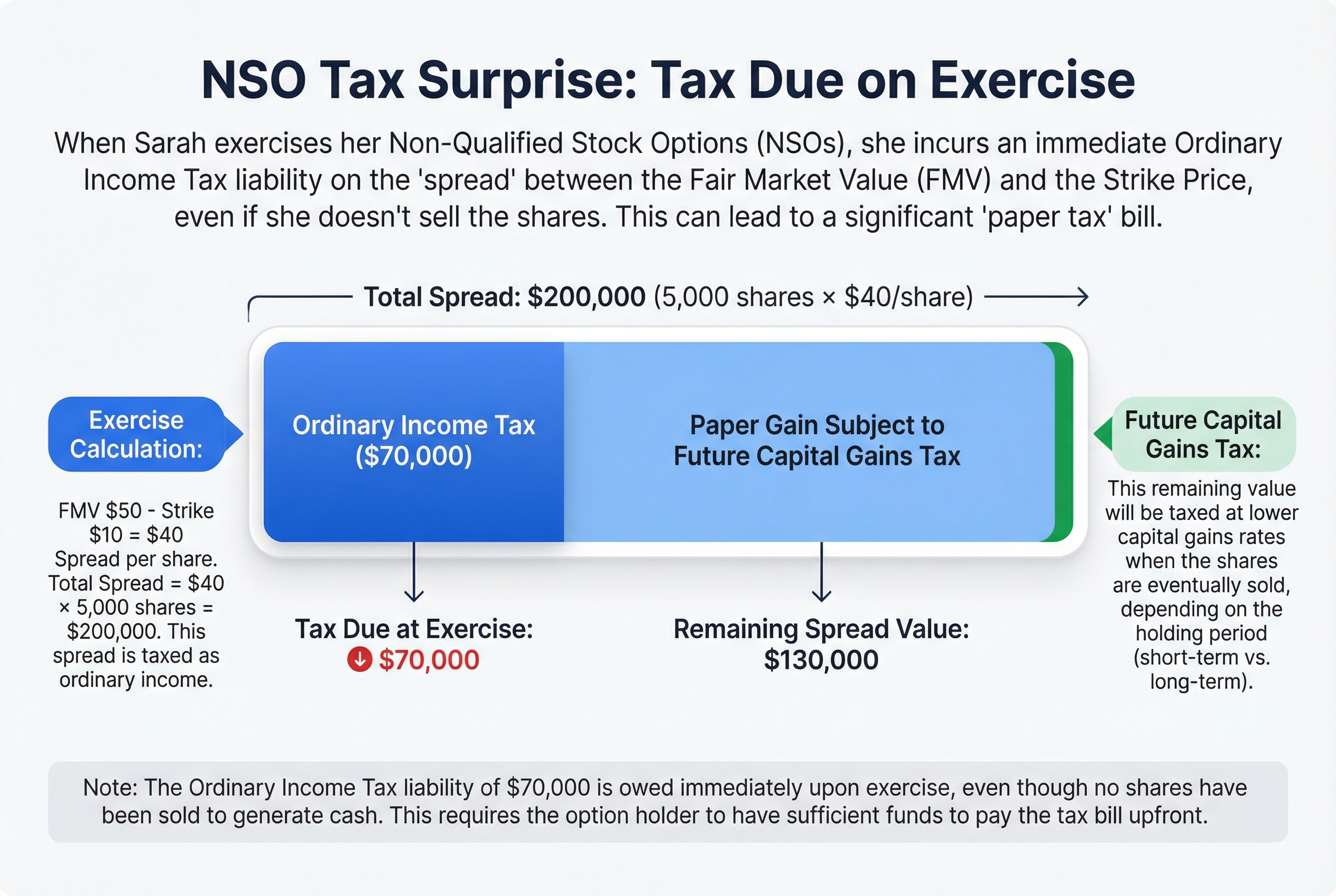 The NSO Tax Trap: Tax is due on the spread ($200,000) immediately upon exercise, resulting in a $70,000 tax bill for Sarah, even though she didn't sell the shares.
What Are NSOs and Who Gets Them?
NSOs (Non-Qualified Stock Options) are like coupons to buy your company's stock at yesterday's price. When you get NSOs, you're receiving the right to buy company shares at a locked-in price called the strike price. That price stays the same no matter how high the stock goes.
Here's a real example: Marcus joins a startup as a contractor and receives 2,000 NSOs at a $5 strike price. This means he can buy 2,000 shares at $5 each anytime before the options expire (usually 10 years). If the stock price hits $50, he still only pays $5 per share. That's a $45 profit per share if he exercises and sells.
Who can get NSOs?
NSOs are the most flexible type of stock option because companies can grant them to:
- Full-time employees
- Part-time employees
- Contractors and consultants
- Board members
- Advisors
This is different from ISOs (Incentive Stock Options), which only employees can receive. If you're not a full-time employee, you'll always get NSOs, not ISOs.
Why companies grant NSOs
Companies use NSOs to attract talent without paying more cash. They're basically saying "we can't pay you $150k in salary, but we'll give you the chance to profit when the company grows." For contractors and advisors, NSOs are the only stock option available.
Your NSOs typically vest over time (often 4 years), so you earn the right to exercise them gradually. But here's where it gets tricky: exercising your NSOs triggers a tax bill, even if you haven't sold a single share yet.
Non-Qualified Stock Options (NQSOs)
The First Tax Hit: Ordinary Income When You Exercise
Here's the tax surprise that hits hardest: the moment you exercise your NSOs, you owe taxes. Not when you sell. Not when the stock goes up. Right when you exercise.
The Bargain Element: Your Taxable "Discount"
Think of it like this. You walk into a store and buy a $50 jacket for $10 because you have an employee discount. The IRS sees that $40 savings as income you earned. Same thing with NSOs.
The bargain element is the difference between what you pay (strike price) and what the stock is worth (fair market value or FMV) when you exercise.
The formula:
(FMV at exercise - Strike price) × Number of shares = Bargain element
This entire bargain element gets taxed as ordinary income. Just like your salary. Just like a cash bonus.
A Real Example: Jennifer's $270,000 Tax Bill
Jennifer has 10,000 NSOs with an $8 strike price. The stock is now trading at $35 per share. She decides to exercise all of them.
Here's the math:
- FMV at exercise: $35
- Strike price: $8
- Bargain element per share: $35 - $8 = $27
- Total bargain element: $27 × 10,000 shares = $270,000
That $270,000 gets added to her income for the year. The IRS treats it exactly like she got a $270,000 bonus.
How Much Tax Does She Actually Owe?
Jennifer is in the 35% federal tax bracket. Here's what she owes:
- Federal income tax: $270,000 × 35% = $94,500
- FICA taxes (Social Security + Medicare): $270,000 × 7.65% = $20,655
- California state tax: $270,000 × 10% (approximate) = $27,000
- Total tax bill: Roughly $142,000
Yes, she needs to come up with $142,000 in cash to cover the taxes. On top of the $80,000 she paid to exercise the options ($8 × 10,000 shares).
Where This Income Shows Up
If you're an employee, this bargain element appears on your W-2 in Box 1 as wages. Your company will withhold some taxes automatically, but often not enough.
If you're a contractor or board member, you'll get a Form 1099-NEC instead. No taxes are withheld, so you owe it all when you file.
The Tax Rates That Apply
Your bargain element gets taxed at your ordinary income tax rates:
- Federal: 22% to 37% depending on your total income
- FICA: 7.65% for employees (your company pays another 7.65%)
- State: 0% to 13% depending on where you live
The higher your income, the more you'll owe. If the bargain element pushes you into a higher tax bracket, the last dollars get taxed at that higher rate.
Now comes the practical question: how do you actually pay this tax bill? Let's look at your options.
How NSOs Are Taxed (And Why It's Different from ISOs) | The Breakdown Lane
How to Actually Pay the Tax Bill When You Exercise
You just calculated your tax bill. Now you need to actually pay it.
Think of it like buying a house. You have three ways to cover the down payment: use cash from savings, sell some investments, or take out a loan. With NSO taxes, you have three similar choices.
Method 1: Pay Cash and Keep All Your Shares
This is the simplest option. You pay the tax bill from your bank account and keep every share you exercised.
How it works: You write a check or transfer money to cover the full tax amount. Your employer withholds the taxes from your payment.
Pros: You keep the maximum number of shares. If the stock price goes up, you benefit from every share.
Cons: You need a lot of cash on hand. Not everyone has tens of thousands sitting in savings.
Method 2: Sell-to-Cover (Most Common)
Your broker automatically sells just enough shares to cover your tax bill. You keep the rest.
How it works: The math is simple: tax owed ÷ current share price = shares to sell
Let's say David exercises 5,000 NSOs. His strike price is $10 and the current fair market value is $40. His tax bill is $52,500 (we calculated this in the previous section).
David needs to sell: $52,500 ÷ $40 = 1,313 shares
The broker sells 1,313 shares for $52,520. David keeps 3,687 shares. He paid his taxes without touching his bank account.
Pros: You don't need cash on hand. You still keep most of your shares. This is what most people do.
Cons: You end up with fewer shares than if you paid cash. You're selling shares right away, which might not be ideal timing.
Method 3: Cashless Exercise (Exercise and Sell Everything)
You exercise your options and immediately sell all the shares in one transaction.
How it works: Using David's example again:
- Exercise 5,000 shares (costs $50,000 at $10 strike price)
- Sell all 5,000 shares immediately (receives $200,000 at $40 per share)
- Pay $50,000 exercise cost and $52,500 in taxes
- Walk away with $97,500 cash
Pros: You get cash immediately. No risk of the stock price dropping after exercise. You don't need money upfront.
Cons: You own zero shares afterward. You miss out if the stock keeps climbing. You're basically just cashing out the spread.
The Withholding Trap You Need to Know About
Your employer will withhold taxes when you exercise. But they usually withhold at the supplemental wage rate, which is 22% federal (or 37% if you make over $1 million).
Here's the problem: if your actual tax rate is higher than 22%, you'll owe more money when you file your tax return.
Example: David's spread is $150,000. His employer withholds 22% ($33,000). But David's actual tax rate is 35% because of his total income. He'll owe an extra $19,500 in April.
Always calculate your real tax rate. Set aside extra cash if the withholding won't cover it.
Private Company Limitations
If your company isn't public, you usually can't sell shares to cover taxes. There's no market to sell into. You'll need to pay cash from your own savings.
This is why private company employees often wait until an IPO or acquisition to exercise. They need a liquidity event to make the math work.
Now that you know how to pay the exercise tax, let's look at the second tax hit that comes when you eventually sell your shares.
The Second Tax Hit: Capital Gains When You Sell Your Shares
Remember how you already paid ordinary income tax when you exercised your NSOs? That was like paying the first toll to cross a bridge. When you eventually sell those shares, you hit a second toll booth. But here's the good news: this second toll can be much cheaper if you wait.
Your Cost Basis Starts at the Exercise Price (Not the Strike Price)
Here's what trips people up. Your cost basis, the number the IRS uses to calculate your taxable gain, is the fair market value when you exercised. Not your strike price.
Think of it like buying a house. You already paid tax on the $20 per share spread when you exercised. The IRS isn't going to tax you on that same money twice. Your new starting point is what the shares were worth when you got them.
Example: You exercised NSOs at a $10 strike price when the FMV was $30. You paid ordinary income tax on that $20 spread already. Your cost basis is now $30 per share.
The One-Year Rule That Saves You Money
When you sell your shares, you only pay tax on gains above your cost basis. But the tax rate depends on how long you held the shares:
Hold less than one year after exercise: Short-term capital gains. Taxed at ordinary income rates (10% to 37%).
Hold one year or more after exercise: Long-term capital gains. Taxed at much lower rates (0%, 15%, or 20% depending on your income).
The holding period starts the day after you exercise. If you exercised on March 15, you need to wait until March 16 of the following year to qualify for long-term rates.
Real Numbers: Why the Waiting Period Matters
Rachel exercised 4,000 NSOs at a $10 strike price when the FMV was $30. She paid ordinary income tax (35% bracket) on the $20 spread, which was $80,000 in taxes at exercise.
She holds the shares for 14 months, then sells at $80 per share.
Her cost basis is $30 per share (the FMV when she exercised). Her capital gain is $50 per share, or $200,000 total. At the 20% long-term capital gains rate, she owes $40,000 in taxes.
What if Rachel got impatient? If she'd sold after just 8 months, that same $200,000 gain would be taxed at her ordinary income rate of 35%. She'd owe $70,000 instead of $40,000. Waiting those extra 6 months saved her $30,000.
How to Report This Tax
You'll report capital gains on Schedule D of your tax return. Your brokerage will send you a Form 1099-B showing your sale proceeds. Make sure the cost basis they report matches what you actually paid tax on when you exercised. Brokerages sometimes get this wrong.
The key takeaway: the second tax hit only applies to gains above what you already paid tax on. And if you can wait a year, you'll pay that tax at a much friendlier rate.
Now that you understand both tax hits (exercise and sale), you might be wondering: why do NSOs get taxed so differently than ISOs? Let's break down that comparison next.
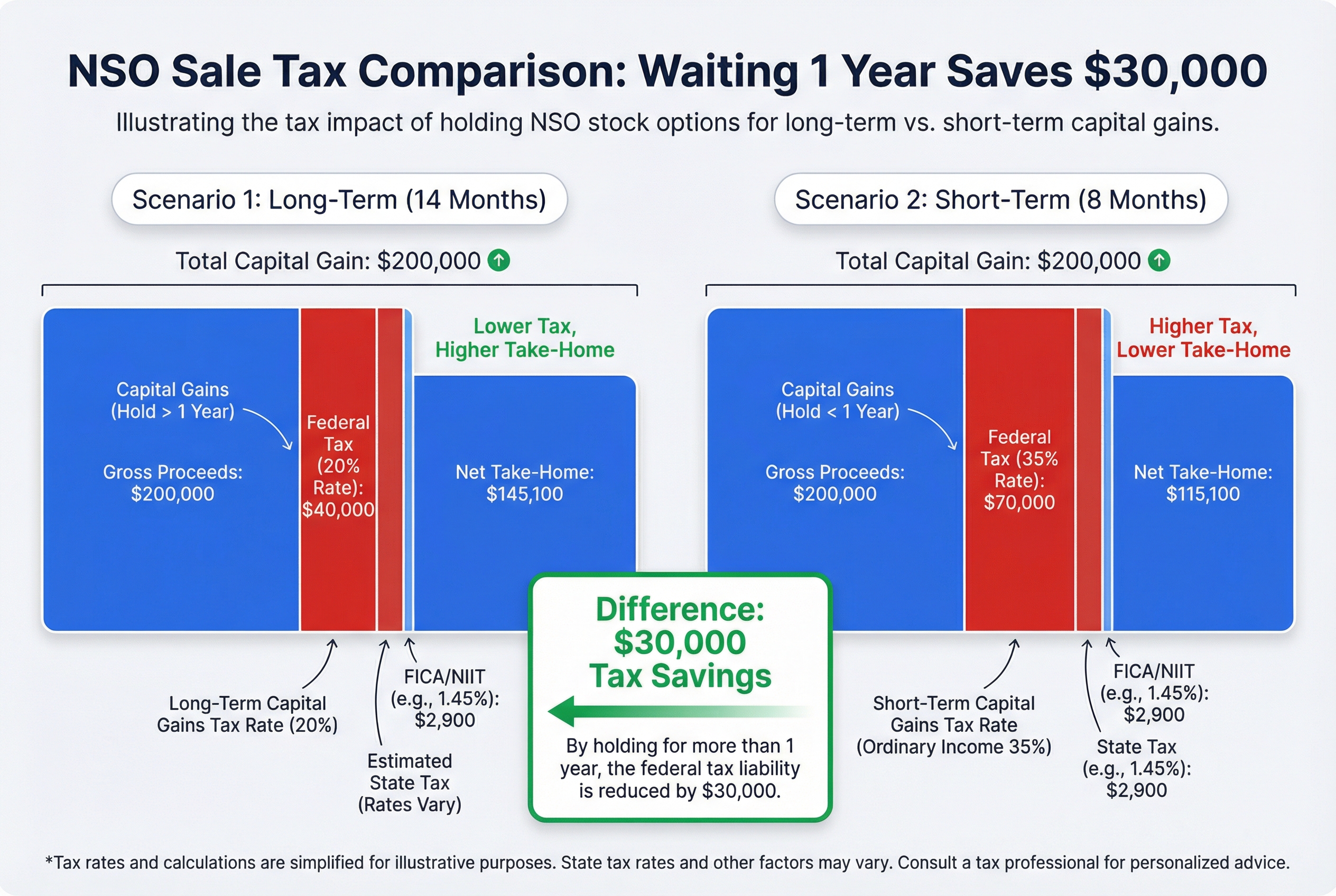 The Two Tolls: NSOs trigger ordinary income tax upon exercise (based on the spread) and capital gains tax upon sale (based on appreciation after exercise).
NSO vs ISO: Why the Tax Treatment Is So Different
If you've heard about ISOs (Incentive Stock Options), you might wonder why anyone would accept NSOs. The answer: ISOs are like a tax-advantaged retirement account with strict rules about who can use it and how. NSOs are like a regular brokerage account that anyone can have.
The Big Tax Difference
ISOs get special treatment from the IRS. If you exercise ISOs and hold the shares, you pay zero tax at exercise. All your gains can potentially qualify for long-term capital gains rates (currently 15-20% for most people).
NSOs don't get this break. You always pay ordinary income tax when you exercise, no matter what you do with the shares. Your tax rate could be 35% or higher.
Side-by-Side: Same Exercise, Different Tax Bills
Let's say Alex has ISOs and Jordan has NSOs. Both exercise 5,000 options at a $10 strike price when the fair market value is $50.
Jordan (NSOs):
- Bargain element: ($50 - $10) × 5,000 = $200,000
- Tax owed at exercise: ~$70,000 (assuming 35% tax rate)
- Due: April 15 next year
Alex (ISOs):
- Tax owed at exercise: $0
- AMT risk: Possible, but no immediate ordinary income tax
Fast forward one year. Both sell at $80 per share.
Jordan's second tax hit:
- Gain since exercise: ($80 - $50) × 5,000 = $150,000
- Tax owed: ~$30,000 (long-term capital gains at 20%)
- Total taxes paid: $100,000
Alex's tax hit:
- Total gain: ($80 - $10) × 5,000 = $350,000
- Tax owed: ~$70,000 (all long-term capital gains at 20%)
- Total taxes paid: $70,000
Alex saves $30,000 in taxes on the same transaction.
Why Can't Everyone Get ISOs?
The IRS limits who can receive ISOs and how many you can exercise:
- Only employees qualify. Contractors, advisors, and board members must receive NSOs.
- $100K annual limit. You can only exercise $100,000 worth of ISOs (based on strike price) in any calendar year. Above that, your options are treated as NSOs.
- Holding requirements. You must hold ISO shares for specific periods to get the tax benefit. Sell too early and they're taxed like NSOs.
- AMT trap. ISOs can trigger Alternative Minimum Tax, a parallel tax system that catches many people by surprise.
Why You Might Have Both
Many employees receive a mix. Your company might grant you ISOs up to the $100K limit, then give you NSOs for anything beyond that. Senior executives often receive large NSO grants because they exceed the ISO limits.
NSOs are also more flexible. Your company can grant them to consultants, give them as board compensation, or use them in situations where ISO rules don't work.
The Trade-Off Is Real
NSOs cost more in taxes, but they're simpler. You know exactly what you owe and when. No AMT calculations. No holding period requirements. No risk of accidentally converting your tax-advantaged ISOs into regular income.
ISOs save you money, but they come with complexity and risk. You need to track holding periods, watch for AMT, and potentially tie up cash in shares you can't sell yet.
Now that you understand why NSOs and ISOs are taxed differently, let's look at a strategy that can dramatically reduce your NSO tax bill: early exercise.
ISO vs NSO: Tax Treatment of Stock Options Explained (Startup Finance)
Early Exercise: A Tax Strategy Your HR Department Won't Explain
Early exercise is like buying a house in a neighborhood before it gets popular. You lock in today's low price, and all future appreciation gets taxed more favorably.
Here's what early exercise means: you buy your NSO shares before they vest. Most people wait until their options vest to exercise them. But some companies let you exercise immediately, even on Day 1.
Why would you do this? The tax savings can be massive.
When you exercise before vesting, the fair market value (FMV) equals your strike price. That means zero taxable income. You pay the exercise cost, file a special form called an 83(b) election, and you're done. All future gains become long-term capital gains if you hold the shares for more than a year.
The Real Numbers: Early Exercise vs. Waiting
Priya joins a startup on Day 1. She gets 20,000 NSOs at a $1 strike price. The FMV is also $1 (very early stage).
She immediately exercises all 20,000 shares for $20,000 and files an 83(b) election. Three years later when the shares vest, the FMV has jumped to $40. She owes $0 in taxes because she already owns the shares.
At the IPO, she sells at $100 per share. Her only tax bill: long-term capital gains on a $99 per share gain ($1,980,000 total) at 20% = $396,000.
Her coworker Sam got the same grant but waited to exercise. At vesting (FMV $40), Sam exercises and owes ordinary income tax on $39 per share × 20,000 = $780,000 of income. His tax bill: roughly $273,000. Then he sells at IPO and pays capital gains on the additional $60 gain.
Priya's total tax: $396,000
Sam's total tax: $273,000 + capital gains on $1.2M = $513,000+
The Critical 83(b) Election
You must file an 83(b) election with the IRS within 30 days of early exercise. Miss this deadline and you'll owe ordinary income tax on the full value when shares vest. There are no extensions, no exceptions.
Think of the 83(b) as proof that you paid for unvested shares. Without it, the IRS treats those shares as compensation when they vest.
The Risks You're Taking
Early exercise isn't free money. You're taking real risks:
Risk 1: You might leave or get fired. If you leave before shares vest, you forfeit the unvested ones. You lose the money you paid to exercise them. If Priya leaves after year 1, she loses 15,000 shares and the $15,000 she paid for them.
Risk 2: The company might fail. Startups fail all the time. Your $20,000 exercise cost goes to zero. You can claim a capital loss, but you're still out the cash.
Risk 3: You need cash now. That $20,000 could have gone to your emergency fund or down payment. Make sure you can afford to lose it.
When Early Exercise Makes Sense
Early exercise works best when:
- You're joining a very early-stage company (FMV is still low)
- You strongly believe in the company's future
- You can afford to lose the exercise cost
- Your strike price equals or is very close to FMV
- You plan to stay at least until vesting completes
Important: Not all companies allow early exercise. Ask your HR team or check your stock option agreement. Many established companies don't offer this option.
If early exercise isn't available or doesn't make sense for you, don't worry. The next section covers what happens if you never exercise your NSOs at all.
What Happens If Your NSOs Expire Before You Exercise
NSO expiration is like a gift card with an expiration date. If you don't use it in time, you lose the value completely. No refunds. No extensions. Nothing.
Here's when your NSOs typically expire:
- 10 years from grant date (the standard expiration for most companies)
- 90 days after you leave the company (the most common post-termination deadline)
- 30 days after termination (some companies are less generous)
- Immediately if you're fired for cause (you lose unvested and sometimes vested options)
- 1 year after your death (your estate gets more time to exercise)
The post-termination deadline is where most people get burned. You might think you have plenty of time to decide, but 90 days goes fast when you're job hunting or dealing with the stress of leaving.
Let's look at what Marcus faces:
Marcus leaves his company on March 1st. He has 8,000 vested NSOs with a $5 strike price. The current share price is $45. He has until May 30th to decide.
His math looks like this:
- Exercise cost: 8,000 shares × $5 =
$40,000 - Spread taxed as income: 8,000 × ($45 - $5) =
$320,000 - Tax bill at 35% rate:
$112,000 - Total cash needed: $152,000
If Marcus exercises, he needs $152,000 in cash. If he doesn't exercise by May 30th, the options expire worthless on May 31st. He loses the potential $320,000 value forever.
Can Marcus get more time? Only if the company agrees to extend the deadline, which is rare. Most companies won't do it.
The brutal reality: Thousands of employees lose valuable options every year because they don't understand these deadlines or can't come up with the cash in time.
Set calendar reminders right now. Put your expiration dates in your phone. Add alerts for 6 months before, 3 months before, and 1 month before each deadline. This simple step prevents a costly mistake.
The next section covers special situations if you're a contractor, board member, or work across state lines.
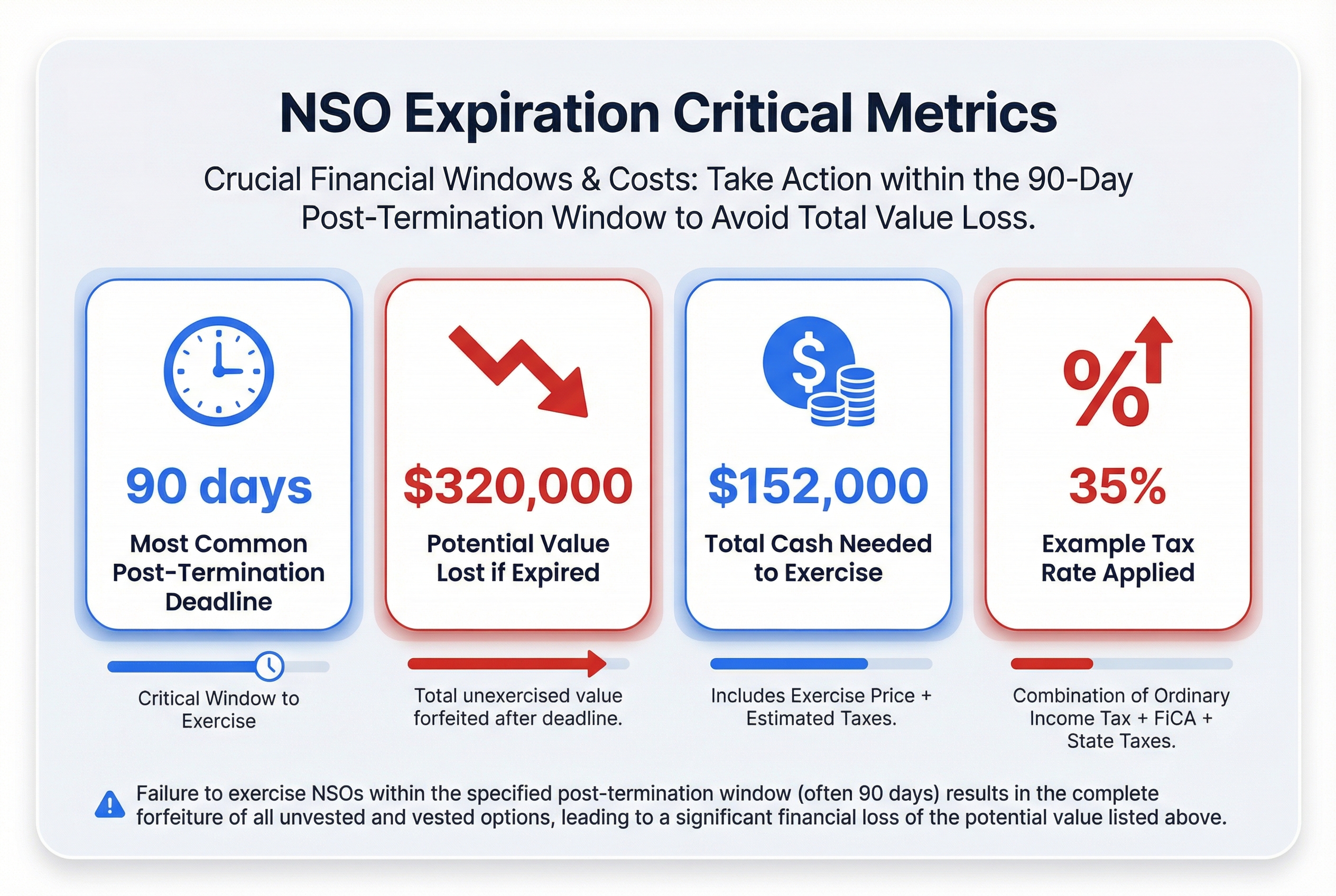 Know Your Deadlines: The 90-day window after leaving a company is the most common time employees lose their NSO value by failing to exercise.
Special Tax Situations: Contractors, Board Members, and Multi-State Workers
NSO taxes for contractors are like doing your taxes as a freelancer. You're responsible for tracking everything yourself and paying quarterly. No employer withholding to save you.
If You're a Contractor or Board Member
Here's what changes when you're not a W-2 employee:
You get a 1099-NEC instead of a W-2. The company reports your bargain element (FMV minus strike price) on Form 1099-NEC, not your W-2. This shows up as non-employee compensation.
You owe self-employment tax instead of FICA. Employees pay 7.65% FICA (Social Security and Medicare), with the employer matching another 7.65%. Contractors pay both halves, roughly 15.3%, called self-employment tax.
You must make quarterly estimated payments. No employer withholding means you send checks to the IRS yourself. Miss these deadlines and you'll owe penalties.
Let's see the real cost difference:
Lisa, a contractor, exercises 3,000 NSOs at a $10 strike price when FMV is $60. Her bargain element is $150,000 ($60 minus $10, times 3,000 shares).
She receives a 1099-NEC showing $150,000 in income. She owes:
- Federal income tax: ~$52,500 (at 35% bracket)
- Self-employment tax: ~$21,186 (15.3% on most of it)
- Total tax bill: ~$73,686
Her employee colleague with the identical exercise pays FICA instead of self-employment tax. The company handles withholding automatically. The employee's total is slightly lower because the employer pays half the FICA.
Board members follow the same 1099-NEC rules as contractors.
If You Work Remotely or Moved Between States
This gets messy fast. Different states claim the right to tax your NSO income using different rules.
Some states tax based on where you lived when options were granted. They argue you earned those options while living there.
Other states tax based on where you exercised. They want their cut of income earned in their state.
You might owe taxes in multiple states. And yes, you might need to file returns in each one.
Here's a real scenario:
Jake received NSOs while living in Texas (no state income tax). He moved to California and worked there for two years while the options vested. Then he moved to Oregon and exercised his options there.
California says: "You earned part of those options while working here. We get to tax our portion." Oregon says: "You exercised here. We tax the income." Texas stays quiet (no income tax).
Jake needs to:
- Calculate what portion of his bargain element California can tax (based on days worked there)
- Pay Oregon tax on the full amount
- Claim a credit on his Oregon return for taxes paid to California
- File returns in both states
Think of it like splitting a restaurant bill when people ordered different things. Each state wants their fair share, but figuring out "fair" requires math and often a tax professional.
The allocation formula matters. Most states use: (Days worked in State A / Total days from grant to exercise) × Bargain element. But some states have their own rules.
Moving makes your tax situation complex enough that DIY software might not cut it. Consider hiring a CPA who knows multi-state taxation.
Now that you understand these special situations, let's talk strategy. When should you actually exercise your NSOs to minimize your total tax bill?
Your NSO Tax Strategy: When to Exercise and When to Wait
Here's the truth: there's no perfect time to exercise NSOs. It's like deciding when to harvest crops. Too early and they haven't grown much. Too late and you might lose everything to a storm.
But you can make a smarter decision by understanding the trade-offs.
The Core Question: Tax Now or Tax Later?
Every NSO exercise comes down to one question: do you want to pay less tax on a smaller gain, or more tax on a bigger gain?
Early exercise = lower taxes, higher risk. You pay tax on a small spread now, but you're betting real money on shares you can't sell yet.
Late exercise = higher taxes, lower risk. You wait until the company is worth more (or goes public), pay more tax, but you have more certainty about what you're getting.
When Early Exercise Makes Sense
Consider exercising early if:
- The FMV is still close to your strike price. If you have 10,000 NSOs at a $2 strike and the FMV is $5, you only owe tax on $3 per share. That's $10,500 in taxes (at 35%) for shares that could be worth much more.
- You believe in the company's future. You're willing to risk the tax money because you think these shares will 10x.
- You can afford the tax bill without stress. You have cash sitting around that won't hurt to lose.
- You want long-term capital gains treatment. The sooner you exercise, the sooner your capital gains holding period starts.
When Waiting Makes More Sense
Hold off on exercising if:
- You don't have cash for the tax bill. Going into debt to pay NSO taxes is almost never smart.
- You're in a high tax bracket this year. If you're earning $400k and the spread is large, you could pay 37% federal plus state taxes. Ouch.
- The company is close to going public. If an IPO is 6-12 months away, you might wait for liquidity. Yes, you'll pay more tax, but you can do a cashless exercise and walk away with actual money.
- You're not sure about the company's prospects. Don't pay real taxes on imaginary gains.
Three Real Scenarios: Same NSOs, Different Outcomes
Let's say you have 10,000 NSOs with a $2 strike price. Here's how different timing plays out:
Scenario A (Early Exercise): You exercise now when FMV is $5. You pay $10,500 in taxes today. Four years later, the company IPOs at $80 per share. You sell and owe long-term capital gains on the $75 per share gain ($800,000 total). At 20%, that's $150,000 in capital gains tax.
Total tax paid: $160,500 Cash after taxes: $639,500 Risk: High (you paid $10,500 for illiquid shares)
Scenario B (Wait for Pre-IPO Growth): You wait until the company is worth more. At $50 FMV, you exercise. You pay ordinary income tax on $48 per share ($480,000 spread). At 35%, that's $168,000. One year later, the company IPOs at $80. You sell and owe long-term capital gains on $30 per share ($300,000 gain). At 20%, that's $60,000.
Total tax paid: $228,000 Cash after taxes: $572,000 Risk: Medium (you paid $168,000 for illiquid shares)
Scenario C (Wait for IPO): You wait until the IPO at $80. You do a cashless exercise, selling enough shares to cover the exercise cost and taxes. The $78 spread ($780,000) is all ordinary income. At 35%, you owe $273,000 in taxes.
Total tax paid: $273,000 Cash after taxes: $507,000 Risk: Low (you got actual cash immediately)
Notice the pattern? Lower risk = higher taxes. Higher risk = lower taxes. There's no free lunch.
How to Spread Exercises Across Tax Years
If you have a lot of NSOs, you don't have to exercise them all at once. Spreading exercises across multiple years can keep you out of higher tax brackets.
Example: You have 20,000 NSOs at a $5 strike, FMV is $25. The spread is $400,000. If you exercise all at once, much of that income gets taxed at 35% or even 37%.
Instead, exercise 10,000 this year ($200,000 income) and 10,000 next year. You might stay in the 32% bracket instead of jumping to 37%. That's $20,000 in tax savings.
The catch? You need time. If your NSOs expire in six months, this won't work.
Don't Let the Tax Tail Wag the Investment Dog
Here's what matters most: do you believe in the company?
If you think the shares will be worth 10x more, paying 35% tax now beats paying 20% tax on zero later.
If you think the company is struggling, don't exercise just to "save on taxes." You can't save your way to wealth by making bad investments.
Model it out with real numbers. Use a spreadsheet. Plug in different FMV scenarios, different tax rates, different holding periods. See what you'd actually net in each case.
And remember: private company shares are illiquid. You can't just sell them if you need cash. That $10,500 tax bill in Scenario A? That's real money you can't get back until there's a liquidity event, which might be never.
Your Decision Framework
Ask yourself these questions:
- How much cash do I have available for taxes?
- What tax bracket am I in this year?
- How confident am I in this company's future?
- How long until I can potentially sell these shares?
- What happens if the company fails and these shares become worthless?
If you can answer those honestly, you'll know whether to exercise now or wait.
Now let's look at the biggest mistakes people make with NSOs, and how you can avoid them.
Avoiding the Biggest NSO Tax Mistakes
NSO tax mistakes are like forgetting to pay a credit card bill. What seems like a small oversight compounds into something expensive and sometimes unfixable.
Here are the costliest errors people make, and how to avoid them.
Missing the 83(b) Election Deadline
If you early exercise NSOs before they vest, you have exactly 30 days to file an 83(b) election with the IRS. Miss this deadline by even one day, and you can't fix it.
Sarah early exercised 50,000 NSOs at $1 per share when the fair market value was also $1. She forgot to file the 83(b) election. Two years later when her shares vested, the stock was worth $30 per share. Because she missed the deadline, she owed taxes on $1.45 million of ordinary income instead of zero. The mistake cost her over $500,000 in unnecessary taxes.
How to avoid it: Set three calendar reminders (day 10, day 20, day 28). Mail the form certified with return receipt. Keep proof forever.
Letting NSOs Expire After Leaving
Most NSOs expire 90 days after you leave your company. The clock starts ticking the day you resign.
Michael had NSOs worth $200,000 in profit. He got busy with his new job and forgot about them. Day 91 came and went. His options expired worthless. That $200,000 vanished completely.
How to avoid it: Mark your termination date on a calendar immediately. Calculate your exercise deadline (usually 90 days). Decide within the first week whether you'll exercise.
Not Saving Cash for the Tax Bill
When you exercise NSOs, you create a tax bill due the following April (or quarterly if you're self-employed). Many people spend their money and get blindsided.
Think of it like buying a car with a credit card. The bill always comes due.
How to avoid it: The moment you exercise, transfer 40% of the income created into a separate savings account. Don't touch it until tax day.
The December Exercise Trap
This is where people lose the most money without realizing it.
Mistake spotlight: James exercised NSOs in early December, creating $300,000 in ordinary income. He was already at $150,000 salary. The additional income pushed him into the 35% bracket instead of 24%, and he lost various deductions due to income phaseouts. If he'd waited until January 2nd to exercise, he would have spread the income across two tax years and saved approximately $25,000 in federal taxes.
Lesson: December exercises are dangerous for large amounts.
How to avoid it: Exercise large amounts in January, not December. This gives you the full year to manage your tax bracket.
Losing Track of Your Cost Basis
Your cost basis is what you paid (strike price) plus the taxes you already paid when you exercised. You need this number when you sell shares, sometimes years later.
Without accurate records, you'll pay taxes twice on the same income.
How to avoid it: Create a spreadsheet the day you exercise. Record: exercise date, number of shares, strike price, fair market value, taxes paid. Keep your W-2 or 1099 from that year showing the income.
Exercising Underwater Options
Underwater means the strike price is higher than the current stock value. Exercising these options is like buying a $50 item for $75. You lose money immediately.
How to avoid it: Never exercise if strike price exceeds fair market value. Just let them expire. The only exception is if you have absolute certainty the stock will recover and you want to start your capital gains holding period.
Not Coordinating with a Tax Professional
The biggest exercises deserve professional help. A $50,000 exercise creates a $20,000 tax bill. Spending $500 for tax advice is cheap insurance.
How to avoid it: Before exercising more than $100,000 worth of NSOs, talk to a CPA who specializes in equity compensation. The fee pays for itself.
Now that you know the mistakes to avoid, let's create your personal action plan.
Your Next Steps: Creating Your NSO Tax Action Plan
You've learned how NSO taxes work. Now it's time to build your personal action plan.
Think of creating an NSO tax plan like packing for a long trip. You need to gather information, check deadlines, and prepare for different scenarios. The more organized you are now, the fewer surprises you'll face later.
Your 90-Day Action Checklist
Follow these steps to take control of your NSO tax situation:
Days 1-7: Gather Your Information
- Find all your option grant documents (check your equity portal, email, or HR)
- Write down the details for each grant: number of options, strike price, vesting schedule, expiration date
- Check your company's post-termination exercise period (don't assume it's 90 days)
- Ask HR if your company allows early exercise
- Get the current 409A valuation (the FMV used for tax calculations)
Days 8-30: Run the Numbers
- Open a spreadsheet to track all your grants and exercises
- Calculate your tax bill for different exercise scenarios (use the formulas from earlier sections)
- Identify which grants you might want to exercise first based on taxes and timing
- Calculate how much cash you'll need for exercise costs plus taxes
Days 31-60: Get Professional Help
- Schedule a meeting with a tax professional before exercising large amounts (over $10,000 in taxes)
- Ask about your specific state tax situation
- Discuss whether early exercise makes sense for you
- Review estimated tax payment requirements
Days 61-90: Set Up Your System
- Set calendar reminders for all vesting dates and expiration dates (especially the 10-year mark)
- Create alerts for 6 months before expiration as a final warning
- If you plan to exercise soon, open a high-yield savings account and start building your tax reserve
- Review your plan and adjust based on what you learned
Real Example: Maria's 90-Day Plan
Maria works at a tech company with three NSO grants totaling 15,000 options. Here's what she did:
Day 1: Found her grant documents. She has 5,000 NSOs at $8 strike price (fully vested, expires in 2 years), 5,000 at $12 (vesting monthly), and 5,000 at $20 (just granted).
Day 7: Calculated taxes for exercising her first grant. At current FMV of $25, exercising 5,000 options means $85,000 in income ($25 - $8 = $17 spread × 5,000). Estimated tax bill: $32,000.
Day 14: Met with her CPA. Decided to wait until January to exercise (better cash flow after bonus, can spread tax payments across the year).
Day 30: Set calendar reminders for her first grant's expiration date in March 2027, plus a 6-month warning in September 2026.
Day 60: Opened a separate savings account. Started automatically transferring $1,500 per month to build her $32,000 tax reserve.
Day 90: Reviewed everything. Decided to exercise the first 5,000 NSOs in January and reassess the others next year.
Questions to Ask Your Tax Professional
Don't go into your meeting unprepared. Bring these questions:
- Should I exercise some NSOs this year or wait until next year?
- How much should I set aside for estimated taxes?
- Does early exercise make sense for any of my grants?
- What happens to my NSO taxes if I move to another state?
- Should I exercise in multiple smaller batches or all at once?
- How do I report NSO exercises on my tax return?
Questions to Ask Your Company
Your HR or equity team can answer these:
- What is our current 409A valuation (FMV)?
- How often does the 409A get updated?
- Do you allow early exercise?
- What is the post-termination exercise period? (Get this in writing)
- Can I do a cashless exercise?
- What are the wire instructions for exercise payments?
Build Your Cash Reserve
If you plan to exercise NSOs while your company is private, you'll need cash for two things: buying the shares and paying taxes.
Start saving now. Even $500 per month adds up to $6,000 in a year. That could cover the taxes on exercising 1,500 NSOs with a $15 spread.
Put this money somewhere safe and accessible. A high-yield savings account works well. You're not investing for growth. You're building a tax fund.
Track Everything in a Spreadsheet
Create a simple spreadsheet with these columns:
- Grant date
- Number of options
- Strike price
- Vesting schedule
- Expiration date
- Exercise date (when you exercise)
- FMV at exercise
- Tax paid
- Shares owned
- Cost basis per share
Update it every time something changes. This becomes your single source of truth.
When tax time comes, you'll have everything organized. When you eventually sell shares, you'll know exactly what you paid (your cost basis).
Review Your Plan Annually
Your NSO situation changes over time. New grants vest. Company valuation goes up (or down). Your income changes. Tax laws change.
Set a calendar reminder every January to review:
- Which options are now fully vested?
- Are any options approaching expiration?
- Has the company's FMV changed significantly?
- Do I have cash saved for exercise taxes?
- Should I adjust my exercise timeline?
What If You're Leaving Your Company?
If you're considering leaving, your timeline compresses dramatically. Most companies give you only 90 days to exercise after termination.
Before you give notice:
- Know exactly which options are vested
- Calculate the total exercise cost plus taxes
- Confirm you have enough cash available
- Understand the post-termination exercise period in writing
- Talk to a tax professional about the timing
Don't wait until your last day to figure this out. You might discover you need $50,000 in cash and have only 90 days to come up with it.
The Bottom Line
You don't need to become a tax expert. You just need to be organized and proactive.
Gather your documents. Run the numbers. Set reminders. Talk to professionals before making big decisions. Save money if you plan to exercise.
NSO taxes are complicated, but your action plan doesn't have to be. Start with step one today. Future you will be grateful.
Frequently Asked Questions
[ANSWER NEEDED]
[ANSWER NEEDED]
[ANSWER NEEDED]
[ANSWER NEEDED]
[ANSWER NEEDED]
[ANSWER NEEDED]
[ANSWER NEEDED]
[ANSWER NEEDED]
Educational Content Only
This content is for educational purposes only and does not constitute financial advice. The information provided is general in nature and may not appl...
YourEmployeeStock.com is not a registered investment advisor.
Related Articles
ESPP Tax Rules: A Simple Guide to What You'll Owe (With Examples)
ESPP taxes confuse even smart employees because the rules change based on how long you hold your shares. This guide walks you through the two types of sales (qualifying vs. disqualifying), shows you exactly what you'll owe with real examples, and helps you avoid the most common costly mistakes.
BasicsEquity Compensation Basics: A Simple Guide to Understanding Your Stock Benefits
Equity compensation means getting paid partly in company stock instead of just cash. This guide breaks down what equity compensation is, the main types you'll encounter (RSUs, stock options, ESPP), how it affects your total pay, and what you need to know to make smart decisions about your stock benefits.
ESPPHow ESPP Works: Your Complete Guide to Employee Stock Purchase Plans
An Employee Stock Purchase Plan (ESPP) lets you buy your company's stock at a discount, usually 10-15% off. This guide explains how ESPP works from enrollment through selling shares, including the tax rules that determine how much money you keep. You'll learn the exact steps, see real dollar examples, and discover strategies competitors don't share.
Not sure what to do with your equity?
Get a free personalized analysis