

Cashless Exercise Explained: How to Exercise Stock Options Without Paying Cash Upfront
Exercise your stock options without draining your bank account
Published March 1, 2026 · Updated March 1, 2026
A cashless exercise lets you exercise stock options without paying cash upfront by simultaneously selling some shares to cover costs. This guide explains how it works, compares it to cash exercise, covers tax implications, and helps you decide if it's the right choice for your situation.
The Cash Crunch: Why Exercising Stock Options Can Feel Impossible
Sarah just checked her equity dashboard and saw something exciting. Her 1,000 stock options are worth $40,000 more than when she got them. The strike price is $10 per share, but the stock now trades at $50. That's a $40,000 paper gain.
Then reality hits. To exercise those options and actually own the shares, she needs $10,000 cash upfront. That's 1,000 shares times the $10 strike price she agreed to pay. But it gets worse. The IRS treats that $40,000 gain as income, so she'll owe taxes immediately. Depending on her tax bracket, that could be another $15,000 out of pocket.
She needs $25,000+ in cash just to claim stock she already earned.
Think of it like winning a house on a game show. You won it, but you still need a down payment to actually move in. Most people don't have that kind of money sitting around. Even if Sarah does have $25,000 saved, does she really want to tie it all up in one company's stock? That feels risky.
This is where cashless exercise comes in. It's the most popular way to exercise stock options at public companies because it solves exactly this problem. You can exercise your options and cover all the costs without writing a single check. The shares themselves pay for everything.
Here's how it works.
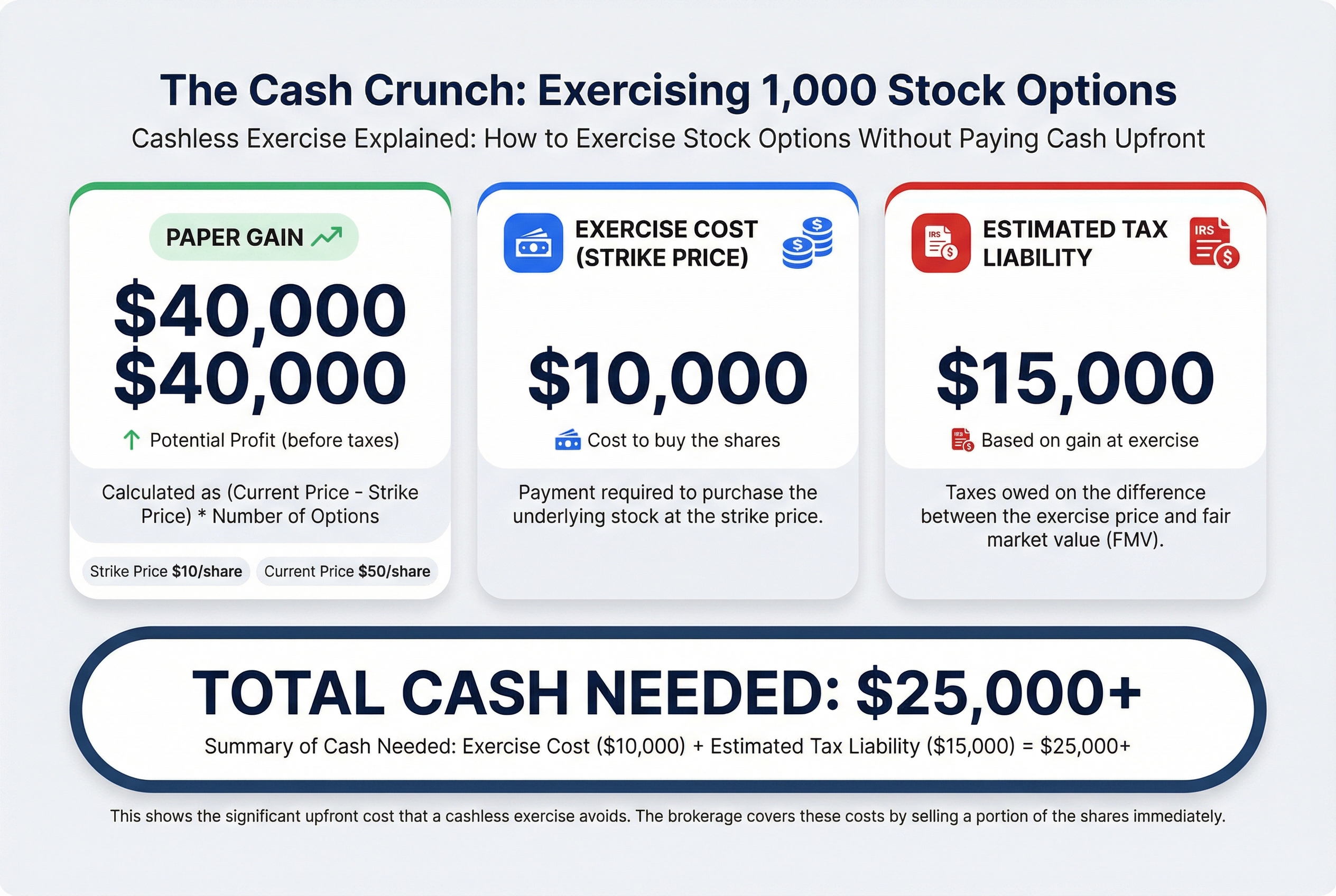 The Cash Crunch: Sarah needs $25,000+ in cash upfront to exercise 1,000 options with a $10 strike price when the stock trades at $50, despite a $40,000 paper gain.
What Is a Cashless Exercise? The Basics in Plain English
A cashless exercise means you exercise your stock options and sell shares at the same time, in one coordinated transaction. The sale proceeds cover your exercise cost automatically. You never write a check or move money from your bank account.
Think of it like trading in your old car when buying a new one. The dealer uses your trade-in value toward the purchase price. You drive away in a new car without pulling cash from your wallet. That's exactly how cashless exercise works with your stock options.
Here's a simple example with round numbers:
You have 1,000 stock options with a $20 strike price. Your company's stock trades at $50 per share. To exercise normally, you'd need $20,000 cash ($20 × 1,000 shares).
With a cashless exercise, your broker handles everything simultaneously:
- They exercise all 1,000 options
- They immediately sell 400 shares for $20,000 (400 × $50 = $20,000)
- That $20,000 pays your strike price
- You keep the remaining 600 shares worth $30,000
You paid nothing out of pocket. The broker coordinated the whole transaction.
Why it's called "cashless": You don't spend your own money. The shares you sell generate the cash needed to buy the shares you keep. Your broker typically also withholds shares to cover taxes, so you end up with fewer than 600 shares, but still zero cash spent.
One important catch: Cashless exercise only works at public companies where shares can be sold immediately. Some private companies offer it during special liquidity events, but most private company employees can't use this option.
Now that you understand the basic concept, let's look at the two specific types of cashless exercise and how they differ.
The Two Types of Cashless Exercise: Sell-to-Cover vs. Same-Day Sale
When you do a cashless exercise, you pick between two paths. Both let you exercise without paying cash upfront, but they give you very different results.
Sell-to-Cover: Keep Some Shares
Think of sell-to-cover like selling just enough Girl Scout cookies to pay for your uniform. You sell what you need, then keep the rest.
Here's how it works. Your broker sells only enough shares to cover your exercise cost and taxes. You keep the remaining shares as stock.
Real example: You exercise 1,000 options with a $15 strike price. The stock is trading at $40.
- Exercise cost: $15,000 (1,000 shares × $15)
- Your gain: $25,000 ($40 - $15 = $25 per share)
- Taxes owed: $9,000 (roughly 36% of your $25,000 gain)
- Total you need: $24,000 ($15,000 + $9,000)
Your broker sells 600 shares at $40 each. That generates $24,000 to cover everything. You keep 400 shares worth $16,000.
You now own company stock. If it goes up, you win. If it drops, you lose.
Same-Day Sale: Cash Out Completely
A same-day sale is like flipping a house for profit without ever moving in. You exercise and immediately sell everything.
Same example, different ending: Same 1,000 options at $15 strike, stock at $40.
- Broker sells all 1,000 shares for $40,000
- Pays the $15,000 exercise cost
- Pays the $9,000 in taxes
- You get $16,000 in cash
No shares. No stock risk. Just cash in your account.
The Key Difference
Both methods give you $16,000 in value. But sell-to-cover gives you stock that could go up or down. Same-day sale gives you cash that stays cash.
Most brokers let you choose which type when you exercise. You're not locked into one or the other.
Now that you know what you end up with, let's look at exactly how your broker pulls this off behind the scenes.
Stock Option Exercise Methods Explained: Cashless, Cash, and Sell-to-Cover
How the Cashless Exercise Transaction Actually Works (Behind the Scenes)
Think of a cashless exercise like an assembly line at a factory. Each station does one specific job, and the whole process runs automatically once you press the start button.
Here's what actually happens when you click "exercise" in your brokerage account.
The Step-by-Step Process
Step 1: You submit the exercise request. You log into your stock plan portal (like E*TRADE, Fidelity, or Schwab) and select cashless exercise for however many options you want to convert.
Step 2: Your broker places a sell order. Within minutes, the broker calculates how many shares they need to sell to cover your costs. They immediately place a market order to sell those shares.
Step 3: Your company issues new shares. The stock plan administrator contacts your company, which creates brand new shares and issues them to you. This is the actual "exercise" happening.
Step 4: The shares sell at market price. Your broker sells the required number of shares at whatever the current stock price is. This sale generates cash.
Step 5: The broker pays everyone. The sale proceeds get divided up. Part pays your strike price to the company. Part covers your tax withholding. What's left becomes shares in your account (sell-to-cover) or cash (same-day sale).
Step 6: You see the results. Within 2-3 business days, your remaining shares or cash appear in your brokerage account.
Real Timeline Example
Monday 9:00am: You log into E*TRADE and select cashless exercise for 500 options at a $20 strike price. Current stock price: $60 per share.
Monday 10:15am: E*TRADE places a sell order for 200 shares at the market price of $60.
Monday 11:00am: Your company's stock plan administrator issues you 500 new shares.
Monday 11:05am: The 200 shares sell for $12,000 total.
Tuesday: E*TRADE uses $10,000 from the sale to pay your strike price (500 options × $20). Another $2,000 goes toward tax withholding.
Wednesday: Your 300 remaining shares appear in your brokerage account.
The entire process runs on autopilot. You don't need to monitor it or take any additional steps. Your broker and company handle all the coordination behind the scenes.
Now that you understand the mechanics, let's tackle the part everyone dreads: taxes.
How to Exercise your Stock Options on a $0 Budget
The Tax Hit: What You'll Owe When You Do a Cashless Exercise
Here's the part that catches most people off guard: cashless exercise doesn't mean tax-free exercise.
When you do a cashless exercise, you owe taxes on the "spread." That's the difference between your strike price and the market price when you exercise. Think of it like getting a bonus check. If your company gives you $50,000, you don't get to keep all $50,000. The IRS takes their cut first.
How the Spread Becomes Taxable Income
The spread gets added to your W-2 as ordinary income. It's taxed at your regular income tax rate, just like your salary.
Let's say you exercise 1,000 NSOs with a $20 strike price when the stock is trading at $70. The spread is $50 per share, which equals $50,000 total. That entire $50,000 shows up on your W-2 as taxable income.
If you're in the 32% federal tax bracket and pay 5% state tax, here's what you owe:
- Federal tax: $16,000 (32% of $50,000)
- State tax: $2,500 (5% of $50,000)
- Total tax bill: $18,500
How Taxes Get Withheld in a Sell-to-Cover
Your employer withholds taxes automatically, usually between 22% and 37% for federal, plus whatever your state requires. In a sell-to-cover transaction, the broker sells extra shares to cover this tax bill.
Using our example above, the broker would sell:
- 286 shares to cover the $20,000 exercise cost ($20 × 1,000 shares)
- 265 shares to cover the $18,500 tax bill
- You keep approximately 449 shares (1,000 - 286 - 265)
Special Note About ISOs
If you have incentive stock options (ISOs), doing a cashless exercise kills their tax advantages. ISOs normally get special treatment, but a same-day sale turns them into regular NSOs for tax purposes. You lose the preferential capital gains treatment. (We have a separate guide on ISO tax strategy if you want the full details.)
The Tax Day Surprise
Here's a critical warning: the automatic withholding might not cover your full tax bill. If you're a high earner or live in a high-tax state, you could owe more when you file your return. Plan accordingly.
Now that you understand the tax cost, let's compare whether cashless exercise or paying cash upfront actually saves you money in the long run.
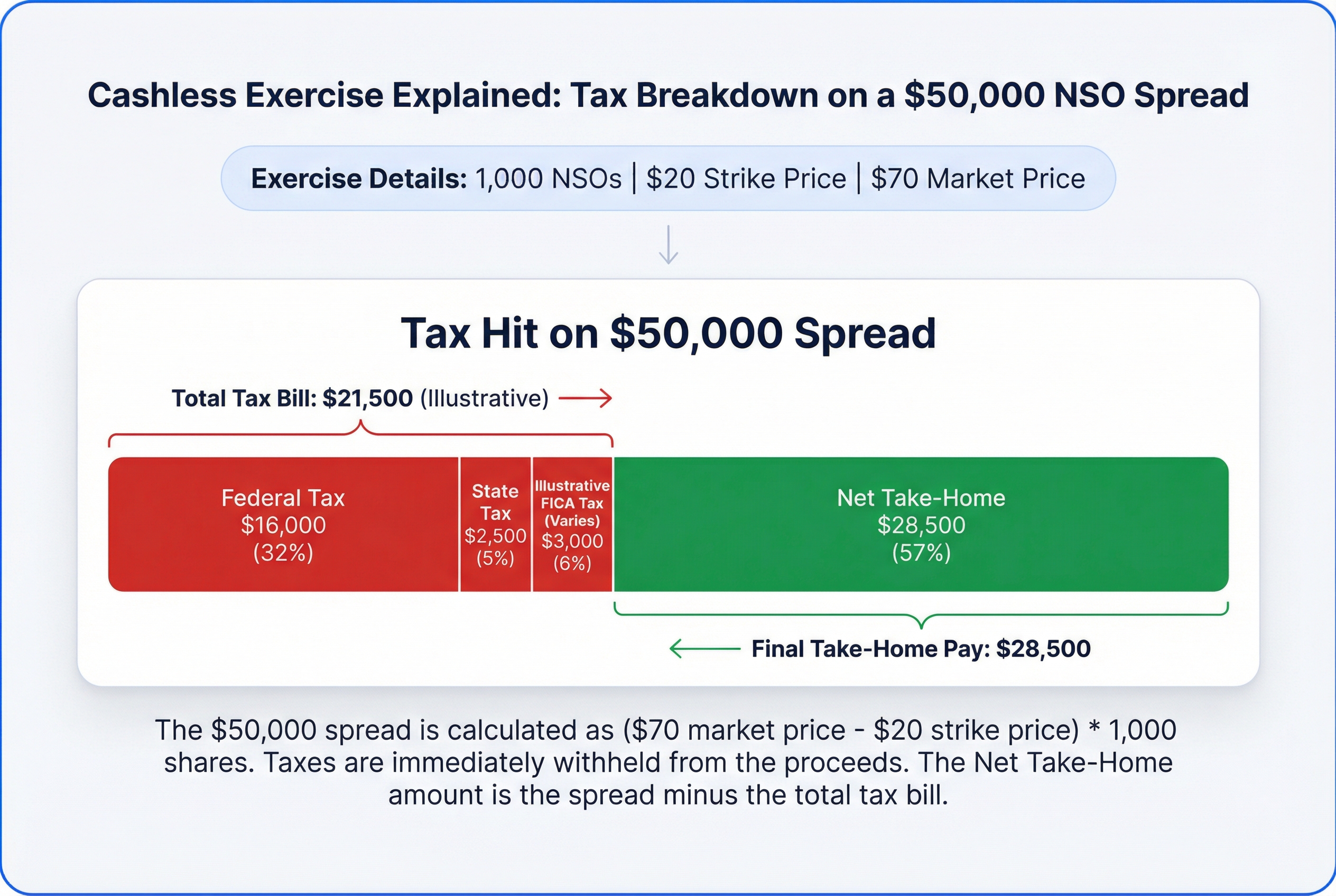 Taxable Spread: The $50,000 spread from exercising 1,000 NSOs at a $70 market price is treated as ordinary income.
Cashless Exercise vs. Cash Exercise: Which Costs You More Long-Term?
Think of cashless exercise like renting a house. It's easier right now because you don't need a down payment. But over time, you pay more and build less wealth.
Cash exercise is like buying that house. You need money upfront, but you save thousands in the long run and own something that can grow in value.
Let's compare them side by side with real numbers.
The Same Starting Point
You have 1,000 stock options with a $30 strike price. Your company's stock is trading at $80 today. That means you have a $50,000 gain on paper ($80 - $30 = $50 per share × 1,000 shares).
Path 1: Cashless Exercise (Same-Day Sale)
You exercise and immediately sell all 1,000 shares. Here's what happens:
- You pay no money upfront
- You owe taxes on the $50,000 spread at ordinary income rates
- Your tax bill: $18,500 (37% federal + state, assuming you're in a high tax bracket)
- You walk away with: $31,500 in cash
- Shares you own after: zero
Path 2: Cash Exercise
You pay $30,000 to exercise and hold the shares. One year later, the stock hits $120. You decide to sell:
- Initial cost: $30,000 out of pocket
- You own 1,000 shares worth $80,000 on day one
- One year later at $120: shares worth $120,000
- Your total gain from $30 to $120: $90,000
- Tax on the gain: $18,000 (20% long-term capital gains rate)
- You receive: $102,000 from the sale
- Subtract your initial $30,000 investment
- Your profit: $72,000
The Bottom Line Comparison
- Cashless profit: $31,500
- Cash exercise profit: $72,000
- Difference: $40,500 more with cash exercise
That's not a typo. Cash exercise can net you $40,500 more in this scenario.
Why Cash Exercise Wins (When It Works)
Three reasons explain the massive difference:
Tax rates matter. Ordinary income tax hits 37% to 52% depending on your state. Long-term capital gains max out at 20% federal (23.8% with Medicare tax). That's a 15 to 20 percentage point difference. On a $50,000 gain, that saves you $7,500 to $10,000 right there.
You own more shares. With cashless, you sell everything immediately. With cash exercise, you keep 1,000 shares that can grow. In our example, those shares went from $80 to $120. That extra $40 per share ($40,000 total) only happens if you own the shares.
Gains stack on gains. Your profit from $30 to $80 gets taxed at lower rates. Then your profit from $80 to $120 also gets taxed at those same lower rates. With cashless, you miss that second gain entirely.
When Cashless Still Makes Sense
Cash exercise requires two things most people don't have:
- $30,000 (or whatever your exercise cost is) sitting in your bank account
- Confidence that your company's stock will keep rising
If you can't check both boxes, cashless is your only realistic option. Getting $31,500 today beats getting $0 because you couldn't afford to exercise.
The next section shows you exactly how to calculate how many shares you'll sell and keep with each method.
Why cashless exercise of ESOPs is more than just one of the exercise ways? by Sudhanshu Mishra
Calculating Exactly How Many Shares You'll Sell (and Keep)
Think of this like figuring out how many pizzas to sell at a fundraiser to cover both the cost of making them AND the taxes you owe on the profit. You need to know three numbers: what you paid to make them, what you owe in taxes, and what each pizza sells for.
Here's the simple formula that works every time:
Shares to sell = (Exercise cost + Tax owed) ÷ Current share price
Let's break down each piece.
Step 1: Calculate Your Exercise Cost
This is easy. Multiply the number of options you want to exercise by your strike price.
Exercise cost = Number of options × Strike price
If you're exercising 500 options with a $25 strike price, that's 500 × $25 = $12,500.
Step 2: Calculate Your Taxable Gain
This is the profit you're making on paper. Subtract your strike price from the current share price, then multiply by the number of options.
Taxable gain = (Current price - Strike price) × Number of options
With a current price of $100 and a strike price of $25, you're making $75 per share in profit. For 500 options, that's ($100 - $25) × 500 = $37,500 in taxable income.
Step 3: Calculate Your Tax Bill
Multiply your taxable gain by your combined tax rate. This includes federal income tax, state income tax, and any local taxes.
Tax owed = Taxable gain × Your tax rate
If your combined rate is 40%, you owe $37,500 × 0.40 = $15,000 in taxes.
Your tax rate depends on your total income and where you live. A tax calculator or your tax advisor can give you an exact number. Most people with NSOs fall between 35% and 50% when you add everything up.
Step 4: Add It All Together
Now add your exercise cost and your tax bill.
Total to cover = Exercise cost + Tax owed
In our example: $12,500 + $15,000 = $27,500. This is the total dollar amount you need to raise by selling shares.
Step 5: Convert Dollars to Shares
Divide that total by the current share price. This tells you exactly how many shares you need to sell.
Shares to sell = Total to cover ÷ Current share price
You need $27,500 ÷ $100 = 275 shares.
The Final Tally
You started with 500 options. You sell 275 shares to cover everything. You keep 225 shares worth 225 × $100 = $22,500.
Your Fill-in-the-Blank Worksheet
Here's a template you can use with your own numbers:
- Exercise cost = _____ options × $_____ strike price = $_____
- Taxable gain = ($_____ current price - $_____ strike price) × _____ options = $_____
- Tax owed = $_____ taxable gain × _____ your tax rate = $_____
- Total to cover = $_____ exercise cost + $_____ tax owed = $_____
- Shares to sell = $_____ total ÷ $_____ current price = _____ shares
- Shares you keep = _____ options - _____ shares sold = _____ shares
Two Important Notes
First, brokers play it safe. They often withhold a bit more than the minimum required. They'd rather over-withhold and have you get a refund than under-withhold and leave you with a surprise tax bill in April.
Second, you usually get to choose. Most exercise forms let you pick between "sell to cover" (sell just enough to pay costs and taxes) or "same-day sale" (sell everything). The math above helps you understand what "sell to cover" actually means.
Now that you know the math, let's talk about what your HR department might not be telling you about how this whole process really works.
What Your HR Department Won't Tell You About Cashless Exercise
Your HR team isn't hiding information on purpose. They just don't know all the messy details that happen after you click "submit" on that exercise form.
Think of cashless exercise like buying a car. The sticker price looks good until you see the dealer prep fee, documentation fee, and destination charge. Your stock options work the same way.
The Fees Nobody Mentions
Your broker charges $10 to $50 per cashless exercise transaction. That comes straight out of your proceeds.
Say you exercise 1,000 options with a $30 strike price. The stock is trading at $50. You expect to pocket $20,000 (the $20 spread times 1,000 shares). But the broker takes $35 off the top. You're already down to $19,965.
The Settlement Gap Can Hurt You
Here's the bigger problem. When you exercise on Monday, the shares don't settle until Wednesday or Thursday. The stock price can drop during that 2-3 day window.
Real example: Tom exercises 1,000 options on Monday at $50/share using cashless. The broker charges $35 in fees. By Wednesday when settlement happens, the stock has dropped to $48. His 400 shares sold at $48 ($19,200) instead of the expected $50 ($20,000). After the $35 fee, he has $19,165 to cover his $20,000 exercise cost. He needs to add $835 from his own pocket.
You thought you were avoiding a cash payment. Now you're scrambling to find $835.
Blackout Periods Lock You Out
If you're a VP or above, you face blackout periods. These are weeks (sometimes months) when you can't trade company stock.
Real example: Maria is a VP and wants to exercise during Q4. Her company has a blackout period from December 15 to January 31 for earnings. She misses her window and the stock drops 15% by the time the blackout lifts.
Most companies have blackouts before earnings announcements. That's 4-8 weeks per year when you can't act, even if your options are about to expire.
Transaction Limits You Didn't Know About
Some companies cap how many options you can exercise in a single transaction. The limit might be 5,000 or 10,000 shares. If you have 20,000 options, you need multiple exercises. That means multiple broker fees.
Your Withholding Might Fall Short
Your employer withholds taxes at a standard rate (usually 22% federal). But your actual tax rate depends on your total income.
If you make $200k and exercise options worth another $100k, you're in a higher bracket. The 22% withholding won't cover your real tax bill. You'll owe more in April.
The AMT Trap (Yes, Even with NSOs)
You normally don't worry about Alternative Minimum Tax with NSOs. But if you have other AMT triggers (like ISO exercises from a previous job, or high state taxes), a big cashless exercise can push you into AMT territory.
Most people don't discover this until their tax preparer delivers bad news.
Section 16 Restrictions for Executives
If you're an executive or own more than 10% of the company, you face Section 16 rules. You must report trades to the SEC. You can only trade during specific windows. And you might need pre-clearance from your legal department.
These rules add 1-2 weeks to your timeline. By the time you get approval, the stock price might have moved.
The bottom line: Cashless exercise isn't as simple as "no cash needed." You need to plan for fees, settlement risk, blackout periods, and potential tax surprises. The next section covers whether you can even use cashless exercise if you work at a private company (spoiler: it's complicated).
Can You Do a Cashless Exercise at a Private Company?
Short answer: probably not. And here's why.
Cashless exercise needs a buyer waiting on the other side. Think of it like trying to sell your house in a town with no real estate market. You can't do a quick sale if nobody's there to buy.
Public companies have stock markets where millions of shares trade every day. Your broker can sell your shares instantly. Private companies don't have this. There's no market, no buyers lined up, no instant transactions.
Why Most Private Companies Can't Offer Cashless Exercise
The math doesn't work without a liquid market. Remember, cashless exercise means:
- Someone exercises your options (creates shares)
- Someone immediately sells enough shares to cover the cost
- You keep the rest
That middle step requires an actual buyer. At private companies, finding buyers takes weeks or months, not seconds.
Three Scenarios Where It Might Be Possible
Tender offers. Sometimes your company or an outside investor (like a VC firm) wants to buy shares from employees. The company might allow cashless exercise during this window.
Here's how it works: Your startup announces a tender offer with a VC firm. You have 2,000 options at a $1 strike price. The tender offer price is $15 per share. During the 2-week window, the administrator handles everything. They exercise your options (creating 2,000 shares for $2,000), immediately sell 134 shares to the VC for $2,000 to cover your exercise cost, and you keep 1,866 shares.
The catch? Tender offers usually have minimums. This one requires $10,000 minimum, so you'd need at least 667 options to participate.
Secondary marketplaces. Platforms like EquityZen and Forge connect private company shareholders with buyers. Some companies allow employees to use these for cashless-style transactions. Expect weeks of paperwork and fees of 5% or more.
Promissory notes. Your company loans you the money to exercise. You repay the loan when you eventually sell shares. This is rare and usually only for executives.
What to Expect If Your Private Company Offers This
Timelines are longer. Public company cashless exercise takes 1-3 days. Private company transactions take weeks or months.
Fees are higher. You might pay 5-10% in transaction fees instead of the $50 broker fee at public companies.
Minimums are common. Many tender offers require $10,000 or $25,000 minimum transactions.
Now that you understand the private company limitations, let's build a framework to decide whether cashless exercise makes sense for your situation.
Decision Framework: Should You Use Cashless Exercise or Pay Cash?
Choosing between cashless exercise and paying cash is like deciding whether to repair your old car or buy a new one. There's no universal right answer. It depends on your savings, your confidence in the vehicle, and what else is happening in your life.
Let's walk through a simple framework to find your answer.
Ask Yourself These Five Questions
1. Do you have enough cash reserves?
If you have less than 6 months of living expenses saved, cashless is probably your move. Don't drain your emergency fund to exercise options. That's like spending your rent money on lottery tickets.
If you have solid savings beyond your emergency fund, cash exercise becomes an option.
2. How strongly do you believe in your company's future?
If you think the stock will double in the next few years, paying cash to exercise makes sense. You'll own more shares and potentially save thousands in taxes.
If you're uncertain or think the stock has already peaked, cashless protects you. You lock in today's value with zero risk.
3. How diversified are you right now?
If more than 20% of your net worth is already in your company stock, you need to diversify. Same-day sale cashless exercise gives you cash to spread across different investments.
If company stock is a small part of your portfolio, you can afford to concentrate more by paying cash.
4. What's your tax bracket?
High earners (making over $200k) save more with cash exercise because the long-term capital gains rate (15-20%) beats the ordinary income rate (32-37%).
Lower earners might not see enough tax savings to justify the cash outlay and risk.
5. When do your options expire?
If expiration is within 6 months, cashless preserves the value without scrambling for cash.
If you have years left, you have time to save up for a cash exercise.
Three Real People, Three Different Choices
Sarah, age 28: The Cash-Strapped Diversifier
Sarah has 1,000 options with a $10 strike price. Her company stock trades at $40. She has $15k in savings (her emergency fund).
"I don't have $10k to spare, and I need to diversify. I'll do a same-day sale cashless exercise, take the $30k cash after taxes, and invest it across different stocks and index funds."
Mike, age 45: The True Believer
Mike has 5,000 options with a $15 strike price. His company stock trades at $50. He has $200k in savings and makes $250k per year.
"I believe this stock will hit $100 in two years. I'll pay the $75k to cash exercise and hold for long-term capital gains. If I'm right, I'll save $30k in taxes compared to cashless."
Jennifer, age 35: The Hybrid Approach
Jennifer has 2,000 options expiring in 3 months with a $13 strike price. Her company stock trades at $65. She has $50k in savings.
"I can't afford to let these expire, but $26k is a lot to risk on one stock. I'll do sell-to-cover cashless exercise, keep half the shares for upside, and have zero out-of-pocket cost. Best of both worlds."
When Life Circumstances Trump Everything
Sometimes the "right" financial choice doesn't matter.
Need a down payment on a house? Cashless gives you cash now.
Baby on the way? Cashless preserves your emergency fund.
Medical bills piling up? Cashless provides liquidity.
Your life situation always wins over theoretical tax savings.
The Hybrid Middle Ground
You don't have to pick just one approach. Many employees split the difference:
- Exercise 50% cashless (same-day sale for immediate cash)
- Exercise 50% with cash (hold for long-term gains)
This balances diversification, tax optimization, and upside potential.
Your Quick Decision Guide
Choose cashless if:
- You have less than $20k in savings beyond emergency funds
- You need cash for a major life expense within 12 months
- Company stock already makes up 20%+ of your net worth
- You're unsure about the company's future prospects
- Your options expire within 6 months
Choose cash exercise if:
- You have substantial savings you can afford to invest
- You strongly believe the stock will appreciate 50%+ over 2-3 years
- You can hold shares for at least 1 year for tax benefits
- Company stock is less than 10% of your total portfolio
- You're in a high tax bracket (32% or above)
Choose hybrid if:
- You want some guaranteed cash but also some upside
- You have moderate savings and moderate conviction
- You want to test the waters without going all-in
Now that you know which approach fits your situation, let's create your specific action plan for making it happen.
What to Do Right Now: Your Cashless Exercise Action Plan
You've learned how cashless exercise works. Now it's time to actually do something about those options sitting in your account.
Think of this like planning a road trip. You wouldn't just jump in the car without checking your route, making sure you have gas money, and knowing where you're going. Same thing here. You need to gather your info, do the math, and make a plan.
Your Week-by-Week Action Plan
Week 1: Gather Your Information
-
Log into your stock plan portal (E*TRADE, Fidelity, Schwab, or wherever your company holds options). Write down:
- How many options you have vested
- Your strike price (the price you pay per share)
- When your options expire
- Your remaining vesting schedule
-
Calculate your potential value. Use this formula:
- (Current stock price - Strike price) × Number of vested options = Gross value before taxes
- Example: Your company trades at $58. You have 1,500 vested options at a $22 strike price. ($58 - $22) × 1,500 = $54,000 in gross value.
Week 2: Check the Rules
-
Email your HR or stock plan administrator. Ask about:
- Blackout periods (times when you can't trade)
- Exercise windows (some companies limit when you can exercise)
- Which broker you must use
- Any special restrictions for your role
-
Review your company's insider trading policy. If you're a manager or have access to financial info, you might have extra restrictions.
Week 3: Run the Numbers
-
Estimate your tax bill. Quick version: multiply your gross value by your tax rate (probably 30-40% total for federal and state). That $54,000 gain? Expect to owe around $16,000 to $22,000 in taxes.
-
Use the decision framework from Section 10. Does cashless exercise make sense for you, or should you pay cash if you have it?
Week 4: Get Ready to Execute
-
Confirm your brokerage account is set up. If you're doing sell-to-cover, you need an account where the shares will land. Your stock plan portal usually links to a brokerage account automatically.
-
Schedule a call with a tax advisor if your options are worth more than $25,000. They can help you understand AMT (for ISOs) and whether you should spread exercises across tax years.
-
Set calendar reminders for:
- Expiration dates (critical - don't lose options)
- Vesting dates (when new options become available)
- Blackout period start/end dates
- Quarterly earnings announcements (often trigger blackouts)
A Real Example: Sarah's Action Plan
Sarah works at a tech company. Here's what she did:
Monday: Logged into her E*TRADE stock plan account. Found she has 1,500 vested options at a $22 strike price, expiring in December 2027.
Tuesday: Checked her company stock price ($58). Calculated potential value: ($58 - $22) × 1,500 = $54,000 before taxes.
Wednesday: Emailed HR asking about blackout periods. Learned she can't exercise during the four weeks around quarterly earnings.
Thursday: Called her tax advisor. Discussed her $95,000 salary and learned she'd owe about $18,000 in taxes (federal + state) on the exercise.
Friday: Reviewed her savings ($8,000 available). Decided to do a sell-to-cover cashless exercise next month. This way she keeps about 600 shares without draining her emergency fund. Set a reminder to execute in early January after her year-end bonus hits (giving her extra cash cushion for the tax bill).
Result: Sarah has a clear plan. She knows exactly what she'll do, when she'll do it, and what it will cost.
Don't Wait Until the Last Minute
Options expire. Blackout periods happen. Stock prices drop. The worst thing you can do is wait until your options are about to expire and then panic.
Start your action plan this week. Even if you don't exercise for six months, you'll know your options (literally) and be ready to move when the time is right.
You've got this. One step at a time.
Frequently Asked Questions
[ANSWER NEEDED]
[ANSWER NEEDED]
[ANSWER NEEDED]
[ANSWER NEEDED]
[ANSWER NEEDED]
[ANSWER NEEDED]
[ANSWER NEEDED]
[ANSWER NEEDED]
Educational Content Only
This content is for educational purposes only and does not constitute financial advice. The information provided is general in nature and may not appl...
YourEmployeeStock.com is not a registered investment advisor.
Related Articles
ESPP Tax Rules: A Simple Guide to What You'll Owe (With Examples)
ESPP taxes confuse even smart employees because the rules change based on how long you hold your shares. This guide walks you through the two types of sales (qualifying vs. disqualifying), shows you exactly what you'll owe with real examples, and helps you avoid the most common costly mistakes.
BasicsEquity Compensation Basics: A Simple Guide to Understanding Your Stock Benefits
Equity compensation means getting paid partly in company stock instead of just cash. This guide breaks down what equity compensation is, the main types you'll encounter (RSUs, stock options, ESPP), how it affects your total pay, and what you need to know to make smart decisions about your stock benefits.
ESPPHow ESPP Works: Your Complete Guide to Employee Stock Purchase Plans
An Employee Stock Purchase Plan (ESPP) lets you buy your company's stock at a discount, usually 10-15% off. This guide explains how ESPP works from enrollment through selling shares, including the tax rules that determine how much money you keep. You'll learn the exact steps, see real dollar examples, and discover strategies competitors don't share.
Not sure what to do with your equity?
Get a free personalized analysis