Free equity analysis
We're still gathering complete information
Some details about Costco's equity programs may be incomplete or based on general industry data. We recommend verifying specifics with your official plan documents or HR department.
Complete guide to understanding your Costco equity compensation, including RSU, ISO, NSO, ESPP, vesting schedules, and tax strategies.
Stock Price
$901.35
Closing price · Sep 15, 2026
Employees
316K
Worldwide
Equity Programs
4
programs
Vesting Period
5 years
RSU vesting
Closing price · Sep 15, 2026
Costco offers 4 equity compensation programs to employees. Click on each program to learn more about eligibility, vesting, and tax implications.
Standard RSU program with 4-year vesting and 1-year cliff. Annual refresh grants available for eligible employees.
Learn about Costco's Incentive Stock Options program, including vesting schedules and tax treatment.
Learn about Costco's Non-Qualified Stock Options program, including vesting schedules and tax treatment.
Learn about Costco's Employee Stock Purchase Plan program, including vesting schedules and tax treatment.
Costco RSUs vest on a Varies by role: 5-year time-vesting (20% annually) for executives; 1-year performance-vesting followed by 5-year time-vesting for executives; 1/3 annually for non-employee directors. Graded vesting mentioned for SDE roles (future hires). schedule with a 12-month cliff.
Example calculation based on 100 shares:
| Year | Vesting % | Shares Vesting | Estimated Value |
|---|---|---|---|
| Year 1 | 25% | 25 | $22,533.75 |
| Year 2 | 25% | 25 | $22,533.75 |
| Year 3 | 25% | 25 | $22,533.75 |
| Year 4 | 25% | 25 | $22,533.75 |
| Total | 100% | 100 | $90,135 |
* Based on Costco stock price of $901.35 as of Sep 15, 2026. Actual values will vary.
25%
25 shares
$22,533.75
25%
25 shares
$22,533.75
25%
25 shares
$22,533.75
25%
25 shares
$22,533.75
Costco vesting schedule based on 100 total shares
Costco offers a comprehensive equity compensation program designed to align employee interests with the company's long-term success. As a Costco employee, you may have access to several types of equity awards, including Restricted Stock Units (RSUs), stock options (both Incentive Stock Options and Non-Qualified Stock Options), Performance Stock Units (PSUs), and an Employee Stock Purchase Plan (ESPP).
Equity compensation gives you the opportunity to share in Costco's growth as a leading retail company. As the company performs well and the stock price increases, your equity awards become more valuable. This creates a direct financial connection between your contributions and the company's success in the marketplace.
Vesting schedules at Costco vary based on your role and the type of equity award. For RSUs, executives typically follow a 5-year vesting schedule with 20% of shares vesting annually. Non-employee directors receive RSUs that vest in thirds over three years. Stock options generally vest over 3-5 years and remain exercisable for up to 10 years from the grant date.
Costco also recognizes long-term loyalty - employees with 25, 30, or 35+ years of service may be eligible for accelerated vesting benefits. Annual RSU grants typically occur on October 22nd.
The ESPP offers a valuable opportunity to purchase Costco stock at a 15% discount with a lookback feature, allowing you to maximize your savings. Understanding these programs can help you make informed decisions about your total compensation package.
Costco uses a role-specific vesting approach that varies significantly depending on your position within the company. Unlike many tech companies that use a standard 4-year vesting schedule with a 1-year cliff, Costco's equity compensation follows different timelines based on your employee category.
For executive officers, Costco employs a 5-year vesting schedule with annual vesting at 20% per year. This creates a uniform distribution where you receive one-fifth of your grant each year over the five-year period. Notably, there is no cliff period for executives - vesting begins in the first year.
Executive RSUs have an additional complexity: they combine 1-year performance vesting followed by 5-year time vesting. This means the shares must first satisfy performance criteria during the initial year, then vest in equal 20% increments annually over the subsequent five years.
Non-employee directors follow a 3-year vesting schedule with shares vesting in thirds annually (approximately 33%, 33%, and 34%). This accelerated schedule reflects the different nature of board service.
For non-executive employees, vesting schedules are less clearly documented but appear to be non-performance based. Some sources mention graded vesting over 3-5 years for certain roles, though specific percentages aren't uniformly defined.
Costco RSUs vest annually rather than monthly or quarterly. Historical grants have shown a pattern of vesting on October 22nd, though this may vary by grant year. This annual vesting frequency means you'll receive your vested shares once per year rather than in smaller, more frequent installments.
While refresher grants are mentioned for executives, Costco doesn't publicly detail the frequency or structure of ongoing equity awards. The implication is that executives may receive additional grants over time, but these details aren't standardized or disclosed.
One unique feature of Costco's equity program is accelerated vesting for long-tenured employees. Those with 25, 30, or 35+ years of service may qualify for faster vesting schedules, rewarding company loyalty with earlier access to equity compensation.
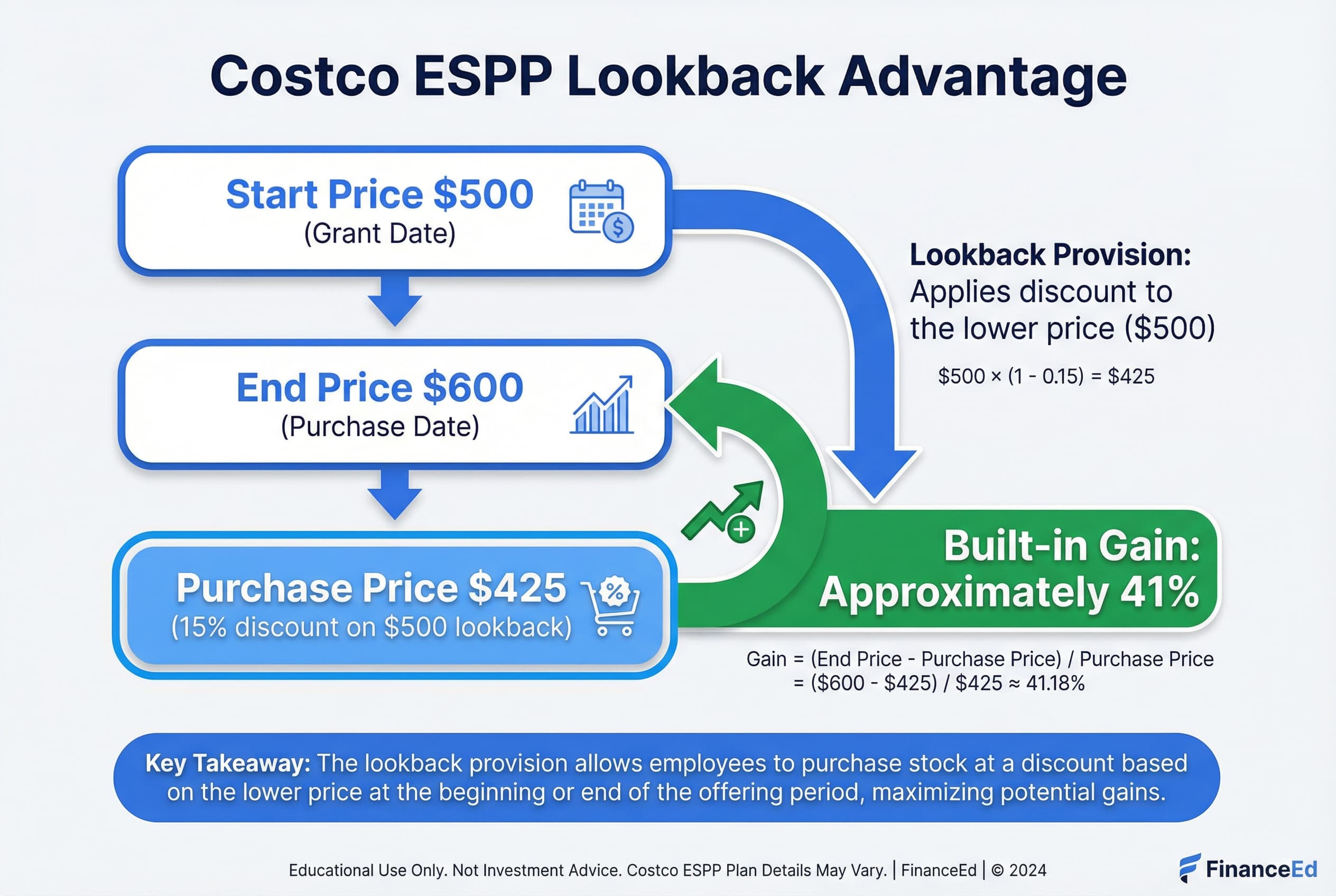
Costco offers employees an Employee Stock Purchase Plan that provides an attractive opportunity to purchase company stock at a discount. The plan offers a 15% discount on the purchase price and includes a lookback provision, which can significantly enhance your potential returns.
The lookback provision allows you to purchase Costco stock at 15% off the lower of two prices: the stock price at the beginning of the offering period or the price at the end of the purchase period. This feature is particularly valuable in rising markets, as you benefit from both the discount and the lower historical price.
For example, if Costco stock is trading at $500 at the start of the offering period and rises to $600 by the purchase date, you'd purchase shares at $425 ($500 minus the 15% discount). This represents a built-in gain of approximately 41% before you even own the shares.
The plan allows annual contributions up to $25,000 (based on the fair market value of shares purchased). This aligns with IRS limits for qualified ESPPs and provides substantial participation opportunities for eligible employees.
Understanding the difference between qualifying and disqualifying dispositions is important for tax planning. A qualifying disposition occurs when you hold shares for at least two years from the offering date and one year from the purchase date, which can result in more favorable long-term capital gains treatment. A disqualifying disposition (selling before meeting these thresholds) results in the discount being taxed as ordinary income.
The combination of the 15% discount and lookback provision makes Costco's ESPP a valuable benefit that can generate immediate returns while building long-term wealth through company stock ownership.
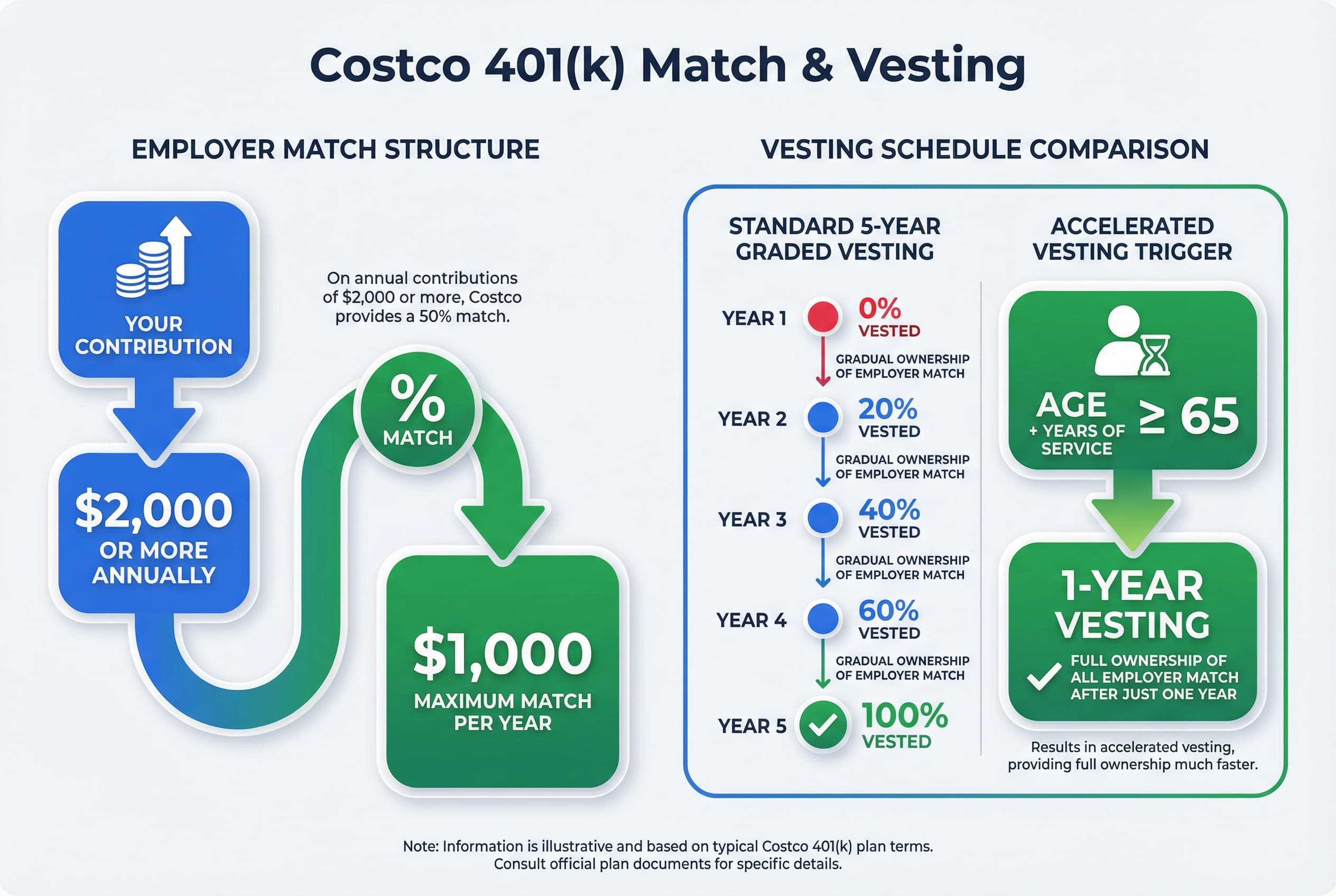
Costco offers a 401(k) plan with employer matching to help you build retirement savings. The company provides a 50% match on your contributions, up to a maximum of $1,000 per year. This means if you contribute $2,000 or more annually, you'll receive the full $1,000 company match.
The employer match follows a 5-year graded vesting schedule, meaning you earn ownership of the matched funds gradually over time. However, there's an accelerated vesting option: if your age plus years of service equals 65 or more, the match vests in just 1 year. This rewards long-term employees who are approaching retirement age.
Beyond the standard match, Costco also provides an annual discretionary contribution to eligible employees. The same 5-year vesting schedule (or 1-year accelerated vesting) applies to these discretionary contributions.
The plan does allow after-tax contributions, which can be useful for high earners who've maxed out their pre-tax contribution limits. However, mega backdoor Roth conversions are not available through Costco's 401(k) plan.
While the $1,000 annual match cap is relatively modest compared to some employers, the discretionary contribution adds meaningful value. If you're a long-tenured employee, the accelerated vesting provision can be particularly beneficial. Consider contributing at least $2,000 annually to capture the full employer match, as this represents an immediate 50% return on that portion of your investment.
Understanding the tax treatment of your Costco equity compensation is crucial for effective financial planning. Here's what you need to know about when and how your equity awards are taxed.
Restricted Stock Units (RSUs) are taxed as ordinary income when they vest. At Costco, this typically occurs annually on October 22nd, depending on your vesting schedule. The value of the shares on the vesting date becomes taxable compensation, just like your regular salary.
Costco uses a default withholding rate of 22% for RSU vesting events, which you can adjust. However, this creates a common "gap" issue: if you're in a higher tax bracket (24%, 32%, 35%, or 37%), the 22% withholding won't cover your full tax liability. You'll owe the difference when filing your tax return. Additionally, you'll owe Social Security and Medicare taxes (FICA), which aren't fully covered by the default withholding.
Costco offers both Incentive Stock Options (ISOs) and Non-Qualified Stock Options (NSOs). NSOs are taxed as ordinary income on the spread between the exercise price and fair market value when exercised. ISOs receive preferential treatment: no ordinary income tax at exercise (though AMT may apply), and if you hold shares for at least two years from grant and one year from exercise, gains qualify for long-term capital gains rates.
AMT Considerations: When exercising ISOs, the spread may trigger Alternative Minimum Tax, even though you haven't sold the shares. This can create a cash flow challenge and requires careful planning.
Costco's Employee Stock Purchase Plan offers a 15% discount with a lookback feature. Tax treatment depends on holding periods. For "qualifying dispositions" (holding shares two years from offering date and one year from purchase), only the discount is taxed as ordinary income, with remaining gains taxed as capital gains. Disqualifying dispositions result in the full discount being taxed as ordinary income.
Any appreciation beyond the initial taxable amount (at vest for RSUs, at exercise for options) is taxed as capital gains when you sell. Long-term capital gains rates (for shares held over one year) are significantly lower than ordinary income rates.
Important Disclaimer: This information is educational only and not tax advice. Tax situations vary based on individual circumstances, income levels, and state residency. Always consult with a qualified tax professional before making decisions about your equity compensation.
While Costco equity compensation can be valuable, concentrating too much of your wealth in a single stock creates significant financial risk. If Costco's stock price declines, you could simultaneously face reduced compensation value and potential job insecurity - a double impact that diversified investors avoid.
As a retail company, Costco faces specific vulnerabilities that could affect your equity value. The retail sector is sensitive to consumer spending patterns, economic downturns, and competitive pressures from e-commerce and traditional competitors. Changes in consumer behavior, supply chain disruptions, or shifts in the competitive landscape could impact stock performance, regardless of Costco's strong market position.
Financial advisors commonly recommend limiting single-stock exposure to 10-20% of your total net worth. This guideline helps protect you from company-specific or industry-specific downturns while still allowing you to benefit from your equity compensation.
Consider developing a regular diversification plan: sell vested shares systematically and reinvest proceeds across different asset classes and industries. This approach, sometimes called "rebalancing," helps manage risk while capturing the value of your compensation.
Remember that with RSU vesting schedules extending up to five years and potential ESPP accumulation, your Costco holdings can grow significantly over time. Regular monitoring and proactive diversification become increasingly important as your equity compensation accumulates.
Consider selling vested RSUs shortly after they vest to avoid concentration risk, especially given Costco's typical 5-year annual vesting schedule (20% per year for many grants, with vesting dates around October 22nd). Remember that RSUs are taxed as ordinary income at vest regardless of whether you sell, so holding doesn't provide additional tax benefits - it simply creates market exposure. If you have stock options with a 10-year expiration period, evaluate exercise timing based on the spread between strike price and current value, keeping in mind the 120-month (10-year) exercise window.
As a retail company employee, your income already depends on Costco's performance. Holding significant equity creates a "double exposure" where both your paycheck and investment portfolio rely on the same company. Financial advisors typically recommend limiting any single stock to 10-15% of your investment portfolio. Review your holdings regularly, especially after vesting events or option exercises.
ESPP: Costco offers a 15% discount with a lookback provision. To qualify for favorable long-term capital gains treatment, hold shares for at least 2 years from the offering date and 1 year from purchase. However, weigh tax savings against concentration risk - immediate sales may be prudent despite higher taxes.
RSU Withholding: The default 22% tax withholding may be insufficient if you're in a higher tax bracket. You can adjust withholding rates to avoid underpayment penalties.
Factor equity into your overall compensation when evaluating job offers or performance. While equity can be valuable, don't let it prevent necessary career moves or risk management decisions.
Note: While 10b5-1 trading plans can provide structure for systematic selling, specific availability at Costco wasn't confirmed in available data. Consult your HR or stock plan administrator for details.
Let's walk through how Restricted Stock Units (RSUs) vest at Costco using a realistic scenario for an executive officer.
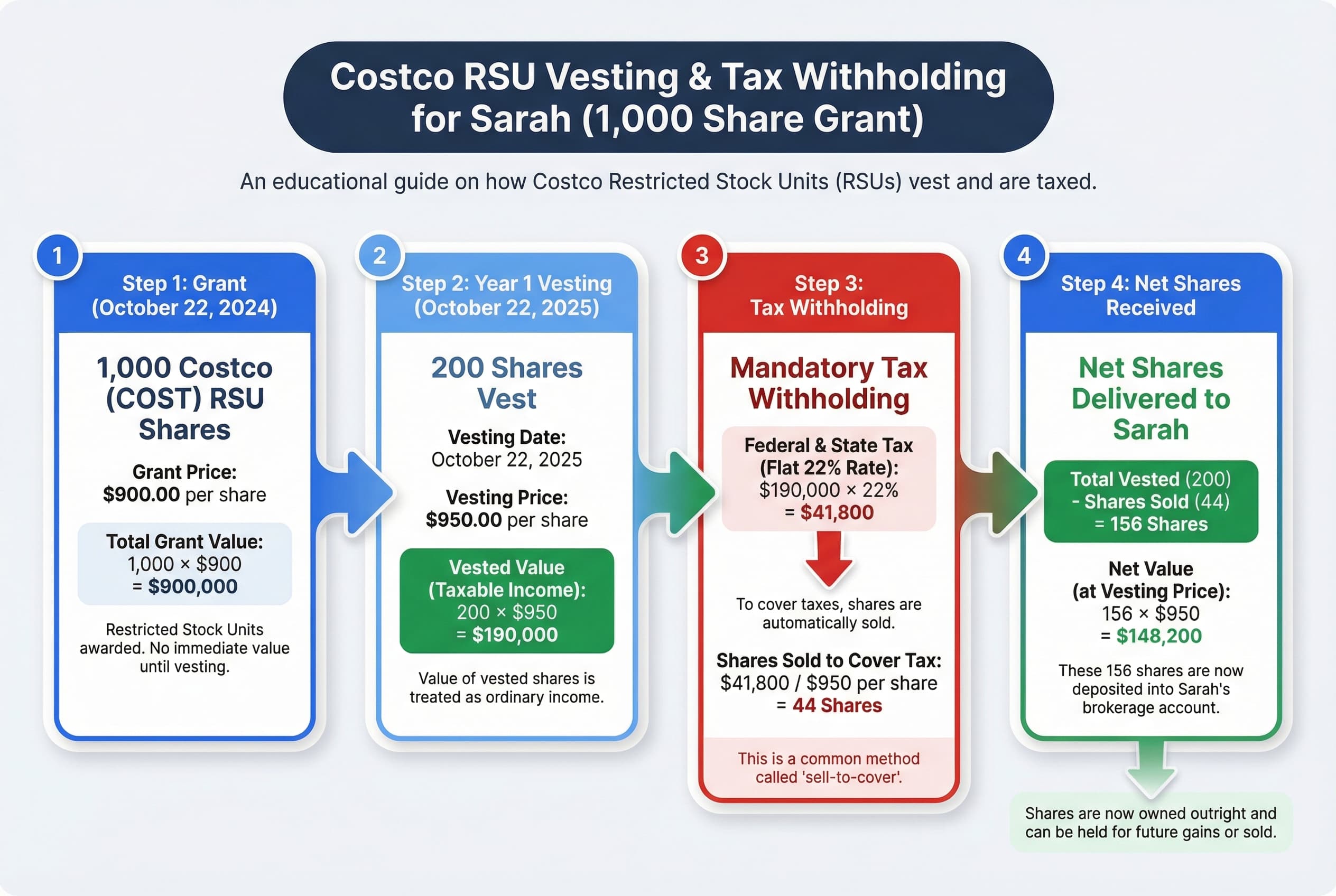
Sarah, a Costco executive, receives an RSU grant of 1,000 shares on October 22, 2024. At the time of grant, Costco stock trades at $900 per share, representing a total grant value of $900,000. Her RSUs follow the standard executive vesting schedule: 20% annually over 5 years.
Year 1 (October 22, 2025): 200 shares vest. The stock price has risen to $950 per share, making the vested value $190,000. Costco withholds 22% for taxes ($41,800), selling approximately 44 shares to cover this. Sarah receives 156 shares worth $148,200.
Year 2 (October 22, 2026): Another 200 shares vest at $1,000 per share ($200,000 value). After 22% withholding ($44,000), Sarah receives 156 shares worth $156,000.
Year 3 (October 22, 2027): 200 shares vest at $1,050 per share ($210,000 value). Tax withholding of $46,200 leaves Sarah with 156 shares worth $163,800.
Year 4 (October 22, 2028): 200 shares vest at $1,100 per share ($220,000 value). After $48,400 in taxes, Sarah receives 156 shares worth $171,600.
Year 5 (October 22, 2029): The final 200 shares vest at $1,150 per share ($230,000 value). After $50,600 withholding, Sarah receives 156 shares worth $179,400.
Over five years, Sarah receives 780 shares (out of the original 1,000 granted) worth approximately $819,000 at their respective vesting dates. The remaining 220 shares were sold to cover the 22% tax withholding.
Important note: The 22% withholding may not cover Sarah's full tax liability if she's in a higher tax bracket, so she should plan for additional taxes when filing her return.
Even with valuable equity compensation, many Costco employees leave money on the table or face unexpected tax bills. Here are the most common pitfalls to avoid:
Costco's default tax withholding rate is 22% on RSU vesting. If you're in a higher tax bracket, this won't cover your full tax liability. You can adjust your withholding rate to avoid a surprise tax bill in April. Consider working with a tax professional to calculate your actual tax rate and adjust accordingly.
Costco's Employee Stock Purchase Plan offers a 15% discount with a lookback feature, yet many employees don't participate. This is essentially a guaranteed return on your money. With a contribution cap of $25,000 annually, it's one of the most valuable benefits available.
As your RSUs vest over five years and ESPP purchases accumulate, you may end up with too much of your net worth tied to Costco stock. This creates unnecessary risk - if the company faces challenges, both your job and portfolio are affected. Consider diversifying by selling some shares after vesting.
If you hold stock options, remember they expire after 10 years. Many employees wait too long to exercise, leaving valuable compensation on the table. Review your option grants regularly and plan your exercise strategy well before expiration.
Understanding how your equity compensation is affected when you leave Costco is crucial for financial planning. Here's what you need to know:
Unvested RSUs are typically forfeited upon termination. Once you leave Costco, any RSU shares that haven't vested by your termination date will be canceled. Since Costco's RSUs generally vest annually (with executives on a 5-year schedule at 20% per year), timing your departure can significantly impact your equity value. Your termination date determines which vesting tranche you'll receive - if you leave before an October 22nd vesting date, you'll miss that year's shares.
Costco's stock options have a 10-year total expiration period, but specific post-termination exercise windows aren't detailed in available plan documents. Generally, you'll have a limited window (often 90 days) after termination to exercise vested options, though this should be confirmed with HR or your plan documents. Any unvested options will be forfeited.
If you're enrolled in Costco's Employee Stock Purchase Plan when you leave, your participation typically ends on your termination date. Accumulated payroll deductions may be returned to you or used to purchase shares at the next purchase date, depending on plan rules and timing.
The distinction between voluntary and involuntary termination isn't specified in available documents. Contact Costco's equity compensation team before your departure to understand your specific situation and deadlines for exercising options or making ESPP decisions.
Costco offers a deferred compensation plan to approximately 1,000 certain management and highly compensated employees. If you're eligible for this program, it provides an opportunity to defer taxation on a portion of your income while building additional retirement savings.
The program allows participants to defer up to 80% of their base salary and 90% of their annual bonus. Costco provides a company match of 50% on deferred amounts, up to a maximum annual match of $5,000. This match vests over five years, or in one year if your age plus years of service equals 65.
Benefits: Tax deferral allows your compensation to grow without immediate taxation, potentially resulting in significant tax savings if you're in a lower tax bracket during retirement. The company match provides additional retirement savings beyond the standard 401(k).
Risks: Deferred compensation plans are unsecured obligations of the company. Unlike 401(k) accounts, your deferred funds remain company assets until distributed, exposing you to creditor risk if Costco faces financial difficulties.
Before participating, evaluate your current tax situation, retirement timeline, and comfort level with company-specific risk. Consider consulting with a financial advisor to determine if deferring compensation aligns with your overall financial strategy.
This content is for educational purposes only and does not constitute financial advice. The information provided is general in nature and may not appl...
YourEmployeeStock.com is not a registered investment advisor.
Vesting schedules vary by role at Costco. Executives typically have a 5-year vesting schedule with 20% vesting annually, while non-employee directors vest over 3 years (approximately one-third each year). Some executive RSUs also include a 1-year performance-vesting requirement before the 5-year time-vesting period begins.
Costco's ESPP offers a 15% discount on the stock price. The plan also includes a lookback feature, which means you can purchase shares at the lower price between the offering date and purchase date, maximizing your potential discount.
You can contribute up to $25,000 per year to Costco's ESPP. This is the annual maximum contribution limit under the plan.
Costco stock options have a 10-year expiration period from the grant date. However, the specific post-termination exercise window details aren't clearly specified, so you should consult your plan documents or HR to understand how long you have to exercise vested options after leaving the company.
Costco's default tax withholding rate for RSU vesting is 22%. However, this may not be sufficient if you're in a higher tax bracket, and you can adjust your withholding rate. Consider consulting a tax advisor to ensure you're withholding enough to cover your actual tax liability.
Based on historical grant patterns, Costco RSUs commonly vest on October 22nd annually. However, your specific vesting dates will depend on when your grant was issued, so check your individual grant agreement for exact dates.
While RSUs convert to shares you can sell upon vesting, you may be subject to insider trading restrictions and blackout periods. Costco also prohibits officers and directors from hedging or pledging company securities, so review your company's trading policies before selling.
Yes, Costco provides significant accelerated vesting benefits for employees with long service records. Employees with 25, 30, or 35+ years of service may be eligible for accelerated RSU vesting, which is a unique feature that rewards employee loyalty.
Get a free personalized analysis from our equity compensation experts

