Free equity analysis
We're still gathering complete information
Some details about Starbucks's equity programs may be incomplete or based on general industry data. We recommend verifying specifics with your official plan documents or HR department.
Complete guide to understanding your Starbucks equity compensation, including RSU, ISO, NSO, ESPP, vesting schedules, and tax strategies.
Stock Price
$99.07
Closing price · Sep 14, 2026
Employees
157.1K
Worldwide
Equity Programs
4
programs
Vesting Period
2 years
RSU vesting
Closing price · Sep 14, 2026
Starbucks offers 4 equity compensation programs to employees. Click on each program to learn more about eligibility, vesting, and tax implications.
Standard RSU program with 4-year vesting and 1-year cliff. Annual refresh grants available for eligible employees.
Learn about Starbucks's Incentive Stock Options program, including vesting schedules and tax treatment.
Learn about Starbucks's Non-Qualified Stock Options program, including vesting schedules and tax treatment.
Learn about Starbucks's Employee Stock Purchase Plan program, including vesting schedules and tax treatment.
Starbucks RSUs vest on a 2-year graded schedule: 50% vests after 1 year, 50% vests after 2 years schedule with a 12-month cliff.
Example calculation based on 100 shares:
| Year | Vesting % | Shares Vesting | Estimated Value |
|---|---|---|---|
| Year 1 | 50% | 50 | $4,953.50 |
| Year 2 | 50% | 50 | $4,953.50 |
| Total | 100% | 100 | $9,907 |
* Based on Starbucks stock price of $99.07 as of Sep 14, 2026. Actual values will vary.
50%
50 shares
$4,953.50
50%
50 shares
$4,953.50
Starbucks vesting schedule based on 100 total shares
Starbucks offers one of the most accessible equity compensation programs in retail through its "Bean Stock" program. The company provides Restricted Stock Units (RSUs), an Employee Stock Purchase Plan (ESPP), and stock options (both ISOs and NSOs) to eligible partners. Additionally, Performance Stock Units (PSUs) may be available for certain roles.
As a publicly traded company (SBUX), Starbucks equity allows you to share in the company's growth and success. When the stock price increases, your compensation grows alongside it. This program is particularly valuable because it extends equity ownership broadly across the organization - including store partners and non-retail employees up to grade 25 - making it one of the more inclusive programs in the retail industry.
RSU grants follow a straightforward 2-year schedule: 50% of your shares vest after one year, and the remaining 50% vest after two years. This relatively short vesting period means you can realize value from your equity compensation sooner than at many other companies. Grants are typically awarded annually in November, though eligibility depends on your hire date (by May 1) and job grade.
The ESPP operates on a quarterly cycle with enrollment periods in March, June, September, and December. You can contribute up to 10% of your base pay to purchase Starbucks stock at a 5% discount with a lookback provision, allowing you to benefit from favorable pricing.
Understanding these programs can significantly enhance your total compensation package at Starbucks.
Starbucks offers equity compensation through its "Bean Stock" program, which features a notably shorter vesting timeline than many tech companies. Understanding how and when your shares vest is crucial for maximizing the value of this benefit.
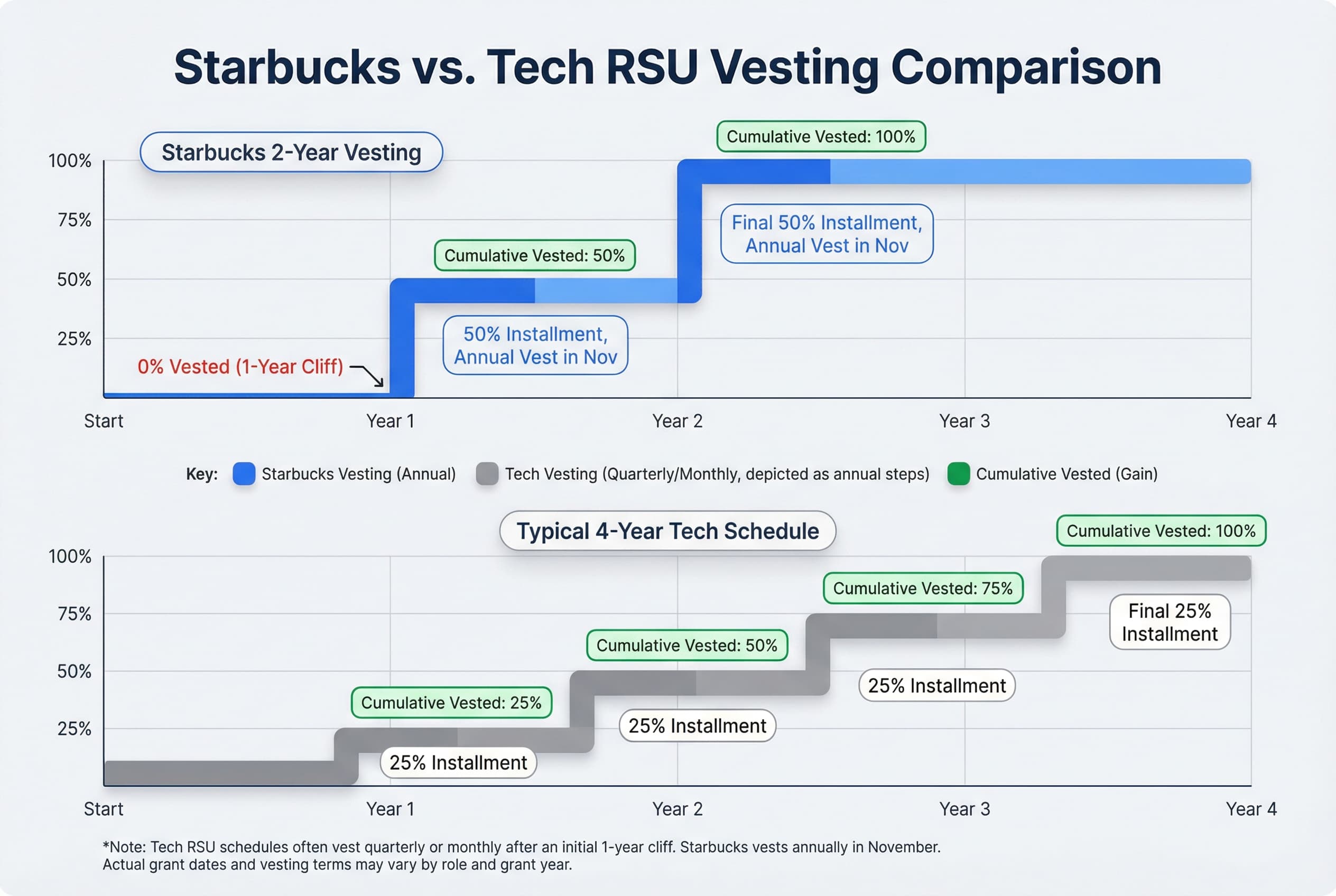
Starbucks uses a 2-year graded vesting schedule for RSU grants. This is considerably shorter than the typical 4-year schedules common in the technology sector. Under this structure, your equity vests in two equal installments:
The vesting schedule includes a 1-year cliff, meaning you must remain employed at Starbucks for at least 12 months before any shares vest. During this cliff period, you don't receive any shares - even if you leave the company just before the one-year mark. Once you pass the cliff, you'll receive your first 50% of the grant. This cliff period protects the company's investment in new hires while ensuring employees who stay receive meaningful equity compensation relatively quickly.
Unlike some companies that vest shares monthly or quarterly, Starbucks RSUs vest annually. The vesting dates occur on specific anniversaries of your grant date - one year and two years after the initial grant. Grants are typically awarded in November each year, pending Board approval, so most employees will see their shares vest in November of the following years.
Starbucks maintains an annual refresher grant program, with awards typically made in November. To be eligible for a November grant, you must have been hired by May 1st of that year. Eligibility also depends on your job grade - store partners and non-retail employees up to grade 25 are eligible, though licensed store partners are not included. These refresher grants follow the same 2-year vesting schedule as initial grants.
The schedule is considered backloaded since you receive nothing in the first year and then 50% at each subsequent anniversary, rather than receiving shares more frequently throughout the vesting period.
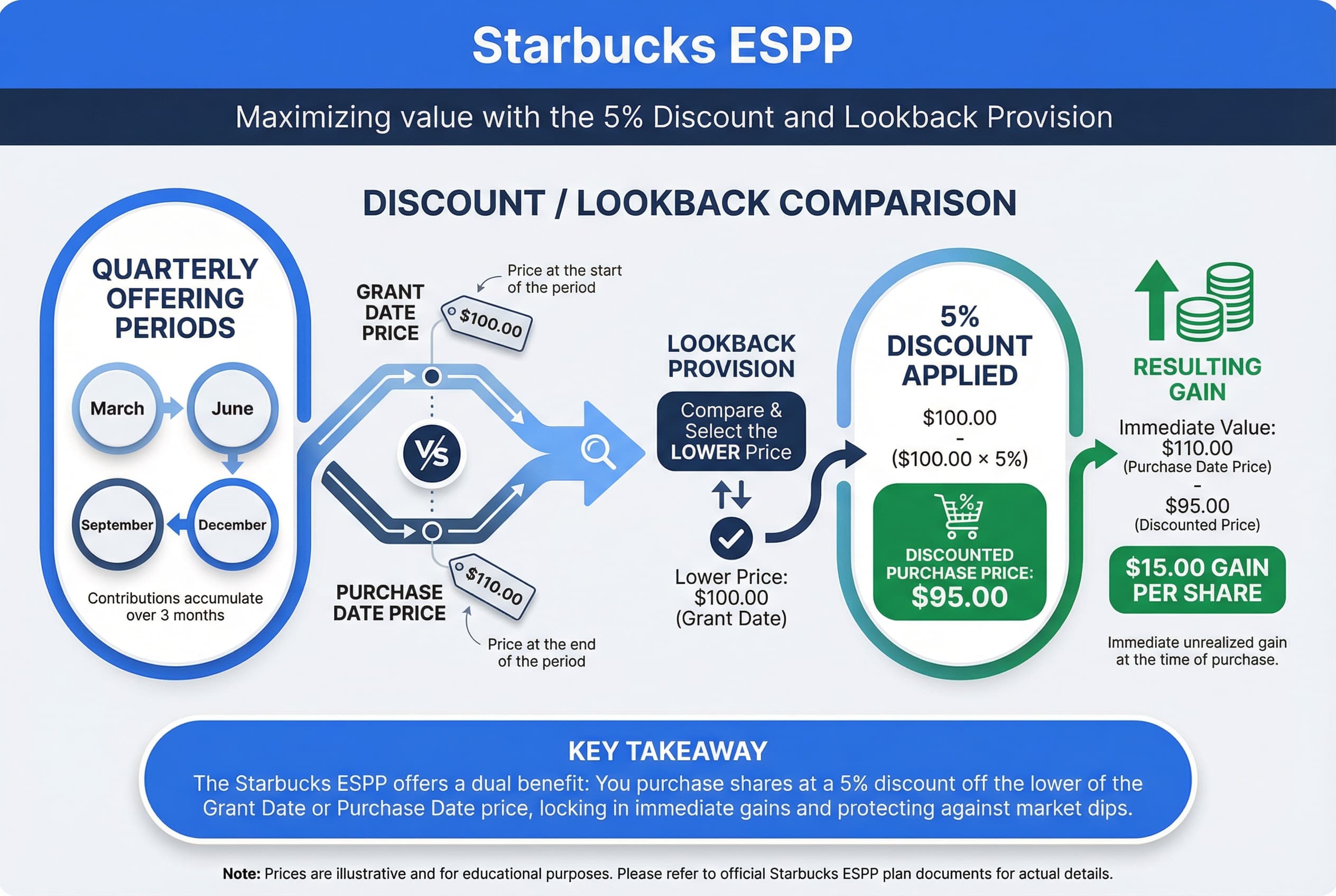
Starbucks offers an Employee Stock Purchase Plan (ESPP) as part of its Bean Stock equity program, allowing eligible partners to purchase company stock at a discount through payroll deductions. The plan features quarterly offering periods in March, June, September, and December, giving you four opportunities throughout the year to participate.
The ESPP provides a 5% discount on the purchase price, combined with a valuable lookback provision. The lookback feature allows you to purchase shares at the lower of two prices: the stock price at the beginning of the offering period or the price at the end of the purchase period. This combination can generate meaningful returns, especially in a rising market. For example, if the stock price increases during the quarter, you'll purchase at the lower beginning price and receive the 5% discount on top of that.
You can contribute between 1-10% of your base pay through after-tax payroll deductions, up to an annual maximum of $25,000 (based on pre-discounted value). With quarterly three-month offering and purchase periods, you have flexibility to adjust your participation throughout the year during the enrollment windows.
Understanding the holding period requirements is important for tax optimization. To achieve a qualifying disposition and receive favorable long-term capital gains treatment, you must hold your ESPP shares for at least one year from the purchase date and two years from the offering period grant date. Selling before meeting both requirements results in a disqualifying disposition, where the discount and any lookback benefit are taxed as ordinary income.
The combination of the discount and lookback provision makes Starbucks' ESPP a compelling benefit, particularly for partners who can afford to hold shares for the qualifying period.
Starbucks offers a competitive retirement savings plan called the Future Roast 401(k) to help partners build long-term financial security.
Starbucks provides a 100% match on the first 5% of your base salary that you contribute to the plan. This means if you contribute at least 5% of your salary, Starbucks will contribute an equal amount, essentially doubling your retirement savings on that portion. The maximum annual match is capped at $6,000.
One of the standout features of Starbucks' 401(k) is immediate vesting - you own the employer match contributions right away with no waiting period. This means if you leave the company, you take the full employer match with you.
You become eligible to participate in the Future Roast 401(k) plan after 6 months of employment with Starbucks.
Based on available information, mega backdoor Roth conversions do not appear to be available through this plan. Details about after-tax contribution options beyond standard Roth 401(k) contributions and brokerage window availability are not specified in the plan documentation.
The combination of a generous 100% match, immediate vesting, and relatively quick eligibility makes Starbucks' 401(k) program a valuable benefit for partners planning their financial future.
Understanding the tax treatment of your Bean Stock awards is crucial for effective financial planning. Here's what you need to know about when and how your equity compensation will be taxed.
Your Restricted Stock Units (RSUs) are taxed as ordinary income at vesting, not when you eventually sell the shares. With Starbucks' 2-year vesting schedule (50% at year one, 50% at year two), you'll owe taxes on each vesting date based on the fair market value of the shares.
A common issue many employees face is the "withholding gap." While your employer withholds taxes at vesting, the default withholding rate may not cover your full tax liability, especially if you're in a higher tax bracket when combined with your salary. You can adjust your withholding rate to help close this gap and avoid owing additional taxes at year-end.
The Employee Stock Purchase Plan offers a 5% discount with a lookback provision. The tax treatment depends on how long you hold the shares. For a "qualifying disposition" (holding shares for at least one year from purchase AND two years from the offering date), you'll pay ordinary income tax only on the discount portion, with any additional gain taxed at favorable long-term capital gains rates. Selling earlier results in "disqualifying disposition" treatment, where the full discount and any gain up to the lookback benefit are taxed as ordinary income.
Once you've paid ordinary income tax on vested RSUs, any subsequent appreciation (or loss) when you sell is treated as capital gains. Hold shares for more than one year after vesting to qualify for long-term capital gains rates, which are typically lower than ordinary income rates.
Starbucks is headquartered in Washington state, which has no state income tax. However, if you work in another state, you'll owe state taxes based on your work location's rules.
Disclaimer: This information is educational only and not tax advice. Tax laws are complex and individual situations vary. Please consult a qualified tax professional or CPA to understand your specific tax obligations.
While Starbucks' Bean Stock program offers valuable wealth-building opportunities, concentrating too much of your net worth in SBUX shares creates significant risk. If the company faces challenges, you could simultaneously experience job insecurity and declining portfolio value - a double impact that can be financially devastating.
As a retail company, Starbucks faces specific vulnerabilities you should consider. Consumer spending patterns shift during economic downturns, competition from other coffee chains intensifies, and changing consumer preferences can impact sales. Supply chain disruptions, labor costs, and real estate expenses also directly affect profitability. These industry-specific factors can cause stock volatility independent of your job performance.
Financial advisors commonly recommend keeping single-stock exposure under 10-20% of your total net worth. This guideline helps protect you from company-specific risks while still allowing you to benefit from your equity compensation.
Consider developing a regular selling strategy as your RSUs vest on their 2-year schedule. With annual grants typically awarded in November, you'll have multiple vesting events creating natural opportunities to rebalance. You might sell a portion of each vesting to fund diversified investments across different industries, asset classes, and geographies.
Your ESPP, with its quarterly purchase periods and 5% discount with lookback, can also contribute to concentration risk if you consistently hold all shares purchased. Evaluate whether selling ESPP shares after the qualifying period aligns with your diversification goals.
With Starbucks' accelerated 2-year vesting schedule (50% at year one, 50% at year two), you'll accumulate shares faster than typical tech companies. Consider selling when equity represents more than 15-20% of your net worth, or when you need funds for major financial goals. Remember that blackout periods apply approximately two weeks before earnings announcements, so plan transactions accordingly.
As a retail company, Starbucks faces unique risks including consumer spending trends, commodity price fluctuations, and competitive pressures. If you're already employed at Starbucks, your income and equity are both tied to the company's performance. This concentration risk suggests gradually diversifying vested shares into a broader portfolio, especially if annual refresher grants (typically awarded in November) continue adding to your holdings.
Starbucks' ESPP offers a 5% discount with a lookback provision on quarterly purchase periods. To qualify for favorable long-term capital gains treatment, hold shares for at least one year from purchase and two years from the offering date. While the 5% discount is modest compared to some companies, the lookback feature can provide additional value in rising markets. You can contribute up to 10% of base pay (maximum $25,000 annually).
Factor your annual RSU grants into compensation decisions, but remember they're variable compensation tied to stock performance. The combination of Bean Stock RSUs, ESPP participation, and the generous 401(k) match (100% on first 5% of salary) creates substantial wealth-building potential beyond base salary.
While the data doesn't confirm 10b5-1 plan availability at Starbucks, these automated trading plans can help you sell shares during blackout periods if offered. Contact your equity plan administrator to verify availability.
Let's walk through how Starbucks' "Bean Stock" RSU program works with a realistic scenario.
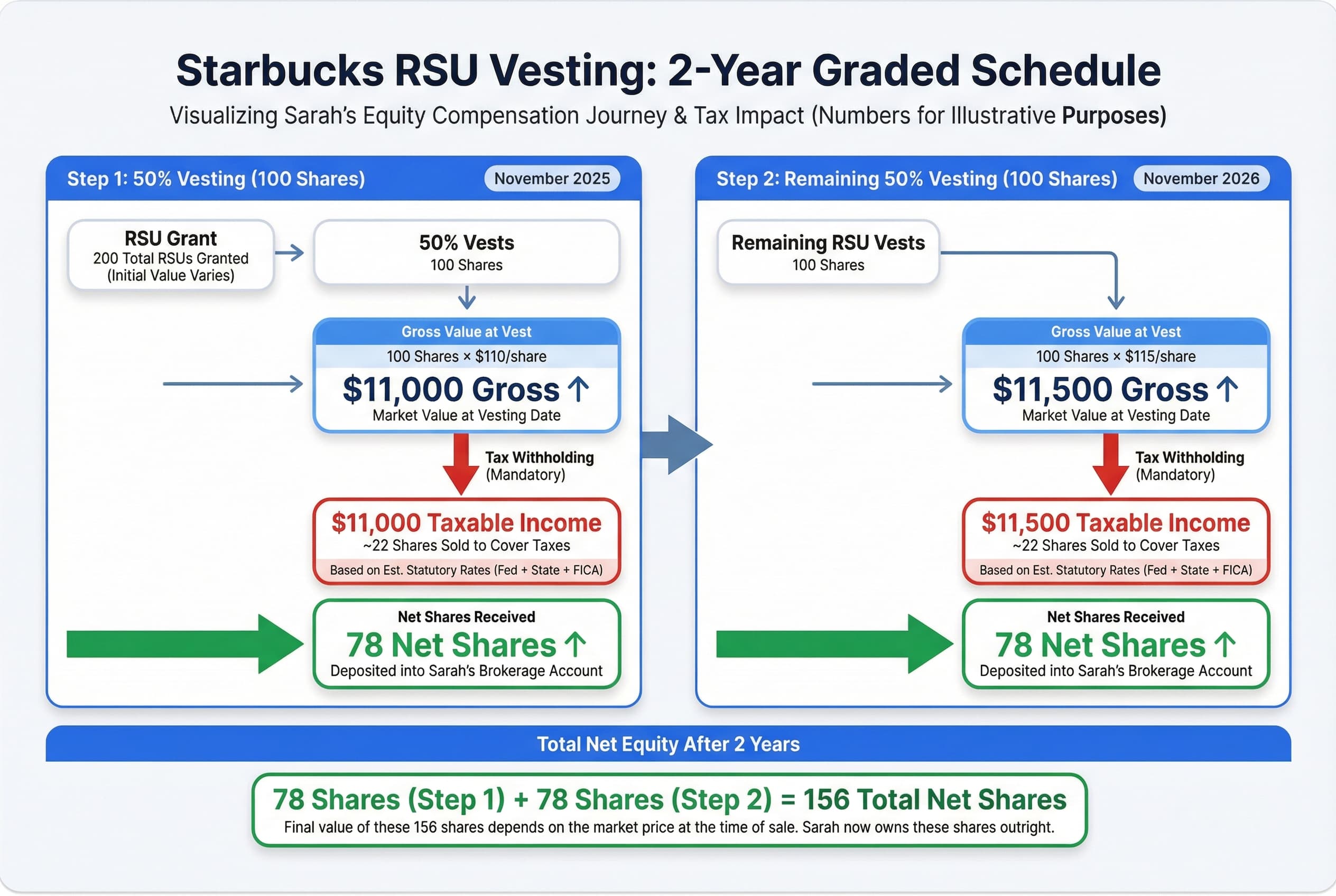
Sarah, a retail manager at Starbucks, receives her annual RSU grant in November 2024. She's awarded 200 RSUs of Starbucks stock. At today's grant price of $100 per share, this represents a potential value of $20,000.
Starbucks uses a 2-year graded vesting schedule with a 1-year cliff:
Year 1 (November 2025):
Year 2 (November 2026):
When RSUs vest, they're treated as ordinary income. Starbucks typically withholds shares to cover taxes (though the exact default rate isn't specified in company documents).
Assuming a 22% supplemental withholding rate (common for equity):
First vesting (Year 1):
Second vesting (Year 2):
After two years, Sarah receives 156 shares to keep or sell (worth $17,940 at the Year 2 price), with $4,950 withheld for taxes. She can hold these shares for potential future growth or sell them during open trading windows, avoiding the 2-week blackout periods before earnings reports.
Even with Starbucks' employee-friendly equity program, partners often make avoidable mistakes that can cost them thousands of dollars.
Many partners don't realize that RSUs have a 12-month cliff period - meaning you must stay employed for one full year before any shares vest. Leaving at 11 months means forfeiting your entire grant. Understanding this timeline is crucial when considering job changes.
Starbucks offers a 5% discount and a lookback provision on its Employee Stock Purchase Plan, allowing you to buy shares at the lower of the beginning or end price each quarter. Yet many eligible partners don't participate, missing out on guaranteed returns. Even small contributions (1-10% of base pay) can add up significantly.
With quarterly ESPP purchases and annual RSU vesting, some partners accumulate too much wealth in SBUX stock. Financial advisors typically recommend keeping no more than 10-15% of your portfolio in any single company - especially your employer, since your job and investments would both be at risk if the company struggles.
RSUs are taxed as ordinary income at vesting, and ESPP sales trigger capital gains taxes. Partners who don't adjust their withholding or save for estimated taxes often face unexpected bills at tax time. Review your withholding settings and consider setting aside funds from each vesting event.
Understanding how your Bean Stock equity is affected when you leave Starbucks is crucial for financial planning.
Any unvested RSUs are forfeited upon termination. Since Starbucks RSUs vest on a 2-year schedule (50% after one year, 50% after two years), timing matters significantly. For example, if you leave 11 months after your grant date, you'll forfeit the entire award. If you leave after 13 months, you'll keep the first 50% that vested but forfeit the remaining 50%.
Your actual termination date relative to vesting dates is critical. RSUs typically vest annually in November at Starbucks. If your last day is before a scheduled vesting date, those shares are forfeited - even if you're just days away from vesting.
If you're enrolled in the Employee Stock Purchase Plan (ESPP) when you leave, you'll typically be withdrawn from the current offering period. Contributions made during that quarter are usually refunded, and you won't receive shares for that incomplete period. However, any shares you've already purchased in previous quarters remain yours.
While Starbucks offers both ISOs and NSOs, specific post-termination exercise windows are not publicly disclosed. If you hold stock options, consult your grant agreement or contact HR immediately upon resignation to understand your exercise deadline.
Note: The information above represents general equity treatment at termination. Always review your specific grant agreements and consult with Starbucks HR for details about your situation.
This content is for educational purposes only and does not constitute financial advice. The information provided is general in nature and may not appl...
YourEmployeeStock.com is not a registered investment advisor.
Starbucks RSUs (called Bean Stock) vest over a 2-year period with a 1-year cliff. 50% of your grant vests after the first year, and the remaining 50% vests after the second year. Vesting occurs annually in November, based on your original grant date.
RSU grants are typically awarded annually in November, pending Board approval. To be eligible for the November grant, you must be hired by May 1st of that year and meet job grade requirements (store partners and non-retail employees up to grade 25 are eligible). Note that partners at licensed stores are not eligible.
Starbucks offers an ESPP with quarterly purchase periods (March, June, September, and December). You can contribute 1-10% of your base pay (up to $25,000 annually) through after-tax payroll deductions. The plan provides a 5% discount and includes a lookback provision, allowing you to purchase shares at the lower price between the beginning and end of the offering period.
When your RSUs vest, the value is treated as ordinary income and subject to income tax withholding. Starbucks allows you to adjust your withholding rate. You'll receive shares after taxes are withheld, and any future gains when you sell will be subject to capital gains tax.
Generally yes, but be aware of blackout periods—typically 2 weeks before earnings announcements and financial reports. For ESPP shares, there may be a holding period before you can move shares out of your ESPP broker account. Always comply with insider trading laws and company policy.
If you leave Starbucks before your RSUs vest, you typically forfeit any unvested shares. Only shares that have already vested (passed their vesting date) are yours to keep. This is why the 1-year cliff is significant—you must stay at least one year to receive any Bean Stock.
Yes, Starbucks does offer both Incentive Stock Options (ISOs) and Non-Qualified Stock Options (NSOs), though they're less common than RSUs. Stock options at Starbucks typically expire 10 years from the grant date. Specific eligibility and vesting details vary by grant.
To receive favorable tax treatment on your ESPP shares, you must hold them for at least 1 year from the purchase date AND 2 years from the grant date (start of the offering period). Selling before meeting both requirements results in a disqualifying disposition, which means more of your gain is taxed as ordinary income rather than capital gains.
Get a free personalized analysis from our equity compensation experts

