Free equity analysis
We're still gathering complete information
Some details about Nike's equity programs may be incomplete or based on general industry data. We recommend verifying specifics with your official plan documents or HR department.
Complete guide to understanding your Nike equity compensation, including RSU, ISO, NSO, ESPP, vesting schedules, and tax strategies.
Stock Price
$36.22
Closing price · Sep 15, 2026
Employees
99.6K
Worldwide
Equity Programs
4
programs
Vesting Period
4 years
RSU vesting
Closing price · Sep 15, 2026
Nike offers 4 equity compensation programs to employees. Click on each program to learn more about eligibility, vesting, and tax implications.
Standard RSU program with 4-year vesting and 1-year cliff. Annual refresh grants available for eligible employees.
Learn about Nike's Incentive Stock Options program, including vesting schedules and tax treatment.
Learn about Nike's Non-Qualified Stock Options program, including vesting schedules and tax treatment.
Learn about Nike's Employee Stock Purchase Plan program, including vesting schedules and tax treatment.
Nike RSUs vest on a 4-year vesting: 25% in year 1, 25% in year 2, 25% in year 3, 25% in year 4 schedule with a 12-month cliff.
Example calculation based on 100 shares:
| Year | Vesting % | Shares Vesting | Estimated Value |
|---|---|---|---|
| Year 1 | 25% | 25 | $905.50 |
| Year 2 | 25% | 25 | $905.50 |
| Year 3 | 25% | 25 | $905.50 |
| Year 4 | 25% | 25 | $905.50 |
| Total | 100% | 100 | $3,622 |
* Based on Nike stock price of $36.22 as of Sep 15, 2026. Actual values will vary.
25%
25 shares
$905.50
25%
25 shares
$905.50
25%
25 shares
$905.50
25%
25 shares
$905.50
Nike vesting schedule based on 100 total shares
Nike offers a comprehensive equity compensation program designed to align employee interests with long-term company performance. The program includes Restricted Stock Units (RSUs), Stock Options (both Incentive Stock Options and Non-Qualified Stock Options), and an Employee Stock Purchase Plan (ESPP).
As a globally recognized brand in the retail industry, Nike's equity compensation allows you to share in the company's success. With nearly 100,000 employees worldwide, Nike uses equity awards to reward performance and retain talent. When Nike grows, your equity grows in value alongside it.
RSUs vest over four years on an annual schedule, with 25% vesting each year. This means you'll receive one-quarter of your grant each year for four consecutive years. Vesting typically occurs in September, and your vested shares include dividend equivalent payments.
One unique feature at Nike is the annual equity election held each August. You can choose to receive your refresher grants as 100% RSUs, 100% stock options, or a 50/50 mix. Keep in mind that if you choose RSUs over options, you'll typically receive fewer shares due to their immediate value.
Stock options expire 10 years from grant and must generally be exercised within 90 days of leaving the company.
The ESPP allows you to purchase Nike stock at a 15% discount with a lookback feature, through semi-annual offering periods starting in April and October. You can contribute up to 10% of your salary, with a maximum of $25,000 per year.
Nike's Restricted Stock Units (RSUs) follow a 4-year vesting schedule with a uniform distribution. Unlike many tech companies that use a 1-year cliff, Nike's vesting schedule divides evenly across all four years: 25% vests in year one, 25% in year two, 25% in year three, and 25% in year four. This uniform approach means you'll begin receiving shares after your first year of employment rather than waiting through a cliff period.
RSUs vest annually rather than monthly or quarterly. According to Nike's documentation, vested shares are typically delivered in either August or September each year, though the exact timing may vary. This annual vesting cadence means you'll receive one-quarter of your grant on each anniversary, making it easier to plan for the tax implications of vesting events.
Nike's RSU structure does not include a traditional cliff period. From your first year of employment, you'll begin accruing vested shares at 25% annually. This differs from companies that require you to complete a full year before any shares vest. However, it's important to note that if you leave Nike before completing your first year, you would forfeit all unvested RSUs unless you qualify for Special Retirement Vesting provisions.
Nike offers annual refresher grants each August, giving employees a unique choice in their equity compensation. You can elect to receive:
It's worth noting that if you choose RSUs over NSOs, you'll typically receive fewer shares, as NSOs are generally granted at a 4:1 ratio compared to RSUs. Refresher grants also follow the same 4-year uniform vesting schedule.
Nike offers Special Retirement Vesting for eligible employees. If you're age 55 or older with at least 5 years of tenure, unvested RSUs continue to vest over the standard 4-year period after separation. For employees age 60 and above, unvested RSUs vest immediately upon qualifying retirement.
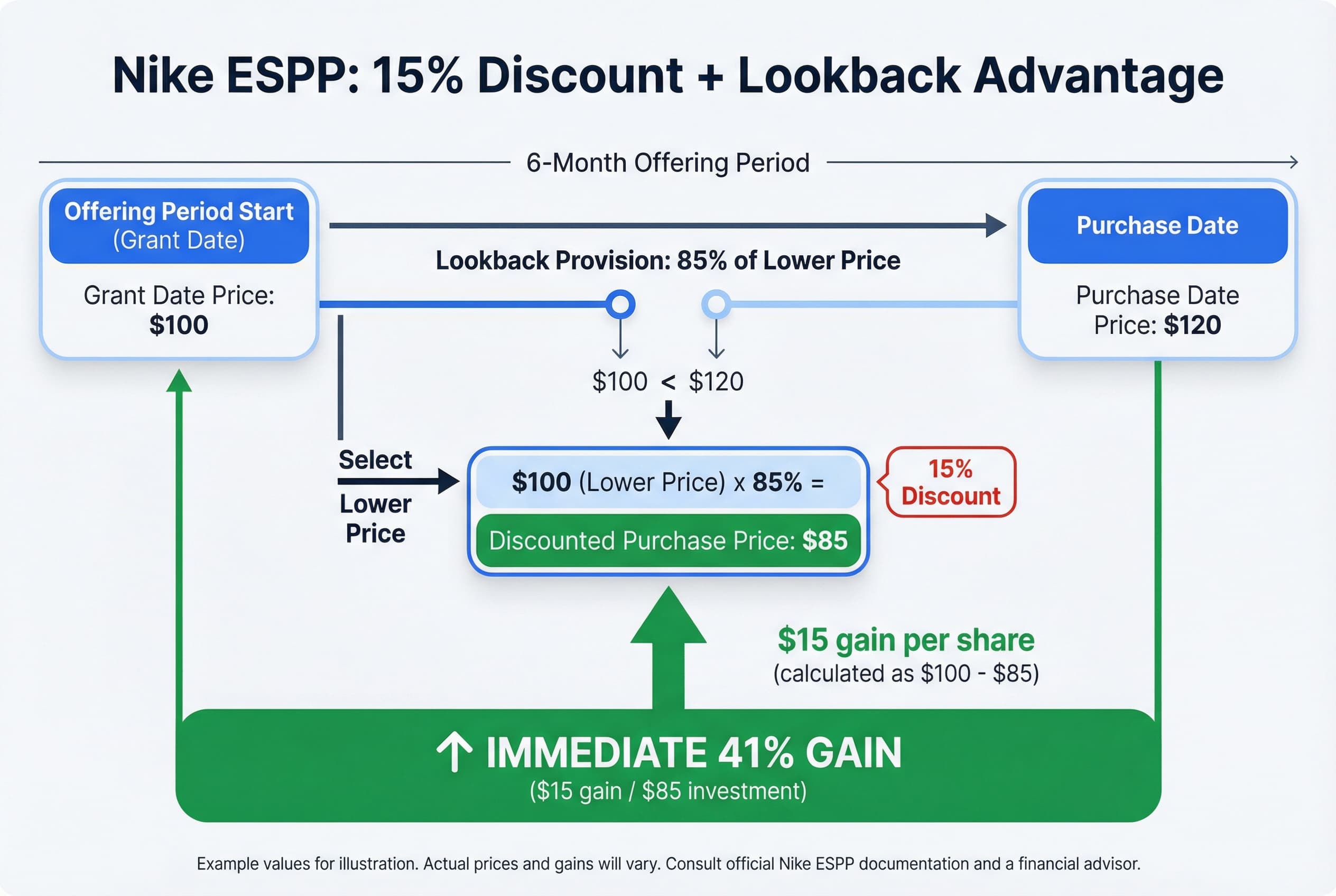
Nike offers employees an attractive ESPP that allows you to purchase company stock at a discount through payroll deductions. The plan provides a 15% discount off the stock price and includes a valuable lookback provision, which can significantly enhance your potential returns.
The lookback feature is particularly powerful. Nike's ESPP uses 6-month offering periods starting April 1 and October 1. At the end of each period, you'll purchase shares at 85% (15% discount) of whichever price is lower: the stock price at the beginning of the offering period or the price at the purchase date. This means if Nike's stock rises during the 6-month period, you benefit from both the discount and the lower starting price.
For example, if Nike stock is $100 at the offering start and rises to $120 at purchase, you'd buy at $85 (15% off the $100 lookback price) - an immediate 41% gain before considering taxes.
You can contribute up to 10% of your salary, with a maximum annual contribution of $25,000 across both offering periods. Enrollment windows occur semi-annually in March and September, aligning with the offering period start dates.
To receive favorable tax treatment (qualifying disposition), you must hold your ESPP shares for at least 2 years from the offering date AND 1 year from the purchase date. Selling before these thresholds results in a disqualifying disposition, where the discount is taxed as ordinary income and any additional gain is taxed as capital gains.
Given the combination of the 15% discount and lookback provision, Nike's ESPP can be one of your most valuable benefits, though concentration risk should be carefully managed.
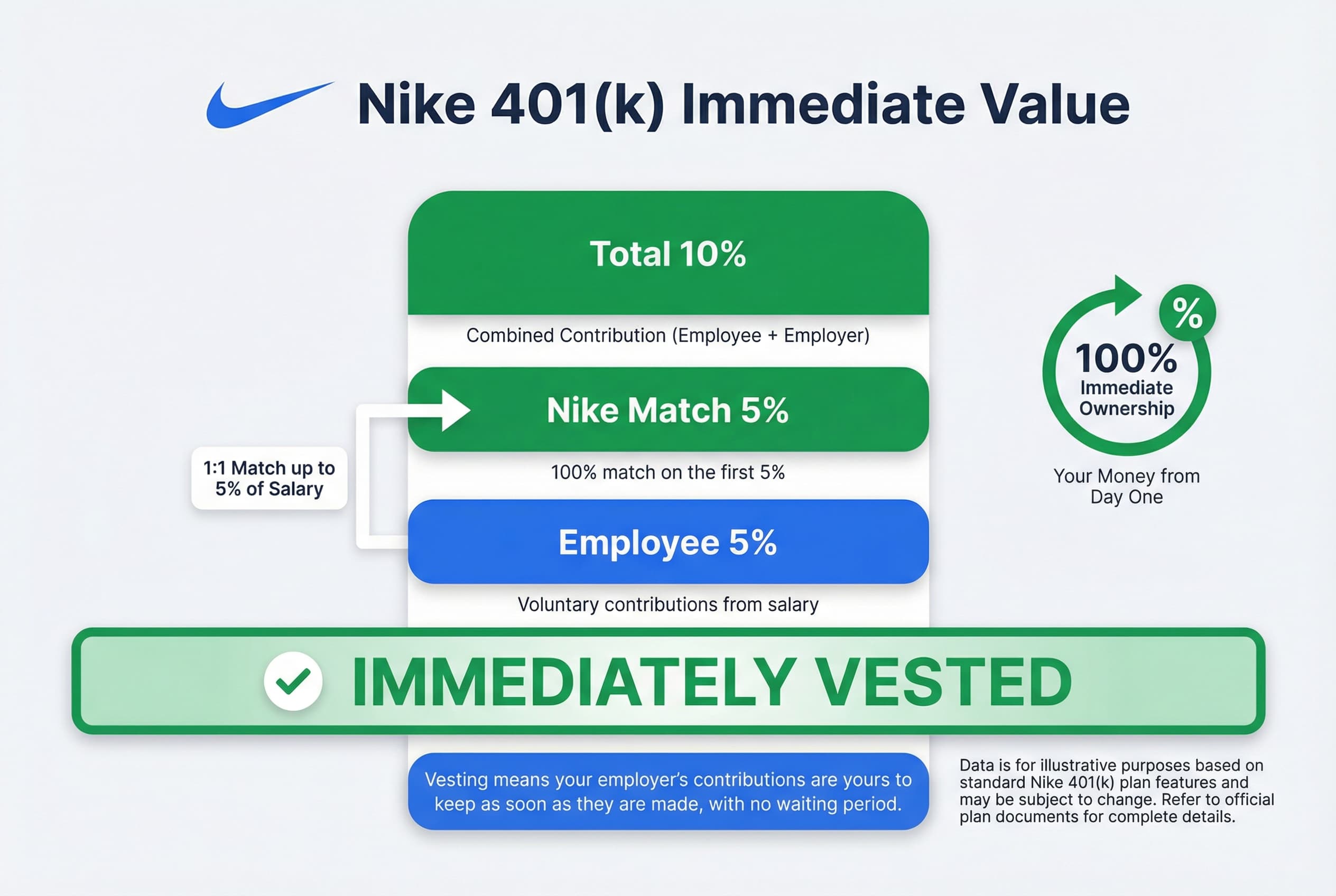
Nike offers a competitive 401(k) plan with immediate value for employees looking to save for retirement.
Nike provides a 100% match on up to 5% of your salary. This means if you contribute 5% of your salary to your 401(k), Nike will contribute an additional 5%, effectively doubling your retirement savings on that portion. The match is immediately vested, so there's no waiting period - the company contributions are yours right away.
The plan offers both traditional pre-tax and Roth 401(k) contributions, giving you flexibility in how you want to be taxed on your retirement savings. For 2023, you can contribute up to $22,500 if you're under 50, or $30,000 if you're 50 or older.
Nike supports a mega backdoor Roth strategy through after-tax contributions. You can contribute an additional 3% of your annual salary in after-tax dollars, capped at $9,900 in total contributions for 2023. This feature is particularly valuable for high earners who want to maximize tax-advantaged retirement savings beyond the standard 401(k) limits.
The combination of immediate vesting, generous matching, and advanced savings strategies like the mega backdoor Roth makes Nike's 401(k) plan a strong component of the total compensation package. To maximize this benefit, consider contributing at least 5% to capture the full company match.
Navigating the tax implications of your Nike equity compensation is crucial for effective financial planning. Here's what you need to know about when and how your stock benefits are taxed.
RSUs: You owe taxes when your RSUs vest, not when they're granted or when you eventually sell the shares. At Nike, with annual vesting, you'll face a tax event each year as 25% of your grant vests. The fair market value of the shares on the vesting date is treated as ordinary income, just like your salary.
Stock Options (ISOs and NSOs): For non-qualified stock options (NSOs), you owe ordinary income tax when you exercise (purchase the shares), based on the difference between the exercise price and the current market value. For incentive stock options (ISOs), there's typically no regular tax at exercise, but the spread may trigger Alternative Minimum Tax (AMT). Both option types incur capital gains tax when you eventually sell the shares.
ESPP: You'll owe taxes when you sell your ESPP shares. If you meet the qualifying disposition requirements (holding for 2 years from the offering date AND 1 year from the purchase date), you'll receive favorable tax treatment with only a portion taxed as ordinary income.
Nike withholds at a default rate of 22% for supplemental income like RSU vesting. However, if you're in a higher tax bracket, your actual tax liability could be significantly higher - potentially up to 37% at the federal level. This creates a common "gap" where you may owe additional taxes at year-end, potentially as much as a 17% shortfall on your RSU value.
The vesting value of RSUs and the exercise spread on NSOs are taxed as ordinary income at your marginal rate. However, any appreciation after vesting (for RSUs) or after exercise (for options) is taxed as capital gains - either short-term (if held less than one year) or long-term (if held more than one year) at more favorable rates.
Nike is headquartered in Oregon, which has a top state income tax rate of 9.9%. Oregon residents will owe state taxes on equity compensation in addition to federal taxes, significantly increasing your overall tax burden.
If you exercise ISOs, the spread between the exercise price and fair market value is an AMT preference item. This can trigger Alternative Minimum Tax liability even though you haven't sold the shares or received cash. Careful planning around ISO exercises is essential to avoid unexpected AMT bills.
Disclaimer: This information is educational only and not tax advice. Tax situations vary based on individual circumstances. Consult with a qualified tax professional to understand your specific tax obligations related to Nike equity compensation.
While Nike equity compensation can be a valuable wealth-building tool, concentrating too much of your net worth in a single stock - even a well-established company like Nike - exposes you to significant risk. If Nike's stock price declines, you could simultaneously face reduced portfolio value, diminished future equity grants, and potential job insecurity, all tied to the same company's performance.
As a retail company, Nike faces unique vulnerabilities including shifting consumer preferences, intense competition from both established brands and emerging direct-to-consumer startups, supply chain disruptions, and economic downturns that reduce discretionary spending. The athletic apparel industry is also increasingly sensitive to social and environmental concerns, which can impact brand perception and sales.
Financial advisors commonly recommend limiting single-stock exposure to 10-20% of your total net worth. This becomes particularly important for Nike employees who may accumulate shares through RSU vesting, ESPP purchases (with the 15% discount and lookback feature), and stock option exercises. Consider selling vested shares systematically to rebalance your portfolio into diversified investments like index funds or bonds.
Remember: your human capital (salary and future equity grants) is already concentrated in Nike. Diversifying your investment portfolio helps protect against company-specific and industry-wide risks while maintaining your long-term financial security.
Nike employees should evaluate selling vested RSUs when their equity compensation creates excessive concentration risk - generally when Nike stock represents more than 10-15% of your total investment portfolio. Since RSUs vest annually over four years (25% per year), each vesting event in August/September is a natural opportunity to reassess your holdings and rebalance.
Working at Nike means your income, benefits, and equity are all tied to the company's performance. This concentration risk is amplified by the annual equity choice between RSUs and NSOs (or a 50/50 mix), plus potential ESPP holdings. Consider diversifying immediately upon RSU vesting to reduce overexposure to a single company's fortunes, regardless of your confidence in Nike's future.
ESPP timing is critical for Nike employees. The plan offers a 15% discount with a lookback provision on six-month offering periods. To qualify for favorable long-term capital gains treatment, you must hold shares for two years from the offering date (April 1 or October 1) and one year from purchase. However, holding for tax benefits increases concentration risk - weigh the potential tax savings against diversification needs.
For RSUs, be aware of potential tax withholding shortfalls. Nike withholds at 22% federally, but if you're in the 37% supplemental rate bracket, you may owe additional taxes at filing.
View your annual equity grants as deferred salary, not a bonus. When evaluating Nike's compensation package, factor in the full four-year vesting value. The annual August election between RSUs and NSOs (typically at a 1:4 ratio) significantly impacts your risk profile and potential upside.
While Nike's trading rules include blackout periods and clawback policies, specific information about 10b5-1 plan availability wasn't confirmed. Contact your equity administrator to explore this automated selling strategy for managing concentration risk systematically.
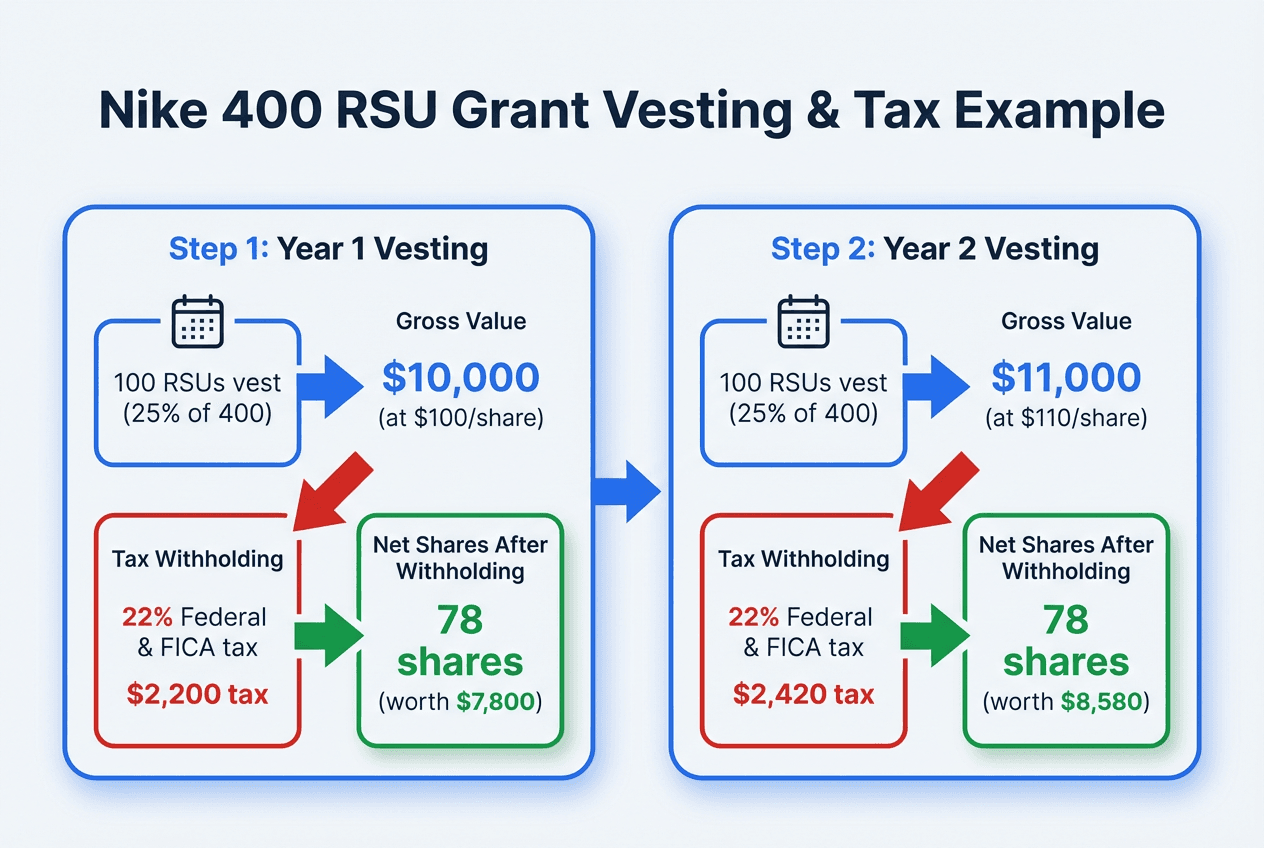
Let's walk through a typical Nike RSU grant to see exactly how vesting works and what you'll receive after taxes.
Suppose you receive a grant of 400 RSUs when you join Nike. At Nike, RSUs vest annually over 4 years at 25% per year, with vesting typically occurring each September.
Year 1 (First September): 100 RSUs vest (25% of 400)
Year 2 (Second September): 100 RSUs vest
Year 3 (Third September): 100 RSUs vest
Year 4 (Fourth September): 100 RSUs vest
After all four years, you'll have received 312 shares (worth $33,540 at the respective vesting prices) from your original 400 RSU grant. Nike withholds shares to cover the 22% federal tax, but note that you may owe additional taxes at year-end if your total income pushes you into a higher bracket.
Important: You'll also receive dividend equivalent payments on vested RSUs, adding extra value to your grant.
Nike employees often make preventable mistakes with their equity benefits. Here are the most common pitfalls to avoid:
Nike withholds at a 22% federal rate for RSU vesting, but your actual tax rate may be higher - potentially up to 37% for supplemental income. This creates a withholding gap of up to 17%, leaving you with an unexpected tax bill at year-end. Plan ahead by setting aside additional funds or adjusting your W-4 withholdings.
Holding RSUs, exercised options, and ESPP shares simultaneously creates significant concentration risk. If Nike's stock declines, your compensation and investments both suffer. Consider diversifying by selling vested shares strategically rather than holding everything long-term.
Nike's ESPP offers a 15% discount with a lookback provision, yet some employees don't participate. Contributing up to the 10% maximum (capped at $25,000 annually) can generate immediate returns, though you'll need to hold shares for two years from the offering date for favorable tax treatment.
Each August, you choose between 100% RSUs, 100% NSOs, or a 50/50 mix. Failing to make an informed decision means missing the opportunity to align your equity with your financial goals and risk tolerance.
If you're approaching age 55 with five years of tenure, leaving before meeting these thresholds means forfeiting unvested equity. Understanding these rules can influence your career timing decisions significantly.
Understanding what happens to your equity compensation when leaving Nike is crucial for financial planning. Here's what you need to know:
Unvested RSUs are typically forfeited upon termination. However, Nike offers Special Retirement Vesting provisions that can protect your unvested equity:
If you don't meet these criteria, you'll lose all unvested RSUs on your termination date.
Nike provides a 90-day post-termination exercise window for vested stock options. After leaving, you have three months to exercise any vested options before they expire. The same Special Retirement Vesting rules apply: employees age 55+ with 5 years tenure can continue vesting options over 4 years (if held for 1+ year), while those 60+ receive immediate vesting.
If you leave during an active ESPP offering period, your contributions typically cease, and accumulated funds are used to purchase shares at the next purchase date. You should verify the specific treatment with Nike's benefits team.
Your termination date matters significantly for vesting. Nike RSUs vest annually (typically in August or September), so leaving just before a vesting date means forfeiting that tranche unless you qualify for Special Retirement Vesting.
Nike offers a deferred compensation plan to higher-earning employees, providing an opportunity to reduce current taxable income while building additional retirement savings.
The program is available to employees earning $150,000 or more in base compensation. This threshold makes the plan accessible to mid-level and senior employees across various functions.
Eligible employees can defer up to 75% of their next year's base salary and up to 100% of their next year's PSP (Performance Sharing Plan) bonus. Deferred amounts grow tax-deferred until distribution, typically at retirement or separation from Nike.
Benefits include immediate tax savings (avoiding current income tax on deferred amounts), tax-deferred growth, and the ability to potentially receive distributions during lower-income retirement years. Risks include being an unsecured creditor of Nike (deferred funds aren't protected if Nike faces financial difficulties), limited access to funds before separation, and potential changes in future tax rates.
Before participating, consider your current cash flow needs, Nike's financial stability, your overall tax strategy, and whether you're already maximizing other tax-advantaged accounts like your 401(k). Deferral elections typically must be made before the calendar year begins, so advance planning is essential.
This content is for educational purposes only and does not constitute financial advice. The information provided is general in nature and may not appl...
YourEmployeeStock.com is not a registered investment advisor.
Nike RSUs vest annually over 4 years at 25% per year. Vesting typically occurs in September each year. When your RSUs vest, you'll also receive Dividend Equivalent Payments for any dividends paid during the vesting period.
Generally, unvested RSUs and stock options are forfeited when you leave Nike. However, if you qualify for Special Retirement Vesting (age 55+ with 5 years of service), your unvested options continue vesting over 4 years if you held them for at least 1 year before leaving. If you're age 60+, unvested options vest immediately upon separation.
Nike's ESPP offers a 15% discount on stock purchases with a lookback provision. You can contribute up to 10% of your salary (maximum $25,000 annually) through payroll deductions. Enrollment occurs semi-annually in March and September, with offering periods starting April 1 and October 1.
Each August, you can choose how to receive your annual equity grant: 100% RSUs, 100% stock options (NSOs), or a 50/50 mix. Keep in mind that if you choose RSUs over options, you'll typically receive fewer shares since options are generally granted at a 4:1 ratio compared to RSUs.
Nike withholds 22% by default for federal taxes when RSUs vest. However, this may not cover your full tax liability—you could face a shortfall of up to 17% depending on your tax bracket, since the supplemental wage rate can be as high as 37%. Plan accordingly to avoid a surprise tax bill.
You have 90 days after leaving Nike to exercise your vested stock options. Options expire 10 years from the grant date. Early exercise is not allowed at Nike, so plan your departure timing carefully if you have valuable vested options.
To qualify for favorable tax treatment on ESPP shares, you must hold them for at least 2 years from the offering date AND 1 year from the purchase date. Meeting both requirements allows you to pay long-term capital gains rates on a portion of your profit rather than ordinary income tax rates.
Yes, Nike matches 100% of your contributions up to 5% of your salary, and the match vests immediately. Nike also offers a Mega Backdoor Roth option allowing you to contribute an additional 3% of your annual salary (capped at $9,900 in 2023) in after-tax contributions that can be converted to Roth.
Get a free personalized analysis from our equity compensation experts

