Free equity analysis
We're still gathering complete information
Some details about Johnson & Johnson's equity programs may be incomplete or based on general industry data. We recommend verifying specifics with your official plan documents or HR department.
Complete guide to understanding your Johnson & Johnson equity compensation, including RSU, NSO, ESPP, vesting schedules, and tax strategies.
Stock Price
$267.20
Closing price · Sep 15, 2026
Employees
128.8K
Worldwide
Equity Programs
3
programs
Vesting Period
4 years
RSU vesting
Closing price · Sep 15, 2026
Johnson & Johnson offers 3 equity compensation programs to employees. Click on each program to learn more about eligibility, vesting, and tax implications.
Standard RSU program with 4-year vesting and 1-year cliff. Annual refresh grants available for eligible employees.
Learn about Johnson & Johnson's Non-Qualified Stock Options program, including vesting schedules and tax treatment.
Learn about Johnson & Johnson's Employee Stock Purchase Plan program, including vesting schedules and tax treatment.
Johnson & Johnson RSUs vest on a Graded/Ratable vesting over several years (implied 4 years based on example, but not explicitly stated as JNJ's schedule) schedule with a 12-month cliff.
Example calculation based on 100 shares:
| Year | Vesting % | Shares Vesting | Estimated Value |
|---|---|---|---|
| Year 1 | 25% | 25 | $6,680 |
| Year 2 | 25% | 25 | $6,680 |
| Year 3 | 25% | 25 | $6,680 |
| Year 4 | 25% | 25 | $6,680 |
| Total | 100% | 100 | $26,720 |
* Based on Johnson & Johnson stock price of $267.20 as of Sep 15, 2026. Actual values will vary.
25%
25 shares
$6,680
25%
25 shares
$6,680
25%
25 shares
$6,680
25%
25 shares
$6,680
Johnson & Johnson vesting schedule based on 100 total shares
Johnson & Johnson offers a comprehensive equity compensation package designed to align employee interests with long-term company performance. As an employee, you have access to several equity vehicles, including Restricted Stock Units (RSUs), Non-Qualified Stock Options (NSOs), Performance Stock Units (PSUs), and an Employee Stock Purchase Plan (ESPP).
Equity compensation represents a significant component of your total rewards, allowing you to build wealth as J&J stock appreciates over time. As a global pharmaceutical leader, J&J has demonstrated long-term stability and growth, making equity holdings potentially valuable for your financial future. The company's commitment to employee ownership is evident in its robust stock ownership guidelines for executives and accessible ESPP for all eligible employees.
RSUs at Johnson & Johnson typically vest using a graded schedule over several years, meaning your shares unlock incrementally rather than all at once. This structure encourages retention while providing regular liquidity events. Once vested, RSUs settle within 60 days (but no later than March 15th of the following year), at which point you'll owe taxes on the value received.
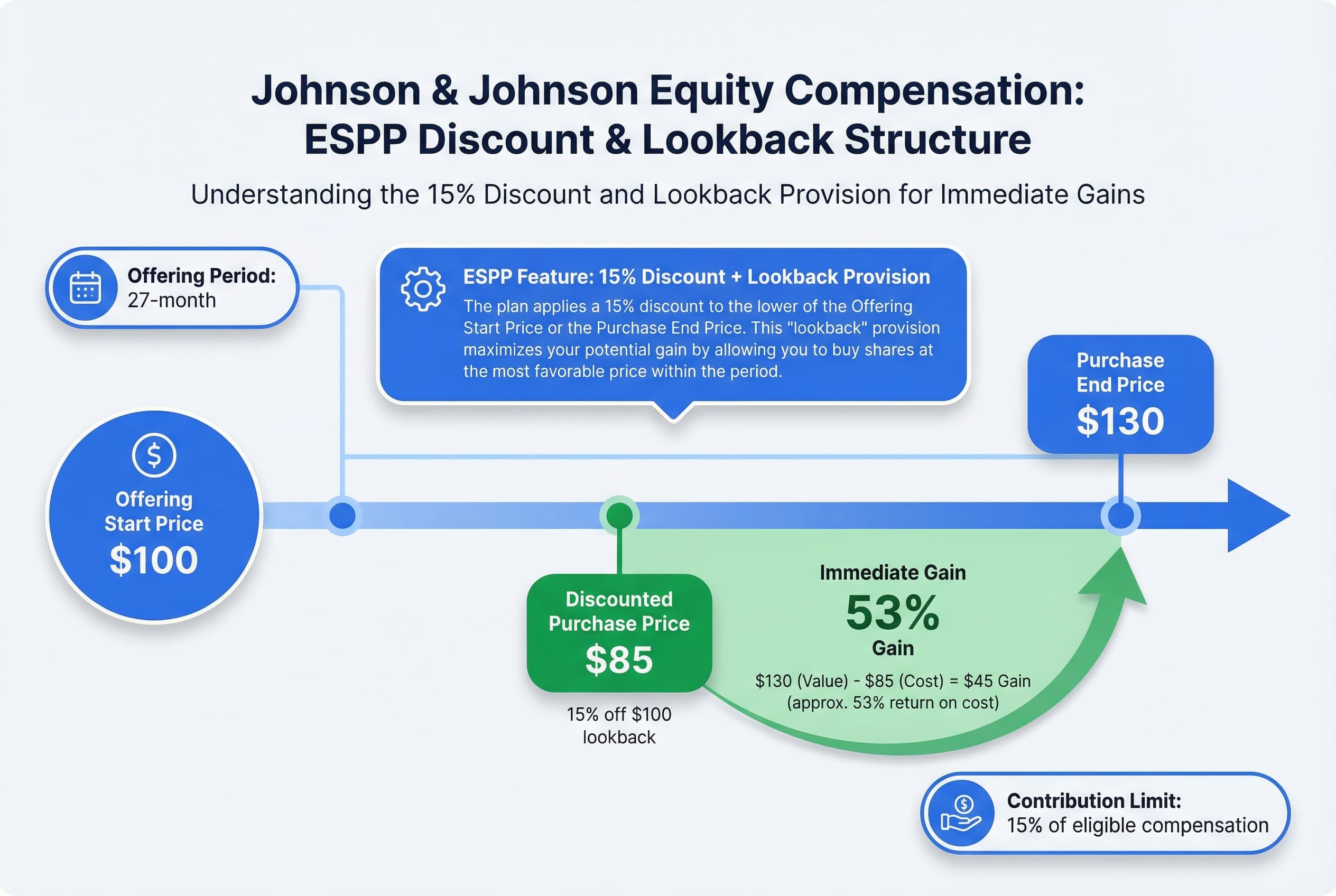
The ESPP offers an attractive 15% discount with a lookback feature over a 27-month offering period, allowing you to purchase J&J stock at favorable prices with up to 15% of your salary (capped at $25,000 annually).
Understanding these equity components and their tax implications is crucial for maximizing your compensation package and building long-term wealth.
Johnson & Johnson uses a graded (or ratable) vesting structure for its Restricted Stock Units (RSUs). While the company's specific vesting percentages and frequency aren't publicly disclosed in detail, this approach means your equity grants vest gradually over multiple years rather than all at once.
Based on available information, J&J's RSU grants typically vest over several years, with industry patterns suggesting a multi-year schedule. Unlike some tech companies that use a standard 4-year plan with a 1-year cliff, J&J's graded vesting approach means you begin earning portions of your equity earlier in the grant period.
One unique aspect of J&J's equity program is the settlement timing. Once your RSUs vest, the company delivers the actual shares within 60 days following the vesting date, but no later than March 15th of the following year. This means there may be a brief delay between when your units vest and when you receive the shares in your account.
The graded vesting structure is neither heavily frontloaded nor backloaded - it provides a relatively uniform distribution of equity over the vesting period. This approach helps with retention while providing earlier access to equity value compared to cliff-heavy structures.
No cliff period information is specified in J&J's publicly available documentation, which differs from many technology companies where you might wait a full year before your first vesting event.
Refresher grants details aren't publicly disclosed, though as a large pharmaceutical company, J&J likely provides additional equity grants to retain talent. The timing and structure of these grants would typically be communicated during performance review cycles.
Be aware that if you retire from J&J and join a competitor within 18 months, you'll forfeit any unvested RSUs. Additionally, executives subject to stock ownership guidelines cannot sell net shares following RSU vesting until they meet their required ownership levels (which can be substantial, up to 12x base salary for senior leaders).
Always consult your specific grant agreement for exact vesting details, as individual grants may vary based on role, level, and grant date.
Johnson & Johnson offers employees a valuable ESPP that allows you to purchase company stock at a discount through payroll deductions. This benefit can provide meaningful returns when used strategically.
The J&J ESPP provides a 15% discount on the stock purchase price and includes a lookback provision. The lookback feature means your purchase price is based on the lower of two prices: the stock price at the beginning of the offering period or the price at the end of the purchase period. This combination can generate substantial returns, especially in rising markets.
For example, if J&J stock is $100 at the offering start and rises to $130 at purchase, you'd buy at $85 (15% off the $100 lookback price), creating an immediate 53% gain if you sell right away.
The ESPP operates with 27-month offering periods, which is longer than many companies' typical 6 or 12-month periods. You can contribute up to 15% of your eligible compensation through payroll deductions, subject to an annual purchase limit of $25,000 (based on the fair market value at the offering start).
How you're taxed depends on when you sell your shares. A qualifying disposition requires holding shares for at least 2 years from the offering date AND 1 year from the purchase date. Meeting these requirements allows more favorable long-term capital gains treatment on a portion of your gain. A disqualifying disposition (selling before meeting both holding periods) results in ordinary income tax on the discount and bargain element.
Given the extended offering period and substantial discount potential, the J&J ESPP can be a powerful wealth-building tool when incorporated into your overall financial plan.
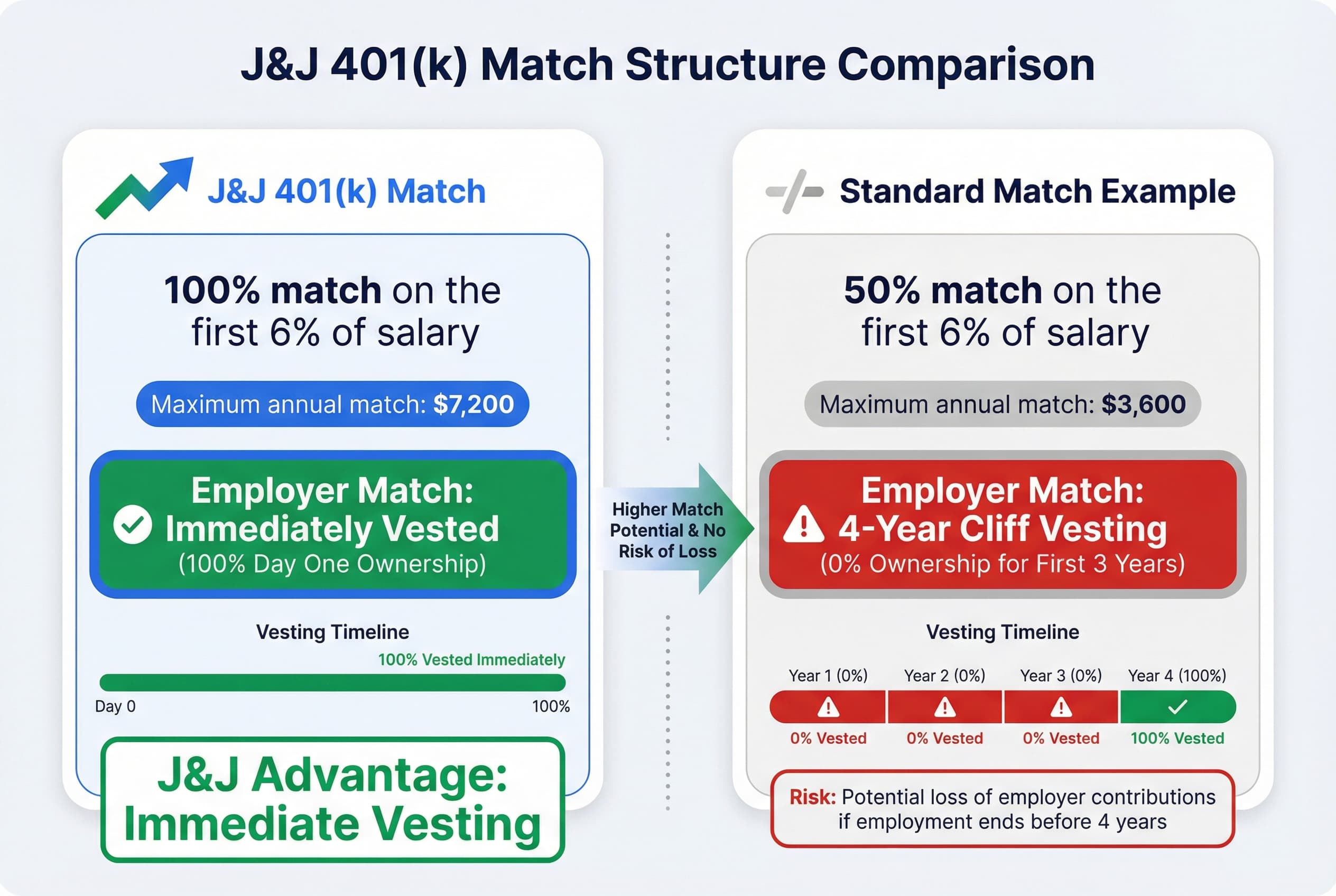
Johnson & Johnson offers a competitive 401(k) retirement savings plan with an attractive employer match structure. The company provides a 100% match on the first 6% of your salary that you contribute to the plan, with a maximum annual match of $7,200. This is one of the more generous match formulas you'll find, as it represents a dollar-for-dollar match rather than the partial matching (such as 50%) that many employers offer.
A significant advantage of J&J's 401(k) plan is that employer matching contributions are immediately vested. This means you own 100% of the company match from day one, with no waiting period required. If you leave the company for any reason, you can take the full employer match with you.
The plan offers a Roth 401(k) option, allowing you to make after-tax contributions that grow tax-free. Additionally, J&J supports after-tax contributions and the mega backdoor Roth strategy. This advanced tax strategy allows high earners who've maxed out standard 401(k) contributions to make additional after-tax contributions and potentially convert them to Roth, significantly increasing your tax-advantaged retirement savings beyond the standard annual limits.
These features make J&J's 401(k) plan particularly valuable for employees focused on maximizing their retirement savings and tax optimization strategies.
Understanding the tax treatment of your equity compensation is crucial for effective financial planning. Here's what you need to know about how your Johnson & Johnson stock benefits are taxed.
RSUs are taxed at vesting as ordinary income, not when you sell the shares. Johnson & Johnson settles RSUs within 60 days following vesting (but no later than March 15th of the following year). The fair market value of the shares on the vesting date becomes taxable income, regardless of whether you sell immediately or hold the shares.
Stock Options (NSOs) trigger ordinary income tax when you exercise, based on the spread between the exercise price and the current market value. Any subsequent gain or loss when you sell is treated as a capital gain or loss.
ESPP shares have complex tax treatment. If you hold shares for both 2 years from the offering date AND 1 year from the purchase date (a "qualifying disposition"), you'll pay ordinary income tax on the discount amount and capital gains on any additional appreciation. Selling earlier results in ordinary income treatment on the full gain.
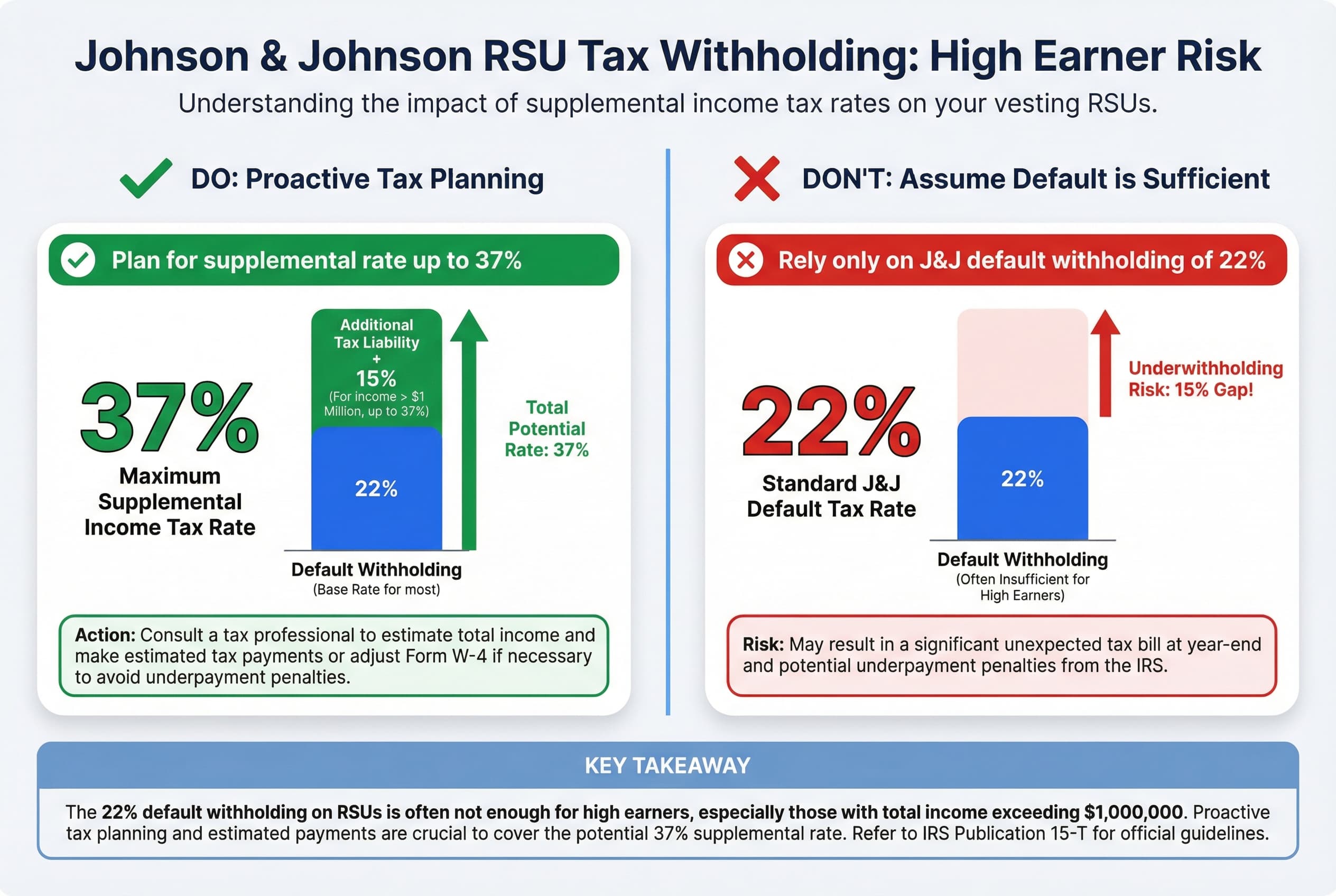
Johnson & Johnson withholds at a 22% default rate for equity compensation, with a 37% supplemental rate for higher earners. However, this may not cover your full tax liability, especially if you're in a higher tax bracket. This "withholding gap" can result in an unexpected tax bill at year-end or underpayment penalties.
After paying ordinary income tax at vesting (for RSUs) or exercise (for NSOs), any subsequent appreciation is taxed as capital gains when you sell. Hold shares for more than one year after the taxable event to qualify for preferential long-term capital gains rates instead of higher ordinary income rates.
New Jersey, where Johnson & Johnson is headquartered, has state income tax that applies to equity compensation. If you work remotely in another state, complex apportionment rules may apply.
Important Disclaimer: This information is educational only and not tax advice. Tax rules are complex and individual circumstances vary significantly. Always consult with a qualified tax professional before making decisions about your equity compensation.
While Johnson & Johnson is a well-established pharmaceutical company, holding too much of your wealth in any single stock - even a stable one - exposes you to unnecessary risk. If the company faces challenges, both your job security and your investment portfolio could be affected simultaneously.
The pharmaceutical industry carries unique risks that can significantly impact stock value. Product liability lawsuits, regulatory challenges, patent expirations on key drugs, and FDA approval setbacks can all create volatility. Even established companies aren't immune to these pressures, which can affect your equity compensation value.
Financial advisors commonly recommend limiting single-stock exposure to 10-20% of your total net worth. This becomes especially important as you accumulate equity through RSUs, PSUs, NSOs, and ESPP purchases over time. Note that Johnson & Johnson executives face stock ownership guidelines requiring holdings up to 12x base salary, but these requirements apply specifically to leadership roles and shouldn't dictate your personal diversification strategy.
Review your holdings regularly, especially after vesting events. Consider selling shares systematically to rebalance your portfolio, keeping in mind any trading restrictions or blackout periods. The ESPP's 15% discount and lookback feature provide immediate gains, but don't let these benefits tempt you into holding excessive company stock long-term. Diversification protects your financial future regardless of any single company's performance.
RSUs at Johnson & Johnson are taxed at vesting, not sale, so you've already paid income tax on vested shares. This creates flexibility - you can sell immediately to capture value or hold if you believe in long-term appreciation. Consider selling when equity exceeds 10-15% of your net worth to manage concentration risk, or when you need funds for major financial goals. Remember that RSUs settle within 60 days of vesting (no later than March 15th of the following year), so plan accordingly.
As a pharmaceutical company employee, your job security and equity compensation are both tied to J&J's performance. If the industry faces headwinds, both could be affected simultaneously. This "double exposure" makes diversification particularly important. Executives should note the stock ownership guidelines (up to 12x base salary for senior leaders) may limit your ability to sell until ownership thresholds are met.
J&J's ESPP offers a 15% discount with a lookback provision over a 27-month offering period. To qualify for favorable tax treatment, hold shares for at least two years from the offering date AND one year from purchase. This "qualifying disposition" allows you to treat some gains as long-term capital gains rather than ordinary income. The $25,000 annual contribution limit is based on fair market value at the offering start.
View your equity grants as deferred compensation that comes with market risk. When evaluating job offers or promotions, consider the expected value of RSUs, PSUs, and options alongside base salary and the generous 401(k) match (100% on 6% of salary, up to $7,200).
While not explicitly confirmed in available data, many large public companies offer 10b5-1 trading plans. These pre-scheduled selling programs can help you sell shares systematically while avoiding blackout period restrictions.
Let's walk through a realistic scenario to see how Restricted Stock Units (RSUs) vest and what you'll actually receive.
Sarah, a senior manager at J&J, receives a grant of 1,000 RSUs as part of her compensation package. At the time of grant, J&J stock trades at $160 per share, making her total grant worth $160,000.
Her RSUs vest using a graded vesting schedule over 4 years, meaning she receives portions of her grant at regular intervals rather than all at once.
Here's how Sarah's RSUs vest:
When her first 250 RSUs vest in Year 1, the stock price has risen to $170 per share. The total value is $42,500 (250 × $170).
J&J withholds 22% for federal taxes at vesting (the company's default withholding rate for supplemental income). This means:
These shares are delivered within 60 days of vesting, but no later than March 15th of the following year.
After the first vesting, Sarah owns 195 shares of J&J stock worth approximately $33,150. She can hold these shares for potential appreciation or sell them (subject to any blackout periods or trading restrictions).
This process repeats each year as additional RSUs vest, with taxes calculated based on the stock price at each vesting date.
Even experienced employees can stumble when managing equity compensation. Here are key mistakes to watch for:
Many J&J employees accumulate significant holdings through RSUs, stock options, and ESPP purchases. While company loyalty is admirable, having too much wealth tied to a single stock creates unnecessary risk. Consider diversifying once shares vest, especially as you approach retirement.
RSUs are taxed as ordinary income when they vest, not when you sell. J&J withholds at a default rate of 22%, which may not cover your actual tax liability if you're in a higher bracket. The supplemental rate can reach 37% for high earners. Without proper planning, you could face a significant tax bill or underpay estimated taxes throughout the year.
J&J's ESPP offers a 15% discount with a lookback provision - a valuable benefit many employees underutilize or ignore entirely. While the 27-month offering period and qualifying disposition rules require planning, this can be essentially free money if structured properly.
Executives subject to ownership guidelines (up to 12x base salary) cannot sell net shares after option exercises or RSU vesting until meeting their requirements. Failing to plan for this restriction can create liquidity challenges when you need access to funds.
Understanding how your equity compensation is affected by termination is crucial for making informed career decisions.
When you leave Johnson & Johnson, unvested RSUs are typically forfeited upon your termination date. Your last official day of employment determines which grants have vested and which you'll lose. Since J&J uses graded vesting over several years, timing your departure can significantly impact how much equity you retain.
Stock options (NSOs) at J&J also stop vesting when you leave. However, specific details about the post-termination exercise window aren't publicly disclosed in standard plan documents, so you'll need to review your individual grant agreements to understand how long you have to exercise vested options after departure.
If you're participating in the Employee Stock Purchase Plan when you leave, you'll typically be withdrawn from any active offering period. Contributions you've made will generally be refunded rather than used to purchase shares. Given J&J's 27-month offering periods, mid-period termination is relatively common.
J&J has unique provisions for retirees: if you join a competitor within 18 months of retirement, you may forfeit unvested RSUs, even those that would have otherwise vested post-retirement. This non-compete provision is particularly important for senior employees to understand.
Always review your specific grant agreements and consult with HR or a financial advisor before making departure decisions.
Johnson & Johnson offers a non-qualified deferred compensation program primarily for senior executives. Based on the company's ownership guidelines and settlement rules, eligibility appears limited to Executive Committee Members, Directors, and potentially Section 16 officers or other specified employees.
The program allows eligible executives to defer a portion of their compensation to a future date, typically retirement or separation from the company. This provides tax deferral benefits, as you won't pay income taxes on deferred amounts until you receive the funds.
Benefits:
Important Restrictions: For specified employees, settlement of deferred compensation may be delayed until six months after separation or death, per IRS Section 409A rules. This is a critical liquidity consideration when planning your finances.
Before participating, consult with a tax advisor to understand how deferral aligns with your overall financial strategy, especially given the settlement delay rules and potential impact on retirement planning.
This content is for educational purposes only and does not constitute financial advice. The information provided is general in nature and may not appl...
YourEmployeeStock.com is not a registered investment advisor.
Johnson & Johnson RSUs typically vest on a graded schedule over several years. Once your RSUs vest, they will be settled and delivered to you within 60 days following the vesting date, but no later than March 15th of the following year. Keep in mind that RSUs are taxed as ordinary income when they vest, not when you sell the shares.
If you retire from Johnson & Johnson and join a competitor within 18 months of your termination, you will forfeit any unvested RSUs. This non-compete provision is designed to protect the company's interests. Make sure to carefully consider the timing and implications before accepting a position with a competitor.
The J&J ESPP allows you to purchase company stock at a 15% discount with a lookback feature, meaning the discount is applied to the lower of the stock price at the beginning or end of the offering period. You can contribute up to 15% of your salary, with a maximum annual purchase limit of $25,000 based on the fair market value at the offering start. The offering period can last up to 27 months.
When your RSUs vest, they are taxed as ordinary income at your regular tax rate. Johnson & Johnson will withhold 22% for federal taxes by default, though the supplemental wage rate can go up to 37% for higher earners. You'll also owe Social Security, Medicare, and any applicable state and local taxes at vesting.
To receive a qualifying disposition for your ESPP shares, you must hold them for at least 2 years from the offering date AND at least 1 year from the purchase date. Meeting both requirements allows a portion of your gain to be taxed at the lower long-term capital gains rate instead of ordinary income rates.
Yes, Johnson & Johnson has trading policies that include blackout periods around certain times. Additionally, if you're subject to stock ownership guidelines (typically executives), you cannot sell net shares following option exercises or RSU/PSU vesting until you've met your required ownership level. Always check current trading windows before selling.
Yes, Johnson & Johnson offers a generous 401(k) match of 100% on the first 6% of your salary you contribute, up to a maximum company match of $7,200 annually. The match vests immediately, and the company also offers a Roth 401(k) option and mega backdoor Roth capability through after-tax contributions.
Johnson & Johnson offers several types of equity compensation including Restricted Stock Units (RSUs), Performance Stock Units (PSUs), Non-Qualified Stock Options (NSOs), and an Employee Stock Purchase Plan (ESPP). The specific mix you receive typically depends on your role and level within the organization.
Get a free personalized analysis from our equity compensation experts

