Free equity analysis
We're still gathering complete information
Some details about Pfizer's equity programs may be incomplete or based on general industry data. We recommend verifying specifics with your official plan documents or HR department.
Complete guide to understanding your Pfizer equity compensation, including RSU, NSO, ESPP, vesting schedules, and tax strategies.
Stock Price
$27.72
Closing price · Sep 14, 2026
Employees
118.5K
Worldwide
Equity Programs
3
programs
Vesting Period
4 years
RSU vesting
Closing price · Sep 14, 2026
Pfizer offers 3 equity compensation programs to employees. Click on each program to learn more about eligibility, vesting, and tax implications.
Standard RSU program with 4-year vesting and 1-year cliff. Annual refresh grants available for eligible employees.
Learn about Pfizer's Non-Qualified Stock Options program, including vesting schedules and tax treatment.
Learn about Pfizer's Employee Stock Purchase Plan program, including vesting schedules and tax treatment.
Pfizer RSUs vest on a 4-year vesting schedule: 25% vests in the 1st year (25.00% annually), and 25% vests in the 2nd, 3rd, and 4th years (2.08% monthly for years 2, 3, and 4). OR 3-year cliff vesting from grant date. schedule with a 12-month cliff.
Example calculation based on 100 shares:
| Year | Vesting % | Shares Vesting | Estimated Value |
|---|---|---|---|
| Year 1 | 25% | 25 | $693 |
| Year 2 | 25% | 25 | $693 |
| Year 3 | 25% | 25 | $693 |
| Year 4 | 25% | 25 | $693 |
| Total | 100% | 100 | $2,772 |
* Based on Pfizer stock price of $27.72 as of Sep 14, 2026. Actual values will vary.
25%
25 shares
$693
25%
25 shares
$693
25%
25 shares
$693
25%
25 shares
$693
Pfizer vesting schedule based on 100 total shares
As a Pfizer employee, you have access to several equity compensation vehicles designed to align your financial success with the company's performance. Pfizer offers Restricted Stock Units (RSUs), Performance Stock Units (PSUs), Non-Qualified Stock Options (NSOs), and an Employee Stock Purchase Plan (ESPP). These programs provide you with opportunities to build ownership in one of the world's leading pharmaceutical companies.
Equity compensation represents a significant portion of your total rewards package. As Pfizer continues to develop innovative treatments and vaccines, your equity grants allow you to share in the company's growth and success. With over 118,000 employees worldwide, Pfizer's equity programs help create a culture of ownership and long-term thinking. The pharmaceutical industry's potential for breakthrough innovations - from drug trial successes to regulatory approvals - can create meaningful value for shareholders and equity holders alike.
RSUs at Pfizer typically follow one of two schedules: a 4-year vesting plan where 25% vests after your first year, then the remaining 75% vests monthly over years 2-4, or a 3-year cliff vesting schedule. Stock options generally vest over three years of continuous service. The ESPP allows you to purchase Pfizer stock at a 15% discount with a lookback feature, through semi-annual purchase periods.
Understanding these programs is essential for maximizing your compensation and building long-term wealth. The following sections will help you navigate each component of Pfizer's equity offerings.
Pfizer offers equity compensation primarily through Restricted Stock Units (RSUs) and stock options, each with distinct vesting timelines that determine when you gain full ownership of your shares.
Pfizer's RSU vesting schedule follows two possible structures, and the specific one applied to your grant will be detailed in your award agreement:
Standard 4-Year Schedule: The most commonly described structure features a 4-year vesting period with a uniform distribution. You'll receive 25% of your grant after completing your first year of service (the "cliff" period), followed by monthly vesting for the remaining three years at approximately 2.08% per month. This results in an equal 25% vesting in each of years two, three, and four.
Alternative 3-Year Cliff: Some grants may use a 3-year cliff vesting structure, where 100% of your RSUs vest after three years of continuous service from the grant date. This schedule has been noted in SEC filings as common for grants issued since 2005.
During the first 12 months after your grant date (the cliff period), your RSUs are accumulating but not yet vested. If you leave Pfizer before completing this one-year cliff, you'll forfeit the entire grant. Once you pass the one-year mark, you'll receive your first 25% vesting (under the 4-year schedule), and subsequent vesting occurs monthly.
Pfizer's 4-year RSU schedule is uniform, meaning you receive an equal 25% of your total grant each year. This differs from backloaded schedules (where more shares vest in later years) or frontloaded schedules (where more vest upfront). The uniform structure provides predictable, consistent equity compensation throughout your tenure.
For employees who receive stock options (NSOs), the vesting period is three years of continuous service from the grant date, which has been the standard since 2005. Options have a contractual term of ten years from the grant date.
Information about refresher grants - additional equity awards given to retain employees after their initial grants vest - is not specified in available company data. Consult with your HR team or compensation documents for details about ongoing equity awards.
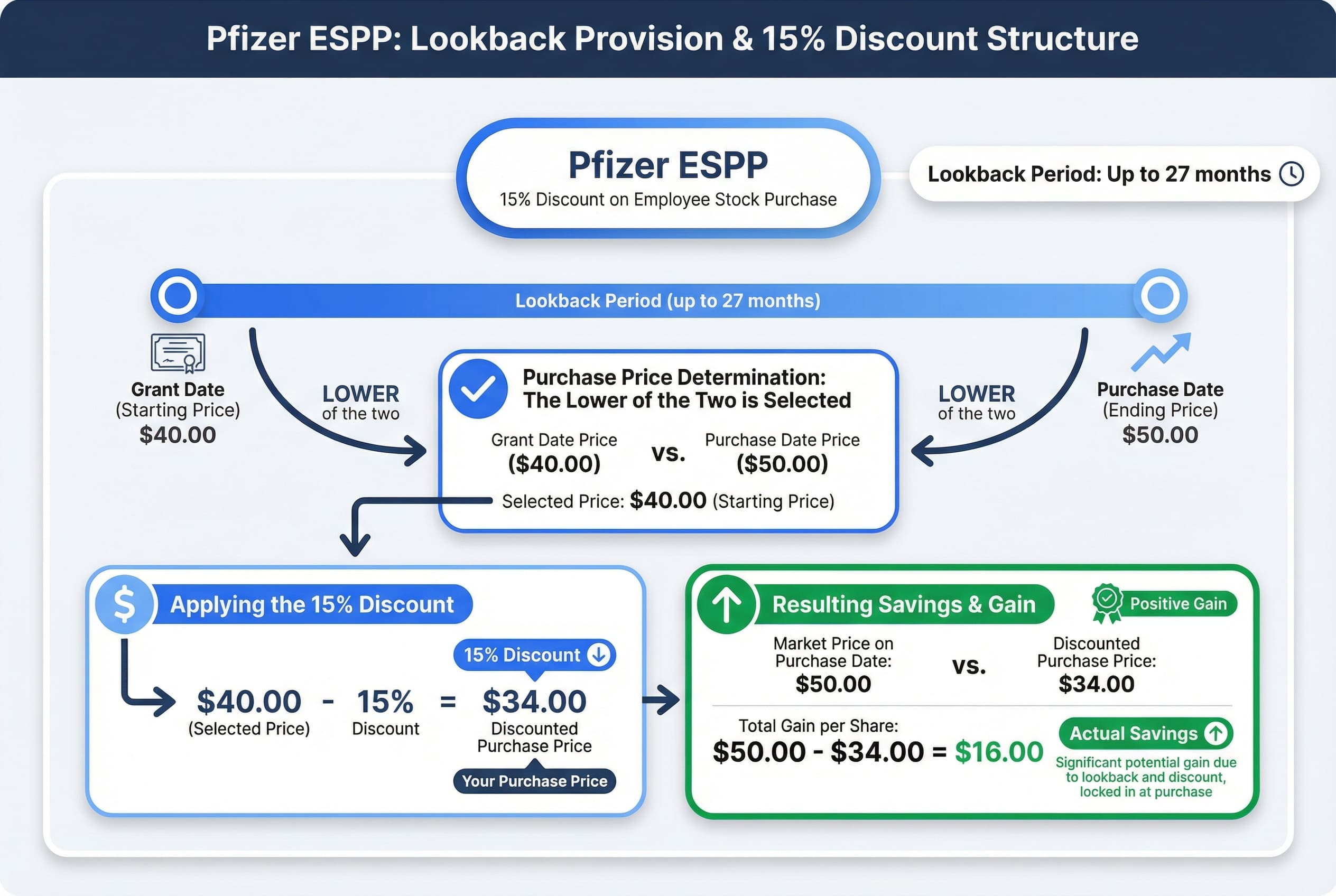
Pfizer offers employees an attractive Employee Stock Purchase Plan that allows you to purchase company stock at a significant discount. The plan provides a 15% discount and includes a lookback provision, creating substantial potential for returns.
The lookback feature is particularly valuable. Pfizer's ESPP has a lookback period of up to 27 months, meaning the purchase price is based on the lower of the stock price at either the beginning of the offering period or the purchase date. Combined with the 15% discount, this can generate meaningful gains even in volatile markets.
For example, if the stock price rises during the offering period, you benefit from purchasing at the lower starting price minus the 15% discount. If the stock price falls, you purchase at the lower current price, still with the 15% discount applied.
The plan operates on 6-month offering periods with semi-annual purchases. Enrollment periods typically align with these offering cycles, generally occurring around January and July, though specific dates may vary.
You can contribute up to $25,000 annually through payroll deductions. This limit aligns with IRS regulations for employee stock purchase plans.
Understanding the tax treatment is essential for maximizing your ESPP benefits. A qualifying disposition occurs when you hold shares for at least one year after the purchase date and at least two years after the offering date. Qualifying dispositions receive more favorable tax treatment, with a portion taxed as long-term capital gains. Disqualifying dispositions (selling before meeting both holding periods) result in the discount being taxed as ordinary income.
Given the lookback provision and discount combination, Pfizer's ESPP can be one of your most valuable benefits, offering immediate returns while building equity in your employer.
Understanding the tax treatment of your Pfizer equity compensation is crucial for effective financial planning. Here's what you need to know about when and how you'll owe taxes on your awards.
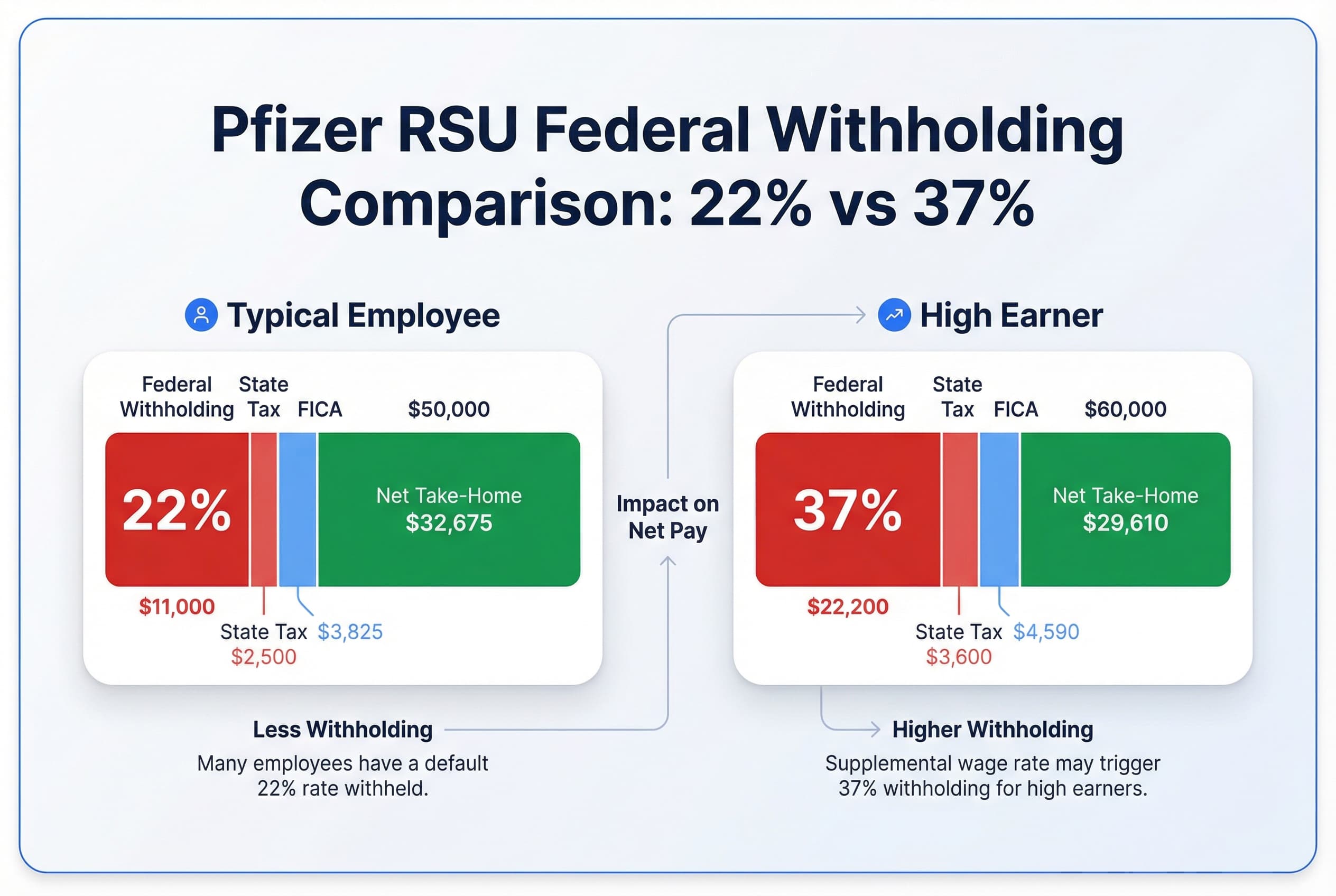
Restricted Stock Units (RSUs) are taxed as ordinary income at vesting, not when you sell the shares. The fair market value of the shares on the vesting date becomes taxable compensation, just like your regular salary. Pfizer typically withholds at a 22% federal rate for most employees, though the supplemental wage rate can reach 37% for high earners.
This creates a common "gap" issue: if you're in a higher tax bracket than 22%, you may owe additional taxes when filing your return. You can often adjust your withholding rate with your plan administrator to avoid surprises at tax time.
After your RSUs vest and you own the shares, any subsequent price appreciation is taxed as capital gains when you sell. If you hold the shares for more than one year after vesting, you'll pay long-term capital gains rates (typically lower than ordinary income rates). Shares held for less than a year trigger short-term capital gains, taxed at ordinary income rates.
Important: Pfizer employees should be aware of potential double taxation if cost basis isn't correctly reported to your brokerage. Ensure your broker has accurate records of the income already taxed at vesting to avoid overpaying on capital gains.
Pfizer grants Non-Qualified Stock Options (NSOs), which trigger ordinary income tax on the "spread" (difference between exercise price and fair market value) when you exercise. You'll face capital gains treatment on any additional appreciation when you eventually sell the shares.
Your Employee Stock Purchase Plan has special tax rules. To receive favorable tax treatment, you must hold shares for at least one year after purchase and at least two years after the offering date (the qualifying period). Otherwise, the discount is taxed as ordinary income.
Consider your state tax obligations, as they vary significantly by location and can materially impact your total tax burden.
Disclaimer: This information is educational only and not tax advice. Tax rules are complex and individual situations vary. Consult a qualified tax professional for personalized guidance.
While Pfizer equity compensation offers valuable wealth-building opportunities, concentrating too much of your net worth in a single stock - even a well-established pharmaceutical company - creates significant financial risk. If Pfizer's stock price declines, you could simultaneously face reduced compensation value, lower portfolio returns, and potentially job insecurity, all tied to the same company.
The pharmaceutical industry faces unique volatility drivers that can impact Pfizer's stock price:
Financial advisors typically recommend limiting single-stock exposure to 10-20% of your total net worth. This means as your RSUs vest and accumulate, you should consider selling shares periodically to rebalance your portfolio into diversified investments like index funds or bonds.
Think of diversification as protection against the unexpected. While you may have confidence in Pfizer's long-term prospects, maintaining a concentrated position means betting your financial future on factors largely outside your control. Regular rebalancing helps you capture the value of your equity compensation while managing risk appropriately.
As your RSUs vest (either annually in year one or monthly in years 2-4), consider selling shares to avoid concentration risk. A common rule of thumb is keeping no more than 10-15% of your net worth in a single stock. Since Pfizer operates in the pharmaceutical industry - subject to regulatory risks, patent cliffs, and clinical trial outcomes - diversification becomes especially important. Consider selling shares systematically after vesting to rebalance your portfolio.
Pharmaceutical companies face unique volatility from drug development pipelines and patent expirations. If your career, health insurance, and retirement savings all depend on Pfizer, holding substantial equity creates significant concentration risk. Evaluate whether you'd be comfortable with your total Pfizer exposure if the stock declined 30-40%, as pharma stocks can experience during patent losses or trial failures.
Pfizer's ESPP offers a 15% discount with a lookback provision, providing immediate value. For maximum tax efficiency, consider holding shares for the qualifying period (at least one year after purchase AND two years after the offering date) to achieve long-term capital gains treatment on the discount. However, this strategy requires accepting market risk. Many employees choose to sell immediately after each semi-annual purchase, locking in the guaranteed 15% return.
View your equity grants as deferred cash compensation, not just upside potential. When RSUs vest, they're taxed as ordinary income at rates up to 37% for high earners. Plan for this tax liability and avoid the common mistake of selling shares to cover unexpected tax bills, which can trigger additional capital gains taxes if the stock has appreciated.
While data on Pfizer's specific policies is limited, many pharmaceutical companies offer 10b5-1 plans, allowing you to establish pre-scheduled sales during blackout periods around earnings announcements.
Let's walk through how RSU vesting works for a Pfizer employee using the most common vesting schedule.
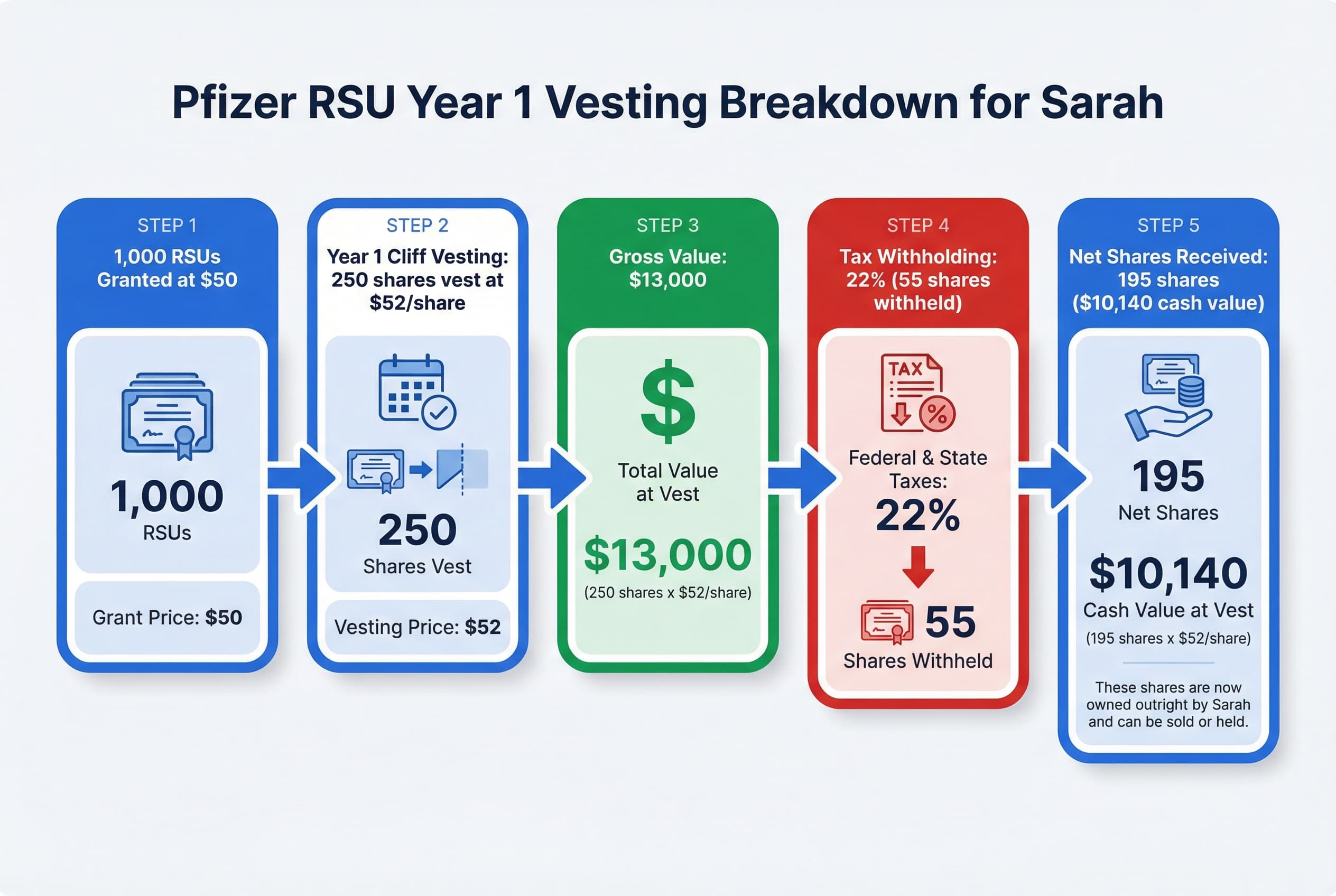
Sarah joins Pfizer and receives a grant of 1,000 RSUs when the stock price is $50 per share. Her grant follows the 4-year vesting schedule with monthly vesting after the first year.
After 12 months of continuous service, Sarah's first vesting occurs:
Pfizer withholds 22% for taxes (the default withholding rate):
For the remaining 36 months, Sarah vests 2.08% monthly (25% ÷ 12 months per year):
By the end of 4 years, assuming the stock price remains at $52:
The 22% withholding covers federal taxes at vest, but Sarah may owe additional taxes at year-end if she's in a higher tax bracket. The shares she receives are hers to hold or sell, and any future gains would be subject to capital gains tax when sold.
Note: Pfizer also offers a 3-year cliff vesting option for some grants, where 100% vests after 36 months of continuous service.
Pfizer employees often leave money on the table or face unexpected tax bills by making these avoidable mistakes:
Many employees don't realize that RSUs typically have a 12-month cliff before the first 25% vests. Leaving before your one-year anniversary means forfeiting your entire grant. Similarly, stock options require three years of continuous service to vest - departing early means losing unvested options entirely.
Holding too much Pfizer stock creates dangerous over-concentration. When your salary, benefits, and investment portfolio all depend on one company's performance, you're exposing yourself to significant risk. Diversify by selling vested RSUs and reinvesting elsewhere.
Pfizer's default withholding rate is 22% on RSU vesting, but if you're in a higher tax bracket, you'll owe additional taxes at filing. The supplemental rate can reach 37%, creating a substantial tax bill in April if you don't plan ahead or adjust your withholding.
Pfizer's ESPP offers a 15% discount with a generous 27-month lookback period, providing significant guaranteed returns. Many employees skip enrollment due to cash flow concerns, missing out on one of the most valuable benefits available.
RSUs may be classified as "non-covered shares," meaning your brokerage won't correctly report your cost basis. This can lead to double taxation on capital gains if you don't track your basis manually.
Understanding how your equity compensation is affected when you leave Pfizer is crucial for financial planning. Here's what typically happens to each component:
Any unvested RSUs are forfeited upon termination of employment. Since Pfizer RSUs typically vest over either a 4-year schedule (25% annually in year 1, then monthly in years 2-4) or a 3-year cliff schedule, only shares that have already vested by your termination date will be yours to keep. The timing of your departure significantly impacts how much equity you retain - leaving just before a vesting date means forfeiting those shares.
Pfizer grants non-qualified stock options (NSOs) that typically vest over three years of continuous service. Like RSUs, unvested options are forfeited when you leave. For vested options, you'll have a limited window to exercise them post-termination, though the specific number of days isn't publicly disclosed. Options expire ten years from the grant date, but your post-termination exercise window will be considerably shorter.
If you leave during an ESPP offering period, you'll typically be withdrawn from the plan. Contributions made up to your termination date are generally returned to you, and you won't participate in the upcoming purchase date. The 6-month offering periods mean timing your departure could affect whether you benefit from the plan's 15% discount and lookback feature.
Note: Voluntary versus involuntary termination differences are not specified in Pfizer's publicly available equity compensation documentation.
Pfizer offers a deferred compensation program available to employees at the Director level and above. This program allows eligible participants to defer a portion of their compensation to future years, typically retirement, as part of a broader financial planning strategy.
Deferred compensation allows you to postpone receiving income until a later date, reducing your current taxable income. The deferred amounts grow tax-deferred until distribution, when they're taxed as ordinary income.
Benefits:
Risks:
Before participating, evaluate your current versus expected future tax rates, your confidence in Pfizer's long-term financial stability, and whether you need current cash flow. Consider consulting with a financial advisor to determine if deferral aligns with your overall compensation strategy, particularly given Pfizer's equity compensation programs.
This content is for educational purposes only and does not constitute financial advice. The information provided is general in nature and may not appl...
YourEmployeeStock.com is not a registered investment advisor.
Pfizer typically uses one of two vesting schedules for RSUs. The most common is a 4-year schedule where 25% vests after your first year, then the remaining 75% vests monthly (2.08% per month) over years 2-4. Alternatively, some grants use a 3-year cliff vesting schedule where 100% vests after three years of continuous service from the grant date.
Pfizer's Employee Stock Purchase Plan (ESPP) offers a 15% discount on the stock price. The plan also includes a lookback provision, which means you purchase shares at 15% off the lower of the stock price at the beginning of the offering period or at the end of the purchase period, maximizing your potential discount.
Stock options at Pfizer typically vest over three years of continuous service from the grant date, which has been the standard practice since 2005. These options have a contractual term of ten years from the grant date, giving you a 10-year window to exercise them once vested.
Pfizer's default tax withholding rate for RSU vesting is 22%, though the supplemental rate can be as high as 37%. You can typically adjust your withholding rate if you expect to be in a different tax bracket. Keep in mind that RSU income is treated as ordinary income and may push you into a higher tax bracket.
Pfizer's ESPP purchases stock semi-annually, with offering periods lasting 6 months. The lookback period extends up to 27 months, allowing you to benefit from the lower stock price over a longer timeframe when calculating your purchase discount.
A qualifying disposition occurs when you hold ESPP shares for at least one year after the purchase date AND at least two years after the offering date. Meeting these requirements allows you to receive more favorable long-term capital gains tax treatment on a portion of your ESPP profit, rather than having all gains taxed as ordinary income.
Yes, Pfizer offers both traditional 401(k) and Roth 401(k) options, and the plan allows after-tax contributions. While Pfizer doesn't offer a 401(k) match, you can still maximize your retirement savings through these accounts and potentially benefit from the different tax treatments.
A common issue for Pfizer employees is incorrect cost basis reporting on vested RSUs, which can lead to double taxation and overpayment of capital gains tax. When RSUs vest, the fair market value is reported as income, and this same amount should be your cost basis. Ensure your brokerage correctly reports this to avoid paying capital gains tax on income you've already been taxed on.
Get a free personalized analysis from our equity compensation experts

