Free equity analysis
Complete guide to understanding your T-Mobile equity compensation, including RSU, ESPP, vesting schedules, and tax strategies.
Employees
83.5K
Worldwide
Equity Programs
2
programs
Vesting Period
3 years
RSU vesting
T-Mobile offers 2 equity compensation programs to employees. Click on each program to learn more about eligibility, vesting, and tax implications.
T-Mobile offers equity compensation to employees primarily through Restricted Stock Units (RSUs) and an Employee Stock Purchase Plan (ESPP). For certain executives, the company also provides Performance Stock Units (PSUs) tied to specific business objectives. These equity benefits are designed to align your interests with the company's long-term success in the competitive telecommunications industry.
As one of the major players in telecommunications with over 83,000 employees, T-Mobile's equity compensation allows you to share in the company's growth. Your RSUs represent actual shares of T-Mobile stock (ticker: TMUS) that convert to ownership once they vest. The ESPP provides an opportunity to purchase shares at a discount, offering immediate value on day one.
T-Mobile uses different vesting schedules depending on when you received your grant and your level:
Director-level and above employees typically receive more substantial grants, with Director+ roles receiving $130,000 or more in annual RSU value. Vesting generally occurs in February and August for newer grants, or annually for older awards.
The ESPP operates on six-month offering periods with enrollment windows in January and July, providing a 15% discount with a lookback feature to maximize your benefit.
T-Mobile uses multiple vesting schedules for RSU grants, with the specific structure depending on when you received your grant and your role level. Understanding which schedule applies to you is essential for planning your equity compensation.
T-Mobile offers three primary vesting structures:
3-Year Annual Vesting: This schedule, typically used for older grants, vests 33.3% of your RSUs each year over three years. Shares vest once annually on your grant anniversary or designated vesting date.
4-Year Monthly Vesting: Another option for general grants vests 25% annually over four years. However, unlike the 3-year schedule, vesting occurs monthly during years 2, 3, and 4, providing more frequent liquidity after the first year.
6-Month Semi-Annual Vesting: For newer grants starting in February 2024, T-Mobile shifted to semi-annual vesting. Shares vest every six months, with vesting dates typically occurring in February and August. This structure provides approximately 8.33% of your grant vesting every six months over the full vesting period.
Your specific vesting dates depend on your grant schedule. Common vesting dates include February 15, May 15, August 15, and November 15. Newer grants follow the February/August pattern, while older grants may vest annually on different dates.
Based on available data, T-Mobile's RSU grants do not appear to have a traditional cliff period where you must wait one year before any shares vest. However, the specific cliff details for standard grants are not explicitly documented, so you should verify this information in your individual grant agreement.
T-Mobile provides refresher grants, particularly for executives and director-level employees (Director+ roles can receive $130,000+ annually in RSUs). Executive long-term incentive (LTI) awards vest over 3 or 4 years, or based on performance periods. However, the company doesn't publicly specify a formal refresher grant policy for non-executive employees.
All three vesting schedules are uniform, meaning shares vest in equal increments throughout the vesting period rather than being front-loaded or back-loaded.
T-Mobile offers an Employee Stock Purchase Plan that provides employees with an attractive opportunity to purchase company stock at a discount. The plan features a 15% discount on the stock price, allowing you to buy T-Mobile shares below market value.
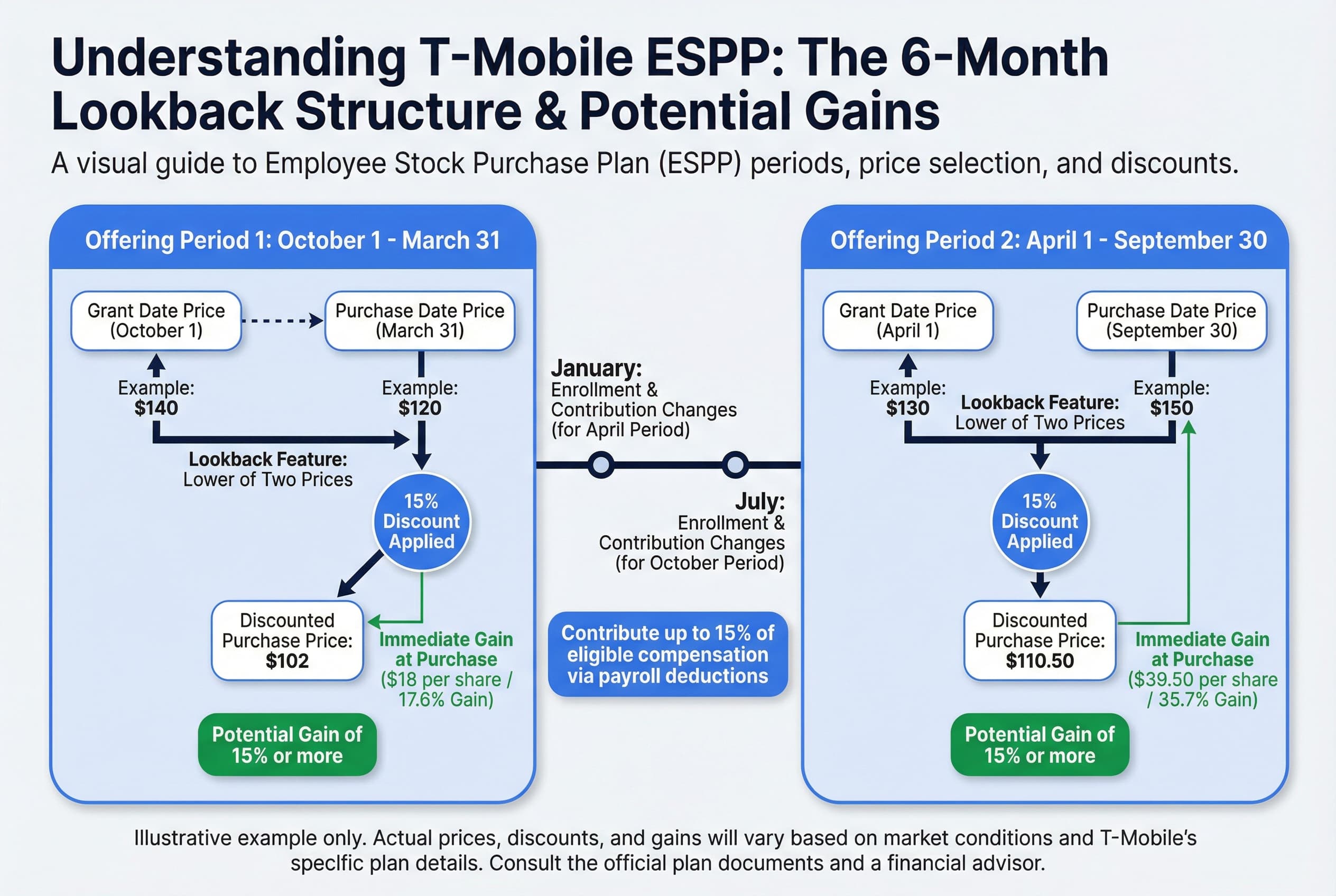
The ESPP includes a lookback provision, which can significantly enhance your returns. The plan operates on 6-month offering periods (running October 1 - March 31 and April 1 - September 30). At the end of each period, you purchase shares at 15% below whichever price is lower: the stock price at the beginning of the offering period or the price at the end of the purchase period.
This lookback feature creates powerful potential returns. If T-Mobile stock rises during the offering period, you benefit from both the 15% discount and the ability to purchase at the earlier, lower price. In favorable market conditions, this combination can generate immediate gains of 15% or more.
You can contribute up to 15% of your eligible compensation through payroll deductions. Enrollment windows occur in January and July, aligning with the semi-annual offering periods. Purchases happen automatically at the end of each 6-month period.
Understanding the tax treatment is important for maximizing your ESPP benefits. A qualifying disposition occurs when you hold shares for at least 2 years from the offering date and 1 year from the purchase date. This allows more favorable tax treatment on a portion of your gains. A disqualifying disposition (selling before meeting these requirements) results in ordinary income tax on the discount and any additional gain taxed as capital gains.
The ESPP represents one of T-Mobile's most valuable benefits, offering a relatively low-risk way to build equity in the company while benefiting from the discount and lookback features.
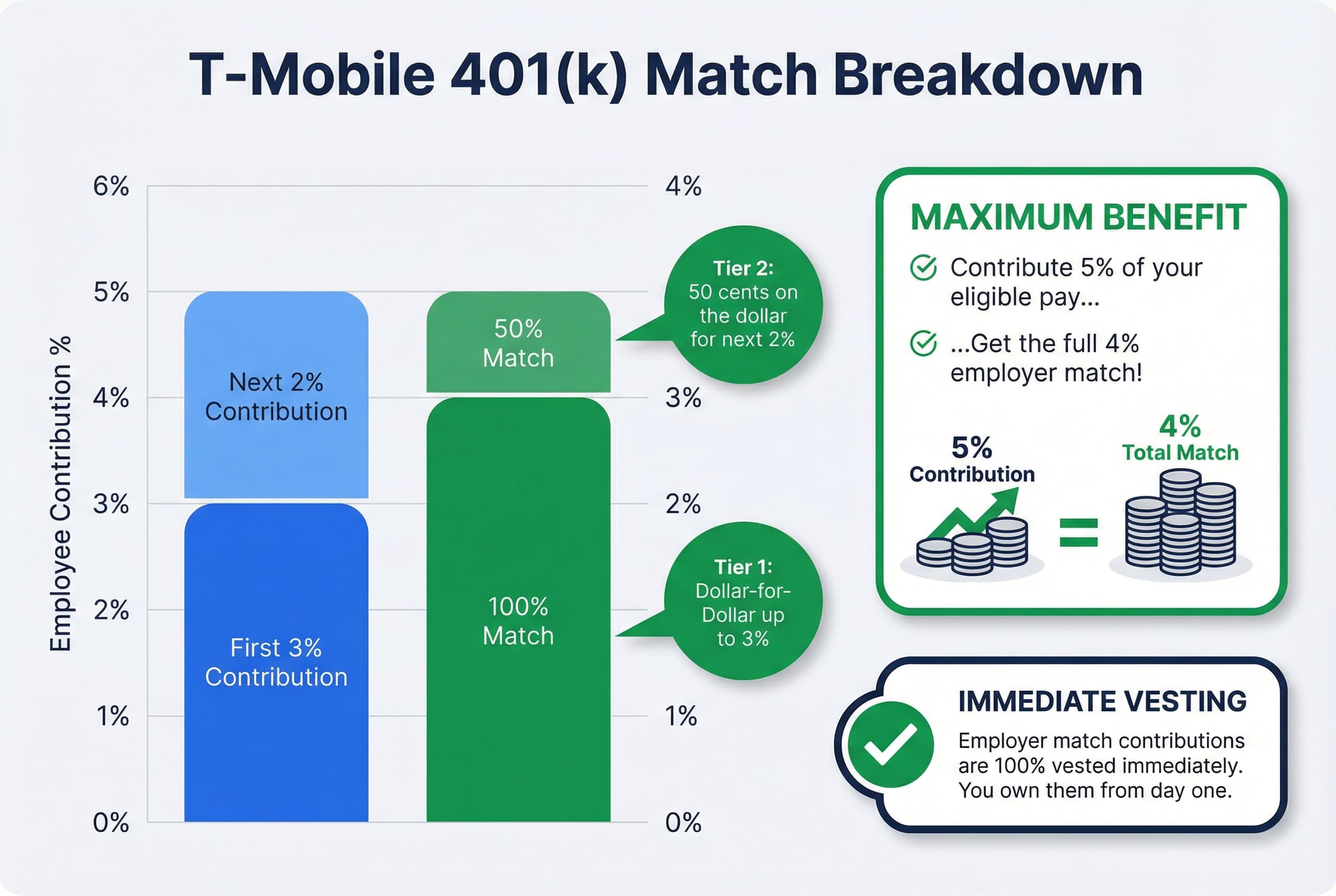
T-Mobile offers a competitive 401(k) plan with an attractive employer match structure. The company provides a 100% match on the first 3% of your salary that you contribute, plus a 50% match on the next 2%. This means if you contribute at least 5% of your salary, you'll receive the full 4% employer match - essentially free money toward your retirement.
One of the standout features of T-Mobile's 401(k) is immediate vesting of employer match contributions. Unlike many companies that require you to stay for several years before the match becomes yours, T-Mobile's contributions are yours from day one, providing valuable portability if you decide to change jobs.
T-Mobile supports sophisticated retirement planning strategies. The plan offers both Roth 401(k) and after-tax contribution options, and importantly, provides mega backdoor Roth conversion capability. This feature allows high earners to potentially contribute significantly more to Roth accounts beyond standard limits - up to the total 2023 contribution limit of $66,000 (including employee contributions, employer match, and after-tax contributions).
The mega backdoor Roth strategy can be particularly valuable for employees receiving substantial RSU compensation, as it provides an opportunity to build tax-free retirement savings alongside your equity compensation. Consider consulting with a financial advisor to determine if this advanced strategy makes sense for your situation.
Understanding the tax treatment of your equity compensation is crucial for effective financial planning. Here's what T-Mobile employees need to know about taxes on RSUs, PSUs, and ESPP shares.
When Taxes Are Owed: RSUs are taxed as ordinary income at vesting, not when you sell the shares. The fair market value of shares on your vesting date becomes taxable compensation, just like your regular salary. This applies whether your RSUs vest annually, monthly, or semi-annually according to your grant schedule.
Withholding and the "Gap" Problem: T-Mobile's default withholding rate is 22% for equity compensation. However, this may create a significant gap if your actual tax bracket is higher. For example, if you're in the 32% or 35% federal tax bracket, the 22% withholding leaves you short - potentially resulting in an unexpected tax bill or underpayment penalties at year-end. You can adjust your withholding settings, and many employees choose to sell additional shares at vest to cover the full tax liability.
After your RSUs vest and you own the shares, any subsequent price appreciation (or decline) is treated as capital gains when you sell. If you hold shares for more than one year after vesting, you'll qualify for long-term capital gains rates, which are typically lower than ordinary income rates. Shares sold within one year are taxed as short-term capital gains at ordinary income rates.
The ESPP offers a 15% discount with a lookback provision. Tax treatment depends on how long you hold shares after purchase. For a "qualifying disposition" (held 2 years from offering date and 1 year from purchase), you'll receive favorable tax treatment on a portion of the gain. Disqualifying dispositions result in the discount being taxed as ordinary income.
This information is educational only and not tax advice. Tax situations vary based on your income, state of residence, filing status, and other factors. Always consult with a qualified tax professional or CPA familiar with equity compensation before making decisions about your T-Mobile stock benefits.
As a T-Mobile employee, your equity compensation can become a significant part of your wealth - but concentrating too much in any single stock, even your employer's, creates meaningful risk.
When a large portion of your net worth is tied to T-Mobile stock, you're exposed to company-specific volatility. Your financial security becomes dependent on both your paycheck and your investments coming from the same source. If T-Mobile faces challenges, you could experience job insecurity and portfolio losses simultaneously.
The telecommunications sector faces unique headwinds including intense competition among major carriers, regulatory changes, massive infrastructure investment requirements for 5G buildout, and market saturation in wireless services. While T-Mobile has shown competitive strength, industry-wide pressures can impact stock performance regardless of company execution.
Financial advisors commonly recommend limiting single-stock exposure to 10-20% of your total net worth. For T-Mobile employees receiving RSUs (potentially $130k+ annually for Director-level and above) and participating in the 15% discount ESPP, this concentration can build quickly.
Consider establishing a systematic selling strategy after RSUs vest. Use your 401(k) match (100% on the first 3% of salary) to build diversified holdings, and explore the mega backdoor Roth option to create tax-advantaged diversification. Regular rebalancing helps protect your financial future while still benefiting from T-Mobile's growth.
Consider selling RSUs immediately upon vesting if T-Mobile stock represents more than 10-15% of your total investment portfolio. Since shares vest annually, semi-annually (February and August for newer grants), or monthly depending on your grant type, each vesting event is an opportunity to rebalance. Remember that you've already paid taxes at vesting, so selling doesn't trigger additional tax liability beyond capital gains on any appreciation since the vest date.
As a telecommunications company, T-Mobile's performance may correlate with your job security - industry downturns could affect both your equity value and employment simultaneously. This "double risk" makes diversification particularly important. If you're a Director or above receiving $130k+ annually in RSUs, you're likely accumulating significant equity exposure that warrants regular review.
ESPP Timing: T-Mobile's ESPP offers a 15% discount with a 6-month lookback, providing potential gains of up to 17.6% at purchase. To qualify for favorable long-term capital gains treatment, hold shares for at least 2 years from the offering date and 1 year from purchase. However, immediate sale may still be advantageous given the guaranteed discount - calculate your specific tax situation.
RSU Tax Withholding: The default 22% withholding may be insufficient if you're in a higher tax bracket. You can adjust withholding rates to avoid an unexpected tax bill at year-end.
View your equity grants as deferred cash compensation rather than investment opportunities. Factor vested RSUs into your annual compensation when evaluating job offers or negotiating raises.
T-Mobile offers 10b5-1 plans, which allow pre-scheduled stock sales during blackout periods. These plans are particularly valuable if you're subject to trading windows based on your position, providing flexibility to execute your diversification strategy regardless of quarterly earnings timing.
Let's walk through a realistic example of how RSU vesting works at T-Mobile using their 3-year annual vesting schedule.
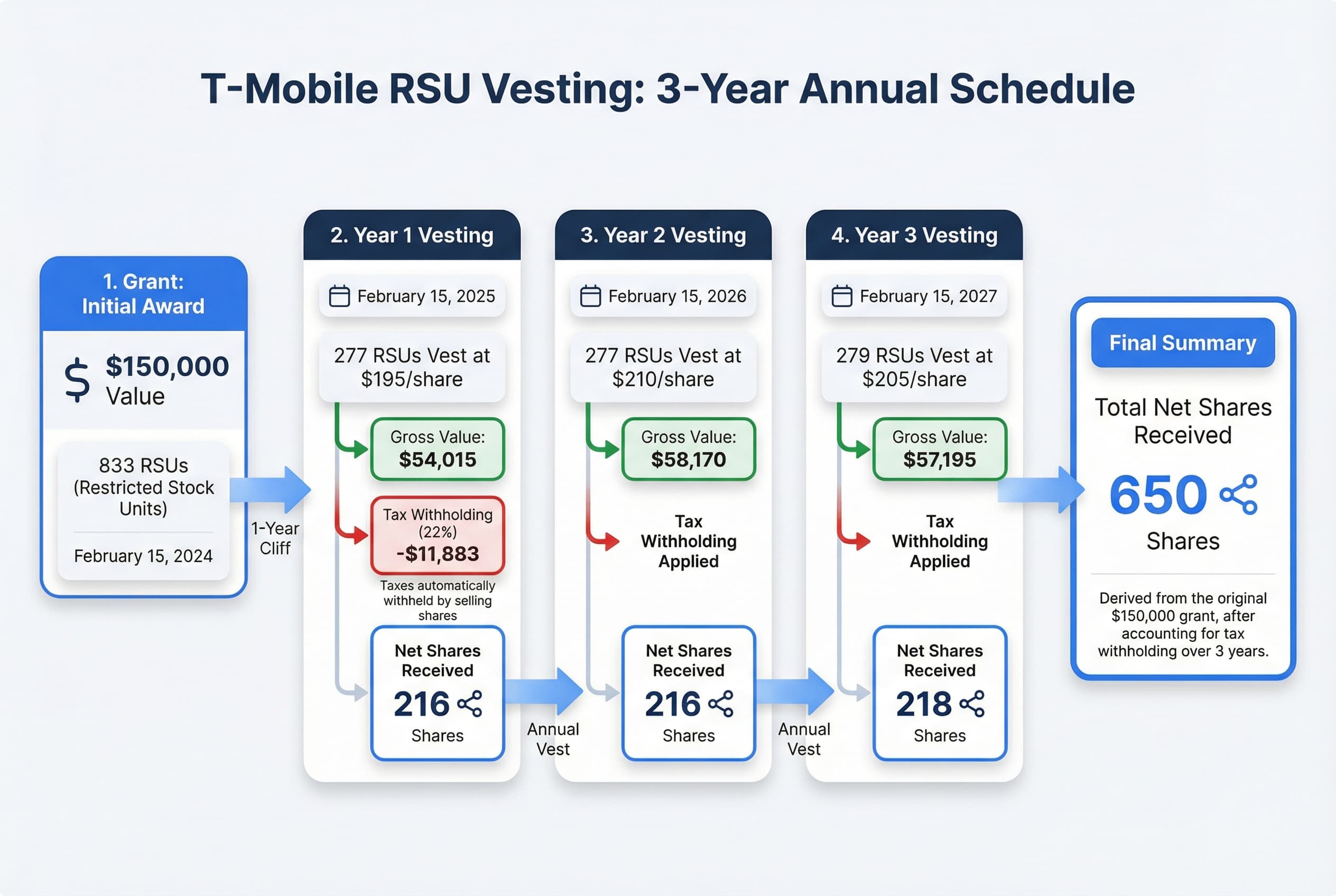
Sarah, a Director at T-Mobile, receives an RSU grant worth $150,000 on February 15, 2024. At the current stock price of $180 per share, this equals approximately 833 RSUs (rounded for simplicity).
Her grant vests equally over three years: 33.3% each year on the anniversary of her grant date.
Year 1 (February 15, 2025):
Year 2 (February 15, 2026):
Year 3 (February 15, 2027):
The 22% default withholding rate may be lower than Sarah's actual tax bracket. If she's in the 32% or 35% bracket, she'll owe additional taxes when filing her return. She can adjust her withholding rate to avoid a surprise tax bill.
Over three years, Sarah receives 650 shares after taxes from her original $150,000 grant, with the final value depending on T-Mobile's stock performance at each vesting date.
T-Mobile employees often miss opportunities or create unnecessary tax burdens by making these avoidable mistakes with their equity compensation:
The default 22% withholding rate on RSU vesting is frequently insufficient for employees in higher tax brackets. If you're a Director+ level employee receiving $130,000+ in annual RSU grants, the actual tax rate could be significantly higher, potentially leaving you with a surprise tax bill in April.
Many employees hold too much T-Mobile stock relative to their overall portfolio. Since your salary already depends on the company's success, concentrating your investments in TMUS stock creates unnecessary risk. Consider diversifying after vesting events.
T-Mobile's ESPP offers a 15% discount with a six-month lookback provision, providing potential returns of 17-35% depending on stock performance. Yet many employees either don't enroll during the January and July windows or contribute less than the 15% maximum, leaving money on the table.
Newer grants (starting February 2024) vest semi-annually rather than annually, affecting cash flow planning and tax timing. Failing to track your specific vesting schedule - whether it's the 3-year annual, 4-year monthly, or newer 6-month pattern - can lead to missed planning opportunities around these dates.
Understanding these pitfalls helps you maximize the value of your T-Mobile equity compensation package.
Understanding how your equity compensation is affected when you leave T-Mobile is crucial for financial planning, whether you're considering a new opportunity or facing an unexpected departure.
When you leave T-Mobile, any unvested RSUs are typically forfeited, regardless of whether your departure is voluntary or involuntary. This applies to all vesting schedules, whether you're on the 3-year annual vesting plan, the 4-year monthly vesting structure, or the newer semi-annual vesting schedule that started in February 2024. Your termination date matters significantly - if you leave just before a vesting date (such as February 15, May 15, August 15, or November 15), you'll miss out on those shares.
Based on available information, T-Mobile does not appear to offer traditional stock options (ISOs or NSOs) as part of standard employee compensation packages, so post-termination exercise windows are not applicable for most employees.
If you're enrolled in T-Mobile's Employee Stock Purchase Plan and leave mid-period, your accumulated contributions will typically be used to purchase shares at the next scheduled purchase date (in February or August), or you may receive a refund of your contributions, depending on the plan's specific termination provisions. However, you cannot continue contributing after your employment ends.
Important note: The specific details of T-Mobile's termination policies may vary based on your employment agreement, level, and circumstances. Always review your equity grant documents and consult with HR or a financial advisor before making decisions around departure timing.
T-Mobile offers a Non-Qualified Deferred Compensation Plan available to Section 16 Officers and executives. This program allows eligible participants to defer the issuance of shares when their RSUs vest, providing greater control over the timing of their taxable events.
When your RSUs are scheduled to vest, you can elect to defer receiving the shares until a future date you specify. This delays both the receipt of shares and the associated tax liability until the deferred settlement date.
Benefits:
Risks:
Deferral elections typically must be made well in advance of vesting (often by December 31 of the prior year), so planning ahead is essential. Consult with a tax advisor to determine if deferral aligns with your overall financial strategy.
This content is for educational purposes only and does not constitute financial advice. The information provided is general in nature and may not appl...
YourEmployeeStock.com is not a registered investment advisor.
T-Mobile has multiple vesting schedules depending on when you received your grant. Older grants typically vest either 33.3% annually over 3 years or 25% annually over 4 years (with monthly vesting in years 2-4). Newer grants starting in February 2024 vest semi-annually, with vesting dates typically in February and August.
Only vested RSUs are yours to keep when you leave T-Mobile. Any unvested RSUs will typically be forfeited upon termination of employment. Make sure to check your specific grant agreement for details, as executive agreements may have different provisions.
T-Mobile's default tax withholding rate is 22% on RSU vesting. However, this may be lower than your actual tax bracket, which could result in owing additional taxes at year-end. You can adjust your withholding rate if you expect to be in a higher tax bracket.
T-Mobile's ESPP offers a 15% discount on stock purchases with a lookback provision. The plan has 6-month offering periods with enrollment windows in January and July. You can contribute up to 15% of your salary, and the purchase price is based on the lower of the stock price at the beginning or end of the 6-month period.
You can generally sell vested shares, but employees may be subject to trading windows depending on your position. T-Mobile has blackout periods, particularly around earnings announcements. If you're in a restricted role, consider setting up a 10b5-1 trading plan to sell shares during blackout periods.
A qualified disposition occurs when you hold ESPP shares for at least 2 years from the offering date and 1 year from the purchase date. Meeting these requirements allows a portion of your gain to be taxed at the lower long-term capital gains rate instead of ordinary income rates, potentially saving you significant taxes.
While T-Mobile provides Long-Term Incentive (LTI) awards including RSUs to executives, the general refresher grant policy for non-executive employees is not clearly specified. Director-level employees and above can receive annual RSU grants of $130,000 or more, but policies may vary by level and performance.
If you're a Section 16 Officer or executive-level employee, you may be able to elect to defer the issuance of shares when your RSUs vest through T-Mobile's Non-Qualified Deferred Compensation Plan. This option is typically not available to non-executive employees, so check your eligibility with HR.
Get a free personalized analysis from our equity compensation experts

