Free equity analysis
Complete guide to understanding your PayPal equity compensation, including RSU, NSO, ESPP, vesting schedules, and tax strategies.
Stock Price
$54.03
Closing price · Sep 14, 2026
Employees
34.6K
Worldwide
Equity Programs
3
programs
Vesting Period
3 years
RSU vesting
Closing price · Sep 14, 2026
PayPal offers 3 equity compensation programs to employees. Click on each program to learn more about eligibility, vesting, and tax implications.
Standard RSU program with 4-year vesting and 1-year cliff. Annual refresh grants available for eligible employees.
Learn about PayPal's Non-Qualified Stock Options program, including vesting schedules and tax treatment.
Learn about PayPal's Employee Stock Purchase Plan program, including vesting schedules and tax treatment.
PayPal RSUs vest on a Multiple schedules exist: 3-year annual vesting (1/3 per year); 4-year vesting (25% Y1, then monthly); 3-year vesting (1/3 cliff, then 1/12 quarterly); Make-Whole RSUs (1/3 cliff, then 1/12 quarterly). schedule with a 12-month cliff.
Example calculation based on 100 shares:
| Year | Vesting % | Shares Vesting | Estimated Value |
|---|---|---|---|
| Year 1 | 33% | 33 | $1,782.99 |
| Year 2 | 33% | 33 | $1,782.99 |
| Year 3 | 34% | 34 | $1,837.02 |
| Total | 100% | 100 | $5,403 |
* Based on PayPal stock price of $54.03 as of Sep 14, 2026. Actual values will vary.
33%
33 shares
$1,782.99
33%
33 shares
$1,782.99
34%
34 shares
$1,837.02
PayPal vesting schedule based on 100 total shares
PayPal offers a comprehensive equity compensation package designed to align employee interests with the company's long-term success. As a publicly traded financial technology company (NASDAQ: PYPL), your equity awards represent real ownership in a leading digital payments platform.
PayPal's equity program includes Restricted Stock Units (RSUs) as the primary equity vehicle for most employees, along with Non-Qualified Stock Options (NSOs) for certain roles. The company also offers Performance-Based RSUs (PBRSUs) that vest based on achieving specific performance targets. Additionally, all eligible employees can participate in the Employee Stock Purchase Plan (ESPP), which allows you to purchase PayPal stock at a 15% discount with favorable lookback provisions.
Your equity compensation provides the opportunity to benefit from PayPal's growth in the rapidly evolving fintech industry. With over 34,000 employees worldwide, PayPal's equity program helps attract and retain top talent while giving you a direct stake in the company's performance.
PayPal uses multiple vesting schedules depending on your role and grant type. Most RSU grants follow either a 3-year or 4-year vesting schedule, with many including a 12-month cliff before initial vesting. Common schedules include annual vesting (one-third per year) or quarterly vesting after the initial cliff period. You can also expect annual stock refreshers, though specific amounts vary by performance and level. Stock options typically vest over 48 months, with an initial 6-month cliff followed by monthly vesting.
PayPal uses multiple vesting schedules depending on your role, grant type, and when you joined the company. Understanding which schedule applies to your specific RSU grant is essential for planning your equity compensation.
PayPal's RSU grants typically follow one of several patterns:
3-Year Annual Vesting: Some grants vest in equal installments of 1/3 per year over three years. This schedule is common for certain roles and older grant structures.
4-Year Vesting with Monthly Cadence: Another common structure vests 25% after the first year, with the remaining shares vesting monthly thereafter. This means you'll receive your first quarter of shares at your one-year anniversary, then smaller monthly installments for the next three years.
3-Year Cliff with Quarterly Vesting: For inducement grants (typically offered to new hires), PayPal uses a 1/3 cliff followed by quarterly vesting. You'll receive one-third of your shares at the 12-month mark, with the remaining shares vesting in equal quarterly installments (1/12 of the total grant each quarter) over the next two years.
PayPal's vesting schedules generally include a 12-month cliff. During this first year, no shares vest. If you leave the company before completing one full year, you forfeit your entire grant. Once you pass the one-year mark, you'll receive your first vesting installment - either 25%, 33.3%, or another amount depending on your specific schedule.
After the cliff period, shares typically vest quarterly for most employees, though some schedules include monthly vesting after the first year. Specific vesting dates occur on grant anniversaries, with inducement grants sometimes vesting at specific intervals (such as 12, 15, and 27 months).
PayPal employees can expect annual stock refreshers - additional RSU grants awarded each year to retain talent. However, the specific amounts vary and aren't publicly disclosed. Refresher grants typically vest over a new four-year period, meaning you'll accumulate multiple overlapping vesting schedules as you progress in your career at PayPal.
PayPal offers a competitive Employee Stock Purchase Plan that allows you to purchase company stock at a significant discount. The plan provides a 15% discount on the purchase price, combined with a valuable lookback provision that can substantially increase your potential returns.
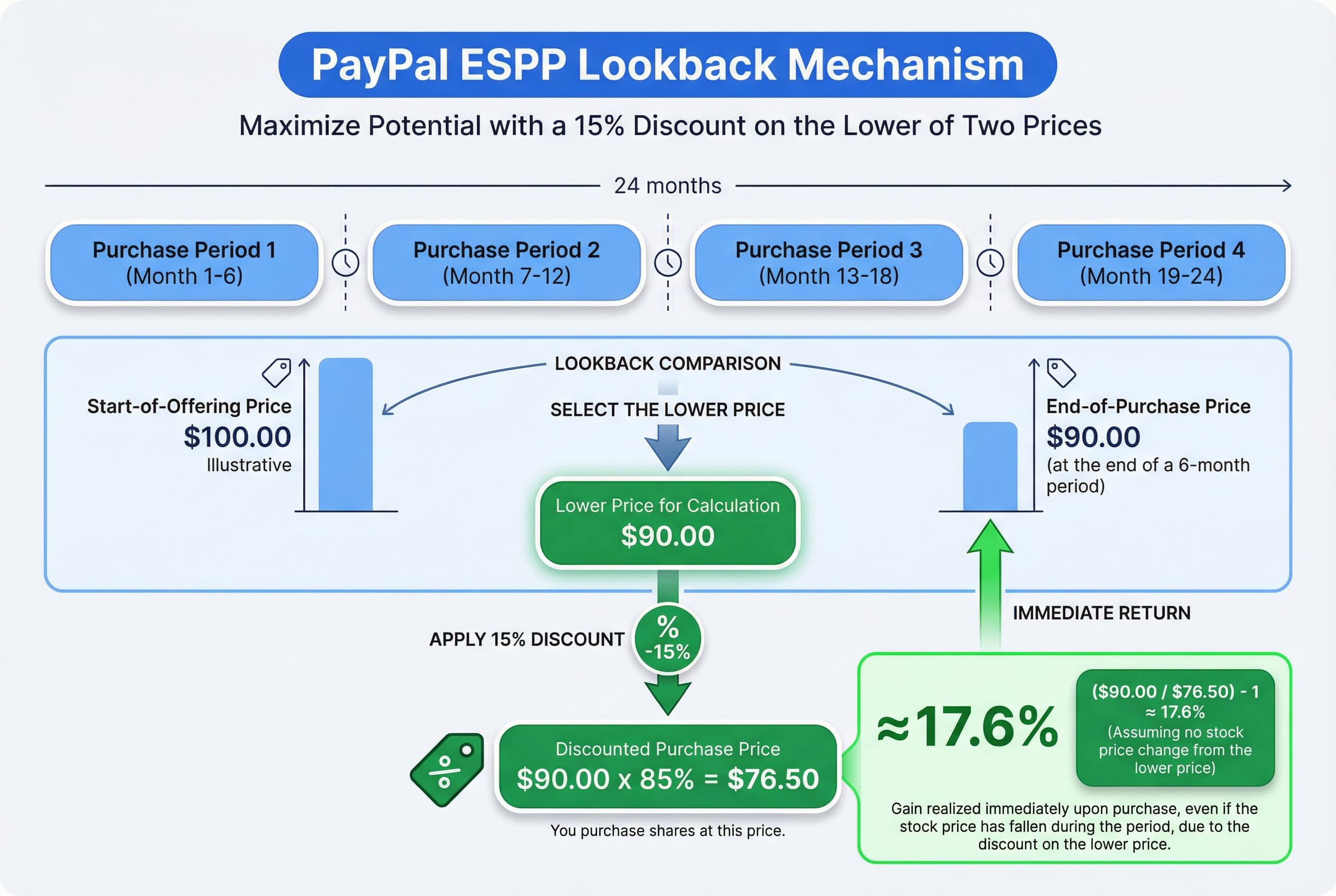
The lookback provision is one of the ESPP's most attractive features. PayPal operates on 24-month offering periods, each divided into four 6-month purchase periods. At each purchase date, you'll buy shares at 85% (the 15% discount) of whichever price is lower: the stock price at the beginning of the 24-month offering period or the price at the end of the 6-month purchase period. This means if PayPal's stock price increases during the offering period, you benefit from purchasing at the lower historical price with the discount applied.
You can contribute up to 10% of your base salary through payroll deductions, subject to the IRS annual limit of $25,000 based on fair market value per calendar year. Enrollment windows open twice annually on May 1 and November 1, aligning with the start of new 24-month offering periods.
The combination of the 15% discount and lookback provision can generate immediate returns of approximately 17.6% (if no stock price change occurs) or significantly more if the stock appreciates during the offering period. For example, if the stock rises 20% during a purchase period, you'd purchase at the lower beginning price with the 15% discount applied.
To receive favorable tax treatment as a qualifying disposition, you must hold shares for more than one year after the purchase date and more than two years after the offering date. Selling before meeting both requirements results in a disqualifying disposition, where the discount is taxed as ordinary income at sale.
PayPal offers a competitive 401(k) plan with an attractive employer match to help you build long-term wealth. Understanding these benefits can significantly impact your retirement savings strategy.
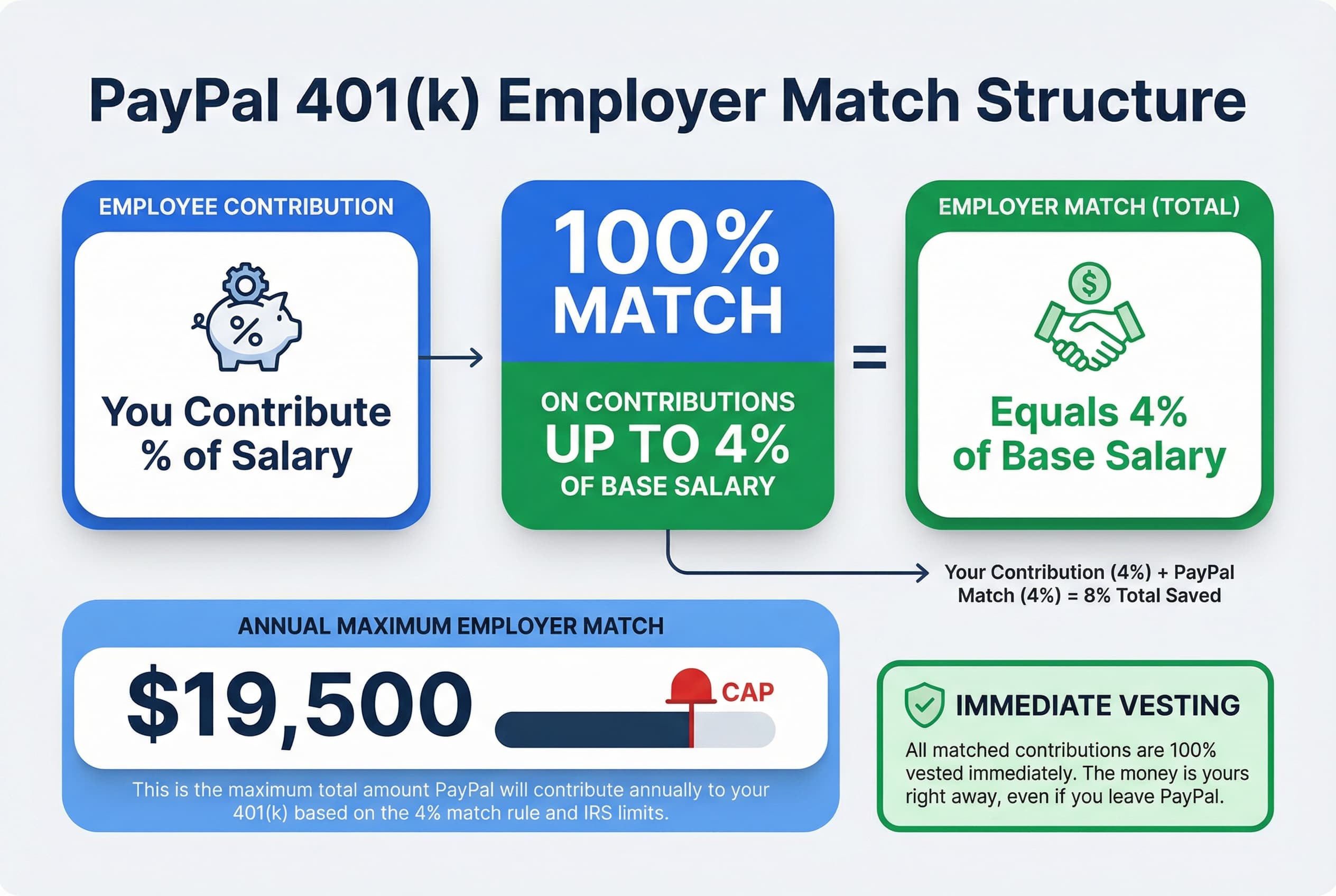
PayPal provides a 100% match on up to 4% of your base salary. This means if you contribute at least 4% of your salary to your 401(k), PayPal will match that contribution dollar-for-dollar. The employer match is capped at $19,500 annually, ensuring substantial retirement savings support even for higher earners.
One of the standout features of PayPal's 401(k) is immediate vesting. All employer matching contributions are yours from day one, with no waiting period required. This means you won't forfeit any matched funds if you leave the company, providing valuable flexibility in your career planning.
PayPal's 401(k) plan includes several advanced features for tax-efficient retirement saving:
These features make PayPal's 401(k) particularly valuable for employees looking to optimize their retirement tax strategy and maximize long-term savings potential.
Understanding the tax treatment of your PayPal equity compensation is crucial for effective financial planning. Here's what you need to know about when and how taxes apply.
RSUs (Restricted Stock Units): Taxes are owed at vesting, not at grant. When your RSUs vest, the fair market value of the shares becomes taxable as ordinary income, regardless of whether you sell the shares. PayPal withholds taxes at a default rate of 22%, though you can adjust this rate.
NSOs (Non-Qualified Stock Options): You'll owe ordinary income tax on the difference between the exercise price and the fair market value when you exercise. Capital gains or losses apply when you later sell the shares.
ESPP (Employee Stock Purchase Plan): Tax treatment depends on whether you hold the shares for a qualifying period (over 1 year after purchase AND over 2 years after the offering date). Qualifying dispositions receive favorable tax treatment, with only the discount taxed as ordinary income and the remainder as capital gains. Non-qualifying dispositions result in the full discount being taxed as ordinary income.
PayPal's 22% default withholding rate often creates a tax shortfall. If you're in a higher tax bracket, you may owe additional taxes at year-end. For California residents, state taxes (up to 13.3%) add to this burden, yet only federal taxes are withheld at vesting. This gap can result in a significant tax bill when filing your return.
The initial value of vested RSUs and exercised NSOs is taxed as ordinary income at your marginal tax rate. Any subsequent appreciation (or loss) when you sell shares is taxed as capital gains - long-term if held over one year, short-term if less.
While PayPal is headquartered in California, a high-tax state, your state tax obligation depends on where you work and reside. California residents face some of the nation's highest state income tax rates, significantly impacting your total tax burden on equity compensation.
Important Disclaimer: This information is educational only and not tax advice. Tax situations vary based on individual circumstances, state of residence, and changing tax laws. Always consult a qualified tax professional or financial advisor for personalized guidance.
As a PayPal employee, your equity compensation can represent significant wealth-building potential. However, concentrating too much of your net worth in any single stock - including your employer's - creates substantial risk that you should actively manage.
When a large portion of your wealth sits in PayPal stock, you face "double exposure": both your income and your investments depend on the same company's performance. If PayPal encounters difficulties, you could simultaneously face job insecurity and declining portfolio value, precisely when you need financial stability most.
PayPal operates in the rapidly evolving financial technology sector, which faces unique challenges including intense competition from traditional banks, fintech startups, and tech giants entering payments. Regulatory changes, cybersecurity threats, shifts in consumer payment preferences, and economic downturns affecting transaction volumes can all significantly impact stock performance.
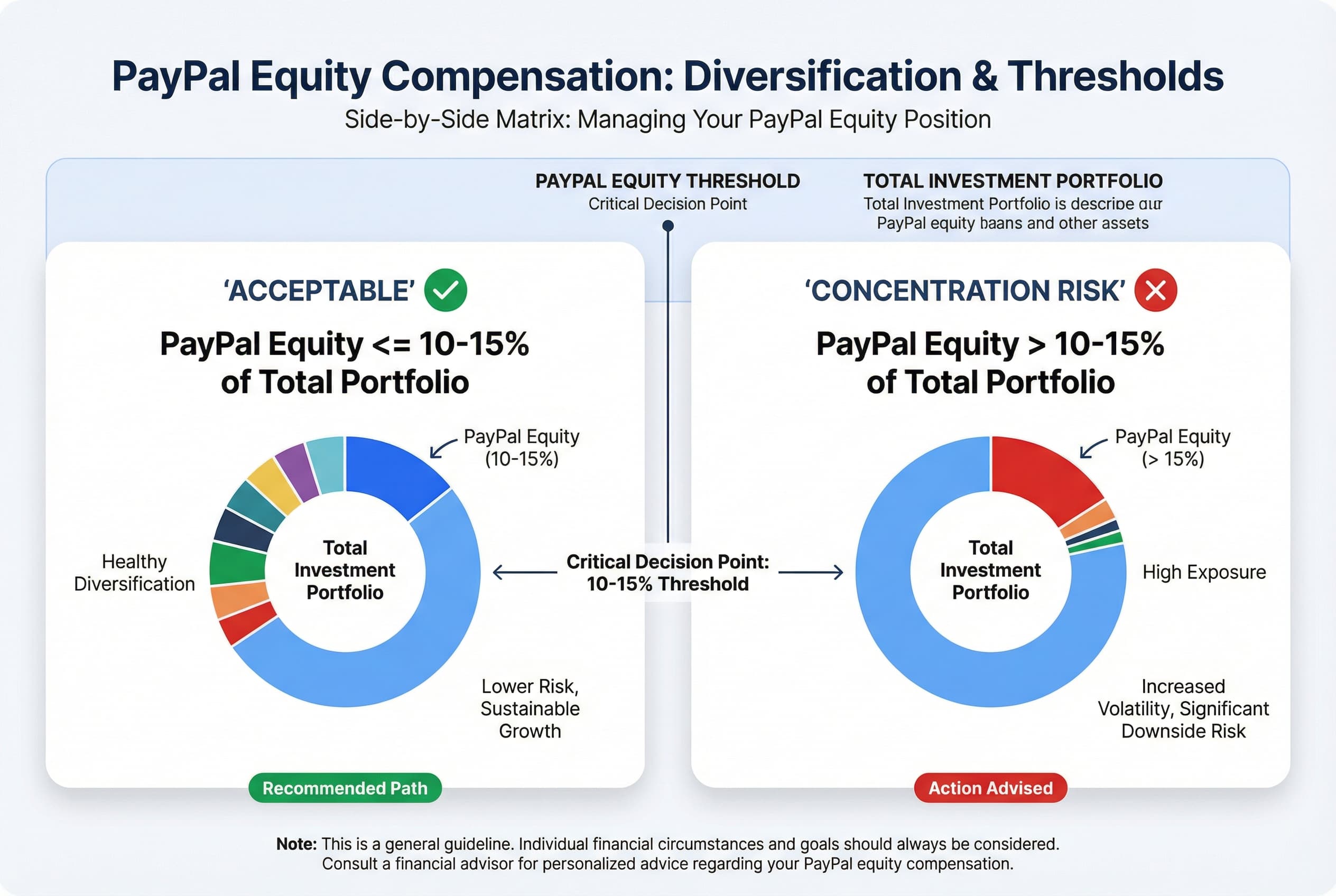
Financial advisors commonly recommend limiting single-stock exposure to 10-20% of your total net worth, including retirement accounts. As your PayPal equity vests - whether through your RSUs, NSOs, or ESPP purchases - consider developing a systematic selling strategy to rebalance your portfolio.
Diversification doesn't mean you lack confidence in PayPal; it means you're protecting your family's financial future from risks beyond your control. Consider consulting a financial advisor familiar with equity compensation to create a personalized diversification plan aligned with your goals and risk tolerance.
As your RSUs vest quarterly or annually (depending on your grant type), consider your overall financial picture. A common approach is to sell a portion at vesting to cover taxes and diversify, while holding the remainder if you're bullish on PayPal's future. Given the fintech industry's volatility, avoid letting PayPal equity exceed 10-15% of your total investment portfolio, especially as you accumulate shares through vesting and annual refreshers.
PayPal employees face concentration risk, particularly if you're also participating in the ESPP. With annual refreshers (typically vesting over four years), your equity exposure can grow significantly over time. Regular rebalancing is essential - consider selling portions of older vested grants to maintain diversification, even if you're optimistic about the company's trajectory.
PayPal's ESPP offers a 15% discount with a lookback provision across 24-month offering periods with semi-annual purchases. For maximum tax efficiency, hold ESPP shares for qualifying disposition: over one year after the purchase date and over two years after the offering date. This allows the discount to be taxed as long-term capital gains rather than ordinary income. However, given the 24-month offering period, carefully weigh the tax benefit against concentration risk.
View your equity as deferred compensation, not a lottery ticket. When evaluating PayPal's total compensation package, remember that RSU values fluctuate with stock price. Factor in the 22% default tax withholding on vesting (which you can adjust) and plan accordingly - many employees are surprised by the tax impact when multiple grants vest simultaneously.
PayPal offers 10b5-1 plans, which allow you to establish pre-scheduled selling programs. These are particularly valuable given PayPal's insider trading policies, as they let you sell shares during blackout periods and remove emotional decision-making from the equation.
Let's walk through a realistic scenario for a mid-level software engineer (CL6) joining PayPal with an RSU grant using the common inducement vesting schedule.
Sarah receives 3,000 RSUs as part of her new hire package. These follow PayPal's inducement vesting schedule: one-third vests after a 12-month cliff, then the remainder vests quarterly over the next two years.
After 12 months, 1,000 RSUs (one-third) vest. If PayPal stock is trading at $65 per share:
The remaining 2,000 RSUs vest quarterly at 250 RSUs per quarter (2,000 ÷ 8 quarters).
Example quarter at $70/share:
Assuming average stock price of $67 across all vesting events:
The 22% withholding covers federal taxes only. You'll owe additional state taxes and may need to pay more at tax time depending on your total income. The actual value you receive depends entirely on PayPal's stock price at each vesting date - it could be higher or lower than these examples.
You can adjust your withholding rate if you prefer more or fewer shares withheld for taxes.
PayPal employees often leave money on the table or face unexpected tax bills due to these common equity compensation mistakes:
Many PayPal RSU grants include a 12-month cliff, meaning nothing vests until you've been with the company for a full year. Leaving before this milestone means forfeiting your entire grant. Understanding your specific vesting schedule - whether it's the 3-year annual, 4-year monthly, or inducement grant structure - is critical before making career decisions.
PayPal's Employee Stock Purchase Plan offers a 15% discount with a lookback provision, yet many employees don't participate. This benefit can generate immediate returns, especially with the lookback feature that uses the lower of the offering date or purchase date price. With semi-annual purchase periods, this represents a significant missed opportunity.
RSUs are taxed as ordinary income when they vest, with PayPal's default withholding rate at 22%. This often falls short of your actual tax liability, especially for higher earners. The result? A surprise tax bill in April. Consider adjusting your withholding or setting aside additional funds to cover the gap.
As RSUs vest quarterly or annually and refreshers arrive each year, PayPal stock can quickly dominate your portfolio. Financial advisors typically recommend keeping company stock below 10-15% of your net worth to manage risk effectively.
Understanding what happens to your equity when leaving PayPal is crucial for financial planning. Here's what you need to know:
When you leave PayPal, all unvested RSUs are forfeited, regardless of whether your departure is voluntary or involuntary. This applies to all RSU types, including standard grants, refreshers, and performance-based RSUs (PBRSUs). Your termination date determines your final vesting event - only shares that have vested by that date are yours to keep.
PayPal grants non-qualified stock options (NSOs) that expire 10 years from the grant date. However, specific post-termination exercise windows are not detailed in available company documentation. You should consult your stock option agreement or HR to understand how long you have to exercise vested options after leaving.
If you leave PayPal during an active ESPP purchase period, your participation typically ends, and accumulated payroll deductions are returned to you. You won't receive shares for that incomplete purchase period. Any shares already purchased in previous periods remain yours.
The timing of your departure matters significantly. Since PayPal uses various vesting schedules (quarterly, annual, or monthly depending on your grant type), leaving just before a vesting date means forfeiting those soon-to-vest shares. Review your vesting schedule carefully when planning your departure to maximize the equity you keep.
PayPal offers a Deferred Compensation Plan, though availability is limited to executive-level employees. Based on available information, the CEO is confirmed as eligible for the PayPal Holdings, Inc. Deferred Compensation Plan.
A deferred compensation plan allows eligible executives to defer receiving a portion of their income until a future date, typically retirement. This means you choose to postpone taxation on that income until you actually receive the funds.
Benefits:
Risks:
If you're eligible, carefully evaluate your current versus expected future tax rates, your confidence in PayPal's long-term financial stability, and your overall retirement savings strategy before participating.
This content is for educational purposes only and does not constitute financial advice. The information provided is general in nature and may not appl...
YourEmployeeStock.com is not a registered investment advisor.
Helpful videos explaining PayPal equity compensation, vesting, and tax strategies.
Compensation - Equity / Long Term Incentives: Stock Options, RSUs and ESPPs
Understanding the Pay Structure at Product Based Companies: Fixed Salary, Bonuses, and Stock Options
PayPal uses multiple RSU vesting schedules depending on your role and grant type. Common schedules include 3-year annual vesting (1/3 per year), 4-year vesting (25% in year 1, then monthly), and for some new hires, a 3-year schedule with 1/3 vesting after a 12-month cliff, then 1/12 quarterly thereafter. Most schedules have a 12-month cliff before your first shares vest.
Yes, PayPal employees can expect annual stock refreshers. However, the amount of RSUs you'll receive in refresher grants is generally not predetermined and varies by performance and level. Refresher grants typically vest over a new four-year period.
PayPal's ESPP allows you to purchase stock at a 15% discount with a lookback provision. The plan has 24-month offering periods divided into four 6-month purchase periods, with enrollment windows in May and November. You can contribute up to 10% of your base salary, subject to a $25,000 annual maximum based on fair market value.
When your RSUs vest, they're treated as ordinary income and subject to federal, state, and payroll taxes. PayPal's default withholding rate is 22% for federal taxes, though you can adjust this rate. You'll also owe capital gains tax on any appreciation when you eventually sell the shares.
To qualify for favorable tax treatment on ESPP shares, you must hold them for more than 1 year after the purchase date AND more than 2 years after the offering date. This is called a qualifying disposition and can result in some of your gain being taxed at lower long-term capital gains rates instead of ordinary income rates.
PayPal grants Non-Qualified Stock Options (NSOs) that typically vest over 48 months, with 12.5% vesting after 6 months (or 25% after one year from hire), then 2.08% monthly thereafter. Options expire 10 years from the grant date, but specific details about how long you have to exercise after leaving the company are not publicly available—check your grant documents or contact HR.
All PayPal employees are subject to the company's Insider Trading Agreement, which restricts when you can trade. PayPal does offer 10b5-1 trading plans, which allow you to set up pre-scheduled sales that can execute even during blackout periods. Contact your stock plan administrator for specific blackout dates that apply to you.
Yes, PayPal matches 100% of your contributions up to 4% of your base salary, with a maximum employer contribution of $19,500. The match vests immediately with no waiting period. PayPal also offers Roth 401(k) options and allows mega backdoor Roth contributions through after-tax contributions.
Get a free personalized analysis from our equity compensation experts

