Free equity analysis
We're still gathering complete information
Some details about Block's equity programs may be incomplete or based on general industry data. We recommend verifying specifics with your official plan documents or HR department.
Complete guide to understanding your Block equity compensation, including RSU, ESPP, vesting schedules, and tax strategies.
Stock Price
$83.46
Closing price · Sep 14, 2026
Employees
1K
Worldwide
Equity Programs
2
programs
Vesting Period
4 years
RSU vesting
Closing price · Sep 14, 2026
Block offers 2 equity compensation programs to employees. Click on each program to learn more about eligibility, vesting, and tax implications.
Block RSUs vest on a 4-year with 1-year cliff, vesting quarterly thereafter schedule with a 12-month cliff.
Example calculation based on 100 shares:
| Year | Vesting % | Shares Vesting | Estimated Value |
|---|---|---|---|
| Year 1 | 25% | 25 | $2,086.50 |
| Year 2 | 25% | 25 | $2,086.50 |
| Year 3 | 25% | 25 | $2,086.50 |
| Year 4 | 25% | 25 | $2,086.50 |
| Total | 100% | 100 | $8,346 |
* Based on Block stock price of $83.46 as of Sep 14, 2026. Actual values will vary.
25%
25 shares
$2,086.50
25%
25 shares
$2,086.50
25%
25 shares
$2,086.50
25%
25 shares
$2,086.50
Block vesting schedule based on 100 total shares
Block offers equity compensation as a core component of your total rewards package, providing you with the opportunity to share in the company's success as a publicly traded financial technology company (ticker: SQ). The program primarily includes Restricted Stock Units (RSUs), Performance Stock Units (PSUs), and an Employee Stock Purchase Plan (ESPP).
Equity compensation gives you ownership in Block, aligning your interests with the company's long-term performance. As Block grows and the stock price appreciates, your equity becomes more valuable. Notably, Block offers a unique flexibility feature: U.S. employees can choose to receive some or all of their RSU compensation in cash instead of stock, distributed through regular payroll. This pilot program provides unusual control over how you receive your compensation.
Most RSU grants follow a 4-year vesting schedule with a 1-year cliff. This means 25% of your grant vests after your first year, with the remaining shares vesting quarterly over the following three years. Annual performance-based refresher grants are typically awarded with a 3-year vesting schedule, helping to retain and reward top performers.
The ESPP allows you to purchase Block stock at a 15% discount with a lookback provision, though specific offering period details vary. Contribution limits are capped at $25,000 annually.
Be aware that Block enforces blackout periods around quarterly earnings announcements, during which you cannot trade shares. However, you can establish a 10b5-1 trading plan to execute pre-scheduled transactions during these restricted periods.
Block uses a 4-year vesting schedule with a 1-year cliff for Restricted Stock Units (RSUs). This is a common structure in the technology industry designed to encourage employee retention over the long term.
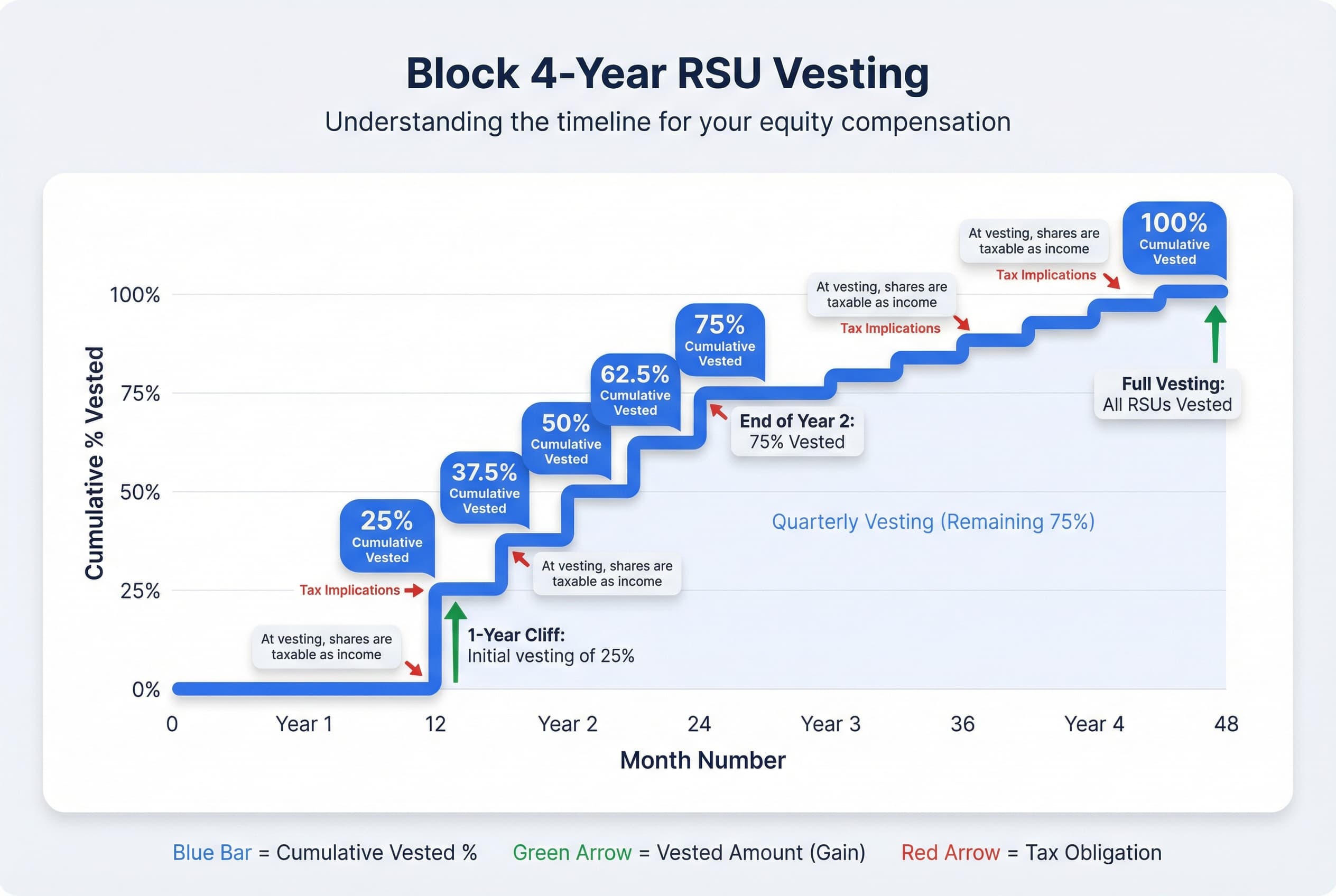
Under this schedule, your RSUs vest over a total of 48 months, with 25% of your grant vesting after you complete your first year of employment. After this initial cliff period, the remaining 75% of your RSUs vest quarterly (every three months) over the next three years.
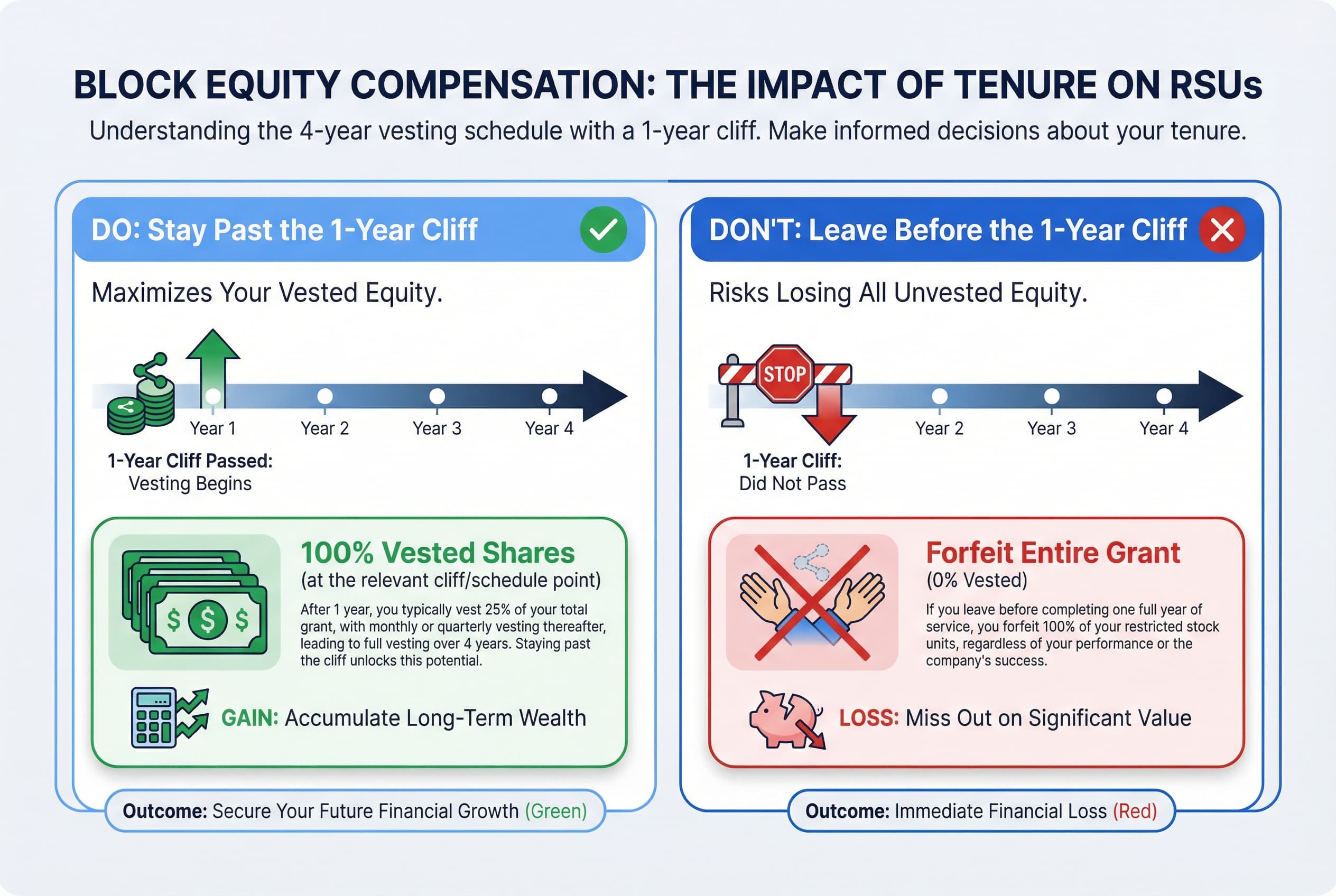
The 1-year cliff is an important aspect of Block's vesting schedule. During your first 12 months of employment, no RSUs vest. This means if you leave the company before completing one full year, you forfeit your entire grant. However, once you reach your one-year anniversary, 25% of your total grant vests all at once. From that point forward, you'll receive quarterly vesting installments.
After the cliff, your RSUs vest on a quarterly basis, meaning you'll receive vested shares four times per year. This creates a relatively uniform distribution pattern, with equal amounts vesting each year (25% annually) throughout the four-year period. This uniform structure means you're not receiving disproportionately more shares in later years (backloaded) or earlier years (frontloaded).
Block provides annual refresher grants based on performance. These ongoing equity awards help maintain your equity compensation as your initial grant vests over time. Refresher grants typically follow a 3-year vesting schedule, which is shorter than the initial 4-year grant period. The specific size and frequency of refreshers are discretionary and tied to your individual performance.
Block offers a distinctive feature: employees can choose to receive their RSU compensation in cash instead of stock, distributed through regular payroll. This flexibility also extends to performance bonuses, allowing you to customize your compensation mix based on your personal financial preferences and risk tolerance.
Block offers an Employee Stock Purchase Plan that allows you to purchase company stock at a discount through regular payroll deductions. This benefit can provide meaningful value, especially when combined with the plan's lookback provision.
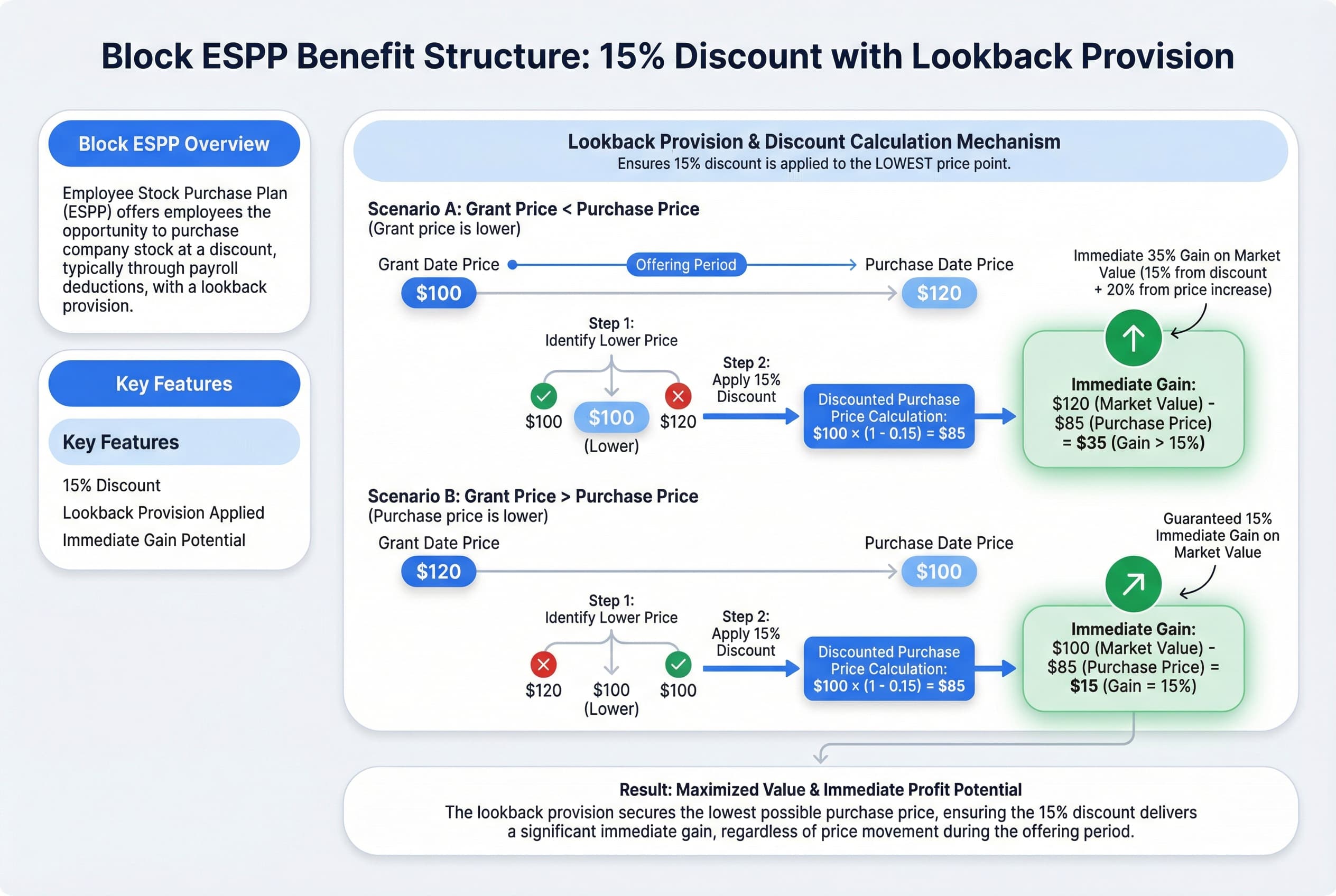
The ESPP offers a 15% discount on Block stock. Additionally, the plan includes a lookback provision, which means you'll purchase shares at 15% off whichever price is lower: the stock price at the beginning of the offering period or the price at the end of the purchase period. This feature can significantly enhance your returns, particularly in a rising stock market.
For example, if Block's stock price increases during the offering period, you'll still purchase at the lower starting price minus the 15% discount. This combination can result in immediate gains of over 15% depending on stock price movement.
You can contribute up to $25,000 annually to the ESPP through payroll deductions. This limit aligns with IRS regulations for qualified employee stock purchase plans.
Understanding the tax implications is important when selling ESPP shares. A qualifying disposition occurs when you hold shares for at least two years from the grant date and one year from the purchase date. Meeting these requirements can result in more favorable tax treatment, with some gains taxed as long-term capital gains rather than ordinary income.
A disqualifying disposition happens when you sell before meeting these holding periods. In this case, the discount and any gains up to the purchase date are taxed as ordinary income, while additional gains may qualify for capital gains treatment.
While the ESPP provides a valuable discount and lookback feature, specific details about offering periods, purchase periods, and enrollment windows were not available in the company data. Contact your HR or benefits team for complete program details and enrollment information.
Understanding the tax treatment of your Block equity compensation is crucial for effective financial planning. Here's what you need to know about when and how your equity awards are taxed.
RSUs (Restricted Stock Units): You owe taxes at vesting, not when you receive the grant or sell the shares. Each time your RSUs vest (quarterly after your one-year cliff at Block), the value of the vested shares is treated as ordinary income, just like your salary. This occurs whether you sell the shares immediately or hold them.
ESPP (Employee Stock Purchase Plan): Tax treatment depends on how long you hold the shares. For a "qualifying disposition," you must hold shares for at least two years from the grant date and one year from the purchase date. Qualifying dispositions receive more favorable tax treatment, with some gains taxed at long-term capital gains rates rather than ordinary income rates.
Block withholds at a 22% default rate for RSU vesting events. However, if your total income pushes you into a higher tax bracket, you may face a supplemental withholding rate of 37%. This creates a common "gap" problem: the amount withheld may be less than your actual tax liability, resulting in an unexpected tax bill when you file your return. Consider setting aside additional funds or adjusting your W-4 to account for this gap.
The value of RSUs at vesting is taxed as ordinary income (taxed at your marginal rate, which can be up to 37% federally). Any subsequent gain or loss when you sell the shares is treated as a capital gain or loss. If you hold shares for more than one year after vesting, gains qualify for long-term capital gains treatment (typically 0%, 15%, or 20% depending on your income).
Tax Planning Disclaimer: This information is educational only and not tax advice. Your individual tax situation depends on many factors including your state of residence, total income, and filing status. Always consult with a qualified tax professional to understand your specific obligations and optimize your tax strategy.
Holding too much of your wealth in Block (SQ) stock exposes you to concentration risk - the danger that a single investment's poor performance could significantly damage your financial security. When your income, benefits, and investment portfolio all depend on one company's success, you're vulnerable to factors beyond your control.
As a financial technology company, Block faces unique challenges that could impact stock value. The fintech industry is highly competitive and subject to evolving regulations, cybersecurity threats, and changing consumer payment preferences. Economic downturns can reduce transaction volumes across Block's platforms, while regulatory changes in digital payments could affect business operations. Additionally, Block's stock has experienced significant volatility, which employees hired during peak valuations (2020-2021) have experienced firsthand.
Financial advisors generally recommend limiting single-stock exposure to 10-20% of your total net worth. This means regularly selling vested RSUs and reinvesting proceeds into a diversified portfolio of stocks, bonds, and other assets. Block offers flexibility here - you can choose to receive some equity compensation as cash instead, which naturally promotes diversification.
Consider establishing a systematic selling plan through a 10b5-1 arrangement, which allows you to sell shares during blackout periods. This helps you diversify gradually while avoiding the stress of timing the market or navigating trading restrictions around earnings announcements.
Block operates in the volatile fintech sector, which can create significant stock price swings. Consider selling RSUs as they vest, especially if Block stock represents a large portion of your net worth. The standard vesting schedule includes a 1-year cliff followed by quarterly vesting, creating natural selling opportunities four times per year. Be mindful of blackout periods around quarterly earnings announcements when planning your sales.
Given Block's stock volatility - a particular concern for employees granted equity during the 2020-2021 highs - maintaining a diversified portfolio is essential. Financial advisors commonly recommend limiting any single stock to 10-15% of your total investment portfolio. Block offers a unique flexibility: you can choose to receive your RSU compensation in cash instead of stock, which can help manage concentration risk from the start.
Block offers an ESPP with a 15% discount and a lookback provision, providing immediate value. To qualify for favorable long-term capital gains treatment, hold ESPP shares for at least two years from the grant date and one year from the purchase date. RSUs are taxed as ordinary income when they vest (at 22% or 37% supplemental rates), so plan for this tax liability.
View your equity grants as part of your overall compensation package, not just a bonus. Annual performance-based refreshers with 3-year vesting schedules mean you'll accumulate overlapping grants over time. Factor this into your financial planning and diversification strategy.
Block makes 10b5-1 plans available, allowing you to establish prearranged selling schedules. These plans let you sell shares during blackout periods and remove emotional decision-making from the equation, which can be valuable given Block's stock volatility.
Even with Block's flexible equity program, employees often make avoidable mistakes that can cost them significantly. Here are the most common pitfalls:
Block RSUs typically follow a 4-year vesting schedule with a 1-year cliff. Many employees don't realize that if they leave before completing their first year, they forfeit their entire grant. This cliff means zero shares vest until you hit that 12-month mark, when 25% vests at once.
Despite Block's unique option to convert equity to cash, employees who keep all their RSUs often become over-concentrated in SQ stock. This is particularly risky in fintech, where stock prices can be volatile. Diversification is crucial - don't let company stock exceed 10-15% of your total investment portfolio.
Block withholds at a 22% default rate for RSU vesting, but your actual tax rate may be 37% or higher depending on your income. This creates a withholding gap that catches many employees by surprise at tax time. Consider adjusting your W-4 or making estimated tax payments to avoid penalties.
Block offers an ESPP with a 15% discount and lookback provision, which can generate immediate gains. Many employees skip enrollment, leaving this valuable benefit on the table. The tax advantages of holding shares for the qualifying period add further value.
Block enforces blackout periods around earnings announcements. Trading during these windows can result in serious compliance issues. Consider setting up a 10b5-1 plan for automated, compliant selling schedules.
Understanding how your equity is affected when you leave Block is crucial for financial planning. Here's what happens to each component of your compensation:
When you leave Block, all unvested RSUs are forfeited, regardless of whether your departure is voluntary or involuntary. This is standard practice across the industry. For example, if you're two years into Block's typical 4-year vesting schedule with a 1-year cliff, you would forfeit the remaining 50% of unvested shares. Your termination date determines your final vesting event - only shares that have vested on or before your last day of employment are yours to keep.
Performance Stock Units (PSUs) follow similar forfeiture rules for unvested awards.
While Block has historically granted stock options, specific details about post-termination exercise windows are not available in company documentation. If you hold options, consult your grant agreement for the exact timeframe you have to exercise vested options after leaving.
If you're participating in Block's Employee Stock Purchase Plan when you leave mid-period, your accumulated payroll deductions are typically returned to you, and you won't participate in that period's purchase. Any shares previously purchased through the ESPP remain yours.
Block offers a unique feature allowing employees to choose cash instead of equity compensation. If you've elected this option, the treatment upon termination may differ. Review your specific elections and grant agreements, or consult with HR for personalized guidance on your situation.
This content is for educational purposes only and does not constitute financial advice. The information provided is general in nature and may not appl...
YourEmployeeStock.com is not a registered investment advisor.
Block RSUs typically vest over 4 years with a 1-year cliff, then vest quarterly thereafter. This means 25% of your grant vests after your first year, and the remaining 75% vests in equal quarterly installments over the next three years. You'll receive additional shares every quarter after your first anniversary.
Yes, Block offers a unique choice program that allows U.S. employees to receive the value of some or all of their equity compensation in cash instead of stock. This cash is distributed as part of your regular pay and also applies to performance bonuses, giving you flexibility in how you receive your compensation.
Block's ESPP allows you to purchase company stock at a 15% discount with a lookback provision, meaning you get the discount on the lower of the price at the beginning or end of the offering period. To qualify for favorable tax treatment, you must hold the shares for at least two years from the grant date and one year from the purchase date.
If you leave Block before your RSUs vest, you will forfeit any unvested shares. Only RSUs that have already vested by your departure date are yours to keep. This is why the 1-year cliff is significant—you must stay at least one year to receive any equity from your initial grant.
When your RSUs vest, they're taxed as ordinary income at their fair market value on the vesting date. Block withholds taxes at a default rate of 22% for federal income tax, though the supplemental wage rate can be as high as 37%. You'll also owe Social Security and Medicare taxes on the vested amount.
You can only sell Block stock during approved open trading windows, as the company has blackout periods around quarterly earnings announcements and major events. Block also offers 10b5-1 plans, which allow you to set up a prearranged selling schedule in advance, enabling sales even during blackout periods.
Yes, Block provides refresher RSU grants on an annual basis based on your performance. These ongoing grants typically vest over a 3-year period, helping to retain employees and provide continued equity incentives beyond your initial grant.
You can contribute up to $25,000 per year to Block's Employee Stock Purchase Plan. This federal limit ensures tax-advantaged treatment of ESPP purchases and applies across all ESPPs you may participate in during a calendar year.
Get a free personalized analysis from our equity compensation experts

