Free equity analysis
We're still gathering complete information
Some details about Netflix's equity programs may be incomplete or based on general industry data. We recommend verifying specifics with your official plan documents or HR department.
Complete guide to understanding your Netflix equity compensation, including RSU, ISO, NSO, ESPP, vesting schedules, and tax strategies.
Stock Price
$80.32
Closing price · Sep 14, 2026
Employees
14.6K
Worldwide
Equity Programs
4
programs
Vesting Period
4 years
RSU vesting
Closing price · Sep 14, 2026
Netflix offers 4 equity compensation programs to employees. Click on each program to learn more about eligibility, vesting, and tax implications.
Learn about Netflix's Restricted Stock Units program, including vesting schedules and tax treatment.
Learn about Netflix's Incentive Stock Options program, including vesting schedules and tax treatment.
Netflix has a unique compensation model where employees choose how much of their compensation to take as stock options versus salary. There's no set equity grant - employees can allocate 0-100% of their compensation to options. Options vest monthly with no cliff.
Learn about Netflix's Employee Stock Purchase Plan program, including vesting schedules and tax treatment.
Netflix RSUs vest on a Varies; one source suggests 1/4 after first year, then 1/36 monthly thereafter, but SEC filing vesting details were blank. schedule with a 12-month cliff.
Example calculation based on 100 shares:
| Year | Vesting % | Shares Vesting | Estimated Value |
|---|---|---|---|
| Year 1 | 25% | 25 | $2,008.00 |
| Year 2 | 25% | 25 | $2,008.00 |
| Year 3 | 25% | 25 | $2,008.00 |
| Year 4 | 25% | 25 | $2,008.00 |
| Total | 100% | 100 | $8,032.00 |
* Based on Netflix stock price of $80.32 as of Sep 14, 2026. Actual values will vary.
25%
25 shares
$2,008.00
25%
25 shares
$2,008.00
25%
25 shares
$2,008.00
25%
25 shares
$2,008.00
Netflix vesting schedule based on 100 total shares
Netflix offers a distinctive approach to equity compensation that stands apart from typical tech companies. The company provides multiple equity vehicles including Restricted Stock Units (RSUs), stock options (both ISOs and NSOs), Performance Stock Units (PSUs), and an Employee Stock Purchase Plan (ESPP) with a 15% discount and lookback provision.
One of Netflix's most unique features is employee choice: you can select your preferred mix of cash salary versus stock options annually. This flexibility allows you to tailor your compensation to your personal financial situation and risk tolerance. The company's compensation philosophy emphasizes being "top of market," meaning your total package is designed to be highly competitive within the industry.
For general employees, stock options are fully vested upon grant - meaning there's no waiting period to own them. Options remain portable even if you leave the company, with a 10-year exercise window. However, there's a catch: you pay 40% of the current stock price to participate in the option program, which means the stock needs to appreciate 40% just to break even.
RSU vesting varies across the organization. For most employees, one common structure includes a 12-month cliff (meaning no shares vest until you've been with the company for one year), followed by monthly vesting over 48 months total. Executive compensation shifted in 2024 to include an equal mix of time-based RSUs and PSUs. The ESPP operates on a 6-month offering period with semi-annual purchases.
Netflix's RSU vesting schedule follows a 4-year vesting period with a 1-year cliff. However, it's important to note that the structure of equity compensation at Netflix varies significantly by role and level, and the available data shows some inconsistencies in how RSUs are granted across the organization.
According to available information, the typical vesting pattern suggests that 25% of your RSUs vest after the first year (the cliff period), with the remaining shares vesting monthly thereafter at a rate of approximately 1/36 per month over the following three years.
RSUs at Netflix vest on a monthly basis following the initial cliff period. This means that after you've completed your first year of employment and received your initial 25% vesting, you'll see shares vest each month for the remaining 36 months of your grant period.
During the 12-month cliff period, none of your RSU shares will vest. This means if you leave Netflix before completing one full year of employment, you will forfeit your entire RSU grant. The cliff serves as a retention mechanism, ensuring employees remain with the company for at least one year before receiving any equity compensation. Once you pass the one-year mark, you'll receive the full 25% that has accumulated during that first year all at once.
Netflix's approach to refresher grants differs from typical tech companies. The available data suggests that refresher grants may not exist in the traditional sense or may be cash-heavy rather than equity-focused. This aligns with Netflix's overall compensation philosophy, which favors high base salaries over equity compensation for general employees.
For executive officers, the compensation structure shifted in 2024 to include an equally weighted mix of time-based RSUs and performance stock units (PSUs), moving away from the traditional stock option model. Executives receive grants that vest in equal thirds over three years (33.3% annually).
It's worth noting that Netflix's equity compensation structure is notably different from other tech companies, with many employees receiving stock options instead of or in addition to RSUs.
Netflix offers an Employee Stock Purchase Plan that allows you to purchase company stock at a discount through payroll deductions. The plan provides a 15% discount off the stock price, making it an attractive benefit for employees looking to build equity in the company.
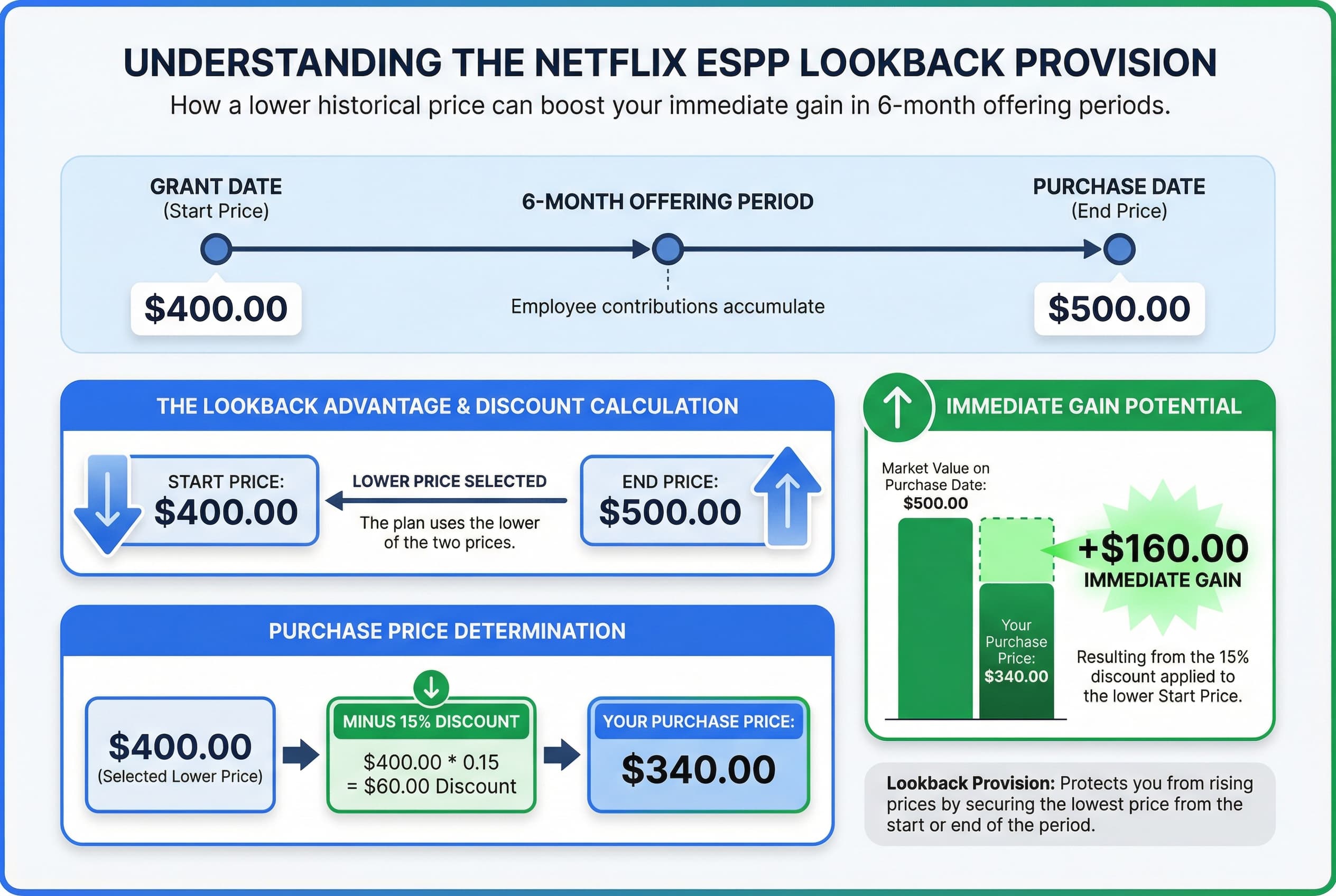
The Netflix ESPP includes a lookback provision, which can significantly enhance your potential returns. With this feature, the purchase price is calculated using the lower of two prices: the stock price at the beginning of the offering period or the price at the end of the purchase period. Combined with the 15% discount, this creates a powerful wealth-building opportunity.
For example, if Netflix stock is at $400 at the start of the offering period and rises to $500 by the purchase date, you'd purchase shares at $340 (15% off the $400 starting price). This combination of the lookback and discount can result in immediate gains, especially in a rising market.
The ESPP operates on 6-month offering periods with semi-annual purchases, meaning you'll have two opportunities per year to purchase stock at a discount.
When you sell your ESPP shares matters for tax purposes. Qualifying dispositions occur when you hold shares for at least two years from the offering period start date and one year from the purchase date, potentially resulting in more favorable tax treatment. Disqualifying dispositions happen when you sell before meeting these requirements, with the discount taxed as ordinary income.
Be aware that blackout periods can coincide with ESPP purchase dates, potentially requiring you to wait until earnings release plus three days before selling your newly purchased shares.
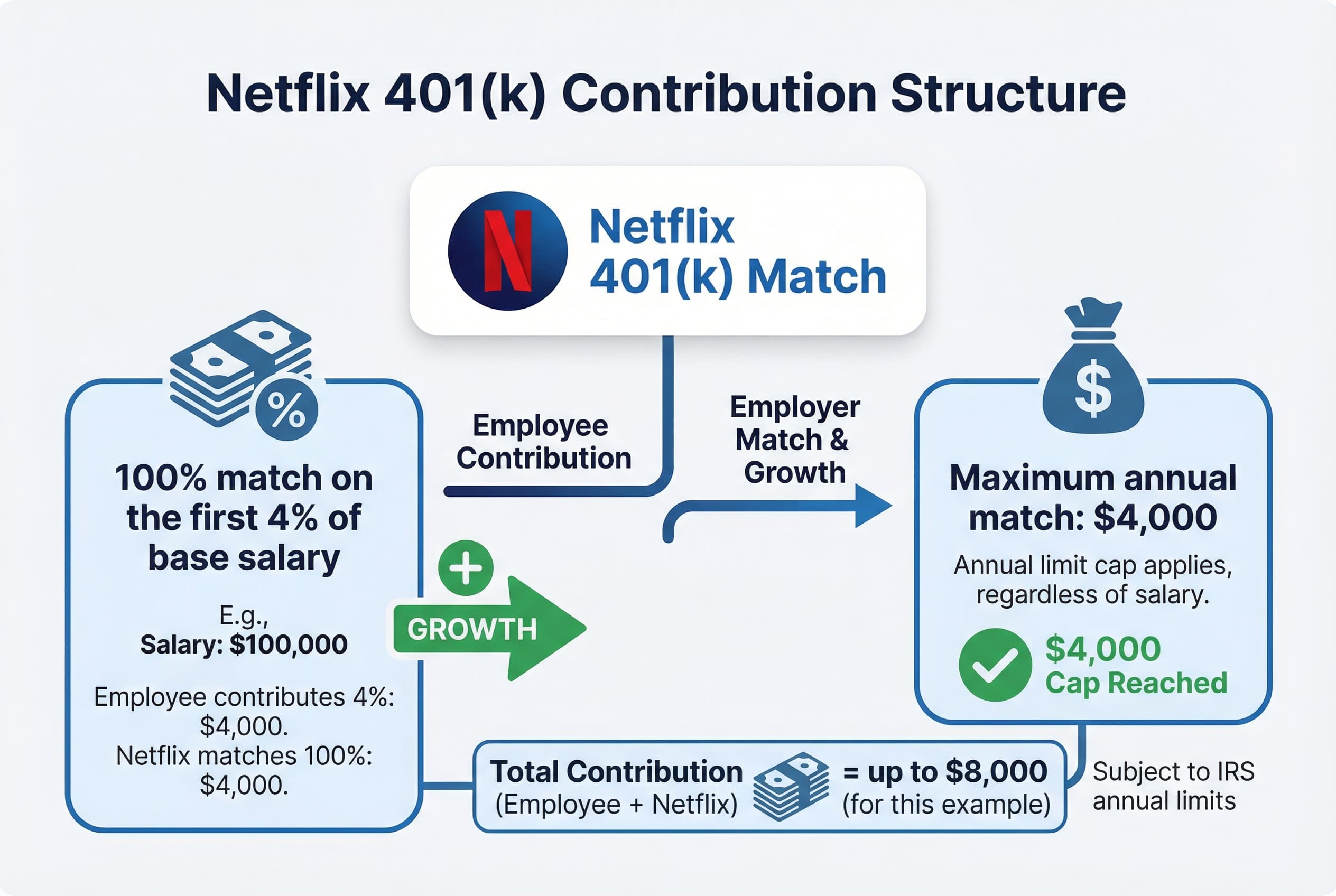
Netflix offers a competitive 401(k) retirement plan with a generous employer match structure. The company provides a 100% match on the first 4% of your base salary, with a maximum annual match of $4,000. This means if you contribute at least 4% of your salary, Netflix will match your contribution dollar-for-dollar up to the cap.
Information about the vesting period for Netflix's 401(k) match is not publicly available in the current data. It's important to check with HR or your plan documents to understand when the employer match becomes fully yours.
Netflix supports mega backdoor Roth conversions and allows after-tax contributions to the 401(k) plan. This is a valuable feature for high earners who have maxed out their regular 401(k) contributions and want to save additional funds in a tax-advantaged way. The mega backdoor Roth strategy allows you to contribute after-tax dollars beyond the standard 401(k) limit and potentially convert them to Roth, enabling tax-free growth.
Whether a self-directed brokerage window is available within the 401(k) plan is not specified in the available data.
Note that retirement benefits may vary by location, so employees in different offices or countries should verify their specific plan details with Netflix's benefits team.
Understanding the tax treatment of your Netflix equity compensation is crucial for effective financial planning. Different types of equity awards trigger taxes at different times and rates.
RSUs and PSUs: For Restricted Stock Units and Performance Stock Units, taxes are owed at vesting. The fair market value of the shares on the vesting date is treated as ordinary income, just like your salary. Netflix will withhold taxes at the supplemental income rate of 22% (federal), but this may not cover your full tax liability.
Stock Options: The tax treatment depends on the option type. For Non-Qualified Stock Options (NSOs), you'll owe ordinary income tax on the "spread" (difference between market price and strike price) when you exercise. Incentive Stock Options (ISOs) receive preferential treatment - no regular income tax at exercise, but they may trigger Alternative Minimum Tax (AMT). For both types, you'll owe capital gains tax on any appreciation when you eventually sell the shares.
ESPP: At purchase, you'll owe taxes based on the discount received (15% at Netflix). Additional taxes may apply at sale depending on your holding period.
Netflix withholds at the 22% supplemental rate for RSUs and NSOs, but if you're in a higher tax bracket, this creates a "gap" between what's withheld and what you actually owe. You may need to make estimated tax payments or increase withholding elsewhere to avoid underpayment penalties.
Any appreciation in your stock value after vesting (for RSUs) or exercise (for options) is taxed as capital gains when sold. Hold shares for more than one year to qualify for long-term capital gains rates, which are lower than ordinary income rates.
California residents should note that California taxes all equity compensation as ordinary income, with no preferential capital gains treatment and rates up to 13.3%. AMT also applies at the state level for ISOs.
Important: This information is educational only and not tax advice. Consult a qualified tax professional familiar with equity compensation to understand your specific situation.
While Netflix equity compensation can be valuable, concentrating too much of your wealth in a single stock - even a successful one - exposes you to unnecessary risk. If Netflix stock declines significantly, you could face a double impact: reduced portfolio value and potential job loss during company difficulties.
Netflix operates in the highly competitive entertainment industry, facing specific challenges including:
These industry-specific factors can create stock price volatility that affects your concentrated holdings.
Financial advisors commonly recommend limiting single-stock exposure to 10-20% of your total net worth. This guideline becomes especially important when your employer stock represents both your equity compensation and your paycheck.
Consider developing a systematic diversification strategy:
Regular rebalancing helps you benefit from Netflix's success while protecting against company-specific or industry-wide downturns.
Netflix's unique equity structure - where employees choose their mix of cash versus stock options annually - requires a distinctive approach to managing your compensation.
Since Netflix stock options are fully vested upon grant (no cliff period for general employees), you can exercise and sell immediately if desired. However, consider your tax situation first. For RSUs (primarily granted to senior leadership), shares become yours at vest and are immediately taxable. Consider selling enough to cover tax obligations at minimum, then evaluate whether to hold based on your diversification needs and market outlook.
With the ESPP's 15% discount and lookback provision, selling immediately after each semi-annual purchase period captures guaranteed returns, though be mindful that blackout periods may force you to wait until "Earnings Release + 3 days" to execute sales.
Netflix's compensation philosophy is cash-heavy compared to other tech companies, which naturally provides better diversification. However, if you've accumulated significant equity through options or ESPP participation, avoid overconcentration. The entertainment industry faces unique competitive pressures, and holding too much company stock creates unnecessary risk.
For stock options, understand that you pay 40% of the current stock price upfront. This creates a cost basis requiring 40% appreciation just to break even. Consider whether exercising ISOs versus NSOs makes sense for your tax bracket - ISOs may trigger AMT but offer preferential long-term capital gains treatment if held properly.
For ESPP shares, holding for the qualifying period (two years from offering period start, one year from purchase) converts some gains to long-term capital gains rates.
While the data doesn't confirm 10b5-1 plan availability, these automated trading plans can help navigate blackout periods if offered, allowing systematic selling during restricted windows.
Let's walk through a typical RSU vesting scenario for a Netflix employee to understand how equity compensation translates into actual shares.
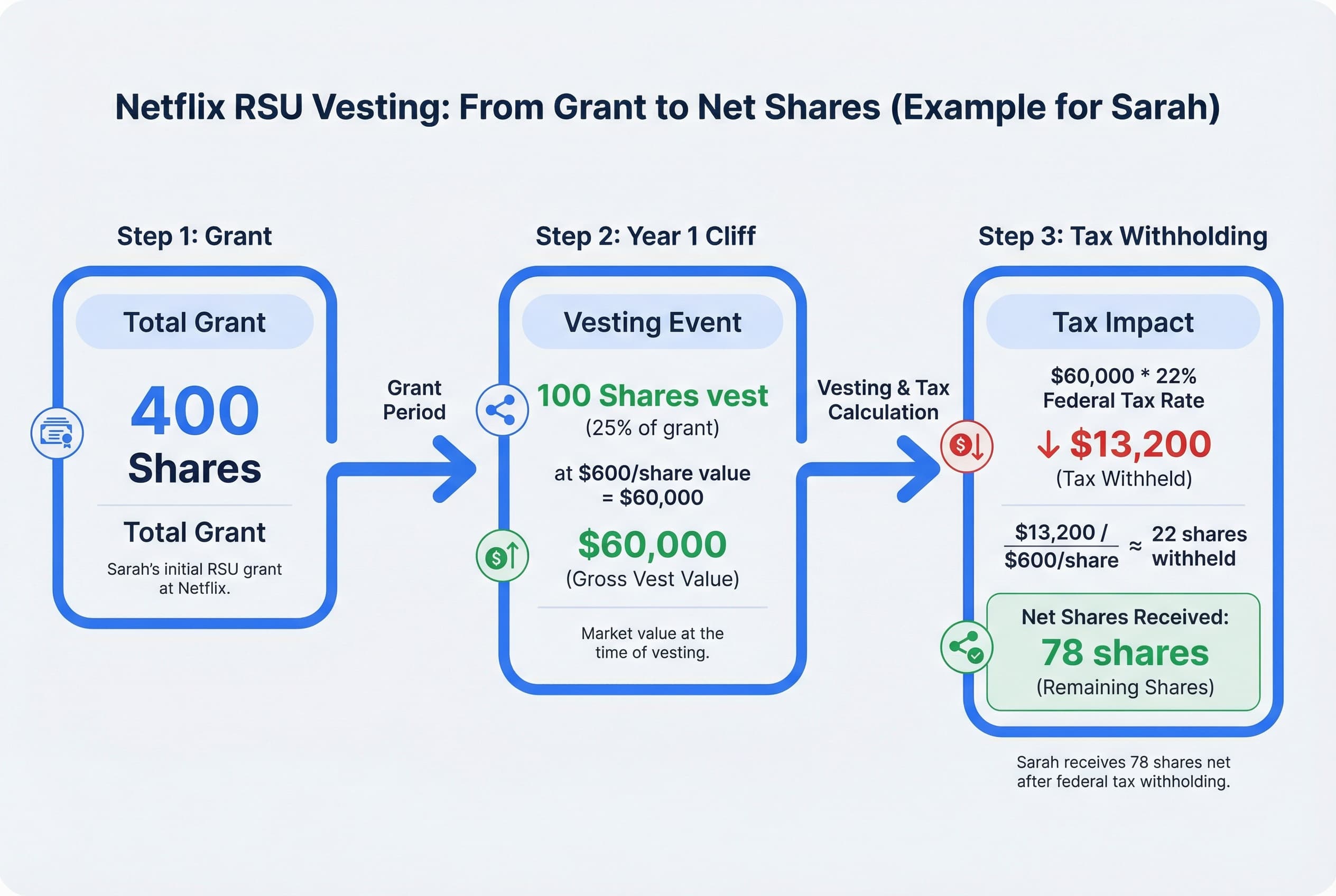
Sarah, a Senior Software Engineer (L5), receives an RSU grant of 400 shares when she joins Netflix. Based on Netflix's vesting structure, these shares vest over 4 years with a 1-year cliff, then monthly thereafter.
Year 1 (Month 12): After her first anniversary, Sarah's cliff vests. She receives 25% of her grant = 100 shares. If Netflix stock is trading at $600 per share, the vesting value is $60,000.
Tax Withholding: Netflix withholds shares to cover the supplemental tax rate of 22%. Sarah's withholding = $60,000 × 22% = $13,200 (approximately 22 shares). She receives 78 shares net.
Years 2-4 (Months 13-48): The remaining 300 shares vest monthly at roughly 8.33 shares per month (300 ÷ 36 months).
Each month, assuming the stock price remains at $600:
Assuming the stock price stays at $600:
Important note: The actual tax withheld covers federal supplemental income tax only. Sarah may owe additional taxes (state, Medicare, etc.) at tax time, and she can adjust her withholding rate if needed.
Netflix's unique equity structure creates specific pitfalls that employees should avoid:
For employees receiving RSUs, Netflix typically uses a 12-month cliff, meaning nothing vests until you've completed your first year. Leaving before this milestone means forfeiting your entire grant. Plan your career moves accordingly, especially if you're approaching the one-year mark.
Netflix's stock options require you to pay 40% of the grant price to participate. Many employees fail to realize this means the stock must appreciate 40% just to break even. This upfront cost requires careful financial planning and tax consideration.
RSU vesting triggers immediate tax liability at your ordinary income rate. Netflix withholds at the 22% supplemental rate, which often falls short of your actual tax burden if you're in a higher bracket. This creates an underpayment gap that requires estimated quarterly tax payments to avoid penalties.
Netflix offers an ESPP with a 15% discount and lookback provision, providing immediate gains. Many employees skip enrollment, missing this low-risk opportunity for returns.
Between vested RSUs, exercised options, and ESPP purchases, Netflix equity can quickly dominate your portfolio. This concentration risk leaves you vulnerable to company-specific downturns. Regularly diversify by selling vested shares, even during blackout-free periods.
Understanding what happens to your equity compensation when you leave Netflix is crucial for financial planning. Here's what you need to know:
Any unvested RSUs will be forfeited upon termination. Since Netflix RSUs typically follow a vesting schedule with a 12-month cliff and monthly vesting thereafter, your termination date directly impacts how much equity you keep. Only shares that have vested by your last day of employment remain yours.
Netflix stock options are notably portable and remain yours even after employment ends. This is a unique feature compared to most tech companies. Your options remain exercisable for up to 10 years from the original grant date, regardless of when you leave the company. However, note that general employee options are fully vested upon grant, so there's no unvested portion to forfeit.
If you leave Netflix during an ESPP offering period, you'll typically forfeit any contributions made during that period. Only shares purchased on previous purchase dates (which occur semi-annually) remain yours to keep.
Your exact termination date matters significantly for RSU vesting, as vesting occurs monthly after the initial cliff. Even a few days' difference can impact whether a vesting tranche is included.
The data doesn't indicate different treatment for voluntary versus involuntary termination, though individual circumstances may vary.
This content is for educational purposes only and does not constitute financial advice. The information provided is general in nature and may not appl...
YourEmployeeStock.com is not a registered investment advisor.
Helpful videos explaining Netflix equity compensation, vesting, and tax strategies.
Breaking Down Six-Figure Tech Salaries! Types of Compensation Explained!
The Netflix Employee Stock Plan is One of the Riskiest We've Ever Seen
Netflix stock options are unique in that they are fully vested upon grant, meaning there is no waiting period or cliff. However, you must pay 40% of the current stock price to participate in the option program. You have 10 years to exercise your options, and they remain yours even if you leave the company.
Your stock options are portable, meaning you keep them even after your employment ends. You still have the full 10-year exercise period from the original grant date to decide when to exercise your options. This is different from most companies that require you to exercise within 90 days of leaving.
Yes, Netflix offers an ESPP with a 15% discount and a lookback provision. The offering and purchase periods are both 6 months, with purchases happening semi-annually. Be aware that blackout periods can sometimes coincide with ESPP purchase dates, which may delay when you can sell your shares.
When your RSUs vest, they are taxed as ordinary income at your regular tax rate. Netflix will withhold taxes at the supplemental rate of 22% federally, though you can adjust this withholding. You may owe additional taxes at year-end if your actual tax rate is higher than the withholding rate.
Netflix's RSU vesting schedule varies by role and level. One common schedule includes a 1-year cliff (25% vesting after the first year), followed by monthly vesting of approximately 2.78% (1/36) for the remaining 36 months, totaling 4 years. Executive officers have different vesting schedules, with some receiving three equal annual installments of 33.3%.
Yes, Netflix offers employees the unique ability to choose their mix of salary versus stock options annually. This flexibility allows you to adjust your compensation based on your personal financial situation, risk tolerance, and views on the company's stock performance. Netflix's overall compensation philosophy tends to favor higher base salaries compared to other tech companies.
The tax treatment depends on whether you have ISOs or NSOs. NSOs are taxed as ordinary income on the difference between the exercise price and fair market value when exercised. ISOs may qualify for preferential capital gains treatment if you meet specific holding requirements, but could trigger Alternative Minimum Tax (AMT) upon exercise.
Yes, Netflix matches 100% of your contributions on the first 4% of your base salary, up to a maximum of $4,000 annually. The plan also supports mega backdoor Roth contributions through after-tax contributions. This match is in addition to Netflix's equity compensation programs.
Get a free personalized analysis from our equity compensation experts

