Free equity analysis
Complete guide to understanding your Disney equity compensation, including RSU, ISO, NSO, ESPP, vesting schedules, and tax strategies.
Stock Price
$108.59
Closing price · Sep 14, 2026
Employees
223K
Worldwide
Equity Programs
4
programs
Vesting Period
3 years
RSU vesting
Closing price · Sep 14, 2026
Disney offers 4 equity compensation programs to employees. Click on each program to learn more about eligibility, vesting, and tax implications.
Standard RSU program with 4-year vesting and 1-year cliff. Annual refresh grants available for eligible employees.
Learn about Disney's Incentive Stock Options program, including vesting schedules and tax treatment.
Learn about Disney's Non-Qualified Stock Options program, including vesting schedules and tax treatment.
Learn about Disney's Employee Stock Purchase Plan program, including vesting schedules and tax treatment.
Disney RSUs vest on a Varies: 3-year annual (33.3%/33.3%/33.3%), 3-year semi-annual (33%/33%/34%), or 4-year annual (25% annually). Executive schedules vary (e.g., semi-annually over three years). schedule with a 12-month cliff.
Example calculation based on 100 shares:
| Year | Vesting % | Shares Vesting | Estimated Value |
|---|---|---|---|
| Year 1 | 33% | 33 | $3,583.47 |
| Year 2 | 33% | 33 | $3,583.47 |
| Year 3 | 34% | 34 | $3,692.06 |
| Total | 100% | 100 | $10,859 |
* Based on Disney stock price of $108.59 as of Sep 14, 2026. Actual values will vary.
33%
33 shares
$3,583.47
33%
33 shares
$3,583.47
34%
34 shares
$3,692.06
Disney vesting schedule based on 100 total shares
Disney offers a comprehensive equity compensation program designed to align employee interests with the company's long-term success in the entertainment industry. As one of the world's leading media and entertainment companies, Disney provides employees with multiple ways to participate in the company's growth and build wealth over time.
Disney's equity program includes several compensation vehicles:
Equity compensation at Disney provides the opportunity to share in the company's success as a global entertainment leader. As Disney stock appreciates, your equity grants become more valuable, creating a direct financial connection to the company's performance across its theme parks, media networks, streaming services, and studio entertainment divisions.
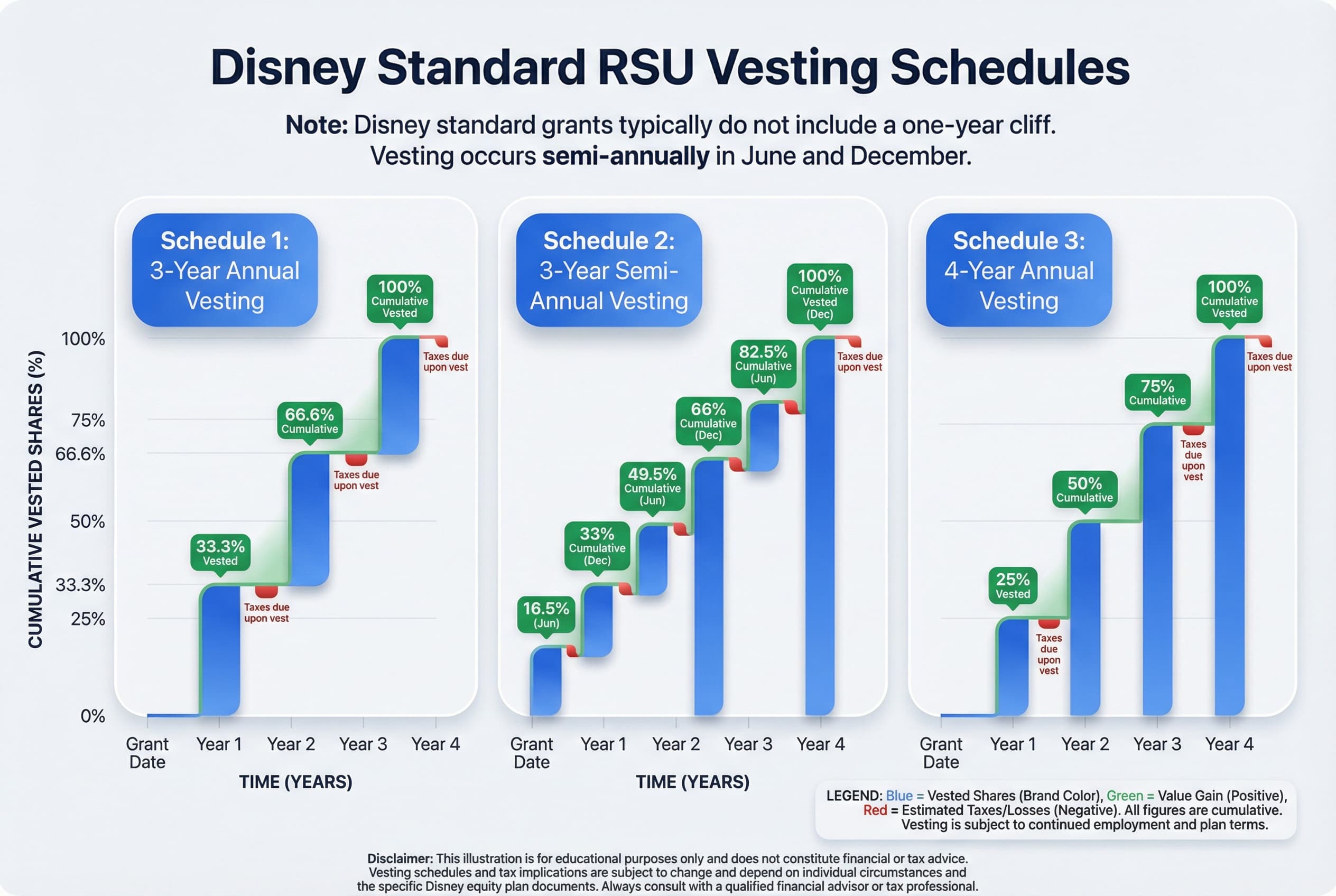
Disney's vesting schedules vary by grant type and level. RSUs typically vest over 3 to 4 years, with vesting occurring semi-annually in June and December. Common schedules include 3-year annual vesting (33.3% per year) or 4-year annual vesting (25% per year). Stock options generally vest 25% per year over four years and remain exercisable for 10 years from the grant date. The ESPP operates on 6-month offering periods with a lookback provision, allowing you to contribute up to 15% of your salary (maximum $25,000 annually).
Disney offers multiple vesting schedules for equity compensation, with the specific timeline depending on your role, level, and grant type. Understanding how your equity vests is crucial for planning your financial future with the company.
Disney's RSU vesting schedules vary across the organization. The most common structures include:
Executive vesting schedules may differ, with some senior leaders receiving semi-annual vesting over three years. Unlike many tech companies, Disney's standard equity grants typically do not include a one-year cliff, meaning you may begin vesting shares earlier in your tenure.
Most Disney employees experience vesting on a semi-annual basis, with shares typically vesting in June and December. This predictable schedule allows you to plan for the tax implications and potential sales of vested shares. The semi-annual pattern applies across most grant types, creating consistency in when you'll receive access to your equity.
Disney provides annual refresher grants to eligible employees, with the amount often tied to seniority level (for example, senior employees might receive LTI refreshers at 35% of their compensation). These refresher grants follow the normal vesting schedules described above. Notably, initial refresher grants may vest around 1.5 years after joining, depending on when you enter the company's grant cycle.
Disney's vesting schedules are uniform, meaning shares vest in equal or nearly equal portions throughout the vesting period. This differs from backloaded schedules (where more shares vest later) or frontloaded schedules (where more vest early). The uniform approach provides predictable, steady equity income as you continue your tenure with the company.
Your equity accounts are held by Merrill Lynch, where you can track your vesting schedule and manage your shares once they vest.
Disney offers an Employee Stock Purchase Plan that allows you to purchase company stock through payroll deductions. The plan operates on a six-month offering period cycle, with purchase periods occurring semi-annually. Enrollment windows are available in January and July, giving you opportunities to join or adjust your participation twice per year.
Disney's ESPP includes a lookback provision, which can significantly enhance your potential returns. This feature allows you to purchase shares at the lower of the stock price at either the beginning of the offering period or the end of the purchase period. For example, if Disney stock is trading at $100 at the start of the offering period but rises to $120 by the purchase date, you'd purchase shares based on the $100 price - an immediate 20% gain.
You can contribute up to 15% of your eligible compensation through payroll deductions, subject to an annual maximum of $25,000. These limits align with IRS regulations for qualified ESPPs and help you manage your investment while maintaining portfolio diversification.
Understanding the tax treatment of your ESPP shares is crucial. A qualifying disposition occurs when you hold shares for at least one year after the purchase date AND two years after the offering date. Meeting these requirements can result in more favorable tax treatment, with some gains taxed as long-term capital gains rather than ordinary income.
A disqualifying disposition happens when you sell before meeting both holding period requirements. In this case, the discount and any gain from the lookback provision are taxed as ordinary income, with only additional appreciation potentially qualifying for capital gains treatment.
The combination of the lookback provision and semi-annual purchase frequency can provide attractive opportunities to build equity ownership in Disney at potentially favorable prices.
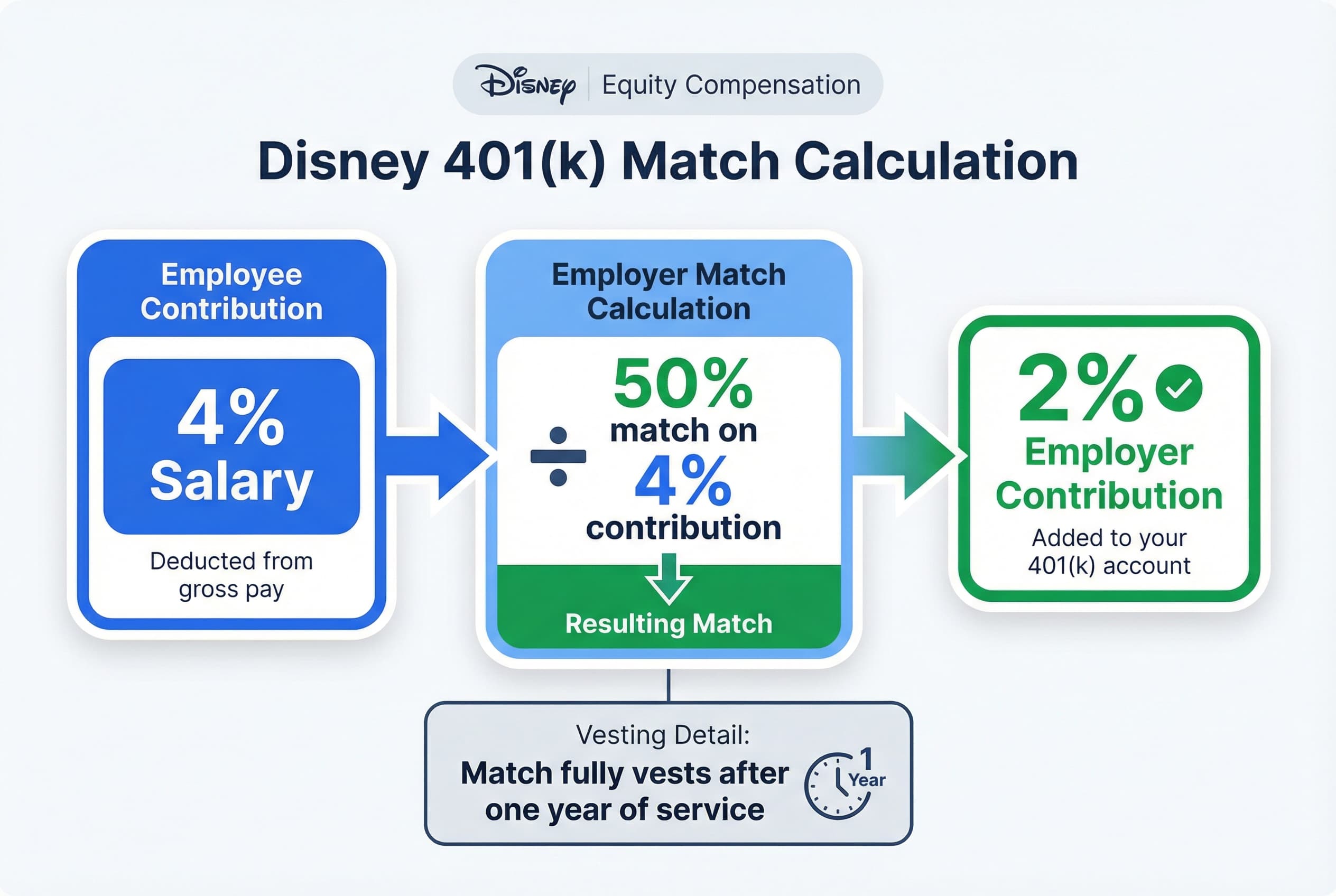
Disney offers a 401(k) retirement plan with employer matching to help you build long-term savings. The company provides a 50% match on up to 4% of your salary. This means if you contribute 4% or more of your salary, Disney will add an additional 2% to your account.
The employer match becomes fully yours after one year of service, which is relatively quick compared to many companies. This shorter vesting period means you can take the full value of Disney's contributions with you if you change jobs after your first year.
Disney offers both traditional and Roth 401(k) options, giving you flexibility in how you want to be taxed on your retirement savings. The plan also allows after-tax contributions, which can be useful for high earners who have maxed out their standard 401(k) contribution limits.
However, mega backdoor Roth conversions are not available through Disney's plan. Additionally, there is no brokerage window option, meaning you'll be limited to the investment funds offered within the plan.
Disney allows loans against your 401(k) savings subject to plan terms, which can provide financial flexibility in emergencies. Many employees choose to use proceeds from their equity compensation (RSUs and stock options) to maximize their 401(k) or Roth 401(k) contributions, taking advantage of the employer match while diversifying their investment portfolio beyond Disney stock.
Understanding the tax treatment of your Disney equity awards is crucial for effective financial planning. Here's what you need to know about when and how your equity compensation will be taxed.
RSUs (Restricted Stock Units): You'll owe taxes at vesting, which typically occurs semi-annually in June and December at Disney. The fair market value of the shares on the vesting date is treated as ordinary income, just like your salary. This means you're taxed even if you don't sell the shares.
Stock Options (ISOs and NSOs): For Non-Qualified Stock Options (NSOs), you owe ordinary income tax when you exercise, based on the difference between the exercise price and the current market value. Incentive Stock Options (ISOs) receive more favorable treatment - no regular tax at exercise, though they may trigger Alternative Minimum Tax (AMT).
ESPP: Disney's Employee Stock Purchase Plan includes a lookback feature. Tax treatment depends on how long you hold the shares. To receive favorable tax treatment, you must hold shares for at least one year after purchase AND two years after the offering date. Selling earlier can result in higher ordinary income tax rates.
Disney can adjust tax withholding rates, but standard supplemental wage withholding may not cover your full tax liability. This creates a common "gap" problem where the amount withheld is less than what you actually owe, potentially resulting in a surprise tax bill at year-end. This is especially important to consider during Disney's June and December vesting periods.
Equity compensation is initially taxed as ordinary income (at your marginal tax rate). However, any appreciation after vesting (for RSUs) or after exercise (for options) qualifies for capital gains treatment when you sell. Long-term capital gains rates apply if you hold shares for more than one year after the taxable event.
If you hold ISOs, the spread at exercise may trigger Alternative Minimum Tax, even though no regular tax is due. This can create cash flow challenges and requires careful planning.
Disclaimer: This information is educational only and not tax advice. Tax laws are complex and individual circumstances vary. Please consult a qualified tax professional to understand your specific situation.
While Disney equity compensation can be valuable, concentrating too much of your wealth in a single stock - even one from an iconic company - exposes you to significant risk. If Disney's stock price declines, both your compensation and net worth suffer simultaneously, creating a double impact on your financial security.
Disney faces unique challenges in the entertainment sector. The company operates in a highly competitive landscape with rapidly evolving consumer preferences, particularly in streaming services. Economic downturns can reduce consumer spending on entertainment and theme parks, while content production costs continue rising. Regulatory changes, shifting media consumption habits, and technological disruption all create volatility specific to this industry.
Financial advisors commonly recommend limiting single-stock exposure to 10-20% of your total net worth. This guideline helps protect you from company-specific or industry-specific downturns. As your Disney equity vests - whether through RSUs vesting semi-annually in June and December, or options vesting over four years - consider selling shares systematically to rebalance your portfolio.
Diversification doesn't mean you lack confidence in Disney; it means you're managing risk prudently. Use vesting events as natural opportunities to sell shares and invest proceeds across different asset classes, industries, and geographies. You might also maximize your 401(k) contributions using equity proceeds, taking advantage of Disney's 50% match on the first 4% of your salary to build diversified retirement savings.
Disney employees should evaluate selling vested RSUs when shares represent more than 10-15% of their total investment portfolio. Since vesting occurs semi-annually in June and December, these dates provide natural opportunities to reassess your position. Consider selling immediately upon vesting to avoid concentration risk, especially if Disney stock already comprises a significant portion of your net worth.
Working in the entertainment industry means your income and equity are both tied to Disney's performance. This concentration risk is particularly relevant given the cyclical nature of entertainment and media. If Disney stock represents a substantial portion of your wealth, prioritizing diversification becomes critical. Use proceeds from equity sales to build a balanced portfolio across different sectors and asset classes.
Disney's ESPP features a lookback provision with semi-annual purchase periods. To qualify for favorable long-term capital gains treatment, hold ESPP shares for at least one year after purchase and two years after the offering date. However, weigh potential tax savings against concentration risk - selling immediately may be prudent despite triggering ordinary income tax on the discount.
Consider maximizing your 401(k) contributions (Disney offers a 50% match on up to 4% of salary) using cash compensation, then using equity proceeds for additional savings or diversification.
Disney offers 10b5-1 trading plans, which allow you to establish predetermined selling schedules. These plans are particularly valuable given Disney's blackout periods related to insider trading restrictions. A 10b5-1 plan enables systematic diversification while providing legal protection, ensuring you can sell shares even during periods when you might possess material non-public information.
Remember: This information is educational only. Consult a qualified financial advisor and tax professional for personalized guidance based on your specific situation.
Let's walk through a realistic scenario to see how Disney's RSU vesting works in practice.
Sarah, a Senior Software Engineer at Disney, receives a new hire grant of 300 RSUs when she joins in January. Her RSUs follow Disney's common 3-year semi-annual vesting schedule, with vesting dates in June and December.
Here's how Sarah's 300 RSUs vest over three years:
In June of her first year, 50 RSUs vest when Disney stock is trading at $100 per share. The gross value is $5,000 (50 shares × $100).
At vesting, RSUs are treated as ordinary income and subject to tax withholding. While Disney's specific default withholding rate isn't publicly available, federal supplemental income is typically withheld at 22% for amounts under $1 million, plus applicable state taxes and payroll taxes (FICA). Assuming a combined withholding of approximately 30%, Disney withholds 15 shares to cover taxes.
Sarah receives 35 shares deposited into her Merrill Lynch account (Disney's LTI custodian), worth approximately $3,500 after withholding.
Over the full three-year period, assuming the stock price remains at $100, Sarah would receive approximately 210 shares after tax withholding from her original 300 RSU grant, worth around $21,000.
Disney employees often miss valuable opportunities or create unnecessary tax burdens by making these common equity compensation mistakes:
Disney's ESPP has a lookback provision, which can create significant tax complexity. Many employees sell shares too early, triggering ordinary income tax on the discount rather than qualifying for more favorable long-term capital gains treatment. To qualify for preferential tax treatment, you must hold shares for at least one year after purchase and two years after the offering date.
With RSUs vesting semi-annually in June and December, plus ESPP purchases twice yearly, Disney employees can quickly accumulate substantial company stock holdings. Failing to diversify creates unnecessary risk - your career and portfolio shouldn't both depend on Disney's performance.
RSU vesting triggers ordinary income tax, but default withholding may not cover your full tax liability, especially if you're in a higher tax bracket. Many employees face unexpected tax bills because they didn't adjust their withholding or set aside additional funds for estimated taxes.
Disney stock options expire after 10 years and must be exercised within 90 days of leaving the company. Employees sometimes wait too long to develop an exercise strategy, missing opportunities to manage tax timing or losing valuable options entirely upon departure.
Employees meeting specific retirement criteria (age 60+ with 10 years of service) may retain certain equity rights, but many don't plan for this advantage when considering retirement timing.
Understanding how your equity is affected when you leave Disney is crucial for financial planning. Here's what you need to know:
When you leave Disney, unvested RSUs are generally forfeited, regardless of whether your departure is voluntary or involuntary. However, there's an important exception: employees who meet specific retirement criteria (age 60 or older with at least 10 years of service) may retain their unvested shares. Performance-Based Units (PBUs) follow similar forfeiture rules, though they already vest on a three-year cliff basis.
If you hold vested stock options, you have 90 days after your termination date to exercise them before they expire. Any unvested options are forfeited upon departure. Since Disney options have a 10-year expiration from the grant date, this 90-day window significantly shortens your exercise timeline.
If you leave Disney during an active ESPP offering period, you'll typically be withdrawn from the plan. Your accumulated payroll deductions may be returned to you, and you won't participate in the upcoming purchase date.
Your exact termination date impacts vesting. Since Disney's equity typically vests semi-annually in June and December, leaving just before a vesting date means forfeiting shares that were close to vesting. Plan your departure timing carefully if possible to maximize vested equity.
This content is for educational purposes only and does not constitute financial advice. The information provided is general in nature and may not appl...
YourEmployeeStock.com is not a registered investment advisor.
Disney RSU vesting schedules vary depending on your grant type and level. Common schedules include 3-year annual vesting (33.3% per year), 3-year semi-annual vesting, or 4-year annual vesting (25% per year). Most vesting events occur in June and December, with semi-annual vesting being the most common frequency.
Generally, unvested RSUs are forfeited when you leave Disney. However, if you meet specific retirement criteria (age 60 or older with at least 10 years of service), different rules may apply. It's important to review your specific grant agreement for details.
Disney's ESPP has 6-month offering periods with semi-annual purchases. You can contribute up to 15% of your eligible compensation, with a maximum of $25,000 per year. The plan includes a lookback provision, meaning you'll purchase shares at the lower price between the beginning and end of the offering period.
ESPP enrollment typically occurs in January and July, during specified enrollment periods (usually the month before the offering date begins). Once enrolled, purchases happen semi-annually, allowing you to acquire Disney stock through payroll deductions.
To qualify for favorable tax treatment on ESPP shares, you must hold them for at least 1 year after the purchase date AND 2 years after the offering date. Selling before meeting both requirements results in a disqualifying disposition, which can result in higher taxes than RSUs or stock options.
You typically have 90 days after leaving Disney to exercise your vested stock options. Options generally vest 25% per year over 4 years and expire 10 years from the grant date, but the post-termination exercise window is much shorter.
Yes, you may be subject to insider trading restrictions and market abuse laws, which can prevent you from buying or selling shares when you have inside information. Disney also has 10b5-1 trading plans available, which allow you to set up pre-planned trading schedules. Additionally, hedging or pledging Disney securities is prohibited for Board members and certain executives.
Yes, Disney provides annual refresher grants as part of their Long-Term Incentive (LTI) program. These refresher grants typically vest over the normal schedule, with some sources suggesting initial refreshers may vest around 1.5 years depending on your joining cycle. The amount varies by seniority level (for example, 35% of compensation for senior-level employees).
Get a free personalized analysis from our equity compensation experts

