Free equity analysis
Complete guide to understanding your Tesla equity compensation, including RSU, ISO, NSO, ESPP, vesting schedules, and tax strategies.
Stock Price
$356.58
Closing price · Sep 15, 2026
Employees
48.8K
Worldwide
Equity Programs
4
programs
Vesting Period
4 years
RSU vesting
Closing price · Sep 15, 2026
Tesla offers 4 equity compensation programs to employees. Click on each program to learn more about eligibility, vesting, and tax implications.
Tesla offers RSUs with a 4-year vesting schedule. Given Tesla's high stock volatility, the value of RSUs can fluctuate significantly. Tesla has historically relied more on options for certain roles.
Tesla grants ISOs to eligible employees. ISOs offer potential tax advantages with qualifying dispositions. The exercise price is set at fair market value on grant date.
Learn about Tesla's Non-Qualified Stock Options program, including vesting schedules and tax treatment.
Learn about Tesla's Employee Stock Purchase Plan program, including vesting schedules and tax treatment.
Tesla RSUs vest on a 4-year with 1-year cliff, followed by quarterly vesting schedule with a 12-month cliff.
Example calculation based on 100 shares:
| Year | Vesting % | Shares Vesting | Estimated Value |
|---|---|---|---|
| Year 1 | 25% | 25 | $8,914.50 |
| Year 2 | 25% | 25 | $8,914.50 |
| Year 3 | 25% | 25 | $8,914.50 |
| Year 4 | 25% | 25 | $8,914.50 |
| Total | 100% | 100 | $35,658 |
* Based on Tesla stock price of $356.58 as of Sep 15, 2026. Actual values will vary.
25%
25 shares
$8,914.50
25%
25 shares
$8,914.50
25%
25 shares
$8,914.50
25%
25 shares
$8,914.50
Tesla vesting schedule based on 100 total shares
Tesla offers a comprehensive equity compensation program designed to align employee interests with the company's long-term success. The program includes Restricted Stock Units (RSUs), stock options (both Incentive Stock Options and Non-Qualified Stock Options), Performance Stock Units (PSUs), and an Employee Stock Purchase Plan (ESPP).
As a publicly traded automotive and clean energy company, Tesla's equity compensation represents a significant portion of total compensation - often more substantial than base salary compared to some tech peers. This structure means your financial success is directly tied to Tesla's growth and stock performance. For context, initial RSU grants for software engineers typically exceed $25,000 in value, with ranges varying significantly by level: entry-level engineers may receive $50,000-$100,000 in RSU value, while senior management grants can exceed $1,000,000.
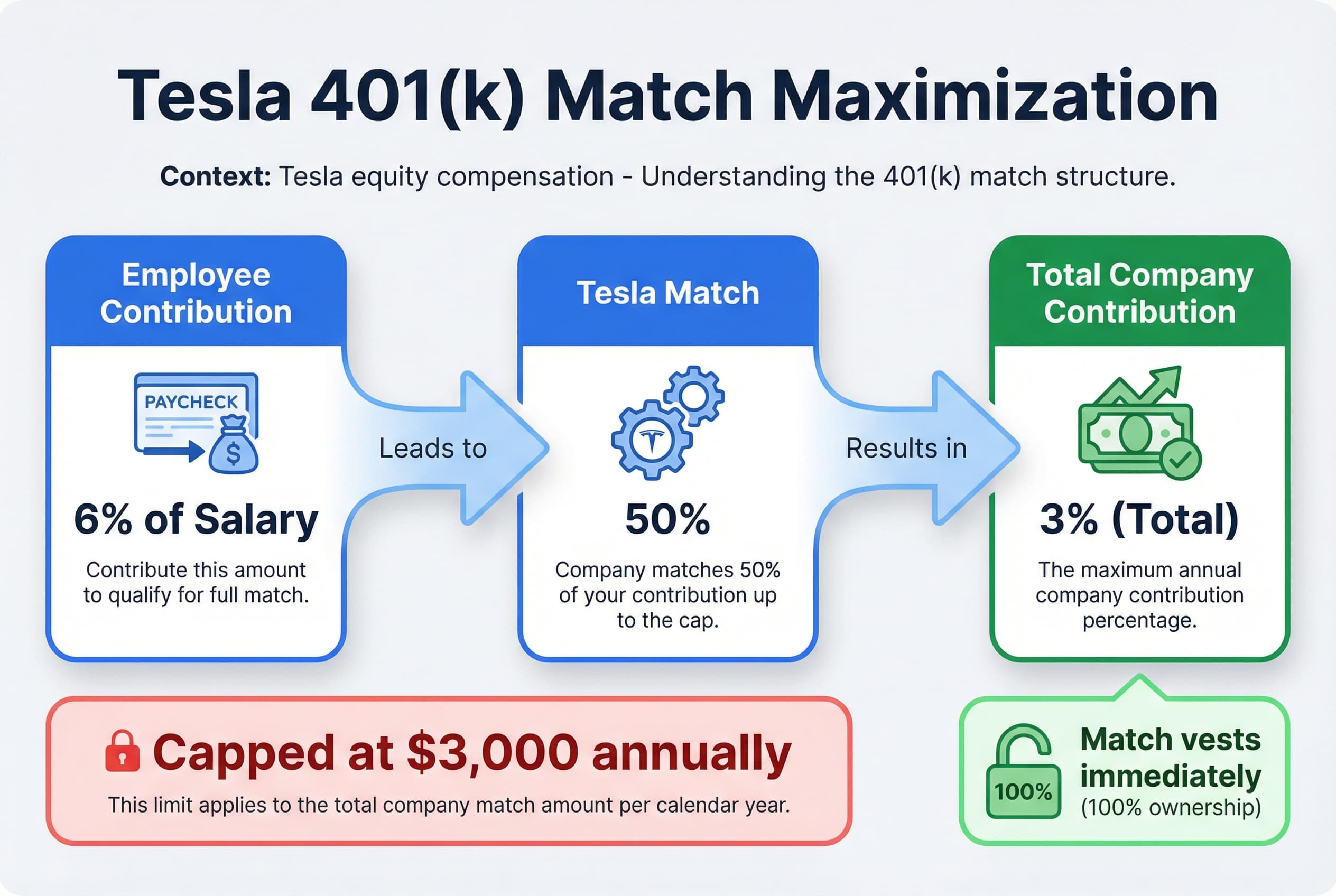
Most RSU grants follow a 4-year vesting schedule with a 1-year cliff, meaning 25% of your grant vests after your first year, followed by quarterly vesting of 6.25% each quarter thereafter. Tesla also offers annual refresher grants during performance reviews for employees with more than one year of tenure, helping maintain your equity stake as initial grants vest.
A unique feature: you can choose between RSUs and stock options, with 3 options granted for every RSU foregone. The ESPP allows you to purchase Tesla stock at a 15% discount with a lookback provision, providing an additional opportunity to build ownership in the company.
Tesla's equity compensation follows a 4-year vesting schedule with a 1-year cliff for Restricted Stock Units (RSUs). This means you must remain employed for at least one full year before any of your equity vests. After completing this initial cliff period, you'll receive 25% of your total grant. The remaining 75% vests on a quarterly basis over the following three years, with 6.25% vesting each quarter.
During your first year at Tesla, no equity vests - this is the "cliff period." If you leave the company before completing one full year of service, you forfeit your entire equity grant. However, once you cross the one-year mark, you immediately vest 25% of your total award. This cliff structure is designed to encourage employee retention during the critical first year.
After the initial cliff, your remaining shares vest every quarter aligned with quarter-end dates. This uniform distribution means you receive equal amounts (6.25% of your original grant) every three months throughout years two, three, and four. For example, if you received a grant of 400 RSUs, you'd vest 100 shares at your one-year anniversary, then approximately 25 shares each quarter thereafter.
Note that Tesla also offers a monthly vesting variant for some grants, where shares vest at 2.08% monthly after the initial 25% cliff, though quarterly vesting is more standard.
Tesla commonly provides annual refresher grants during performance reviews for employees who have completed at least one year of tenure. These refresher grants help maintain your equity compensation as your initial grant vests over time. Initial grants for software engineers typically exceed $25,000 in value, and the company may also issue ad-hoc spot grants or one-time awards based on performance or retention needs.
Tesla's vesting schedule is uniform, meaning shares vest in equal increments after the cliff period. This differs from backloaded schedules (where more vests later) or frontloaded schedules (where more vests earlier), providing predictable, consistent equity vesting throughout your tenure.
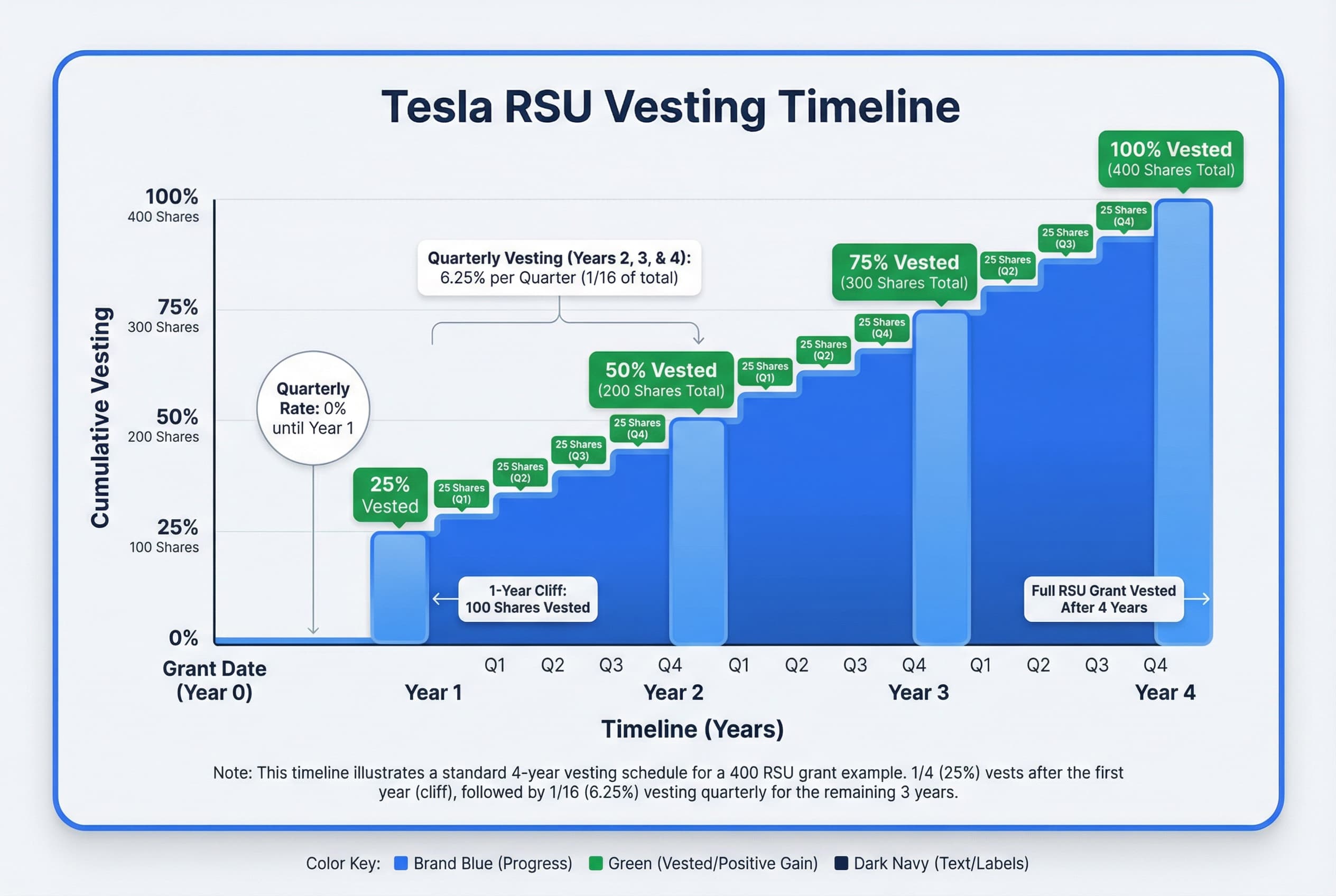
Tesla offers employees a valuable opportunity to purchase company stock at a discount through its Employee Stock Purchase Plan. The program provides a 15% discount on Tesla shares and includes a lookback provision, creating significant potential for returns.
The ESPP operates on 6-month offering periods with enrollment windows in January and July. Employees can contribute up to 15% of their eligible compensation through payroll deductions during each period. At the end of the 6-month purchase period, accumulated contributions are used to purchase Tesla stock at a 15% discount.
The lookback provision enhances the benefit considerably. Tesla applies the 15% discount to whichever price is lower: the stock price at the beginning of the offering period or the price at the end of the purchase period. This means if Tesla's stock price increases during the 6-month period, you benefit from both the price appreciation and the 15% discount on the lower starting price.
The combination of the lookback provision and discount can generate substantial immediate returns. For example, if Tesla's stock rises during the offering period, you could see gains well exceeding the 15% discount alone, as you're purchasing shares at 85% of the lower historical price.
How you're taxed depends on when you sell your ESPP shares. A qualifying disposition requires holding shares for at least 2 years from the offering period start date and 1 year from the purchase date. Meeting these requirements can result in more favorable long-term capital gains treatment. A disqualifying disposition (selling before these periods) means the discount is taxed as ordinary income, with any additional gain taxed as capital gains.
The ESPP represents one of the most straightforward ways to build equity in Tesla with reduced risk and immediate value.
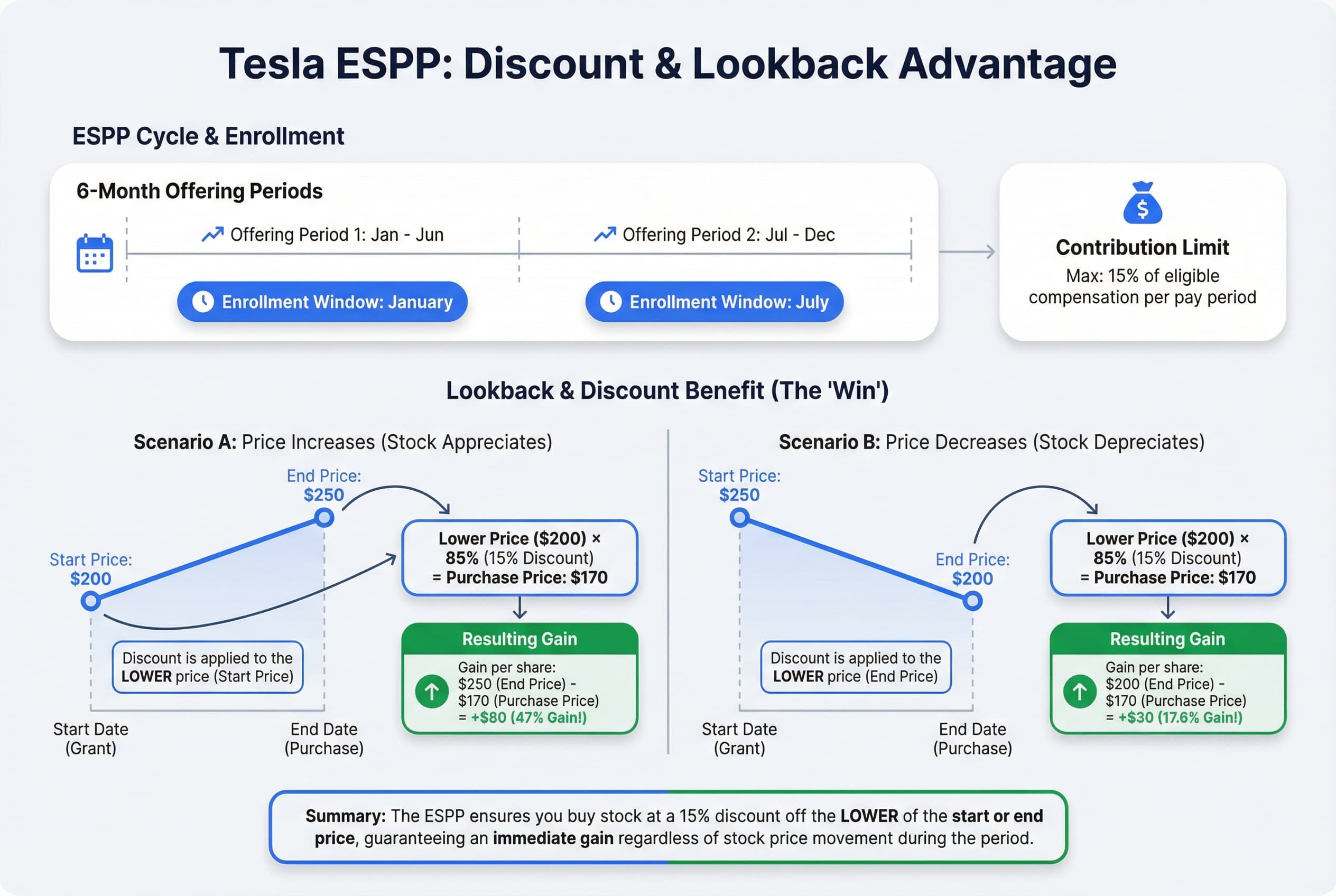
Tesla offers a 401(k) retirement plan with company matching to help you build long-term savings. Understanding how this benefit works can help you maximize your retirement contributions.
Tesla provides a 50% match on up to 6% of your salary. This means if you contribute 6% of your salary to your 401(k), Tesla will add an additional 3% match. The company match is capped at approximately $3,000 annually.
One of the standout features of Tesla's 401(k) is that the company match vests immediately. This means you own 100% of Tesla's contributions right away, with no waiting period. If you leave the company, you can take the full match with you.
Tesla offers both traditional and Roth 401(k) options, giving you flexibility in how you want to be taxed on your retirement savings. The plan also supports after-tax contributions, which can be useful for high earners who want to save beyond the standard 401(k) limits.
However, mega backdoor Roth conversions are not available through Tesla's plan, and there is no brokerage window option for self-directed investments within the 401(k).
To maximize this benefit, consider contributing at least 6% of your salary to receive the full company match. Since the match vests immediately, you're receiving an instant 50% return on your contributions up to that threshold - a valuable component of your total compensation package.
Understanding the tax treatment of your Tesla equity compensation is crucial for effective financial planning. Different award types trigger taxes at different times and rates.
RSUs are taxed as ordinary income at vesting, regardless of whether you sell the shares. The fair market value of the vested shares becomes taxable compensation on your W-2. For stock options, ISOs and NSOs have different treatment: NSOs trigger ordinary income tax upon exercise (based on the spread between exercise price and fair market value), while ISOs may qualify for preferential treatment if holding period requirements are met.
For the ESPP, taxes depend on whether you meet the qualifying disposition requirements (2 years from grant date AND 1 year from purchase date). Qualifying dispositions receive partial capital gains treatment, while disqualifying dispositions are taxed as ordinary income on the discount.
Tesla withholds at a 22% default rate for supplemental income like RSU vesting, though you can adjust this rate. However, this often creates a significant gap: if your actual tax bracket is higher (which the 37% supplemental rate suggests for high earners), you'll owe additional taxes at filing. Given Tesla's high share price, many employees use a sell-to-cover strategy at vesting to meet tax obligations.
RSU vesting and NSO exercise are taxed as ordinary income at your marginal rate. Any subsequent appreciation after vesting (for RSUs) or exercise (for options) qualifies for capital gains treatment when sold - long-term if held over one year, short-term otherwise.
Exercising ISOs without selling can trigger Alternative Minimum Tax (AMT) on the spread between exercise price and fair market value, a common concern among Tesla employees given the stock's appreciation potential.
Tesla is headquartered in Texas (formerly California), which has no state income tax. However, if you worked in California or another high-tax state during vesting, you may owe state taxes based on where you performed services.
Disclaimer: This information is educational only and not tax advice. Tax situations vary significantly based on individual circumstances. Consult a qualified tax professional or financial advisor to understand your specific tax obligations.
While Tesla equity compensation can be valuable, concentrating too much of your wealth in a single stock creates significant risk. If Tesla's stock price declines, you could simultaneously face reduced compensation value, potential job insecurity, and diminished net worth - all tied to the same company's performance.
Tesla operates in the highly competitive automotive industry, facing unique challenges including:
Tesla stock has historically experienced significant price swings, amplifying the concentration risk for employees.
Financial advisors commonly recommend limiting any single stock to 10-20% of your total net worth. Consider these approaches:
Remember: your human capital (salary and future grants) is already concentrated in Tesla, making financial diversification even more critical.
Tesla employees should evaluate selling vested RSUs as they vest quarterly to manage concentration risk. Since Tesla's compensation structure relies heavily on equity with lower base salaries compared to tech peers, maintaining too much wealth in a single stock can be risky. Consider selling at least enough shares to cover tax withholding (typically 22% federal, though supplemental rates can reach 37%) and to diversify your portfolio. Tesla's blackout periods around earnings releases will restrict when you can trade, so plan sales accordingly.
Given Tesla's automotive industry exposure and stock volatility, aim to limit your Tesla holdings to no more than 10-15% of your total investment portfolio. This is especially important if your income and equity compensation are both tied to the company's performance. The quarterly vesting schedule provides natural opportunities to rebalance regularly.
For the ESPP, maximize the 15% discount with lookback provision by contributing up to the 15% maximum. To qualify for favorable long-term capital gains treatment, hold shares for 2 years from the grant date AND 1 year from each semi-annual purchase date (January and July enrollment periods). However, weigh this against concentration risk - sometimes selling immediately after purchase makes sense despite higher tax rates.
Tesla offers 10b5-1 plans, which allow you to establish pre-scheduled selling programs. These plans let you sell shares during blackout periods and remove emotion from selling decisions. Consider setting one up to systematically diversify your holdings while maintaining compliance with insider trading policies.
Remember that Tesla's compensation philosophy emphasizes equity over cash. Initial grants for software engineers typically exceed $25,000, with annual refreshers common after your first year. Factor vesting schedules into financial planning, especially during your first year when no equity vests due to the one-year cliff.
Let's walk through a realistic scenario for a mid-level engineer at Tesla who receives an RSU grant worth $150,000 at the time of hire.
Sarah joins Tesla as a P3-level software engineer and receives 150 RSUs (assuming a stock price of $1,000 per share at grant = $150,000 total value). Her RSUs vest over 4 years with quarterly vesting after a 1-year cliff.
Year 1 (Cliff):
Years 2-4 (Quarterly):
When Sarah's first cliff vests, she receives $37,500 in value. Tesla withholds 22% for federal taxes using the standard supplemental income rate.
After the first year cliff, Sarah receives 29.25 shares (worth $29,250 at the current price). She'll owe the $8,250 in taxes, but this is already withheld through the sell-to-cover process.
Each subsequent quarter, she'll vest 9.375 shares, with approximately 2.06 shares sold to cover the 22% tax withholding, netting her about 7.31 shares per quarter.
Important note: If Tesla's stock price changes, the value at vest will differ from the original grant value, but the number of RSUs remains the same.
Tesla employees often make costly mistakes with their equity compensation. Here are the most common pitfalls to avoid:
Many new hires don't realize that RSUs at Tesla vest on a 4-year schedule with a 1-year cliff. This means you receive nothing if you leave before your first anniversary. Plan your career moves carefully around this milestone to avoid forfeiting your entire initial grant.
With Tesla's lower base salaries compared to tech peers and heavy reliance on equity, employees can become dangerously overexposed to a single stock. Diversify once your RSUs vest, even if you're bullish on the company's future. A concentrated position amplifies both gains and losses.
Tesla defaults to 22% withholding on RSU vesting, but this rarely covers your full tax obligation. High earners face supplemental rates up to 37%, plus state taxes. Without proper planning, you could face a substantial tax bill at year-end. Consider increasing your withholding rate or setting aside additional funds from each vesting event.
Tesla's ESPP offers a 15% discount with a lookback provision, providing an immediate return on investment. Enrolling during the January or July windows and contributing up to 15% of your salary can generate significant value, especially with the lookback feature.
Due to Tesla's high share price, you may need to sell shares to cover taxes at vesting. Understand this process and potential blackout periods to avoid surprises.
Understanding what happens to your equity compensation upon departure from Tesla is crucial for financial planning. Here's what you need to know:
Unvested equity is typically forfeited when you leave Tesla, regardless of whether your departure is voluntary or involuntary. This applies to both RSUs and stock options. Since Tesla's standard vesting schedule includes a one-year cliff followed by quarterly vesting over four years, any equity that hasn't vested by your termination date will be lost.
Your termination date significantly impacts your equity. Because Tesla RSUs vest quarterly (aligned with quarter-end dates), leaving just before a vesting date means forfeiting that tranche. If possible, timing your departure after a vesting date can preserve more of your equity value.
For vested stock options (ISOs and NSOs), you'll have a limited window to exercise after leaving Tesla. However, specific post-termination exercise window details aren't publicly disclosed in Tesla's standard documentation, so review your grant agreement carefully or consult with HR before departure.
If you leave Tesla during an active ESPP offering period, you'll typically be withdrawn from the plan. Your accumulated contributions may be returned to you without completing the purchase, meaning you won't receive the 15% discount or benefit from the lookback provision for that period.
Bottom line: Unvested equity represents a significant consideration when planning your departure from Tesla, particularly given the company's equity-heavy compensation structure.
This content is for educational purposes only and does not constitute financial advice. The information provided is general in nature and may not appl...
YourEmployeeStock.com is not a registered investment advisor.
Helpful videos explaining Tesla equity compensation, vesting, and tax strategies.
The KILLER way to UNLOCK TESLA equity
Tesla Compensation System #TESLA
Tesla RSUs follow a 4-year vesting schedule with a 1-year cliff, meaning you receive nothing until you complete your first year. After the cliff, you receive 25% of your grant, then the remaining 75% vests quarterly (6.25% every three months) over the next three years. Your vesting dates align with quarter-end dates throughout the vesting period.
If you leave Tesla voluntarily or are terminated, you will forfeit all unvested RSUs and options. Only the shares that have already vested by your departure date are yours to keep. This is one of the most common concerns among Tesla employees, so consider your vesting schedule carefully before making career decisions.
Tesla's ESPP allows you to contribute up to 15% of your salary to purchase Tesla stock at a 15% discount. The plan has 6-month offering periods with enrollment windows in March and September, and it includes a lookback provision that uses the lower of the stock price at the beginning or end of the period. Purchases occur semi-annually.
When your RSUs vest, they're taxed as ordinary income at their fair market value on the vesting date. Tesla's default withholding rate is 22%, though the supplemental rate can be as high as 37% for higher earners. Due to Tesla's high share price, you'll often need to use a sell-to-cover strategy where some shares are automatically sold to cover the tax withholding.
Yes, Tesla offers employees a unique choice between RSUs and stock options. For every RSU you forgo, you receive 3 stock options instead. Options have a 10-year expiration period and follow a multi-year vesting schedule similar to RSUs, but they require you to pay an exercise price to convert them into shares.
Tesla enforces blackout periods tied to insider trading policies, particularly before earnings releases. You must review Tesla's insider trading policy and blackout-window calendar before making any trades. Tesla does offer 10b5-1 trading plans, which allow you to set up pre-scheduled sales that can execute even during blackout periods.
Tesla commonly provides annual refresher grants during performance reviews for employees with more than one year of tenure. These additional equity grants help retain employees as their initial grants vest and are typically awarded based on performance and level. For software engineers, initial grants typically exceed $25,000 in value.
To receive favorable long-term capital gains tax treatment on your ESPP shares, you must hold them for at least 2 years from the grant date (start of the offering period) AND at least 1 year from the purchase date. If you sell before meeting both requirements, it's considered a disqualifying disposition and a portion will be taxed as ordinary income.
Get a free personalized analysis from our equity compensation experts

