Free equity analysis
We're still gathering complete information
Some details about Shopify's equity programs may be incomplete or based on general industry data. We recommend verifying specifics with your official plan documents or HR department.
Complete guide to understanding your Shopify equity compensation, including RSU, ISO, NSO, ESPP, vesting schedules, and tax strategies.
Stock Price
$133.89
Closing price · Sep 14, 2026
Employees
7K
Worldwide
Equity Programs
4
programs
Vesting Period
1 years
RSU vesting
Closing price · Sep 14, 2026
Shopify offers 4 equity compensation programs to employees. Click on each program to learn more about eligibility, vesting, and tax implications.
Standard RSU program with 4-year vesting and 1-year cliff. Annual refresh grants available for eligible employees.
Learn about Shopify's Incentive Stock Options program, including vesting schedules and tax treatment.
Learn about Shopify's Non-Qualified Stock Options program, including vesting schedules and tax treatment.
Learn about Shopify's Employee Stock Purchase Plan program, including vesting schedules and tax treatment.
Shopify RSUs vest on a Varies: 3-year schedule (1/3, 1/3, 1/3) or 1-year schedule (100% cliff removed) schedule.
Example calculation based on 100 shares:
| Year | Vesting % | Shares Vesting | Estimated Value |
|---|---|---|---|
| Year 1 | 100% | 100 | $13,389.00 |
| Total | 100% | 100 | $13,389.00 |
* Based on Shopify stock price of $133.89 as of Sep 14, 2026. Actual values will vary.
100%
100 shares
$13,389.00
Shopify vesting schedule based on 100 total shares
Shopify offers a comprehensive equity compensation package designed to align employee interests with the company's long-term success. As an e-commerce leader, Shopify provides several equity vehicles including Restricted Stock Units (RSUs), stock options (both ISOs and NSOs), Performance Stock Units (PSUs), and an Employee Stock Purchase Plan (ESPP).
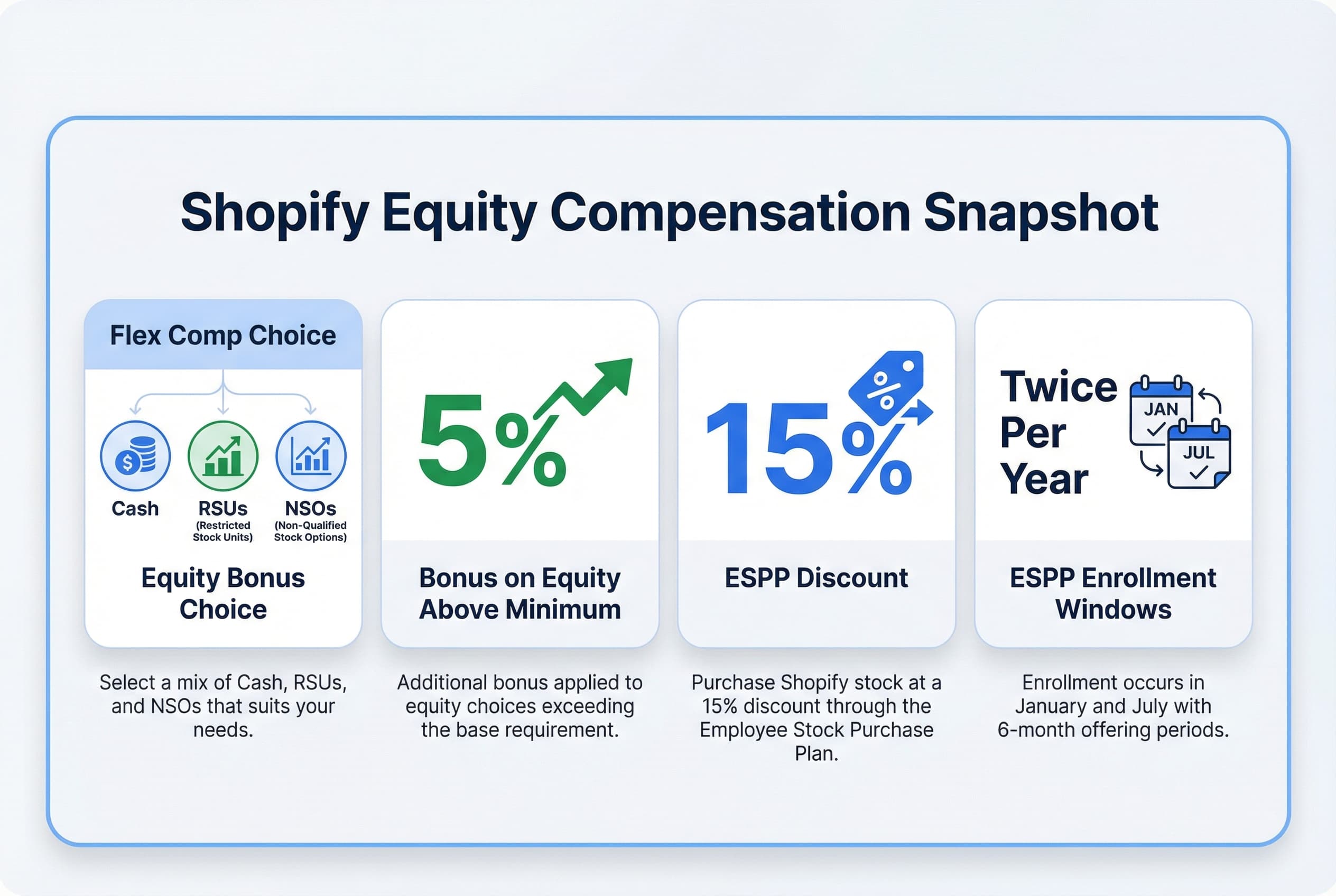
What makes Shopify's equity program particularly distinctive is its Flex Comp system, which empowers you to choose your own compensation mix between cash, RSUs, and stock options through an intuitive slider interface. When you allocate more than the minimum toward equity, Shopify rewards this choice with a 5% bonus on the additional equity amount - a unique feature that encourages ownership thinking.
Shopify has removed the traditional one-year cliff, meaning your equity begins vesting immediately upon grant. RSU vesting schedules vary depending on your offer, with options including a traditional 3-year schedule (vesting in thirds annually) or newer structures with quarterly vesting. For senior employees (L6+), performance-based refresher grants are awarded annually, typically ranging from 33-50% of your initial grant value based on performance, and vest over three years.
The ESPP offers a 15% discount with a lookback provision over 6-month offering periods, allowing you to purchase Shopify stock at favorable prices twice per year during January and July enrollment windows.
This flexible, employee-centric approach to equity compensation reflects Shopify's commitment to letting you build wealth in the way that works best for your financial situation.
Shopify has recently modernized its equity vesting approach, making it more employee-friendly than traditional tech company schedules. The company eliminated the standard one-year cliff that typically requires employees to wait a full year before receiving any equity, allowing vesting to begin immediately upon grant.
Shopify currently operates with multiple vesting schedules depending on the type of grant and when it was issued. The most notable feature is that there is no cliff period - your shares begin vesting right away rather than requiring you to wait a full year before seeing any equity.
For RSUs, shares vest on a quarterly basis, meaning you'll receive portions of your grant four times per year. The company has moved away from requiring employees to stay a full year before any vesting occurs, which was a significant policy change aimed at improving retention and employee satisfaction.
Some grants follow a 3-year schedule with annual allocations split evenly (one-third per year), while others may vest over a 1-year period. The specific schedule you receive may vary based on the type of grant and your role level.
Since there's no cliff period, your equity begins vesting immediately on a quarterly schedule. This means that every three months, a portion of your grant becomes yours to keep. This is a significant advantage compared to traditional vesting schedules where you'd need to wait 12 months before receiving anything.
Shopify offers performance-based annual refresher grants for employees at L6 and above. These refreshers are tied to your performance review:
Refresher grants vest over a 3-year period, providing ongoing equity compensation for strong performers. This structure rewards high achievers with meaningful additional equity beyond their initial grant.
The vesting schedule is uniform rather than backloaded or frontloaded, with consistent quarterly vesting throughout the grant period.
Shopify offers an Employee Stock Purchase Plan that allows you to purchase company stock at a discount through regular payroll deductions. The plan provides a 15% discount on the purchase price, which already makes it an attractive benefit for building equity ownership.
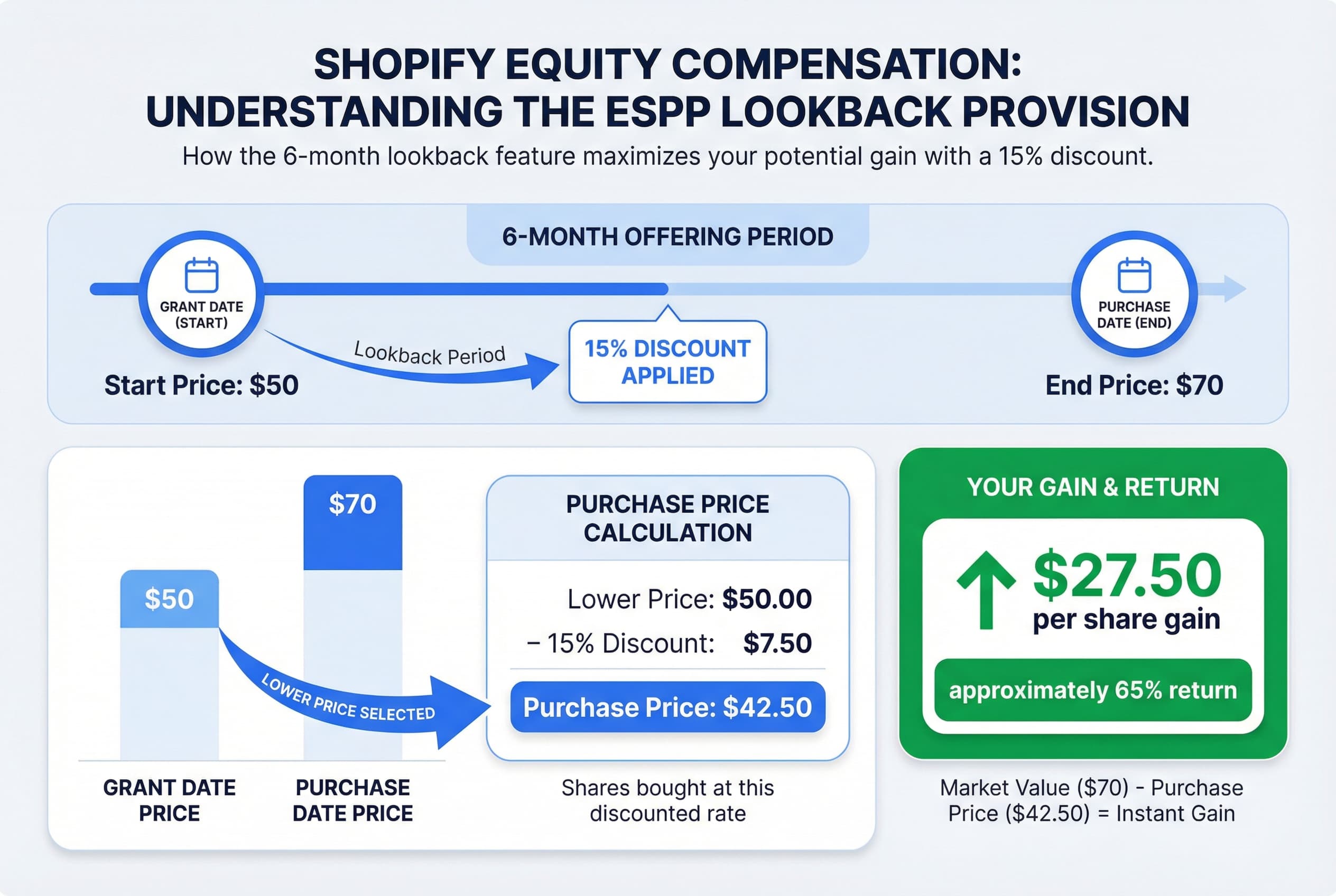
The ESPP includes a lookback provision, which can significantly enhance your returns. Here's how it works: at the end of each 6-month offering period, the purchase price is determined by taking the lower of two prices - either the stock price at the beginning of the offering period or the price at the end (purchase date) - and then applying the 15% discount to whichever is lower.
This means if Shopify's stock price increases during the offering period, you benefit from purchasing at the lower starting price with the discount applied. For example, if the stock starts at $50 and rises to $70, you'd purchase at $42.50 ($50 minus 15%), giving you an immediate gain of $27.50 per share, or approximately 65% return on your contribution.
You can contribute up to 15% of your eligible compensation, subject to a $25,000 annual limit based on fair market value at the offering date. The plan operates on 6-month offering and purchase periods, with purchases occurring semi-annually.
Enrollment windows typically open a few times per year, usually in January and July - the month before each offering period begins.
To qualify for favorable tax treatment, you must hold shares for at least 2 years from the offering date AND 1 year from the purchase date (qualifying disposition). Selling before these periods results in a disqualifying disposition, which triggers ordinary income tax on the discount and any bargain element from the lookback provision.
Understanding the tax implications of your Shopify equity compensation is essential for effective financial planning. The timing and type of taxation varies significantly depending on the award type.
RSUs are taxed at vesting as ordinary income based on the fair market value of the shares on that date. Since Shopify has removed the one-year cliff and vesting now begins immediately with quarterly vesting, you'll face tax obligations each quarter shares vest. This differs from stock options, where taxation typically occurs at exercise rather than vesting.
For ISOs and NSOs, the timing differs. NSOs trigger ordinary income tax when you exercise (based on the spread between exercise price and fair market value). ISOs receive more favorable treatment - no regular tax at exercise if you hold the shares, though AMT may apply (see below). For both option types, you'll owe capital gains tax when you eventually sell the shares.
ESPP purchases create taxation at sale. If you meet the qualifying disposition period (2 years from offering date AND 1 year from purchase date), the 15% discount is taxed as ordinary income, while any additional gain receives favorable long-term capital gains treatment. Disqualifying dispositions result in the full discount being taxed as ordinary income.
Shopify will withhold taxes when RSUs vest, but the statutory withholding rate often falls short of your actual tax obligation, especially for high earners. This "gap" between what's withheld and what you owe can result in a surprise tax bill. Consider making estimated tax payments or adjusting your W-4 withholding to cover the shortfall.
Equity compensation creates two types of tax: ordinary income (taxed at your marginal rate, potentially up to 37% federal) and capital gains (0%, 15%, or 20% federal for long-term holdings). The difference is substantial - strategic holding periods can significantly reduce your tax burden.
If you exercise ISOs and hold the shares, the spread may trigger Alternative Minimum Tax, even though no regular tax is due. This complex calculation requires careful planning.
Disclaimer: This information is educational only and not tax advice. Tax situations vary based on individual circumstances, income level, and location. Always consult a qualified tax professional before making decisions about your equity compensation.
When you receive equity compensation from Shopify, you're building wealth - but it's important to understand the risks of holding too much of your net worth in a single stock, even one you believe in.
Having significant wealth concentrated in Shopify stock creates a "double exposure" problem: your income and your investments both depend on the same company's success. If Shopify faces challenges, you could simultaneously see reduced job security and declining portfolio value.
As an e-commerce platform company, Shopify faces specific industry risks including intense competition from larger tech players, changing merchant needs, economic downturns that reduce consumer spending, and rapid technological shifts. The e-commerce sector can be particularly volatile, as demonstrated by significant stock price swings across the industry.
Financial advisors commonly recommend limiting single-stock exposure to 10-20% of your total net worth. This doesn't mean you lack confidence in Shopify - it's simply prudent risk management. Consider selling vested shares regularly and reinvesting proceeds into diversified index funds or other asset classes.
With Shopify's ESPP offering a 15% discount and lookback provision, you're earning immediate gains - making it even more important to have a disciplined selling strategy rather than accumulating unlimited company stock. Regular rebalancing protects your financial future while still allowing you to benefit from Shopify's growth.
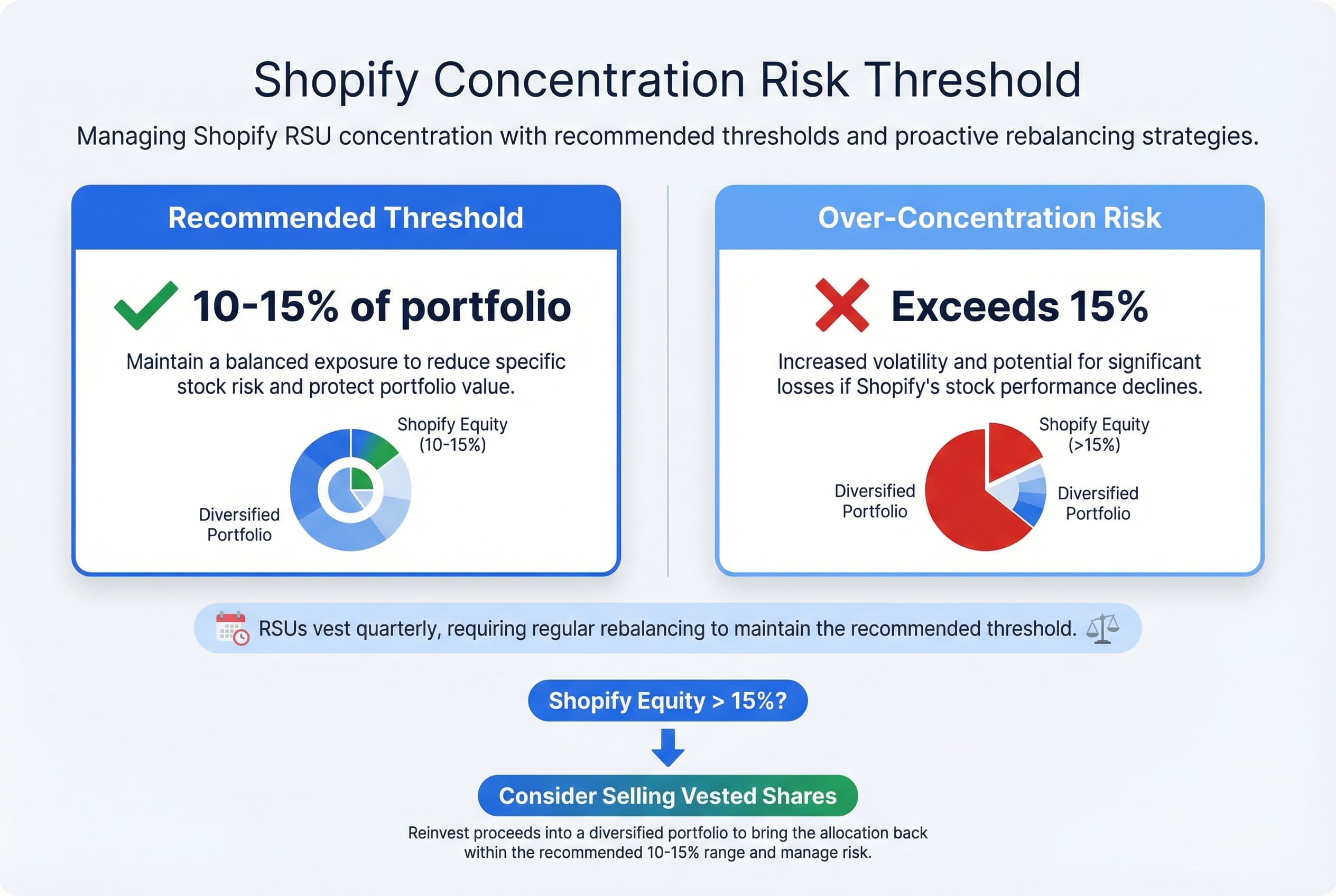
As your RSUs vest quarterly, evaluate your concentration risk regularly. A common guideline suggests limiting single-stock positions to 10-15% of your investment portfolio. Consider selling vested shares when Shopify equity exceeds this threshold, especially given the e-commerce sector's volatility. With no vesting cliff, you'll receive shares more frequently, making regular rebalancing easier to implement.
Shopify's unique "Flex Comp" system lets you choose your compensation mix between cash, RSUs, and NSOs. While the 5% bonus for choosing extra equity is attractive, avoid over-concentrating in company stock. If you're already receiving substantial equity grants or holding significant ESPP shares, consider allocating more toward cash to maintain diversification across your total financial picture.
Shopify's ESPP offers a 15% discount with a lookback provision over 6-month periods. To qualify for favorable long-term capital gains treatment, hold shares for at least two years from the offering date and one year from the purchase date. However, given the immediate 15% discount (plus potential lookback gains), selling immediately after purchase can still be profitable - you'll just pay ordinary income tax on the discount. Calculate whether the tax savings from a qualifying disposition outweigh the concentration risk of holding.
Factor your vesting equity into your annual compensation when evaluating your financial position. Performance-based refreshers (33-50% of initial grants for L6+ employees) mean your equity compensation can grow significantly. However, remember that unvested equity isn't guaranteed income - consider it a bonus rather than your financial foundation.
While specific details about 10b5-1 availability aren't documented, be aware that blackout periods can extend settlement dates. If available, these plans allow systematic selling during blackout windows, helping you execute diversification strategies consistently.
Let's walk through how Shopify's RSU vesting works using a realistic scenario.
Sarah, a Software Engineer at Shopify, receives a grant of 300 RSUs as part of her compensation package. Under Shopify's current vesting structure, there's no cliff period - her shares begin vesting immediately on a quarterly schedule over one year.
With quarterly vesting over 12 months, Sarah's shares vest in four equal installments:
When RSUs vest, they're treated as ordinary income. Let's look at Sarah's first vesting event:
Quarter 1 Vesting:
At vesting, Shopify withholds shares to cover taxes. Assuming a typical supplemental income tax rate of approximately 40% (federal + state):
Following this pattern each quarter, Sarah would receive approximately 180 net shares after tax withholding across all four vesting periods (assuming the same stock price and tax rate).
Important note: The actual tax withholding rate varies based on your location and tax situation. You may owe additional taxes at year-end depending on your total income and tax bracket.
Even with Shopify's innovative Flex Comp system, employees frequently make costly errors with their equity benefits. Here are the most common pitfalls to avoid:
Many Shopify employees hold too much of their net worth in SHOP stock through RSUs and ESPP purchases. While loyalty is admirable, financial advisors typically recommend limiting single-stock exposure to 10-15% of your portfolio. Consider diversifying as shares vest, especially given the stock's historical volatility.
Shopify's ESPP offers a 15% discount with a lookback provision - an excellent benefit. However, employees often misunderstand the tax treatment of qualifying versus disqualifying dispositions. To achieve favorable long-term capital gains treatment, you must hold shares for two years from the offering date and one year from the purchase date. Selling earlier triggers ordinary income tax on the discount and potentially more.
RSUs vest quarterly without a cliff, meaning you'll face tax events throughout the year. Shopify withholds taxes at vesting, but this may not cover your full obligation, especially if you're in a higher tax bracket. Consider making quarterly estimated tax payments to avoid penalties and year-end surprises.
With enrollment periods typically opening only in January and July, missing these windows means waiting months to participate. Set calendar reminders to enroll during these brief periods and maximize your 15% discount opportunity.
Understanding what happens to your equity when you leave Shopify is critical for making informed career decisions.
When you leave Shopify, any unvested RSUs are forfeited, regardless of whether your departure is voluntary or involuntary. This applies to both initial grants and performance-based refreshers. Since Shopify has removed the traditional one-year cliff and equity vests quarterly, you'll retain whatever has vested up to your termination date, but anything scheduled to vest afterward is lost.
While Shopify grants both Incentive Stock Options (ISOs) and Non-Qualified Stock Options (NSOs), specific post-termination exercise window details are not publicly available. Typically, companies provide 90 days to exercise vested options after leaving, but you should confirm this timeframe with HR or your equity plan documents before departing.
If you leave Shopify during an active ESPP offering period, your participation typically ends, and accumulated payroll deductions may be returned to you rather than used to purchase shares at the next purchase date. Any shares already purchased in previous periods remain yours.
Your exact termination date impacts vesting since Shopify vests equity quarterly. Leaving just before a vesting date means forfeiting that tranche, while staying until the vesting date allows you to capture it.
Always review your specific equity agreements and consult with HR before making departure decisions.
This content is for educational purposes only and does not constitute financial advice. The information provided is general in nature and may not appl...
YourEmployeeStock.com is not a registered investment advisor.
Helpful videos explaining Shopify equity compensation, vesting, and tax strategies.
Finances and... Company Stock Options
Shopify has removed the traditional one-year cliff, so your RSUs begin vesting immediately upon grant. Vesting occurs quarterly, with schedules varying between employees—some follow a 3-year schedule (1/3 annually) while newer grants may vest over different periods. Check your specific grant agreement for your exact vesting schedule.
Flex Comp allows you to customize your compensation mix between cash, RSUs, and stock options using a slider interface. If you choose to allocate more equity (RSUs or options) above the minimum guardrails, you receive a 5% bonus on that extra equity allocation. This gives you flexibility to align your compensation with your personal financial goals.
Shopify's ESPP offers a 15% discount on company stock with a lookback provision, meaning you purchase at 85% of the lower price between the offering date and purchase date. The offering periods are 6 months long with enrollment windows typically opening in January and July. You can contribute up to 15% of your salary, with a maximum of $25,000 per year.
Only vested RSUs are yours to keep if you leave Shopify. Any unvested RSUs will be forfeited upon termination of employment. Since Shopify now vests equity quarterly with no cliff, you'll retain whatever has vested up to your departure date.
You can generally sell vested RSUs during open trading windows, as Shopify has blackout periods that restrict when employees can trade. If a settlement date falls during a blackout period or trading restriction, it will be extended. Note that you're not allowed to perform hedging strategies like buying protective puts on your Shopify stock.
If you're at L6 or above, you're eligible for annual performance-based refresher grants. Targets are 33% of your initial grant for a positive review and 50% for a high positive review. These refresher grants vest over 3 years.
To receive favorable tax treatment on ESPP shares, you must hold them for at least 2 years from the offering date AND 1 year from the purchase date (qualifying disposition). If you sell before meeting both requirements (disqualifying disposition), the discount is taxed as ordinary income. The tax complexity of ESPP dispositions is a common concern for Shopify employees, so consider consulting a tax professional.
Shopify offers RSUs (Restricted Stock Units), stock options (both ISOs and NSOs), PSUs (Performance Stock Units), and an ESPP. Through the Flex Comp program, you can choose your preferred mix of cash and equity. Signing bonuses are also available, though they're typically quite small.
Get a free personalized analysis from our equity compensation experts

