Free equity analysis
Complete guide to understanding your Salesforce equity compensation, including RSU, ISO, NSO, ESPP, vesting schedules, and tax strategies.
Employees
65.8K
Worldwide
Equity Programs
4
programs
Vesting Period
4 years
RSU vesting
Salesforce offers 4 equity compensation programs to employees. Click on each program to learn more about eligibility, vesting, and tax implications.
Salesforce RSUs vest over 4 years with a 1-year cliff followed by quarterly vesting. The company is known for a strong culture of equity participation with annual refresh grants.
Learn about Salesforce's Incentive Stock Options program, including vesting schedules and tax treatment.
Learn about Salesforce's Non-Qualified Stock Options program, including vesting schedules and tax treatment.
Salesforce ESPP offers 15% discount with lookback provision. Good complement to RSU program.
Salesforce offers a comprehensive equity compensation package designed to align employee interests with the company's long-term success in the cloud computing industry. As a public company (ticker: CRM), Salesforce primarily grants Restricted Stock Units (RSUs) to its broad employee base, supplemented by an Employee Stock Purchase Plan (ESPP) and stock options (both ISOs and NSOs) for certain roles.
Equity compensation represents a significant portion of total compensation at Salesforce, often ranging from tens of thousands to hundreds of thousands of dollars over the vesting period. For example, initial RSU grants can range from $58,000 to $200,000 over four years, depending on role and level. As Salesforce shares are publicly traded, your RSUs convert directly to cash value upon vesting, providing real financial benefit without the complexity of private company stock.
Most RSU grants at Salesforce follow a 4-year vesting schedule with a 1-year cliff, meaning you'll receive 25% of your grant after your first year, with the remaining shares vesting quarterly (or sometimes monthly) thereafter. Annual refresher grants may be awarded during performance reviews or promotions, though these are not guaranteed for all levels below Lead MTS. The ESPP allows you to purchase Salesforce stock at a 15% discount with a lookback provision, with purchase periods occurring semi-annually.
Understanding how your equity works is essential to maximizing your total compensation at Salesforce.
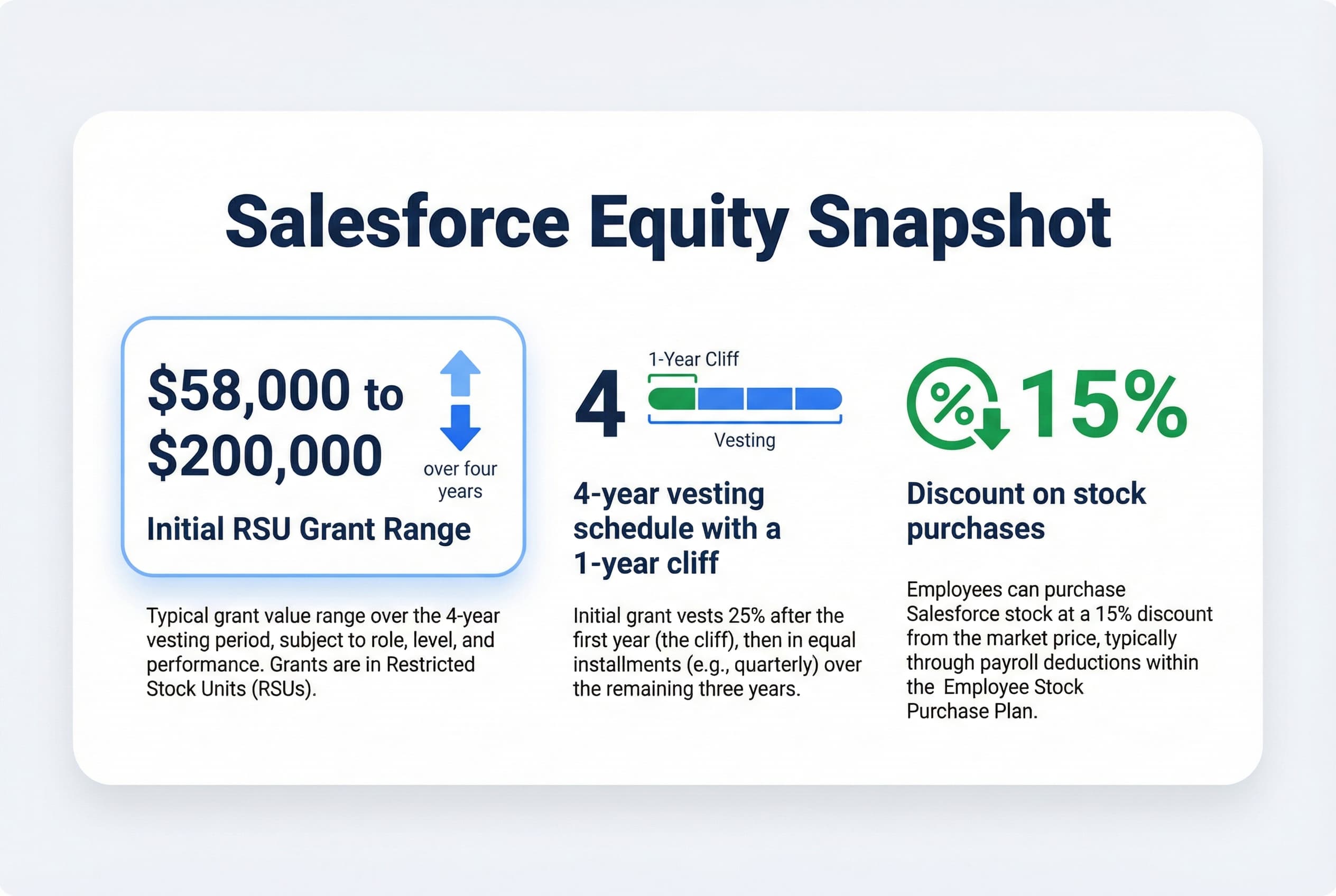
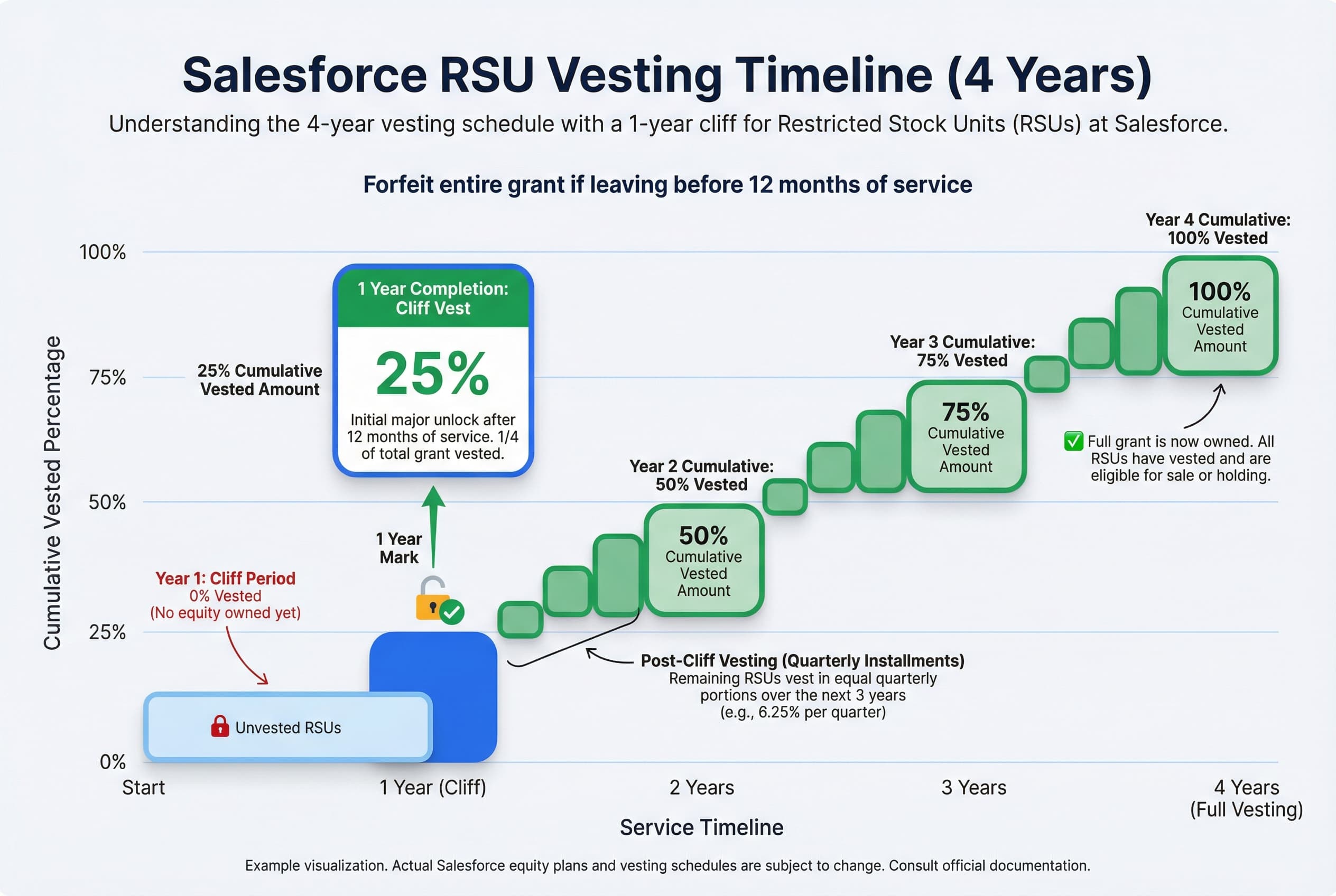
Salesforce follows a 4-year vesting schedule with a 1-year cliff for RSU grants. This is a uniform vesting structure, meaning shares vest in equal installments throughout the vesting period. After completing your first year (the cliff period), 25% of your total grant vests, followed by the remaining 75% distributed evenly over the next three years.
After the initial cliff, your RSUs vest on a quarterly basis. Some employees may experience monthly vesting depending on their specific grant terms. For reference, Non-Employee Directors have specific quarterly vesting dates on the 22nd of February, May, August, and November, though standard employee vesting dates may follow a different pattern.
The uniform distribution means you'll receive 25% of your total grant each year, broken down into smaller quarterly (or monthly) installments after year one.
During your first year at Salesforce - the cliff period - no shares vest. This means if you leave the company before completing 12 months of service, you forfeit your entire initial equity grant. The cliff serves as a retention mechanism, ensuring employees remain with the company for at least one year.
Once you complete the cliff, you'll receive that first 25% of your grant all at once, which can be a significant equity event. From that point forward, shares vest regularly according to the quarterly or monthly schedule.
Salesforce offers annual refresher grants during performance reviews or upon promotion, though these are not guaranteed for lower-level positions (below Lead MTS). The availability and size of refreshers depend on your level and performance.
For context, MTS-level employees may receive refreshers around $40,000 vested over 4 years, while Senior MTS refreshers are typically around $55,000 over 4 years. These refresher grants follow the same 4-year vesting schedule as initial grants, creating overlapping vesting schedules that can provide more consistent equity compensation over time.
It's important to note that refresher grants are discretionary and vary significantly based on role, level, and individual performance rather than being a standard benefit for all employees.
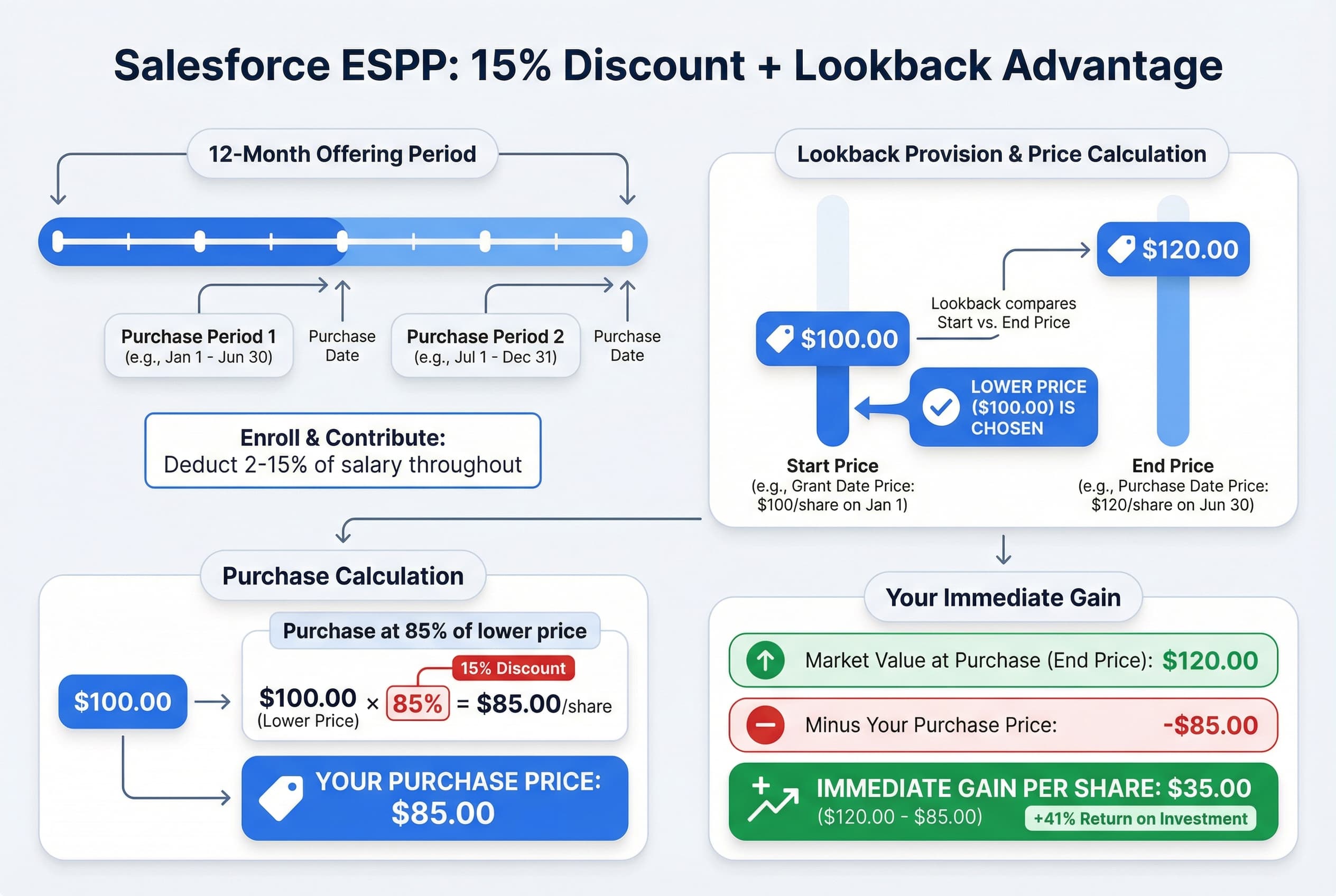
Salesforce offers a compelling ESPP that allows employees to purchase company stock at a significant discount. The plan provides a 15% discount off the stock price, combined with a lookback provision that can dramatically increase your potential returns.
The ESPP operates on a 12-month offering period with 6-month purchase periods. This means you'll have two purchase opportunities per year. The lookback provision compares the stock price at two points: the beginning of the 12-month offering period and the end of each 6-month purchase period. You'll purchase shares at 85% of whichever price is lower.
This combination of the 15% discount and lookback can generate substantial returns. If Salesforce stock rises during the offering period, you benefit from buying at the lower starting price with the additional discount - potentially yielding immediate gains of 15% or more.
You can contribute up to 15% of your salary, with a maximum annual contribution of $21,250. Enrollment windows occur twice yearly in May and November, with specific enrollment dates on June 15 and December 15 corresponding to the purchase and offering periods.
Understanding the tax treatment of your ESPP shares is important. A qualifying disposition occurs when you hold shares for more than one year after the purchase date and more than two years after the offering date. This allows for more favorable long-term capital gains treatment on a portion of your gains. A disqualifying disposition (selling before meeting both holding requirements) means the discount is taxed as ordinary income.
Note that ESPP shares can generally be sold immediately following purchase, though company blackout periods and insider trading restrictions may apply.
Salesforce offers a competitive 401(k) plan with generous employer matching and advanced savings features that can significantly boost your retirement savings.
Salesforce provides a 100% match on up to 6% of your salary, with a maximum annual match of $5,000. This means if you contribute 6% of your salary, the company will match it dollar-for-dollar up to the $5,000 cap. The best part? The match is immediately vested, so you own the full employer contribution from day one with no waiting period.
One of Salesforce's standout retirement benefits is the availability of the mega backdoor Roth conversion strategy. The plan allows after-tax contributions beyond the standard pre-tax and Roth 401(k) limits, with an overall 401(k) contribution cap of $69,000 (including employer match and after-tax contributions). This feature enables high earners to potentially contribute significantly more to tax-advantaged retirement accounts by making after-tax contributions and converting them to Roth.
The plan also allows you to roll over Traditional IRA funds into the 401(k), which can be useful for consolidating retirement accounts or executing backdoor Roth IRA strategies. Note that a brokerage window (self-directed investment option) is not available within the plan.
For employees looking to maximize their retirement savings, taking full advantage of the employer match and exploring the mega backdoor Roth option can be powerful wealth-building strategies.
Understanding the tax treatment of your Salesforce equity compensation is crucial for effective financial planning. Here's what you need to know about when and how you'll owe taxes on your RSUs, ESPP, and stock options.
Restricted Stock Units are taxed as ordinary income at the time they vest, not when you sell the shares. When your RSUs vest (typically quarterly at Salesforce), the fair market value of the shares becomes taxable compensation, just like your salary. This means if $10,000 worth of RSUs vest, that amount is added to your W-2 income for the year.
A common concern among Salesforce employees is that standard RSU withholding may underestimate your actual tax liability. Federal supplemental income withholding rates don't always align with your marginal tax rate, especially for higher earners. If you're in a tax bracket above the statutory withholding rate, you may owe additional taxes when filing your return. Consider adjusting your W-4 withholding or making estimated tax payments to avoid surprises.
After your RSUs vest and you own the shares, any subsequent price appreciation is taxed as capital gains when you sell. If you hold the shares for more than one year after vesting, you'll pay long-term capital gains rates (typically lower than ordinary income rates). Shares held for less than one year generate short-term capital gains, taxed at ordinary income rates.
Salesforce's ESPP with its 15% discount and lookback provision creates a tax situation at purchase and sale. The discount is generally taxed as ordinary income, while additional gains may qualify for favorable capital gains treatment if you meet the qualifying disposition requirements (holding shares more than one year after purchase AND more than two years after the offering date).
Salesforce is headquartered in California, a high-tax state with rates up to 13.3%. If you work in California or another high-tax state, you'll owe state income taxes on your equity compensation in addition to federal taxes. Some states also have different treatment for capital gains versus ordinary income.
Salesforce grants both ISOs and NSOs. With Incentive Stock Options, exercising (but not selling) can trigger Alternative Minimum Tax (AMT), potentially creating a significant tax bill even without cash proceeds. Non-qualified Stock Options are taxed as ordinary income upon exercise based on the spread between the exercise price and fair market value.
Disclaimer: This information is educational only and not tax advice. Tax situations vary significantly based on individual circumstances, state of residence, and timing of transactions. Always consult with a qualified tax professional before making decisions about your equity compensation.
While Salesforce equity compensation can be a valuable part of your total rewards, concentrating too much of your wealth in a single stock - even one you know well - creates significant financial risk. If Salesforce's stock price declines, you could simultaneously face reduced portfolio value and potential job insecurity, a double impact that can be difficult to recover from.
As a cloud computing company, Salesforce faces particular vulnerabilities. The enterprise software market is highly competitive, with rapid technological change and evolving customer preferences. Economic downturns often lead companies to cut software spending, directly impacting revenue. Additionally, the company's stock can be volatile based on quarterly earnings, product adoption rates, or shifts in market sentiment toward growth stocks.
Financial advisors commonly recommend limiting any single stock to 10-20% of your total net worth. This guideline helps protect you from company-specific and industry-specific downturns while still allowing you to benefit from Salesforce's success.
Consider establishing a regular selling discipline as your RSUs vest quarterly. Rather than holding all vested shares, you might sell a predetermined percentage to reinvest in diversified index funds or other asset classes. This approach, sometimes called "sell to cover plus," helps you gradually reduce concentration while building a more resilient portfolio. Remember to account for tax implications when planning your selling strategy.
As your RSUs vest quarterly (or monthly, depending on your grant), consider developing a systematic selling strategy rather than holding all shares indefinitely. A common approach is selling a portion at each vesting event to reduce concentration risk, particularly after your first-year cliff when 25% vests at once. Remember that RSUs are taxed as ordinary income at vest, so you've already paid taxes whether you sell immediately or hold.
Salesforce operates in the competitive cloud computing industry, and holding too much company stock creates concentration risk. Financial advisors often recommend limiting any single stock to 10-15% of your investment portfolio. If Salesforce equity represents a substantial portion of your net worth, prioritize diversification - especially if your job, income, and investments are all tied to the company's performance.
ESPP Optimization: Salesforce's ESPP offers a 15% discount with a 6-month lookback provision, providing potential gains of 17.6% or more. Consider maximizing contributions up to the $21,250 limit. You can sell shares immediately after purchase, though holding for qualifying disposition periods (>1 year after purchase AND >2 years after offering date) may provide tax advantages depending on your situation.
401(k) Opportunities: Take advantage of Salesforce's mega backdoor Roth option, which allows after-tax contributions up to the $69,000 total limit (including the company match). This can significantly boost tax-advantaged savings.
Factor in RSU refreshers when evaluating compensation, though note they're not guaranteed below Lead MTS level. Annual refreshers typically range from $40k-$55k vesting over four years, adding meaningful ongoing value beyond your initial grant.
While the data doesn't confirm 10b5-1 plan availability, be aware of Salesforce's blackout periods when planning sales. A systematic selling approach helps navigate these restrictions.
Let's walk through how vesting works for a Senior Software Engineer who receives a typical initial grant at Salesforce.
Sarah joins Salesforce as a Senior Software Engineer and receives an RSU grant of $125,000 vesting over 4 years. At the current stock price of approximately $250 per share, this equals 500 RSUs.
Salesforce uses a 1-year cliff followed by quarterly vesting:
Year 1 (Month 12): After working one full year, Sarah's first vest occurs. She receives 25% of her grant = 125 RSUs. At $250/share, this is worth $31,250.
Years 2-4 (Quarterly): The remaining 375 RSUs vest quarterly over the next three years. Every three months, Sarah receives approximately 31 RSUs (worth about $7,800 per quarter).
When RSUs vest, they're treated as ordinary income. While Salesforce's specific withholding rate isn't publicly disclosed, the standard supplemental wage rate is typically 22% federal, plus state and FICA taxes (usually totaling 30-40%).
Using a conservative 35% total withholding on Sarah's first vest:
After the first year, Sarah receives 81 shares in her brokerage account (worth $20,250). She can hold these shares or sell them immediately. The remaining RSUs continue vesting quarterly, with similar tax withholding at each vest date.
Important note: The actual tax withholding may underestimate your total tax liability depending on your income bracket, so plan accordingly for tax season.
Even experienced employees can stumble when managing their Salesforce equity. Here are the most frequent missteps to avoid:
Many new hires don't fully grasp that RSUs at Salesforce typically include a one-year cliff - meaning you receive nothing if you leave before your first anniversary. That initial 25% only vests after 12 months, making early departures costly. Plan your career moves accordingly.
Standard RSU withholding often falls short of your actual tax liability, especially for higher earners. When your RSUs vest, Salesforce withholds taxes, but this may not cover your full obligation. Consider making estimated tax payments quarterly to avoid a surprise bill at year-end.
Salesforce offers a generous 15% discount with a lookback provision through its ESPP. Employees who skip enrollment miss out on essentially guaranteed returns. With semi-annual purchase periods and a contribution limit of $21,250 annually, this benefit can generate significant value with minimal risk.
As RSUs vest quarterly and ESPP shares accumulate, many employees become overexposed to Salesforce stock. Holding too much of your net worth in a single company - especially your employer - creates unnecessary risk. Develop a diversification strategy that balances loyalty with prudent financial planning.
Unlike initial grants, refreshers aren't guaranteed for employees below Lead MTS level. Don't assume annual equity grants will continue - budget and plan accordingly, treating refreshers as bonuses rather than guaranteed compensation.
Understanding what happens to your equity compensation when you leave Salesforce is crucial for making informed career decisions.
All unvested RSUs are forfeited upon termination, regardless of whether you leave voluntarily or involuntarily. This is standard practice across the industry. Since Salesforce RSUs typically vest over four years with quarterly vesting, timing your departure can significantly impact your total compensation. If you're approaching a vesting date (typically February 22, May 22, August 22, or November 22), waiting until after that date could mean retaining thousands of dollars in equity.
While Salesforce does grant both ISOs and NSOs, specific post-termination exercise windows are not publicly documented. Generally, you'll have a limited window (often 90 days) to exercise vested options after leaving, but you should confirm this detail in your specific grant documents or with HR.
If you leave during an active ESPP offering period, your participation typically ends on your termination date. Any contributions made up to that point are usually refunded, and you won't participate in the upcoming purchase. Since Salesforce's ESPP operates on six-month purchase periods (June and December), leaving mid-period means forfeiting the 15% discount and lookback benefit for that period.
Key Takeaway: Your termination date directly impacts vesting, so strategic timing around quarterly vesting dates can maximize your equity retention.
This content is for educational purposes only and does not constitute financial advice. The information provided is general in nature and may not appl...
YourEmployeeStock.com is not a registered investment advisor.
Helpful videos explaining Salesforce equity compensation, vesting, and tax strategies.
RSU ESOP ESPP explained || Taxation rules in India || #finvestomate
Strategies for Restricted Stock Unit Taxes (RSUs)
Salesforce RSUs typically vest over 4 years with a 1-year cliff, followed by quarterly vesting thereafter. This means 25% of your grant vests after your first year, then the remaining 75% vests in equal quarterly installments over the next three years. Some employees may have monthly vesting instead of quarterly.
Refresher grants may be awarded annually during performance reviews or upon promotion, but they are not guaranteed, especially for employees below Lead MTS level. For example, MTS-level employees typically receive refreshers around $40k vested over 4 years, while Senior MTS refreshers are around $55k over 4 years, though these are not automatic.
Salesforce offers an Employee Stock Purchase Plan with a 15% discount and a lookback provision. You can contribute up to 15% of your salary (maximum $21,250 per year), and the plan purchases shares semi-annually at 85% of the lower price between the offering date and purchase date. Enrollment periods are in May and November.
Any RSUs that have already vested are yours to keep when you leave Salesforce. However, any unvested RSUs will typically be forfeited upon termination. If you're a specified employee and receive vesting acceleration payments, these may be delayed by 6 months plus 1 day due to Section 409A requirements.
When your RSUs vest, they're treated as ordinary income and subject to federal, state, and local income taxes, plus FICA taxes. Salesforce will withhold taxes at vesting, but be aware that the standard withholding may underestimate your actual tax liability, especially if you're in a higher tax bracket.
Yes, you can generally sell ESPP shares immediately following purchase. However, you'll be subject to any company-imposed blackout periods and insider trading restrictions. For favorable tax treatment (qualifying disposition), you must hold shares for more than 1 year after the purchase date AND more than 2 years after the offering date.
RSU grants vary widely by level and role. Examples include $58k to $200k over 4 years for initial grants, with a Senior Software Engineer receiving around $125k over 4 years and a Lead MTS receiving approximately $160k. Your specific grant will depend on your level, role, and negotiation.
Yes, Salesforce does grant both Incentive Stock Options (ISOs) and Non-Qualified Stock Options (NSOs), though RSUs are the primary equity vehicle for most employees. Stock options have a 10-year expiration period, but specific details about vesting schedules and exercise windows vary by grant.
Get a free personalized analysis from our equity compensation experts

