Free equity analysis
We're still gathering complete information
Some details about Procter & Gamble's equity programs may be incomplete or based on general industry data. We recommend verifying specifics with your official plan documents or HR department.
Complete guide to understanding your Procter & Gamble equity compensation, including RSU, ISO, NSO, ESPP, vesting schedules, and tax strategies.
Employees
101K
Worldwide
Equity Programs
4
programs
Vesting Period
N/A
RSU vesting
Procter & Gamble offers 4 equity compensation programs to employees. Click on each program to learn more about eligibility, vesting, and tax implications.
Learn about Procter & Gamble's Restricted Stock Units program, including vesting schedules and tax treatment.
Learn about Procter & Gamble's Incentive Stock Options program, including vesting schedules and tax treatment.
Learn about Procter & Gamble's Non-Qualified Stock Options program, including vesting schedules and tax treatment.
Learn about Procter & Gamble's Employee Stock Purchase Plan program, including vesting schedules and tax treatment.
Procter & Gamble offers a comprehensive equity compensation program designed to align your financial success with the company's performance. As a P&G employee, you have access to multiple equity types, including Restricted Stock Units (RSUs), stock options (both Incentive Stock Options and Non-Qualified Stock Options), Performance Stock Units (PSUs), and an Employee Stock Purchase Plan (ESPP).
Equity compensation represents a significant portion of your total rewards package at this Fortune 500 consumer goods leader. With P&G's established market position and track record, equity awards provide an opportunity to build wealth alongside the company's growth. A unique feature of P&G's program is the Long-Term Incentive Plan (LTIP), which allows you to choose your preferred mix of stock options and RSUs - offering flexibility to match your personal financial goals and risk tolerance.
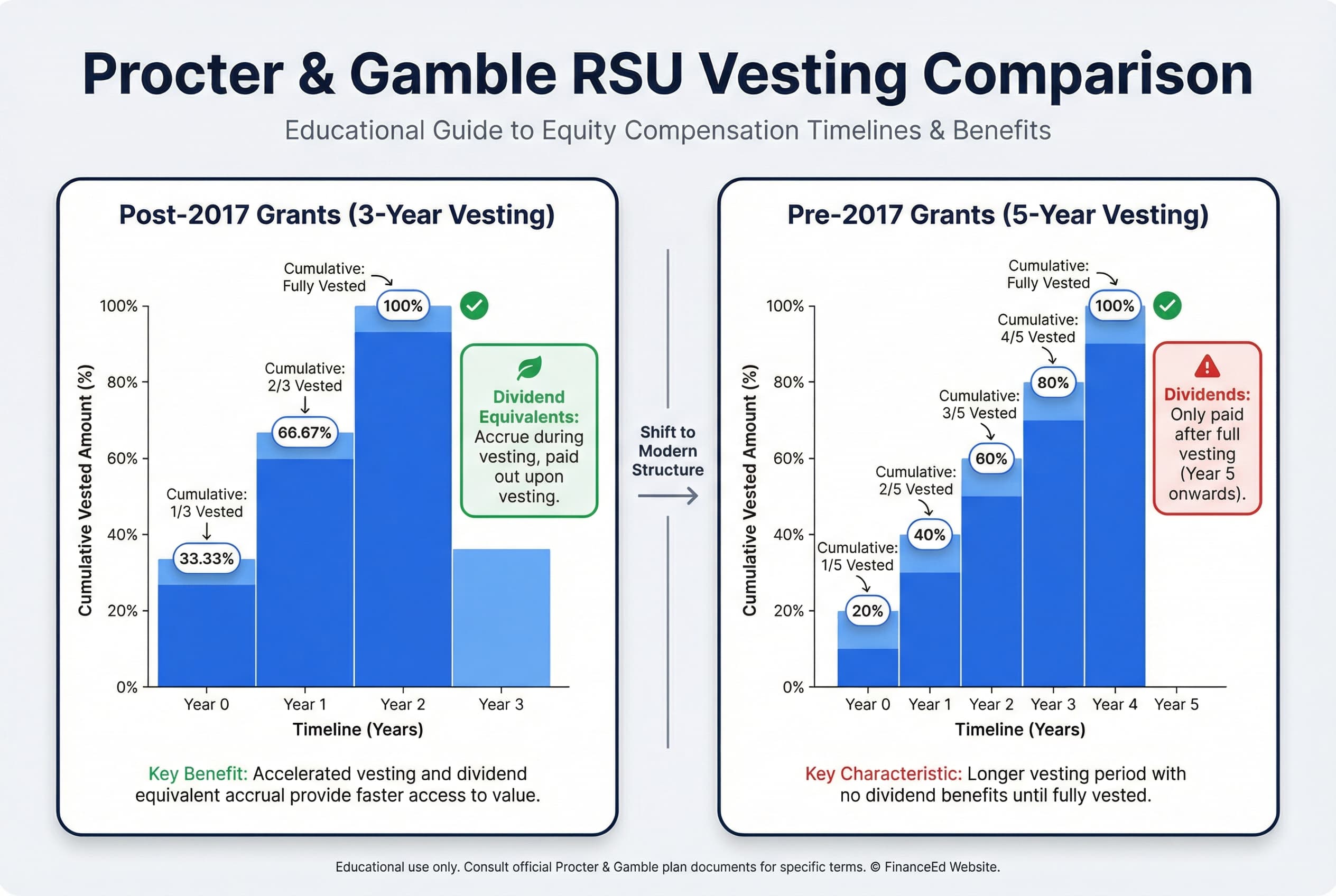
P&G's vesting terms have evolved over time. For grants made after 2017, RSUs typically vest over three years, while earlier grants followed a five-year schedule. Stock options generally vest over three years and cannot be exercised within the first year (except in the case of death). The ESPP allows you to purchase P&G stock at a 15% discount through semi-annual purchase periods.
Early vesting may occur under specific conditions, including retirement, disability, or company divestiture. Understanding these timelines is essential for maximizing the value of your equity compensation and planning your financial future at P&G.
Procter & Gamble's equity vesting schedules have evolved over time, with a notable change in 2017. For equity grants issued after 2017, both Restricted Stock Units (RSUs) and stock options typically vest over 3 years. However, if you received grants before 2017, you may have a longer 5-year vesting period for RSUs. This distinction is important when planning your financial future, as it affects when you'll actually own your shares outright.
Unlike many technology companies that impose a one-year cliff, P&G's equity compensation generally does not require you to wait a full year before any vesting occurs. For stock options specifically, grants are typically not exercisable within the first year from the grant date, except in the case of death. This means you'll begin seeing some benefit from your equity awards earlier in your tenure, though the exact vesting frequency and percentages are not publicly detailed.
P&G provides several circumstances under which your equity may vest earlier than the standard schedule. Early vesting can occur upon death, retirement, disability, or in cases where the company divests a business unit under specific conditions. These provisions offer important protections and should be considered when evaluating your total compensation package.
One distinctive feature of P&G's equity program is the flexibility offered through their Long-Term Incentive Plan (LTIP). Employees can choose their preferred mix of stock options and RSUs in various ratios (100/0, 75/25, 50/50, 25/75, or 0/100), allowing you to tailor your compensation to your risk tolerance and financial goals.
Additionally, the treatment of dividends differs based on when your RSUs were granted. Post-2017 RSUs receive dividend equivalents during the vesting period, while pre-2017 RSUs only pay dividends after full vesting - another important consideration for long-term financial planning.
While specific information about refresher grant policies and exact vesting percentages isn't publicly available, understanding these core vesting principles will help you maximize the value of your P&G equity compensation.
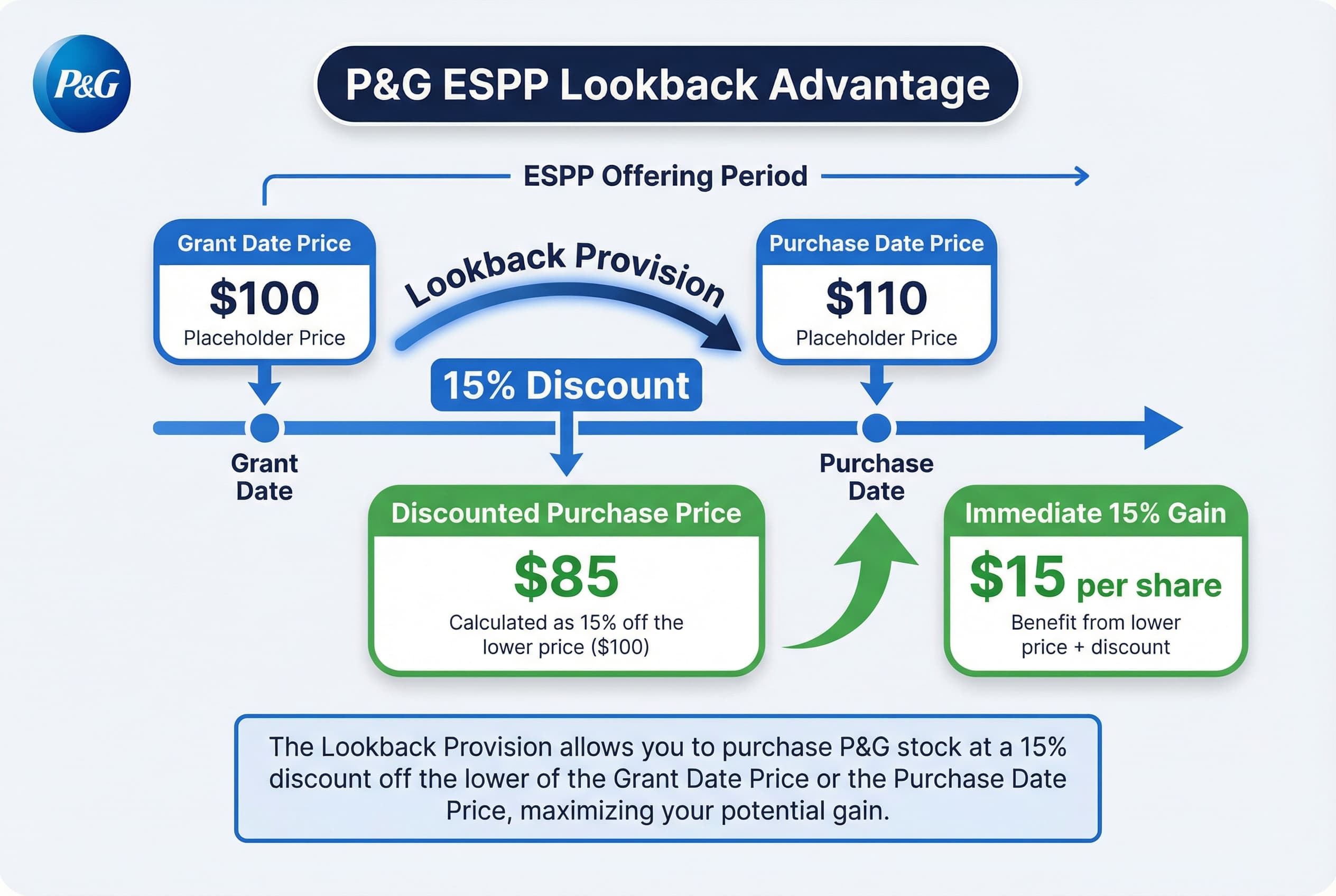
Procter & Gamble offers employees an ESPP that provides an attractive opportunity to purchase company stock at a discount. The plan offers a 15% discount on the stock price and includes a lookback provision, which can significantly enhance your potential returns.
The lookback provision allows you to purchase stock at 15% off the lower of two prices: the stock price at the beginning of the offering period or the price at the end of the purchase period. This feature provides built-in downside protection and upside potential. For example, if P&G stock rises during the offering period, you'll purchase at the lower beginning price minus the 15% discount. If the stock declines, you'll benefit from the lower ending price, still with the 15% discount applied.
P&G's ESPP operates on 6-month offering periods with purchases occurring semi-annually. This relatively short timeframe means you can benefit from the lookback provision twice per year.
You can contribute up to 15% of your eligible compensation, subject to an annual maximum of $25,000 (per IRS regulations). This allows meaningful participation while maintaining a diversified financial strategy.
The combination of the 15% discount and lookback provision can generate immediate gains of 15% or more, depending on stock price movements during the offering period. This represents a compelling risk-adjusted return opportunity.
To receive favorable long-term capital gains treatment on your ESPP shares (a qualifying disposition), you must hold the shares for at least 2 years from the offering date and 1 year from the purchase date. Selling before these periods results in a disqualifying disposition, with a portion of your gain taxed as ordinary income.
Understanding the tax treatment of your Procter & Gamble equity compensation is essential for effective financial planning. Different award types trigger taxes at different times and rates.
Restricted Stock Units (RSUs) are taxed as ordinary income at vesting based on the fair market value of the shares. For P&G's typical 3-year vesting schedule (post-2017 grants), you'll owe taxes each time a portion vests. The company will withhold taxes automatically, but you can adjust the withholding rate.
Stock Options (both ISOs and NSOs) have different tax timing. Non-Qualified Stock Options (NSOs) trigger ordinary income tax when exercised, based on the difference between the exercise price and the fair market value. Incentive Stock Options (ISOs) receive preferential treatment - no ordinary income tax at exercise if you meet holding requirements (2 years from grant, 1 year from exercise), but they may trigger Alternative Minimum Tax (AMT).
ESPP purchases are taxed based on whether you meet the qualifying disposition period (2 years from offering date, 1 year from purchase). Qualifying dispositions receive favorable capital gains treatment on a portion of the gain, while disqualifying dispositions are taxed partially as ordinary income.
When RSUs vest or NSOs are exercised, P&G withholds taxes at supplemental income rates. However, this withholding may be insufficient if you're in a higher marginal tax bracket, creating a potential "gap" that results in additional taxes owed when you file your return. Consider adjusting your withholding or setting aside extra funds to cover this shortfall.
After paying ordinary income tax at vesting (RSUs) or exercise (options), any additional appreciation is taxed as capital gains when you sell. Long-term capital gains rates (holding shares for more than one year after acquiring them) are significantly lower than ordinary income rates.
P&G is headquartered in Ohio, which has state income tax. If you work in Ohio or another state with income tax, you'll owe state taxes on equity compensation in addition to federal taxes.
Disclaimer: This information is educational only and not tax advice. Equity compensation taxation is complex and depends on your individual circumstances. Consult a qualified tax professional for personalized guidance.
While Procter & Gamble is a well-established consumer goods company, holding too much of your wealth in any single stock - even a stable one - exposes you to unnecessary risk. If P&G faces challenges, both your job security and investment portfolio could be impacted simultaneously.
As a consumer goods company, P&G faces unique risks including changing consumer preferences, increased competition from private-label brands, retail channel disruption, and currency fluctuations in international markets. While the company has demonstrated resilience, no single stock is immune to market volatility or sector-specific downturns.
P&G employees face particular concentration risk through the PST Plan, which requires holding P&G shares until age 45 before reallocation is allowed. Combined with RSUs, stock options, and ESPP purchases, your P&G holdings can quickly become a disproportionate part of your net worth.
Financial advisors generally recommend limiting single-stock exposure to 10-20% of your total net worth. Consider these strategies:
The goal isn't to avoid P&G stock entirely - it's to ensure your financial future doesn't depend entirely on one company's performance.
As a P&G employee, you likely accumulate company stock through multiple channels - RSUs, stock options, and the ESPP. A critical consideration is avoiding overconcentration in a single stock. While P&G is a stable consumer goods company, holding too much of your net worth in your employer's stock creates both employment and investment risk in one basket. Consider selling vested shares periodically to maintain diversification, particularly if P&G stock represents more than 10-15% of your investment portfolio.
P&G's ESPP offers a 15% discount with a lookback provision and semi-annual purchase periods. To maximize tax efficiency, consider holding ESPP shares for the qualifying period (two years from the offering date and one year from the purchase date). This allows favorable long-term capital gains treatment on the discount portion. However, if you're already heavily concentrated in P&G stock, selling immediately after purchase to capture the discount may be prudent despite less favorable tax treatment.
With RSUs typically vesting over three years (for post-2017 grants), plan for the tax impact at vesting. You can adjust your tax withholding rate to ensure adequate coverage. For stock options with a 10-year expiration and three-year vesting, consider exercising strategically based on your financial goals and tax situation, rather than waiting until expiration.
P&G has blackout periods, particularly around earnings releases. While specific details about 10b5-1 plan availability aren't provided in company materials, these pre-arranged trading plans can help you sell shares systematically outside blackout windows if offered.
View equity as part of your total compensation package, not just a bonus. Factor vesting schedules and potential forfeiture into career decisions, especially since unvested equity is lost if you leave before vesting dates.
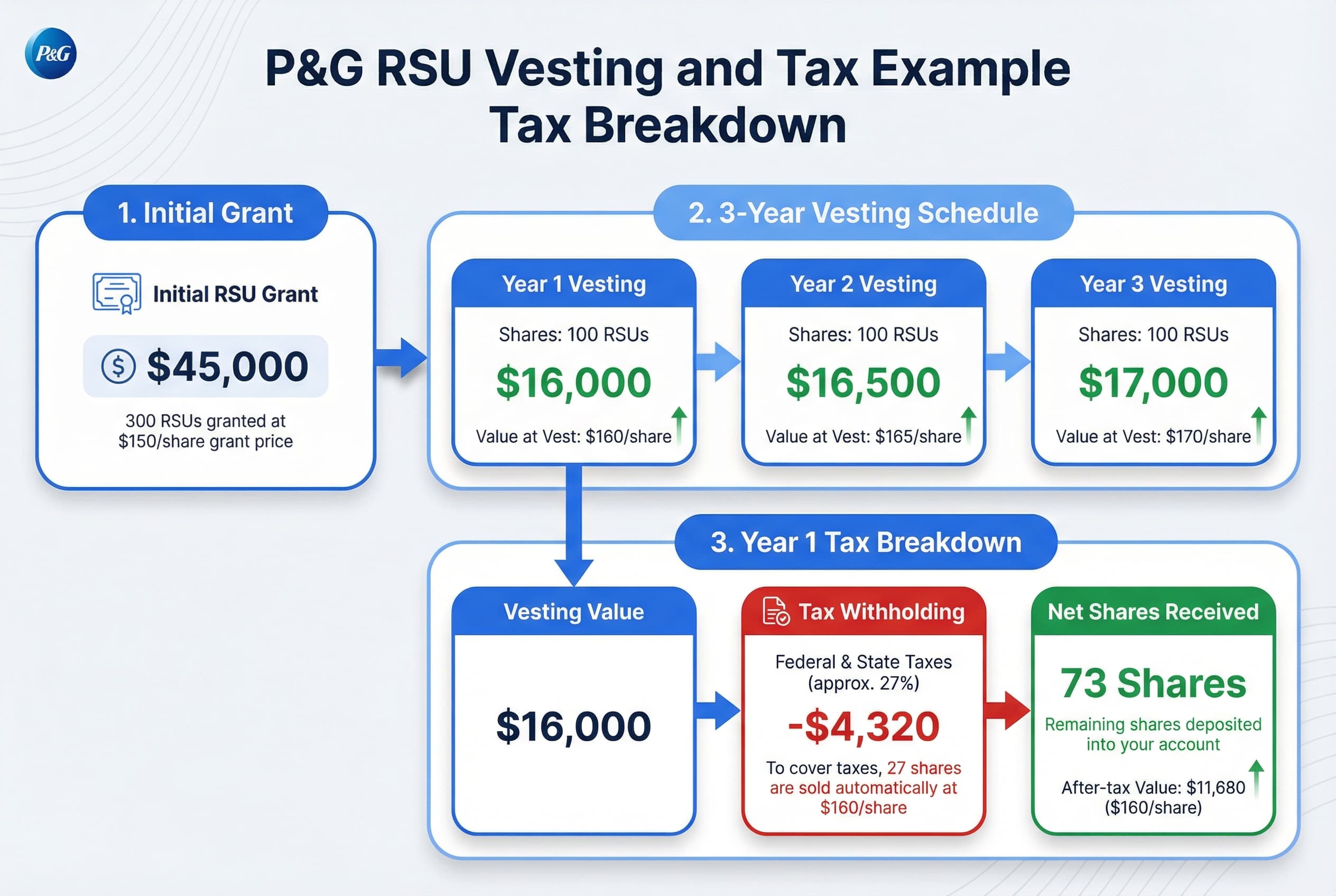
Let's walk through how RSU vesting works for a mid-level employee at P&G who receives a grant under the current (post-2017) program.
Sarah, a B2-level Product Manager, receives a grant of 300 RSUs when she joins P&G. With P&G stock trading at $150 per share, her total grant value is $45,000.
P&G's post-2017 RSUs vest over 3 years. While the exact vesting percentages aren't publicly specified, let's assume the shares vest in equal annual installments:
Year 1: 100 RSUs vest
Year 2: 100 RSUs vest
Year 3: 100 RSUs vest
At each vesting event, P&G withholds shares to cover taxes. The specific withholding rate varies based on your W-4 elections and can be adjusted. Assuming a typical supplemental wage rate of 22% federal plus 5% state:
Year 1 withholding: $16,000 × 27% = $4,320 (approximately 27 shares sold) Shares received: 73 shares
Over three years, Sarah receives approximately 219 shares after tax withholding (73 + 73 + 73), worth about $37,230 at the final vesting price. The withheld shares cover her tax obligations, though she may owe additional taxes depending on her total income and tax bracket.
Important note: P&G also pays dividend equivalents on post-2017 RSUs, providing additional value during the vesting period.
P&G employees have access to valuable equity benefits, but several common mistakes can significantly reduce their value:
The biggest risk for P&G employees is excessive concentration in company stock. The PST Plan requires you to hold P&G shares until age 45 before reallocation is allowed, which can create significant single-stock concentration risk. When combined with RSUs and ESPP purchases, many employees find themselves with too much of their net worth tied to P&G's performance.
Tax planning at P&G is complex due to different vesting, exercise, and settlement dates across RSUs and stock options. Many employees underpay estimated taxes or face unexpected tax bills when RSUs vest. You can adjust your withholding rates, so work with a tax professional to ensure adequate coverage throughout the year.
P&G's ESPP offers a 15% discount with a lookback provision on semi-annual purchases. Missing enrollment windows means leaving free money on the table. However, remember the qualifying period requirements: hold shares for two years from the offering date and one year from the purchase date to receive favorable tax treatment.
RSUs and stock options typically vest over three years (for post-2017 grants). Leaving P&G before vesting dates means forfeiting unvested equity. Understanding your vesting schedule is crucial when considering career moves or retirement timing.
Understanding how your departure from P&G affects your equity compensation is crucial for financial planning. Here's what typically happens:
Unvested awards are generally forfeited when you leave P&G. This applies to both Restricted Stock Units (RSUs) and stock options that haven't completed their vesting schedule. Since P&G RSUs typically vest over three years for post-2017 grants (or five years for pre-2017 grants), any unvested portion is lost upon termination.
However, early vesting may occur in specific circumstances, including death, retirement, disability, or company divestiture, depending on your situation and plan terms.
For vested stock options, the data available doesn't specify P&G's post-termination exercise window. You should review your specific grant documents or contact Stock Plan Administration to understand how long you have to exercise vested options after leaving. Options typically expire 10 years from the grant date, but termination usually accelerates this timeline significantly.
If you leave during an ESPP offering period, you'll need to check whether your accumulated contributions will be used for the next scheduled purchase or returned to you. P&G's ESPP operates on six-month offering periods with semi-annual purchases.
Your termination date matters significantly as it determines which awards have vested. Contact P&G's Stock Plan Administration well before your departure to understand your specific situation and avoid forfeiting valuable equity.
This content is for educational purposes only and does not constitute financial advice. The information provided is general in nature and may not appl...
YourEmployeeStock.com is not a registered investment advisor.
The vesting period depends on when your RSUs were granted. For grants made after 2017, RSUs typically vest over 3 years. If you received RSUs before 2017, they vest over 5 years. Early vesting may occur under specific conditions such as death, retirement, disability, or divestiture.
Yes, P&G's Long-Term Incentive Plan (LTIP) allows you to choose your mix of stock options and RSUs. You can select from five allocation options: 100% options, 75/25, 50/50, 25/75, or 100% RSUs. This gives you flexibility to align your equity compensation with your personal financial goals and risk tolerance.
P&G's ESPP allows you to purchase company stock at a 15% discount with a lookback feature. The offering and purchase periods are 6 months, with purchases occurring semi-annually. You can contribute up to 15% of your eligible compensation, subject to a maximum of $25,000 per year.
If you leave P&G before your stock options vest, you will generally forfeit any unvested options. Stock options granted after 2017 typically vest over 3 years and generally cannot be exercised within the first year of the grant date, except in cases of death. Once vested, options expire 10 years from the grant date.
It depends on when your RSUs were granted. RSUs granted after 2017 receive dividend equivalents during the vesting period. However, RSUs granted before 2017 do not pay dividends until after they vest.
Yes, P&G has blackout periods when you cannot exercise options, sell shares, or complete certain transactions. These blackouts typically occur around earnings releases, though specific timing isn't publicly detailed. P&G's Insider Trading Policy applies to all employees, and the company may suspend transactions for corporate purposes (except in the five days before option expiration).
P&G allows you to adjust your tax withholding rates for equity compensation events. Because RSUs, stock options, and ESPP purchases have different vesting, exercise, and settlement dates, tax planning can be complex. Consider consulting with a tax professional to optimize your withholding strategy based on your individual situation.
The P&G PST & ESOP Plan (PST Plan) is one of P&G's main retirement programs that involves holding P&G shares. A unique feature is that you must hold these P&G shares until age 45 before you're allowed to reallocate them to other investments. This creates concentrated single-stock risk that you should consider in your overall financial planning.
Get a free personalized analysis from our equity compensation experts

