Free equity analysis
Complete guide to understanding your Lockheed Martin equity compensation, including RSU, ISO, NSO, ESPP, vesting schedules, and tax strategies.
Stock Price
$529.38
Closing price · Sep 14, 2026
Employees
121K
Worldwide
Equity Programs
4
programs
Vesting Period
3 years
RSU vesting
Closing price · Sep 14, 2026
Lockheed Martin offers 4 equity compensation programs to employees. Click on each program to learn more about eligibility, vesting, and tax implications.
Standard RSU program with 4-year vesting and 1-year cliff. Annual refresh grants available for eligible employees.
Learn about Lockheed Martin's Incentive Stock Options program, including vesting schedules and tax treatment.
Learn about Lockheed Martin's Non-Qualified Stock Options program, including vesting schedules and tax treatment.
Learn about Lockheed Martin's Employee Stock Purchase Plan program, including vesting schedules and tax treatment.
Lockheed Martin RSUs vest on a 3-year cliff for standard grants; 1-year cliff for CFO one-time grant schedule with a 12-month cliff.
Example calculation based on 100 shares:
| Year | Vesting % | Shares Vesting | Estimated Value |
|---|---|---|---|
| Year 1 | 33% | 33 | $17,469.54 |
| Year 2 | 33% | 33 | $17,469.54 |
| Year 3 | 34% | 34 | $17,998.92 |
| Total | 100% | 100 | $52,938 |
* Based on Lockheed Martin stock price of $529.38 as of Sep 14, 2026. Actual values will vary.
33%
33 shares
$17,469.54
33%
33 shares
$17,469.54
34%
34 shares
$17,998.92
Lockheed Martin vesting schedule based on 100 total shares
As a Lockheed Martin employee, you have access to a comprehensive equity compensation package designed to align your financial success with the company's long-term performance. The company offers several types of equity awards, including Restricted Stock Units (RSUs), Performance Stock Units (PSUs), Stock Options (both Incentive Stock Options and Non-Qualified Stock Options), and an Employee Stock Purchase Plan (ESPP).
Equity compensation represents a significant portion of total compensation, particularly as you advance in your career. For standard long-term incentive awards, approximately 30% of the opportunity comes in the form of RSUs. This equity stake allows you to benefit directly from Lockheed Martin's success as a leading aerospace and defense company, creating potential wealth accumulation beyond your base salary.
Most standard RSU grants follow a 3-year cliff vesting schedule, meaning your shares vest 100% after three years of service. Stock options typically vest in thirds over three years - one-third on each anniversary of your grant date - and remain exercisable for up to 10 years from the grant date.
The ESPP provides an accessible entry point to equity ownership, allowing you to purchase company stock at a 15% discount with a lookback feature that uses the lower price between the offering period start and purchase date. Purchase periods occur semi-annually, giving you two opportunities per year to build your equity position at a favorable price.
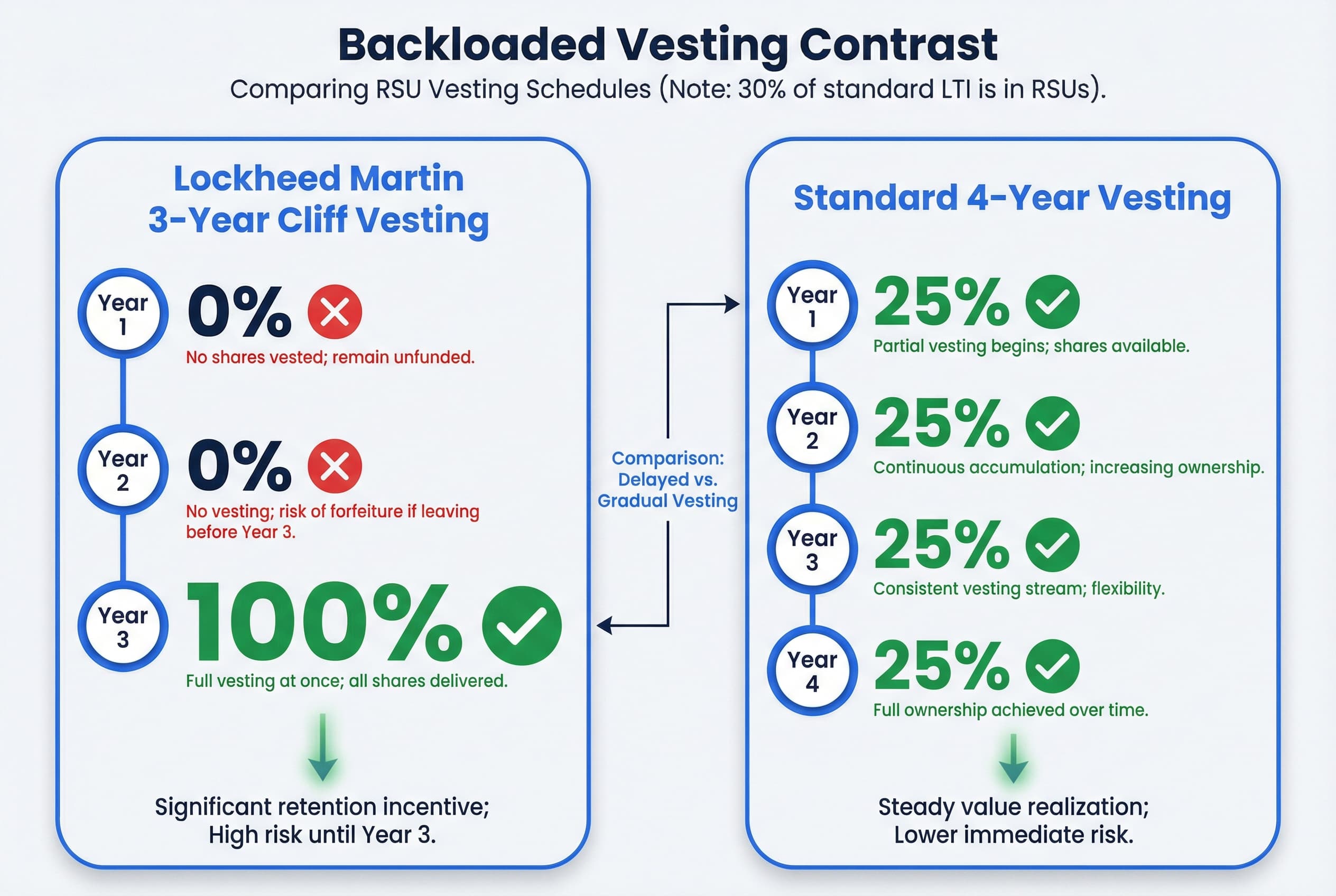
Lockheed Martin uses a 3-year cliff vesting schedule for its standard Restricted Stock Unit (RSU) grants. This is a notably backloaded structure, meaning employees receive 100% of their RSUs all at once after three full years of service - there is no gradual vesting along the way.
For most employees, RSUs vest annually, with the vesting percentages structured as 0% in year one, 0% in year two, and 100% in year three. This differs significantly from the more common 4-year vesting schedule with quarterly or annual increments seen at many technology companies.
During the cliff period (the first three years after your grant date), your RSUs remain unvested. This means if you leave Lockheed Martin before completing three full years of service, you will forfeit the entire RSU grant. The shares are essentially in a "pending" state - they're allocated to you, but you don't own them yet and cannot sell them.
It's important to note that while you're waiting for the cliff, you won't receive any shares, dividends, or voting rights associated with the RSUs. Only after successfully completing the three-year period will the shares vest and become yours to hold or sell (subject to any applicable trading restrictions).
Lockheed Martin does provide annual refresher grants as part of its ongoing compensation strategy. For standard long-term incentive (LTI) awards, approximately 30% of the opportunity comes in the form of RSUs. These refresher grants follow the same 3-year cliff vesting schedule as initial grants, creating a rolling series of vesting events once you've been with the company for several years.
While the 3-year cliff is standard for most employees, executive-level grants may differ. For example, the CFO received a one-time grant with a 1-year cliff vesting 100% after one year, and the CEO's 2020 new hire grant vested in equal thirds (33.33%) on each of the first three anniversaries. These variations are typically reserved for senior executive recruitment and retention purposes.
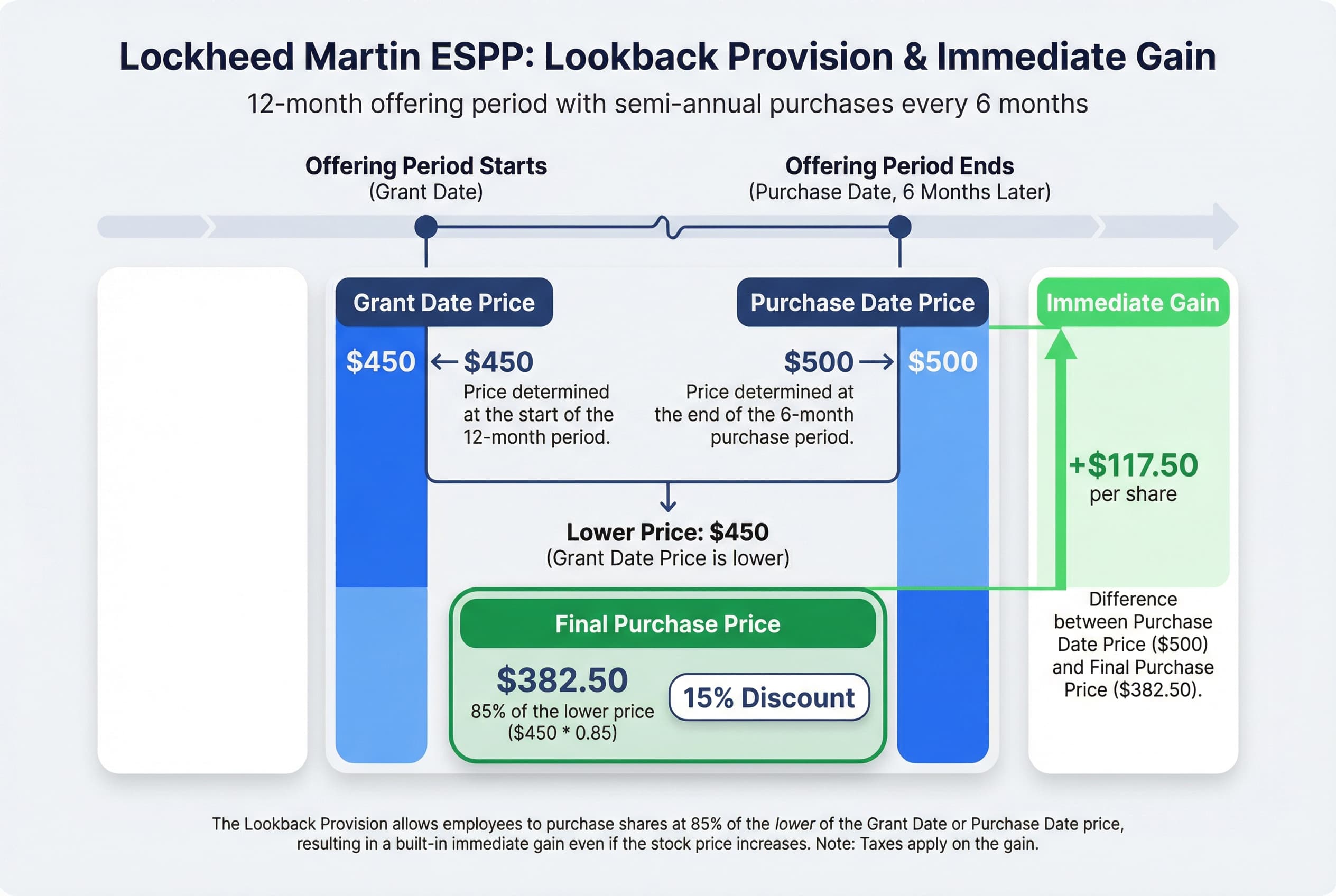
Lockheed Martin offers a compelling ESPP that allows employees to purchase company stock at a significant discount. The plan provides a 15% discount on the purchase price, combined with a lookback provision that can substantially enhance your returns.
The ESPP operates on a 12-month offering period with semi-annual purchase periods every 6 months. The lookback provision compares the stock price at two points: the beginning of the 12-month offering period and each 6-month purchase date. You'll purchase shares at 85% (reflecting the 15% discount) of whichever price is lower. This means if Lockheed Martin's stock price rises during the offering period, you benefit from both the discount and the lower historical price.
Employees can contribute up to $25,000 annually through payroll deductions. The combination of the 15% discount and lookback provision can generate immediate gains. For example, if the stock price increases from the offering start to a purchase date, you could see returns exceeding 15% on that purchase, even before any additional stock appreciation.
Understanding the difference between qualifying and disqualifying dispositions is important for tax planning. A qualifying disposition occurs when you hold shares for over 1 year after the purchase date and over 2 years after the offering date. Qualifying dispositions may receive more favorable long-term capital gains treatment, while disqualifying dispositions (selling earlier) result in ordinary income treatment on the discount portion.
The ESPP purchases occur semi-annually, allowing you to take advantage of the program twice per year. Check with your benefits team for specific enrollment windows and contribution adjustment periods.
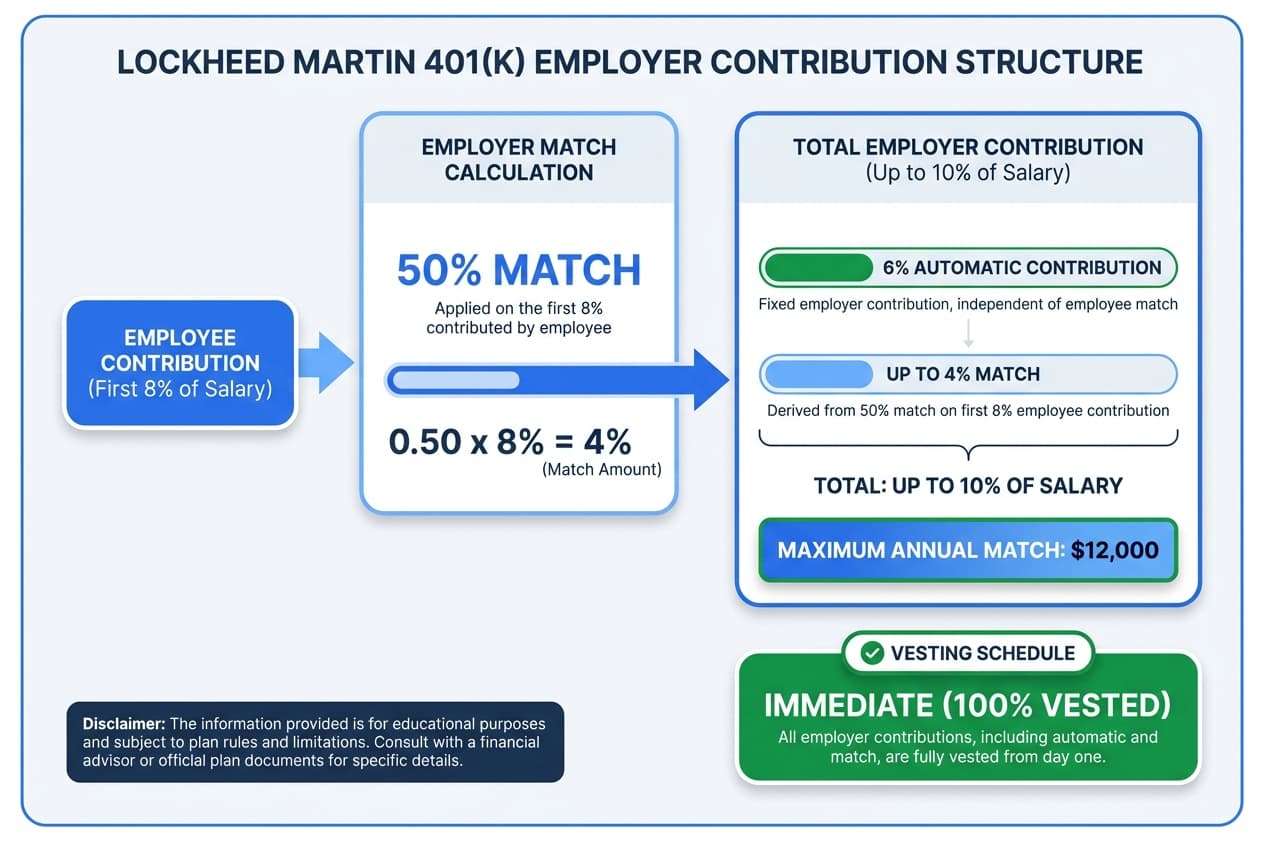
Lockheed Martin offers a competitive 401(k) plan with generous employer contributions. The company provides a 50% match on the first 8% of your salary that you contribute. For non-represented employees, total company contributions can reach up to 10% of your salary, which includes a 6% automatic contribution plus the matching component, with a maximum match of $12,000.
One of the standout features of Lockheed Martin's 401(k) is immediate vesting. You're fully vested in all employer contributions from day one, meaning you own 100% of the company match regardless of how long you've been with the organization.
The plan offers both traditional pre-tax and Roth 401(k) contribution options, giving you flexibility in your tax planning strategy. Employer matching contributions are automatically invested in an Employee Stock Ownership Plan (ESOP) fund, which holds Lockheed Martin stock.
The plan includes a brokerage window for employees who want expanded investment choices beyond the standard fund lineup. After-tax contributions are available, though a mega backdoor Roth option is not offered. This means you can make after-tax contributions, but the plan structure doesn't support the in-plan Roth conversion strategy that mega backdoor Roth requires.
Participants can also take loans from their 401(k) at a rate of 1% over prime, providing access to funds if needed while you're still employed.
Understanding the tax treatment of your equity compensation is crucial for effective financial planning. Here's what you need to know about taxes on your Lockheed Martin equity awards.
RSUs and PSUs: You owe taxes at vesting, not when you sell the shares. When your RSUs vest (typically on a 3-year cliff schedule at Lockheed Martin), the full value of the shares becomes taxable as ordinary income, just like your salary. This creates a tax liability even if you don't sell the shares immediately.
Stock Options (ISOs and NSOs): For non-qualified stock options (NSOs), you owe ordinary income tax on the "spread" (difference between exercise price and fair market value) when you exercise. For incentive stock options (ISOs), there's no regular tax at exercise, but the spread may trigger Alternative Minimum Tax (AMT). Both option types incur capital gains tax when you eventually sell the shares.
ESPP: Taxes depend on how long you hold the shares. For a qualifying disposition (holding shares over 1 year after purchase AND over 2 years after the offering date), you'll pay ordinary income tax on the discount portion and capital gains on any additional appreciation. Disqualifying dispositions are taxed less favorably.
Lockheed Martin defaults to 100% withholding on RSU vests, though you can adjust this rate. Federal supplemental income is typically withheld at 22% (or 37% for amounts over $1 million annually), but your actual tax rate may be higher depending on your total income. This creates a common "gap" where withholding doesn't cover your full tax liability, potentially resulting in an underpayment penalty or a surprise tax bill at year-end.
Lockheed Martin has major operations in states with varying tax rates. If you work in California, Virginia, or other locations, you'll owe state income tax on equity compensation in addition to federal taxes.
Exercising ISOs can trigger AMT, particularly if you exercise a large number of options without selling. The spread at exercise is an AMT preference item that may require you to pay AMT even though you haven't generated cash from the transaction.
Disclaimer: This information is educational only and not tax advice. Tax situations vary based on individual circumstances. Consult a qualified tax professional or financial advisor for personalized guidance on your equity compensation.
While Lockheed Martin equity compensation can be valuable, concentrating too much of your wealth in a single stock - even your employer's - creates significant risk. You're already dependent on the company for your income, benefits, and potentially pension. Adding substantial stock holdings means your financial well-being is tied to one organization's performance.
As an aerospace and defense company, Lockheed Martin faces unique risks including:
These sector-specific risks mean Lockheed Martin's stock can move differently than the broader market, potentially amplifying volatility in your portfolio.
Financial advisors typically recommend limiting single-stock exposure to 10-20% of your total net worth. This includes all Lockheed Martin holdings: RSUs, ESPP shares, stock options, and any additional shares you've purchased.
Consider your complete financial picture: if you have RSUs vesting on a 3-year cliff schedule, plan ahead for the concentration that creates. The ESPP's 15% discount and lookback feature is attractive, but avoid holding too many shares long-term. Regularly rebalancing by selling vested equity and reinvesting in diversified funds helps manage this risk while still benefiting from your compensation package.
As a Lockheed Martin employee, you'll face unique timing considerations due to the company's 3-year cliff vesting schedule for standard RSU grants. This backloaded structure means you'll receive 100% of your RSUs at once after three years, creating a concentration event. Consider selling a portion immediately upon vesting to reduce single-stock risk, especially if Lockheed Martin stock represents a significant portion of your net worth.
Be mindful of quarterly blackout periods, which begin 14 days before each quarter's accounting close and continue until one full trading day after earnings are released. The Q4 blackout starts December 18th, so plan sales accordingly.
Working in aerospace means your salary, benefits, and equity are all tied to one industry. This concentration risk is particularly important at Lockheed Martin, where defense sector volatility can impact both job security and stock value simultaneously. Financial advisors often suggest limiting any single stock to 10-15% of your investment portfolio, though your specific situation may vary.
Lockheed Martin's ESPP offers a 15% discount with a 6-month lookback provision, providing potential gains of 15-40%+ depending on stock movement. For maximum tax efficiency, hold ESPP shares for qualifying disposition periods (over 1 year from purchase AND over 2 years from offering date) to convert ordinary income into long-term capital gains. However, this strategy increases concentration risk.
With 30% of standard long-term incentive opportunities delivered as RSUs, equity forms a substantial portion of your compensation package. Factor in the time value of backloaded vesting when comparing offers - your effective annual compensation is lower in early years than headline numbers suggest.
Note: This information is educational only, not personalized financial advice. Consult a qualified financial advisor for your specific situation.
Let's walk through a realistic scenario to show how Restricted Stock Units (RSUs) vest at Lockheed Martin.
Sarah, a mid-level engineer, receives an RSU grant worth $30,000 as part of her annual compensation package. At the current stock price of $500 per share, this equals 60 RSU shares. The grant follows Lockheed Martin's standard 3-year cliff vesting schedule, meaning all shares vest at once after three years.
Year 1 (Grant Date): Sarah receives her grant letter showing 60 RSUs. Nothing vests yet - the shares remain unvested on paper.
Year 2 (First Anniversary): Still no vesting. The shares continue accumulating value, but Sarah doesn't own them yet.
Year 3 (Third Anniversary - Vesting Date): All 60 RSUs vest at once. The stock price has grown to $550 per share, making the total value $33,000 (60 shares × $550).
At vesting, Lockheed Martin treats the $33,000 as ordinary income. The company withholds shares to cover taxes. While the default withholding rate is 100%, employees can adjust this. Assuming Sarah keeps the standard supplemental wage withholding of approximately 22% federal plus 7% state/local (totaling 29%):
Sarah receives 42-43 shares worth approximately $23,430 after withholding. She can hold these shares for potential future growth or sell them immediately.
Important note: This backloaded vesting schedule means you receive nothing until year three, so plan your finances accordingly. The actual tax withholding may vary based on your total income and tax situation.
Even experienced employees can make costly errors with their equity compensation. Here are the most common pitfalls to avoid:
Standard RSU grants at Lockheed Martin vest 100% after three years - meaning you receive nothing if you leave before the cliff. This backloaded schedule differs from many tech companies' annual vesting, making early departures particularly expensive. Plan your career moves carefully around these dates.
Between RSUs, PSUs, the ESPP, and automatic 401(k) matching invested in the company ESOP fund, you can quickly become overexposed to Lockheed Martin stock. Diversification is critical - consider selling vested shares regularly to reduce risk, especially as you approach retirement.
The ESPP offers a 15% discount with a six-month lookback provision, creating significant upside potential. However, many employees don't understand the tax benefits of holding shares for a qualifying disposition (over one year after purchase AND over two years after the offering date). Selling too early converts favorable long-term capital gains into ordinary income.
While Lockheed Martin defaults to 100% withholding on equity, employees can adjust this rate. Choosing lower withholding without proper tax planning - particularly for Section 16 insiders - can create substantial tax bills at year-end. Always consult a tax professional before reducing withholding rates.
Stock options expire after 10 years. Don't let valuable options expire worthless by waiting too long to exercise.
Understanding what happens to your equity compensation when you leave Lockheed Martin is crucial for financial planning. Here's what you need to know:
Any unvested Restricted Stock Units (RSUs) or Performance Stock Units (PSUs) are typically forfeited upon termination. Since Lockheed Martin uses a 3-year cliff vesting schedule for standard RSU grants, this means if you leave before the three-year anniversary, you'll lose the entire grant. However, there's an important exception: if you're retirement-eligible, you may qualify for vesting acceleration, which could allow you to retain some or all of your unvested equity.
For stock options, you generally have a limited window to exercise any vested options after termination. Options at Lockheed Martin have a 10-year total expiration period from the grant date, but post-termination exercise windows are typically much shorter. Any unvested options are forfeited upon departure.
If you leave mid-period during an Employee Stock Purchase Plan offering, you'll typically be withdrawn from the plan. Your accumulated contributions may be returned to you, and you won't participate in the upcoming purchase. Any shares already purchased remain yours.
Your termination date significantly impacts vesting. Leaving even days before a vesting anniversary could mean forfeiting substantial equity value. The distinction between voluntary and involuntary termination may affect retirement-related vesting acceleration eligibility, so review your specific situation carefully.
Lockheed Martin offers a Deferred Management Incentive Compensation Plan (DMICP) exclusively for executive officers. This program allows eligible executives to defer a portion of their annual incentive compensation rather than receiving it as immediate cash.
When you participate in the DMICP, your deferred amounts are credited as phantom stock units. These units track the performance of Lockheed Martin stock, allowing your deferred compensation to potentially grow (or decline) based on the company's stock performance.
Benefits:
Risks:
Since this program is limited to executive officers, participation requires careful evaluation of your overall tax strategy and retirement planning. Consider consulting with a financial advisor to determine if deferring compensation aligns with your long-term financial goals and risk tolerance.
This content is for educational purposes only and does not constitute financial advice. The information provided is general in nature and may not appl...
YourEmployeeStock.com is not a registered investment advisor.
Standard RSU grants at Lockheed Martin have a 3-year cliff vesting schedule, meaning 100% of your RSUs vest after three years. This is a backloaded schedule, so you won't receive any shares until the full three-year period is complete. Annual refresher grants may follow the same pattern, with RSUs representing approximately 30% of long-term incentive opportunities.
Yes, Lockheed Martin offers an ESPP with a 15% discount and a lookback provision. The plan has 12-month offering periods with semi-annual purchases every 6 months, and the lookback period is 6 months. You can contribute up to $25,000 per year to purchase company stock at a discount.
Stock options at Lockheed Martin typically vest in three equal installments: one-third on each of the first, second, and third anniversaries of the grant date. You have 10 years from the grant date to exercise your options before they expire. The company offers both ISOs (Incentive Stock Options) and NSOs (Non-Qualified Stock Options).
Your unvested RSUs and options will typically be forfeited when you leave the company, unless you meet retirement eligibility requirements which may trigger vesting acceleration. For vested stock options, you'll need to exercise them before they expire (within the 10-year window from grant date). Note that executive-level employees may be subject to a Post-Employment Conduct Agreement with non-compete provisions lasting 1-2 years.
Quarterly trading blackout periods begin 14 days before the accounting closing date for each quarter and continue until the market opens the day after earnings are publicly announced (with at least one full trading day elapsed). For Q4, the blackout starts on December 18th. Additionally, short sales, publicly traded options, hedging transactions, and pledging securities are prohibited at all times.
Lockheed Martin's default tax withholding rate for RSUs is 100%, though you can adjust this rate. Keep in mind that if you're a Section 16 Insider and elect a lower withholding rate, you could face additional tax liability. When your RSUs vest, they're taxed as ordinary income at your marginal tax rate.
From a tax perspective, ESPP shares are often recommended to be sold last compared to RSUs or stock options due to favorable tax treatment for qualifying dispositions. A qualifying disposition occurs if you hold shares for over 1 year after purchase AND over 2 years after the offering date, which can result in more favorable capital gains treatment on a portion of your gain.
Yes, Lockheed Martin offers a 401(k) with a generous company match: 50% on the first 8% you contribute (up to $12,000 maximum), plus an automatic 6% contribution for non-represented employees. You're immediately vested in all employer contributions, and the plan offers both traditional and Roth 401(k) options. The company also has a Deferred Management Incentive Compensation Plan (DMICP) for executive officers.
Get a free personalized analysis from our equity compensation experts

